herapeutic hypothermia as a bridge to
transplantation in patients with fulminant
hepatic failure
INTRODUCTION
Malignant brain edema associated with hepatic encephalopathy is an
important cause of death in fulminant acute liver failure (ALF).(1) To date,
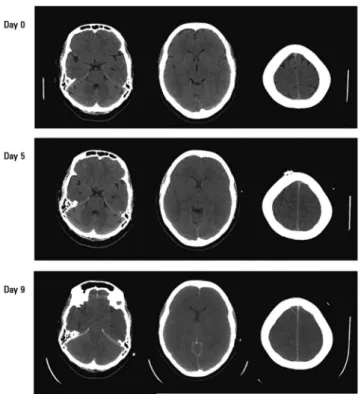
no speciic treatment has been shown to prevent the development of brain edema, intracranial hypertension and brain herniation (Figure 1). Orthotopic liver transplantation (OLT) is the only accepted treatment for this condition,
but many patients die while waiting for a suitable organ donor.(2,3)
Early diagnosis and management of hepatic encephalopathy are critical to prevent or allow time for liver transplantation. Several general measures are initiated once grade III - IV encephalopathy develops, including ventilator support, deep sedation and the use of mannitol or hypertonic saline. Bridge techniques to OLT, such as bio artiicial livers and hepatocyte transplantation,
are still experimental.(2,4)
herapeutic mild hypothermia has unique advantages in this setting because it reduces high intracranial pressure and may prevent irreversible neuronal damage until a donor liver becomes available or spontaneous recovery occurs. In the present article, we will discuss the role of hypothermia in patients with fulminant hepatic failure and coma and suggest an algorithm for its implementation. We searched the literature using MedLine and the National Institutes of Health/National Library of Medicine through 2013. he following search terms were used: acute liver failure or fulminant hepatic failure with therapy and hypothermia. No limitation for publication date was used.
Luis Castillo1, Guillermo Bugedo1, Max Rovegno1
1. Departamento de Medicina Intensiva, Pontificia Universidad Católica de Chile -
Santiago, Chile. he most important topics in
fulminant hepatic failure are cerebral edema and intracranial hypertension. Among all therapeutic options, systemic induced hypothermia to 33 - 34ºC has been reported to reduce the high
Conflicts of interest: None.
Submitted on August 27, 2014 Accepted on January 6, 2015
Corresponding author: Luis Castillo
PO Box 114-D
Postal Code 6510260 - Santiago, Chile E-mail: [email protected]
Responsible editor: Flávia Ribeiro Machado
Hipotermia terapêutica como ponte até transplante em pacientes
com falência hepática fulminante
ABSTRACT
Keywords: Hypothermia; Transplantation; Liver failure, acute pressure and increase the time during which patients can tolerate a graft. his review discusses the indications and adverse efects of hypothermia.
promotes the entrance of water into the cells.(13) Other
proinlammatory mediators and cytokines shown to be increased in the course of ALF might have permissive or direct efects on the development of hepatic
encephalopathy.(3)
An increase in cerebral blood low (CBF) has also been identiied early in the course of patients with
ALF and brain edema.(7) Several mechanisms have been
implied, including increased production of nitric oxide, prostaglandins, and proinlammatory mediators. Failure of CBF auto regulation is typically observed late during the course of hepatic encephalopathy.
Effects of hypothermia on the brain
Several experimental models and human clinical trials performed in diferent clinical settings have demonstrated that lowering the body core temperature
may beneit the brain.(14) In fact, moderate hypothermia
is routinely performed to protect the brain during cardiac surgery. However, it has only recently been shown that hypothermia can increase the likelihood of neurologically intact survival in patients with cardiac
arrest.(15,16) Currently, hypothermia has gained popularity
as a brain protective strategy for comatose survivors of
sudden cardiac death.(14,17)
Recently, a study comparing a strategy of targeted temperature maintenance at 36ºC versus hypothermia (33ºC) in 950 patients with coma after cardiac arrest showed no major diferences in all-cause mortality between
both strategies.(18) Although the concept of targeted
temperature is attractive because it avoids fever, the 2010 American Heart Association Guidelines still recommend hypothermia between 32ºC to 34ºC for 12 to 24 hours in
comatose adult patients after cardiac arrest.(19-21)
During ALF, the pathophysiology of brain edema and the goals of hypothermia are diferent than those of hypoxic encephalopathy. Hypothermia is not focused on fever control; it is used to prevent or control intracranial hypertension and reduce the toxic efects of ALF on the brain. With this therapeutic objective in mind, we expect to prolong the wait time before liver transplantation.
he protective efect of hypothermia has been traditionally attributed to a reduction in the metabolic rate, and hence a reduction in oxygen consumption Figure 1 - Sequential computed tomography of the brain in a 37 year old female
patient admitted due to acute liver failure, hepatic encephalopathy and the need for ventilatory support. The patient showed a normal computed tomography scan on admission. On the fifth day, there was a marked loss of the normal sulci pattern. As malignant brain edema progressed, the loss of normal
grey/white differentiation was noted, and a marked loss of the basal cisterns and brainstem compression were
observed. The patient was refractory to medical treatment and died while waiting for a donor.
Pathophysiological concepts in hepatic encephalopathy
Episodes of intracranial hypertension may be detected during the course of ALF in 80% to 95% of patients with stage III-IV hepatic encephalopathy
undergoing intracranial pressure (ICP) monitoring.(5,6)
High ICP remains responsible for substantial mortality (25 - 50%) and neurocognitive sequelae in patients
surviving ALF,(3,5,7-9) thus justifying the need for more
efective therapies.
Hepatic encephalopathy is most likely due to several mechanisms that are not fully understood, including the accumulation of ammonia and glutamine, which afect brain metabolism and function. During ALF, a direct relationship exists between the levels of ammonia,
encephalopathy and cerebral herniation.(8,10-12) Inside
and glucose utilization. For each 1ºC decrease in core temperature, the cerebral metabolic rate decreases by
6% to 7%.(14) Hypothermia also protects the cell by
maintaining the integrity of the lipoprotein membrane and decreasing enzymatic reactions that lead to cell damage or death.
Mild hypothermia can also reduce intracranial pressure and has been shown to decrease CBF due
to cerebral vasoconstriction.(22) his protective efect
decreases intracranial pressure and may also act as an
anticonvulsant.(23) However, multicenter clinical trials
evaluating hypothermia in traumatic brain injury have
yielded conlicting results.(24-26)
herapeutic hypothermia is also used in many other clinical scenarios without demonstrated beneit, including stroke, near-drowning, spinal cord ischemia,
and status epilepticus, among others.(23,27,28)
Bradycardia is associated with hypertension and cardiac arrhythmias, which are known side efects of hypothermia. Hypothermia may induce coagulation abnormalities and increase the risk of infections, particularly pneumonia. Additionally, electrolyte disorders and hyperglycemia have been reported. Most complications of hypothermia are easily preventable with good intensive care and should not limit its use when indicated.(4,22,27)
Experimental trials of hypothermia in acute liver failure
Mild hypothermia prevents the development of brain edema and intracranial hypertension in experimental models of ALF, possibly by preventing hyperemia, altering brain ammonia or glucose metabolism, or by a combined
efect.(4,29,30) Hypothermia therapy also improves survival
and the neurological outcome in animal models of acute
liver failure.(31,32) No other intervention has the ability
of hypothermia to prevent the cerebral complications of ALF in such a systematic and reproducible way, most likely due to the multiple pathogenetic mechanisms involved, as opposed to single targets afected by other measures.(9,30)
However, direct extrapolation of animal indings to the human condition is limited due to interspecies
diferences in the pathophysiology of ALF.(9) Experimental
models in small rodents do not reproduce all aspects of human ALF, including its multiple causes, as well as
systemic complications such as sepsis, respiratory failure or renal failure. Additionally, technical aspects, including the efects of rewarming, cannot be easily applied to the clinical setting.
Clinical data of hypothermia in acute liver failure
Moderate hypothermia (32 - 34ºC) may prevent or control intracranial hypertension (ICH) in patients with ALF. Several clinical reports and non-controlled trials
suggest that mild hypothermia may improve outcomes.(33-36)
he irst series included seven patients with ALF and
refractory intracranial hypertension.(36) Four patients
were successfully transplanted after 10-14 hours of mild hypothermia (32 - 33ºC), while three patients who were unsuitable candidates for OLT died after rewarming. Years later, the same author reported 14 patients with ALF and increased ICP, of which 13 could be transplanted after a median of 32 hours (range,
10 - 118 hours) of cooling.(35)
Hypothermia likely reduces ICP by impacting multiple mechanisms. Hypothermia produces a sustained and signiicant reduction in arterial ammonia concentration, cerebral blood low, brain cytokine production, and
markers of oxidative stress.(35) It may also prevent cerebral
hyperemia and increases in intracranial pressure during
liver transplantation.(5)
A recent prospective, randomized, controlled, multicenter trial (not published yet) evaluated 54 patients with ALF, imminent brain edema and intracranial pressure
(ICP) monitoring.(37) he patients were randomized
to receive standard medical therapy (33 patients) or moderate hypothermia (33.2 ± 0.7ºC) for 3 consecutive days (21 patients). Intracranial hypertension (ICP > 25mmHg) was observed in nearly half of the patients (57% hypothermia versus 45% control, p = 0.58), but there were no diferences in mortality (48% hypothermia versus 58% control) or in the incidence of adverse events in the two groups.
Unanswered question
of mannitol or hypertonic saline, mild hyperventilation, light sedation, or vasoactive agents for preventing
hypotension.(6) However, the timing and targets of these
therapies, as well as the usefulness of monitoring ICP and CPP, are controversial issues.
In our country, where the waiting time for a liver donor is well beyond 48 hours, the necessity of delaying the natural evolution of brain edema is crucial. Available liver support systems have mostly failed in the treatment of ALF and are still not recommended outside of clinical
trials.(2,4) In contrast, therapeutic hypothermia has been
shown to prevent or control intracranial hypertension in experimental models and clinical studies of ALF. Despite the absence of controlled trials showing improved outcomes in this setting, a better selection of patients and new technological advances for the implementation of hypothermia may produce better clinical results and buy time until a liver donor becomes available.
CONCLUSION
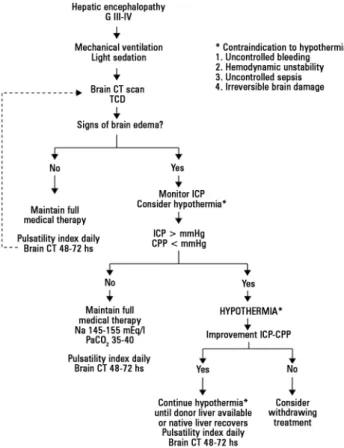
At this time, and before a better clinical evidence becomes available, the use of therapeutic hypothermia in patients with acute liver failure can only be recommended as an active measure when intracranial hypertension cannot be controlled by full medical conventional treatment. Figure 2 - Suggested algorithm for managing acute liver failure and hepatic
encephalopathy. Therapeutic hypothermia is considered when early signs of brain edema appear on a computed tomography scan, ideally under intracranial pressure monitoring. CT - computed tomography;
TCD - transcranial Doppler; ICP - intracranial pressure; CPP - cerebral perfusion pressure; Na - sodium
plasma levels; PaCO2 - partial pressure of carbono dioxide.
Os tópicos mais importantes na falência hepática fulminante são o edema cerebral e a hipertensão intracraniana. Dentre todas as opções terapêuticas, tem sido relatado que a hipotermia sistêmica induzida em níveis entre 33 - 34ºC reduz a elevação da
pressão e aumenta o tempo durante o qual os pacientes podem tolerar um enxerto. Esta revisão discutiu as indicações e os efeitos adversos da hipotermia.
RESUMO
Descritores: Hipotermia; Transplante; Falência hepática aguda
REFERENCES
1. Ostapowicz G, Fontana RJ, Schiodt FV, Larson A, Davern TJ, Han SH, McCashland TM, Shakil AO, Hay JE, Hynan L, Crippin JS, Blei AT, Samuel G, Reisch J, Lee WM; U.S. Acute Liver Failure Study Group. Results of a prospective study of acute liver failure at 17 tertiary care centers in the United States. Ann Intern Med. 2002;137(12):947-54.
2. Raghavan M, Marik PE. Therapy of intracranial hypertension in patients with fulminant hepatic failure. Neurocrit Care. 2006;4(2):179-89. 3. Bernal W, Auzinger G, Dhawan A, Wendon J. Acute liver failure. Lancet.
2010;376(9736):190-201.
4. Polson J, Lee WM; American Association for the Study of Liver Disease. AASLD position paper: the management of acute liver failure. Hepatology. 2005;41(5):1179-97.
5. Jalan R, Olde Damink SW, Deutz NE, Davies NA, Garden OJ, Madhavan KK, et al. Moderate hypothermia prevents cerebral hyperemia and increase in intracranial pressure in patients undergoing liver transplantation for acute liver failure. Transplantation. 2003;75(12):2034-9.
6. Raschke RA, Curry SC, Rempe S, Gerkin R, Little E, Manch R, et al. Results of a protocol for the management of patients with fulminant liver failure. Crit Care Med. 2008;36(8):2244-8.
8. Bernal W, Hall C, Karvellas CJ, Auzinger G, Sizer E, Wendon J. Arterial ammonia and clinical risk factors for encephalopathy and intracranial hypertension in acute liver failure. Hepatology. 2007;46(6):1844-52. 9. Vaquero J. Therapeutic hypothermia in the management of acute liver
failure. Neurochem Int. 2012;60(7):723-35. Review.
10. Clemmesen JO, Larsen FS, Kondrup J, Hansen BA, Ott P. Cerebral herniation in patients with acute liver failure is correlated with arterial ammonia concentration. Hepatology. 1999;29(3):648-53.
11. Bhatia V, Singh R, Acharya SK. Predictive value of arterial ammonia for complications and outcome in acute liver failure. Gut. 2006;55(1):98-104. 12. Tofteng F, Hauerberg J, Hansen BA, Pedersen CB, Jorgensen L, Larsen
FS. Persistent arterial hyperammonemia increases the concentration of glutamine and alanine in the brain and correlates with intracranial pressure in patients with fulminant hepatic failure. J Cereb Blood Flow Metab. 2006;26(1):21-7.
13. Desjardins P, Du T, Jiang W, Peng L, Butterworth RF. Pathogenesis of hepatic encephalopathy and brain edema in acute liver failure: role of glutamine redefined. Neurochem Int. 2012;60(7):690-6.
14. Varon J, Marik PE, Einav S. Therapeutic hypothermia: a state-of-the-art emergency medicine perspective. Am J Emerg Med. 2012;30(5):800-10. 15. Bernard SA, Gray TW, Buist MD, Jones BM, Silvester W, Gutteridge G,
et al. Treatment of comatose survivors of out-of-hospital cardiac arrest with induced hypothermia. N Engl J Med. 2002;346(8):557-63.
16. Hypothermia after Cardiac Arrest Study Group. Mild therapeutic hypothermia to improve the neurologic outcome after cardiac arrest. N Engl J Med. 2002;346(8):549-56. Erratum in N Engl J Med. 2002;346(22):1756.
17. Nunnally ME, Jaeschke R, Bellingan GJ, Lacroix J, Mourvillier B, Rodriguez-Vega GM, et al. Targeted temperature management in critical care: a report and recommendations from five professional societies. Crit Care Med. 2011;39(5):1113-25.
18. Nielsen N, Wetterslev J, Cronberg T, Erlinge D, Gasche Y, Hassager C, Horn J, Hovdenes J, Kjaergaard J, Kuiper M, Pellis T, Stammet P, Wanscher M, Wise MP, Åneman A, Al-Subaie N, Boesgaard S, Bro-Jeppesen J, Brunetti I, Bugge JF, Hingston CD, Juffermans NP, Koopmans M, Køber L, Langørgen J, Lilja G, Møller JE, Rundgren M, Rylander C, Smid O, Werer C, Winkel P, Friberg H; TTM Trial Investigators. Targeted temperature management at 33ºC versus 36ºC after cardiac arrest. N Engl J Med. 2013;369(23):2197-206.
19. Storm C. The use of hypothermia and outcome post cardiopulmonary resuscitation in 2014. Rev Bras Ter Intensiva. 2014;26(2):83-5.
20. Abreu A, Duque A, Paulino C, Brito J, Silvestre J, Goncalves-Pereira J, et al. The neuroprotective role of therapeutic hypothermia after cardiac arrest. Rev Bras Ter Intensiva. 2011;23(4):455-61.
21. Peberdy MA, Callaway CW, Neumar RW, Geocadin RG, Zimmerman JL, Donnino M, Gabrielli A, Silvers SM, Zaritsky AL, Merchant R, Vanden Hoek TL, Kronick SL; American Heart Association. Part 9: post-cardiac arrest care: 2010 American Heart Association Guidelines for Cardiopulmonary Resuscitation and Emergency Cardiovascular Care. Circulation. 2010;122(18 Suppl 3):S768-86. Erratum in: Circulation. 2011;123(6):e237. Circulation. 2011;124(15):e403.
22. Sinclair HL, Andrews PJ. Bench-to-bedside review: Hypothermia in traumatic brain injury. Crit Care. 2010;14(1):204. Review.
23. Corry JJ, Dhar R, Murphy T, Diringer MN. Hypothermia for refractory status epilepticus. Neurocrit Care. 2008;9(2):189-97.
24. Marion DW, Penrod LE, Kelsey SF, Obrist WD, Kochanek PM, Palmer AM, et al. Treatment of traumatic brain injury with moderate hypothermia. N Engl J Med. 1997;336(8):540-6.
25. Hutchison J, Ward R, Lacroix J, Hébert P, Skippen P, Barnes M, Meyer P, Morris K, Kirpalani H, Singh R, Dirks P, Bohn D, Moher D; HyP-HIT Investigators; Canadian Critical Care Trials Group. Hypothermia pediatric head injury trial: the value of a pretrial clinical evaluation phase. Dev Neurosci. 2006;28(4-5):291-301.
26. Schreckinger M, Marion DW. Contemporary management of traumatic intracranial hypertension: is there a role for therapeutic hypothermia? Neurocrit Care. 2009;11(3):427-36.
27. Linares G, Mayer SA. Hypothermia for the treatment of ischemic and hemorrhagic stroke. Crit Care Med. 2009;37(7 Suppl):S243-9.
28. Lee K, Strozyk D, Rahman C, Lee LK, Fernandes EM, Claassen J, et al. Acute spinal cord ischemia: treatment with intravenous and intra-arterial thrombolysis, hyperbaric oxygen and hypothermia. Cerebrovasc Dis. 2010;29(1):95-8.
29. Rose C, Michalak A, Pannunzio M, Chatauret N, Rambaldi A, Butterworth RF. Mild hypothermia delays the onset of coma and prevents brain edema and extracellular brain glutamate accumulation in rats with acute liver failure. Hepatology. 2000;31(4):872-7.
30. Jiang W, Desjardins P, Butterworth RF. Direct evidence for central proinflammatory mechanisms in rats with experimental acute liver failure: protective effect of hypothermia. J Cereb Blood Flow Metab. 2009;29(5):944-52.
31. Eguchi S, Kamlot A, Ljubimova J, Hewitt WR, Lebow LT, Demetriou AA, et al. Fulminant hepatic failure in rats: survival and effect on blood chemistry and liver regeneration. Hepatology. 1996;24(6):1452-9. 32. Vaquero J, Belanger M, James L, Herrero R, Desjardins P, Côté J, et al.
Mild hypothermia attenuates liver injury and improves survival in mice with acetaminophen toxicity. Gastroenterology. 2007;132(1):372-83.
33. Castillo L, Pérez C, Ruiz C, Bugedo G, Hernández G, Martínez J, et al. [Intravascular hypothermia for the management of intracranial hypertension in acute liver failure: case report]. Rev Med Chil. 2009;137(6):801-6. Spanish. 34. Jacob S, Khan A, Jacobs ER, Kandiah P, Nanchal R. Prolonged hypothermia
as a bridge to recovery for cerebral edema and intracranial hypertension associated with fulminant hepatic failure. Neurocrit Care. 2009;11(2):242-6. 35. Jalan R, Olde Damink SW, Deutz NE, Hayes PC, Lee A. Moderate
hypothermia in patients with acute liver failure and uncontrolled intracranial hypertension. Gastroenterology. 2004;127(5):1338-46.
36. Jalan R, O Damink SW, Deutz NE, Lee A, Hayes PC. Moderate hypothermia for uncontrolled intracranial hypertension in acute liver failure. Lancet. 1999;354(9185):1164-8.