(1) Universidade Federal de São Paulo – UNIFESP – São Paulo (SP), Brasil. (2) Departamento de Fonoaudiologia
- Universidade Federal de São Paulo – UNIFESP – São Paulo (SP), Brasil. Work done in the Departamento de Fonoaudiologia, Universidade Federal de São Paulo – UNIFESP – São Paulo (SP), Brazil.
Financial support: Fundação de Amparo à Pesquisa do Estado de São Paulo FAPESP - process number 2010/04404-0.
Conlict of interest: non-existent
Acoustically controlled auditory training in an adult
after traumatic brain injury
Treinamento auditivo acusticamente controlado em um indivíduo adulto
após traumatismo cranioencefálico
Andrea Tortosa Marangoni Castan(1) Cyntia Barbosa Laureano Luiz(2) Daniela Gil(2)
Received on: August 12, 2016 Accepted on: October 24, 2016
Mailing address:
Andrea Tortosa Marangoni Castan R. Botucatu, 802, Vila Clementino São Paulo (SP), Brasil CEP: 04023-062
E-mail: [email protected]
ABSTRACT
Electrophysiological and behavioral assessment of auditory processing has been an important tool for the diagnosis and therapeutic monitoring in individuals after traumatic brain injury. In this case report, the patient underwent electrophysiological and behavioral assessment of auditory processing pre and post acoustically controlled auditory training (ACAT) and six months after the intervention. The ACAT was orga
-nized in eight sessions, focusing on the training of auditory abilities of temporal ordering, auditory closure and igure-ground. Post evaluation ACAT showed better results considering the processes of encoding,
organization, and non-verbal. Electrophysiological evaluation showed improved morphology and shorter
latencies in auditory brainstem response and higher amplitude of long latency auditory evoked potential (P300). During the reassessment six months after of the ACAT, stability and improved behavioral and elec
-trophysiological evaluation were observed. Acoustically controlled auditory training proved to be effective in developing and reining different auditory abilities as demonstrated in electrophysiological and behavio
-ral assessments of the cent-ral auditory processing and the beneits were stable long term. Keywords: Hearing; Neuronal Plasticity; Rehabilitation; Brain Injuries
RESUMO
A avaliação eletroisiológica e comportamental do processamento auditivo tem sido uma importante fer
-ramenta para o diagnóstico e monitoramento terapêutico de indivíduos pós traumatismo cranioencefálico. No presente relato de caso o paciente foi submetido à avaliação eletroisiológica e comportamental do processamento auditivo pré e pós treinamento auditivo acusticamente controlado (TAAC) e seis meses após a intervenção. O TAAC foi organizado em oito sessões, enfocando o treinamento das habilidades auditivas de ordenação temporal, fechamento auditivo e igura-fundo. Na avaliação pós TAAC foi obser
-vada melhora quanto aos processos gnósicos de codiicação, organização e não verbal. Em relação à avaliação eletroisiológica houve melhora na morfologia e na latência das ondas do potencial evocado auditivo de tronco encefálico e na amplitude do componente potencial evocado auditivo de longa latência (P300). Na reavaliação após 6 meses do TACC foi veriicada estabilidade e melhora da avaliação com
-portamental e eletroisiológica. O treinamento auditivo acusticamente controlado mostrou-se eicaz ao desenvolver e reinar diferentes habilidades auditivas como demonstrado na avaliação eletroisiológica e comportamental do processamento auditivo e os benefícios mostraram-se estáveis no longo prazo. Descritores: Audição; Plasticidade Neuronal; Reabilitação; Traumatismos Encefálicos
A 22-year-old, right-handed male individual with auditory thresholds within normal range who had suffered severe head injury (initial Glasgow= 6 ) partici-pated in this study seven months after the trauma. The patient was 99 days hospitalized, with 72 days in the ICU in induced coma and presented an image exami-nation showing diffuse axonal lesion and subdural hematoma on the left.
The patient was submitted to: clinical history; Inspection of external auditory meatus; tonal and vocal audiometry: immittance testing; Behavioral evaluation of auditory processing and Short (BEAP) and Long latency (P300) auditory evoked potentials previous to, immediately after and six months after the acoustically controlled auditory training (ACAT).
Auditory evoked potentials were registered using a Traveler Express device from the brand Biologic Evoked Potential and the registers were recorded in an acoustically treated and electrically protected room. The data gathering was initiated by the P300 and afterwards BEAP was performed, since the P300 is
inluenced by the state of alertness and attention to the
acoustic stimulus, whereas the BEAP does not suffer
this type of inluence.
To obtain the P300, binaural tone burst auditory stimuli were used with frequencies of 1,000 Hz for the frequent stimulus and 2,000 Hz for the rare stimulus, with intensity of 80 dBHL for both. There were 300 stimuli, 240 for the frequent and 60 for the rare, in a ratio of 80% for the frequent and 20% for the rare. The polarity used was alternated, the presentation speed of the stimuli occurred at regular intervals of one per
second and the ilter used was from 0.5 to 20 Hz. The
registration window was of 750 ms. At each scan, two waves were recorded, one for frequent stimulus and one for rare. At the end, the waves were subtracted to obtain P300.
In the Brainstem Auditory Response (BAER), click stimuli presented monaurally at 80dBNA were used,
with rareied polarity and presentation speed of 19.1
clicks / second. Registration window was set from 0 to 10.24 milliseconds and the low-pass and high-pass
ilters were 3,000Hz and 100Hz respectively. To analyze
the reproducibility of the tracing, a total of 2,000 stimuli were presented twice. The absolute latencies of waves I, III, and V and the interpeak intervals I-III, III-V and I-V were marked and recorded.
Behavioral auditory processing evaluation included
the simpliied evaluation of the auditory processing
INTRODUCTION
Traumatic Brain Injury (TBI) is deined as any
traumatic aggression that results in skull fracture, scalp injury, functional impairment of the meninges, encephalon or vessels. These lesions can be caused by the impact and movement of acceleration and decel-eration of the brain within the cranial casing1.
TBI lesions may result in central auditory deicits due
to the connection with different areas, including cortical and subcortical hearing areas2, being important the evaluation of short and long latency auditory evoked potentials, as well as central auditory processing3,4. In addition, an Intervention program, aimed at the quality of life of these patients from the point of view of hearing and language proves to be important.
In the irst three months, especially in the irst
month, there is a spontaneous recovery after a brain
injury, more speciically after TBI. After this period, the
injured brain can modify and readapt itself through stimulation-induced neuronal plasticity, and the size, location and severity of the lesion being limiting factors in this process5,6.
Acoustically controlled auditory training (ACAT) consists of a set of strategies used to enable or rehabil-itate auditory perception, which assists in the linguistic and phonemic processing necessary for speech comprehension and maximizes the effects of plasticity of the central auditory nervous system7.
Auditory evoked potentials provide important infor-mation for the diagnosis and may assist in the thera-peutic monitoring of individuals after brain trauma, revealing changes in the neural activity related to the auditory experience provided by the ACAT. Due to its plasticity, central nervous system is able to reorganize as a consequence of stimulation, and thus, the latency
and amplitude parameters can be modiied in auditory evoked potentials, relecting an objective measure of
neural plasticity.
From the stated, the present study aims at verifying the effects of an acoustically controlled auditory training program in an adult after suffering brain trauma within a period up to six months after the intervention.
CASE PRESENTATION
In each training session, an accuracy score of about 70% was required to move to the next stage, in order to maintain motivation and avoid patient frustration9.
The results of electrophysiological and behav-ioral evaluations of central auditory processing were
classiied as normal and altered. The results were
considered normal if they were within the following standards:
I - BAEP: Absolute latencies of waves I, III, and V and interpeaks I - III, III - V and I - V per ear were recorded and documented. Normality criteria used to evaluate auditory pathway integrity (absolute and interpeak latencies) were the ones suggested by the equipment
manufacturer. The alterations were classiied as: low
brainstem lesion, high brainstem lesion or diffuse brainstem lesion.
II - P300: For the analysis of this potential, the latency of the P3 wave was considered. Normal values used were those proposed by McPherson (1996) 10.
III - Central Auditory Processing: Normality criteria used for behavioral evaluation of auditory processing were described by Pereira (2004)11.
RESULTS
In clinical history, the patient reported the following
speech-language complaints: dificulty in locating sounds, agitation, slowed speech, dificulty in reading and writing, attention and memory deicits.
Regarding behavioral and electrophysiological evaluations of auditory processing, the results are presented in the tables below. They are divided into three periods, namely: 1- Before ACAT 2- Immediately after ACAT; 3- Six months after ACAT.
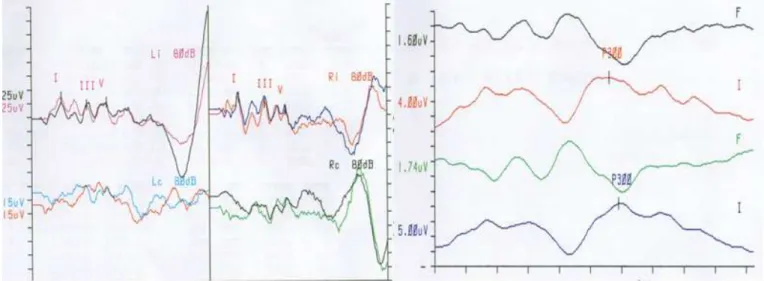
Table 1 shows the results of auditory processing behavioral tests that were measured by percentage. The other tests as well as the altered gnosic processes considering three moments of the evaluation will be presented in separate tables (Tables 2, 3 and 4). Results of electrophysiological evaluation will be presented in Table 5 and in Figures 1, 2 and 3.
verbal and nonverbal sequential memory tests) and by six tests performed in acoustic booth using verbal and nonverbal stimuli recorded in compact discs presented by means of a two-channel audiometer, namely: speech in noise test (SPIN), staggered spondaic word test(SSW), duration pattern test (DPT), dichotic consonant-vowel test - free recall (DCVT), synthetic
sentence identiication with ipsilateral competitive
message (SSI-ICM) and random gap detection test (RGDT)
ACAT program was organized in eight sessions, each of them lasting 45 minutes, performed twice a week, following Ziliotto, Pereira proposal (in press) 8. In this program, the sessions, as well as the activities in each session, were organized in increasing order of complexity with the objective of challenging the auditory system. For this, the signal-to-noise ratio was varied from positive (more favorable) to negative (less favorable).
The program involved the training of temporal ordering skills (frequency pattern and duration of sounds), auditory closure (sentences, words and
igures) and igure-to-ground for sentences, words and
CVC words and for non-verbal tests (environmental sounds) in monotic and dichotic tasks. The patient was asked to point phrases, digits, repeat sounds or imitate the presented sound patterns.
Right and left ears were trained separately. Thus, in a training session, aiming at training the right ear, the sounds presented on the left should be ignored by the patient and vice versa. Regarding the level of
intensity, the ear under training had its intensity ixed,
while the presentation intensity in the contralateral ear was progressively increased, causing a change in the signal-to-noise ratio, from positive to negative, that is,
from the easiest to the most dificult condition, using
Table 1. Results of auditory processing behavioral tests obtained in the three evaluations
Period. SL
VSM NVSM SPIN DCVT SSI-MCC
(-40) SSI-MCI (0) SSI-MCI (-10) SSI-MCI (-15) DPT 3
sounds 4 sounds
3 sounds
4
sounds RE LE OD OE RE LE RE LE RE LE RE LE
1 80% 100% 100% 33,30% 96% 96% 100% 90% 100% 100% 100% 100% 80% 90% 73%
2 80% 100% 100% 66,60% 96% 96% 100% 92,50% 100% 100% 100% 100% 90% 90% 100% 100% 90%
3 100% 100% 100% 96% 96% 100% 95% 100% 100% 100% 100% 100% 100% 100% 100% 93,30%
Time; RE: right ear; LE: left ear; SL: sound localization test; VSM: verbal sequential memory test; NVSM: nonverbal sounds sequential memory test; SPIN: speech in noise test; SSI (MCI/MCC): synthetic sentence identiication with ipsilateral /contralateral competitive ; DCTV dichotic consonant-vowel test - free recall; DPT: duration
pattern test
Table 2. Results of the dichotic consonant-vowel test - free recall; and RGDT obtained in the three evaluations
Time DCVT – Free attention RGDT
RE LE Mistakes
1 9 hits 7 hits 8 12,5ms
2 13 hits 5 hits 6 8,75ms
3 14 hits 1 hits 9 8,75ms
RE: right ear; LE: left ear; DCVT: dichotic consonant-vowel test - free recall; RGDT random gap detection test.
Table 3. SSW qualitative assessment data in the three evaluations
Time.
SSW - Analisy Qualitative H/L Auditory
effect
L/H Auditory
effect H/L Order effect L/H Order effect Inversions TypeA
1 X
2 X
3
H/L: high/low; L/H low/High
Table 4. Altered gnosic processes in the three evaluations
ALTERED GNOSIC PROCESSES
Time Decoding Coding Organization Non Verbal
1 X X X X
2 X
3 X
Table 5. Results of electrophysiological evaluation the auditory processing obtained in the three evaluations
Time.
BEAP P300
RE Latency RE AMP. LE Latency LE AMP. latency amplitude
I III V I-III III-V I-V I III V I III V I-III III-V I-V I III V A2 A4 A2 A4 1 1.68 3.86 5.63 2.18 1.77 3.95 0.21 0.15 0.08 1.74 3.92 5.57 2.18 1.65 3.84 0.14 0,03 0.03 279.20 294.20 6.61 9.06 2 1.62 3.86 5.45 2.24 1.59 3.84 0.21 0.13 0.18 1.56 3.86 5.34 2.30 1.47 3.78 0.21 0.24 0.20 316.20 320.20 10.51 11.10 3 1.68 3.86 5.45 2.18 1.59 3.78 0.08 0.25 0.25 1.56 3.80 5.39 2.24 1.59 3.84 0.10 0.26 0.14 304.20 305.20 13.04 13.09
Figure 1. BEAP and P300 in evaluation 1
Figure 2. BEAP and P300 in evaluation 2
In the RGDT test (Table 2), the individual’s perfor-mance changed from abnormal to normal after ACAT, showing an adequacy of the temporal resolution auditory ability, which is related to phonological aspects and auditory discrimination16.
Regarding the qualitative analysis of the SSW test (Table 3), it was observed that initially (Evaluation 1) the patient had the high / low order effect, which is
related to a dificulty in auditory memory. In the second
moment of the evaluation, the patient presented a low/ high order effect, and in the last evaluation (Evaluation 3), there were no errors tendencies. Therefore, it was observed that the individual presented an improvement
in the qualitative analysis of SSW, and this inding is
relevant, since it is an individual who had suffered TBI. It is known that individuals who suffer TBI may have
temporary or permanent deiciencies and disabilities,
such as visual, motor, linguistic, cognitive and/or behav-ioral. The most frequent are memory, attention and organization alterations17. Thus, in observing the data, it can be stated that ACAT has helped the individual to
improve a common dificulty found in this population, which can beneit the quality of life, since with better
memory capacity it is possible that the communicative
exchanges to be more eficient.
As for the impaired gnostic processes (Table 4), a
signiicant improvement was observed after ACAT, and
in the initial evaluation the individual presented altera-tions in all the gnostic processes and after the auditory training, only the decoding alteration remained. As previously mentioned, with these data, we observed an improvement in two cognitive alterations commonly found in post-TBI subjects: organization and memory (coding/gradual memory loss), helping to improve the quality of life of the patient. It is worth mentioning that the decoding alteration found after ACAT may have elapsed from the limitation imposed by the lesion presented by the patient. In addition, the purpose of auditory training is not to make the tests normal from a quantitative point of view, but to make individuals more
adapted and able to establish more eficient communi -cative exchanges in their daily lives.
According to one study18, an intense and increasing order of complexity ACAT tends to maximize cortical plasticity and, consequently, results in learning. This was precisely the proposal of the auditory training described in this individual, and, thus, these behav-ioral results demonstrated that the ACAT favored the
neuronal plasticity, relecting in behavioral change.
It was observed that immediately after the acousti-cally controlled auditory training (Time 2), the patient presented an improvement in the behavioral auditory processing evaluation, presenting an alteration only in the dichotic consonant-vowel test - free recall, despite having presented improvement in the right ear advantage in this test compared to the initial evaluation
(evaluation 1), that is, the patient presented a signiicant
improvement in the behavioral auditory processing evaluation after ACAT (Tables 1, 2 and 3). In addition, as for the gnosic processes, in the initial evaluation (evaluation 1) the individual presented alteration in all the gnosic processes and immediately after the training
(Evaluation 2), only the decoding deciit remained, revealing signiicant improvement (Table 4).
Concerning electrophysiological evaluation, improvement in wave morphology, amplitude and latency of the BEAP, which previously showed a lower brainstem dysfunction in the left ear. An improvement in the amplitude of the P3 component was observed in the Evaluation 2, although no changes related to latency of this component was observed (Table 5 and Charts 1 and 2).
It was observed that six months after ACAT, the performance of the individual in the behavioral and electrophysiological evaluation remained unchanged or improved, as in Duration Pattern Test, in the SSW (Qualitative Analysis), and in the amplitude of the P300 component (Tables 1, 2 , 3, 4 and 5 and Chart 3).
DISCUSSION
It is important to emphasize that there is a limited number of studies in the literature that directly addresses to the theme of this case, especially in individuals with damaged brains, making necessary the correlation with other populations.
After ACAT, it could be observed an improvement in the behavioral auditory processing evaluation, with an improvement or even adjustment in auditory abilities (Tables 1 to 4), which are commonly altered in individuals after TBI, as shown in some studies that performed auditory processing evaluation In this population12-14.
plasticity20,23-26. In this case, the extent of the change was the amplitude of the wave.
It was observed that six months after the ACAT, the performance of the individual in the behavioral and electrophysiological evaluation remained stable or even improved, such as in the Duration Pattern Test, the SSW (Qualitative Analysis), and the amplitude of the P3 component (Tables 1 To 5 and charts 1 to 3), demon-strating that acoustically controlled auditory training provided an alteration of the neuronal substrate, that is, triggering the effect of neuronal plasticity, remaining stable over time, as demonstrated by the behavioral and electrophysiological evaluations.
Studies shows that neural changes often precede behavioral ones28,29 suggesting that a longer follow-up (in terms of time) can bring about even greater improvement in auditory abilities. It is known that when trained individuals expose themselves to activities with a hearing demand, such as communicating in a noisy environment, the environment itself will keep the hearing abilities improved and still allow them to continue to be improved.
Authors21 reported that if a rehabilitation generates neuronal changes, it can be said that the intervention
strategy was successful. Thus, it is possible to afirm
that, in this case, the ACAT was effective in rehabili-tating the central auditory alterations found in this patient who suffered TBI, supporting a study30 that showed improvement in the symptoms, the behavioral and electrophysiological evaluations of the AP, post auditory training, in a patient who suffered a mild TBI.
It is known that neuronal plasticity in injured individuals occurs differently from those without brain injury. However, this case showed that ACAT was
eficient in promoting neuronal plasticity through stimu -lation in individuals after TBI, adjusting auditory abilities and being able to partially compensate for cognitive,
metacognitive and metalinguistic deicits, as mentioned
by authors 2.
CONCLUSION
Acoustically controlled auditory training proved to
be effective in developing and reining different auditory
skills as demonstrated in behavioral and electrophysi-ological assessment in an individual following severe brain injury and a stability in auditory skills were observed six months after auditory training.
auditory abilities after ACAT, due to the alteration of the
neural substrate, reafirming the data of this research,
suggesting the ACAT as a rehabilitation tool for central
auditory deicits9,19,20.
Regarding the auditory electrophysiological evalu-ation (Table 5), the individual presented, after the ACAT, an improvement in the wave morphology, amplitude and latency of the BAEP, which previously presented a left brainstem change and an improvement in the amplitude of the Component P3. After six months of ACAT (evaluation 3), it was observed that BAEP remained unchanged and there was an increase in the amplitude of the P3 component, although no improvement was observed in the latency of this wave
after auditory training. These indings demonstrated an
objective measure of the neuronal plasticity caused by ACAT, since according to authors21, auditory training is a set of tasks designed to activate the auditory
and associated systems, so that there are beneicial
changes in auditory behavior and central auditory nervous system. The changes observed in the auditory evoked potentials after auditory training, related to latency and/or amplitude, are due to the excitation of a large number of neurons and greater neuronal synchrony22.
Although different authors23,24 recommend the use of auditory evoked potentials to monitor the neurophysi-ological changes brought about by auditory training, the type of potential most used for this purpose is the long-latency auditory evoked potential, since neuronal plasticity is different throughout the auditory pathway, being greater in the cortical regions25,26. Thus, there are few studies that used BAEP to monitor changes after auditory training, and the two studies that used BAEP
with speech stimulus did not report signiicant changes
after training25,26, whereas the only study carried out
with click stimulus27 presented an improvement in
BAEP after auditory training in children with auditory processing disorders. However, considering the
indings of the present study, BAEP proved to be an
effective method for measuring the neuronal plasticity caused by stimulation and should be included in the post-intervention monitoring studies.
14. Santos RBF, Marangoni AT, Andrade AN, Vieira MM, Ortiz KZ, Gil D. Avaliação comportamental do processamento auditivo em indivíduos pós traumatismo cranioencefálico: estudo piloto. Rev. CEFAC. 2013;15(5):1156-62.
15. Bradshaw JL, Nettleton NC. Human cerebral
asymmetry. New Jersey: Prentice Hal; 1983.
16. Keith RW. RGDT – Random gap detection test. St. Louis: Auditec; 2000.
17. Leathem J, Heath E, Woolley C. Relatives’
perceptions of role change, social support and stress after traumatic brain injury. Brain Inj. 1996;10(1):27-38.
18. Merzenich MM, Jenkins WM, Johnston P, Schreiner
C, Miller SL, Tallal P. Temporal processing deicits
of language-learning impaired children ameliorated by training. Science. 1996;271(5245)77-81.
19. Zalcman TE, Schochat E. A eicácia do treinamento
auditivo formal em indivíduos com transtorno de processamento auditivo. Rev Soc Bras Fonoaudiol. 2007;12(4):310-4.
20. Gil D, Iorio MC. Formal auditory training in adult hearing aid users. Clinics. 2010;65(2)165-74.
21. Musiek FE, Berge BE. A neuroscience view of auditory training/stimulation and central auditory processing disorders. In Masters MG, Stecker NA, Katz J. Central auditory processing disorders – mostly management. Boston: Allyn and Bacon; 1998. p. 15-32.
22. Cone-Wesson B, Wunderlich J. Auditory evoked potentials from the cortex: audiology applications. Current Opinion on Otolaryngology and Head and Neck Surgery. 2003; 11(5):372-7.
23. Musiek FE, Shinn J, Hare C. Plasticity, auditory training and auditory processing disorders. Seminars in Hearing. 2002;23(4):264-75.
24. Tremblay KL, Kraus N. Auditory training induces asymmetrical changes in cortical neural activity. J Speech Lang Hear Res. 2002;45(3):564-72.
25. Hayes EA, Warrier CM, Nicol TG, Zecker SG, Kraus N. Neural plasticity following auditory training with learning problems. Clin Neurophysiol. 2003;114(4):673-84.
26. Russo NM, Nicol TG, Zecker SG, Ilayes EA, Kraus N. Auditory training improves neural
REFERENCES
1. Braga FM, Ferraz FAP. Traumatismo crânio-encefálico. In: Prado FC, Ramos J, Valle JR, organizadores. Atualização terapêutica: manual prático de diagnóstico e tratamento. 17ª ed. São Paulo: Artes Médicas; 1995. p. 728-30.
2. Musiek FE, Chermak G. Testing and treating (C) APD in head injury patients. Hear J. 2008;61(6):36-8. 3. Jeger S & Jeger J.Alterações auditivas. Um Manual
para Avaliação Clínica. 1a. ed. (Trat. Auditory Disorders Little Brown and Company), Rio de Janeiro, Livraria Atheneu Editora, 1989.
4. Bergemalm PO, Lyxell B. Appearances are deceptive:Long-term cognitive and central auditory sequelae from closed head injury. IJA. 2005;44(1):39-49.
5. Lendrem W, Lincoln NB. Spontaneous recovery of language in patients with aphasia between 4 and 34 weeks after stroke. J Neurol Neurosurg Psychiatry. 1985;48(8):743-8.
6. Nudo J. Neural bases of recovery after brain injury. J Commun Disord. 2011;44(5):515-20.
7. Musiek FE, Berge BE. How electrophysiologic
tests of central auditory processing inluence
management. In Bess F, (editor). Children with hearing impairment. Nashville, Vanderbilt: Bill Wilkerson Center Press, 1998. p.145-62.
8. Ziliotto ZN, Pereira LD. Estimulação auditiva em cabina acústica: relato de caso. In Pereira, LD, Azevedo MF, Machado LP, Ziliotto KN. Processamento auditivo: terapia fonoaudiológica. Uma abordagem de reabilitação. São Paulo: Lovise [no prelo].
9. Musiek FE, Schochat E. Auditory training and central auditory processing disorders: a case study. Semin Hear. 1998;19(4):357-65.
10. McPherson DL. Late potencials of the auditory system (evoked potencials). Singular Press. Cidade. 1996.
11. Pereira LD. Avaliação do processamento auditivo central. In: Lopes-Filho O. (organizador). Tratado de Fonoaudiologia, 2ª edição, São Paulo: Tecmedd; 2004. p.111-30.
12. Murphy CFB, Fillippini R, Palma D, Zalcman TE, Lima JP, Schochat E. Auditory training and cognitive functioning in adult with traumatic brain injury. Clinics. 2011;66(4):713-5.
27. Vieira HS, Reis ACMB. Avaliação da efetividade do treinamento auditivo em grupo com crianças com alteração de processamento auditivo. Trabalho de conclusão de curso –FMRP/USP. 2009.
28. Tremblay K, Kraus N, McGee T. The time course of auditory perceptual learning: neurophysiological changes during speech-sound training. Neuroreport. 1998;9(16):3557-60.
29. Kraus N. Speech-sound perceptual learning. Hear J. 1999;52(11):64-6.