The effects of pre-op trainning on the anxiety levels of children
in Corum/Turkey
SELEN OZAKAR AKCA1*, DUYGU GOZEN2, YELIZ YELEN AKPINAR3
1Dr. and Assistant professor at Hitit University Health School, Corum, Turkey
2Dr. and Associate professor at Istanbul University Florence Nightingale Faculty of Nursing, Istambul, Turkey 3Education Director of the Association of Public Hospitals, Corum, Turkey
S
UMMARYStudy conducted at the Hitit University,
Health School, Corum, Turkey
Article received: 8/1/2014
Accepted for publication: 8/9/2014
*Correspondence:
Address: Hitit University, Health School, Samsun Cad., 96
Corum, Turkey Postal code: 1259
Phone: +903642230732 Fax: +9036422230730
[email protected], [email protected],
http://dx.doi.org/10.1590/1806-9282.61.02.121
Financial support: none
Conflict of interest: none
Objective: all individuals regardless of their age or level of development require physical, emotional and cognitive preparation before an operation. It is known that the attitudes of pediatric nurses towards pediatric patients are influential on the anxiety levels of children awaiting an operation. This study aims to de-termine the effect of pre-op trainning on the anxiety levels of pediatric patients hospitalized for hernioplasty surgery.
Methods: this cross sectional and quasi-experimental study included a total of 100 patients aged 7-12 years admitted for inguinal hernia surgery, 50 of which were the control group and 50 the experiment group. The data was gathered us-ing the patients’ identification forms and a child steady state anxiety scale. Re-search data was evaluated with appropriate statistical methods.
Results: the groups showed similar socio-demographic features and no
statis-tically significant difference was observed (p>0.05). During the pre-op period neither of the groups showed any statistically significant difference in terms of both state and trait anxiety levels (p>0.05), however the experiment group showed a statistically significant drop in their anxiety levels during the post-op period (p<0.05).
Conclusion: the state anxiety levels of children receiving a planned pre-op train-ning are lower compared to children who did not receive such traintrain-ning. Reduc-ing the anxiety levels of sick children is possible through givReduc-ing visual and tan-gible information appropriate with the age and developmental level of the sick child during the pre-op period.
Keywords: child, pediatric, hernia surgery, anxiety, perioperative care.
I
NTRODUCTIONAll individuals regardless of their age or level of development require physical, emotional and cognitive preparation be-fore an operation.1,2 Providing pre-op trainning for sick chil-dren is among the important duties of nurses who are mem-bers of pediatric surgery teams, and such trainning is necessary for the physical, emotional and cognitive prepa-ration of the patients.3,4 Most studies indicate that health-care interferences attempted before admission and opera-tion is influential on the child’s anxiety and concerns.5,6,7
Children often experience fear, anger, guilt, anxiety and stress during the pre-op period. Age and cognitive de-velopment of the child, time to be spent in hospital, treat-ment method and nature of the illness affect the anxiety
levels of sick children.4,6 It is reported that sick children re-ceiving pre-op preparation and trainning experience less post-op anxiety and recover faster.4,5,7
M
ETHODSThis research, which is planned based on the idea that the anxiety levels of sick children admitted to hospitals where a pre-op trainning program exists decrease, aims to determine the effects of pre-op trainning on the anxi-ety levels of sick children admitted to the Pediatric Wards with inguinal hernia diagnosis.
year-old children who were admitted to the State Hospital for in-guinal hernia surgery. The sample group included 7 to 12 year-old inpatients from the State Hospital with no audito-ry or visual loss, or psychiatric histoaudito-ry, which were open for cooperation and who have willingly accepted to take part in the research through improbabilistic sampling method. 100 patients were approached during the data collection peri-od; all the patients and their families willingly took part in the research and they were divided into two groups of 50 pa-tients, as experiment and control groups. Before the begin-ning of the study, the ethics committee approval was ob-tained. Additionally, the parents of the volunteer children participating were informed regarding the purpose of the study and a written consent was also obtained from them.
The data was gathered using the patients’ identification forms, and a child steady state anxiety scale was prepared by the researchers. The patients in the control group were pro-vided with the already existing oral information regarding the surgery, while the patients in the experiment group received audio visual trainning, including pictures of the surgical pro-cedure, as a brochure prepared by the authors. Before start-ing with the research, the parents of the volunteer adolescent participants were informed regarding the purpose of the study and a written consent was obtained from them.
The patient identification form consists of 10 iden-tifying questions regarding age, gender, family type, num-ber of siblings, physical environment, health insurance, family income, chronic diseases, other health issues and previous surgeries. This form was filled by the research-er during 10 minute face to face intresearch-erviews with patients in both the experiment and the control groups.
State-trait anxiety scale for children was created by Spielberger, in 1976, with two sub-scales of 20 questions for state-trait anxiety.8 Each item receives 0,1 or 2 points according to the intensity of the symptom. Trait anxiety defines how the individual generally feels and reflects the individual’s tendency to anxiety. State anxiety defines the anxiety felt by the individual at a certain time and under certain circumstances that may also show alterations ac-cording to external factors. The validity and reliability tests of the scale were performed by Ozusta.9 The score obtained from the test for both state and trait anxiety varies from 20 to 60 points, and higher scores are consid-ered as higher anxiety levels. The scale was applied to both groups, following the patient identification form.
Following the patient identification form and the state-trait anxiety scale for children, the sick children in the ex-periment group received trainning accompanied by a pic-ture brochure, while the patients in the control group received the standard oral hospital trainning. The anxiety
scale for children was again applied post-op to both groups and the pre- and post-op anxiety levels were compared.
Percentage and chi-square tests were used to analyze the socio-demographic features for evaluating the re-search data. Significance test between differences of two averages was used to analyze the pre-op state and trait anxiety levels. Significance test between differences of two pairs and covariance tests were used to analyze post-op state and trait anxiety levels. The statistical significant was accepted as p<0.05.
R
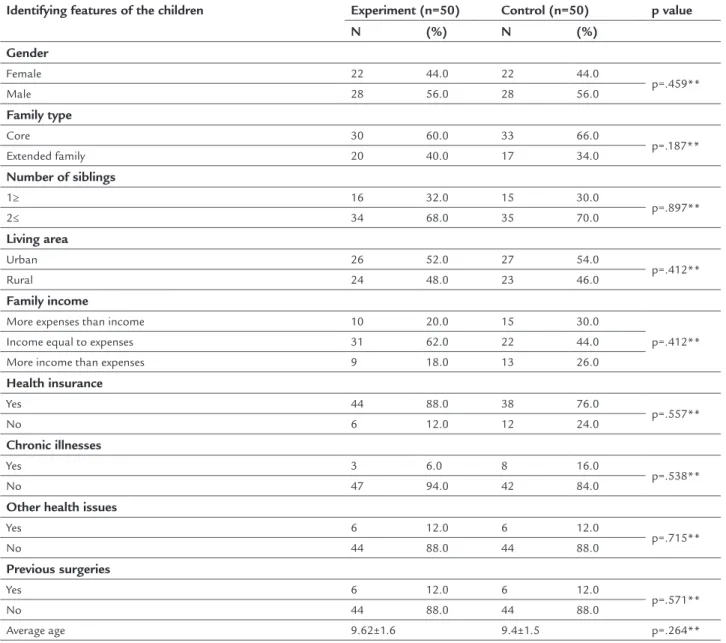
ESULTSThe comparison of the identifying features of the patients in both the experiment and the control groups are given in Table 1. The average age of the patients included in the research was 9.62±1.6 years in the experiment group and 9.4±1.5 years in the control group. 44% of the patients in-cluded in the research were female and 56% were male.
The variation according to the family type of the chil-dren in this research indicates that the majority in both groups (60 and 66%) belongs to a core family unit. The ma-jority of children in both groups (68 and 70%) had 2 or more siblings, 52% of the children in the experiment group and 54% of the children in the control group lived in a ru-ral area, 20% of the children in the experiment group and 30% of the children in the control group had more expens-es than income. The authors found that the majority of the children in both groups (88 and 76%) had health in-surance, very few of the children in both groups (6 and 16%) had a chronic illness and only 12% of the children in both the experiment and control groups had additional health issues. Regarding previous surgeries underwent by the children, 12% in both the experiment and control groups had undergone previous surgeries and 88% of the children in both groups had no previous surgery experience. No sta-tistically significant difference was observed when the com-parison of the identifying features of the patients in both groups (experiment/control) such as average age, (p=0.264), gender (p=0.459), family type (p=0.187), number of sib-lings (p=0.897), physical environment (p=0.412), family in-come (p=0.412), health insurance (p=0.557), chronic ill-nesses (p=0.538), other health issues (p=0.715) or previous surgeries (p=0.571), and the children in both groups pre-sented similar variation (p>0.05, Table 1).
chil-TABLE 1 Comparison of the identifying features of the patients in both the experiment and the control group.
Identifying features of the children Experiment (n=50) Control (n=50) p value
N (%) N (%)
Gender
Female 22 44.0 22 44.0
p=.459**
Male 28 56.0 28 56.0
Family type
Core 30 60.0 33 66.0
p=.187**
Extended family 20 40.0 17 34.0
Number of siblings
1≥ 16 32.0 15 30.0
p=.897**
2≤ 34 68.0 35 70.0
Living area
Urban 26 52.0 27 54.0
p=.412**
Rural 24 48.0 23 46.0
Family income
More expenses than income 10 20.0 15 30.0
p=.412** Income equal to expenses 31 62.0 22 44.0
More income than expenses 9 18.0 13 26.0
Health insurance
Yes 44 88.0 38 76.0
p=.557**
No 6 12.0 12 24.0
Chronic illnesses
Yes 3 6.0 8 16.0
p=.538**
No 47 94.0 42 84.0
Other health issues
Yes 6 12.0 6 12.0
p=.715**
No 44 88.0 44 88.0
Previous surgeries
Yes 6 12.0 6 12.0
p=.571**
No 44 88.0 44 88.0
Average age 9.62±1.6 9.4±1.5 p=.264**
Note: Values are given in n and %. p<0.05*, p>0.05**
dren in the control group (CAL=46.4±5.3; SAL=50.3±5.1); however, the difference found was not statistically signif-icant (t=0.045, p= 0.962, Table 2).
TABLE 2 Distribution of the pre-op state and trait anxiety levels of the children in both the experiment and control groups.
Experiment (n=50) Control (n=50)
x ± SD x ± SD p value
Trait anxiety levels
47.2±7.4 46.4±5.3 0.962*
State anxiety levels
52.3±6.2 50.3±5.1 0.338*
Notes. Values are given as arithmetic average ( x ) ± standard deviation (SD). * Significance test between differences of two averages.
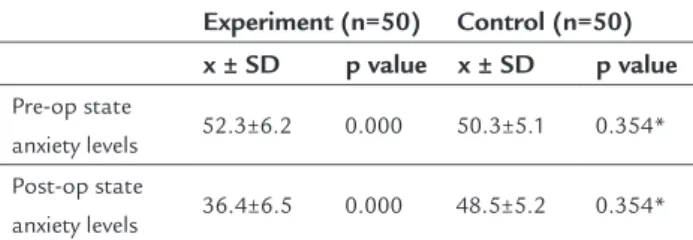
When the pre-op and post-op state and trait anxiety levels of the children in both the experiment and control groups are compared using the significance test between differences of two pairs, the difference found in the con-trol group was not statistically significant (t=0.998, p=0.354); however, the difference in the experiment group (t=18.292, p=0.000; Table 3) in the post-op period was considered highly statistically significant.
TABLE 3 Distribution of the pre and post-op state and trait anxiety levels of the children in both the experiment and control groups.
Experiment (n=50) Control (n=50)
x ± SD p value x ± SD p value
Pre-op state
anxiety levels 52.3±6.2 0.000 50.3±5.1 0.354* Post-op state
anxiety levels 36.4±6.5 0.000 48.5±5.2 0.354*
Notes. Values are given arithmetic average ( x ) ± standard deviation (SD). * Significance test between differences of two pairs.
D
ISCUSSIONThe findings of this study reveal that the state anxiety lev-els of children receiving planned pre-op trainning are low-er compared to the control group.
The comparison of the identifying features of the pa-tients in both the experiment and control groups showed no statistically significant difference (p>0.05; Table 1). The pre-op anxiety levels of the patients in both groups were found to be statistically similar (Table 2). The similar pre-op fea-tures of the patients in both groups and the homogeneity of the groups was an important factor in determining the ef-fectiveness of the trainning given by the researcher.
In their study, Sarı et al.10 found no statistically signif-icant difference between the anxiety levels of 70 female and male children aged 6-12. In their study, Baygın et al.11 did not find a statistically significant difference between the anxiety levels of male and female children aged 6-12, either. The findings of the research revealed that the patients in both the experiment and control groups had similar iden-tifying pre-op features (Table 1) and the pre-op state-trait anxiety levels of both groups were also similar, corroborat-ing finds in the literature.10,11
In a study by Turan et al.12 on adolescents aged 10-13 years awaiting surgical operations, the results revealed that the patients had a state anxiety level of 37.38±8.00, and the patients aged 14 older had a state anxiety level of 45.62±9.12. In another study by Caumo et al.16 on chil-dren aged 7-13 years, the trait pre-op anxiety level of the children was 38.58±6.54, while the state anxiety level was found at 32.12±7.95.
In the study by William Li and Lam18 on children aged 7-12 years, the pre-op state anxiety level average score was reported at 38.77±7.52. The state anxiety level of the ex-periment group was found at 52.3±6.2 and 50.3±5.1, in the control group. And according to other studies,12,16,18 state-trait anxiety levels were higher in the research group (Table 2). According to Watson and Visram’s17 literature study, regarding pre-op anxiety and post-op behavior of children, the children aged 7-11 years had a higher
anxi-ety level and they wanted to be included in the decision--making process of the operation. Thus, the necessary pre--op explanation regarding the operation must be given in a stress free environment. The research group, also being aged 7-11 years, is a corroborative finding considering the higher state-trait anxiety levels than Turan’s12 research, which may be related to age. When comparing the age range16,18 with the literature, where the range is similar, the higher state and trait anxiety levels are thought to be resulting from differences in countries and cultures.
Ng et al.13 state that pre-op briefing is a civilized and ethical approach and is effective in reducing the anxiety level of patients. It is found that the state anxiety level av-erages of children receiving planned pre-op trainning us-ing visual materials are significantly lower and statistical-ly significant, compared to children receiving the standard oral trainning given at the hospital (Table 3). This result proves that children are more interested in visual materi-als, and the use of such materials for the trainning of sick children is far more effective to reduce anxiety levels.
In their study, Kain et al.14 found that trainning pro-grams for operations, including cognitive approaches such as therapeutic games and an introduction to the op-erating room 5-7 days before the surgery, reduces the anx-iety levels of patients older than 6 years. Ucak and Kıvrak19 report that the use of a coloring book reduces the anxi-ety levels of the children and parents undergoing adeno-tonsillectomy operations. This study also revealed that the trainning given with the support of visual materials during the pre-op period reduced the anxiety levels of the sick children in the experiment group, compared to the child patients in the control group (Table 3).
As a result of the research, it is found that there is no significant difference regarding the pre-op period. The high state and trait anxiety levels during the pre-op peri-od (Table 2) and the lower and statistically significant dif-ference in the state and trait anxiety levels of the patients in the experiment group compared to the control group is a finding that proves the efficiency of the trainning giv-en by the researcher (Table 3).
C
ONCLUSIONinformation appropriate to the age and developmental lev-el of the sick child during the pre-op period.
The time to start pre-op preparation, when and how much information should be given is directly related to the child’s age and developmental level. This period shall be adequate enough to allow the child to ask questions and not be so long that would create unnecessary anxi-ety.5,16 Due to the concerns of sick children aged 6–12 re-garding their body image, they would like to know de-tails regarding whether they will be awake during the operation, how long the procedure will take, when they will be able to walk, and how they will look after the op-eration. The answers must be given honestly; the steps of the procedure should be explained using a model or au-dio visual material (posters, videos, brochures) on a step by step basis in order to reduce the anxiety levels.15,16,18
A
CKNOWLEDGMENTSThis study was presented as a poster at the 49th Turkish Con-gress of Paediatrics & International Association for Adoles-cent Health – 10th World Congress & 1st Congress of Paediat-ric Association of the Balkan, Istanbul, 10-13 Haziran 2013.
R
ESUMOOs efeitos do preparo pré-operatório nos níveis de ansie-dade de crianças em Corum/Turquia.
Objetivo: todo indivíduo, independentemente da idade
ou fase de desenvolvimento, requer preparo físico, emo-cional e cognitivo antes de qualquer operação. Sabe-se que a atitude dos enfermeiros frente ao paciente pediá-trico tem influência sobre o nível de ansiedade das crian-ças que esperam para serem operadas. Este estudo tem como objetivo determinar o efeito do preparo pré-opera-tório sobre os níveis de ansiedade de pacientes pediátri-cos hospitalizados para procedimento de hernioplastia.
Métodos: este estudo transversal e quase-experimental in-cluiu um total de 100 pacientes com idade de 7 a 12 anos internados para cirurgia de hérnia inguinal; 50 deles for-maram o grupo de controle e os demais 50, o grupo de ex-perimento. Os dados foram colhidos a partir de formulá-rios de identificação dos pacientes e uma escala de estado-traço de ansiedade para crianças. Os dados da pes-quisa foram avaliados com os devidos métodos estatísticos.
Resultados: os grupos mostraram características sociodemo-gráficas semelhantes e nenhuma diferença estatisticamente significativa foi observada (p>0,05). Durante o período pré--operatório, nenhum dos grupos apresentou qualquer dife-rença estatisticamente significativa em termos de níveis de es-tado de ansiedade ou traços (p>0,05); no entanto, o grupo de
experimento mostrou queda estatisticamente significativa dos níveis de ansiedade no período pós-operatório (p<0,05).
Conclusão: os níveis de estado de ansiedade das
crian-ças que receberam preparo pré-operatório planejado são mais baixos em comparação com as crianças que não re-ceberam esse treinamento. Reduzir os níveis de ansiedade de crianças doentes é possível quando se oferece informa-ções visuais e palpáveis adequadas à idade e à fase de de-senvolvimento da criança no período pré-operatório.
Palavras-chave: criança, pediatria, hérnia/cirurgia, an-siedade, assistência perioperatória.
R
EFERENCES1. Debes C, Aissou M, Beaussier M. [Preparing patients for surgery to improve functional recovery and reduce postoperative morbidity]. Ann Fr Anesth Reanim. 2014;33:33-40.
2. Guo P. Preoperative education interventions to reduce anxiety and improve recovery among cardiac surgery patients: a review of randomised controlled trials. J Clin Nurs. 2014;doi: 10.1111/jocn.12618. [Epub ahead of print] 3. Williams C. A background report on nurse staffing in children’s and young
people’s health care: A review and analysis of the evidence. Commissioned by the Royal College of Nursing. Royal College of Nursing; 2013. Available at: https://www.rcn.org.uk/__data/assets/pdf_file/0007/527272/004369.pdf. 4. Wilson DG. Clinical guidelines: march 2014 to february 2015. Cardif and
Vale University Health Board; 2014. Available at: http://www.cardiffpicu. com/pdf/CardiacClinical Guidelines2014.pdf.
5. Wong DL, Hockenberry-Eaton M. Health promotion of the adolescent and family. In: Hockenberry-Eaton M, editor. Wong’s essentials of pediatric nursing. St Louis: Mosby Company; 2005. p.520-39.
6. Omaya I, Banihani MD, Michael C, Ost MD. Preparing the child for minimally invasive surgery and what parents and children truly remember. Pediatric Endourol Tech. 2013;30:323-31.
7. He HG, Zhu L, Li HC,Wang W, Vehvilainen-Julkunen K, Chan SW. A randomized controlled trial of the effectiveness of a therapeutic play intervention on outcomes of children undergoing inpatient elective surgery: study protocol. J Adv Nurs 2014;70:431-42.
8. Spielberger CD. Assesment of state and trait anxiety: conceptual and methodological issues. South Psychol. 1985;2:6-16.
9. Ozusta S. Adaptation, validity and reliability of State-Trait Anxiety Inventory for children. Türk Psikoloji Derg. 1995;10:32-44.
10. Sarı Ş, Tunç EŞ, Bilgin Z. Çocuklarda dental kaygının farklı test yöntemleri ile değerlendirilmesi: Karşılaştırılmalı bir çalışma. A Ü Diş Hek Fak Derg 2002;29:127-35.
11. Baygın O, Tuzuner T, Isık B, Arslan I, Tanrıver M. Evaluation of the correlation between preoperative anxiety and pain level in children having primary tooth extractions. J Istanbul University Faculty Dentistry 2012;46:32-42. 12. Turan NK, Acaroglu R. The relationship between anxiety levels of adolescents
who undergo surgical interventions and their parents and analysis of anxiety causes. Turkiye Klinikleri J Med Sci. 2012;32:308-15.
13. Ng SKS, Chau AW, Leung WK. The effect of preoperative information in relieving anxiety in oral surgery patients. Community Dent Oral Epidemiol 2004;32:227-35. 14. Kain ZN. Preoperative preparation in chidren: a cross-sectional study. J Clin
Anesth. 1996;8:508-14.
15. Mooney KM. Preoperative management of the pediatric patient. J Plast Surg Nurs. 1997;17:69-75.
16. Caumo W, Broenstrub JC, Fialho L, Petry SMG, Bandeira D, Lougercio A, et al. Risk factors for postoperative anxiety in children. Acta Anaesthesiol Scand. 2000;44:782–89.
17. Watson AT, Visram A. Children’s preoperative anxiety and postoperative behaviour. Pediatr Anesthesia. 2003;13:188–204.
18. William Li HC, Lam HYA. Paediatric day surgery: impact on Hong Kong Chinese children and their parents. J Clin Nurs. 2003;12:882–7. 19. Ucak H, Kıvrak N. The painting booklet designed for children who are