Rev Bras
Cineantropom
Hum
DOI: http://dx.doi.org/10.5007/1980-0037.2018v20n5p391
original article
Acute responses of high-intensity circuit
training in women: Low physical fitness levels
show higher muscle damage
Respostas agudas de um circuito de treino de alta
intensidade em mulheres: Níveis baixos de aptidão física
apresentam maior dano muscular
Aline Bianca Alves Nasci1
Rafael Bueno Orcy2
Léo Dutra Cabistany1
Andressa Formalioni1
Fabrício Boscolo Del Vecchio1
Abstract – High-intensity intermittent exercise (HIIE) elicits large improvements in health and cardiorespiratory fitness (CRF). HIIE can be applied with calisthenics exercises to improve strength and endurance. The acute effects of high-intensity circuit training (HICT) considering different CRF on myological variables are unknown.The aim was measure acute effects of HICT in young women considering different levels of CRF. Twelve women were allocated in two groups, who achieve 41mLO2•kg-1•min-1 or more= High Physical Fitness (HPF, n=5) and who achieve less than 41mLO2•kg-1•min-1= Low Physical Fitness (LPF,n=7). Protocol: 2x4 sets of 20 seconds at maximum intensity (all-out fashion) interspersed with 10 seconds of passive rest (jumping jacks, squat and thrust using 2kg dumbbells, mountain climber, and burpees). Blood samples were collected before, immediately after, 15minutes, 30minutes, one hour and 24 hours after. Heart rate, serum myoglobin, lactate, and creatine kinase (CK) concentration were analyzed. The HR achieved 94.1±3.7% of HRmax for LPF and 104.5±20.3% for HPF, p=0.03. The mean of delta lactate was similar between groups. The highest myoglobin has reached at 1h after the exercise protocol, with 50.0±30.2 ng/mL for LPF and 36.9±9.25 ng/mL for HPF. The delta of total CK before and after the exercise protocol shows that the serum CK level in LPF was significantly higher than HPF group (p=0.042). HICT composed by calisthenic protocol produced elevated and similar effects on HRmax, serum lactate and myoglobin in the woman with HPF and LPF. However, LPF group presented higher muscle damage inferred by serum CK concentrations.
Key words: Creatine kinase; High-intensity interval training; Myoglobin; Sodiun lactate.
Resumo – O exercício intermitente de alta intensidade(HIIE) melhora a saúde e a aptidão cardiorrespiratória(CRF). HIIE pode ser aplicado com exercícios calistênicos para melhorar a força e resistência. Os efeitos agudos do treinamento de alta intensidade(HICT) considerando diferentes CRF em variáveis miológicas são desconhecidos. O objetivo foi medir os efeitos agudos do HICT em mulheres jovens, considerando diferentes níveis de CRF. Elas foram alocadas pelo
nível de VO2máx. em dois grupos, as que atingiram 41mLO2•kg-1•min-1 ou mais= alta aptidão
física(HPF,n=5) e menos de 41mLO2•kg-1•min-1= baixo aptidão física(LPF,n=7). Protocolo:
2x4 séries de 20s com intensidade máxima (all-out) intercalados com 10s de repouso passivo (jumping jacks, squat and thrust usando halteres 2kg, mountain climber e burpees). Sangue foi coletado antes, zero, 15, 30min, 1h e 24hs depois. Foram analisadas, freqüência cardíaca, mioglobina sérica, lactato e creatina quinase (CK). A FC alcançou 94,1±3,7% da FCmax para LPF e 104,5±20,3% para HPF, p=0,03. A média do delta lactato foi semelhante entre os grupos. O pico de mioglobina foi 1h após o protocolo de exercício, com 50.0±30.2ng/mL para LPF e 36.9±9.25ng/mL para HPF. O delta de CK total antes e depois do protocolo de exercício mostra que o nível sérico de CK no LPF foi significativamente maior do que o grupo HPF(p=0,042). O HICT com exercícios calistênicos produziu efeitos elevados e semelhantes sobre FCmax, lactato sérico e mioglobina nas mulheres com alta e baixa aptidão física. No entanto, o grupo LPF
1 Federal University of Pelotas. Su-perior School of Physical Education. Pelotas, Rio Grande do Sul. Brazil.
2 Federal University of Pelotas. Department of Physiology and Pharmacology. Pelotas, Rio Grande do Sul. Brazil.
INTRODUCTION
Interval training is characterized by relatively brief, intermittent bouts of
intense exercise, separated by periods of lower intensity exercise or rest1.
Chronically, high-intensity circuit exercise (HICT) elicits large
improve-ments in health and cardiorespiratory fitness2,3 and high-intensity circuit
training (HICT) also elicit greater adherence than more traditional, longer
duration, low-intensity training among women4. Despite the common
use of running and cycling in HICT, calisthenics also can be applied to
improve cardiorespiratory fitness (CRF), strength and endurance4,5.
Pre-viously, was found that CRF can contribute to intermittent performance on cycle ergometer, and higher levels are associated with better results in
male athletes6. However, the effects of HICT considering different CRF
on hemodynamical and myological variables in women are unknown. From the cardiovascular and muscular point of view, calisthenic HICT increases the heart rate (HR) near to 87% of HR peak and blood lactate
concentration higher than 8 mmol·L-1 in a mixed sample compose by male
and female5. However, cardiorespiratory7,8 and muscular9,10 differences
between genres in HICT are known1, and studies involving women and
separated analysis by sex are widely desirable1,9.
Despite its aerobic-nature11,12, HICT elicits high glycolytic
activa-tion, inferred by elevated lactate concentration5 and glycogen depletion12.
Additionally, the power output decrement1, physiological demands5,6,12
and muscle injury – traditionally analyzed by creatine kinase (CK) – are
protocol dependent13,14. Considering well-trained male subjects (VO
2max =
58.3±5.9 mLO2•kg-1•min-1), significantly higher CK values (from 300 U/L
to more than 700 U/L) were observed 24 hours after 4 sets of six all-out sprints lasting 5 s, with 25 s between bouts and 5 min between sets in
comparison to other longer sprints14.In highly trained female athletes, 15
x 30 m running resting 65 s generated an increase of creatine kinase (CK)
higher than 400% (near to 300 U/L), with a peak in 24h post-HICT13.
Both CK and Myoglobin (Mb) are released from the muscle and
frequently are used as muscle damage markers15. CK blood concentration
has higher values observed 24h to 72h after the exertion13. Myoglobin has
faster transference to bloodstream after cell injury than CK and its peak
is reached frequently earlier16. It is important to highlight that the level
of fibers damage depends on physical fitness and exercise characteristics,
as mode, intensity, and duration17. Specifically concerning the effects of
physical fitness, seems that trained women show earlier increase in plasma glycerol concentrations, different profile in lactate concentration during and
post-HICT, with no differences in HR and oxygen uptake18, although CRF
is related to HICT performance in cycle ergometer19. We expect a rise of
levels, than High Physical Fitness (HPF) after calisthenics HIIC, but it is necessary to measure and quantify its effects under muscular damage markers in the blood. Considering the lack of time for exercises in general
population1, the low complexity and adaptability of HICT4, and the limited
knowledge regarding the effects of CRF on physiological responses after high-intensity intermittent exercise with callisthenic protocol, the aim of this study was to measure and compare acute effects of a HICT session in young women with different levels of aerobic physical fitness.
METHODOLOGICAL PROCEDURES
Study design and participants
This research was an experimental trial and the sample size was calculated using the statistical program WinPepi11.65 considering the previous study that analyzed blood lactate concentration [Lac] in trained versus untrained
women18. Assuming a [Lac] of 4.1±0.4 mmol.L-1 in the first and 5.2±0.8
mmol.L-1 in the second, an observed power of 0.8, and p<0.05 in a bi-tailed
test, were needed 5 participants per group. The recruitment occurred on local Physical Education College. Were invited the healthy young women, from 18 to 35 years, free of chronic diseases with normal Body Mass Index
(BMI), who were included20. Participants with some musculoskeletal
limita-tion that disrupted exercise protocol performance and who had previously trained with this protocol were excluded. The final sample size had twelve young females, which signed an informed consent form and received previ-ous guidelines for the intervention. The research was approved by Federal University of Pelotas Ethic committee under the number 004/2012.
The participants were submitted to three laboratories visits, firstly to an incremental test, the second to perform a single session of high-intensity intermittent exercise, before the session was performed a familiarization for all participants and the third to 24h-after blood collection. For CRF
alloca-tion, after the incremental test, women who achieve 41 mLO2•kg-1•min-1 or
more were consider as High Physical Fitness (HPF, n = 5) and who achieve
less than 41 mLO2•kg-1•min-1 were considered as Low Physical Fitness
(LPF, n = 7) according percentile 80% of ACSM reference for female21.
Procedures
The participants received previous guidelines for the whole intervention, such as: being fed, having slept for at least 8 hours, not having consumed alcoholic beverages, stimulants or smoked for at least 2 hours before blood collections and did not perform vigorous physical exercises for at least 72 hours before the start of the exercise protocol.
At the first visit, the participants performed a maximum incremental cycle ergometer test (Ergo-FIT™, model Ergo 167 Cycle, Pirmasens,
Germany) to measure the maximum oxygen uptake (VO2max) and
maxi-mal heart rate (HRmax). Previously, they warmed-up during 5 minutes at
of VO2max consisted of an incremental test, in which the individual was instructed to pedal at a pre-established cadence in the range of 55 to 65 rpm (revolutions per minute), increasing by 25 watts every two minutes
of the test, until exhaustion, or inability to maintain cadence. For VO2max
measure was used an open circuit gas analyzer (VO2000, MedicalGraph) during the test. It was calibrated with Brezee software (Medgraphics™, Minnesota, USA), using high flow pneumotachometer, medium size neo-prene™ masks, and records of mean values for every three breaths. The test was finished when the participant was not able to maintain the cadence and
we considered the highest oxygen uptake in the incremental test as VO2max.
To measure the HRmax a cardiac monitor (Polar RS800CX™,
Kem-pele, Finland) was used and records in internal memory of the own device during collection were saved, later the obtained data were downloaded in computer and analyzed in specific software (Polar Pro Trainer 5.0). The maximum, minimum and mean of HR measurements were obtained. For
all visits, temperature (22-24o C) and humidity (40%) were controlled.
After 72 hours of relaying the incremental test, women attended the laboratory for the second visit at same daytime. Initially, they performed each movement of the protocol for familiarization, then performed the
HICT protocol adapted from McRae et al4. Briefly, they performed 8 sets
of 20 seconds at maximum intensity (all-out fashion) interspersed with 10 seconds of passive rest the following exercises: jumping jacks, squat and thrust using 2 kg dumbbells, mountain climber, and burpees. The exercises
were performed twice in this order, completing 4min session4.
The blood samples were collected before, immediately after, 15 min-utes, 30 minutes and one hour after the exercise protocol. In each time, 5 ml venous blood was collected and centrifuged immediately at 3000 rpm for 10 minutes in order to separate the serum. Serum was stored at -20C for further measurements of lactate, and myoglobin. At the third visit, performed 24 hours after, the same blood collection was performed, which was used to creatine kinase values, lactate and myoglobin analysis. Before, during and after HICT the HR measurement also was done with cardiac monitor (Polar RS800CX™, Kempele, Finland). Samples each 1s were recorded, and the peak value was considered. HR was performed prior to performing the incremental test and the exercise protocol. Consider-ing the CK time-course, only pre and post 24h measures were performed.
The electrochemiluminescence immunoassay was used for myoglobin analyses, serum samples were analyzed in Elecsys 2010 using the Roche® Kit -12178214 122. Serum total CK activity values were measured by UV assay using a Kit Labtest® (CK-NAC liquiform- 117), following the manufacturer’s recommendations for use, with SpectraMax® 190 Micro-plate Reader. Serum lactate concentration was measured on the YSI 2300 STAT PLUS™ instrument.
conducted two-way analyses of variance (ANOVA, group x moment) with repeated measures. The Mauchly test was used to analyze the sphericity and the Greenhouse-Geisser correction was employed when appropriated.
The mean of variation of post and pre values of lactate concentration in incremental test and protocol exercise was compared with Student’s t-test
and Mann-Whitney U test was used for CK (difference between CK pre
and post 24h of exercise protocol). For myoglobin, due to the non-normal distribution and violation of the sphericity pointed by Levene’s test, Fried-man’s analysis of variance was used, since repeated measurements occurred over time. As the study has repeated measures, trends were analyzed by ANOVA with repeated measures considering group Low Physical Fitness
(LPF) vs High Physical Fitness (HPF) and moment. Bonferroni post-hoc
was used considering different moments.
RESULTS
The sample consisted of 12 women (7 LPF and 5 HPF), there were no differences between groups for age, height, body mass, BMI, resting heart
rate (RHR) and maximal heart rate achieved in incremental test (HRmax).
Regarding VO2max, there were differences between groups, and data are
shown in Table 1.
Table 1. Subjects characteristics, according to physical fitness level (N=12).
Physical Fitness Level
Low (n=7) High (n=5) p-value
Age (years) 23.0± 4.7 23.6± 2.9 0.80
Height (cm) 164.0±6.9 161±7.8 0.50
Body mass (kg) 164.0±6.9 161±7.8 0.50
BMI (kg/m2) 63.3±7.9 58.5±4.9 0.50
RHR (bpm) 76.8± 9.3 80.2± 8.3 0.50
HRmax (bpm) 184.8±9.2 172.0±24.0 0.22
VO2max (mLO2•kg-1•min-1) 37.9 ± 1.5 48.9 ± 5.5 0.001
Note. BMI = Body Mass Index; RHR = Resting Heart Rate; HRmax = Maximal Heart Rate in incremental test; VO2max = Maximum Oxygen Uptake.
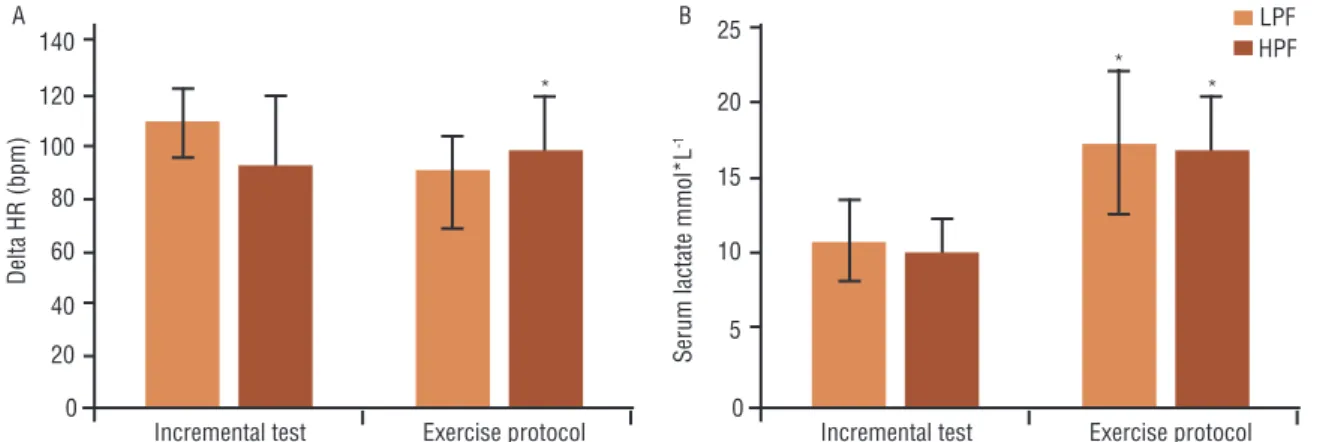
No differences were found between the groups for delta HR (HR post – HR pre) during the incremental test (LPF = 108.0±13.1 bpm; HPF = 91.8±26.4 bpm; p = 0.18) and exercise protocol (LPF = 89.4±13.7 bpm; HPF = 97.4±20.3 bpm; p = 0.43). However, figure 1A shows that delta HR in the incremental test was different from the delta in exercise protocol
only in LPF group (p = 0.005; p = 0.76 for HPF). Considering HRmax,
the highest HR in the incremental test, in the end of HICT protocol the
HR achieved 94.1±3.7% of HRmax for LPF and 104.5±20.3% for HPF
protocol. The mean delta lactate for LPF group was 10.7 ± 2.7 mmol•L-1
in the incremental test and 17.3 ± 4.7 mmol•L-1 in exercise protocol (p =
0.003). Also, for the HPF group, the exercise protocol obtained higher lactate means compared to the incremental test (respectively 16.9 ± 4.6
mmol•L-1 and 10.0 ± 2.3 mmol•L-1; p = 0.03).
The analysis of the serum lactate concentration during exercise protocol
(figure 2) showed differences between moments (F = 98.2, p <0.001, ƞ2
p
= 0.91, power = 1), but not between groups (F = 0.66; P = 0.8, ƞ2
p = 0.07,
power = 0.05), or interactions (F =0.97; p = 0.99; ƞ2
p = 0.01, power =0.07).
The repeated measures ANOVA identified a significant cubic trend curve, with initial elevation followed by a decrease in subsequent moments (F = 165.1, p <0.001, ƞ2
p = 0.94, power = 1). The highest values were observed
immediately after HICT, with 19.9 ± 4.5 mmoL-1 for LPF and 19.3± 5.2
mmol.L-1 for HPF.
Figure 2. Lactate serum concentration during exercise protocol. LPF: Low Physical Fitness; HPF: High Physical Fitness. * = Different of all others moments; # = different of time 0’post, 15’post and 30’post; Ŧ = different of time 0’post, 15’post and 30’post and 1h post.
In the analysis of the serum myoglobin concentration (figure 4),
dif-ferences between moments (F = 4.3; p = 0.3; ƞ2
p = 0.3; power = 0.63) were
observed, with no differences between groups (F = 0.45; p = 0.5, ƞ2
p = 0.43,
power = 0.09), or interactions (F =0.9; p = 0.3; ƞ2
p = 0.8; power =0.17). A
cubic tendency was identified by repeated measures ANOVA, with
eleva-tion followed by a decrease in subsequent moment (F = 5.0; p= 0.04; ƞ2
p =
0.33; power = 0.52). The highest values were observed at 1h after the exercise protocol, with 50.0± 30.2 ng/mL for LPF and 36.9± 9.25 ng/mL for HPF.
Figure 3. Myoglobin serum concentration during exercise protocol. LPF (Low Physical Fitness) and HPF (High Physical Fitness). * = Different of 15 min post in LPF.
The median (25-75% percentile) of total CK pre exercise protocol for
LPF was 48.5 (16.5-52.3) U•L-1 and for HPF 79.9 (22.0-97.9) U•L-1 and
post 24hs was 95.0 (55.10-131,0) U•L-1 for LPF and 76.3 (21.3-116.2)
U•L-1 for HPF, figure 4A. We compare the delta of total CK (difference
between CK pre and post 24h of exercise protocol) with Mann-Whitney
U test that indicated, on average, that the serum CK level in LPF (Mean
Rank= 8.29 U•L-1, n=7) was significantly higher than HPF group (Mean
Rank = 4.0 U•L-1, n=5), U=5.0, z = -2.03, p=0.042, figure 4B.
DISCUSSION
The present study aimed to compare the acute physiological effects of an HICT session in women with different levels of physical fitness. The ana-lyzed groups were similar for the anthropometric variables, RHR, RPE,
and HRmax, while VO2max were higher for HPF group. We did not find differences between LPF and HPF subjects for the variation of the HR, serum lactate and myoglobin after HICT. However, the main finding was that the serum CK level in LPF was significantly higher than HPF group. Exercise-induced muscle damage occurs following unaccustomed and/ or very vigorous exercise and the increased levels of CK and myoglobin rank
among those signs of exercise-induced muscle damage23. The high-intensity
character of HIIE can potentially lead to muscle fiber impairment which can be manifested by increases in of CK and myoglobin concentration in
plasma24,25. To our knowledge, this is the first study that analyzed the acute
effects of a calisthenics HICT on muscle injury markers such as myoglobin and CK. For myoglobin concentrations, we did not find differences between the fitness levels, it was only observed that the concentration increases 30 min after HICT, achieve the highest values 1 h after and returns to the baseline values after 24 hours. This result is similar to the finding of Joo16, that analyzed
the myoglobin concentration in ten healthy active men underwent a HIIE protocol (eight 3-min bouts at a running velocity corresponding to 90% of maximal oxygen uptake interspersed with 3-min active recovery periods).
Cipryan25 also presented similar results to ours regarding concentrations and
curve of myoglobin, with its peak in one hour after short HIIE completed by endurance and sprint athletes. Another study, involving professional female basketball players, the myoglobin curve was similar to Joo16 after a match, and
the highest levels were around 100-200 ng•mL-127. In the present study, the
highest levels of myoglobin were lower, probably for the low volume of exercise. In our study, CK concentrations showed an increase 24 h post exercise, and the LPF group had higher increase than HPF. We believe that exercise-induced muscle damage occurs more intensely in LPF probably for lower muscular fitness caused by low physical fitness of this group26,27. As a limitation, we did
not measure CK and myoglobin points after 24hs, but previous studies shown that concentrations returning to pre-exercise levels after 48 h13,28.
Regarding the heart rate, there were no differences between groups, and
applied protocol can be considered intense and reached 94-104% HRmax.
Pre-viously, Gist et al5 involving trained subjects (VO
2peak = 54.1 ± 5.4 mLO2•kg -1•min-1) in all-out calisthenics exercises composed by 4 sets of 30s of burpee
with a rest of 4 minutes between bouts, found values of 84% of HRmax.
Ad-ditionally, with active women, McRae et al4 using a similar exercise protocol
similar applied here (8 sets, 20s:10s), found averages of 92 ± 4% HRmax. These
differences can be due to the nature of applied HICT because Gist et al5
used an effort: pause relationship similar to Sprint Interval Training, while
we and McRae et al4 applied short-time HICT28. In the HICT protocol,
the LPF group reached a lower variation (delta) of the HR compared to the incremental test. Perhaps this finding can be explained by the fact that LPF responds less intensely to the all-out stimulus, probably because they have a
lower neuromuscular response, thus achieving a lower HR2.
serum lactate of both groups to values above 19 mmol•L-1, which leads to
a high anaerobic contribution5. When comparing calisthenic HICT with
the incremental test, we found significant differences with higher serum
levels for HICT. Smilios et al28 studied responses of eleven moderately
trained man, who executed on three separate sessions, 4x4-min runs at 90% of maximal aerobic velocity (MAV) with 2-min, 3-min, and 4-min
of active recovery. They found lactate levels around 7-8 mmol.L-1 for 2 min
recovery and that the use of a short compared to longer recovery interval during the execution of HICT does not substantially affect the exercise time performed at near maximal rate of oxygen consumption, but results in greater cardiovascular stress, as evident by higher heart rates, and activates
more the anaerobic glycolysis28. Our protocol had only 10s of rest between
the bouts, which caused intense effects on HR and anaerobic glycolysis, evidenced by high HR and measured lactate levels. It is important to point that this kind of protocol, lasting only 4 min, when applied four times per week during one month, was able to improve maximal oxygen uptake
and muscular endurance in a similar sample of women4.Recently, other
investigation found that this same protocol, made thrice during 16 weeks
(total volume accumulated = 384 min), was sufficient to improve VO2peak,
intensity associated to VO2peak, as well as body fat in healthy males similar
to 30 min/day of moderate-continuous aerobic running (total volume =
1,440 min)29. Considering the low complexity and short time during this
workout, new studies should investigate the chronic effects of whole body high intensity interval training on body composition of female population.
The present study has interesting points, as the comparison of physi-ological responses between incremental test and HICT, and the analysis considering the cardiorespiratory fitness. Additionally, other useful aspect
was the inclusion of McRae´s recommendation4, mixing different
calis-thenic exercises in the same workout. Finally, we must to highlight the absence of RPE after HICT as a limitation. However, it is important to point that similar sample previously evaluated performing similar protocol
reported values near from 17 arbitrary units in 6-20 scale4. Furthermore,
our sample reached a blood lactate concentration near from 20 mmol.L-1,
and HRmax of 94.1±3.7% for LPF and 104.5±20.3% for HPF, confirming the high intensity nature of this HICT.
CONCLUSION
In summary, we found that HICT protocol produced similar effects under HRmax, serum lactate and myoglobin in the woman with high and low physical fitness, but LPF presented more muscle damage marked for an increase in serum CK concentrations. A high-intensity calisthenic protocol
can achieve elevated values of HRmax and produce higher lactate
concentra-tions than an incremental test.
Funding
This research did not receive any specific grant from funding agencies in the public, commercial, or not-for-profit sectors. This study was funded by the authors.
Ethical approval
Ethical approval was obtained from the local Human Research Ethics Committee – Federal University of Pelotas, and the protocol was written in accordance with the standards set by the Declaration of Helsinki.
Conflict of interest statement
The authors have no conflict of interests to declare.
Author Contributions
Conceived and designed the experiments: FBDV and ABAN Performed the experiments: ABAN, RBO, LDC and AF. Analyzed the data: RBO, ABAN and FBDV. Contributed reagents/materials/analysis tools: FBDV and ABAN. Wrote the paper: ABAN, RBO and FBDV.
REFERENCES
1. Gibala MJ, Gillen JB, Percival ME. Physiological and Health-Related Adapta-tions to Low-Volume Interval Training: Influences of Nutrition and Sex. Sports Med 2014;44(Suppl 2):127-37.
2. Milanović Z, Sporiš G, Weston M. Effectiveness of High-Intensity Interval Training (HIT) and Continuous Endurance Training for VO2max Improve-ments: A Systematic Review and Meta-Analysis of Controlled Trials. Sports Med 2015;45(10):1469-81.
3. Costigan SA, Eather N, Plotnikoff RC, Taaffe DR, Lubans DR. High-intensity interval training for improving health-related fitness in adolescents: a systematic review and meta-analysis. Br J Sports Med 2015;49 (19):1253-61.
4. McRae G, Payne A, Zelt JGE, Scribbans TD, Jung ME, Little JP, et al. Extremely low volume, whole-body aerobic-resistance training improves aerobic fitness and muscular endurance in females. Appl Physiol Nutr Metab 2012;37(6):1124-31. 5. Gist NH, Freese EC, Ryan TE, Cureton, KJ. Effects of low volume, high-intensity
whole-body calisthenics on Army ROTC cadets. Mil Med 2015;180(8):492–8. 6. Franchini E, Takito MY, Kiss MAPD. Performance and energy systems
contribu-tions during upper-body sprint interval exercise. J Exerc Rehabil 2016;12(6):535-41. 7. Panissa VL, Julio UF, França V, Lira FS, Hofmann P, Takito MY, et al. Sex-Related Differences in Self-Paced All Out High-Intensity Intermittent Cycling: Mechanical and Physiological Responses. J Sports Sci Med 2016;15(2):372-78. 8. Townsend LK, Couture KM, Hazell TJ. Mode of exercise and sex are not important
for oxygen consumption during and in recovery from sprint interval training. Appl Physiol Nutr Metab 2014;39(12):1388–94.
9. Willcocks RJ, Williams CA, Barker AR, Fulford J, Armstrong N. Age- and sex-related differences in muscle phosphocreatine and oxygenation kinetics during high-intensity exercise in adolescents and adults. NMR Biomed 2010;23(6):569-77. 10. Esbjörnsson-Liljedahl M, Bodin K, Jansson E. Smaller muscle ATP reduction in
women than in men by repeated bouts of sprint exercise. J Appl Physiol 2002;93(3): 1075-83.
CORRESPONDING AUTHOR
Rafael Bueno Orcy
Adolfo Fetter Avenue, 3551/E8. Postal Code: 96090-840. Pelotas, Rio Grande do Sul, Brazil.
E-mail: [email protected] 1574-80.
12. Parolin ML, Chesley A, Matsos MP, Spriet LL, Jones NL, Heigenhauser GJ. Regulation of skeletal muscle glycogen phosphorylase and PDH during maximal intermittent exercise. Am J Physiol 1999;277(5 Pt 1):890-900.
13. Keane KM, Salicki R, Goodall S, Thomas K, Howatson G. Muscle Damage Re-sponse in Female Collegiate Athletes After Repeated Sprint Activity. J Strength Cond Res 2015;29(10):2802-7.
14. Wiewelhove T, Fernandez-Fernandez J, Raeder C, Kappenstein J, Meyer T, Kell-mann M, et al. Acute responses and muscle damage in different high-intensity interval running protocols. J Sports Med Phys Fitness 2016;56(5):606-15. 15. Armstrong RB. Initial events in exercise-induced muscular injury. Med Sci Sports
Exerc 1990;22(4):429–35.
16. Joo CH. Development of a non-damaging high-intensity intermittent running protocol. J Exerc Rehabil 2015;11(2):112-8.
17. Tschakert G, Hofmann P. High-Intensity Intermittent Exercise: Methodological and Physiological Aspects. Int J Sports Physiol Perform 2013;8(6):600-10. 18. Trapp EG, Chisholm DJ, Boutcher SH. Metabolic response of trained and
un-trained women during high-intensity intermittent cycle exercise. Am J Physiol Regul Integr Comp Physiol 2007;293(6):2370-5.
19. Bishop D, Edge J, Goodman C. Muscle buffer capacity and aerobic fitness are associated with repeated-sprint ability in women. Eur J Appl Physiol 2004;92(4-5):540-7.
20. World Health Organization. Global Recommendations on Physical Activity for Health. Geneva, Switzerland: World Health Organization; 2010.
21. American College of Sports Medicine; ACSM’s guidelines for exercise testing and prescription. 6th ed. Philadelphia: Lippincott Williams & Wilkins. 2000. 22. Laurent CM, Green JM, Bishop PA, Sjökvist J, Schumacker RE, Richardson
MT, et al. A Practical Approach to Monitoring Recovery: Development of a Per-ceived Recovery Status Scale. J Strength Cond Res 2011;25(3):620-8.
23. Chen TC, Nosaka K, Sacco P. Intensity of eccentric exercise, shift of opti-mum angle, and the magnitude of repeated-bout effect. J Appl Physiol (1985) 2007;102(3):992–9.
24. Paulsen G., Mikkelsen U.R., Raastad T., Peake J.M. Leucocytes, Cytokines and Satellite Cells: What Role Do They Play in Muscle Damage and Regeneration Following Eccentric Exercise? Exerc Immunol Rev 2012;18:42-97.
25. Cipryan L. IL‐6, Antioxidant Capacity and Muscle Damage Markers Following High‐Intensity Interval Training Protocols. J Hum Kinet 2017:56:139-148. 26. Moreira A, Nosaka K, Nunes JA, Viveiros L, Jamurtas AZ, Aoki MS. Changes
in muscle damage markers in female basketball players. Biol Sport 2014;31(1):3-7. 27. Bucheit, M, and Laursen, P. High intensity interval training solutions to the
programming puzzle. Cardiopulmonary emphasis. Sports Med 2013;43(3):313-38. 28. Smilios I, Myrkos A, Zafeiridis A, Toubekis A, Spassis A, Tokmakidis SP. The
effects of recovery duration during high-intensity interval exercise on time spent at high rates of oxygen consumption, oxygen kinetics and blood lactate. J Strength Cond Res 2018;32(8): 2183-9.