SUMMARY
Objective: To analyze the association between maternal obesity and postnatal infectious complications in high-risk pregnancies. Methods: Prospective study from August 2009 through August 2010 with the following inclusion criteria: women up to the 5th post-partum day; age ≥ 18 years; high-risk pregnancy; singleton pregnancy with live fetus at labor onset; delivery at the institution; maternal weight measured on day of delivery. he nutritional status in late pregnancy was assessed by the body mass index (BMI), with the application of the Atalah et al. curve. Patients were graded as underweight, adequate weight, overweight, or obese. Postpartum complications investigated during the hospital stay and 30 days post-discharge were: surgical wound infection and/or se-cretion, urinary infection, postpartum infection, fever, hospitalization, antibiotic use, and composite morbidity (at least one of the complications mentioned). Results: 374 puerperal women were included, graded according to the inal BMI as: underweight (n = 54, 14.4%); adequate weight (n = 126, 33.7%); overweight (n = 105, 28.1%); and obese (n = 89, 23.8%). Maternal obesity was shown to have a signiicant association with the following postpartum complications: surgical wound infection (16.7%, p = 0.042), urinary infection (9.0%, p = 0.004), antibiotic use (12.3%, p < 0.001), and composite morbidity (25.6%, p = 0.016). By applying the logistic regression model, obesity in late pregnancy was found to be an independent variable regardless of the composite morbid-ity predicted (OR: 2.09; 95% CI: 1.15-3.80, p = 0.015). Conclusion: Maternal obesity during late pregnancy in high-risk patients is independently associated with postpartum infectious complications, which demonstrates the need for a closer follow-up of mater-nal weight gain in these pregnancies.
Keywords: Nutritional status; obesity; pregnancy; postpartum period; high-risk preg-nancy; puerperal infection.
©2012 Elsevier Editora Ltda. All rights reserved.
Study conducted at the Discipline of Obstetrics, Department of Obstetrics and Gynecology, Medical School, Universidade de São Paulo, São Paulo, and at the
Nutrition and Dietetics Division, Nutrology Group, Clinical Hospital, Medical School, Universidade de São Paulo, São Paulo, SP, Brazil
Submitted on: 09/21/2011
Approved on: 02/19/2012
Financial support:
Master’s scholarship to the student Letícia Vieira de Paiva granted by Fundação de Amparo à Pesquisa do Estado de São Paulo (FAPESP)
Correspondence to:
Roseli Mieko Yamamoto Nomura Av. Dr. Eneas de Carvalho Aguiar, 255 10º andar, sala 10037 São Paulo – SP, Brazil CEP: 05403-000 [email protected]
Conflicts of interest: None.
Maternal obesity in high-risk pregnancies and postpartum infectious
complications
LETÍCIA VIEIRADE PAIVA1, ROSELI MIEKO YAMAMOTO NOMURA2, MARIA CAROLINA GONÇALVES DIAS3,MARCELO ZUGAIB4
1Nutritionist, Postgraduate Program Student, USP, São Paulo, SP, Brazil 2Associate Professor, Universidade de São Paulo (USP), São Paulo, SP, Brazil
INTRODUCTION
Nutritional status results from the balance between nu-trient intake and energy expenditure in the body to meet daily needs. he nutritional status investigation is based on the measurement of physical parameters and on the over-all body composition. he parameters adopted for nutri-tional surveillance in pregnant women are: body mass in-dex (BMI) and gestational weight gain. Weight and height measurements are the most oten used, and BMI is the key indicator for maternal nutritional status diagnosis1,2. his
index allows for the identiication of pregnant women at nutritional risk, mainly regarding maternal obesity; in this condition, a nutritional guidance aiming to promote ma-ternal health is recommended in order to provide a better condition for delivery and appropriate neonate weight2.
In obese pregnant women, postpartum complications are frequent, mainly infectious complications. A number of studies show that, regardless of the delivery route, en-dometritis, wound infection, episiotomy tears, postpartum bleeding, and prolonged surgery time are more frequent3-5.
hese aspects are worrying, as excess weight in Brazil rep-resents the most prevalent nutritional problem, found in 25% to 30% of pregnancies6-8. he obesity incidence is
growing among women of childbearing age, according to the Institute of Medicine (IOM) – a government agency that is part of the U.S. National Academy of Science9. In
addition, obesity in itself raises the pregnancy risk due to the acknowledged association with preeclampsia, dia-betes mellitus, fetal macrostomia, venous thromboembo-lism10-11, increased C-section incidence12-14, dystocias, and
postpartum complications15, inluencing pregnancy
out-comes16-17. However, the postpartum infectious outcomes
in obese women with other comorbidities are not known. To ill this gap, the present study was conducted in high-risk pregnancies aiming to ind the inluence of maternal nutritional status during late pregnancy on the occurrence of postpartum complications.
METHODS
his prospective observational study was performed from August 2009 through August 2010. he investigation pro-tocol and the informed consent were approved by the In-stitutional Ethics Committee under the No. 1233/07.
Were invited to participate in the study 472 women whose delivery was conducted in the University Hospital, a tertiary center. he following inclusion criteria were ad-opted: women up to the 5th postpartum day whose
preg-nancy was considered as high-risk; maternal age ≥ 18 years; singleton pregnancy with live fetus at labor onset; delivery at the institution; maternal weight measured on the day of delivery; and agreement to participate in the study. hose who had any complicating clinical or ob-stetric event were considered as high-risk pregnancies.
he exclusion criteria adopted were: no telephone contact obtained ater hospital discharge, and impaired ability to understand the interview.
Data were collected in an interview by the investigator with a previously designed protocol containing: patient’s data, hospitalization data, habits/addictions, obstetric events, clinical diagnoses, and delivery/neonate data. he following data regarding clinical and/or obstetric events were collected from the patient's charts: delivery type (vaginal, forceps-assisted, C-section) and postpartum complications (surgical wound infection and/or secretion, urinary infection, postpartum infection, fever, hospital-ization, mastitis, need for antibiotic therapy). Postpartum complications that occurred up to the 30th postpartum day
were also tracked with telephone interviews by the inves-tigator, ater hospital discharge. he occurrence of one or more postpartum maternal complications was considered composite morbidity.
he maternal nutritional status in late pregnancy was assessed by the body mass index (BMI) based on the pa-tient’s height and weight, both measured on the day of delivery. BMI range values per gestational week from the Atalah et al.18 curve were used to grade the maternal
nutri-tional status: underweight, adequate weight, overweight, obese.
Gestational age was calculated from the irst day of the last menstrual period (LMP) when it was consistent with the gestational age estimated by an ultrasonography per-formed in the 20th gestational week at the latest. In cases
when this concordance was not observed, gestational age was calculated from the irst ultrasonography data. he neonate weight in grams, measured at the delivery room, was compared with the Alexander et al.19 normality curve
as follows: those with a weight lower than the 10th
per-centile in the matching range were considered small for gestational age (SGA); those between the 10th and the 90th
percentiles were considered adequate for gestational age (AGA), and those with a percentile higher than the 90th percentile were large for gestational age (LGA).
he sotware Medcalc version 11.5.1.0 was used to calculate the sample size. As no prior studies with high-risk pregnant women are available, the postpartum infec-tious complications ratios from the study by Bianco et al.3
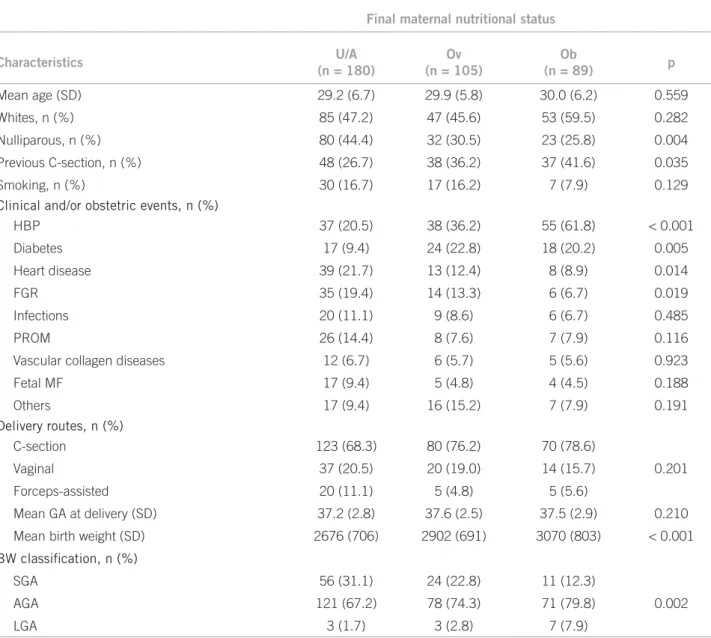
(n = 105, 28.1%); or obesity (n = 89, 23,8%). he popula-tion characteristics in the analyzed groups are shown in Table 1.
he results were analyzed with the sotware Medcalc (Medcalc sotware bvba, version 11.5.1.0). Categorical variables were descriptively analyzed, and absolute and relative frequencies were calculated. he results were ex-pressed as means and standard-deviations in order to analyze continuous variables. he chi-squared test was applied to compare ratios, with the Fisher’s exact test be-ing used when relevant. he ANOVA test was used to compare the means among groups for variables with a normal distribution, and the Kruskal-Wallis test was used for variables with non-normal distribution. he multiple
logistic regression model was used to identify independent variables associated with the outcome. A p-value of 0.05 (alpha = 5%) was adopted as the signiicance level. hus, descriptive levels (p) lower than that value were consid-ered signiicant (p < 0.05).
RESULTS
he analysis of factors associated with maternal nutri-tional status in late pregnancy (Table 1) demonstrated a signiicantly higher ratio of nulliparous women in the un-derweight and adequate weight group (p = 0.004) and a signiicantly higher frequency of a previous C-section in the obese group (p = 0.035). Regarding the occurrence of clinical events, a higher frequency of arterial hypertension
Table 1 – Maternal characteristics in high-risk pregnancies according to the nutritional status classification at the end of pregnancy
Final maternal nutritional status
Characteristics U/A
(n = 180)
Ov (n = 105)
Ob
(n = 89) p
Mean age (SD) 29.2 (6.7) 29.9 (5.8) 30.0 (6.2) 0.559
Whites, n (%) 85 (47.2) 47 (45.6) 53 (59.5) 0.282
Nulliparous, n (%) 80 (44.4) 32 (30.5) 23 (25.8) 0.004
Previous C-section, n (%) 48 (26.7) 38 (36.2) 37 (41.6) 0.035
Smoking, n (%) 30 (16.7) 17 (16.2) 7 (7.9) 0.129 Clinical and/or obstetric events, n (%)
HBP 37 (20.5) 38 (36.2) 55 (61.8) < 0.001
Diabetes 17 (9.4) 24 (22.8) 18 (20.2) 0.005
Heart disease 39 (21.7) 13 (12.4) 8 (8.9) 0.014
FGR 35 (19.4) 14 (13.3) 6 (6.7) 0.019
Infections 20 (11.1) 9 (8.6) 6 (6.7) 0.485
PROM 26 (14.4) 8 (7.6) 7 (7.9) 0.116
Vascular collagen diseases 12 (6.7) 6 (5.7) 5 (5.6) 0.923
Fetal MF 17 (9.4) 5 (4.8) 4 (4.5) 0.188
Others 17 (9.4) 16 (15.2) 7 (7.9) 0.191
Delivery routes, n (%)
C-section 123 (68.3) 80 (76.2) 70 (78.6)
Vaginal 37 (20.5) 20 (19.0) 14 (15.7) 0.201
Forceps-assisted 20 (11.1) 5 (4.8) 5 (5.6)
Mean GA at delivery (SD) 37.2 (2.8) 37.6 (2.5) 37.5 (2.9) 0.210
Mean birth weight (SD) 2676 (706) 2902 (691) 3070 (803) < 0.001
BW classification, n (%)
SGA 56 (31.1) 24 (22.8) 11 (12.3)
AGA 121 (67.2) 78 (74.3) 71 (79.8) 0.002
LGA 3 (1.7) 3 (2.8) 7 (7.9)
in the obese group, and of diabetes in overweight and obese groups was found (p < 0.001 and p = 0.005, respectively). As for heart disease and restricted fetal growth restriction, these events had a higher frequency in the underweight and adequate weight group (p = 0.014 and p = 0.019, re-spectively). his group also presented a signiicantly lower (p < 0.001) mean birth weight than the other groups. A higher number of SGA neonates and a lower number of AGA neonates (p = 0.002, Table 1) were observed.
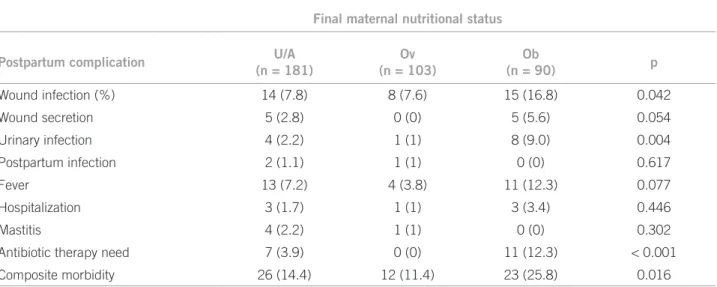
By investigating postpartum maternal complications (Table 2), obesity late in the pregnancy was observed to be signiicantly associated with the following results: surgical wound infection (p = 0.042), urinary infection (p = 0.004), antibiotic therapy need (p < 0.001), and com-posite morbidity (p = 0.016).
Aiming to ind the factors independently associated with the occurrence of composite maternal morbidity, a logistic regression model with backward elimination of factors was used. he confounding variables included in the model were: classiication of the inal maternal nutri-tional status, high blood pressure, diabetes, birth weight classiication, and type of delivery. Maternal obesity in late pregnancy was independently associated with postpar-tum composite morbidity, with an odds ratio (OR) of 2.09 (95% CI 1.15-3.80, p = 0.015, Table 3).
DISCUSSION
his study found that obesity in late high-risk pregnan-cies is an independent factor for postpartum complica-tions. his association has been indicated in population studies3-5,20, but no studies focused on high-risk pregnant
women are available, cases in which comorbidities and other factors can contribute to the occurrence of these outcomes.
In the present study, maternal obesity showed an asso-ciation with clinical events, such as hypertension, diabetes, and heart disease by the nutritional status classiication. Even though these diseases may interfere with the occur-rence of delivery complications, the results demonstrated that obesity is the relevant and independent factor. In this university hospital with a high C-section rate21, it is
essen-tial to minimize factors contributing to complications. he increased C-section rates in Brazil are an impor-tant aspect in the management of high-risk pregnancies. Any factor favoring a higher postoperative morbidity should be weighed when the delivery route is selected. Sebire et al.5, in a retrospective cohort population study,
reported a rate of 10.9% maternal obesity, assessed by the pregestational BMI, with an increased risk for events such as postpartum bleeding (OR: 1.39; 95% CI: 1.32-1.46), genital tract infection (OR: 1.30; 95% CI: 1.07-1.56), uri-nary infection (OR: 1.39; 95% CI: 1.18-1.63), and abdomi-nal wall infection (OR: 2.24; 95% CI: 1.91-2.64). No study in high-risk pregnant women addressing the inluence of maternal weight on delivery complications is available. In addition to several comorbidities that could be associated, obesity is revealed as an important factor in determining these complications. he present cases assessed for inal BMI in high-risk pregnancies have also shown an asso-ciation between obesity and postpartum infectious com-plications, demonstrating the need for improved precon-ceptional guidance in order that women conceive in better nutritional conditions, as well as the adoption of preven-tive measures so that the nutritional classiication does not change during the course of the pregnancy.
Another relevant aspect refers to women who move from eutrophy to overweight or obesity. Excess maternal weight gain should alert to delivery and postpartum complications,
Table 2 – Postpartum complications in high-risk pregnancies according to the nutritional status classification at the end of pregnancy
Final maternal nutritional status
Postpartum complication U/A
(n = 181)
Ov (n = 103)
Ob
(n = 90) p
Wound infection (%) 14 (7.8) 8 (7.6) 15 (16.8) 0.042
Wound secretion 5 (2.8) 0 (0) 5 (5.6) 0.054
Urinary infection 4 (2.2) 1 (1) 8 (9.0) 0.004
Postpartum infection 2 (1.1) 1 (1) 0 (0) 0.617
Fever 13 (7.2) 4 (3.8) 11 (12.3) 0.077
Hospitalization 3 (1.7) 1 (1) 3 (3.4) 0.446
Mastitis 4 (2.2) 1 (1) 0 (0) 0.302
Antibiotic therapy need 7 (3.9) 0 (0) 11 (12.3) < 0.001
Composite morbidity 26 (14.4) 12 (11.4) 23 (25.8) 0.016
especially when women reach the range characterizing obe-sity. Controlling the weight gain is important both for mater-nal and fetal health, and for the delivery outcome7,22.
Selig-man et al.23, in a national study with pregnant women from
the general population, found that pregestational obesity and excess weight gain independently increase the risk of a C-section and adverse outcomes at the delivery; however, they did not analyze maternal BMI at the end of the pregnancy.
Mantakas et al.20 observed that a higher BMI implicates
a higher risk for postpartum infection in pregnant women undergoing C-sections (OR: 2.41; 95% CI: 0.86-9.88). he present study did not show any association between ma-ternal obesity and delivery route, as C-sections were prev-alent in all analyzed groups. his likely occurred because the study speciically addresses high-risk pregnant wom-en, in whom clinical comorbidities increase C-section rates. However, in multivariate analysis, vaginal delivery remained in the logistic regression model and it is sug-gested to exert a protective efect on composite morbidity, although statistical signiicance was not reached.
Maternal obesity in itself predisposes women to ges-tational complications and increases the need for obstet-ric intervention. Weiss et al.24 observed a higher chance
of pregnancy-induced hypertension in obese women compared with overweight and underweight groups (OR: 2.2, 95% CI: 2.1-2.6; OR: 1.5, 95% CI: 1.4-1.7; OR: 0.7, 95% CI: 0.6-0.8) respectively.
he proportion of obesity in high-risk pregnant wom-en was 24% and composite morbidity, meaning the occur-rence of at least on morbid event investigated, was found in approximately 25% of them. Any postoperative mor-bidity impairs maternal well-being and may damage the relationship between the mother and her newborn child. At times, the need to use antibiotics can lead to concerns about breastfeeding until the complication afecting the mother is resolved.
Fetal complications most commonly associated with maternal obesity are fetal death, genetic diseases, and macrostomia12,22,25,26. he present study also found a
high-er mean birth weight and a highhigh-er LGA rate in pregnant women classiied as obese ater the inal BMI. However, despite the fact that the variable LGA neonate remained in the logistic regression inal model, it did not reach statisti-cal signiicance for the composite maternal morbidity.
his study is limited by the impossibility to obtain follow-up data of weight gain over the pregnancy to com-pare diferent maternal outcomes and delivery complica-tions. he study of subgroups with speciic comorbidities can identify other factors associated with postpartum complications in further studies. In addition, the informa-tion on postpartum complicainforma-tions was obtained by phone calls and cases were excluded due to loss of contact, which could have contributed to some bias.
CONCLUSION
In conclusion, this study demonstrated that, in high-risk pregnancies, inal maternal obesity is independently as-sociated with postpartum infectious complication oc-currence, such as surgical wound infection, urinary in-fection, antibiotic therapy need, as well as composite morbidity. his demonstrates that more efective maternal weight gain follow-up is needed to minimize postpartum complications.
ACKNOWLEDGEMENTS
he authors are grateful to the Fundação de Amparo à Pes-quisa do Estado de São Paulo [Research Support Founda-tion of the State of São Paulo] (FAPESP) for the funding support received (master’s scholarship).
REFERENCES
1. World Health Organization. Division of noncommunicable disease. Pro-gramme of nutrition family and reprodutive health. Obesity: preventing and managing the global epidemic: report of a WHO consultation on obesity. Ge-neva: WHO; 1998.
2. Brasil. Ministério da Saúde. Manual técnico pré-natal e puerpério. Atenção qualiicada e humanizada. Brasília (DF); 2005.
3. Bianco AT, Smilen SW, Davis Y, Lopez S, Lapinski R, Lockwood CJ. Pregnancy outcome and weight gain recommendations for the morbidly obese women. Obstet Gynecol. 1998;91(1):97-102.
4. Perlow JH, Morgan MA. Massive maternal obesity and perioperative cesarean morbidity. Am J Obstet Gynecol. 1994;170(2):560-5.
5. Sebire NJ, Jolly M, Harris JP, Wadsworth J, Jofe M, Beard RW, et al. Maternal obesity and pregnacy outcome: a study of 287,213 pregnacies in London. Int J Obes Relat Metab Disord. 2001;25(8):1175-82.
6. Nucci LB, Schmidt MI, Duncan BB, Fuchs SC, Fleck ET, Britto MS. Nutritional status of pregnant women: prevalence and associated pregnancy outcomes. Rev Saúde Pública. 2001;35(6):502-7.
7. Stulbach TE, Benício MHD, Andreazza R, Kono S. Determinantes do ganho ponderal escessivo durante a gestação em serviço público de pré-natal de baixo risco. Rev Bras Epidemiol. 2007;10(1):99-108.
8. Vítolo MR, Bueno MSF, Gama CM. Impacto de um programa de orientação dietética sobre a velocidade de ganho de peso de gestantes atendidas em uni-dades de saúde. Rev Bras Ginecol Obstet. 2011;33(1):13-9.
9. IOM (Institute of Medicine), NRC (National Research Council). Weight gain during pregnancy: reexamining the guidelines. Washington (DC): he Na-tional Academies Press; 2009.
Table 3 – Multiple logistic regression with backward elimination of independent factors associated with postpartum maternal morbidity
Variable Odds ratio 95% confidence interval p
Obesity 2.09 1.15 - 3.80 0.015
Vaginal delivery 0.43 0.17 - 1.04 0.061
LGA neonate 2.78 0.85 - 9.06 0.090
10. Jarvie E, Ramsey JE. Obstetric management of obesity in pregnancy. Semin Fetal Neonatal Med. 2010;15(2):83-8.
11. Gunatilake RP, Perlow JH. Obesity and pregnancy: clinical management of the obese gravida. Am J Obstet Gynecol. 2011;204(2):106-19.
12. Bhattacharya S, Campbell DM, Liston WA, Bhattacharya S. Efect of body mass index on pregnancy outcomes in nulliparous women delivering singleton ba-bies. BMC Public Health. 2007;7:168.
13. Chu SY, Kim SY, Schmid CH, Dietz PM, Callaghan WM, Lau J, et al. Ma-ternal obesity and risk of cesarean delivery: a meta-analysis. Obes Rev. 2007;8(5):385-94.
14. Dodd JM, Crowther CA, Robinson JS. Dietary and lifestyle interventions to limit weight gain during pregnancy for obese or overweight women: a system-atic review. Acta Obstet Gynecol Scand. 2008;87(7):702-6.
15. Huda SS, Brodie LE, Sattar N. Obesity in pregnancy: prevalence and metabolic consequences. Semin Fetal Neonatal Med. 2010;15(2):70-6.
16. Fazio Ede S, Nomura RM, Dias MC, Zugaib M. Consumo dietético de ges-tantes e ganho ponderal materno após aconselhamento nutricional. Rev Bras Ginecol Obstet. 2011;33(2):87-92.
17. Dias MC, Fazio Ede S, de Oliveira FC, Nomura RM, Faintuch J, Zugaib M. Body weight changes and outcome of pregnancy ater gastroplasty for morbid obesity. Clin Nutr. 2009;28(2):169-72.
18. Atalah SE, Castilho CL, Castro SR, Aldea PA. Propuesta de um nue-vo estándar de evalución nutricional em embarazadas. Rev Med Chile. 1997;125(12):1429-36.
19. Alexander GR, Himes JH, Kaufman RB, Mor J, Kogan M. A United States na-tional reference for fetal growth. Obstet Gynecol. 1996;87(1):163-8. 20. Mantakas A, Farrel T. he inluence of increasing BMI in nulliparous women
on pregnancy outcome. Eur J Obstet Gynecol Reprod Biol. 2010;153(1):43-6. 21. Nomura RM, Alves EA, Zugaib M. Complicações maternas associadas ao tipo
de parto em hospital universitário. Rev Saúde Pública. 2004;38(1):9-15. 22. Sirimi N, Goulis DG. Obesity in pregnancy. Hormones (Athens).
2010;9(4):299-306.
23. Seligman LC, Duncan BB, Branchtein L, Gaio DSM, Mengue SS, Schmidt MI. Obesity and gestational weight gain: cesarean delivery and labor complica-tions. Rev Saúde Pública. 2006;40(3):457-65.
24. Weiss JL, Malone FD, Emig D, Ball RH, Nyberg DA, Comstock CH, et al. Obe-sity, obstetric complications and cesarean delivery rate: a population-based screening study. Am J Obstet Gynecol. 2004;190(4):1091-7.
25. Gluckman PD, Hanson MA, Cooper C, hornburg KL. Efect of in ute-ro and early-life conditions on adult health and disease. N Engl J Med. 2008;359(1):61-73.