www.eerp.usp.br/rlae
Corresponding Author:
Maria da Saudade de Oliveira Custódio Lopes
Escola Superior de Saúde do Instituto Politécnico de Leiria Campus 2 – Morro do Lena – Alto do Vieiro
2411-901, Leiria, Portugal E-mail: [email protected]
Positive parenting by parents of children up to three years of age:
development and validation of measurement scales
Maria da Saudade de Oliveira Custódio Lopes
1Maria dos Anjos Coelho Rodrigues Dixe
2This study aimed to describe the development and validation of three multidimensional
scales in which the same 30 items, distributed among five dimensions, measure parents’
self-perceived confidence, difficulties and knowledge needs in the exercise of positive
parenting during the first three years of the child’s life. The content of the scales resulted
from the literature and exploratory studies and was validated by experts. The analysis of its
reliability and validity, using Pearson’s correlations and Cronbach’s alpha, was based on data
from a questionnaire administered to a non-probabilistic sample of 1011 parents. In the
dimensions and items, α-values ranged between 0.769 and 0.890 and r-coefficients were >0.37;p <0.01. It was concluded that the scales measure three variables that correspond to the practice of positive parenting and their use permits guiding nursing support.
Descriptors: Parents; Parenting; Child Rearing; Psychometrics; Measures.
1 Doctoral student, Universidade Católica Portuguesa, Portugal. Professor, Escola Superior de Saúde, Instituto Politécnico de Leiria, Portugal.
Exercício da parentalidade positiva pelos pais de crianças até três anos: construção e validação de escalas de medida
Os objetivos deste estudo foram descrever a construção e obtenção de algumas
evidências de validade de três escalas multidimensionais em que os mesmos 30 itens,
distribuídos por cinco dimensões, medem a autoperceção da coniança, das diiculdades
e da necessidade de conhecimentos dos pais no exercício da parentalidade positiva,
nos primeiros três anos da criança. O conteúdo das escalas resultou da literatura e
de estudos exploratórios e foi validado por peritos. A análise da sua idedignidade e validade, por meio de correlações de Pearson e coeiciente alfa de Cronbach, partiu dos
resultados de um questionário aplicado a uma amostra não probabilística de 1.011 pais.
Nas dimensões e itens, os valores de α situaram-se entre 0,769 e 0,890 e os de r foram >0,37; p<0,01. Concluiu-se que as escalas medem três variáveis que operacionalizam o exercício da parentalidade positiva, e a sua utilização permite direcionar o apoio de
enfermagem.
Descritores: Pais; Pátrio Poder; Educação Infantil; Psicometria; Medidas.
Ejercicio parental positivo por los padres de niños hasta tres años: construcción y validación de escalas de medición
Este estudio tuvo el objetivo de describir la construcción y validación de tres escalas
multidimensionales en que los mismos 30 ítems, distribuidos en 5 dimensiones, miden la
auto-percepción de la conianza, de las diicultades y de la necesidad de conocimientos de
los padres en el ejercicio parental positivo en los primeros tres años del niño. El contenido
de las escalas resultó de la literatura y de estudios de explotación y fue validado por
expertos. El análisis de su idelidad y validez partió de los resultados de un cuestionario
aplicado la una muestra no probabilística de 1011 padres. En las dimensiones e ítems, los
valores de Coeiciente Alfa de Cronbach se situaron entre 0,769 y 0,890 y los de fueron >0,37; p<0,01. Se concluyó que las escalas miden tres variables que hacen operacional el ejercicio parental positivo y su utilización permite direccionar el apoyo de enfermería. Descriptores: Padres; Patría Potestad; Crianza del Niño; Psicometría; Medidas.
Introduction
Positive parenting is part of the set of functions
attributed to parents in order to take care of and educate
their children and is fundamental for the child’s health
and development. It is deined as parental behavior that
guarantees the raising and education of the child, setting
limits, maintaining a positive relationship and optimizing
their developmental potential(1).
The promotion of positive parenting competencies
is recommended as a strategy to prevent child
maltreatment(2) and further the child’s development in
the irst three years of life(3). During these years, the
human brain comes with great learning potential and
parents have the opportunity to optimize their children’s
development.
Positive parenting involves a complex set of
responsibilities for the parents and presupposes daily
activities that prevent risk behaviors, encourage desires
behaviors and attend to the child’s needs(1-4). They it
into ive functional domains or dimensions(2): 1. The
child’s physical needs (covers activities aimed at seeing
to the child’s basic needs, such as eating, rest and
hygiene); 2. The child’s safety (covers activities aimed
at health protection and protection against danger and
care in case of illness); 3. Development, behavior and
stimulation of the child (covers attitudes to promote
adequate behaviors and development promotion and
stimulation activities); 4. Positive communication with
of interaction between parents and children and the
adoption of a relationship of affection and love) and
5. Positive discipline (covers the promotion of
self-control and the establishment of limits for the child with
consistency and love).
In feeding, activities related to breastfeeding are
evidenced, due to its importance for the child and the
effect of nursing support(5). Care in case of the child’s
illness is also included because it represents a source of
dificulties for the parents(6).
Health professionals play a fundamental role in
training parents to perform these activities(1) and serve
as a resource to cope with the parents’ dificulties(7).
This support should depart from the parents’ potentials,
interests, dificulties and differences(8-9) and permit
the valuation of their practical knowledge and their
participation in decision-making, which are premises for
the practical success of nursing interventions(9).
Parents’ potentials can be expressed as
self-conidence and knowledge to manage the parenting
process and their assessment permits and directs
anticipated nursing interventions(10). This presupposes
the use of measurement instruments to diagnose this
potential (conidence and knowledge) and the parents’ dificulties.
Based on the analysis of other studies(8,11), it was
veriied that the instruments used did not cover all activities and speciic dimensions of positive parenting.
Therefore, we decided to construct original instruments.
As recommended(12), for this type of instruments, items
were included that resulted from speciic activities in the
positive parenting domain, as well as items resulting
from inquiries among parents about their dificulties.
These instruments are described in this study, with two
aims: to construct three scales for parents to self-assess
their positive parenting practice in the irst three years of the child’s life (1) and to analyze the psychometric
qualities of these scales by obtaining evidence on their
reliability and validity (2).
Method
To achieve these goals, a two-phase methodological
study was designed, involving (1) the construction of
the scales and (2) their psychometric analysis.
Phase 1. Construction of the scale
Based on the structure that describes the transition
processes from a nursing intervention perspective(10)
and which indicates the parents’ conidence as the indicator of this process, the parents’ dificulties as
critical points for support and knowledge as a condition,
the assessment of positive parenting practice was
considered according to three variables: self-perceived
conidence, self-perceived dificulties and self-perceived
need for knowledge. These three variables were put in
practice by using the same items and dimensions the
three scales have in common. All scales consist of two
parts, one with the items that serve as stimuli to trigger
the responses and the other with the responses(13). In
this study, the stimuli are shared among the three scales,
while the response items differ. In their construction
process, the following recommended procedures(14) were
performed:
Selection of items for inclusion in the instruments
Based on a literature review(8) and orientations
by child health promotion organizations(1-4,15), for each
deinition mentioned earlier, the items were deined that translated speciic activities of positive parenting
practice, which the same entities consider fundamental
for the child’s health and development. In addition,
activity-related items that were more dificult for the
parents were selected and added (e.g.: breastfeeding
procedures and taking care of the child when ill). These
were identiied through exploratory studies(6-7), involving
fathers and mothers of children up to three years of age,
with information collected through a questionnaire with open-ended questions.
Content validity
To interpret and determine the pertinence of
the items, the Delphi technique was applied in three
phases, resulting in a 100% consensus among the
experts’ opinions about the structure and contents
of the items and their inclusion in each dimension of
the instrument. After identifying available resources
and deining communication means, criteria to deine
experts and the acceptance level of a consensual
opinion(16), we departed from an instrument that was
elaborated with the selected items for each dimension
and, in a continuous re-elaboration process, the experts’
commented agreement or disagreement was obtained.
More than ten years of experience in child health
care delivery and/or teaching and research and being
active in functions attributed through
Rev. Latino-Am. Enfermagem 2012 July-Aug.;20(4):787-95.
selection of an eight-member expert group, including
one faculty member from the nursing research area
and one from the pediatric nursing area, both holding a
Ph.D. degree; two faculty members in maternal health nursing, one faculty in community health nursing;
one faculty member in education for health and one
psychologist in positive psychology, both holding a Ph.D.
degree; and one pediatrician who was the director of a
pediatric hospital service.
Then, the contents and form of the items were
analyzed, involving the parents of children in the age
group required for this research. The thinking aloud
method was applied(14) to four parents, followed by a
pretest of 16 parents.
Scoring and interpretation of results
The valuation process of the items and
determination of the results was the same for the three
positive parenting scales. On each scale, there were
ive response categories for each item. Score 1 was attributed to answers that stated not conident at all, no dificulty or no need for further knowledge. On the
other hand, score 5 was attributed to answers indicating
great conidence, a lot of dificulty and great need for
further knowledge. Hence, all answers were scored on a
ive-point intervals, with the highest scores referring to parents’ greater conidence, more dificulties and more
need for knowledge in positive parenting practice.
Phase 2. Psychometric analysis of the scales on positive parenting practice
The psychometric analysis of the constructed
instrument was based on the results of its application to
a parent sample.
Population and sample
Departing from the population of parents of children
between three months and three years and a half of age
(age of children attending kindergartens) in the Leiria
District, located in Central Portugal, a non-probabilistic
convenience sample was constituted.
In total, 2750 questionnaires were distributed
across kindergartens and health centers in different
cities, indicating that mothers and fathers should
complete them. The sample comprised the 1011 parents
(664 mothers and 347 fathers) who completed and
returned the questionnaires. These participating parents
were mainly Portuguese (94.4%). The remaining
parents belonged to twelve other nationalities but were
able to read and write Portuguese. Their ages ranged
between 17 and 54 years (M=33.02; SD=4.91), 92.1% were married, 87.7% lived in their own home, 87.1% were employed, 64.7% held a primary or secondary
education degree and 55.5% of the participants gained
a family income ranging between 1000 and 2000 euros,
while 22.7% gained less than 1000 euros.
Information collection instrument
In line with the study design and objectives, a
questionnaire was constructed, containing questions
to characterize the sample and 40 questions that
corresponded to the selected items to measure the
three variables in positive parenting practice. The same
item should be answered in Likert style in three different
columns, one for the parents’ self-perceived conidence, another for the parents’ self-perceived dificulties and
the third for the parents’ self-perceived knowledge
needs to practice positive parenting [e.g.: in the item
“in the introduction of new foods”, the parents answered
between 1 (not conident at all) and 5 (very conident), in the other from 1 (no dificulty) to 5 (great dificulty)
and in the third also from 1 (no knowledge needs) to 5
(great knowledge needs)].
Formal and ethical procedures in data collection
In the assessment of the items and the study’s
acceptability and in the data collection procedures, the
premises of research involving human behaviors and
organizational entities were taken into account.
The study neither infringed on the participants’
rights nor their integrity and the institutions that served
as intermediaries sustained its ethical acceptability.
Formal authorization was requested from the directors
of the Health Center Groups in the Leiria District and
the directors or managers of kindergartens in the same
district to apply the data collection instrument.
The questionnaires were delivered to the
kindergartens in individual envelopes for completion at
home and returned in a closed envelope. They contained
an introductory text to explain the study objectives and
the voluntary, anonymous and conidential nature of the answers, although results would be used in scientiic
studies. Their free completion and return translated the
consent to participate in the study.
At the Health Centers, meetings were scheduled
child health, in order to distribute the questionnaires for
completion while awaiting the consultation. The parents
placed the questionnaire (whether completed or not) in
a closed box available for this purpose.
Data treatment and analysis
To study the scales’ psychometric properties,
Pearson’s item-total correlation coeficient was used
for the analysis of homogeneity, convergence and item
discrimination. Cronbach’s Alpha coeficients were used
for the dimensions as a whole and for the items, so as to
analyze internal consistency, calculating the elimination
of one item at a time(14).
Items with item-total correlation coeficients below 0.20 were eliminated and Alpha coeficients higher than 0.70 were considered appropriate as the items contained
a small number of items(14).
Results
Items included in the multidimensional scales
The procedures to obtain evidence of content
validity by the experts and the other psychometric
property analysis motivated the elimination of ten items,
so that the three multidimensional scales consisted of
the following 30 items and ive dimensions, deined
based on theory and validated by the experts:
Dimension 1: Physical Needs of the Child, including
items 1 to 9: 1- In breastfeeding procedures, 2- In
feeding procedures, 3- When dealing with the child’s
behavior during breastfeeding/feeding, 4- When assessing whether breastfeeding/feeding is suficient for the child, 5- In the introduction of new foods, 6- In the preparation of the irst soups, 7- When helping the child to establish his/her sleeping pattern, 8- When giving the irst baths, and 9- When taking care of the child during colic.
Dimension 2: Safety of the Child, including items
10 to 15: 10- When identifying healthy foods, 11- When
preparing a safe environment (without danger) for the
child, 12- When identifying harmful environments for
the child (exposure to tobacco, led, mercury, toxins),
13- When perceiving signs of illness in the child, 14- When taking care of the child when ill, 15- To understand the importance of child health surveillance (taking to consultations and vaccines).
Dimension 3: Development, Behavior and
Stimulation of the Child, comprising items 16 to 21: 16 – When getting to know the phases of the child’s development, 17- Knowing what actions stimulate the child, 18 – In the choice of learning materials according to the child’s age (toys, music, books), 19- In attitudes that promote adequate behaviors in the child, 20- When
using bathing times to stimulate the child, 21- When
using feeding times to stimulate the child.
Dimension 4: Positive Communication with the
Child, including items 22 to 26: 22 – When answering the child’s crying with affection, 23- When interpreting
the signs the child uses to communicate, 24- In the beneits of a warm and loving relationship for the child, 25- In the establishment of activities that make the child feel special and important, 26- In attitudes that enhance
positive communication with the child (simple, clear and
stimulating)
Dimension 5: Positive Discipline, corresponding
to items 27 to 30: 27 – When understanding the importance of discipline for the child, 28- When setting
rules appropriate to the child’s age and development, 29- When using positive discipline (of teaching or an alternative proposal) instead of punishments, threats
and restrictions and 30- When being a good model for
the child.
Psychometric analysis of the scales
Reliability
Table 1 displays statistical data for the items
included in the scales, evidencing the internal
consistency analysis based on Cronbach’s Alpha
coeficient (α) for the ive dimensions in the three scales (Parents’ self-perceived conidence in positive parenting practice – ECPPP; parents’ self-perceived dificulties in positive parenting practice – EDPPP; and parents’
self-perceived knowledge needs in positive parenting
practice – ENCPPP). All items in the ive dimensions and three scales obtained Cronbach’s Alpha coeficients (α)
superior to 0.71.
Homogeneity analysis is accomplished using
Pearson’s correlation coeficients between the items and
the dimension they belong to, excluding the item. These
surpass 0.46 for the ECPPP, 0.37 for the EDPPP and 0.50
Rev. Latino-Am. Enfermagem 2012 July-Aug.;20(4):787-95.
D Item
ECPPP EDPPP ENCPPP
M SD r without item
α without
item M SD
r without item
α without
item M SD
r without item
α without
item 1 3.55 0.65 0.827 2.53 0.65 0.796 2.58 0.75 0.855
1 3.55 1.06 0.548 0.807 2.57 1.12 0.483 0.776 2.52 1.13 0.577 0.840
2 3.66 0.94 0.554 0.807 2.36 1.00 0.565 0.766 2.43 1.07 0.606 0.837
3 3.56 0.96 0.633 0.798 2.53 1.00 0.619 0.758 2.56 1.03 0.656 0.833
4 3.33 1.01 0.552 0.807 2.71 1.01 0.525 0.771 2.76 1.06 0.614 0.837
5 3.71 0.87 0.547 0.808 2.47 0.97 0.474 0.777 2.64 1.05 0.606 0.838
6 3.76 0.97 0.541 0.808 2.26 1.06 0.470 0.778 2.44 1.12 0.613 0.837
7 3.46 1.01 0.462 0.817 2.71 1.11 0.374 0.791 2.63 1.14 0.512 0.847
8 3.70 1.13 0.465 0.818 2.27 1.14 0.459 0.780 2.28 1.15 0.525 0.846
9 3.26 1.02 0.496 0.813 2.92 1.06 0.419 0.785 2.99 1.11 0.505 0.847
2 3.82 0.64 0.799 2.31 0.65 0.769 2.60 0.82 0.824
10 3.96 0.89 0.513 0.777 2.17 0.98 0.514 0.735 2.47 1.10 0.600 0.794
11 3.77 0.88 0.600 0.757 2.38 0.94 0.577 0.719 2.52 1.08 0.654 0.783
12 4.09 0.97 0.510 0.779 1.99 1.00 0.493 0.740 2.28 1.18 0.565 0.802
13 3.27 0.92 0.568 0.764 2.78 0.95 0.460 0.748 3.13 1.11 0.568 0.800
14 3.50 0.90 0.597 0.757 2.77 0.95 0.541 0.728 3.06 1.08 0.609 0.792
15 4.33 0.84 0.537 0.771 1.78 0.95 0.493 0.740 2.14 1.14 0.553 0.804
3 3.74 0.66 0.860 2.37 0.67 0.845 2.68 0.87 0.896
16 3.76 0.87 0.598 0.847 2.34 0.90 0.573 0.829 2.70 1.08 0.657 0.888
17 3.55 0.87 0.649 0.837 2.55 0.88 0.631 0.818 2.90 1.08 0.729 0.876
18 3.89 0.84 0.659 0.836 2.25 0.88 0.621 0.820 2.59 1.06 0.706 0.880
19 3.59 0.82 0.695 0.830 2.51 0.85 0.648 0.815 2.79 1.01 0.746 0.874
20 3.90 0.89 0.639 0.839 2.19 0.92 0.655 0.813 2.47 1.10 0.738 0.875
21 3.78 0.89 0.672 0.833 2.36 0.93 0.620 0.820 2.58 1.05 0.747 0.874
4 4.00 0.67 0.856 2.19 0.71 0.841 2.48 0.90 0.886
22 4.02 0.89 0.623 0.839 2.22 0.97 0.557 0.834 2.49 1.10 0.680 0.872
23 3.75 0.82 0.612 0.841 2.47 0.88 0.620 0.815 2.69 1.01 0.700 0.867
24 4.32 0.81 0.662 0.828 1.84 0.90 0.642 0.809 2.16 1.11 0.709 0.865
25 4.02 0.83 0.728 0.811 2.10 0.91 0.729 0.785 2.47 1.10 0.778 0.849
26 3.85 0.80 0.733 0.810 2.27 0.86 0.685 0.798 2.59 1.06 0.760 0.854
5 3.75 0.71 0.840 2.52 0.77 0.837 2.78 0.95 0.890
27 3.92 0.84 0.673 0.798 2.42 0.97 0.694 0.783 2.69 1.13 0.772 0.853
28 3.70 0.85 0.738 0.769 2.58 0.94 0.712 0.775 2.83 1.08 0.780 0.850
29 3.53 0.90 0.662 0.804 2.65 0.91 0.651 0.802 2.94 1.06 0.765 0.856
30 3.86 0.83 0.624 0.819 2.39 0.92 0.621 0.815 2.63 1.08 0.717 0.874
Table 1 – Means, standard deviations and Cronbach’s Alpha coeficients (α) for the items and dimensions and Pearson’s
correlations (r) for the ECPPP, EDPPP and ENCPPP scale items
D – Dimension
ECPPP: Scale of Parents’ Self-Perceived Conidence in the Practice of Positive Parenting EDPPP: Scale of Parents’ Self-Perceived Dificulties in the Practice of Positive Parenting ENCPPP: Scale of Parents’ Self-Perceived Knowledge Needs in the Exercise of Positive Parenting
Validity
Table 2 describes Pearson’s correlation coeficients
between the dimensions of each positive parenting
practice scale. For all scales these coeficients exceed
0.45 and are signiicant (p≤0.01), indicating convergent
validity among the dimensions of each scale, as well
as the fact that these dimensions measure the same
D
ECPPP EDPPP ENCPPP
D1 D2 D3 D4 D5 D1 D2 D3 D4 D5 D1 D2 D3 D4 D5
r r r r r r r r r r r r r r r
D1 1 1 1
D2 0.67 1 0.63 1 0.76 1
D3 0.60 0.72 1 0.58 0.68 1 0.66 0.74 1
D4 0.48 0.65 0.75 1 0.45 0.59 0.69 1 0.59 0.68 0.79 1
D5 0.49 0.62 0.75 0.76 1 0.48 0.56 0.69 0.68 1 0.55 0.66 0.76 0.80 1
Table 2 – Pearson’s correlation matrix among ive dimensions of each scale in the exercise of positive parenting
p≤0.01 D – Dimension
ECPPP: Scale of Parents’ Self-Perceived Conidence in the Practice of Positive Parenting EDPPP: Scale of Parents’ Self-Perceived Dificulties in the Practice of Positive Parenting ENCPPP: Scale of Parents’ Self-Perceived Knowledge Needs in the Exercise of Positive Parenting
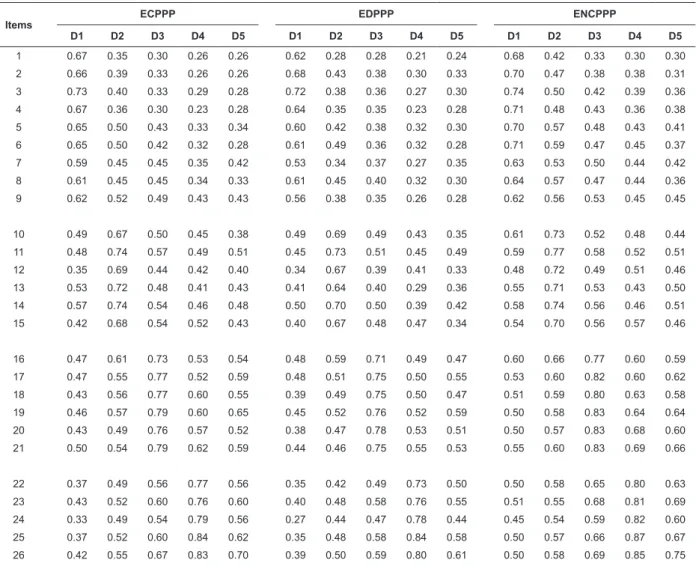
Table 3 describes the results that permit assessing
the items’ discriminant validity, in which these items’
correlation coeficients with the dimension they belong to are more than 0.1 higher than the correlation coeficient
Items
ECPPP EDPPP ENCPPP
D1 D2 D3 D4 D5 D1 D2 D3 D4 D5 D1 D2 D3 D4 D5
1 0.67 0.35 0.30 0.26 0.26 0.62 0.28 0.28 0.21 0.24 0.68 0.42 0.33 0.30 0.30
2 0.66 0.39 0.33 0.26 0.26 0.68 0.43 0.38 0.30 0.33 0.70 0.47 0.38 0.38 0.31
3 0.73 0.40 0.33 0.29 0.28 0.72 0.38 0.36 0.27 0.30 0.74 0.50 0.42 0.39 0.36
4 0.67 0.36 0.30 0.23 0.28 0.64 0.35 0.35 0.23 0.28 0.71 0.48 0.43 0.36 0.38
5 0.65 0.50 0.43 0.33 0.34 0.60 0.42 0.38 0.32 0.30 0.70 0.57 0.48 0.43 0.41
6 0.65 0.50 0.42 0.32 0.28 0.61 0.49 0.36 0.32 0.28 0.71 0.59 0.47 0.45 0.37
7 0.59 0.45 0.45 0.35 0.42 0.53 0.34 0.37 0.27 0.35 0.63 0.53 0.50 0.44 0.42
8 0.61 0.45 0.45 0.34 0.33 0.61 0.45 0.40 0.32 0.30 0.64 0.57 0.47 0.44 0.36
9 0.62 0.52 0.49 0.43 0.43 0.56 0.38 0.35 0.26 0.28 0.62 0.56 0.53 0.45 0.45
10 0.49 0.67 0.50 0.45 0.38 0.49 0.69 0.49 0.43 0.35 0.61 0.73 0.52 0.48 0.44
11 0.48 0.74 0.57 0.49 0.51 0.45 0.73 0.51 0.45 0.49 0.59 0.77 0.58 0.52 0.51
12 0.35 0.69 0.44 0.42 0.40 0.34 0.67 0.39 0.41 0.33 0.48 0.72 0.49 0.51 0.46
13 0.53 0.72 0.48 0.41 0.43 0.41 0.64 0.40 0.29 0.36 0.55 0.71 0.53 0.43 0.50
14 0.57 0.74 0.54 0.46 0.48 0.50 0.70 0.50 0.39 0.42 0.58 0.74 0.56 0.46 0.51
15 0.42 0.68 0.54 0.52 0.43 0.40 0.67 0.48 0.47 0.34 0.54 0.70 0.56 0.57 0.46
16 0.47 0.61 0.73 0.53 0.54 0.48 0.59 0.71 0.49 0.47 0.60 0.66 0.77 0.60 0.59
17 0.47 0.55 0.77 0.52 0.59 0.48 0.51 0.75 0.50 0.55 0.53 0.60 0.82 0.60 0.62
18 0.43 0.56 0.77 0.60 0.55 0.39 0.49 0.75 0.50 0.47 0.51 0.59 0.80 0.63 0.58
19 0.46 0.57 0.79 0.60 0.65 0.45 0.52 0.76 0.52 0.59 0.50 0.58 0.83 0.64 0.64
20 0.43 0.49 0.76 0.57 0.52 0.38 0.47 0.78 0.53 0.51 0.50 0.57 0.83 0.68 0.60
21 0.50 0.54 0.79 0.62 0.59 0.44 0.46 0.75 0.55 0.53 0.55 0.60 0.83 0.69 0.66
22 0.37 0.49 0.56 0.77 0.56 0.35 0.42 0.49 0.73 0.50 0.50 0.58 0.65 0.80 0.63
23 0.43 0.52 0.60 0.76 0.60 0.40 0.48 0.58 0.76 0.55 0.51 0.55 0.68 0.81 0.69
24 0.33 0.49 0.54 0.79 0.56 0.27 0.44 0.47 0.78 0.44 0.45 0.54 0.59 0.82 0.60
25 0.37 0.52 0.60 0.84 0.62 0.35 0.48 0.58 0.84 0.58 0.50 0.57 0.66 0.87 0.67
26 0.42 0.55 0.67 0.83 0.70 0.39 0.50 0.59 0.80 0.61 0.50 0.58 0.69 0.85 0.75
with the dimensions they do not belong to. Only items
8 and 9 of the ENCPPP scale reveal a difference of 0.07 and 0.06, respectively.
Table 3 – Pearson’s correlations between the item results and the different scale dimensions in the exercise of positive
parenting
Rev. Latino-Am. Enfermagem 2012 July-Aug.;20(4):787-95.
D – Dimension
ECPPP: Scale of Parents’ Self-Perceived Conidence in the Practice of Positive Parenting EDPPP: Scale of Parents’ Self-Perceived Dificulties in the Practice of Positive Parenting ENCPPP: Scale of Parents’ Self-Perceived Knowledge Needs in the Exercise of Positive Parenting
Items
ECPPP EDPPP ENCPPP
D1 D2 D3 D4 D5 D1 D2 D3 D4 D5 D1 D2 D3 D4 D5
27 0.41 0.54 0.62 0.69 0.82 0.40 0.48 0.59 0.61 0.84 0.49 0.58 0.68 0.74 0.88
28 0.44 0.53 0.66 0.63 0.86 0.46 0.50 0.62 0.58 0.85 0.50 0.58 0.67 0.68 0.88
29 0.39 0.47 0.59 0.56 0.82 0.34 0.40 0.52 0.49 0.81 0.44 0.54 0.65 0.64 0.87
30 0.39 0.50 0.59 0.63 0.79 0.37 0.46 0.53 0.55 0.79 0.47 0.57 0.62 0.71 0.84
Table 3 - (continuation)
Discussion
The importance attributed to positive parenting and
the acknowledged importance of professionals’ role to
support the parents justify the aim of this study, which
described the construction and evidence collection of
some psychometric properties for instruments to
self-assess positive parenting practice in the irst three years
of a child’s life. This instrument measures variables that
are considered signs of parents’ need for support and
permit early and adequate nursing interventions(9-10).
The literature review and exploratory studies
permitted the development of a set of items, whose
interpretation and pertinence was assessed by a
multidisciplinary team of experts and two samples of
parents, as recommended in the literature(13-14). After
the suggested corrections, 40 items resulted that were
joined in three scales with ive common dimensions and
different answers, in which the parents perceived their
conidence, dificulties or knowledge needs in positive
parenting practice.
These answers were collected, using a questionnaire,
in a sample of 1011 parents of children up to three and
a half years of age. Based on the analysis of the results,
some psychometric properties could be deined for the
three multidimensional scales.
After eliminating those items with item-total
correlation coeficients below 0.20 and Cronbach’s Alpha coeficients below 0.70, Alpha coeficients between 0.769 and 0.896 were obtained for all scale dimensions.
According to the literature(14), these coeficients are
appropriate, as they refer to sub-scales with few items
and indicate the items’ good internal consistency and
the reliability of the results.
Coeficients obtained when correlating the items
with the dimension they belong to, when excluding the
item, surpassed 0.46 for the ECPPP, 0.39 for the EDPPP
and 0.50 for the ENCPPP. Thus, 100% homogeneity
of the items can be appointed, as well as the items’
convergent validity with the dimension they belong to,
as coeficients are superior to 0.20(14).
In discriminant validity analysis, the correlation
between the item and the dimension it belongs to should
be 0.1 higher than the coeficients between the item and
the dimensions it does not belong to(14), as veriied in the
different dimensions of the three scales, except for two
items in the dimension physical needs of the child, which
is part of the ENCPPP. One item revealed a difference
by only 7 and another by only 6 points when compared with the coeficients in the safety dimension. Given the
importance of their conceptual contents(1-4) and the fact
that they indicate activities that cause dificulties for
the parents(6,8), we decided not to eliminate them. They
were inserted in the dimensions where they obtained
the highest score and, at the same time, where their
content it. Consequently, it is guaranteed that the 30 items in the inal scales measure the dimensions they
belong to.
The three scales with common items permit
measuring the three variables by completing only a
one-page questionnaire and do not oblige the parents to read
different items for each scale. The multidimensional
nature of the scales also permits the individual use of
each dimension as a subscale. The correlation coeficients among the dimensions of each scale superior to 0.48 (p≤
0.01), however, indicate that convergent validity exists
among the dimensions and that all of them contribute
to measure the same construct(13-14) – positive parenting
practice.
The testing of the instruments in a non-probabilistic
sample represents a limitation, as this affects the
generalizability of its results. Also, the lack of reference
measures did not permit the analysis of the construct’s
external validity. Nevertheless, the considerable sample
size and the fact that it included mothers and fathers indicate its potential, which should be conirmed through
Received: Jan. 10th 2012 Accepted: Aug. 3th 2012
Conclusion
The procedures followed to construct and validate
three multidimensional positive parenting practice scales
were described, according to the steps recommended
in the literature. The obtained scales reveal common
dimensions and items as well as good psychometric
properties, and are entitled: Scale of Parents’
Self-Perceived Conidence in Positive Parenting Practice (ECPPP), Scale of Parents’ Self-Perceived Dificulties in
Positive Parenting Practice (EDPPP) and Scale of Parents’
Self-Perceived Knowledge Needs in Positive Parenting
Practice (ENCPPP). The use of these scales will contribute
to improve clinical practice, based on the parents’ needs
and with a view to child health promotion. They permit
diagnosing the parents’ support needs and directing and
anticipating nursing interventions. They also serve as
measurement instruments to assess the effect of these
interventions and other studies in this sensitive area for
nursing care.
References
1. Council of Europe. Recommendation Rec(2006)19 of
the Committee of Ministers to member states on child
day-care, adotado by the Committee of Ministers on 13
December 2006. [acesso 2 jun 2009]. Disponível em: https://wcd.coe.int/ViewDoc.jsp?id=1073507&BackCol orLogged=FFAC75
2. Centers for Disease Control and Prevention (CDC).
Babies & Toddlers: Learn Some Positive Parenting Tips: CDC Features 2008. [acesso 21 set 2008]. Disponível
em: http://www.cdc.gov/Features/Parenting/
InfantsToddlers.html
3. American Academy of Pediatrics. Your Baby’s First
year. 2nd ed. New York: American Academy of Pediatrics; 2005. 698 p.
4. Brazelton TB, Sparrow JD. Touchpoints Birth to 3:
your child’s emotional and behavioral development. 2nd
ed. Cambridge: Da Capo Press; 2006. 500 p.
5. Graça LCC, Figueiredo MCB, Conceição MTCC.
Contributos da intervenção de enfermagem de cuidados
de saúde pri mários para a promoção do aleitamento
materno. Rev. Latino-Am. Enfermagem [periódico na Internet]. Mar-abr 2011 [acesso 2 nov 2011];19 (2):[09
telas]. Disponível em: http://www.scielo.br/pdf/rlae/
v19n2/pt_27.pdf
6. Lopes MSOC, Dixe MA, Catarino H. Parentalidade
nos primeiros três anos da criança: stress e coping
auto relatados pelos pais. Int J Develop Educ Psychol. 2010;1(1):335-9.
7. Lopes MSOC, Dixe MA, Catarino H. Estratégias de
coping no _xercício da parentalidade e a sua relação
com os factores sociodemográficos. Int J Develop Educ Psychol. 2010;1(1):661-9.
8. Lopes MSOC, Catarino H, Dixe MA. Parentalidade
Positiva e Enfermagem: revisão sistemática da literatura.
Referência. julho 2010; III Série(1):109-9.
9. Mello DF, Lima RAG. Êxito técnico, sucesso prático
e sabedoria prática: bases conceituais hermenêuticas
para o cuidado de enfermagem à criança. Rev. Latino-Am. Enfermagem. [periódico na Internet]. jul-ago 2009
[acesso 2 nov 2011]; 17(4):580-5. Disponível em: http://www.scielo.br/pdf/rlae/v17n4/pt_22.pdf.
10. Meleis AI, Sawyer LM, Im EO, Messias DKH,
Schumacher K. Experiencing Transitions: An Emerging
Middle-Range Theory Transitions. Adv Nurs Science. 2000;23:12-28.
11. Crncec R, Barnett B, Matthey S. Rev Scales Parenting. Nurs. 2010;18(3): doi: 10.1891/1061-3749.18.3.210.
12. Bandura A. Guide for Constructing Self-Efficacy
Scales. In Pajares F, Urdan T. Self-efficacy beliefs
of adolescents. Greenwich (CT): Information Age
Publishing; 2006. v. 5; [acesso 13 fev 2010]; p. 307-37. Disponível em: http://des.emory.edu/mfp/014-BanduraGuide2006.pdf
13. Ribeiro JLP. Metodologia de Investigação em Psicologia e Saúde. Porto: Legis Editora/Livpsic; 2007. 170 p.
14. Streiner DL, Norman GR. Health Measurement
Scales: A Practical Guide to their Development and Use.
4th Ed. Oxford: Oxford University Press; 2008. 428 p.
15. Nemours Foundation (US) Nine Steps to More
Effective Parenting. 2004. [acesso 21 set 2008].
Disponível em: http://kidshealth.org/parent/positive/
family/nine_steps.html.