Licenciado sob uma Licença Creative Commons DO): http://dx.doi.org. . / - . . .AO
[T]
Mobility, balance and muscle performance according
to self-efficacy for falls in the elderly
[)]
Mobilidade, equilíbrio e desempenho muscular
segundo a autoei cácia para quedas em idosas
[A]
Carolina Raíssa Bento Pereira da Silva, Ricardo Oliveira Guerra, Aline Medeiros Cavalcanti da Fonsêca, Andréa de Carvalho Gomes, Álvaro Campos Cavalcanti Maciel*
Universidade Federal do Rio Grande do Norte UFRN , Natal, RN, Brazil
[R]
Abstract
Introduction: Changes in mobility, postural balance and muscle strength in the aging process may cause a fall in the elderly by changing or not perceived self-efficacy in preventing falls, the goal is to compare mobility, body balance and muscle performance according to self-efficacy for falls in community-dwell-ing elderly women. Materials and methods: A comparative study of cross-section, with community-dwelling elderly. We evaluated sociodemographic data, cognition Mini-Mental State Examination , effi-cacy for falls )nternational Effieffi-cacy Scale for Falls, Brazil , mobility Timed Up and Go Test , body balance by Berg Balance Scale, Balance Master System: Modified Clinical Test of Sensory )nteraction on Balance mCTS)B , Tandem walk TW Sit to Stand STS and muscular performance by isokinetic dynamometry.
* CRBPS: MSc, e-mail: [email protected] ROG: PhD, e-mail: [email protected] AMCF: MSc, e-mail: [email protected]
Using the cutoff point at or above points, two groups, G with low perceived efficacy in preventing falls n = and G with high perceived efficacy in preventing falls n = were allocated. Student’s t test was performed for comparison between groups, with p value of . . Results: Comparing the elderly women regarding the efficacy of falls, significant differences were observed in the variables Timed Up and Go Test p = . , speed of oscillation test mCTS)B p = . and the isokinetic dynamometry knee extension movement, peak torque p = . and power p = . . Conclusion: Comparing community-dwelling elderly women with low and high efficacy for falls, significant differences were in variables re-lated to mobility, body balance and muscle function.
[P]
Keywords: Aging. Postural balance. Muscle strength.
[B] Resumo
Introdução: Alterações na mobilidade, equilíbrio postural e força muscular no processo de envelhecimento podem ocasionar queda em idosos, alterando ou não a autoeficácia percebida em evitar quedas. Objetivo: Comparar mobilidade, equilíbrio corporal e desempenho muscular segundo a autoeficácia para quedas em idosas comunitárias. Materiais e métodos: Estudo comparativo de corte transversal com 63 idosas comunitá-rias. Foram avaliados dados sociodemográficos; cognição (Mini Exame do Estado Mental); eficácia para que-das (Escala de Eficácia de Quedas Internacional, Brasil); mobilidade (Timed Up and Go Test); equilíbrio corpo-ral pela Escala de Equilíbrio de Berg, pelo Balance Master System: Modified Clinical Test of Sensory Interaction on Balance (mCTSIB), pelo Tandem walk (TW) e pelo Sit to Stand (STS); e desempenho muscular pela dina-mometria isocinética. Por meio do ponto de corte igual ou acima de 23 pontos, foram alocados dois grupos: G1, com baixa eficácia percebida em evitar queda (n = 36) e G2, com alta eficácia percebida em evitar queda (n = 27). Foi realizado o teste t de Student para comparação entre grupos, com p valor de 0,05. Resultados: Comparando as idosas em relação à eficácia para quedas, encontrou-se diferenças significativas nas variáveis
Timed Up and Go Test (p = 0,04), na velocidade de oscilação do teste mCTSIB (p = 0,01) e nas variáveis da dinamometria isocinética no movimento de extensão do joelho, pico de torque (p = 0,04) e potência (p = 0,03).
Conclusão: Comparando idosas de comunidades com baixa e alta eficácia para quedas, observaram-se diferen-ças nas variáveis relacionadas à mobilidade, equilíbrio corporal e função muscular. [K]
Palavras-chave: Envelhecimento. Equilíbrio Postural. Força muscular.
Introduction
Falls in the elderly represent today an important theme within the rehabilitation process, since it can have consequences such as physical injuries, func-tional losses and psychological implications, such as the fear of falling , . Some researchers have referred to the fear of falling as a feeling of uneasi-ness with loss in confidence or balance disorders, de-pression, anxiety and reduction of social contacts . Another frequently used term, self-efficacy is defined as the abilities perceived by the individual or self-confidence in dealing with a particular situation . According to Bandura , self-efficacy component is a self-regulatory mechanism by which people ex-ercise control over motivation, thinking styles and
emotional life. )t is an individual’s coping strategy for containing threats he considers fearful. )n this sense, perceived self-efficacy in preventing falls is the perception that the subject has to avoid falls, in the face of a non-dangerous everyday practices. )n contrast, low self-efficacy or loss of confidence in avoiding falls is defined as the fear of falling, or inef-ficiency in dealing with falls in the elderly that makes an individual fearful .
The said term seems to be related to physical function and performance in everyday activities, sug-gesting that the sense of present and urgent danger resonates effects in the body that make it suitable for defensive reaction to become active , .
co-morbidities and depressive symptoms. These as-pects are linked to reduced mobility, balance abnor-malities with or without falls and muscle weakness, generating a negative impact on the physical and mental condition of this population , , .
Lopes et al. found a significant moderate cor-relation between mobility, dynamic balance and risk of falls, emphasizing that the restriction of movement results in loss of physical conditioning, muscle atro-phy, balance deficit and dependence on Activities of Daily Living ADLs . From the above link between the variables related to the physical aspects, it is nec-essary to emphasize the importance of self-efficacy perceived preventing falls in the psychological con-text, as the belief in the ability to perform a function allows for the accomplishment of the same.
Considering that, the level of confidence that the individual has in their abilities is a strong motivator and regulator of their behavior. For example, when ) believe that ) can climb a ladder ) realize the task, this conception can interfere in aspects such as mobility, balance and muscle strength, as the balance between the physical and mental components preserves health in biopsychosocial context.
)n view of the above, despite reduced muscle strength, balance disorders and mobility being de-scribed as potential risk factors for falls in the elderly, the possible relationship of these variables with self-efficacy for falls in the elderly have not been clearly established until now. Thus, the aim of this study is to compare mobility, body balance and muscle per-formance according to self-efficacy for falls in elderly resident in community.
Materials and methods
This is a comparative cross-sectional study, with population of women aged from to years resid-ing in the community and who were attendresid-ing two groups of elderly in the city of Natal, with data col-lection period between March and September .
The sample included elderly women and was selected by voluntary demand among those who met the following inclusion criteria: being female, living in the community independently and age equal to or over years. All signed the )nformed Consent Form, considering the ethical aspects based on the Declaration of (elsinki and the National (ealth Council Resolution / . The project was approved
by the Research Ethics Committee Comitê de Ética em Pesquisa – CEP at Onofre Lopes Teaching (ospital (ospital Universitário Onofre Lopes – (UOL , under the protocol number / .
Exclusion criteria considered were: presented neurological alterations and/or musculoskeletal such as brain strokes sequelae, Parkinson’s disease, amputations in the upper and/or lower limbs, frac-tures of the lower limbs or spine that prevented the completion of the evaluation and cognitive status incompatible with schooling assessed by the Mini-Mental State Examination MMSE .
All participants were evaluated through a proto-col containing identification and socio-demographic data age, body weight, height, marital status, and years of schooling ; regular practice physical ac-tivity; history of falls in the last six months; along with the Mini Mental State Examination MMSE ; )nternational Falls Efficacy Scale – Among Elderly Brazilians FES-)-BRAZ)L ; Timed Up and Go Test TUGT ; Berg Balance Scale BBS ; Smart Balance Master™ tests and the isokinetic test with Biodex System ™ dynamometer .
MMSE is composed of items, with subtests that assess spatiotemporal orientation, immediate memory, recall, attention and language. )t adopted the cut-off points suggested by Brucki et al. .
The FES-)-BRAS)L assigns values to daily activi-ties living DAL according to the degree of concern in the elderly fall to carry them out. As for the score that can be verified by applying the ratio, it varies from one to four per item, reaching a total score of to points, the adopted cut-off point is equal to or more than points to characterize low efficacy perceived in avoiding fall. )t should be noted that as the value of the total score increases the degree of concern about falling also rises . )ndividuals who were less effective in avoiding perceived fall were allocated to the G n = , G group is composed of the elderly with high perceived efficacy in preventing fall n = .
task includes changing the centre of gravity forward in the initial position and on the support base feet , followed by trunk extension in the upright position with maintenances of the same .
The parameters measured in the Sit to Stand STS were weight transfer time, force exerted when climbing, speed oscillation during the rise phase and symmetry of the left and right body hemisphere. For implementation of the three tests, all subjects per-formed each condition for seconds three attempts of seconds , where the device recorded the oscil-lation of the center of gravity during each run.
Regarding isokinetic dynamometry, three series of five concentric isokinetic contractions a rate of °/s were performed to evaluate the muscular performance of the flexor group and member of the right knee extensor, with two minutes rest between sets. The said speed is adopted, because it is the most suitable and safe for isokinetic in the elderly and due to the fact that the smaller the angular velocity, the greater the torque , . Through the concen-tric contractions we obtained on record: agonist/ antagonist ratio, peak torque, peak torque to body weight and average power during the movement of the aforementioned joint.
The collected data were analyzed descriptively by means of the statistical package SPSS version . . Kolmogorov-Smirnov test was used to check for nor-mality, while Student’s t-test was used to compare the means of mobility, balance and muscle strength values between groups of low and high efficacy for falls. At all stages of the statistical analysis, the level of significance p < . and a confidence interval C) of % were considered.
Results
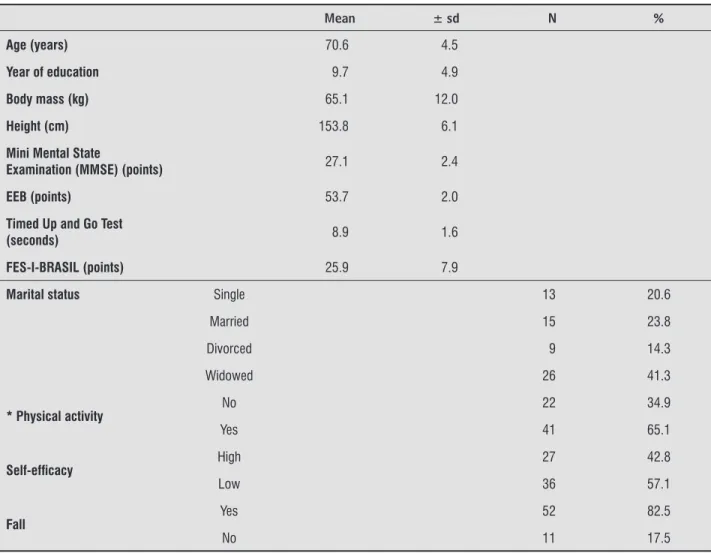
Sixty three women were evaluated, with a mean age of . ± . years and prevalence of low self-efficacy for falls of . %. Other sample char-acteristics are presented in Table .
According to the )nternational Falls Efficacy Scale Among Elderly Brazilians FES-)-BRAS)L , the sample was divided into two groups, where volunteers were assigned to the low efficacy for falls group and another volunteers in high efficiency for falls group. On the analysis between the groups, there was significant difference only in the variable of Timed Up and Go Test TUGT p = . , as shown in Table . speed, in a safe manner. (igher values of time
repre-sent higher risks of falls .
The Berg Balance Scale BBS evaluates the per-formance of functional balance, analyzing it quanti-tatively based on items common to everyday life, and the tasks are performed in this order: seated po-sition to a standing popo-sition; remain standing without support; remain seated without support; standing position to a sitting position; transfer from one chair to another; remain in a standing position with eyes closed; remain standing with feet together; on foot, reach forward with the elbows extended; on foot, picking up an object from the floor; turn to look back; rotate degrees; positioning the feet alternately on a stair; remain on foot with a foot ahead; and stay on one foot .
The maximum score that can be achieved is points where each item has an ordinal scale of five alternatives ranging from to points . For its application, just a digital stopwatch, a tape measure, a platform of inches tall, a chair of inches tall with arm rests and back and another chair of inches tall with support for back and without support for arms. Score equal or below points is considered suggestive of balance disorders, being a risk factor of falls .
)n relation to the Balance Master three tests were selected: . modified Clinical Test of Sensory )nteraction on Balance mCTS)B that analyzes the static postural balance quantifying the speed of oscil-lation in the individual standing on the platform in different conditions: eyes open on a firm surface; eyes closed on a firm surface; eyes open unstable surface foam ; closed eyes on an unstable surface foam .
To analyze the balance on unstable surface, we used a foam block integrated with the Balance Master system which is cm in length and breadth, cm in height and a density of . kg/m . For the closed-eye condition, a mask for blindfolding that came with the device was used. - Tandem Walk TW , which quantifies the dynamic postural balance by the characteristics of walking in tandem by the participant heel of one foot leaned on the toes of the other foot , where the parameters measured are: width of step, speed and oscillation of the trunk in reference to the center of gravity.
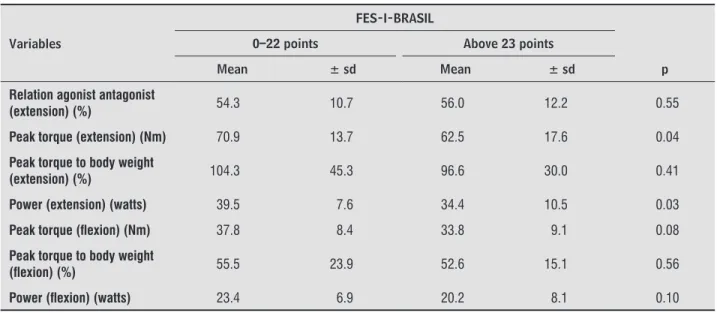
For the isokinetic dynamometry variables, there were no significant differences in knee extension movement with respect to the peak torque variable p = . and power p = . , as shown in Table . Table shows data on the Balance Master
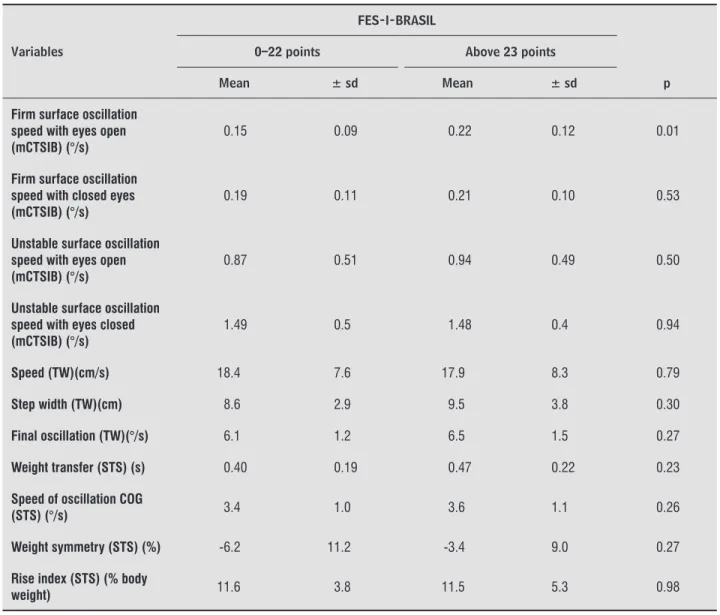
System™ tests. Difference was found only for the variable speed oscillation on firm surface with eyes opened p = . .
Table 1 - Characteristics of the sample of 63 Community-dwelling elderly women of Natal, RN, 2012
Mean ± sd N %
Age (years) 70.6 4.5
Year of education 9.7 4.9
Body mass (kg) 65.1 12.0
Height (cm) 153.8 6.1
Mini Mental State
Examination (MMSE) (points) 27.1 2.4
EEB (points) 53.7 2.0
Timed Up and Go Test
(seconds) 8.9 1.6
FES-I-BRASIL (points) 25.9 7.9
Marital status Single 13 20.6
Married 15 23.8
Divorced 9 14.3
Widowed 26 41.3
* Physical activity No 22 34.9
Yes 41 65.1
Self-effi cacy High 27 42.8
Low 36 57.1
Fall
Yes 52 82.5
No 11 17.5
Note: *Physical activity self-reported.
Table 2 - Mean and standard deviation (± sd) of the independent variables according to self-efficacy of falls in the
Community-dwelling elderly women of Natal, RN, 2012
Variables
FES-I-BRASIL
0–22 points Above 23 points
Mean ± sd Mean ± sd p
Age (years) 70.2 4.5 70.9 4.5 0.54
Year of education 9.8 5.7 9.7 4.3 0.95
Body mass (kg) 62.8 10.1 66.9 13.1 0.18
Table 2 - Mean and standard deviation (± sd) of the independent variables according to self-efficacy of falls in the Community-dwelling elderly women of Natal, RN, 2012
Variables
FES-I-BRASIL
0–22 points Above 23 points
Mean ± sd Mean ± sd p
Height (cm) 154.3 7.1 153.4 5.3 0.58
Mini Mental State
Examination (MMSE) (points) 27.7 1.6 26.7 2.8 0.10
EEB (points) 54.0 1.7 53.5 2.1 0.34
Timed Up and Go Test
(seconds) 8.5 1.2 9.3 1.7 0.04
(Conclusion)
Table 3 - Mean and standard deviation (± sd) of the variables in the balance master system on self-efficacy function in
falls in the Community-dwelling elderly women of Natal, RN, 2012
Variables
FES-I-BRASIL
0–22 points Above 23 points
Mean ± sd Mean ± sd p
Firm surface oscillation speed with eyes open (mCTSIB) (°/s)
0.15 0.09 0.22 0.12 0.01
Firm surface oscillation speed with closed eyes (mCTSIB) (°/s)
0.19 0.11 0.21 0.10 0.53
Unstable surface oscillation speed with eyes open (mCTSIB) (°/s)
0.87 0.51 0.94 0.49 0.50
Unstable surface oscillation speed with eyes closed (mCTSIB) (°/s)
1.49 0.5 1.48 0.4 0.94
Speed (TW)(cm/s) 18.4 7.6 17.9 8.3 0.79
Step width (TW)(cm) 8.6 2.9 9.5 3.8 0.30
Final oscillation (TW)(°/s) 6.1 1.2 6.5 1.5 0.27
Weight transfer (STS) (s) 0.40 0.19 0.47 0.22 0.23
Speed of oscillation COG
(STS) (°/s) 3.4 1.0 3.6 1.1 0.26
Weight symmetry (STS) (%) -6.2 11.2 -3.4 9.0 0.27
Rise index (STS) (% body
Table 4 - Mean and standard deviation (± sd) of the variables of the isokinetic dynamometry according to the self-effica-cy of falls Community-dwelling elderly women of Natal, RN, 2012
Variables
FES-I-BRASIL
0–22 points Above 23 points
Mean ± sd Mean ± sd p
Relation agonist antagonist
(extension) (%) 54.3 10.7 56.0 12.2 0.55
Peak torque (extension) (Nm) 70.9 13.7 62.5 17.6 0.04
Peak torque to body weight
(extension) (%) 104.3 45.3 96.6 30.0 0.41
Power (extension) (watts) 39.5 7.6 34.4 10.5 0.03
Peak torque (fl exion) (Nm) 37.8 8.4 33.8 9.1 0.08
Peak torque to body weight
(fl exion) (%) 55.5 23.9 52.6 15.1 0.56
Power (fl exion) (watts) 23.4 6.9 20.2 8.1 0.10
Discussion
)n gerontological assessment, the focus is to make a comprehensive analysis of the individual. Features such as capturing of sociodemographic data and ap-plication of mini mental state examination help in investigation facilitating identification of a probable disorder in cognition. Being a criterion for inclusion in the study, the average MEEM observed is com-patible with the preserved cognition, and being an indispensable evaluation tool as Scheffer et al. observed cognitive complaints and low financial re-sources in the elderly who had fear of falling.
From the point of view of rehabilitation, it is crucial to understand various relations between falls and the measures of muscle strength, postural control and mobility. )n this sense, BBS that is widely used in re-search with the elderly has shown that postural bal-ance remained within the normal patterns of age . The average FES-) scale found in the study . points puts the elderly at a level of sporadic pos-sibility of falling, as established by Camargos . Self-efficacy for fall assessed by FES-) was also used in Sweden and was presented as a highly reliable questionnaire to assess fear of falling among the el-derly in the Community . )n a literature review, epidemiological studies showed – % among the elderly who have experienced fear of falling inde-pendent of having been dropped; indicating that this
may contribute to both the functional decline and to reduced quality of life .
)n relation to the average score of TUGT . s , it was observed that in general the elderly women are classified in the group of subjects without problems of balance, since the cut-off point of this parameter is seconds . (owever, a significant difference was found between the older of the two groups p = . with the worst results in the group above points in the FES-). This result corroborates the findings of Aveiro et al. that generalize TUGT as a test that assesses strength and power of lower limbs with re-gard to mobility and therefore is the best predictor for defining an individual as a faller or non faller. )n con-trast, although the difference between the groups, are found to be within normal parameters since none of the elderly subjects approached the seconds in the testing time. )t is believed that the results found here seems to point to the fact that a more compromised future for those who attained more time in the test.
)n contrast, although the difference between the groups, parameters observed are within the normal range since none of the elderly subjects approached the seconds in the testing time. The results pre-sented here seem to point to a compromised future for those that attained higher time in the testing.
Conclusion
The results indicated the presence of low effi-cacy for falls in community-dwelling elderly, show-ing the effectiveness )nternational Falls Efficacy Scale – Among Elderly Brazilians FES-)-BRAS)L as
appropriate strategy for the assessment of how the individual feels able to perform a task without the occurrence of falls. )n this regard, it is suggested that comparing low and high efficacy groups for fall, there is statistically significant differences as regards mo-bility, static balance and muscle strength. (owever, new research is needed for deeper understanding of the results presented in this work.
References
. Rezende AAB, Silva )L, Cardoso FB, Beresford (. Medo do idoso em sofrer quedas recorrentes: a marcha como fator determinante da independência funcio-nal. Acta Fisiatr. ; : - .
. Beck AP, Antes DL, Meurer ST, Benedetti TRB, Lopes MA. Fatores associados às quedas entre idosos prati-cantes de atividades físicas. Texto Contexto Enferm.
; : - .
. Costa EM, Pepersack T, Godin ), Bantelle M, Petit B, Lêveque A. Fear of falling and associated activity re-striction in older people: results of a cross-sectional study conducted in a Belgian town. Arch Public (ealth.
; : - .
. Camargos FFO. Adaptação transcultural e avaliação das propriedades psicométricas da falls efficacy scale – international: um instrumento para avaliar medo de cair em idosos [dissertação]. Belo (orizonte: Universidade Federal de Minas Gerais; . . Bandura A. The evolution of social cognitive theory.
)n: Smith KG, (itt MA, editor. Great minds in man-agement. Oxford; New York: Oxford University Press;
. p. - .
. Perracini MR, Teixeira LF, Ramos JLA, Pires RS, Na-jas MS. Fall-related factors among less and more active older outpatients. Rev Bras Fisioter. ;
: - .
Ben Achour Lebib et al. in a systematic review suggest the standardization of this test, because age, gender, and co-morbidities affect the time of comple-tion of the same. Kwan et al. stated that TUGT has more accurate results in more compromised patients when compared to healthy subjects and non-fallers.
With regard to the assessment of postural bal-ance, the Balance Master SystemTM provides data on
postural balance and vestibular system, playing an important role in the early assessment of gait prob-lems and risk of falls in the elderly, in addition to allowing rehabilitation of the impaired balance. )n this sense, Binda et al. compared elderly with high efficacy with the low efficacy for falls, identi-fied in the elderly community-dwelling with fear of falling, some limitations in the ability to balance while the muscle strength did not differ between the groups. A significant difference in mCTS)B test to Balance Master SystemTM is with respect to oscilla-tion speed on the firm surface with eyes open, and as similarly discussed in this study by Mirka and Black affirming that the elderly need to increase oscil-lation, in order to compensate for their lack of ability to maintain postural balance seeking greater sen-sory interaction.
Regarding muscle performance, in particular the peak torque and capacity of the knee extensors, where significant differences were found, it is known that the power of the muscles of the lower limbs is an important factor, together with force, influences physical performance of the elderly . Keskin et al. showed that the muscular performance of knee extensors and flexors is not a significant factor for fall or risk of falling in elderly women, especially for those with preserved functionality. Foldavari et al. showed that the peak knee extension power is an independent predictor of functional capacity reported by community-dwelling women, suggest-ing that the decline in muscle function is by age and gender. (owever, Deschenes et al. reported that, in general, loss of muscle strength leads to greater difficulties in balance and increased risk of falls.
. (alvarsson A, Franzén E, Ståhle A. Assessing the relative and absolute reliability of the Falls Efficacy Scale-)nternational questionnaire in elderly individu-als with increased fall risk and the questionnaire’s convergent validity in elderly women with osteopo-rosis. Osteoporos )nt. ; :
-. Gagnon N, Flint AJ-. Fear of falling in the elderly-. Geriatr Aging. ; : - .
. Gunter KB, White KN, (ayes WC, Snow CM. Func-tional mobility discriminates nonfallers from one-time and frequent fallers. J Gerontol A Biol Sci Med.
; :M - .
. Kwan MM, Lin S), Chen C(, Close JC, Lord SR. Senso-rimotor function, balance abilities and pain influence Timed Up and Go performance in older community-living people. Aging Clin Exp Res. ; : - . . Aveiro M, Driusso P, Barham EJ, Pavarini SC), Oishi J.
Mobilidade e risco de quedas de população idosa da comunidade de São Carlos.Ciênc Saúde Coletiva.
; : - .
. Kumar S, Vendhan GV, Awasthi S, Tiwari M, Sharma VP. Relationship between fear of falling, balance impair-ment and functional mobility in community dwelling elderly. )JPMR. ; : - .
. Ben Achour Lebib S, Missaoui B, Miri ), Ben Salah FZ, Dziri C. Role of the Neurocom Balance Master in as-sessment of gait problems and risk of falling in elderly people. Ann Readapt Med Phys. ; : - . . Binda SM, Culham EG, Brouwer B. Balance, muscle
strength, and fear of falling in older adults. Exp Aging Res. ; : - .
. Mirka A, Black FO. Clinical application of dynamic pos-turography for evaluating sensory integration and vestibular disfunction. Neurol Clin. ; : - . . Bean JF, Kiely DK, (erman S, Leveille SG, Mizer K,
Frontera WR, et al. The relationship between leg power and physical performance in mobility-limited older people. J Am Geriatr Soc. ; : - . . Keskin D, Borman P, Ersöz M, Kurtaran A, Bodur (,
Aky“z M. The risk factors related to falling in elderly females. Geriatr Nurs. ; : - .
. Scheffer AC, Shuurmans MJ, Van Dijk N, Van Der (oof T, De Rooij SE. Fear of falling: measurement strategy, prevalence, risk factors and consequences among older persons. Age Ageing. ; : - . . Dias RC, Freire MTF, Santos EGS, Vieira RA, Dias JMD,
Perracini MR. Características associadas à restrição de atividades por medo de cair em idosos comunitários. Rev Bras Fisioter. ; : - .
. Lopes KT, Costa DF, Santos LF, Castro DP, Bastone AC. Prevalência do medo de cair em uma população de idosos da comunidade e sua correlação com mobili-dade, equilíbrio dinâmico, risco e histórico de quedas. Rev Bras Fisioter. ; : - .
. Folstein MF, Folstein SE, Mchugh PR. Mini-mental state : a practical method for grading the cognitive state of patients for the clinician. ; : - . . Podsiadlo D, Richardson S. The Timed Up & Go :
a test of basic functional mobility for frail elderly per-sons. J Am Geriatr Soc. ; : - .
. Miyamoto ST, Lombardi Junior ), Berg KO, Ramos LR, Natour J. Brazilian version of the Berg balance scale. Braz J Med Biol Res. ; : - .
. NeuroCom )nternational, )nc. Balance master opera-tors manual. Version . . Clackamas; .
. Biodex Medical Systems, )nc. System Pro. Appicar-tion/operation manual. [cited , Jan th] Avail-able from: http://www.biodex.com/sites/default/ files/ man_ .pdf
. BruckiSMD, NitriniR, CaramelliP, BertolucciP(F, Okamoto )(. Sugestões para o uso do mini-exame do estado mental no Brasil. Arq. Neuro-Psiquiatr.
; B : - .
. Pereira LSM, Dias RC, Dias JMD, Gomes GC, Sitta M). Fisioterapia. )n: Freitas EV, Py L, Neri AL, Cançado FAX, Gorzoni ML, Rocha SM. Tratado de Geriatria e Gerontologia. Rio de Janeiro: Guanabara Koogan;
. p. - .
. Aquino MA, Leme LEG, Amatuzzi MM, Greve JMD, Terreri ASAP, Andrusaitis FR, et al. )sokinetic assess-ment of knee flexor/extensor muscular strength in elderly women. Rev (osp Clin Fac Med. ;
. Foldavari M, Clark M, Laviolette LC, Bernstein MA, Kaliton D, Castaneda C, et al. Association of muscle power with functional status in community-dwell-ing elderly women. J Gerontol A Biol Sci Med Sci.
; :M - .
. Deschenes MR, Mccoy RW, (oldren NA, Eason MK. Gen-der influences neuromuscular adaptations to muscle unloading. Eur J Appl Physiol. ; : - .
Received: / / Recebido: / /