349
E
DITORIALRev Bras Oftalmol. 2016; 75 (5): 348- 51
D
ecision-making in health is a daily challenge in the life of the ophthalmologist.Patients, operators and public and private managers are increasingly requiringdemanding conducts based on the best scientific evidence available, seeking the assurance of safe and effective procedures.Such responses arise continuously in the literature, and keeping up to date in all areas of ophthalmic knowledge is an arduous task, which requires a time not always available to doctors, whose agendasare increasingly filled with too many activities.In addition, carrying out new studies seeking the solution to an issue can be a slow, expensive process requiring structural and professional resources not always accessible.Systematic reviews have emerged with the intention to provide the medical and scientific community objective responses to questions clearly formulated without the need for new clinical studies.The neutral qualitative analysis of published studies and the methodology predefined dramatically decrease the occurrence of biases, and change the systematic review into gold standard in getting quick and available evidence for making decisions and developing health policies. The first step towards a systematic review is a clear formulation of a question related to a matter relevant to the clinical practice.One of the recommended ways is known by the acronym PICO1, consisting of P for patient or population, I for intervention
or indicator, C for comparison or control, and O for outcome, which means the clinical outcome, result, or finally, the answer expected to be in the sources of scientific information2. For example:”Does the consumption of vitamin C reduce the risk of cataracts? “.
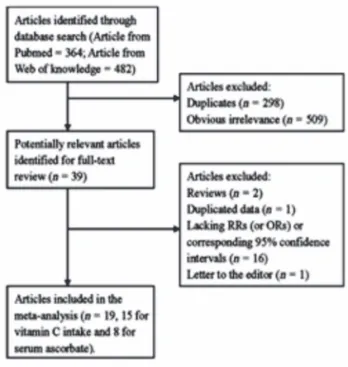
In the case above, P corresponds to the population exposed to the risk of having cataracts, I is the high dietary consumption or supplementation of vitamin C, C is the failure to use said supplement (use of placebo) or dietary consumption at low levels of vitamin, and O is the risk of developing cataracts.This clear answer to a question allows the construction of a comprehensive, but objective search strategy, which will be the framework for research in databases like Cochrane Central Register of Controlled Trials (CENTRAL), Medline, Embase, Lilacs, and unpublished data (gray search, which ranges from magazine articles to non-scientific papers presented at congresses).Thus, it is possible to recover the greatest amount of studies on the issue raised in the present world literature, which will be subjected to critical analysis as to eligibility for inclusion and quality of information (Figure 1).
Systematic Review and the necessity of
evidence-based practice in ophthalmology
Figure 1: Example of methodology for the recovery of articles to be included in a systematic review and meta-analysis3. It can be observed that the clear definition of the criteria for inclusion and exclusion of articles was able to transform an initial high number of results in a smaller amount of studies to be taken into account in the review and statistical analysis.
Source: Wei L, Liang G, Cai C, Lv J. Association of vitamin C with the risk of age-related cataract:a meta-analysis. ActaOphthalmol. 2016; 94(3), e1703.
Revisão sistemática e a necessidade de condutas
oftalmológicas baseadas em evidências
350
Rev Bras Oftalmol. 2016; 75 (5): 348-51
Quality of Evidence Definition
High New research hardly change the confidence in the estimated effect.· Multiple high-quality studies, with consistent results
· In special cases:a big, high-quality, multi-center test.
Moderate New research may have an important impact on the confidence in the estimated effect,
and may change the recommendation.· A high-quality study
· Multiple studies with some limitations
Low New research most likely will have an important impact on the confidence of the estimated effect, and is likely to change the recommendation.
· One or more studies with serious limitations
Very low Any recommendation is uncertain.
· Expert opinion
· Absence of scientific evidence
· One or more studies with very serious limitations
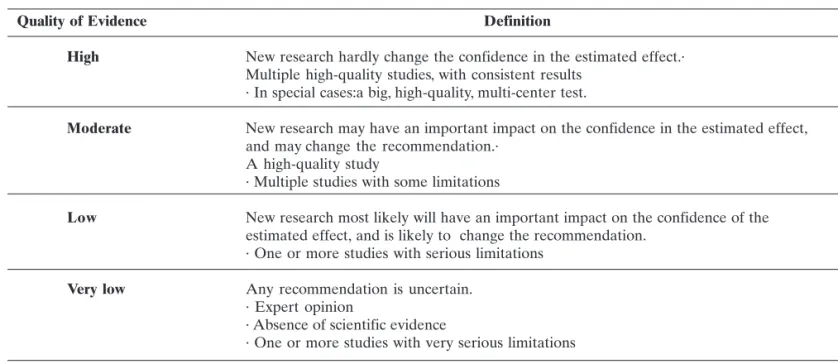
Gradually, the other quality levels present conclusions with increasing probability of change after further studies and,
at “Very Low” level, any recommendation is only hypothetical.
In many cases, though well conducted and drawn, the number of patients allocated in only one study combined with the
magnitude of the effect and/or response variation is unable to provide a statistically significant response to the question raised.To
solve such problem, systematic reviews may count with the meta-analysis:grouping and statistical analysis of results of different
studies, however, with similar methodologies and features.The meta-analysis below shows that the result of studies analyzed
individually is not always able to demonstrate the use of vitamin C as a protective factor for the development of cataracts, with
some studies actually pointing it even as a risk factor.The grouping of data from different studies allows a synthesis (Figure 2)
stating that there is evidence of the protective effect of vitamin C in relation to the development of cataract.
Figure 2: Illustrative image (forest plot) of the result of a study of meta-analysis3 showing in aggregate or global analysis (diamond) vitamin C as a protective factor on the development of senile cataract (OR: 0.70 - 95% CI 0.56 a 0.88), despite studies as Vitale(5) and Taylor(6) if considered individually, show odds ratio >1, i.e., vitamin C as a risk factor(5,6).
Source: Wei L, Liang G, Cai C, Lv J. Association of vitamin C with the risk of age-related cataract:a meta-analysis.ActaOphthalmol.2016; 94(3), e1703. Carricondo PC, Barbosa LJ, Bernardo WM
Objectively, after the analysis of literature, the systematic reviews have answers with varying degrees of quality
evidence, shown in Table 1, according to GRADE
4methodology. Recommendations with “High” quality most likely can
and should be applied in clinical practice because, being based on studies of good strength of evidence, the chance of their
results are refuted by new studies
is very low.Table 1
351
Rev Bras Oftalmol. 2016; 75 (5): 348-51
This is an example of what can be achieved with a systematic review and meta-analysis of the studies published to
date.It is an area that deserves attention and encouragement, so that the synthesis of the best medical knowledge available
is synthetized, making it more accessible to more colleagues.
In times in which it is required from physicians, paradoxically, diagnostic and treatment accuracy combined with
cost-effectiveness, it is imperative to carry out systematic reviews and meta-analyzes giving guidance to ophthalmological
treatment in a clear, objective, and updated way, based on the best scientific evidence available in the literature.
R
EFERENCESPedro Carlos Carricondo¹,
Leonardo José Barbosa¹,
Wanderley Marques Bernardo²
¹ Department of Ophthalmology, Hospital das Clínicas, School of Medicine, Universidade de São Paulo, São Paulo, SP, Brazil. ² School of Medicine, Universidade de São Paulo, São Paulo, SP, Brazil.
1. Scott RW, Murphy AL. Ask, and ye shall retrieve. Evidence-Based Med. 1998; 3(4): 100-1.
2. Nobre MR, Bernardo WM, Jatene FB. [Evidence based clinical practice. Part 1-well structured clinical questions]. Rev Assoc Med Bras (1992). 2003;49(4):445-9. Portuguese.
3. Wei L, Liang G, Cai C, Lv J. Association of vitamin C with the risk of age-related cataract: a meta-analysis. Acta Ophthalmol. 2016; 94(3), e170.
4. Guyatt GH, Oxman AD, Vist GE, Kunz R, Falck-Ytter Y, Alonso-Coello P, Schünemann HJ; GRADE Working Group. GRADE: an emerging consensus on ratingquality of evidence and strength of recommendations. BMJ. 2008;336(7650):924-6.
5. Vitale S, West S, Hallfrisch J, Alston C, Wang F, Moorman C, ET AL.. Plasma antioxidants and risk of cortical and nuclear cataract.Epidemiology. 1993;4(3):195-203.
6. Taylor A, Jacques PF, Chylack LT Jr, Hankinson SE, Khu PM, Rogers G, et al. Long-term intake of vitamins andcarotenoids and odds of early age-related cortical and posterior subcapsular lensopacities. Am J Clin Nutr. 2002;75(3):540-9.