Provision of Speech, Language and Hearing services in
the public municipal healthcare network in the state
capitals of Northeast Brazil
Oferta da Fonoaudiologia na rede pública municipal de saúde nas
capitais do Nordeste do Brasil
Jéssica Andrade Pinheiro dos Santos1, Vladimir Andrei Rodrigues Arce2, Liz Duque Magno3, Silvia Ferrite2,4
ABSTRACT
Introduction: In Brazil, the State is responsible for universal and equal access to healthcare, although a scarcity in services is common.
Purpose: To describe and compare the supply of Speech, Language and Hearing (SLH) professionals under direct government management in the municipal public healthcare networks in the state capitals of the Brazilian Northeast. Methods: Data for 2007 and 2014 was collected
from the National Register of Health Facilities and the Brazilian Institute of Geography and Statistics. The variables were the number of SLH professionals under direct government management in the municipal public healthcare network, the operational level of healthcare, and the number of health units under municipal management. Our analysis estimated: the supply of professionals, by resident population and level of healthcare unit, the evolution between 2007 and 2014 and the current professional deficit. Results: Between 2007 and 2014, the supply of
professionals in Northeastern state capitals rose; however, the 2014 average was only 1.5 professionals per 100,000 inhabitants. The greatest supply was found in João Pessoa and Aracaju, while the least was in Natal and Salvador. In terms of the ratio of professionals/health units per level of healthcare, the greatest supply of professionals was found in hospital care and the least in primary care. The estimated professional deficit was substantial and presented intra-regional differences.
Conclusion: The supply of professionals under direct government
management in the state capitals of the country’s Northeast region is insufficient and unequal, restricting access to SLH services.
Keywords: Speech, language and hearing sciences; Health services
accessibility; Unified Health System; Health inequalities; Health services coverage
RESUMO
Introdução: No Brasil, o Estado é responsável pelo acesso universal e igualitário à saúde, porém, é comum a escassez na oferta de serviços. Objetivo: Descrever e comparar a oferta do profissional de Fonoaudiologia na rede pública municipal de saúde, administração direta, nas capitais da região Nordeste do Brasil. Métodos: Os dados foram coletados do Cadastro Nacional de Estabelecimentos de Saúde (CNES) e do Instituto Brasileiro de Geografia e Estatística (IBGE), para 2007 e 2014. As variáveis foram o número de fonoaudiólogos da administração direta da rede pública municipal de saúde, o nível de atenção de lotação do profissional e o número de unidades de saúde da gestão municipal. Na análise, foram estimadas a oferta do profissional, de acordo com a população residente e por nível de atenção das unidades de saúde, a evolução 2007-2014 e o deficit atual do profissional. Resultados: Houve crescimento na oferta do profissional no conjunto das capitais do Nordeste do país (2007-2014), porém, com média de apenas 1,5 fonoaudiólogo para cada 100.000 habitantes, em 2014. As maiores ofertas foram verificadas em João Pessoa e Aracaju e, as menores, em Natal e Salvador. Considerando-se a razão fonoaudiólogos/unidades de saúde por nível de atenção, as maiores ofertas foram observadas na Atenção Hospitalar e, as menores, na Atenção Básica. O deficit estimado de fonoaudiólogos foi expressivo, com diferenças intrarregionais. Conclusão: A oferta de fonoaudiólogos na rede pública municipal de saúde, via administração direta, nas capitais do Nordeste do país, é insuficiente e desigual, restringindo o acesso da população aos serviços de Fonoaudiologia.
Palavras-chave: Fonoaudiologia; Acesso aos serviços de saúde; Sistema
Único de Saúde; Desigualdades em saúde; Cobertura de serviços de saúde
Work conducted at the Department of Speech, Language and Hearing Sciences, Universidade Federal da Bahia – UFBA – Salvador (BA), Brazil. (1) Speech, Language and Hearing Course, Universidade Federal da Bahia – UFBA – Salvador (BA), Brazil.
(2) Department of Speech, Language and Hearing Sciences, Universidade Federal da Bahia – UFBA – Salvador (BA), Brazil. (3) Hospital Universitário da Universidade Federal de Sergipe – UFS – Aracaju (SE), Brazil.
(4) International Centre for Evidence in Disability (ICED), London School of Hygiene & Tropical Medicine, London, UK.
Funding: Conselho Nacional de Desenvolvimento Científico e Tecnológico (CNPq)(234968/2014-1).
Conflict of interests: No
Authors’ contribution: SF and JAPS were responsible for the study outline and design and for data collection, treatment and analysis; JAPS, VARA, LDM and SF worked on data interpretation, and the drafting, reviewing and approval of the article’s final version for publication. JAPS conducted the project, under the supervision of SF and the co-supervision of VARA.
Corresponding author: Silvia Ferrite. E-mail: [email protected]
INTRODUCTION
Universal and equal access to healthcare is one of the guiding principles of Brazil’s Unified Health System (Sistema Único de Saúde: SUS)(1). In healthcare, access is understood to start with
the way the user is received at the point of seeking a service, to include pathways within the system and to end with the resolution of need(2). Several aspects are related to access, such
as the organizational design and geographic availability of health systems, as well as the population’s socio-economic and cultural characteristics. Naturally, access is directly related to meeting the population’s health needs and these must guide practices, services and health policies within SUS, from the perspective of comprehensive healthcare. In this context, we understand that health needs also refer to way of life and conditions that favour the enjoyment of heath, necessitating intersectoral operations(3).
Given the wide spectrum of access and the complexity of its relationship with the population’s health needs, we have taken this as the focus of our study of the provision of Speech, Language and Hearing (SLH) care within the public health network, in an analysis of the availability of human resources for this area. Since professionals may be employed directly through the SUS network itself or via contracted providers, it is worth noting that this study is interested in the provision of SLH services under direct municipal management.
In general, SLH operations within health services include activities for the promotion and protection of health; the prevention of risks and injuries; and the recovery and rehabilitation of functionalities in a range of aspects related to human communication and the stomatognathic system (breathing, sucking, swallowing and speaking) over the entire life cycle; these take place in Primary Care Units, Specialist Outpatient Care, Hospitals, Educational Units, households and other community resources(4).
Although it is a State responsibility, access to public SLH services is limited in several locations around the country(5,6,7,8),
and does not meet the population’s needs and demands, leading to the inadequate provision of care. Few studies have investigated SLH provision in SUS. Two have been conducted in Minas Gerais(7,8), one in Bahia(5) and one in Pernambuco(6), all
using different approaches. The results suggest inter-regional differences and an insufficient number of SLH professionals to meet the population’s needs, particularly in regions of low socio-economic status.
In the Northeast region, difficulties accessing public health services are common(9) and likely to be reproduced in SLH
services, with varying local characteristics. Furthermore, legal recognition of professional SLH work is relatively new (Law no. 6965/81)(10) and its inclusion in the field of collective health
is relatively recent, even in professional training(4,11), which
may further reinforce the restricted nature of professional teams and their absence from the public healthcare network in certain municipalities.
Insufficient provision of SLH services generates inequalities in access to health services. Data referring to 2010, demonstrates that the number of SLH procedures per 1,000 inhabitants in the SUS Northeast region (4.31) was lower than the national average (6.07)(12).
Within this context, we also note the lack of indicators to estimate the workforce required to meet SLH health needs. Only one criteria has been described in the literature, which recommends 1 SLH professional per 10,000 inhabitants in Primary Care, 1 per 50,000 inhabitants in Specialised Care and 1 per 100,000 inhabitants in Hospital Care(13). It is therefore
necessary to construct parameters and data regarding the provision of SLH services in Brazil, in order to reveal the access situation for these services, as well as to indicate action priorities for professionals, managers and researchers in this area.
The aim of this study, therefore, is to describe, compare and analyse the provision of SLH professionals in the municipal public health network, examining services under direct management, in all the capitals in the Northeast region of Brazil.
METHODS
This is a quantitative and observational study of mixed ecological design using secondary data, which seeks to describe and compare the supply of SLH professionals in the municipal public health network in the capitals in the Northeast region of Brazil. Our data sources were the National Register of Health Facilities (Cadastro Nacional de Estabelecimentos de Saúde: CNES) of the SUS IT Department (Departamento de Informática do SUS: DATASUS) and the Brazilian Institute of Geography and Statistics (Instituto Brasileiro de Geografia e Estatística: IBGE).
The study’s units of analysis were nine municipalities, specifically all the capitals in the Northeast region of Brazil. The reference population was residents in these municipalities. Data was collected for 2014 and compared to data from 2007, since this was the earliest year in which quantitative records for SLH professionals were available on the CNES, from all the data available for the study period. For both calendar years, December was the reference month for data collection.
The main study variables were: a) number of SLH professionals in the municipal health network in 2007 and 2014, directly managed by the Municipal Health Department located in the State’s municipal capital and providing SUS care; b) level of healthcare (Primary, Specialised or Hospital Care), taking account of the type of establishment in which the professionals were working (Psychosocial Healthcare Centre - Centro de Atenção Psicossocial: CAPS, hospital, etc.); c) number of health units in the municipal network over the same period.
the number of SLH professionals and the population of each capital in 2007 and 2014, using the NSLH/POP calculation, where NSLH refers to the number of SLH professionals in the municipal health network and POP the state capital’s resident population. Since it takes account of differences in population size, this measurement allows us to compare the supply between capitals over time.
The second measurement was employed to analyse the evolution of the supply of professionals over the period, comparing the 2014 supply with that observed in 2007 in each capital, calculating the percentage proportional variation.
The third measurement was the estimated N_HU/NSLH
ratio between the number of health units under municipal management (N_HU) and the number of SLH professionals in the municipal health network (NSLH) in 2014. To this end, we considered the health units (CNES/DATASUS) in which the professional could (in the authors’ judgement) be functionally allocated, classified by level of care, namely: Primary Care – Health Centre/Basic Health Unit; Specialised Care – CAPS, Specialised Clinic/Specialised Outpatients and Polyclinic; Hospital Care – Specialised Hospital, General Hospital and Day Hospital; Others – Health Service Regulation Centre, Health Department, Health Surveillance Unit or Mixed Unit.
The fourth measurement was employed to estimate the professional deficit in the municipal health network in each capital, where the parameter was an expectation of one SLH professional per 10,000 inhabitants(13), using the calculation:
Deficit = (Pop/10,000) - NSLH, where Pop/10,000 refers to the estimated number of SLH professionals required to ensure service provision under direct management in the capital’s municipal health network, in 2014. To complement this, we also estimated the proportion of the need for SLH professionals that was being met in the capitals in 2014, using the calculation (NSLH x 100)/(Pop/10,000).
In order to provide greater data consistency, a second, alternative parameter was proposed and adopted to estimate the need and corresponding deficit of professionals in Primary Care. This parameter was based on Decree no. 3124 of 28 December 2012(14), which reset the number of Family Health
teams linked to Family Support Health Centres (Núcleos de Apoio à Saúde da Família: NASF) to nine, since NASFs anticipate the presence of SLH professionals. Estimated need was therefore based on the calculation N_FHT/9, where N_FHT
refers to the projected number of Family Health teams required for total coverage of the population resident in the municipality, and 9 refers to the maximum Family Health Strategy (Estratégia Saúde da Família: ESF) coverage for each NASF. In our projection, we adopted the measure of one Family Health team for every 3,450 inhabitants, a standard calculation used by the Ministry of Health’s Primary Care Department(15). We then
considered the expectation of one SLH professional per NASF and estimated the deficit of professionals and the proportion in which demand was met in 2014.
The study was approved by the Research Ethics Committee of the Institute of Collective Health (Instituto de Saúde Coletiva: ISC) at the Universidade Federal da Bahia (Nº. 118/14).
RESULTS
Based on CNES/DATASUS, the total number of SLH professionals in the public health networks under the direct management of the municipal capitals in the Northeast region rose from 81 in 2007 to 189 in 2014. The supply of SLH professionals for the resident population in these municipalities rose from 0.70 per 100 thousand inhabitants in 2007 to 1.54 in 2014 - a rise of 119.1%. Due to a scarcity of data, estimates are based on 100,000 inhabitants. João Pessoa and Aracaju had the highest number of professionals in 2014, with more than four SLH professionals per 100,000 inhabitants, in contrast to Natal and Salvador, with less than one professional for the same population group. If we consider the change in supply between 2007 and 2014, Natal and Salvador were the only capitals in the Northeast that presented a reduction in the supply of professionals within the municipal public health network, contrasting with the indices of growth observed in São Luís, Aracaju, Recife and João Pessoa (Table 1).
The distribution of SLH professionals in these municipal public health units demonstrated that in 2014 most professionals were working in Specialised Care (42.9%), followed by Primary Care (32.3%), with the smallest portion in Hospital Care (18.5%). It was only in João Pessoa that the majority of SLH professionals were working in Primary Care (64.9%). In contrast, in São Luís, Teresina and Salvador there were no SLH professionals at this level of care. In 2014, in São Luís and Fortaleza most professionals worked in Hospital Care, at 53.3% and 46.2% respectively. The case of São Luís is worth noting, since in 2007 most SLH professionals (75%) were working in Primary Care, while by 2014 none were working there (Table 2).
To understand the distribution of professionals in existing health units at each level of healthcare, we estimated the relationship between the number of units per SLH professional working in the public municipal health network in the capitals, in 2014. In the totality of capitals, we identified the existence of 1 SLH professional for every 12.4 health units in Primary Care, 2 in Specialised Care and 0.7 in Hospital Care. With the exception of Salvador, which did not have any hospitals under direct municipal management, the greatest supply of professionals was observed in Hospital Care. In contrast, the least supply was observed in Primary Care, in particular in São Luís, Teresina and Salvador, where there were no records of SLH professionals, as well as in Natal and Maceió, where there was 1 SLH professional for every 56 and 31 basic units respectively (Table 3).
for the totality of capitals in the Northeast region in 2014 was 1,255 professionals. However, only 189 professionals were working in the municipalities’ public health networks, that is 15.4% of the required number, at a deficit of 1,036 professionals. The municipalities of João Pessoa and Aracaju were notable for containing almost half the SLH professionals required by population expectation. In contrast, Natal contained only 8.1% and Salvador 1.0% (Table 4).
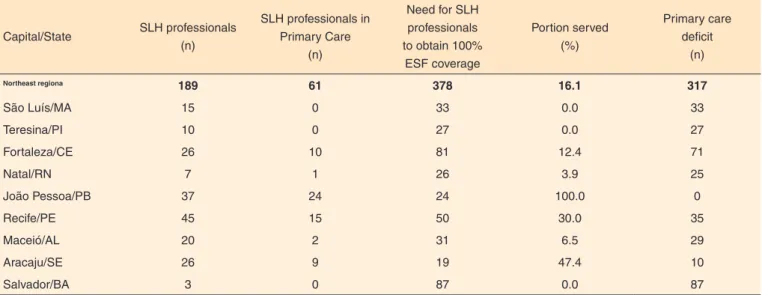
Regarding the alternative parameter, for 100% projected ESF coverage with a corresponding number of SLH professionals in NASF, we estimated that 378 professionals were required to meet the totality of need for Primary Care in the Northeast capitals. However, this set of capitals only presented 16.1% of
this total. The best results were, once again, obtained in João Pessoa and Aracaju. According to this parameter, João Pessoa was notable as being the only capital that did not present a professional deficit, in contrast to São Luís, Teresina and Salvador, which did not present any professionals in Primary Care (Table 5).
DISCUSSION
These results provided evidence of growth, between 2007 and 2014, in the supply of SLH professionals in the municipal public health networks under the direct management of the capitals in the country’s Northeast region. However, two Table 1. Supply of Speech Language and Hearing (SLH) professionals in the municipal public health networks (direct management) of capitals in the Northeast region of Brazil 2007-2014
Capital/State SLH professionals Resident population
Professionals per 100,000 inhabitants
Evolution of supply 2007-2014
(%)
2007 2014 2007 2014 2007 2014
Northeast regiona 81 189 11,513,425 12,259,975 0.70 1.54 119.1
São Luís/MA 4 15 1,017,774 1,064,197 0.39 1.41 258.6
Teresina/PI 7 10 815,061 840,600 0.86 1.19 38.5
Fortaleza/CE 0 26 2,458,545 2,571,896 0.00 1.01
---Natal/RN 10 7 801,665 862,044 1.25 0.81 -34.9
João Pessoa/PB 16 37 683,278 780,738 2.34 4.74 102.4
Recife/PE 20 45 1,528,971 1,608,488 1.31 2.80 113.9
Maceió/AL 13 20 941,294 1,005,319 1.38 1.99 44.0
Aracaju/SE 6 26 511,891 623,766 1.17 4.17 255.6
Salvador/BA 5 3 2,754,946 2,902,927 0.18 0.10 -43.1
Source: CNES/DATASUS, 2015; IBGE, 2015
aTaking all the capitals in the Northeast region into consideration
Subtitle: SLH = Speech-language and hearing
Table 2. Supply of SLH professionals in the municipal public health networks (direct management) of capitals in the Northeast region of Brazil, by level of healthcare 2007-2014
Capital/State
SLH professionals Level of healthcare
Primary Specialised Hospital Not classified
2007 n
2014 n
2007 (%)
2014 (%)
2007 (%)
2014 (%)
2007 (%)
2014 (%)
2007 (%)
2014 (%)
Northeast regiona 81 189 7.4 32.3 76.5 42.9 11.1 18.5 5.0 6.3
São Luís/MA 4 15 75.0 -- -- 33.3 25.0 53.3 -- 13.4
Teresina/PI 7 10 -- -- 100.0 60.0 -- 40.0 --
--Fortaleza/CE 0 26 -- 38.5 -- 11.5 -- 46.2 -- 3.8
Natal/RN 10 7 10.0 14.3 50.0 42.9 -- 28.6 40.0 14.2
João Pessoa/PB 16 37 6.2 64.9 50.0 18.9 43.8 8.1 -- 8.1
Recife/PE 20 45 5.0 33.3 95.0 55.6 -- 4.4 -- 6.7
Maceió/AL 13 20 -- 10.0 92.3 70.0 7.7 15.0 -- 5.0
Aracaju/SE 6 26 -- 34.6 100.0 57.7 -- 3.9 -- 3.8
Salvador/BA 5 3 -- -- 100.0 100.0 -- -- --
--Source: CNES/DATASUS, 2015; IBGE, 2015
aTaking all the capitals in the Northeast region into consideration
separate parameters indicated that the 2014 supply remained inadequate, only obtaining approximately 15% of the total professionals who should constitute SLH care in the SUS municipal public health network. In contrast to the growth observed in most capitals, there was a quantitative reduction in professionals in Natal and Salvador. Surprisingly, Salvador, the capital with the largest resident population, almost three million inhabitants, had the least SLH professional supply in its municipal public health network - only three professionals in 2014.
These findings are consistent with a previous study(6) that
described the supply of SLH professionals in each Brazilian region and revealed that an overview of SLH operations
presented very distinct regional differences, arising principally from local socio-economic conditions, with the greatest deficit of SLH professionals in the North, followed by the Northeast. Another study(16) addressing geographic and social inequalities
in health service access in Brazil between 1998 and 2003, observed that access to such services is strongly influenced by the social conditions of the people and the location in which they reside, evidencing better access in regions considered to be more developed, in other words the Southeast and the South, although great social inequality of access was also seen in these regions.
In terms of the level of healthcare in which the SLH professionals work, in the Northeast region, we noted a Table 3. Number of health units for each (1) SLH professional in the municipal public health network (direct management), by level of healthcare, in the capitals in the Northeast region of Brazil, 2014
Capital/State
Level of healthcare
Primary Specialised Hospital Not classified
HU (n)
SLH (n)
Ratio HU/ SLH
HU (n)
SLH (n)
Ratio HU/ SLH
HU (n)
SLH (n)
Ratio HU/ SLH
HU (n)
SLH (n)
Ratio HU/ SLH
Northeast regiona 772 61 12.7 158 81 2.0 26 35 0.7 76 12 6.3
São Luís/MA 57 0 -- 11 5 2.2 3 8 0.4 7 2 3.5
Teresina/PI 82 0 -- 11 6 1.8 5 4 1.3 12 0
--Fortaleza/CE 94 10 9.4 20 3 6.7 8 12 0.7 12 1 12.0
Natal/RN 56 1 56.0 16 3 5.3 2 2 1.0 5 1 5.0
João Pessoa/PB 110 24 4.6 12 7 1.7 3 3 1.0 11 3 3.7
Recife/PE 150 15 10.0 33 25 1.3 3 2 1.5 9 3 3.0
Maceió/AL 62 2 31.0 14 14 1.0 1 3 0.3 2 1 2.0
Aracaju/SE 44 9 4.9 11 15 0.7 1 1 1.0 3 1 3.0
Salvador/BA 117 0 -- 30 3 10.0 0 0 -- 15 0
--Source: CNES/DATASUS, 2015
aTaking all the capitals in the Northeast region into consideration
Subtitle: SLH = Speech-language and hearing; HU = health unit
Table 4. Professional deficit in the municipal public health services (direct management) in Northeast capitals, using as a parameter the expectation of one Speech Language and Hearing (SLH) professional for every 10,000 inhabitants, Brazil, 2014
Capital/State SLH professionals (n)
Resident population (N)
Need for a SLH professional (Pop/10,000)
Portion served (%)
Estimated deficit (n)
Northeast regiona 189 12,259,975 1,225 15.4 1,036
São Luís/MA 15 1,064,197 106 14.1 91
Teresina/PI 10 840,600 84 11.9 74
Fortaleza/CE 26 2,571,896 257 10.1 231
Natal/RN 7 862,044 86 8.1 79
João Pessoa/PB 37 780,738 78 47.4 41
Recife/PE 45 1,608,488 161 28.0 116
Maceió/AL 20 1,005,319 101 19.9 81
Aracaju/SE 26 623,766 62 41.7 36
Salvador/BA 3 2,902,927 290 1.0 287
Source: CNES/DATASUS, 2015; IBGE, 2015
aTaking all the capitals in the Northeast region into consideration
significant evolution of professional allocation to Primary Care, coinciding with a period of accentuated growth in the provision of services at this level of care and the definition of the Family Health Strategy (Estratégia Saúde da Família: ESF) as a priority across the nation(1).
This data demonstrates a possible change in the characteristic inclusion of SLH care within the health field. Historically, this professional has been practiced strictly from a clinical point of view, with great value placed on specialist professional and the level of priority intervention at the secondary level of care(17). However, with the creation of
SUS and, latterly, with the 2008 emergence of Family Support Health Centres (Núcleos de Apoio à Saúde da Família: NASF), in which it is expected that SLH professionals will play an important role in the organization of the health system and the transformation of health service practices(18,19,20) within SUS,
Primary Care has become an important sphere of operation for these professionals(17). In the Northeast, this change is
very well represented in João Pessoa, where we identified an evolution of the operations of SLH professionals in Primary Care between the periods prior to (2007) and following (2014) the establishment of the NASF.
The 2014 reality may express an important reorganization of the SLH professional working model, since the data demonstrates a reduction in the predominance of Specialised Care in SLH practice within SUS in the capitals of the Northeast region. However, in some of these capitals, this process remained under-developed, revealing more intense inequalities, in which no professionals in the municipal public health network worked in Primary Care, as was the case in São Luís, Teresina and Salvador. This specific context prevents the professional becoming more involved in concrete actions
aimed at the reorientation of the SUS healthcare model and, further, compromises the comprehensive nature of care at this level, since health problems that could be addressed in a more resolutive manner through the participation of the SLH professional may continue to be neglected.
In other capitals, in particular in Natal and Maceió, there were professionals working at Primary Care level, but in insufficient number, given the quantity of health units in these municipalities. This can lead to overload and operational difficulties. Given that the National Primary Care Policy(21) sets out that the territory of
one family health unit should cover a maximum of 12 thousand people (three or four ESF teams) and that Decree 3124/12(14)
established a limit of nine ESF teams for each NASF, the ideal distribution would be at most three units per SLH professional. However, we note that the estimated number of health units for each SLH professional in Primary Care may be influenced by differences in ESF coverage in these capitals.
The increased number of SLH professionals identified in Hospital Care may have been affected by the changes established by GM Decree no. 2809/12, which organizes Long-stay Care for the Urgent and Emergency Care Network and other Themed Healthcare Networks within SUS(22), as
well as GM Decree no. 930/12, which defines the guidelines and objectives for the organization of comprehensive and humanized care for newborns, in severe or potentially severe situations, through classification and qualification criteria for beds in neonatal units within SUS(23). These consider that a
SLH professional must be one of the professionals within the multi-professional team.
The estimated SLH professional deficit was significant and displayed important intra-regional differences. We ascertained that none of the nine capitals in the Northeast region met the Table 5. Speech Language and Hearing (SLH) Professional deficit in Primary Care in the municipal public health network (direct management) in Northeast capitals, according to the newly proposed parameter – one professional per NASF, for 100% projected ESF coverage – Brazil, 2014
Capital/State SLH professionals (n)
SLH professionals in Primary Care
(n)
Need for SLH professionals to obtain 100%
ESF coverage
Portion served (%)
Primary care deficit
(n)
Northeast regiona 189 61 378 16.1 317
São Luís/MA 15 0 33 0.0 33
Teresina/PI 10 0 27 0.0 27
Fortaleza/CE 26 10 81 12.4 71
Natal/RN 7 1 26 3.9 25
João Pessoa/PB 37 24 24 100.0 0
Recife/PE 45 15 50 30.0 35
Maceió/AL 20 2 31 6.5 29
Aracaju/SE 26 9 19 47.4 10
Salvador/BA 3 0 87 0.0 87
Source: CNES/DATASUS, 2015; IBGE, 2015
aTaking all the capitals in the Northeast region into consideration
parameter proposed by Lessa and Miranda(13) and only one met
the new, more conservative, parameter proposed here to analyse Primary Care provision. We note that this new parameter was estimated for a 100% projected ESF coverage, avoiding possible distortions in estimates arising from differences in this coverage between capitals. In absolute terms, Salvador and Fortaleza have the greatest deficits. These parameters are constructed on the basis of assumptions and have their limitations. In this case, both represent efforts to fulfil the need for indicators to quantify the workforce that could ensure that SLH health needs are met, enabling an analysis of the provision of SLH care in SUS and describing access to these services. Descriptive epidemiological studies of the population’s need for SLH care are required, in order to ratify the adoption of or improvements to these parameters.
There is a large gap and significant unmet need in SLH services in the public network(12), as confirmed in the context
described for the Northeast region. Certain issues may be at the heart of the current scenario, such as the historically low inclusion of SLH care in the public policies constructed by the Brazilian State, the hegemony of professional operations in individual clinics, primarily in the private sector, and the late inclusion of public health contents and experiences in the professional training curriculum, with even less integration within teaching services(4,24,25). However, in recent years, the
profession has invested positively in all these fronts.
Added to this are factors related to the underfunding of public health, with recurring budget cuts, which undermine investments and the expansion of service provision, as well as the coexistence of a complex network of private and philanthropic providers and social organizations that administer public services indirectly, generating public-private combinations that compete with each other for professional resources and contracts that require SUS regulation, monitoring and evaluation(1,26).
The limits of this study include the fact that CNES data may contain inaccuracies, since it is supplied by the municipalities and is not always updated. Furthermore, although our analysis considered the level of care in which the professionals worked, we were unable to confirm the kind of activities they carried out, since the study did not analyse procedures. In terms of study potential, it is worth noting our contribution to the proposed construction of a new parameter to evaluate SLH provision in SUS, with support from current Primary Care policies. In addition, the results presented here constitute evidence, generated by appropriate methodology, which could and should be used to support the inclusion of SLH care in the municipal public health networks of all the municipalities in the study, in order to extend access to health services, contribute to the implementation of SUS principles and improve the population’s quality of life. Further studies of access to public SLH services across Brazil are required, specifically addressing the provision of SLH care, and taking into account the SUS contracted
services that complement the SUS own network. These are the private clinics, philanthropic institutions and teaching clinics at higher education institutions that supply some of the demand for SLH care in the cities.
CONCLUSION
Based on a range of estimates and parameters, we noted a significant deficit in the supply of SLH professionals in the municipal public health networks under direct management in the country’s Northeastern capitals. The supply of SLH professionals is insufficient and unequal across these capitals, restricting, and even preventing, access to SLH services. Despite the expansion of SLH care within Primary Care, this remains the level of care that suffers the greatest absence of professionals, a fact that requires reflection and discussion.
This evidence reveals an incomplete agenda in relation to the issue of access to public SLH services in SUS. The population’s health needs are at the heart of this agenda and demand an expansion of health service responses and policies. Efforts are required for the allocation of more professionals within the public health network, with a positive prediction that a significant change to the SLH professional distribution profile between the levels of healthcare is still to come.
REFERENCES
1. Paim J, Travassos C, Almeida C, Bahia L, Macinko J. O sistema de saúde brasileiro: história, avanços e desafios. Lancet. 2011;377(9779):1778-97.
2. Jesus WLA, Assis MMA. Revisão sistemática sobre o conceito de acesso nos serviços de saúde: contribuições do planejamento. Cienc Saúde Coletiva. 2010;15(1):161-70. https://doi.org/10.1590/S1413-81232010000100022
3. Barbiani R, Junges JR, Nora CRD, Asquidamini F. A produção científica sobre acesso no âmbito do Sistema Único de Saúde do Brasil: avanços, limites e desafios. Saúde Soc. 2014;23(3):855-68. https://doi.org/10.1590/S0104-12902014000300010
4. Lipay MS, Almeida EC. A fonoaudiologia e sua inserção na saúde pública. Rev Cienc Med. 2007;16(1):31-41.
5. Bazzo LMF, Noronha CV. Acesso aos serviços fonoaudiológicos no Sistema Único de Saúde (SUS) em Salvador: uma batalha a ser vencida no cotidiano. Rev Baiana Saúde Pública. 2009;33(4):628-41.
6. Buarque APFC, Campos LCS, Reis FKW, Guedes JBR, Lima TFP, Pereira GFC et al. Caracterização da oferta de fonoaudiólogos segundo macrorregiões do Brasil. In: Anais do 17º Congresso Brasileiro de Fonoaudiologia; 21-24 out. 2009 [acesso 26 set 2016]; Salvador, BA. Disponível em: http://www.sbfa.org.br/portal/ anais2009/resumos/R1550-1.pdf
CEFAC. 2012;14(2):196-205. https://doi.org/10.1590/S1516-18462011005000088
8. Ferreira CL, Silva FR, Martins-Reis VO, Friche AAL, Santos JN. Distribuição dos fonoaudiólogos na atenção à saúde no estado de Minas Gerais entre 2005 e 2010. Rev CEFAC. 2013;15(3):672-80. 9. Assis MMA, Jesus WLA. Acesso aos serviços de saúde:
abordagens, conceitos, políticas e modelo de análise. Cienc Saúde Colet. 2012;17(11):2865-75. https://doi.org/10.1590/S1413-81232012001100002
10. Pereira FCB, Aarão PCL, Seixas KL, Silva HG, Tavares APN, Campos FR et al. Histórico da Fonoaudiologia em Minas Gerais: impressão dos protagonistas. Rev CEFAC. 2012;14(2):313-26. https://doi.org/10.1590/S1516-18462011005000092
11. Penteado RZ, Servilha EAM. Fonoaudiologia em saúde pública/ coletiva: compreendendo prevenção e o paradigma da promoção da saúde. Disturbios Comun. 2004;16(1):107-16.
12. Miranda GMD, Mendes ACG, Silva ALA, Rodrigues M. Assistência fonoaudiológica no SUS: a ampliação do acesso e o desafio da superação das desigualdades. Rev CEFAC. 2015;17(1):71-79. https:// doi.org/10.1590/1982-0216201515213
13. Lessa FJD, Miranda GMD. Fonoaudiologia e Saúde Pública. In: Brito ATB, organizador. Livro de fonoaudiologia. São José dos Campos: Pulso; 2005. p. 379-84.
14. Ministério da Saúde (BR). Portaria nº 3.124, de 28 de dezembro de 2012. Redefine os parâmetros de vinculação dos Núcleos de Apoio à Saúde da Família (NASF) Modalidades 1 e 2 às Equipes Saúde da Família e/ou Equipes de Atenção Básica para populações específicas, cria a Modalidade NASF 3, e dá outras providências. Diário Oficial União; 2 jan 2013;Seção 1.
15. Ministério da Saúde (BR). Secretaria de Atenção à Saúde, Departamento de Atenção Básica. Histórico de cobertura da saúde da família. 2016 [citado 26 set 2016]. Disponível em: http://189.28.128.100/dab/docs/geral/historico_cobertura_sf_nota_ tecnica.pdf
16. Travassos C, Oliveira EXG, Viacava F. Desigualdades geográficas e sociais no acesso aos serviços de saúde no Brasil: 1998 e 2003. Cienc Saúde Coletiva. 2006;11(4):975-86. https://doi.org/10.1590/ S1413-81232006000400019
17. Molini-Avejonas DR, Mendes VLF, Amato CAH. Fonoaudiologia e Núcleos de Apoio à Saúde da Família: conceitos e referências. Rev Soc Bras Fonoaudiol. 2010;15(3):465-74. https://doi.org/10.1590/ S1516-80342010000300024
18. Arce V, Lopes SMB, Santos JN. Processo de trabalho em saúde na perspectiva do território. In: Marchesan IQ, Silva HJ, Tomé MC, organizador. Tratado de especialidades em fonoaudiologia. São Paulo: Guanabara Koogan; 2014. p. 766-71.
19. Andrade AF, Lima MM, Monteiro NP, Silvia VL. Avaliação das ações da Fonoaudiologia no NASF da cidade do Recife. Audiol Commun Res. 2014;19(1):52-60. https://doi.org/10.1590/S2317-64312014000100010
20. Silva ATC, Aguiar ME, Winck K, Rodrigues KGW, Sato ME, Grisi SJFE et al. Núcleos de Apoio à Saúde da Família: desafios e potencialidades na visão dos profissionais da Atenção Primária do Município de São Paulo, Brasil. Cad Saúde Pública. 2012;28(11):2076-84. https://doi.org/10.1590/S0102-311X2012001100007
21. Ministério da Saúde (BR). Política nacional de atenção básica. Brasília, DF: Ministério da Saúde; 2012.
22. Ministério da Saúde (BR). Portaria nº 2.809, de 7 de dezembro de 2012. Estabelece a organização dos cuidados prolongados para retaguarda à Rede de Atenção às Urgências e Emergências (RUE) e às demais redes temáticas de atenção à saúde no âmbito do Sistema Único de Saúde (SUS). Diário Oficial União. 18 set 2013;Seção 1. 23. Ministério da Saúde (BR). Portaria nº 930, de 10 de maio de 2012.
Define as diretrizes e objetivos para a organização da atenção integral e humanizada ao recém-nascido grave ou potencialmente grave e os critérios de classificação e habilitação de leitos de Unidade Neonatal no âmbito do Sistema Único de Saúde (SUS). Diário Oficial União; 11 mai 2012;Seção 1.
24. Soleman C, Martins CL. O trabalho do fonoaudiólogo no Núcleo de Apoio à Saúde da Família (NASF): especificidades do trabalho em equipe na atenção básica. Rev CEFAC. 2015;17(4):1241-53. https:// doi.org/10.1590/1982-0216201517417114
25. Silva VL, Lima MLLT, Lima TFP. A formação profissional do fonoaudiólogo para a atenção primária à saúde. In: Silva VL, Lima MLLT, Lima TFP, Advincula KP. A prática fonoaudiológica na atenção primária à saúde. São José dos Campos: Pulso; 2013. p. 181-90.