Assessment of Treatment for
Functional Posterior Cross-bites
in Patients at the Deciduous Dentition Phase
André Luiz Tannus DUTRA1 Antônio Carlos CARDOSO2
Arno LOCKS2
Ana Cristina Barreto BEZERRA3
1Department of Health Sciences, University of Brasília (UnB), Brasília, DF, Brazil
2Department of Stomatology, Federal University of Santa Catarina (UFSC), Florianópolis, SC, Brazil 3Department of Dental Pediatrics, University of Brasília (UnB), Brasília, DF, Brazil
The aim of this study was to clinically assess the results of treatment for functional posterior cross-bites by means of selective grinding in individuals at the deciduous dentition phase over a period of 12 months. From a total of 1,011 children examined in the 2-to-6-year age bracket, 26 with functional posterior cross-bites were selected. The sample was divided into 2 groups of 13 children each, group 1 receiving the treatment proposed and group 2 serving as the control group. Treatment was followed up by exercises designed to alter the children’s muscular memory. The results showed that correction of functional posterior cross-bite was achieved for all the children treated, the correction remaining stable 12 months later. No self-correction of malocclusion occurred among the control group.
Key Words: cross-bite, occlusal adjustment, deciduous dentition.
Correspondence: Dr. André Luiz Tannus Dutra, SQSW 105 – Bloco B – Apartamento 312, 70670-422 Brasília, DF, Brasil. E-mail: [email protected]
INTRODUCTION
Most of the cross-bites encountered in decidu-ous dentition have a functional cause, the etiological factor being premature contact, normally located in the deciduous cuspids (1-5). Early intervention, at the de-ciduous dentition phase, could avert the formation of severe structural deformities in permanent dentition (6).
The treatment recommended for deflective con-tacts involves occlusal adjustment manipulating the patient’s bite into a centric relation followed by a set of myo-functional exercises (2,3,7,8). When adjustment is insufficient to produce uncrossing of the bite, orth-odontic treatment is prescribed, the type of appliance employed depending on the complexity of the case (9). Grinding should be done at an angle of 45 de-grees to the long axis of the tooth or at an angle of over 30 degrees producing incline planes that allow the
lower jaw to assume an adequate position. Selective grinding would produce a slight increase in the width of the maxillary arch and a slight reduction in the width of the mandibular arch. The pressure exerted on the in-cline planes would move the maxillary cuspids in a buccal direction and the mandibular ones in a lingual direction. When the width of the maxilla in the decidu-ous inter-canine and inter-molar regions is equal to or slightly greater than the width of the corresponding mandibular regions, grinding is recommended but in cases where the mandibular measurements are wider than those of the maxilla, mechanotherapy is prefer-able.
question-able.
During research of a method using occlusal grind-ing and incline resin bite-planes cemented to the dental cuspids to correct unilateral cross-bite, Kantomaa ob-served that the width of the dental arch in the region of the first deciduous molars spontaneously increased 1.4 mm following treatment (10). Myers et al. noted that radiographic measurements of the articulation space indicated that functional posterior cross-bites among children affected the condylar position (11). This dem-onstrated that, prior to corrective treatment, both the vertical and the horizontal spaces measured were sig-nificantly smaller on the side where the cross-bite was located.
MATERIAL AND METHODS
Sample Selection
A sample of 26 children was selected from 18 municipal day-care centers and pre-schools in the city of Florianópolis (southern Brazil) following examina-tion of 1,011 children in the 2-to-6-year-old age bracket (492 boys and 519 girls) (Table 1). The sample was divided into two groups: group 1 consisting of 13 children receiving treatment and group 2 comprised by 13 children serving as the control group. Children at the mixed dentition phase were excluded except in cases where the first permanent molars were in a state of infra-occlusion. Prior consent of parents or guardians was obtained for all the children before treatment com-menced. The control group also received adequate treatment upon conclusion of the study.
Before selection of the sample, a letter of presen-tation from the Florianópolis Municipal Education De-partment was requested providing due institutional au-thorization for the study to be carried out. The educa-tional establishments and the children participating in the study were chosen at random without the adoption of any prior criterion. Meetings were held with parents and guardians at all establishments involved in the study to explain the problem of malocclusion and to provide necessary information about how treatment of the children was to be performed.
Check-ups were made during two visits and were carried out by the main researcher, who selected cases of functional cross-bite for subsequent treatment. The children were placed in a recumbent
posi-tion on a mattress always beside their teachers so as to obtain greater cooperation and to reduce anxiety. Dur-ing the clinical examination, the examiner was posi-tioned behind the children telling them to open and close their mouths in order to detect the presence of posterior cross-bites.
With the jaw positioned in a centric relation, the definitive diagnosis of malocclusion was made. The technique used was described by Dawson (12) and recommended by Celenza (13). This technique consists of bilateral manipulation with the child lying on his back with his head tilted back to avoid muscular action and his mouth open approximately 1 cm. Children who presented unilateral posterior cross-bites in the maxi-mum habitual intercuspidation position (MHI) with mandibular deviation and when in centric relation no longer presented a cross-over condition but rather pre-mature tooth contact were classified as suffering from functional posterior cross-bite and therefore consid-ered apt to participate in the study. The personal details for each child in both groups were recorded during the first encounter.
Each patient was photographed in frontal norm in both the MHI position and in centric relation. Photo-graphs were taken both prior to and 12 months after treatment.
Treatment
The treatment consisted of ten 30-min sessions for each child in group 1, 20 min being used for occlusal adjustment and 10 min for myo-functional exercises performed with the aid of a mirror. The parents or guardians were instructed to repeat the exercises at home for 5 min at least once a day (7).
The sessions were held weekly for patients from group 1. The control group attended only the initial session and another session at the end of the 12-month period, when treatment of the children in group 2 commenced.
hand being placed on the child’s chin to facilitate mandibular retrusion (14). The change in manipulation technique was due to operational difficulties.
After grinding, each patient received topical ap-plication of fluoride to prevent post-grinding sensitiv-ity.
Assessment of Treatment
An initial assessment was made immediately upon completion of occlusal adjustment, subsequent assessments being carried out 6 and 12 months after treatment.
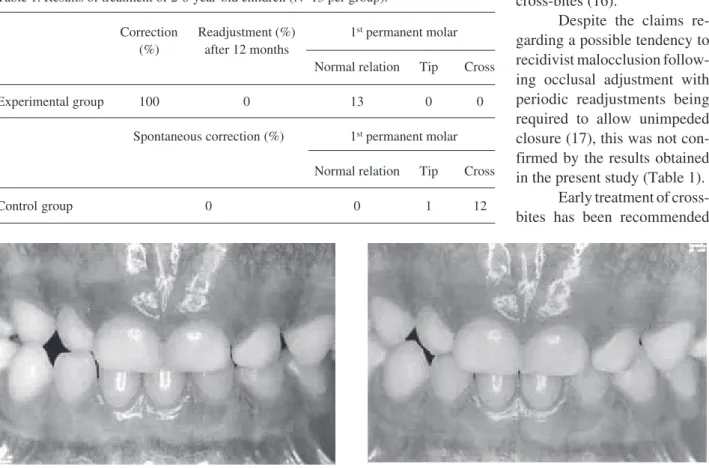
Final assessment consisted of a clinical exami-nation and comparison of the initial (Figure 1) and final photographs (Figure 2). Treatment was considered to be successful when a child presented a normal transver-sal relation 12 months after treatment with absence of crossed or protruding teeth and no mandibular
devia-tion in the MHI posidevia-tion. The reladevia-tion of the first permanent molars was disregarded in the assessment of the results.
RESULTS AND DISCUSSION
Premature contacts in functional posterior cross-bites occur mostly in the area of the deciduous cuspids (90%), and selective grinding has been recommended for treatment (2,4,5). According to Vigorito, when de-ciduous cuspids erupt, they present a tip-to-tip relation, provoking deviation of the mandible (15). The present study has found that premature contacts occur mostly in the cuspids (84%) followed by the deciduous molars (16%). No deflective contact was observed in the first deciduous molars.
Brandão suggested that, when grinding alone fails to correct deviation of the mandible, composite resin should be placed solely on the occlusal plane of the deciduous teeth (direct flat surfaces) to correct posterior cross-bites (16).
Despite the claims re-garding a possible tendency to recidivist malocclusion follow-ing occlusal adjustment with periodic readjustments being required to allow unimpeded closure (17), this was not con-firmed by the results obtained in the present study (Table 1).
Early treatment of cross-bites has been recommended
Figure 1. Child with posterior cross-bite before treatment in the maximum habitual intercuspidation position (MHI).
Figure 2. Twelve months after treatment with absence of crossed or protruding teeth and no mandibular deviation in the MHI position.
Table 1. Results of treatment of 2-6-year-old children (N=13 per group).
Correction Readjustment (%) 1st permanent molar
(%) after 12 months
Normal relation Tip Cross
Experimental group 100 0 13 0 0
Spontaneous correction (%) 1st permanent molar
Normal relation Tip Cross
by several researchers, stressing that correction at the deciduous dentition phase avoids severe structural de-formities in permanent dentition. (3,6,18,19). Among the 13 children treated in the present study, all func-tional posterior cross-bites were corrected, no cuspal relation being observed in any dental element. More-over, all previously unaligned average lines proved coincidental following treatment.
However, others do not recommend routine treat-ment of cross-bites in deciduous dentition because of the occurrence of spontaneous correction (20). No self-correction was detected among the control group in the 12 months under observation, nor was any spontaneous improvement of malocclusion observed, though per-haps a greater length of time is required for observation to obtain more detailed information on this aspect. The results of this study confirm the findings of Kutin and Hawes, who report that posterior cross-bites are not self-correcting (21) (Table 1).
The main difficulty encountered following cor-rection of posterior cross-bites by selective grinding was in erasing the functional muscular memory. Some children required as many as 10 memorization exercise sessions, performed with the use of mirrors to visualize and stabilize the new occlusal status (3,13). The favor-able results observed in this study may be due to the fact that the exercises were continued at home with the help and cooperation of the children’s parents.
Total correction of posterior cross-bites (64%) was also achieved by Kurol and Berglund by means of selective grinding (22); however, they observed spon-taneous correction in 45% of the cases studied. This high rate of self-correction was attributed to the elimi-nation of sucking habits, which normalized transversal relations.
In the present study, 16% of the children were observed to suck feeding bottles, 23% sucked pacifiers, 31% sucked their thumbs and 16% bit their nails. These rates remained unaltered in both groups throughout the 12 months in which the children were under observa-tion, regardless of advice as to the importance of elimi-nating such deleterious habits. One possible explana-tion for the lack of spontaneous correcexplana-tion in the con-trol group is the fact that the attempts to make the patients abandon these habits during the period covered by the study were unsuccessful.
All the children in group 1 presented first perma-nent molars in normal transversal relation, both in the
maximum habitual intercuspidation position (MHI) and in centric relation. These findings are in agreement with those of others who reported a normal transversal rela-tion in the first permanent molars in 84.3% (23), 91.4% (21), 100% (10) of their cases.
It is important to note that Thilander et al. re-ported a correction rate of only 27.2% for posterior cross-bites treated by selective grinding, compared to a 21.4% spontaneous correction rate for this type of malocclusion (8). This study covered a period of 8 years, so the children were observed from the decidu-ous to the permanent dentition phase. This might affect the results when compared with research confined to the deciduous dentition phase, as was the case of the present study, in which all the cases treated with selec-tive grinding produced full correction and no cases of self-correction were observed.
RESUMO
O objetivo deste estudo foi avaliar clinicamente o resultado do tratamento das mordidas cruzadas posteriores de origem funcional, através de desgaste seletivo, em indivíduos na fase de dentição decídua, durante o período de 12 meses. Foram examinadas 1011 crianças, com idades entre 2 e 6 anos, selecionando-se 26 indivíduos que apresentavam mordida cruzada posterior funcional. A amostra foi dividida em 2 grupos de 13 crianças cada, sendo o grupo 1 o que recebeu o tratamento proposto e o grupo 2 servindo como controle. Após o tratamento, foram realizados exercícios com o objetivo de modificar a memória muscular da criança. Os resultados possibilitaram constatar que houve correção da mordida cruzada posterior funcional em todas as crianças tratadas, ocorrendo estabilidade da correção após 12 meses. O grupo controle não apresentou nenhum caso de autocorreção da maloclusão.
REFERENCES
1. Borell G. Functional posterior crossbites. Bull N Y Soc Dent Child New York, 1969;20:8.
2. Buck DL. The fixed “w” arch for correction of posterior crossbites in children. J Am Dent Assoc 1970;81:1140-1142.
3. Cheney EA. Indications and methods for the interception of functional crossbites and inlockings. Dent Clin N Am 1959;3:385-401.
4. Myers DR. A table of clinical and radiographic clues to develop-ing malocclusions in the mixed dentition period. ASDC J Dent Child 1974;41:445-447.
5. Ngan P, Wei SHY. Treatment of posterior crossbite in the pri-mary and early mixed dentition. Quintessence lnt 1990;21:451-459.
6. Clifford FO. Cross bite correction in the deciduous dentition: Principles and procedures. Am J Orthod Dentofacial Orthop 1971;59:343-349.
J Dent Child 1981;48:181-191.
8. Thilander B, Wahlund S, Lennartson B. The effect of early interceptive treatment in children with posterior cross-bite. Eur J Orthod 1984;6:25-34.
9. Cohen MM. Mordida cruzada posterior. In: Ortodontia Pediátrica Preventiva. Rio de Janeiro: Interamericana, 1979. p 59-61. 10. Kantomaa T. Correction of unilateral crossbite in the deciduous
dentition. Eur J Orthod 1986;8:80-83.
11. Myers DR. Condylar position in children with functional poste-rior crossbite: Before and after crossbite correction. Pediatr Dent 1980;2:190-195.
12. Dawson PE. Centric relation. Dent Clin N Am 1979;23:179. 13. Celenza FV. The theory and clinical management of centric
positions: II. Centric. Relation and centric relation occlusion. lnt J Periodontics Restorative Dent 1984;4:63-86.
14. Guichet NF. Clinical management of occlusally related orofacial pain and TMJ dysfunction. J Craniomandib Prac 1983;1:60-73. 15. Vigorito JW. Mordida cruzada. Descruzadores de mordida. In:
Ortodontia Clínica Preventiva. 2nd edn. São Paulo: Artes Médicas, 1986. p 169-205.
16. Brandão MR de C. Pista direta plana na correção da mordida cruzada posterior. Rev Ass Paul Cirurg Dent 1995;49:127-129. 17. Ziebert GJ, Donegan SJ. Tooth contacts and stability before and
after occlusal adjustment. J Prosthet Dent 1979;42:276-281. 18. Davis JW. Why early treatment of crossbites? Part two. Dent Dig
1969;75:496-499.
19. Ngan P, Fields H. Orthodontic diagnosis and treatment planning in the primary dentition. ASDC J Dent Child 1995;62:25-33. 20. Leighton BC. The early development of cross bites. Dent Pract
Dent Rec 1996;17:145-152.
21. Kutin G, Hawes RR. Posterior cross-bites in the deciduous and mixed dentitions. Am J Orthod Dentofacial Orthop 1969;56:491-504.
22. Kurol J, Berglund L. Longitudinal study and cost-benefit analysis of the effect of early treatment of posterior cross bites in the primary dentition. Eur J Orthod 1992;14:173-179.
23. Schroder V, Schroder I. Early treatment of unilateral posterior crossbite in children with bilaterally contracted maxillae. Eur J Orthod 1984;6:65-69.