0103 - 5053 $6.00+0.00
Article
* e-mail: [email protected]
Preparation of a Ferrofluid Using Cyclodextrin and Magnetite
Alberto Bocanegra-Diaz, Nelcy D. S. Mohallem and Rubén D. Sinisterra*
Departamento de Química, ICEx, Universidade Federal de Minas Gerais, Avenida Antônio Carlos 6627, 31270-901 Belo Horizonte - MG, Brazil
Um ferrofluido foi obtido a partir da magnetita e da β-ciclodextrina, com a formação de um complexo de inclusão. A caracterização físico-química do complexo magnétita: β-ciclodextrina foi realizada através de espectroscopia de absorção na região do infravermelho com transformada de Fourier, difração de raios X, análise térmica (TG/DTA), microscopia eletrônica de transmissão (TEM) e espectroscopia de absorção atômica. É a primeira vez que se relata na literatura a formação de um complexo de inclusão de um óxido metálico em ciclodextrinas
A ferrofluid has been obtained from magnetite and β-cyclodextrin, with the formation of an inclusion complex. The magnetite and β-cyclodextrin complex was characterized by FTIR spectroscopy, X-ray diffraction, thermal analysis (TG/DTA), transmission electron microscopy (TEM) and atomic absorption spectroscopy. As far as we know, this is the first report on an inclusion compound between a metal oxide and cyclodextrins.
Keywords: ferrofluid, cyclodextrin, magnetite, magnetic materials, inclusion complex
Introduction
Ferrofluids are colloidal suspensions composed of single-domain magnetic nanoparticles dispersed in appropriate solvents (polar or non polar).1 Since their
discovery in 1965 by Papell,2 ferrofluids have raised a
growing interest in the scientific and industrial communities due to their physical properties and applications. Ferrofluids can be applied to immunoassay, cell separation, contrast agents for ultrasound and magnetic resonance imaging (MRI), magnetic inks, biosensors, magnetic microactuactors, seals, bearing dampers and lubricants, etc.3
These specialized applications of ferrofluids impose strict requirements on their characteristics, such as chemical composition, size distribution uniformity, crystal structure, stability of magnetic properties, surface structure, adsorption properties, solubility and low toxicity.4
Many of these properties depend decisively on particle size, shape, composition and structure, and therefore rigorous control of the synthesis of ferrofluids is necessary.5
Cyclodextrins are water-soluble oligosaccharides composed of at least six (1-4) linked α-D-glucosyl residues which have the shape of a hollow, truncated cone, capable of forming inclusion complexes with a variety of guest molecules in the solid state, as well as in solution, with sizes compatible with the dimensions of the cavity.7
Cyclodextrins are used as surfactants and size controllers of different kind of materials.6
In the present work, we describe the preparation and characterization of a ferrofluid using β-cyclodextrin to stabilize magnetite nanoparticles in colloidal suspension. In this system, β-cyclodextrin may also act as a size selector.
Experimental
Analytical grade chemicals and deionized water were used throughout.
Synthesis of magnetite
of NH4OH, 8.5 mol L-1 as precipitant agent. The resulting
black powder was washed several times with water until neutralization, and dried in air at 110 °C. Elemental analysis: Calcd for Fe3O4.H2O:Fe, 67.1; H, 0.80; O, 32.0%; Found: Fe, 66.8; H, 0.84; O, 32.30%.
Preparation of the magnetic fluid
The preparation of the magnetic fluid was carried out by mixing 2.8 mg of β-cyclodextrin and 8.0 mL of NH4OH (8.5 mol L-1) dissolved in 15.0 mL of deionized water under
continuous and vigorous stirring. The resulting solution was heated to 40 °C, and 2.0 mg of magnetite was slowly added. The system was kept at 40-50 °C, resulting in a black suspension with pH 7, which was dried at 60 °C in air to form a black powder nanocomposite. Elemental analysis: Calcd for Fe3O4 (C42O35H70).H2O: Fe, 12.1; C, 36.4; O, 46.2; H, 5.2%; Found: Fe, 11.40; C, 34.75; O, 47.87; H, 5.98%.
Physical mixture of magnetite and β-cyclodextrin
For comparison with the solid nanocomposite, a physical mixture (PM) of β-cyclodextrin and magnetite in the same molar ratio was prepared without heating.
Methods
In order to verify the stability of the ferrofluid, some physical and chemical tests were carried out, namely, centrifugation, sedimentation and stirring in the presence of a magnet.
The metal contents of the complex were determined on a Hitachi Z 8200 atomic absorption spectrophotometer. The pH measurements were carried out with universal indicative paper (Merck). Elemental analysis was performed using a Perkin-Elmer apparatus model PE2400.
X-ray powder diffraction (XRD) patterns were recorded at 25 °C with a Rigaku-Geigerflex diffractometer using Cu-Kα radiation (λ=0.154056 (1) Å). Graphite monochromater was used, in order to increase the analysis efficiency. Data were collected in the 2θ mode, with 2θ
ranging from 4 to 60° in 0.05° steps. Due to crystallinity differences of the samples (ferrite, ferrofluid and β -cyclodextrin), an optimization of the data collection was necessary in order for reasonable quality XRD patterns to be obtained. Nanoparticle size was estimated using the Debye-Scherrer equation (Dhkl=0.9λ/βcosθ), in which β
stands for the half width of the XRD diffraction line.8
Infrared spectra were recorded in the 4000-400 cm-1
range with a Galaxy 300 Mattson FT-IR infrared spectrometer, using KBr disks.
Simultaneous thermogravimetric and differential temperature analyses (TG/DTA) were obtained with TA instrument SDT 2060 system in alumina microcrucibles under dynamic O2 atmosphere and a heating rate of 10 °C min-1.
Transmission electron micrographs (TEM) were obtained on a Carl Zeiss CEM 902 microscope. Samples were prepared by placing drops of ferrofluid on a copper grid coated with carbon film and dried in air. The nanocomposites (dried ferrofluid) were also analyzed. Spontaneous magnetization was determined on a portable magnetometer.9
Results and Discussion
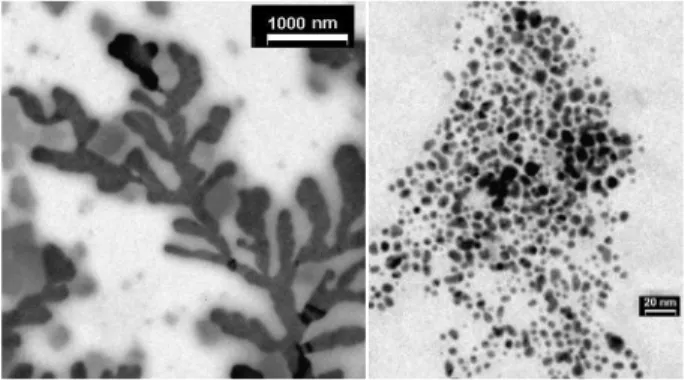
The obtained ferrofluid was dark brown, exhibited positive magnetic behavior in the presence of a permanent magnet, and kept its colloidal characteristics for up to 12 months. Ferrofluid sedimentation was not observed when the sample was submitted to 14.000 rpm centrifugation for 5 min at 27 °C. This result suggests that the magnetite and β-cyclodextrin colloidal solution was stable. The ferrofluid with particle size < 2 nm formed branched or dendritic structures (Figure 1).
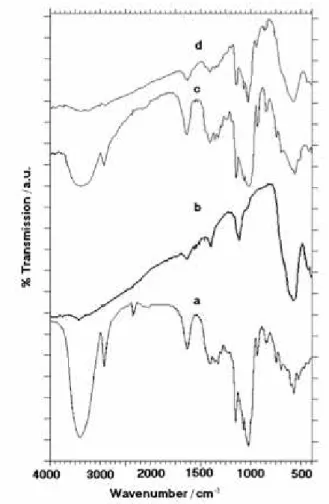
The FTIR spectrum of the nanocomposite (Figure 2d) shows bands at 575 and 450 cm-1, associated with the
stretching and torsional vibration modes of the magnetite Fe-O bonds in tetrahedral and octahedral sites, respectively (Table 1). The attributions are in accordance with Keiser et al.10and Poling,11 who described two broad bands at 580
and 400 cm-1 associated with magnetite. The absorptions
in the 846-1640 cm-1 range are related to the characteristic
deprotonation of the hydroxyl groups of β-cyclodextrin in the nanocomposite, as described in the literature.12
However, Wenz13 reported the need of drastic chemical
conditions such as high temperature, strong reducing agent (NaH) and absence of water for the deprotonation of β -cyclodextrin to occur, which is not the case in our work. On the other hand, in accordance with previous works the suppression of -OH vibrational modes in the 3000-3700 cm-1 region has been related to evidence of
host-guest interaction as a consequence of complete water release upon inclusion.14,15 Hence we can suggest the
inclusion of magnetite into the β-cyclodextrin cavity, (Scheme 1). This hypothesis was also confirmed by our previous magnetic results published elsewhere.16
The infrared spectrum of the physical mixture clearly shows predominance of β-cyclodextrin vibrations and overlapping of the magnetite bands (Figure 2b).
The diffractogram of the nanocomposite (Figure 3d) suggests the presence of a new crystalline phase in contrast to the XRD pattern of PM (Figure 3c), magnetite (Figure 3b) and β-cyclodextrin (Figure 3a). The presence of β -cyclodextrin and magnetite characteristic reflections indicated the maintenance of the cyclodextrin and magnetite crystallographic organization in the nanocomposite. These results could suggest a column crystalline organization of the inclusion compound (Scheme 2a and 2b) as observed by MacMullan et al.17
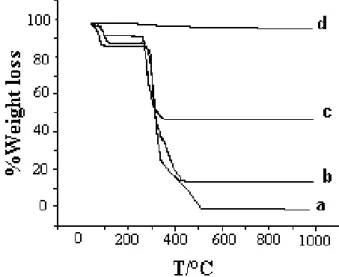
Thermal analysis data reinforce the hypothesis of inclusion of magnetite into b-cyclodextrin. The TG curve of β-cyclodextrin (Figure 4a) shows a thermal decomposition behavior, as discussed elsewhere.14 The
DTA curve of β-cyclodextrin (Figure 5a and insert) shows two endothermic events at 85 and 303 ºC, and two Table 1. Infrared absorption frequencies (cm-1) of β-cyclodextrin
and of ferrofluid
β-cyclodextrin Ferrofluid Tentative Assignment 3512 ν(OH) of primary OH groups γ
3342 ν(OH) of secondary OH groups
3196 H-bonded in different ways
3107
1650 1650 δ(HOH) of two different types of water molecules existing
in the cavities
1459 1459 φ(OCH), φ(HCH)
1420 1420 φ(OCH), φ(CCH)
1398 φ(CCH), φ(OCH), φ(COH)
1158 1158 ν(C-O-C)
1100 1100 ν(C-O-C)
575 ν(Fe-O)
450 ν(Fe-O)
Figure 2. IR spectra of: a- β-cyclodextrin, b- magnetite, c- the physical mixture (PM) of β-cyclodextrin and magnetite, d-nanocomposite.
spectrum of the nanocomposite. In contrast, this vibration can be clearly observed in the spectra of the β-cyclodextrin and of the physical mixture (PM) (Figure 2a, 2c). This decrease could be interpreted as resulting from total
exothermic events at 345 and 480 ºC, respectively. The event at 85 ºC is associated with the loss of water molecules (17%), as verified in the respective TG curve. The endothermic event at 303 ºC could be associated with the oligossacharide fusion followed by thermal decomposition between 345-485 ºC (83% of weight loss).
The TG curve of the nanocomposite (Figure 4c) resembles the β-cyclodextrin thermal decomposition profile, but a final residue of 46% was observed. In comparison, the PM (Figure 4b) and β-cyclodextrin (Figure 4a) TG curves present 12% and no residue, respectively. The nanocomposite DTA curve (Figure 5c) reveals two thermal events, a small wide endothermic peak at 97 ºC, and an exothermic peak at 350 ºC. The first peak could be associated with the loss of water (9%), which was also verified in the respective TG curve. The exothermic peak
is in accordance with the total thermal decomposition of the nanocomposite.
In contrast, the PM TG curve (Figure 4b) resembles quite well the β-cyclodextrin thermal decomposition profile. The PM DTA curve (Figure 5b) showed a single endothermic peak at 110 ºC and two exothermic events at 285 and 415 ºC, respectively. The first peak is attributed to water loss (12%), and the next two peaks could be associated respectively to the occurrence of some interaction between β-cyclodextrin and magnetite in the PM and the β-cyclodextrin thermal decomposition process (76% of weight loss).
The fluid density and spontaneous magnetization of the nanocomposite were 8.48 g L-1 and 4.4 A m2 kg-1, Figure 3. XRD pattern of: a- β-cyclodextrin, b- magnetite, c- the
physical mixture (PM) of β-cyclodextrin and magnetite, d-nanocomposite.
Scheme 2. Graphic representation of the channel-like arrangement of β-cyclodextrin (a) and of the nanocomposite supported by the dipole-dipole interactions of the included magnetite (b).
Figure 4. TG curves of (a) β-cyclodextrin, (b) the physical mixture (PM) of β-cyclodextrin and magnetite in 1:1 molar ratio, (c) nanocomposite, and (d) magnetite.
respectively. The lower value of the spontaneous magnetization in comparison with that of magnetite (90 A m2 kg-1) suggests that both the magnetic fluid and
the nanocomposite could be used in bioprocessing isolation of monoclonal antibodies from ascite fluid or from culture3 and as a contrast agent in MRI and
ultrasound,18 among other applications.
Finally, the transmission electronic microscopy (TEM) of the nanocomposite shows a series of aligned magnetite particles (Figure 6). The literature reports the use of surfactants as cyclodextrins and micelles as templates for the control of nanoparticle size and shape.6,18-20 Hence, we
suggest, therefore, that cyclodextrin plays a similar role in the control of the magnetite particle shape and size, in the present case through the inclusion of magnetite into the β -cyclodextrin cavity.
Conclusion
A new ferrofluid compound was obtained and characterized from magnetite and β-cyclodextrin. To the best of our knowledge, this is the first report in the literature on the inclusion of metallic oxides into β-cyclodextrin. The present work strongly suggests the key role of cyclodextrins in the control of the magnetite shape and nanosize through its inclusion into the β-cyclodextrin cavity.
Acknowledgements
The authors would like to thank the Dr. N. Spezialli of Departamento de Física - UFMG for XRD analyses, Dr. F. Galembeck of Instituto de Química - UNICAMP for TEM micrographs, and the financial support of the Brazilian agencies CAPES and CNPq.
References
1. Shen, F.; Laibinis, P. E.; Hatton, T.A.; J. Magn. Magn. Mat.
1999, 194, 37.
2. Papell, S.S.; U.S. Pat 3,215,572, 1965.
3. Bocanegra-Diaz, A.; Mohallem, N.D.S.; Sinisterra, R.D; PCT / BR 02/00155, 2002; Molday R. S.; U.S. Pat 4,452,773, 1982; Pilgrimm, H.; U.S. Pat 6,274,121, 2001; Groman, E.V.; Josephson, L.; Lewis, J.M; U.S. Pat 4,951,675, 1990; Cockbain,
J.; WO 97/25073, 1997; Liberti, P.A.; Rao, G.C.; Chiarappa,
J.N.; U.S. Pat 6,120,856, 2000; Kovac, Z.; Gardineer, B.A.;
U.S. Pat 3,990,981, 1976; Sambucetti, C.J; Mitchell, J.W.;
U.S. Pat 4,026,713, 1977; Kovac, Z.; Sambucetti, C.J.; U.S.
Pat 4,107,063, 1978; Pérez-Castillejos, R.; Plaza, J.A.; Losantos, E.P.; Acero, M.C.; Cané, C.; Serra-Mestres, F.; Sens.
Actuators, A2000, 84, 176.
4. Kuznetsov, O. A.; Brusentsov, N. A.; Kuznetsov, A. A.; Yurchenko, N.Y.; Osipov, N. E.; Bayburtskiy, F.S.; J. Magn.
Magn. Mat. 1999, 194, 83.
5. Gruttner, C.; Rudershausen, S.; Teller, J.; J. Magn. Magn.
Mat. 2001, 225, 1; Yu, L.Q.; Zheng, L.J.; Yang, J.X.; Mat.
Chem. Phys.2000, 66, 6; Kim, D.K.; Zhang, Y.; Voit, W.; Rao,
K.V.; Muhammed, M.; J. Magn. Magn. Mat. 2001, 225, 30; Gruttner, C.; Teller, J.; J. Magn. Magn. Mat. 1999, 194, 8;
Zins, D.; Cabuil, V.; Massart, R.; J. Mol. Liq.1999, 83, 217; Facounnier, N.; Bée, A.; Roger, J.; Pons, J.N.; J. Mol. Liq.
1999, 83, 233; Massart, R.; Cabuil, V.; J. Chim. Phys.1987,
84, 967; Pileni, M.P.; Nature 2003, 2, 145.
6. Bardi, L; Mattei, A.; Steffan, S.; Marzona, M.; Enz. Mic. Tech.
2000, 27, 709.
7. Saenger, W.; Angew. Chem. Int. Ed. Engl. 1980, 19, 344; Cortés, M. E.; Sinisterra, R.D.; Avila-Campo, M.J.; Tortamano, Figure 6. TEM micrographs of solid state nanocomposite. The dark
N.; Rocha, R.G.; J. Inclusion Phenom. Macrocyclic Chem.
2001, 40, 297; Beraldo, H.; Sinisterra, R.D.; Teixeira, L.R.; Vieira, R.P.; Doretto, M.C.; Biochem. Biophys. Res. Commun.
2002, 296. 241; Sinisterra, R.D.; Najjar, R.; Santos, P.S.; Alves,
O.L.; Alves de Carvalho, C.A.; Munson, E.; Thakur, C.; Mol.
Recog. Incl.1998, 511.
8. Cullity, B. D.; Elements of X-ray Diffraction, A. W. P. C, Inc:
Massachusetts, 1967.
9. Coly J. M. D.;. Fabris J. D; Rev. Fis. Apl. Instr.1982, 7, 25.
10. Keiser, J.T.; Brown, C.W.; Heidersbach, R.H.; J. Electrochem.
Soc. 1982, 129, 2686.
11. Poling, G.W.; J. Electrochem. Soc. 1969, 116, 958. 12. Fuchs, R.; Habermann, N; Klufers, P.; Angew. Chem. Int. Ed.
Engl. 1993, 32, 852.
13. Wenz, G.; Angew. Chem. Int. Ed. Engl. 1994, 33, 803.
14. Sinisterra, R.D.; Najjar, R.; Alves, O.L.; Santos, P.S.; Alves de Carvalho, C.A.; Conde da Silva, A.L.; J. Inclusion Phenom.
Mol. Rec. Chem.1995, 22, 91.
15. Bocanegra, A.; Mohallem, N.D.S.; Sinisterra, R.D.; Mat. Res.
Soc. Symp. Proc. 711, 2002, 30.1.
16. Bocanegra, A.; Novak, M., Mohallem, N.D.S.; Sinisterra, R.D.;
J. Magn. Magn. Mater.2003, in press.
17. McMullan, R.K.; Saenger, W.; Fayes, J.; Mootz, O.; Carbohydr. Res.1973, 31, 37.
18. Kohata, S.; Jyodoi, K.; Ohyoshi, A.; Thermochim. Acta1993,
217, 187.
19. Klaveness, J.; Rongved, P.A.; Stubberud, L.; U.S. Patent
5,928,626, 1999.
20. Whaley, S. R.; English, D.S.; Hu, E.L.; Barbara, P.F.;Belecher, A. M.; Nature2000, 405, 665; Kumar, R.V.; Koltypin, Y.; Xu,
X.N.; Yeshurun, Y.; Gedanken, A. and Felner, I.; J. Appl.
Phys. 2001, 89, 6324; Sun, S.; Murray, C.B.; Dieter, W.; Folks,
L.; Moser, A.; Science2000, 287, 1989; Puntes, V.F.; Krishnan,
K.M.; Alivisatos, A. P.; Science2001, 291, 2115; Philp, D.; Stoddart, F.; Angew. Chem. Int. Ed. Engl.1996, 35, 1155.