Obstructive sleep apnea syndrome in truck drivers*
Síndrome da apneia obstrutiva do sono em motoristas de caminhão
Lucia Castro Lemos, Elaine Cristina Marqueze, Fernanda Sachi, Geraldo Lorenzi-Filho, Claudia Roberta de Castro Moreno
Abstract
Objective: To determine the prevalence of obstructive sleep apnea syndrome (OSAS), as well as to identify factors associated with a greater risk of developing OSAS, among truck drivers. Methods: The study population comprised 209 truck drivers (mean age, 38.8 years; 98.5% males) at two branches of a transportation company. The mean body mass index was 26.5 ± 4.4 kg/m2. The participants completed questionnaires regarding sociodemographic data, physical activity and OSAS. The prevalence of OSAS was estimated using the Berlin Questionnaire, associations between OSAS and the factors studied being assessed through univariate and multivariate regression analysis.
Results: The prevalence of OSAS in the population was 11.5%. Of the 209 truck drivers, 72 (34.5%) reported having fallen asleep while driving and 81 (38.7%) reported snoring. The following variables were found to present statistically significant associations with OSAS: informal employment (OR = 0.27; p = 0.01); body mass index ≥ 25 kg/m2 (OR = 13.64; p = 0.01); and poor sleep quality (OR = 3.00; p = 0.02). Conclusions: The prevalence of OSAS in this study was lower than that reported in other studies of truck drivers and yet higher that that observed for the general population. In addition, our results suggest that work characteristics, such as employment status, are associated with OSAS. These data show the relevance of considering work activity in studies of factors associated with OSAS.
Keywords: Sleep apnea, obstructive; Sleep disorders; Questionnaires.
Resumo
Objetivo: Estimar a prevalência da síndrome da apneia obstrutiva do sono (SAOS) e verificar os fatores associados à chance de desenvolver SAOS em motoristas de caminhão. Métodos: A população desse estudo constituiu-se de motoristas de caminhão de duas filiais de uma empresa transportadora (n = 209), com idade média de 38,8 anos, sendo 98,5% do sexo masculino. O índice de massa corpórea médio foi de 26,5 ± 4,4 kg/m2. Os participantes responderam questionários sobre dados sociodemográficos, atividade física e SAOS. A prevalência de SAOS foi estimada por meio do Questionário de Berlim e sua associação com os fatores estudados foi verificada pela análise de regressão univariada e multivariada. Resultados: A prevalência de SAOS na população foi de 11,5%. Dos 209 motoristas, 72 (34,5%) referiram dormir ao volante enquanto dirigiam ao menos uma vez e 81 (38,7%) referiram roncar durante o sono. As variáveis estatisticamente significativas associadas à SAOS foram vínculo empregatício informal (OR = 0,27; p = 0,01), índice de massa corpórea ≥ 25 kg/m2 (OR = 13,64; p = 0,01) e qualidade do sono ruim (OR = 3,00; p = 0,02). Conclusões: Apesar de a prevalência de SAOS ter sido inferior à observada em outros estudos com motoristas, essa prevalência é superior à da população em geral. Os resultados ainda sugerem que as características do trabalho, entre as quais o vínculo de trabalho, estão associadas à SAOS. Esses dados evidenciam a relevância de se levar em consideração a atividade de trabalho em estudos que investi-guem fatores associados à SAOS.
Descritores: Apneia do sono tipo obstrutiva; Transtornos do sono; Questionários.
* Study carried out at the University of São Paulo School of Public Health, São Paulo, Brazil.
Correspondence to: Lucia Castro Lemos. Faculdade de Saúde Pública da Universidade de São Paulo, Av. Dr. Arnaldo, 715, Departamento de Saúde Ambiental, 1º andar, CEP 01246-904, São Paulo, SP, Brasil.
Tel 55 11 9847-3000. E-mail: [email protected]
Financial support: This study received financial support from the Conselho Nacional de Desenvolvimento Científico e Tecnológico (CNPq, National Council for Scientific and Technological Development).
which comprises questions related to risk factors for the syndrome, such as obesity, hypertension,
snoring, daytime sleepiness and fatigue.(16) In a
PubMed search using the keywords “Berlin ques-tionnaire” and “sleep”, performed in October of 2008, 65 references were found. This result suggests that the Berlin Questionnaire is used in several countries. Among those 65 references, only the studies by Moreno et al. were found to
have used this instrument in truck drivers.(17,18)
In those studies, 26.1% of the population was
found to be at high risk of developing OSAS.(17)
The relevance of studies of OSAS in truck drivers is related to the inability of such indi-viduals to maintain a satisfactory level of concentration and the necessary psychomotor
coordination to drive,(1) which increases the risk
of accidents.(11,19-21) The decrease in the
perform-ance of drivers has been observed by various
researchers.(19,21,22)
In view of what has been presented above, the objective of the present study was to determine the prevalence of and identify factors associated with OSAS in a population of truck drivers.
Methods
This was a cross-sectional study involving truck drivers employed at two branches of a motor freight transportation company. A total of 209 drivers, accounting for 95.4% of this popu-lation, were interviewed. Of those, 123 worked at the Campinas branch (located in the state of São Paulo) and 86 worked at the Belo Horizonte branch (located in the state of Minas Gerais). The sociodemographic characteristics (gender, age, marital status and years of professional driving experience) of the drivers working at the two branches were similar. The drivers at both branches worked in one of two sectors: transfer (long hauls) or distribution/collection (short hauls within the city limits). There were no exclusion criteria; all drivers in the company were invited to participate in the study.
Most drivers were male (98.6%), and the mean age at the time of data collection was
38.8 ± 8.9 years (range, 22-62 years). A great
number of drivers (58%) were informally employed. Therefore, less than half of the popu-lation consisted of hired (formally employed) drivers. Most drivers (65.7%) worked in the distribution/collection sector, and 70% worked irregular hours that included night shifts.
Introduction
Sleepiness impairs work, social, neuropsy-chological and cognitive activities, as well as increasing the risk of accidents. A study
conducted in Brazil(1) revealed that 7.6% of the
accidents involving interstate drivers occurred due to excessive sleepiness, which illustrates the association between sleepiness and accidents that is frequently observed in various
profes-sional categories.(2)
Irregular sleeping habits or sleep disorders per se, resulting from sleep deprivation, can cause excessive sleepiness. Of the sleep disorders leading to sleepiness, the most prevalent among professional drivers is obstructive sleep apnea
syndrome (OSAS).(3) In the general population,
OSAS, as diagnosed by polysomnography, ranges from 1% to 5% in men and from 1.2% to 2.5%
in women.(4) However, OSAS is more prevalent in
the population of professional drivers. There are studies in which the prevalence of moderate or severe OSAS among such drivers was found to
be 46%.(3,5) Recently, the prevalence in railway
engine drivers was found to be approximately
20%.(6) In Brazil, a study of bus drivers revealed
that 60% present at least one sleep-related
complaint or problem.(7)
Cases of OSAS are characterized by complete upper airway obstruction (apnea) or partial upper airway obstruction (hypopnea) during
sleep.(8) This obstruction is typically accompanied
by decreased oxygen-hemoglobin saturation, and its principal symptoms are loud snoring, periods of apnea, fragmented sleep and frequent
awakenings, resulting in daytime sleepiness.(9)
One of the principal risk factors for OSAS is body
mass index (BMI) greater than 30 kg/m2 (the
cut-off value for obesity as defined by the World
Health Organization).(10) Therefore, it could be
postulated that the tendency toward excessive daytime sleepiness can be predicted, to some
extent, by BMI.(11) In addition, various studies
have found an association between degree of
OSAS severity and obesity.(12,13) Other risk factors,
such as gender, age, alcohol consumption and
smoking, are well known.(14,15)
Although polysomnography is considered the gold standard for the diagnosis of OSAS, subjec-tive instruments have been used in population studies for the identification of individuals at
higher risk of developing the disease.(14) One
(< 25 kg/m2 or ≥ 25 kg/m2); sleep quality (good
or poor); work sector (transfer or distribution/ collection); work schedule (daytime or irregular); professional driving experience (< 20 years or
≥ 20 years); smoking status (current smoker or
not); alcohol consumption (yes or no); length
of time driving per workday (≤ 10 h or > 10 h);
and age (≤ 40 years or > 40 years). The level of
significance was set at 5%. Data analysis was carried out using the STATA program, version 9.0 (Stata Corp.; College Station, TX, USA).
Results
The results of the present study revealed that the prevalence of OSAS in the population studied was 11.5% (Table 1).
Regarding sleep-related symptoms, the Berlin Questionnaire revealed that 38.7% of the drivers reported habitual snoring and 20% reported snoring that bothers other people, with a frequency of more than twice a week. In addition, 21.5% reported waking up feeling tired, 17% reported difficulty in falling asleep after going to bed, and 34.5% reported having The drivers who participated in the study
were interviewed at the transportation company between March and July of 2007. All partici-pants gave written informed consent using a form that had been approved by the Ethics Committee of the University of São Paulo School of Public Health.
In order to collect data, the drivers completed a questionnaire consisting of questions regarding sociodemographic characteristics, a physical
activity assessment scale(23) and an OSAS risk
scale.(16)
In addition, the questionnaire included questions regarding smoking, alcohol consump-tion, employment status, work sector and work schedule. The physical activity assessment scale used was the International Physical Activity Questionnaire, short version, which considers the frequency and duration of vigorous, moderate and mild physical activities, classifying
respond-ents as highly active, active or sedentary.(23) The
prevalence of OSAS was determined using the
Berlin Questionnaire,(16) which classifies
indi-viduals based on their risk of developing the syndrome. This questionnaire consists of three categories: the first includes questions regarding frequent snoring (3-4 times per week); the second refers to frequent daytime sleepiness (3-4 times per week) or sleepiness while driving; and the third refers to a history of high blood
pressure and obesity (BMI ≥ 30 kg/m2). Drivers
who fell into at least two of these categories were classified as being at high risk of
devel-oping OSAS.(16) It should be emphasized that
there are suggestions for changing the interpre-tation of the scale, as well as for altering the scale itself, such as excluding hypertension and
obesity (category 3).(24) In the present study, the
classification followed the suggestion of the authors of the scale, since this is the one most
commonly adopted.(25)
In order to determine BMI, we used the reported body mass (kg) and height (m). We classified BMI in accordance with the proposals
made by the World Health Organization.(10)
First, a descriptive statistical analysis (means and standard deviations) was carried out. We used univariate and multivariate (forward stepwise) logistic regression analysis in order to build the statistical model. In the regres-sion analysis, the following dichotomous categories were created for the variables: BMI
Table 1 - Distribution of the number and percentage of truck drivers, by risk of developing obstructive sleep apnea syndrome.
Risk of OSAS Drivers, n %
Low 185 88.5
High 24 11.5
Total 209 100
Normal weight
Ov
erweight Obesity I Obesity II
Obesity III
(%)
100.0 90.0 80.0 70.0 60.0 50.0 40.0 30.0 20.0 10.0 0.0
36.0 47.8
15.8
0.4
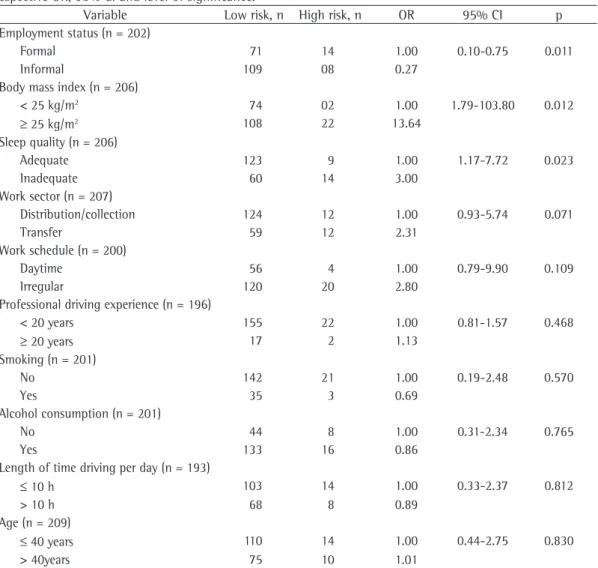
in the overweight range. However, only 9.6% of the drivers reported hypertension and 80.1% reported never smoking. The variables associ-ated with OSAS were employment status, BMI and sleep quality. Table 2 shows the results of the univariate analysis of the variables for risk of OSAS.
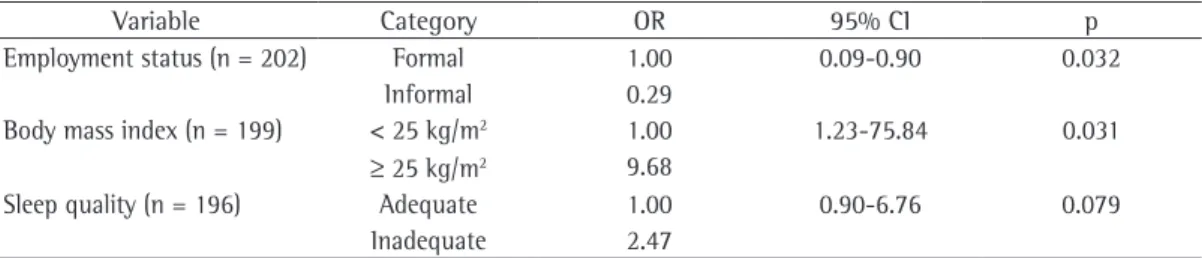
The variables with p < 0.20 (employment status, BMI, sleep quality, work sector and work shift) were tested in the multivariate regression model. In addition, the model was adjusted for age (Table 3).
Informal employment was a protective factor against OSAS (OR = 0.29; p = 0.032), which demonstrates that the way in which work is organized can influence the health of workers. Poor sleep quality was significant as an fallen asleep while driving. The majority (65.1%)
reported having good-quality sleep.
Of the drivers who reported having fallen asleep while driving, 25% are at high risk of developing OSAS. Of those who reported having suffered truck accidents within the preceding 12 months, 15.9% were at high risk of devel-oping OSAS. Of the sample as a whole, 47.8% were overweight and 15.8% were obese.
Most drivers were sedentary (70%) and drank alcohol on weekends (74%), which might have contributed to the rate of overweight observed
(mean BMI of 25.7 ± 6.3 kg/m2).
Of the sample as a whole, 47.8% were overweight and 15.8% were obese. Figure 1 shows the distribution of BMI in the popula-tion studied, revealing that most drivers were
Table 2 - Variables analyzed for risk of obstructive sleep apnea syndrome (univariate analysis), with the respective OR, 95% CI and level of significance.
Variable Low risk, n High risk, n OR 95% CI p Employment status (n = 202)
Formal 71 14 1.00 0.10-0.75 0.011
Informal 109 08 0.27
Body mass index (n = 206)
< 25 kg/m2 74 02 1.00 1.79-103.80 0.012
≥ 25 kg/m2 108 22 13.64
Sleep quality (n = 206)
Adequate 123 9 1.00 1.17-7.72 0.023
Inadequate 60 14 3.00
Work sector (n = 207)
Distribution/collection 124 12 1.00 0.93-5.74 0.071
Transfer 59 12 2.31
Work schedule (n = 200)
Daytime 56 4 1.00 0.79-9.90 0.109
Irregular 120 20 2.80
Professional driving experience (n = 196)
< 20 years 155 22 1.00 0.81-1.57 0.468
≥ 20 years 17 2 1.13
Smoking (n = 201)
No 142 21 1.00 0.19-2.48 0.570
Yes 35 3 0.69
Alcohol consumption (n = 201)
No 44 8 1.00 0.31-2.34 0.765
Yes 133 16 0.86
Length of time driving per day (n = 193)
≤ 10 h 103 14 1.00 0.33-2.37 0.812
> 10 h 68 8 0.89
Age (n = 209)
≤ 40 years 110 14 1.00 0.44-2.75 0.830
ious and temporary employment contracts have
been increasing worldwide.(27) These new ways
of organizing work have an impact on the health of workers that is different from that observed in workers who are formally employed. An example of this is a survey using data from fifteen European countries. This survey revealed that workers submitted to precarious employment had higher rates of work dissatisfaction, fatigue and muscle pain than did those who were formally employed. However, the rates of absenteeism and stress symptoms are higher among workers with permanent full-time employment than among
those with precarious employment.(27)
In the present study, formal employment, in which workers are formally hired by the company, was the principal factor increasing the risk of developing OSAS. This result can be interpreted in the following way: although being regularly employed is an important factor in determining work conditions and lifestyle, the autonomy resulting from outsourced work is a protective factor against the risk of developing OSAS in this study population.
The way the work schedule is organized affects the health of drivers also in terms of eating habits, since irregular shifts can lead to
poor timing and poor-quality meals,(17) which can
result in weight gain and, consequently, increase
the incidence of OSAS.(28) It seems plausible that
irregular meal times contributed to the high prevalence of overweight observed in this study. For decades, there has been a consensus that the periodicity of meals can affect body weight, since the metabolic efficiency of foods differs
according to the time of their ingestion.(20)
According to a family budget study, 40.6% of Brazilian individuals over 20 years of age
are overweight.(29) Although these data(29)
show a high prevalence of overweight in the general population, the prevalence was even higher (47.8%) among the drivers evaluated in adjustment variable in the model (OR = 2.46;
p = 0.079), which means that individuals with OSAS have poor quality sleep due to the symp-toms characteristic of the syndrome, such as daytime sleepiness. In the final model, the factors associated with OSAS were employment status (OR = 0.29; p = 0.032) and BMI (OR = 9.68; p = 0.03). Although sleep quality was not asso-ciated with OSAS, the model showed better adjustment after the inclusion of this variable (OR = 2.47; p = 0.079).
Discussion
As previously mentioned, various studies have shown the prevalence of OSAS to be higher among professional drivers than in the general
population.(3,5,7,17,18) In such studies, the
preva-lence of OSAS has been determined by subjective
instruments(17,18) or by polysomnography.(3,5,7)
The prevalence of OSAS in the present study was lower than that reported in other studies and yet higher than that observed for the general population. It is estimated that objective evalua-tions would confirm a diagnosis of OSAS in 60% of individuals who are at high risk of developing
the syndrome.(26) In addition, those who are at
higher risk of developing OSAS complain about poor sleep quality. Consequently, there is an association between high OSAS risk and reported sleep quality; drivers who are at high risk of developing OSAS classify their sleep quality as poor. Probably, the fragmentation resulting from the increase in awakenings leads them to perceive their sleep quality as poor.
The relationship between OSAS and employ-ment status, revealed in the present study, needs to be investigated more fully, especially in terms of the implications of the types of employment of this professional category. This is particularly relevant, since contemporary socioeconomic changes have led to alterations in the way in which work is organized. The number of
precar-Table 3 - Model of factors associated with risk of obstructive sleep apnea syndrome, controlled for age.
Variable Category OR 95% CI p
Employment status (n = 202) Formal 1.00 0.09-0.90 0.032 Informal 0.29
Body mass index (n = 199) < 25 kg/m2 1.00 1.23-75.84 0.031 ≥ 25 kg/m2 9.68
Sleep quality (n = 196) Adequate 1.00 0.90-6.76 0.079 Inadequate 2.47
15. Li X, Sundquist K, Sundquist J. Socioeconomic status and occupation as risk factors for obstructive sleep apnea in Sweden: a population-based study. Sleep Med. 2008;9(2):129-36.
16. Netzer NC, Stoohs RA, Netzer CM, Clark K, Strohl KP. Using the Berlin Questionnaire to identify patients at risk for the sleep apnea syndrome. Ann Intern Med. 1999;131(7):485-91.
17. Moreno CR, Carvalho FA, Lorenzi C, Matuzaki LS, Prezotti S, Bighetti P, et al. High risk for obstructive sleep apnea in truck drivers estimated by the Berlin questionnaire: prevalence and associated factors. Chronobiol Int. 2004;21(6):871-9.
18. Moreno CR, Louzada FM, Teixeira LR, Borges F, Lorenzi-Filho G. Short sleep is associated with obesity among truck drivers. Chronobiol Int. 2006;23(6):1295-303. 19. Vorona RD, Ware JC. Sleep disordered breathing and
driving risk. Curr Opin Pulm Med. 2002;8(6):506-10. 20. Shiomi T, Arita AT, Sasanabe R, Banno K, Yamakawa
H, Hasegawa R, et al. Falling asleep while driving and automobile accidents among patients with obstructive sleep apnea-hypopnea syndrome. Psychiatry Clin Neurosci. 2002;56(3):333-4.
21. Barbé, Pericás J, Muñoz A, Findley L, Antó JM, Agustí AG. Automobile accidents in patients with sleep apnea syndrome. An epidemiological and mechanistic study. Am J Respir Crit Care Med. 1998;158(1):18-22. 22. Findley LJ, Unverzagt ME, Suratt PM. Automobile
accidents involving patients with obstructive sleep apnea. Am Rev Respir Dis. 1988;138(2):337-40. 23. Matsudo SM, Araújo T, Matsudo VKR, Andrade D ,
Andrade E, Oliveira LC, et. al. Questionário Internacional de Atividade Física (IPAQ): estudo e validade reprodutibilidade no Brasil. Rev Bras Ativ Fis Saúde. 2001;6(2):5-18.
24. Nardone DA. Risk for obstructive sleep apnea. Ann Intern Med. 2000;132(9):758; author reply 759. 25. Chung F, Yegneswaran B, Liao P, Chung SA,
Vairavanathan S, Islam S, et al. Validation of the Berlin questionnaire and American Society of Anesthesiologists checklist as screening tools for obstructive sleep apnea in surgical patients. Anesthesiology. 2008;108(5):822-30. 26. Netzer NC, Strohl KP. Risk for obstructive sleep apnea.
[letter]. Ann Intern Med. 2000;132(9):759.
27. Benavides FG, Benach J, Diez-Roux AV, Roman C. How do types of employment relate to health indicators? Findings from the second European survey on working conditions. J Epidemiol Community Health. 2000;54(7):494-501.
28. Mancini MC, Halpern A. Síndrome da apnéia obstrutiva do sono e obesidade. Rev Bras Clin Ter. 1997;23(2):43-7. 29. Instituto Brasileiro de Geografia e Estatística- IBGE
[homepage on the Internet]. Brasília: Ministério do Planejamento, Orçamento e Gestão. [updated 2007 Nov 12; cited 2007 Dec 15]. Pesquisa de Orçamentos Familiares - POF 2002-2003. Available from: http:// w w w . i b g e . g ov. b r / h o m e / e s t a t is t i c a / p o p u l a c a o / condicaodevida/pof/2002/default.shtm
30. Fundação Instituto Brasileiro de Geografia e Estatística. [homepage on the Internet]. Dados sobre exercício físico, indicadores sociais [on line], 1998. [updated 2008 Oct 28; cited 2008 Nov 8]. Available from: http://www. sempreemforma.com.br/vida_saudavel/infogeral/dados-ibge-exerc-fisic.htm
the present study. Although the proportion of sedentary drivers was high (70.0%) in our study, it was lower than that observed for the general
population (80.1%).(30) In the present study,
the relationship between being overweight and having a sedentary lifestyle was not sufficiently clear, since other factors related to the lifestyle of professional drivers, such as the previously mentioned eating habits, seem to be risk factors for being overweight.
However, the results obtained suggest that work characteristics, such as employment status, are associated with OSAS. These data show the relevance of considering such characteristics in future studies.
References
1. Viegas CA, Oliveira HW. Prevalence of risk factors for obstructive sleep apnea syndrome in interstate bus drivers. J Bras Pneumol. 2006;32(2):144-9.
2. Folkard S, Tucker P. Shift work, safety and productivity. Occup Med (Lond). 2003;53(2):95-101.
3. Stoohs RA, Guilleminault C, Dement WC. Sleep apnea and hypertension in commercial truck drivers. Sleep. 1993;16(8 Suppl):S11-3; discussion 13-4.
4. Young T, Palta M, Dempsey J, Skatrud J, Weber S, Badr S. The occurrence of sleep-disordered breathing among middle-aged adults. N Engl J Med. 1993;328(17):1230-5.
5. Stoohs RA, Bingham LA, Itoi A, Guilleminault C, Dement WC. Sleep and sleep-disordered breathing in commercial long-haul truck drivers. Chest. 1995;107(5):1275-82. 6. Nena E, Tsara V, Steiropoulos P, Constantinidis T,
Katsarou Z, Christaki P, et al. Sleep-disordered breathing and quality of life of railway drivers in Greece. Chest. 2008;134(1):79-86.
7. Mello MT, Santana MG, Souza LM, Oliveira PC, Ventura ML, Stampi C, et al. Sleep patterns and sleep-related complaints of Brazilian interstate bus drivers. Braz J Med Biol Res. 2000;33(1):71-7.
8. Victor LD. Obstructive sleep apnea. Am Fam Physician. 1999;60(8):2279-86.
9. Drager LF, Ladeira RT, Brandão-Neto R.A, Lorenzi-Filho G, Benseñor IM. Síndrome da Apnéia Obstrutiva do Sono e sua Relaçäo com a Hipertensäo Arterial Sistêmica: Evidências Atuais. Arq Bras Cardiol. 2002;78(5):531-6. 10. World Health Organization. Obesity: Preventing and
managing the global epidemic. Geneva: WHO; 1997. 11. Dagan Y, Doljansky JT, Green A, Weiner A. Body
Mass Index (BMI) as a first-line screening criterion for detection of excessive daytime sleepiness among professional drivers. Traffic Inj Prev. 2006;7(1):44-8. 12. Knorst M, Souza FJ, Martinez D. Obstructive sleep
apnea-hypopnea syndrome: association with gender, obesity and sleepiness-related factors. J Bras Pneumol. 2008;34(7):490-6.
13. Strobel RJ, Rosen RC. Obesity and weight loss in obstructive sleep apnea: a critical review. Sleep. 1996;19(2):104-15.
About the authors
Lucia Castro Lemos
Masters Student. University of São Paulo School of Public Health, São Paulo, Brazil.
Elaine Cristina Marqueze
Doctoral Student. University of São Paulo School of Public Health, São Paulo, Brazil.
Fernanda Sachi
Biologist. University of São Paulo School of Public Health, São Paulo, Brazil.
Geraldo Lorenzi-Filho
Director of the Sleep Laboratory of the Pulmonology Department. Heart Institute of the University of São Paulo School of Medicine Hospital das Clínicas, São Paulo, Brazil.
Claudia Roberta de Castro Moreno