Evaluation of the Ef
fi
cacy and Tolerability of Oral
Cipro
fl
oxacin used in the Comprehensive
Treatment of External Bacterial Otitis: An
Observational Prospective Study
Alexander Vladimirovich Gurov
1Andrey Ivanovich Kriukov
1Vera Yakovlevna Kunelskaya
1Galina Nikolaevna Isotova
1Georgiy Borisovich Shadrin
1Yuliya Vladislavovna Luchsheva
1Vladislav Olegovich Yakimov
1Amit Garg
2Shyam Prasad Akku
2Namita Gupta
31The Sverzhevskiy Otorhinolaryngology Healthcare Research Institute, Moscow Department of Healthcare, Moscow, Russian Federation
2Emerging Markets, Global Medical Affairs, Dr. Reddy's Laboratories Ltd., Hyderabad, Telangana, India
3Global Medical Affairs, Dr. Reddy's Laboratories Ltd., Hyderabad, Telangana, India
Int Arch Otorhinolaryngol 2017;21:329–335.
Address for correspondence Namita Gupta, MBBS, Global Medical Affairs, Dr. Reddy's Laboratories Ltd., Banjara Hills, Hyderabad 500034, Telangana, India (e-mail: [email protected]).
Keywords
►
otitis
►
cipro
fl
oxacin
►
observational study
►
staphylococcus
►
pseudomonas
Abstract
Introduction
Otitis Externa is common ear infection with a prevalence of 1%.
Objective
The objective of this study is to evaluate the clinical and microbiological
ef
fi
cacy and safety pro
fi
le with oral cipro
fl
oxacin in the external bacterial otitis (EBO)
management.
Methods
This is a prospective observational study conducted with EBO outpatients
referred to the otorhinolaryngology center in Moscow between March and August 2013.
Our study included patients from two cohorts, acute external bacterial otitis (AEBO)
-Group 1 - and exacerbation of chronic otitis externa (CEBO) - -Group 2. We administered
Cipro
fl
oxacin 500 mg twice daily with standard topical EBO treatment for up to 10 days.
Patients underwent evaluation on study visit days 1, 3, 5, and 10 for the severity.
Bacteriological examination of ear canal cultures took place on Day 1 and Day 10.
Results
We collected data from 60 EBO outpatients (AEBO:
N
¼
30 and CEBO:
N
¼
30). Swimming was the major risk factor associated with the disease in addition
to the most common pathogenic organisms -
Staphylococcus aureus
and
Pseudomonas
aeruginosa
. was We attained complete resolution of the in
fl
ammatory process in 28
(93%) and 27 (90%) patients in the AEBO and CEBO group, respectively. We con
fi
rmed
this by microbiological test with almost complete eradication of the causative
organ-isms. Overall, we observed good positive dynamics of ear canal with no major side
effects.
Conclusion
We found that Cipro
fl
oxacin 500 mg, when administered orally twice daily
for 7 to 10 days in otitis externa patients is clinically and microbiologically effective and
comparatively safer than other antimicrobials.
received August 4, 2016 accepted
November 28, 2016 published online February 17, 2017
DOI https://doi.org/ 10.1055/s-0037-1598648. ISSN 1809-9777.
Copyright © 2017 by Thieme Revinter Publicações Ltda, Rio de Janeiro, Brazil
Introduction
Otitis externa (OE), an infection of the external auditory canal, is common worldwide with a prevalence of 10%. The exact incidence is unknown. The acute form of the disease affects 4 in 1,000 persons and the chronic form affects 3–5% of the population of the United States annually. The clinical picture of OE consists of redness, pain, itching, secretion, along with conductive hearing loss, and even dizziness at times. Otitis externa caused by Pseudomonas aeruginosa may turn malignant and progress to pseudomonal temporal bone osteomyelitis. It is more common in swimmers, humid environments, and people with hearing aids, ab-sence of ear wax, narrow ear canals, and mechanical trauma.1–3
The empirical therapy should be considered for success-ful treatment of the disease. Wide-spectrum antimicrobial drugs (AMD), which are active against the most possible pathogens, particularly P.aeruginosa, antipseudomonal cephalosporins (ceftazidime, cefepime), and fl uoroquino-lones (ciprofloxacin), should be prescribed as soon as possible.
Ciprofloxacin, is a drug of choice for treating severe otitis externa. Due to its better absorption, wide distribution, and broad spectrum of activity against gram negative and gram positive pathogens, severe infections can be treated orally. This can reduce the number of hospitalizations required for parenteral therapy and patients can be discharged from the hospital earlier.4
The current gold-standard treatment in uncomplicated cases consists of appropriate analgesia, topical antibiotics with or without topical steroids. However, severe or resis-tant cases such as patients who are systemically unwell, immunosuppressed, suffering from complications, or have canal stenosis are treated by systemic antibiotics.5 More-over, Otitis externa is accompanied by severe diffuse edema of the cartilaginous part of the external auditory canal skin, which makes the use of topical antibacterial drugs challenging.
Ciprofloxacin exerts bactericidal effect on gram-nega-tive microorganisms not only during division but also at resting stage. This property of the drug ensures its higher clinical efficacy as compared with penicillins, cephalosporins, and aminoglycosides which affect only multiplying bacteria. It is also considered as the very potent antibiotic affecting problematic microorganisms -P. aeruginosa (including multi-drug resistant strains) and Staphylococcus aureus (including some methicillin-resis-tant strains).
Very few studies have been conducted in the primary care environment over the use of topical or oral antibiotics therapy in otitis externa management.
The present study aims to investigate and evaluate, in clinical practice, clinical and microbiological efficacy, toler-ance, and determination of optimum treatment period with systemically administered ciprofloxacin in the treatment of external bacterial otitis (EBO).
Methods
Participants and Study Design
This was a Prospective, Phase IV, Open label, Observational Study. The study took place over the period between March 2013 and August 2013 in one of the diagnostic centers in Moscow.
We studied external bacterial otitis (EBO) outpatients who visited the ENT clinic; we collected data from two cohorts of patients: Group 1 - acute external bacterial otitis (AEBO) and Group 2 - exacerbation of chronic EBO group (CEBO).
We conducted the study in accordance with the Declaration of Helsinki and Good Clinical Practice (GCP). All patients pro-vided signed informed consent prior to the start of the study in accordance with local regulations and standards of Bioethics.
We included in the study patients of both genders (male and female) aged 18 to 65 years with EBO symptoms during the acute stage or during the exacerbation stage of chronic otitis externa. This criteria was regardless of the pathological process, spreading rate, presence of complications, or aggravating fac-tors (prolonged antibiotic, hormonal drugs, cytostatics, radio-therapy of neoplasms, presence of chronic somatic diseases, and secondary immune deficiency caused by these diseases).
We excluded from the study patients with a history of hypersensitivity to ciprofloxacin or any other quinolone agent and those using systemic and/or topical AMDs less than two weeks before visiting the physician.
We also excluded from the study patients with any con-dition that did not meet the protocol requirement or who, in the opinion of the physician, makes the patient unsuitable for inclusion, were excluded from the study.
Therapeutic Scheme and Dose Assignment
In each group, patients received ciprofloxacin (Ciproletfilm coated tablets 500mg; Dr. Reddy’s Laboratory, Hyderabad, India) twice daily in addition to the standard topical EBO treatment (phenazone and lidocaine hydrochloride 1g solu-tion), which is instilled into the external auditory canal of the patient’s affected ear, either with 5 drops 3 times daily, or every 1.5–2 hours if applying cotton wick.6The treatment was administered for 10 days.
Patients also received hyposensitization treatment with or without administration of nonsteroidal anti-inflammatory drugs for analgesia during the whole course of antibacterial therapy of external otitis.
The study drug was given until we achieved clinically significant results but not longer than 10 days.
Assessments
We evaluated study participants prior to treatment, on the day of treatment initiation (Day 1), and during the treatment visits on Days 1, 3, 5, and 10. The duration of study for each patient in this program was 10 days.
external ear canal of the affected ear on the day of visit. We performed otoscopy at every study visit.
Clinical Assessment and Otoscopic examination took
place on visit days 1, 3, 5, and 10. We assessed the following clinical parameters: Body temperature, Ear pain, Hearing acuity, Pathological discharge from the ear, Itching of skin, Pain when pressing the hircus, Hyperemia and infiltration of the skin of cartilage part of external ear canal, Narrowing of the lumen of cartilage part of the external ear canal. We rated the clinical parameters as per severity according to 4 cate-gories (Absent, Mild, Moderate, and Severe) by the physician at all clinic visits.
Antimicrobial Effectivenesswas determined by
bacterio-logical determinations (ear canal cultures): a smear of secre-tion from the external auditory canal of the patient’s affected ear was taken for microscopic and microbiological analysis on the day of presentation before treatment initiation and on Day 10. In all cases, we analyzed the smear microscopy stained by Gram’s Method to identify gram-positive or gram-negative microbialflora.
Study Endpoints
We assessed Clinical Effectiveness by the proportion of
patients who experienced clinical success as assessed by complete resolution of the inflammatory process at the end of therapy in both the groups.
We assessedAntimicrobial Effectivenessby the
bacter-iological eradication at the end of therapy.
The other criteria for of assessment were Subjective General Efficacy Assessment (reported by physician): Pro-nounced, Satisfactory and Unsatisfactory effect; Subjective General Tolerability Assessment (reported by physician): Good, Satisfactory, and Unsatisfactory; and the percentage of patients with positive dynamics of otitis externa.
We monitored, classified and reported all adverse events (AEs) according to good clinical practice (GCP) standards from the local regulatory authority.
Results
We studied 60 external bacterial otitis (EBO) outpatients, referred to the Otorhinolaryngology clinic. We collected data from two cohorts of patients: Group 1 - acute external bacterial otitis (AEBO) (N¼30) and Group 2 - exacerbation of chronic EBO group (CEBO) (N¼30). The 60 were comprised of 24 men and 36 women aged 19 to 60 years (median age 34.75.6 years).
The disease onset was associated with water entry into the external auditory canal during swimming. Majority of them had cleaned the external auditory canal using a cotton wick or other means before swimming or immediately after.
The period of disease (exacerbation) was 2 to 5 days prior to the study initiation. The causative microorganisms belonged to both gram positive and gram negative microflora.
A few patients used antihistamines and non-steroid anti-inflammatory drugs for pain relief during thefirst 1.5–2 days from the treatment initiation of otitis externa.
Efficacy Analysis
Clinical Effectiveness
We observed good positive dynamics on otoscopy and com-plete resolution of the inflammatory process in the external auditory canal by the end of therapy.
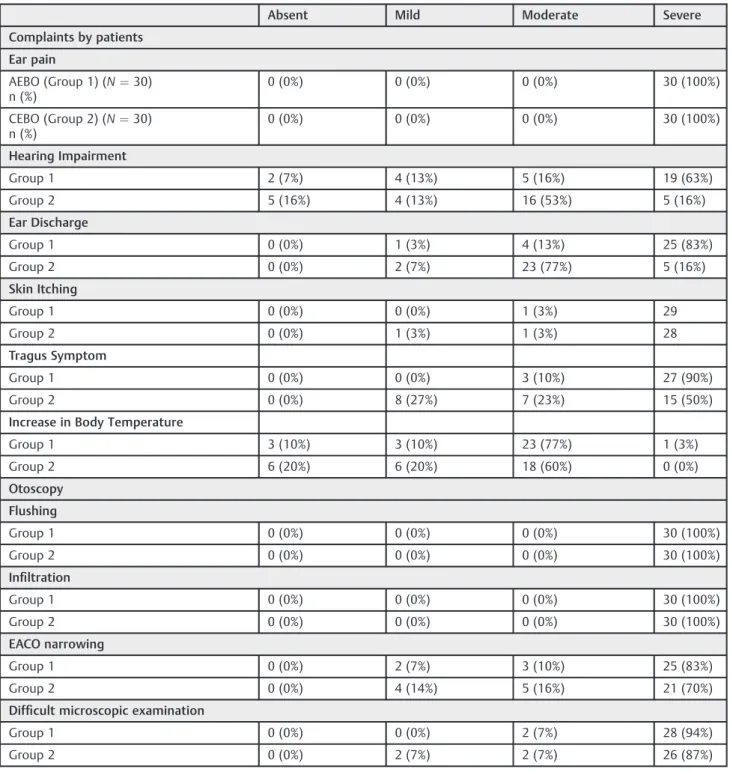
We present a summary table of signs and symptoms of Otitis Externa at baseline in►Table 1.
Ear Pain
On Day 1, all (100%) patients presented with severe ear pain in both the groups. Post treatment, in Group 1, on Day 3, severe ear pain persisted in 4 (13%) patients, followed by moderate and mild ear pain in 8 (27%) and 18 (60%) patients, respec-tively. On Day 5, only one (3%) patient had severe ear pain; 2 (6%) and 6 (20%) patients had mild and moderate pain, respectively. We observed complete resolution of symptoms in 21 (70%) patients.
In Group 2, on Day 3, severe ear pain persisted in 1 (3%) patient, followed by moderate and mild ear pain in 15 (50%) and 14 (47%) patients, respectively. On Day 5, 3 (10%) patients each had mild and moderate pain, respectively. We observed complete resolution of symptoms in 24 (80%) patients.
On Day 10, ear pain resolved completely in all the patients in both the groups except for the persistence of mild pain in 1 patient in Group 1 (►Fig. 1).
Hearing Acuity
On Day 1, hearing impairment was severe in 19 (63%) patients, moderate in 5 (17%), and mild in 4 (13%) patients in Group 1. We observed further improvement on Day 3 and Day 5 with only 7 (23%) patients having severe, 10 (33%) patients having moderate, and 9 (30%) patients having mild symptoms on Day 3 and 2 (6%) patients with severe, 5 (17%) with moderate, and 2 (6%) patients with mild hearing im-pairment on Day 5.
However, in Group 2, on Day 1, hearing impairment was severe in 5 (16%) patients, moderate in 16 (53%), and mild in 4 (13%) patients. On Day 3, 1 (3%) patient had severe, 12 (40%) patients had moderate, and 10 (33%) patients had mild symptoms. On Day 5, moderate hearing loss persisted in 2 (6%) patients and mild in 3 (10%) patients.
By Day 10, 21% and 25% patients completely recovered in Group 1 and Group 2, respectively (►Fig. 2).
Narrowing of External Auditory Canal Opening
On Day 1, we observed severe narrowing of the opening of the external auditory canal (EACO) cartilage part in 25 (83%) patients in Group I and 21 (70%) patients in Group II, moderate in 3 (10%) patients in Group I and 5 (17%) patients in Group II, and mild in 2 (7%) patients in Group I and 4 (13%) patients in Group II.
Overall, the narrowing as observed by otoscopy, persisted in 12 (40%) patients and 13 (43%) patients in Group 1 and Group 2, respectively, on Day 5.
Similarly, positive dynamics and complete resolution of other signs and symptoms such as ear discharge (►Fig. 3), skin itching, tragus symptom (high tenderness while pressing tragus), increase in body temperature (►Fig. 4and►Fig. 5), flushing and skin infiltration, and difficult microscopic
examination were also present in patients from baseline to Day 10 in both groups.
Microbial Effectiveness
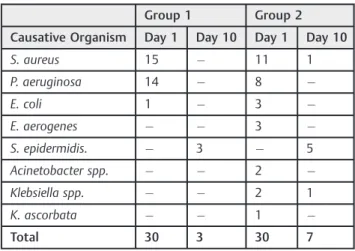
In patients with AEBO (Group 1),S. aureuswas the predomi-nant strain, detected in 15 cases,P. aeruginosain 14 cases, and E. coliin 1 case. In CEBO group,S. aureuswas present in 11 patients, followed byP. aeruginosaandE. coli.
Table 1 Baseline assessment of signs and symptoms of otitis externa by the physician (N¼60)
Absent Mild Moderate Severe
Complaints by patients
Ear pain
AEBO (Group 1) (N¼30) n (%)
0 (0%) 0 (0%) 0 (0%) 30 (100%)
CEBO (Group 2) (N¼30) n (%)
0 (0%) 0 (0%) 0 (0%) 30 (100%)
Hearing Impairment
Group 1 2 (7%) 4 (13%) 5 (16%) 19 (63%)
Group 2 5 (16%) 4 (13%) 16 (53%) 5 (16%)
Ear Discharge
Group 1 0 (0%) 1 (3%) 4 (13%) 25 (83%)
Group 2 0 (0%) 2 (7%) 23 (77%) 5 (16%)
Skin Itching
Group 1 0 (0%) 0 (0%) 1 (3%) 29
Group 2 0 (0%) 1 (3%) 1 (3%) 28
Tragus Symptom
Group 1 0 (0%) 0 (0%) 3 (10%) 27 (90%)
Group 2 0 (0%) 8 (27%) 7 (23%) 15 (50%)
Increase in Body Temperature
Group 1 3 (10%) 3 (10%) 23 (77%) 1 (3%)
Group 2 6 (20%) 6 (20%) 18 (60%) 0 (0%)
Otoscopy
Flushing
Group 1 0 (0%) 0 (0%) 0 (0%) 30 (100%)
Group 2 0 (0%) 0 (0%) 0 (0%) 30 (100%)
Infiltration
Group 1 0 (0%) 0 (0%) 0 (0%) 30 (100%)
Group 2 0 (0%) 0 (0%) 0 (0%) 30 (100%)
EACO narrowing
Group 1 0 (0%) 2 (7%) 3 (10%) 25 (83%)
Group 2 0 (0%) 4 (14%) 5 (16%) 21 (70%)
Difficult microscopic examination
Group 1 0 (0%) 0 (0%) 2 (7%) 28 (94%)
Group 2 0 (0%) 2 (7%) 2 (7%) 26 (87%)
The details of Microbial Culture in both the groups pre-and post- treatment is shown in►Table 2.
As reported earlier, we achieved clinical success in 28 patients in the AEBO group and in 27 patients in the CEBO group, which was also confirmed by microbiological test.
On Day 10, 5 patients in Group 2 and 3 patients in Group 1 revealed the presence of S. epidermidis on microbial culture, which should be regarded as saprophytic flora. However, 2 patients in Group 2 revealed S. aureus and Klebsiella spp. in their microbial culture.
Safety
It should be noted that we did not observe drug-associated adverse events and side effects in patients during the treatment.
On Day 10, Subjective general efficacy assessment was
“Pronounced”and Subjective general tolerability assessment was“Good.”
The percentage of patients with positive dynamics of otoscopic signs of otitis externa was 100% in both the groups by Day 10.
The percentage of patients with full resolution of the inflammatory process was 20% in Group 1 (6 patients) and 17% in Group 2 (5 patients) on Day 5, which drastically improved on Day 10 with 93% in Group 1 (28 patients) and
90% in Group 2 (27 patients) reporting complete resolution of the inflammatory process.
Discussion
The empirical treatment of otitis externa utilizes the drugs with broad spectrum of activity and with a higher efficacy against common pathogens, such as P. aeruginosa and S. aureus. Fluoroquinolones have this property led by ciprofloxacin; which has a very high bactericidal activity against wide spectrum of pathogens including both gram positive and gram negative organisms with no ototoxic side effects.
We conducted the present observational study in otitis externa outpatients with an intent to study the clinical and microbiological efficacy and safety of oral ciprofloxacin pre-scribed to patients in the clinical settings.
A prospective observational study conducted in AEBO patients by Pabla et al observed that the majority of patients (44%) in the ENT clinic were prescribed topical antibiotics with oral antibiotics in patients with severe disease or those with high risk; only 14% were given topical treatment by their physician. This demonstrates a wide variation in the usage of topical or/and oral antibiotics in clinical practice in the management of otitis externa.7
Fig. 3 Proportion of patients with ear discharge from day 1 to day 10.
Fig. 4 Proportion of patients with body temperature from day 1 to day 10 (Acute External Bacterial Otitis).
100%
40%
10%
0%
100%
53.30%
10%
0%
0% 20% 40% 60% 80% 100% 120%
Day 1 Day 3 Day 5 Day 10
Proportion
of Patient
s, %
Treatment Duration in Days
AEBO CEBO
Fig. 1 Proportion of patients with ear pain from day 1 to day 10.
An epidemiological survey by Rowlands et al had also shown a similar ambiguity in UK General Practice and em-phasizes a dire need to develop the standard guidelines to guide clinicians for administering the appropriate treatment regimen to patients with OE.8
Although topical antimicrobial therapy is highly effective, it may at times fail due to failure of delivery and inability to reach the infection site properly. This occurs due to various reasons such as ear canal occlusion due to wax, debris, edema, and granulation tissue. In such cases, systemic antibiotics remains a better treatment option for the prescribers. Never-theless, topical preparations are more likely to attain higher concentrations at the target site and had comparatively better cure rates than systemic antimicrobials, as studied earlier.7 Thus, the best approach may be to use the combination of both systemic and topical treatment.
Thefirst evidence based clinical practice guidelines on acute otitis externa (AOE) management was produced by the American Academy of Otolaryngology-Head and Neck Sur-gery Foundation (AAO-HNSF). The recommendations suggest that topical preparations should be used in diffuse
uncom-plicated AOE as compared with systemic antibiotics, which should not be routinely used and recommended only in complicated cases, such as those in which the disease extends out from the ear canal or in immuno-compromised states, among others.9
Ear syringing to remove wax, inserting foreign objects in the ear canal, or any such practices should be discouraged particularly in high risk patients prone to develop“ malig-nant”or“invasive”otitis externa. Instead, high risk patients should be advised for early referral to the ENT department for proper assessment and treatment.9
In a study by Roland et al, results showed that Ciprofl ox-acin/Dexamethasone treatment resulted in greater pain relief attained over the first 3 days in patients with acute OE compared with Neomycin/Polymyxin/Hydrocortisone and a rapid reduction in severe pain after treatment initiation.10
In our study, complete resolution of the inflammatory process in the external auditory canal was observed in 28 (93%) patients in AEBO group and 27 (90%) patients in CEBO group. This was also confirmed by microbiological test. S. aureusandKlebsiella spp.were detected in the culture of two patients in CEBO group on Day 10. The lack of treatment is most likely due to the development of ciprofloxacin resistant strains.
Additionally, we observed good positive dynamics of oto-scopic signs, with 100% of patients showing good results by Day 10 in both the groups.
Swimming was identified as the significant risk factor associated with the disease. However, pathogenic organisms, S. aureusandP. aeruginosa, were considered to be the most common etiology, withS. aureusbeing a dominant organism in our study. This varied slightly from the survey by Fein-messer et al, whereP. aeruginosawas the dominant pathogen in swimmers with OE.11
Our study is conducted independent of the disease dura-tion; we studied both acute and chronic otitis externa pa-tients. The study results are similar to the studies done earlier. Clinical cure and bacteriological eradication rates are comparatively better in the quinolone containing monothera-pies vis a vis classic antibiotic-steroid combination drugs. This was confirmed in the meta-analysis done by Mosges et al for thefirst time.12They showed a significantly higher cure rate (OR: 1.29; 95% CI: 1.06–1.57; p¼0.01) and a significantly superior eradication rate (OR: 1.44; 95% CI: 1.03–2.02; p¼0.03) by the use of quinolone drugs.
Dosing schedules of systemic administration have not been studied; topical therapy (quinolone drops) suggests twice daily dosing. In an open label study, ofloxacin showed good clinical outcomes with once daily regimen. The optimal duration of therapy varies from a few days to several weeks in published studies.9Our study demonstrated the effectiveness of twice daily dosing of oral ciprofloxacin for 7 to 10 days.
The well-defined regimens of the marketed products have clear advantages, such as less frequent dosing and shorter duration of therapy; this further improves patient's compli-ance, reducing the development of bacterial resistance and the potential for unwanted side effects.
Table 2 Microbiological characteristic of otitis externa causative agents in the examined patients
Group 1 Group 2
Causative Organism Day 1 Day 10 Day 1 Day 10
S. aureus 15 11 1
P. aeruginosa 14 8
E. coli 1 3
Е. aerogenes 3
S. epidermidis. 3 5
Acinetobacter spp. 2
Klebsiella spp. 2 1
K. ascorbata 1
Total 30 3 30 7
During the monitoring of AEBO and exacerbation of CEBO treatment, no adverse events associated with the drug pro-ducts were reported.
A further study with larger sample size is warranted to draw anyfirm conclusion.
Conclusion
We found Ciprofloxacin (1000 mg daily for 7 to 10 days) to be an effective and safe drug for the treatment of otitis externa; it is a prudent in clinical practice and may be prescribed on routine basis, especially in severe cases or in high risk patients suffering from diabetes or immune suppression.
Note
This trial is registered with http://clinicaltrials.gov, num-ber NCT02140073.
References
1 van Balen FAM, Smit WM, Zuithoff NPA, Verheij TJM. Clinical efficacy of three common treatments in acute otitis externa in primary care: randomised controlled trial. BMJ 2003;327 (7425):1201–1205
2 Hajioff D, Mackeith S. Otitis externa. BMJ Clin Evid 2010;2010:510
3 Osguthorpe JD, Nielsen DR. Otitis externa: Review and clinical update. Am Fam Physician 2006;74(09):1510–1516
4 Louie TJ; Committee on Antimicrobial Agents. Canadian Infectious Disease Society. Ciprofloxacin: an oral quinolone for the treatment of infections with gram-negative pathogens. CMAJ 1994;150(05): 669–676
5 Jayakar R, Sanders J, Jones E. A study of acute otitis externa at Wellington Hospital, 2007-2011. Australas Med J 2014;7(10): 392–399
6 Sander R. Otitis externa: a practical guide to treatment and prevention. Am Fam Physician 2001;63(05):927–936, 941–942
7 Pabla L, Jindal M, Latif K. The management of otitis externa in UK general practice. Eur Arch Otorhinolaryngol 2012;269(03):753–756
8 Rowlands S, Devalia H, Smith C, Hubbard R, Dean A. Otitis externa in UK general practice: a survey using the UK General Practice Research Database. Br J Gen Pract 2001;51(468):533–538
9 Rosenfeld RM, Schwartz SR, Cannon CR, et al. Clinical practice guideline: acute otitis externa. Otolaryngol Head Neck Surg 2014; 150(1, Suppl)S1–S24
10 Roland PS, Younis R, Wall GM. A comparison of ciprofloxacin/ dexamethasone with neomycin/polymyxin/hydrocortisone for otitis externa pain. Adv Ther 2007;24(03):671–675
11 Agius AM, Pickles JM, Burch KL. A prospective study of otitis externa. Clin Otolaryngol Allied Sci 1992;17(02):150–154