Safety and ef
fi
cacy of regional citrate anticoagulation
in continuous blood puri
fi
cation treatment of patients
with multiple organ dysfunction syndrome
B. Tuerdi
1, L. Zuo
1, H. Sun
1, K. Wang
1, Z. Wang
2and G. Li
21
Respiratory Intensive Care Units, the First Affiliated Hospital of Xinjiang Medical University, Urumqi, Xinjiang, China
2
Intensive Care Units, Branch of the First Affiliated Hospital of Xinjiang Medical University, Changji, Xinjiang, China
Abstract
The aim of this study was to discuss the safety and efficacy of regional citrate anticoagulation (RCA) on continuous blood purification (CBP) during the treatment of multiple organ dysfunction syndrome (MODS). Thirty-five patients with MODS were divided into two groups: the local citrate anticoagulation (RCA) group, and the heparin-free blood purification (hfBP) group. The MODS severity was assessed according to Marshall’s MODS score criteria. Blood coagulation indicators, blood pressure,filter lifespan,filter replacement frequency, anticoagulation indicators, and main metabolic and electrolyte indicators were analyzed and compared between RCA and hfBP groups. RCA resulted in lower blood pressure than hfBP. Thefilter efficacy in RCA treatment was longer than in the hfBP group. The blood clearance of creatine, blood urea nitrogen and uric acid was better in the RCA group. RCA also led to higher pH than hfBP. Neither treatment resulted in severe bleeding events. In addition, MODS score was positively correlated with prothrombin time and activated partial thromboplastin time but negatively correlated with platelet concentration. RCA is a safer and more effective method in CBP treatment; however, it could also lead to low blood pressure and blood alkalosis.
Key words: Multiple organ dysfunction syndrome; Continuous blood purification; Blood coagulation function; Sodium citrate
Introduction
Multiple organ dysfunction syndrome (MODS) is a common critical illness, referring to the occurrence of simul-taneous or sequential organ or system dysfunction 24 h after severe infection, wound shock, major surgery, severe pancreatitis, cardio-pulmonary resuscitation or other protop-athies (1). It is generally believed that MODS is attrib-uted to uncontrolled inflammatory mediators release, usually accompanied by inflammatory and metabolic disorders (2). Despite MODS pathogenesis being widely acknowledged and various therapies being introduced, the mortality of MODS is still much higher than 40%, rankingfirst among all critical illness-caused deaths (3,4).
Continuous blood purification (CBP), also named con-tinuous renal replacement therapy, is a technology used to eliminate blood metabolites slowly and continually. As a new technology, CBP has already been applied in non-kidney disease treatments and has shown unique advan-tages when treating severe acute pancreatitis, systemic inflammatory response syndrome, sepsis, acute respiratory distress syndrome and MODS, becoming the main measure used to rescue critically ill patients (5). CBP is characterized
by its hemodynamic stability, high metabolites clearance rate, efficiency of inflammatory mediator elimination and provision of nutritional support (6). In recent years, CBP has been widely applied to salvage and treat severely ill patients with remarkable therapeutic efficacy. CBP has been extensively applied in intensive care units in China, and its use on MODS treatment has been fully acknowl-edged (7). However, CBP needs continuous anticoagula-tion. Patients undergoing CBP are usually accompanied by active bleeding or a high risk of bleeding. The dissemi-nated intravascular coagulation, triggered by severe wounds, infection, sepsis and shock, needs to be controlled (8). Insufficient anticoagulation (frequent coagulation) can sus-pend the treatment, and raise the clinical costs as well. On the other hand, over-anticoagulation may result in bleeding, or even life-threatening problems (9).
Therefore, the conduct of a safe and effective antico-agulation during CBP treatment is paramount. Although there are various anticoagulants available, none is omnip-otent, given the variety of patients’ physical conditions (10). For instance, the commonly used heparin may result
Correspondence: B. Tuerdi:<[email protected]>
in severe bleeding; low-molecular-weight heparin needs a high water-flow rate and the flow increases the volume load, which cannot be tolerated by hemodynamically instable patients; trisodium citrate is not consistent, and the technical aspect of its use is rather complicated; and regional citrate anticoagulation (RCA) could lead to low blood pressure of patients. The safety and efficacy of various anticoagulants need to be evaluated to pro-vide useful information for clinicians when choosing the appropriate anticoagulants for their patients. On the other hand, heparin-free blood purification (hfBP) combined with molecular adsorbent recirculating system (MARS) showed a better non-bleeding outcome. In addition, heparin-free-MARS purification did not compromise the circuit function and longevity (11). A study on unfractionated heparin in 61 MARS treatment sessions in 33 patients showed that the platelet count was reduced but the platelet func-tion remained unchanged (12). Heparin-free purification was also required for patients without disseminated intra-vascular coagulation, who demonstrated some coagula-tion abnormalities and thrombocytopenia during coupled plasmafiltration adsorption (CFPA) purification therapy (13). In this study, RCA and hfBP were compared in terms of the anticoagulation safety and efficacy during CBP treatment of MODS patients. This study may provide evi-dence that RCA could be a better choice for MODS CBP treatments.
Material and Methods
Patients
Thirty-five patients (25 males and 10 females) with MODS who came to the hospital for CBP during June 2009 and September 2010 were enrolled in this study. The MODS of the 35 patients was caused by trauma (n=8), septic shock (n=10), severe acute pancreatitis (n=7), pregnancy-induced hypertension (n=3), postpartum hemorrhage (n=2), hepatic failure (n=1), open-heart surgery (n=3) and abdom-inal aortic aneurysm (n=1). All the included participants who agreed with this study were randomly assigned to RCA blood purification (RCA group, n=17) or the hfBP group (n=18). Written informed consent and ethics approval were signed by the patients’legal representatives.
Inclusion and exclusion criteria
Patients with MODS who needed CBP and met the MODS diagnosis criteria (the Marshall 1995 MODS score criteria, shown in Supplementary Table S1) were included (14,15). Those with MODS caused by hemato-logic system disorders or severe thrombocytopenia were excluded.
Intervention
Diapact polysulfone HI PS 18 filter (B. Braun, Germany) and circuit tube were used to establish the extracorporeal circuit system. The patients in both groups
were treated with continuous veno-venous hemofiltration (CVVH). Pre-dilution mode was used and the replacement
fluid speed was 3000–4000 mL/h. The blood flow was
kept above 150 mL/min. Ionized calcium (iCa) levels were measured 1 h after the start of CVVH and every 6 h thereafter.
Anticoagulant citrate dextrose A (ACD-A) solution (600 mL, purchased from Nigale Corporation, China) was used as the replacement fluid in the RCA group. The ACD-A infusion rate was 2–2.5% of blood flow rate, which was 4150 mL/min. During this procedure, the concentration of main electrolytes reached the final 140 mmol/L of Na+, 105 mmol/L of Cl–, 0 mmol of Ca2+, 0.94 of Mg2+,
11.1 mmol/L of glucose, 21 mmol/L of HCO3–and 4.6 mmol/L
of citrate. Bicarbonate substitutionfluid was used as the hfBP solution with 140 mmol/L of Na+, 110 mmol/L of Cl–,
1.5 mmol/L of Ca2+, 0.94 mmol/L of Mg2+, 10.5 mmol/L of
glucose and 35 mmol/L of HCO3–.
Adverse reactions
No reverse reactions were seen in either group. The evaluated reverse reactions include paresthesia, twitching movement, fever and bleeding complications.
Study endpoints
Our study endpoints were efficacy and safety. Safety was defined as the lack of adverse events such as hemorrhage complications including digestive tract, respira-tory tract, incision, oral mucosa and derma hemorrhage before and after treatment. The duration of thefirstfilter and the replacement frequency offilters were assessed. Major bleeding was defined as the presence of severe bleeding with spontaneous blood pressure drop. Metabolic alkalosis was defined as pH47.5. Hypocalcemia was defined as ionized calcium levelo1.1 mmol/L.
Data collection
The severity of MODS was scored using MODS score system before and after the treatment in the two groups. The Glasgow Coma Scale was calculated by a nurse who did not participate the study. The hemorrhage complica-tions were assessed by a physician who was not involved in this study.
Coagulation indicators including prothrombin time (PT), PT activity, activated partial thromboplastin time (APTT), international normalized ratio (INR), fibrinogen (FIB) and platelet concentrations were recorded before and 24 h after CBP. Besides, the pressure of artery (PA), the pressure before hemofilter (PBE), the pressure of vein (PV), transmembrane pressure (TMP), the duration of
Statistical analyses
Data are reported as means±SD. Data were analyzed using the SPSS 20.0 package (IBM, USA). One-way ANOVA was used to compare differences of the indicators among different MODS groups before treatment. Param-eters between the RCA and hfBP groups were com-pared using the t-test. Pre-treatment and post-treatment assessments were compared using the t-test. Bartlett sphericity test with or without Greenhouse-Geisser correc-tion was performed to compare inter-group or intra-group data at different time points. Statistical significance was determined if P values were less than 0.05.
Results
Clinical characteristics of participants at the initiation of blood purification
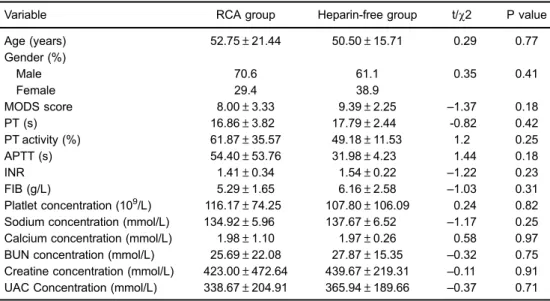
Generally, there were no notable differences in the tested indicators between the RCA and hfBP groups (Table 1).
Blood coagulation indicators
In both groups, the coagulation indicators did not differ significantly before and after treatment. There was also no significant difference between the RCA post-treatment out-comes and the hfBP post-treatment outout-comes (Table 2).
Hemorrhage events and blood pressure comparison
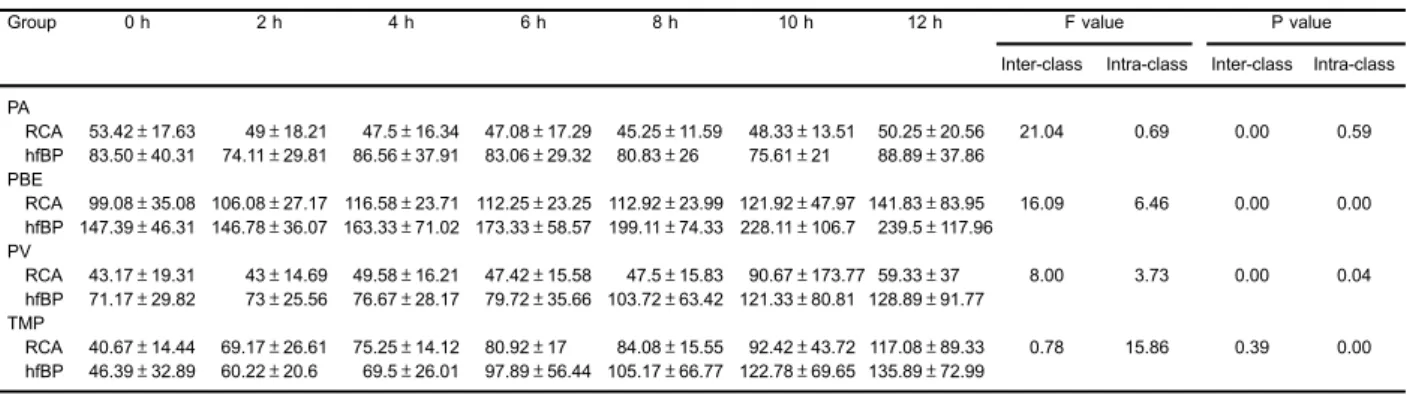
No patients in either group showed hemorrhage symptoms (Table 3). Within each group, PA did not differ
significantly between different time points, whereas PBE, PV and TMP altered substantially as the anticoagulation treatment time advanced. Except for TMP, the remaining tested indicators were significantly higher in the hfBP group than in the RCA group. RCA resulted in lower blood pressure than hfBP treatment, indicating that RCA might be a risk factor for bleeding.
Lifespan and replacement frequency of thefilter
Thefilter lifespan of the RCA group was approximately 29.8 h, whereas that of the hfBP group was about 12.5 h and this difference was significant. The replacement frequency of the RCA group (5.90%) was substantially smaller than that of the hfBP group (88.90%). These results indicated that hfBP increased the risk of blood clotting, showing worse efficacy in anticoagulation (Table 4).
Blood clearance
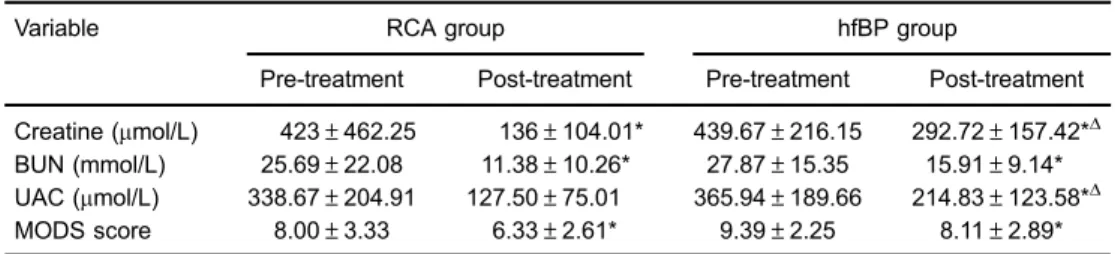
The concentration of creatine (Cr), blood urea nitrogen (BUN) and MODS score were significantly lower after both treatments compared with pre-treatment. Cr and uric acid concentrations in the hfBP group were both significantly higher after treatment than in the RCA group (Table 5). These results indicated that RCA had better clearance outcomes in terms of Cr and uric acid clearance than hfBP.
Main metabolic and electrolyte indicators
RCA significantly increased systemic pH after treat-ment, suggesting that RCA could result in metabolic alkalosis
Table 1.Baseline characteristics of patients with multiple organ dysfunction syndrome (MODS) at the initiation of blood purification.
Variable RCA group Heparin-free group t/w2 P value
Age (years) 52.75±21.44 50.50±15.71 0.29 0.77
Gender (%)
Male 70.6 61.1 0.35 0.41
Female 29.4 38.9
MODS score 8.00±3.33 9.39±2.25 –1.37 0.18
PT (s) 16.86±3.82 17.79±2.44 -0.82 0.42
PT activity (%) 61.87±35.57 49.18±11.53 1.2 0.25
APTT (s) 54.40±53.76 31.98±4.23 1.44 0.18
INR 1.41±0.34 1.54±0.22 –1.22 0.23
FIB (g/L) 5.29±1.65 6.16±2.58 –1.03 0.31
Platlet concentration (109/L) 116.17±74.25 107.80±106.09 0.24 0.82 Sodium concentration (mmol/L) 134.92±5.96 137.67±6.52 –1.17 0.25
Calcium concentration (mmol/L) 1.98±1.10 1.97±0.26 0.58 0.97
BUN concentration (mmol/L) 25.69±22.08 27.87±15.35 –0.32 0.75
Creatine concentration (mmol/L) 423.00±472.64 439.67±219.31
–0.11 0.91
UAC Concentration (mmol/L) 338.67±204.91 365.94±189.66 –0.37 0.71
during treatment. RCA significantly decreased iCa level after treatment, suggesting that RCA could result in hypocalcemia. Na+ and HCO3– concentrations had no
significant difference before treatment and after treat-ment in both groups. Similarly, RCA also showed signif-icantly higher pH and lower iCa level than hfBP treatment. Na+ and HCO3–concentrations had no significant
differ-ence between groups (Table 6).
Correlation between coagulation indicators and MODS scores
PT and INR showed no difference among the three MODS score groups. PT activity in the410–15 group was
more intense than the 0–p5 and45–p10 groups. APTT
of the45–p10 group was significantly lower than in the
0–p5 and410–15 groups, and platelet concentration of
the410–15 group was significantly lower than the 0–p5
Table 2.Coagulation indicators at baseline and after continuous blood purification within regional citrate anticoagulation (RCA) or heparin-free blood purification (hfBP) groups.
PT (s) PT activity (%) APTT (s) INR FIB (g/L) Platelet concentration (109/L)
RCA group
Before treatment 16.86±3.82 61.87±35.57 54.40±53.76 1.14±0.34 5.29±1.65 116.17±74.25 After treatment 17.43±2.65 48.58±11.88 33.07±5.37 1.46±0.23 4.41±1.80 119.83±62.72
t –0.49 1.43 1.41 –0.45 1.34 –0.19
P value 0.66 0.18 0.19 0.66 0.21 0.85
hfBP group
Before treatment 17.79±2.44 49.18±11.53 31.98±4.23 1.54±0.22 6.16±2.58 107.80±106.09 After treatment 17.71±3.73 50.32±9.95 34.56±8.15 1.55±0.48 5.65±2.24 102.64±112.50
t 0.78 –0.38 –1.8 –0.14 1.1 0.78
P value 0.94 0.71 0.09 0.89 0.29 0.45
Data are reported as means±SD. PT: prothrombin time; APTT: activated partial thromboplastin time; INR: international normalized ratio; FIB:fibrinogen. Statistical analysis was performed with thet-test.
Table 3.Anticoagulation efficacy of regional citrate anticoagulation (RCA) and heparin-free blood purification (hfBP) treatments.
Group 0 h 2 h 4 h 6 h 8 h 10 h 12 h F value P value
Inter-class Intra-class Inter-class Intra-class
PA
RCA 53.42±17.63 49±18.21 47.5±16.34 47.08±17.29 45.25±11.59 48.33±13.51 50.25±20.56 21.04 0.69 0.00 0.59 hfBP 83.50±40.31 74.11±29.81 86.56±37.91 83.06±29.32 80.83±26 75.61±21 88.89±37.86
PBE
RCA 99.08±35.08 106.08±27.17 116.58±23.71 112.25±23.25 112.92±23.99 121.92±47.97 141.83±83.95 16.09 6.46 0.00 0.00 hfBP 147.39±46.31 146.78±36.07 163.33±71.02 173.33±58.57 199.11±74.33 228.11±106.7 239.5±117.96
PV
RCA 43.17±19.31 43±14.69 49.58±16.21 47.42±15.58 47.5±15.83 90.67±173.77 59.33±37 8.00 3.73 0.00 0.04 hfBP 71.17±29.82 73±25.56 76.67±28.17 79.72±35.66 103.72±63.42 121.33±80.81 128.89±91.77
TMP
RCA 40.67±14.44 69.17±26.61 75.25±14.12 80.92±17 84.08±15.55 92.42±43.72 117.08±89.33 0.78 15.86 0.39 0.00 hfBP 46.39±32.89 60.22±20.6 69.5±26.01 97.89±56.44 105.17±66.77 122.78±69.65 135.89±72.99
Data are reported as means±SD. PA: pressure of artery; PBE: pressure before hemofilter; PV: pressure of vein; TMP: transmembrane pressure. Statistical analysis was performed with one-way ANOVA.
Table 4.Filter lifespan and the number of patients with multiple organ dysfunction syndrome treated with regional citrate anticoagulation (RCA) or heparin-free blood purification (hfBP) undergoingfilter replacement.
Group Filter
lifespan (h)
Complete replacement (n)
Filter replacement (n)
No replacement (n)
Total (n)
Replacement rate (%)
RCA 29.84±21.34 0 2 15 17 5.90
HfBP 12.46±17.13 15 1 2 18 88.9*
w2=20.91 P=0.001
and45–p10 groups. FIB concentration in the45–p10
group was significantly more intense than in the 0–p5
group. These results indicated a positive correlation between PT activity and MODS score but a negative correlation between platelet concentration and MODS score (Table 7).
Discussion
CBP appears to be the last resort to rescue MODS patients due to its advantage of continuity during the
treatment. In this process, protecting patients from bleed-ing is important. However, how to conduct anticoagulation during CBP therapy for MODS patients with a high risk for bleeding still remains problematic (9). We assessed the efficacy and safety of RCA in the CBP treatment in this study. We compared the anticoagulation effects of MODS patients going through RCA or hfBP. By analyzing blood coagulation indicators, blood pressure, blood clearance and the occurrence of complications, we arrived at the conclusion that RCA is a comparatively safe and effective method in CBP treatment of MODS patients.
Table 5.Blood clearance parameters and multiple organ dysfunction syndrome (MODS) scores of regional citrate anticoagulation (RCA) and heparin-free blood purification (hfBP) treatment groups.
Variable RCA group hfBP group
Pre-treatment Post-treatment Pre-treatment Post-treatment
Creatine (mmol/L) 423±462.25 136±104.01* 439.67±216.15 292.72±157.42*D BUN (mmol/L) 25.69±22.08 11.38±10.26* 27.87±15.35 15.91±9.14* UAC (mmol/L) 338.67±204.91 127.50±75.01 365.94±189.66 214.83±123.58*D
MODS score 8.00±3.33 6.33±2.61* 9.39±2.25 8.11±2.89*
Data are reported as means±SD. BUN: blood urea nitrogen; UAC: uric acid. * Po0.05, post-treatmentvs pre-treatment;DP
o0.05, heparin-freevsRCA after treatment. Statistical analysis was performed with the t-test.
Table 6.Main metabolic and electrolyte parameters before and after the treatment of patients with multiple organ dysfunction syndrome treated with regional citrate anticoagulation (RCA) or heparin-free blood purification (hfBP).
Group pH iCa (mmol/L) Na+(mmol/L) HCO
3
-(mmol/L)
RCA
Before treatment 7.35±0.14 1.68±2.26 134.92±5.96 21.32±7.03 After treatment 7.43±0.05*+ 1.08±0.10 137.75±3.31 24.16±1.74 hfBP
Before treatment 7.42±0.09 1.07±0.15 137.67±6.52 21.73±4.38 After treatment 7.44±0.06 1.06±0.14 138.44±4.64 22.69±2.70
Data are reported as means±SD. iCa: ionized Ca. * Po0.05, before-treatmentvsafter-treatment group; +Po0.05, RCAvshfBP group. Statistical analysis was performed with thet-test.
Table 7.Correlation between multiple organ dysfunction syndrome (MODS) score and coagulation indicators of patients with multiple organ dysfunction syndrome treated with regional citrate anticoagulation or heparin-free blood purification.
MODS score PT (s) PT activity (%) APTT (s) INR FIB (g/L) Platelet (109/L)
0–p5 19.37±2.22 41.70±8.41 41.77±4.54 1.62±0.21 3.59±1.62 130.00±79.89 45–p10 17.62±2.96 50.45±14.11 33.78±8.77 1.51±0.25 6.23±2.31* 129.19±99.81
In our research, we selected ACD-A, a commercially available blood preservation solution, to act as the anti-coagulant. There are many indicators to assess antico-agulation efficacy including whole blood activated clot-ting time, calcium level at the vein side of extracorporeal circulation and the lifespan of filters (16). We chose the lifespan of filters as our primary outcome of efficacy. A longerfilter lifespan means a more effective treatment time and less treatment interruption. In our research, a better efficacy of RCA anticoagulation was found. This result was consistent with a published study, in which RCA treatment was related to a longer lifespan offilters com-pared with the control group (17). Morabito et al. (18) also suggested that RCA could ensure enough filter life and decrease treatment cost.
RCA technology inputs sodium citrate through arterial blood. Citrate and calcium react in the blood and form calcium citrate, which is hard to dissolve, so the activated calcium ions in the blood significantly decrease, thrombin and other blood coagulation processes occur leading to full anticoagulation. The most important aim of hemodia-lysis is to remove the poisonous solute and metabolites in the patients’bodies, and it has to be achieved only under the condition of efficient extra-corporeal circuit antico-agulation. Despite the reported efficacy of RCA, several safety endpoints should also be considered. The blood concentration of Cr, BUN, and UAC also significantly decreased after RCA treatment. Compared with the con-trol group, RCA revealed better ability in Cr, BUN and UAC clearance, indicating its higher safety. Citrate cannot be used with hemofiltration alone because of the insuffi -cient clearance of sodium citrate in blood, which could cause the imbalance of serum sodium and bicarbonate concentrations (19). Moreover, high ultrafiltration rate was reported to reach high clearances (19). No report has carefully elaborated the mechanism by which RCA eliminates Cr, BUN and UAC in blood after the blood purification process. However, studies found that citrate anti-coagulation indeed demonstrated better blood solute clearance than other purification methods (20-22). It has been agreed that the excess citrate used in RCA purification can be metabolized via the kidney and liver. We believe that this is related to the good Cr, BUN and UAC clearance results of RCA purification method.
In the present study, we also assessed the blood pressure-related indicators, such as PA, PBE, PV and TMP, to evaluate the safety of different anticoagulants. RCA resulted in lower blood pressure than hfBP, suggest-ing a lower risk of bleedsuggest-ing. (23). The most common complication of RCA treatment is hypocalcemia, which together with metabolic alkalosis are closely correlated with the use of sodium citrate. In our study, hemorrhage complications were not observed in RCA and hfBP
groups; however, it was possible that other complications such as citrate acidosis, hypernatremia and metabolic acid-basic disorder may occur (24). For example, the electrolyte indicator ‘‘pH’’ was higher in patients treated with RCA, suggesting that RCA may result in metabolic alkalosis. However, the risk of metabolic alkalosis when using citrate and bicarbonate is rarely high and could be lower when using a carefully calculated bicarbonate continuous veno-venous hemofiltration algorithm (18,25). Another study pointed out that a lower dialysate bicarbo-nate concentration (o25 mmol/L) may lower the occur-rence of alkalosis (26). As mentioned before, the severest complication caused by citrate infusion is hypocalcemia, which could result in myocardial dysfunction or even death (27,28). The metabolic process of citrate in the body is fast. If we stop the input of sodium citrate, within 10 to 30 minutes the level of citrate and free calcium in the body can be restored to the normal level. Therefore, the proper operation may ensure safety in therapy. For example, metabolic complications could be reduced if a standard-ized protocol is applied to adjust dialysate flow and calcium substitution so that the blood pH and ionized calcium levels would be maintained within a normal range (29). In the present study, imbalances of iCa were not significantly different between the RCA and hfBP groups after treatment, which is probably because of the small study population. This contradiction requires a further study involving a larger patient cohort to study the ionized calcium imbalance after the treatment of RCA and other anticoagulants.
There are some limitations to this study. First, the sample consisted of only 35 patients, which was limited compared with other studies probing into RCA (30). Second, although this study included a variety of out-comes, it still lacked some important indicators, such as other potential complications like 30-day survival rate (31). Hence, we failed to present an impressive reduction in mortality after the use of RCA. The efficacy and safety of other anticoagulants could also be considered in further studies.
In conclusion, RCA treatment demonstrated safer and more effective outcomes than the hfBP treatment. How-ever, RCA could also lead to several adverse effects such as blood alkalosis and low blood pressure.
Supplementary material
Click here to view [pdf].
Acknowledgments
References
1. Walsh CR. Multiple organ dysfunction syndrome after multiple trauma. Orthop Nurs 2005; 24: 324–333; quiz 334–335.
2. Schmidt H, Lotze U, Ghanem A, Anker SD, Said SM, Braun-Dullaeus R, et al. Relation of impaired interorgan commu-nication and parasympathetic activity in chronic heart failure and multiple-organ dysfunction syndrome.J Crit Care2014; 29: 367–373, doi: 10.1016/j.jcrc.2013.12.015.
3. Kochanek KD, Murphy SL, Anderson RN, Scott C. Deaths: final data for 2002.Natl Vital Stat Rep2004; 53: 1–115.
4. Kung HC, Hoyert DL, Xu J, Murphy SL. Deaths:final data for 2005.Natl Vital Stat Rep2008; 56: 1–120.
5. Rico MP, Fernandez Sarmiento J, Rojas Velasquez AM, Gonzalez Chaparro LS, Gastelbondo Amaya R, Mulett Hoyos H, et al. Regional citrate anticoagulation for continuous renal replacement therapy in children. Pediatr Nephrol 2017; 32: 719, doi: 10.1007/s00467-016-3568-1.
6. Kielstein JT, Kretschmer U, Ernst T, Hafer C, Bahr MJ, Haller H, et al. Efficacy and cardiovascular tolerability of extended dialysis in critically ill patients: a randomized controlled study.Am J Kidney Dis2004; 43: 342–349, doi: 10.1053/
j.ajkd.2003.10.021.
7. Kumar VA, Craig M, Depner TA, Yeun JY. Extended daily dialysis: A new approach to renal replacement for acute renal failure in the intensive care unit.Am J Kidney Dis2000; 36: 294–300, doi: 10.1053/ajkd.2000.8973.
8. Baglin T. Disseminated intravascular coagulation: diagnosis and treatment. BMJ 1996; 312: 683–687, doi: 10.1136/
bmj.312.7032.683.
9. Berbece AN, Richardson RM. Sustained low-efficiency dialysis in the ICU: cost, anticoagulation, and solute removal.Kidney Int2006; 70: 963–968, doi: 10.1038/sj.ki.5001700.
10. Pannu N, Gibney RN. Renal replacement therapy in the intensive care unit.Ther Clin Risk Manag2005; 1: 141–150, doi: 10.2147/tcrm.1.2.141.62908.
11. Tan HK, Yang WS, Chow P, Lui HF, Choong HL, Wong KS. Anticoagulation minimization is safe and effective in albumin liver dialysis using the molecular adsorbent recirculating system.Artif Organs2007; 31: 193-199, doi: 10.1111/j.1525-1594.2007.00364.x.
12. Faybik P, Bacher A, Kozek-Langenecker SA, Steltzer H, Krenn CG, Unger S, et al. Molecular adsorbent recirculating system and hemostasis in patients at high risk of bleeding: an observational study.Crit Care2006; 10: R24, doi: 10.1186/ cc3985.
13. Abdul Cader R, Abdul Gafor H, Mohd R, Yen Kong W, Arshad N, Kong N. Coupled Plasma Filtration and Adsorption (CPFA): A Single Center Experience.Nephrourol Mon2013; 5: 891-896, doi: 10.5812/numonthly.11904.
14. Gasparovic V, Filipovic-Grcic I, Merkler M, Pisl Z. Contin-uous renal replacement therapy (CRRT) or intermittent hemodialysis (IHD) - what is the procedure of choice in critically ill patients? Ren Fail 2003; 25: 855–862, doi: 10.1081/JDI-120024300.
15. Xing R, Jin Y, Sun L, Yang L, Li C, Li Z, et al. Interleukin-21 induces migration and invasion of fibroblast-like synovio-cytes from patients with rheumatoid arthritis. Clin Exp Immunol2016; 184: 147–158, doi: 10.1111/cei.12751.
16. Vargas Hein O, Kox WJ, Spies C. Anticoagulation in continuous renal replacement therapy. Contrib Nephrol 2004; 144: 308–316, doi: 10.1159/000078898.
17. Oudemans-van Straaten HM. Citrate anticoagulation for continuous renal replacement therapy in the critically ill. Blood Purif2010; 29: 191–196, doi: 10.1159/000245646.
18. Morabito S, Pistolesi V, Tritapepe L, Zeppilli L, Polistena F, Strampelli E, et al. Regional citrate anticoagulation in cardiac surgery patients at high risk of bleeding: a con-tinuous veno-venous hemofiltration protocol with a low concentration citrate solution. Crit Care 2012; 16: R111, doi: 10.1186/cc11403.
19. Palsson R, Niles JL. Regional citrate anticoagulation in continuous venovenous hemofiltration in critically ill patients with a high risk of bleeding.Kidney Int1999; 55: 1991–1997,
doi: 10.1046/j.1523-1755.1999.00444.x.
20. Schmitz M, Taskaya G, Plum J, Hennersdorf M, Sucker C, Grabensee B, et al. Continuous venovenous haemofiltration using a citrate buffered substitutionfluid.Anaesth Intensive Care2007; 35: 529–535.
21. Onishi S, Yoshino S. Cathartic-induced fatal hypermagne-semia in the elderly. Intern Med 2006; 45: 207–210,
doi: 10.2169/internalmedicine.45.1482.
22. Monchi M, Berghmans D, Ledoux D, Canivet JL, Dubois B, Damas P. Citrate vs. heparin for anticoagulation in contin-uous venovenous hemofiltration: a prospective randomized study.Intensive Care Med2004; 30: 260–265, doi: 10.1007/
s00134-003-2047-x.
23. Amanzadeh J, Reilly RF, Jr. Anticoagulation and continuous renal replacement therapy.Semin Dial2006; 19: 311–316,
doi: 10.1111/j.1525-139X.2006.00178.x.
24. Kramer L, Bauer E, Joukhadar C, Strobl W, Gendo A, Madl C, et al. Citrate pharmacokinetics and metabolism in cirrhotic and noncirrhotic critically ill patients.Crit Care Med2003; 31: 2450–2455, doi: 10.1097/01.CCM.0000084871.76568.E6. 25. Hetzel GR, Schmitz M, Wissing H, Ries W, Schott G, Heering
PJ. Regional citrate versus systemic heparin for anticoagula-tion in critically ill patients on continuous venovenous haemofiltration: a prospective randomized multicentre trial. Nephrol Dial Transplant2011; 26, doi: 10.1093/ndt/gfq575. 26. Tolwani AJ, Prendergast MB, Speer RR, Stofan BS, Wille
KM. A practical citrate anticoagulation continuous venove-nous hemodiafiltration protocol for metabolic control and high solute clearance.Clin J Am Soc Nephrol2006; 1: 79–87,
doi: 10.2215/CJN.00040505.
27. Zaloga GP. Hypocalcemia in critically ill patients.Crit Care Med1992; 20: 251–262, doi:
10.1097/00003246-199202000-00014.
28. Saner FH, Treckmann JW, Geis A, Losch C, Witzke O, Canbay A, et al. Efficacy and safety of regional citrate anticoagulation in liver transplant patients requiring post-operative renal replacement therapy. Nephrol Dial Trans-plant2012; 27: 1651–1657, doi: 10.1093/ndt/gfr510. 29. Stucker F, Ponte B, Tataw J, Martin PY, Wozniak H, Pugin J,
30. Slowinski T, Morgera S, Joannidis M, Henneberg T, Stocker R, Helset E, et al. Safety and efficacy of regional citrate anticoagulation in continuous venovenous hemo-dialysis in the presence of liver failure: the Liver Cit-rate Anticoagulation Threshold (L-CAT) observational
study. Crit Care 2015; 19: 349, doi: 10.1186/s13054-015-1066-7.