Surgical Treatment for Recurrent Benign
Paroxysmal Positional Vertigo
Gonzalo Corvera Behar
1Miguel Alfredo García de la Cruz
1,21Instituto Mexicano de Otología y Neurotología S.C., México, DF, Mexico
2Department of Otolaryngology, Hospital General Dr. Manuel Gea González, México, DF, Mexico
Int Arch Otorhinolaryngol 2017;21:191–194.
Address for correspondence Gonzalo Corvera Behar, MD, Paseo de la Reforma 2608-904, 11950, México, DF, Mexico
(e-mail: [email protected]).
Introduction
Benign paroxysmal positional vertigo (BPPV) is a very common vestibular disorder, characterized by episodic vertigo following certain provocative head movements. It is considered to be the most frequent type of peripheral vertigo, although estimates regarding its frequency among patients with this type of symptoms vary between 5 and
40%.1,2Since the histopathologic studies of Schuknecht and Ruby,3in the early 70's, it has been regarded as a disease that originates in the posterior semicircular canal, yet many aspects of its pathophysiology remain uncertain.4
The vast majority of all BPPV cases are of the posterior canal variant. The pathophysiology that causes most of these cases is thought to be canalithiasis. This is probably because most of the free-floating endolymph debris tends to gravitate
Keywords
►
benign paroxysmal
positional vertigo
►
vertigo/surgery
►
semicircular canals
►
otologic surgical
procedures
Abstract
Introduction
Benign paroxysmal positional vertigo is a generally benign condition
that responds to repositioning maneuvers and frequently resolves spontaneously.
However, for some patients it can become a disabling condition in which surgery must
be considered. Two different surgical techniques exist, singular neurectomy and
posterior semicircular canal occlusion.
Objective
The objective of this study is to review the current status of singular nerve
section and posterior semicircular canal occlusion as treatments for intractable benign
paroxysmal positional vertigo, and to determine if there are published data available
that favors one over the other.
Data Sources
MEDLINE and OLDMEDLINE databases of the National Library of
Medicine.
Data Synthesis
Four studies regarding singular neurectomy and 14 reports on
semicircular canal occlusion were analyzed. Both techniques are reported to provide
similar symptomatic bene
fi
t, with low risk of hearing loss and balance impairment.
However, anatomical and clinical studies of singular neurectomy show it to be a more
challenging technique, and considering that it is indicated in a very small number of
cases, it may be dif
fi
cult to master.
Conclusions
Both singular neurectomy and semicircular canal occlusion can be safe
and effective in those few patients that require surgery for intractable positional
vertigo. Although semicircular canal occlusion requires a postauricular transmastoid
approach, it is ultimately easier to learn and perform adequately, and thus may be
considered the best alternative.
received
December 2, 2016
accepted
February 1, 2017
DOIhttp://dx.doi.org/ 10.1055/s-0037-1599784.
ISSN 1809-9777.
Copyright © 2017 by Thieme-Revinter Publicações Ltda, Rio de Janeiro, Brazil THIEME
to the posterior canal, being the most gravity-dependent part of the vestibular labyrinth in both the upright and supine positions. Once the debris enters the posterior canal, the cupular barrier at the shorter, more dependent end of the canal blocks the exit of the debris. Therefore, the debris becomes "trapped" and can only exit at the end that has no ampulla (the common crus).5The prevalence of horizontal canal BPPV, although lower than that of the posterior canal type, is significant, accounting for up to 20% of the cases of paroxysmal vertigo6; the lower incidence is attributed to its spatial orientation, since the lateral canal slopes up and has its cupular barrier at the upper end. Therefore, free-floating debris in the lateral canal would tend tofloat back out into the utricle as a result of natural head movements. Superior canal involvement is exceedingly rare.
Current treatment of all forms of BPPV is mostly through canal repositioning maneuvers, developed to free the canal from lithiasis. Such maneuvers were described by Epley7and Semont,8and are very effective, with a success rate of up to 98% after three sessions. Furthermore, spontaneous resolu-tion is frequent, usually occurring after 6 to 8 weeks of the initial symptoms; thus, BPPV is generally considered a benign disease.
However, positional vertigo is a potentially disabling condition, and a small fraction of the patients present symptoms and refractory vertigo after repeated canal repo-sitioning maneuvers and physical therapy. For these patients, surgery may be considered- and various techniques have been proposed, including utricular ablation, microvascular decompression, singular nerve section (SNS), and two pro-cedures that are considered as functionally equivalent, pos-terior semicircular canal occlusion (PSCO) and laser assisted “partitioning.”9–14 The only techniques that have been widely adopted, or that have been studied by more than one author, are posterior ampullary nerve (“singular nerve”) section and semicircular canal occlusion (SCO). It is impor-tant to note that singular neurectomy is performed through an external ear canal approach, which can be done under local anesthesia, while SCO requires a retroauricular incision and simple mastoidectomy.
The objective of this study is to review the current status of these two procedures and to determine if published data exist to favor one over the other.
Review of the Literature
Search Strategy and Study Selection
Most publications regarding BPPV are not classified by its Medical Subject Heading (MESH) term. In fact, a search using that term only produces 193 publications. We, therefore, conducted a search through PaperChase, a service which provides Telnet access to all references found in the MEDLINE and OLDMEDLINE databases of the National Library of Med-icine, and which can provide great granularity in its search terms. We then searched for publications containing any of the following words and/or MESH terms: “Benign Paroxysmal Positional Vertigo”,“Positional”,“Vertigo”,“Postural”,“ Cupu-lolithiasis” and “Semicircular canals”, which we then cross
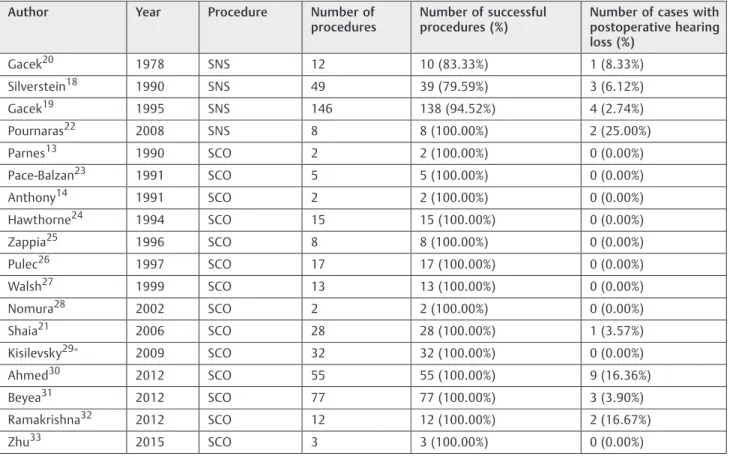
referenced with “Vertigo/Surgery”, which unites the term “Vertigo”with surgical treatment. In this way, we obtained a manageable amount of studies to analyze. The studies that met our inclusion criteria are summarized in►Table 1. This cannot be considered as an exhaustive review, but considering the homogeneity of the results reported, it can be considered a representative analysis of the published data.
Results
After reviewing the literature, it became evident that BPPV-related surgical cases have been decreasing since the early 1990s, presumably because of the emergence and high success rate of the repositioning maneuvers. It is also evident that singular nerve section (SNS), which was never widely adopted, seems to have been largely abandoned. Anatomical studies report a wide variation in the possibility of locating the singular nerve, ranging from 98%, in Kos et al,15to 20%, reported by Lewer et al.16Both authors agree, however, on the difficulty of correctly identifying the nerve through a surgical approach via the external ear canal. In 2008, Feigl et al17reported an interesting anatomical study in which they documented that a significant learning curve is needed to obtain adequate results. The largest series published are those of Silverstein and White,18 in 1990, and Gacek,19in 1995; the latter reported, in an earlier study, an inability to locate the singular nerve in two of hisfirst 12 patients (16%).20
In contrast with SNS, SCO is a much more straightforward technique, and thus, still a subject of study. Regarding published results and complications, by aggregating all the patients reported in the studies shown in►Table 1, we can observe that SCO is reported to be successful in eliminating positional vertigo in 100% of the patients, which is somewhat difficult to believe, although some papers mention recur-rence of vertigo through another canal, and Shaia et al21 mention an 85% patient satisfaction rate, even though all patients had normalization of the Hallpike test. On the other hand, SNS is reported to be successful in 79 to 94% of cases, probably due to the anatomical difficulties mentioned above. Both techniques report a similar incidence of postoperative hearing loss, around 5%.
It is important to note that, although there would seem to be a slightly better success rate with SCO as compared to SNS, the majority of the studies analyzed do not evaluate post-operative vertigo using objective and quantifiable instru-ments, and those that do, differ between them. It is difficult to assure that the differences between the procedures re-garding results are truly significant. Hearing loss is also loosely reported, with differing definitions of what consti-tutes hearing loss and whether or not it can be attributed to the procedures. Still, both techniques seem to provide important benefits, with an acceptable risk of hearing and balance loss in selected patients.
Discussion
The choice between SNS and. SCO for the few patients with intractable BPPV is based on the success rate and risk for
International Archives of Otorhinolaryngology Vol. 21 No. 2/2017
Endolymphatic Sac Surgery for Ménière’s Disease Corvera Behar, García de la Cruz
hearing loss. This review would seem to indicate a slightly lower success rate for SNS, perhaps due to the difficulty in locating the singular nerve near the base of the round window. When performing a SCO, there are no troubles in locating the semicircular canals for any otologic surgeon, and the result in hearing preservation depends mostly on how carefully the canal is opened and manipulated. It is worth mentioning that we have also been using SCO as a conservative surgical procedure for patients with intractable Ménière’s disease and serviceable hearing, and that our experience in avoiding hearing loss and controlling vertigo agrees with that of the studies we have reviewed. In our experience, SCO is a very straightforward technique and it avoids the anatomical difficulty of locating the singular nerve. Thus, we consider SCO as the technique of choice for those rare patients who require surgery for intractable positional vertigo.
Final Comments
Both SCO and SNS are effective surgical options for patients with difficult to control, incapacitating, BPPV. Although SCO requires a retroauricular, transmastoid approach, it is an easier and safer procedure, thus it should be considered the best alternative.
Conflict of Interest
The authors declare no conflicts of interest.
References
1 von Brevern M, Radtke A, Lezius F, et al. Epidemiology of benign paroxysmal positional vertigo: a population based study. J Neurol Neurosurg Psychiatry 2007;78(07):710–715
2 Neuhauser HK, von Brevern M, Radtke A, et al. Epidemiology of vestibular vertigo: a neurotologic survey of the general popula-tion. Neurology 2005;65(06):898–904
3 Schuknecht HF, Ruby RR. Cupulolithiasis. Adv Otorhinolaryngol 1973;20:434–443
4 Corvera G, Corvera J. Benign positional paroxysmal vertigo as a symptom of a global vestibular disturbance. In: Arenberk IK, ed. Dizziness and balance disorders. Amsterdam/New York: Kugler Publications; 1993:541–543. ISBN 09–6299–100–9
5 Parnes LS, Agrawal SK, Atlas J. Diagnosis and management of benign paroxysmal positional vertigo (BPPV). CMAJ 2003; 169(07):681–693
6 Nuti D, Mandalà M, Salerni L. Lateral canal paroxysmal positional vertigo revisited. Ann N Y Acad Sci 2009;1164:316–323 7 Epley JM. The canalith repositioning procedure: for treatment of
benign paroxysmal positional vertigo. Otolaryngol Head Neck Surg 1992;107(03):399–404
8 Semont A, Freyss G, Vitte E. Curing the BPPV with a liberatory maneuver. Adv Otorhinolaryngol 1988;42:290–293
Table 1 Success rate and incidence of postoperative hearing loss reported by different authors after singular nerve section or
semicircular canal occlusion
Author Year Procedure Number of procedures
Number of successful procedures (%)
Number of cases with postoperative hearing loss (%)
Gacek20 1978 SNS 12 10 (83.33%) 1 (8.33%)
Silverstein18 1990 SNS 49 39 (79.59%) 3 (6.12%)
Gacek19 1995 SNS 146 138 (94.52%) 4 (2.74%)
Pournaras22 2008 SNS 8 8 (100.00%) 2 (25.00%)
Parnes13 1990 SCO 2 2 (100.00%) 0 (0.00%)
Pace-Balzan23 1991 SCO 5 5 (100.00%) 0 (0.00%)
Anthony14 1991 SCO 2 2 (100.00%) 0 (0.00%)
Hawthorne24 1994 SCO 15 15 (100.00%) 0 (0.00%)
Zappia25 1996 SCO 8 8 (100.00%) 0 (0.00%)
Pulec26 1997 SCO 17 17 (100.00%) 0 (0.00%)
Walsh27 1999 SCO 13 13 (100.00%) 0 (0.00%)
Nomura28 2002 SCO 2 2 (100.00%) 0 (0.00%)
Shaia21 2006 SCO 28 28 (100.00%) 1 (3.57%)
Kisilevsky29 2009 SCO 32 32 (100.00%) 0 (0.00%)
Ahmed30 2012 SCO 55 55 (100.00%) 9 (16.36%)
Beyea31 2012 SCO 77 77 (100.00%) 3 (3.90%)
Ramakrishna32 2012 SCO 12 12 (100.00%) 2 (16.67%)
Zhu33 2015 SCO 3 3 (100.00%) 0 (0.00%)
Abbreviations: SNS, singular nerve section; SCO, semicircular canal occlusion.
Kisilevsky et al report less than 10dB average loss by frequency.
9 Anthony PF. Utricular macular ablation for benign paroxysmal positional vertigo. Ear Nose Throat J 1996;75(07):416–421 10 Møller MB. Results of microvascular decompression of the eighth
nerve as treatment for disabling positional vertigo. Ann Otol Rhinol Laryngol 1990;99(9 Pt 1):724–729
11 Møller MB, Møller AR, Jannetta PJ, Sekhar L. Diagnosis and surgical treatment of disabling positional vertigo. J Neurosurg 1986; 64(01):21–28
12 Gacek RR. Transection of the posterior ampullary nerve for the relief of benign paroxysmal positional vertigo. Ann Otol Rhinol Laryngol 1974;83(05):596–605
13 Parnes LS, McClure JA. Posterior semicircular canal occlusion for intractable benign paroxysmal positional vertigo. Ann Otol Rhinol Laryngol 1990;99(5 Pt 1):330–334
14 Anthony PF. Partitioning of the labyrinth: application in benign paroxysmal positional vertigo. Am J Otol 1991;12(05):388–393 15 Kos MI, Feigl G, Anderhuber F, Wall C, Fasel JH, Guyot JP. Transcanal
approach to the singular nerve. Otol Neurotol 2006;27(04): 542–546
16 Leuwer RM, Westhofen M. Surgical anatomy of the singular nerve. Acta Otolaryngol 1996;116(04):576–580
17 Feigl G, Kos I, Anderhuber F, Guyot JP, Fasel J. Development of surgical skill with singular neurectomy using human cadaveric temporal bones. Ann Anat 2008;190(04):316–323
18 Silverstein H, White DW. Wide surgical exposure for singular neurectomy in the treatment of benign positional vertigo. Lar-yngoscope 1990;100(07):701–706
19 Gacek RR. Technique and results of singular neurectomy for the management of benign paroxysmal positional vertigo. Acta Oto-laryngol 1995;115(02):154–157
20 Gacek RR. Further observations on posterior ampullary nerve transection for positional vertigo. Ann Otol Rhinol Laryngol 1978; 87(3 Pt 1):300–305
21 Shaia WT, Zappia JJ, Bojrab DI, LaRouere ML, Sargent EW, Diaz RC. Success of posterior semicircular canal occlusion and application of the dizziness handicap inventory. Otolaryngol Head Neck Surg 2006;134(03):424–430
22 Pournaras I, Kos I, Guyot JP. Benign paroxysmal positional vertigo: a series of eight singular neurectomies. Acta Otolaryngol 2008; 128(01):5–8
23 Pace-Balzan A, Rutka JA. Non-ampullary plugging of the posterior semicircular canal for benign paroxysmal positional vertigo. J Laryngol Otol 1991;105(11):901–906
24 Hawthorne M, el-Naggar M. Fenestration and occlusion of poster-ior semicircular canal for patients with intractable benign par-oxysmal positional vertigo. J Laryngol Otol 1994;108(11): 935–939
25 Zappia JJ. Posterior semicircular canal occlusion for benign par-oxysmal positional vertigo. Am J Otol 1996;17(05):749–754 26 Pulec JL. Ablation of posterior semicircular canal for benign
paroxysmal positional vertigo. Ear Nose Throat J 1997;76(01): 17–22, 24
27 Walsh RM, Bath AP, Cullen JR, Rutka JA. Long-term results of posterior semicircular canal occlusion for intractable benign paroxysmal positional vertigo. Clin Otolaryngol Allied Sci 1999; 24(04):316–323
28 Nomura Y. Argon laser irradiation of the semicircular canal in two patients with benign paroxysmal positional vertigo. J Laryngol Otol 2002;116(09):723–725
29 Kisilevsky V, Bailie NA, Dutt SN, Rutka JA. Lessons learned from the surgical management of benign paroxysmal positional ver-tigo: the University Health Network experience with posterior semicircular canal occlusion surgery (1988-2006). J Otolaryngol Head Neck Surg 2009;38(02):212–221
30 Ahmed RM, Pohl DV, MacDougall HG, Makeham T, Halmagyi GM. Posterior semicircular canal occlusion for intractable benign positional vertigo: outcome in 55 ears in 53 patients operated upon over 20 years. J Laryngol Otol 2012;126(07):677–682 31 Beyea JA, Agrawal SK, Parnes LS. Transmastoid semicircular canal
occlusion: a safe and highly effective treatment for benign par-oxysmal positional vertigo and superior canal dehiscence. Lar-yngoscope 2012;122(08):1862–1866
32 Ramakrishna J, Goebel JA, Parnes LS. Efficacy and safety of bilateral posterior canal occlusion in patients with refractory benign paroxysmal positional vertigo: case report series. Otol Neurotol 2012;33(04):640–642
33 Zhu Q, Liu C, Lin C, et al. Efficacy and safety of semicircular canal occlusion for intractable horizontal semicircular benign parox-ysmal positional vertigo. Ann Otol Rhinol Laryngol 2015;124(04): 257–260
International Archives of Otorhinolaryngology Vol. 21 No. 2/2017
Endolymphatic Sac Surgery for Ménière’s Disease Corvera Behar, García de la Cruz