1 A Work Project, presented as part of the requirements for the Award of a Master’s Degree in
Finance from the NOVA – School of Business and Economics
An Innovative Assessment of
Corporate Credit Risk
easyJet plc
Panagiotis Sanidas, No 2443
A Project carried out on Master in Finance Program, under the supervision of: Professor Miguel Ferreira.
2
Disclaimer
With this disclaimer, the author, Panagiotis Sanidas, states that the presenting work is completely done on his own and that all the references and sources used, have been explicitly mentioned throughout all the thesis. Therefore, the copyright of the thesis belongs to the author, who is responsible for the content.
Preface / Acknowledgment
This master thesis defines the end of my studies in the Masters program in Finance at Nova SBE University. This was only possible thanks to the suggestions and the support of a number of people I would like to mention.
First of all, I would like to express my gratitude to my supervisor, Miguel Ferreira, for giving me this opportunity and for making this thesis possible with his feedback.
I would also like to express my thanks to professor Martijn Boons for his reference when needed. Furthermore I would like to thank Rita and my flatmates, Giulia, Mariya, Matteo, for their support and the nice memories during the past year.
Finally, I would like to thank my family and my Godmother who continuously gave me strong support through all my years of studying that now come to an end.
Abstract
3
Executive summary
EasyJet is a European short-haul airline based in Luton, England and is therefore subject to risks related to the aviation industry as well as to the country and region it operates.
The depreciation of the pound after “Brexit” is expected to add about £90m to full-year costs.
During the next year, the acquisition of an Air Operators Certificate in another EU country is anticipated, to ensure continuation of operations between UK and EU.
According to both World Bank and IMF forecasts, oil price is expected to stay in relatively low levels and below $60 per barrel until 2021, indicating lower costs.
European Commission forecasts a slow but stable GDP growth for the next 3 years, between 1.5% and 1.7%.
Operating in more of the 100 busiest connections in Europe than any other airline signifies a strong market share which is planning to increase.
easyJet’s efficiency is characterized by very high load factor (91.5%) and its ability to keep costs low while increasing revenue.
Strong profitability of the past years seems to slow down, yet ROIC will remain higher than the cost of capital and stably above 10%.
FFO-to-debt will remain well above 0.5x despite the weaken earnings.
October’s new issue of £500mn bonds will robust leverage, resulting in a Debt-to-EBITDA ratio around 1.5x the next two years.
Trend of low liquidity ratios will stop, forecasting a current ratio of above 1.0 in 2017.
Implemented Altman’s Z-score model suggests no signs of bankruptcy for 2016-2017 while it implies necessity for further analysis regarding 2017-2018.
According to Merton DD applied model, the probability of default within the next year is 0.022%, which corresponds to an AA rating.
Business Risk Financial Risk Merton DD Overall
4
TABLE OF CONTENTS
DISCLAIMER ... 2
PREFACE / ACKNOWLEDGMENT ... 2
ABSTRACT ... 2
EXECUTIVE SUMMARY ... 3
TABLE OF CONTENTS... 4
LIST OF ABBREVIATIONS ... 5
1. INTRODUCTION ... 6
1.1.CREDIT RATING:BACKGROUND,DEFINITION AND OBJECTIVE ... 6
1.2.UNDERLYING RESEARCH METHODOLOGY ... 7
1.3.ASSUMPTIONS AND THE EXPECTED OUTCOME ... 9
2. BUSINESS RISK RATING... 10
2.1.COUNTRY RISK ... 10
2.2.INDUSTRY RISK ... 11
2.3.COMPETITIVE POSITION... 12
2.4.PROFITABILITY ... 17
3. FINANCIAL RISK RATING ... 18
3.1.CASH FLOW ADEQUACY ... 18
3.2.CAPITAL STRUCTURE &LEVERAGE ... 19
3.3.LIQUIDITY ... 20
4. IMPLEMENTATION OF DIFFERENT APPROACHES ... 21
4.1.ALTMAN Z-SCORE MODEL ... 21
4.2.MERTON DISTANCE TO DEFAULT MODEL ... 22
4.2.1.LITERATURE REVIEW ... 22
4.2.2PROBABILITY OF DEFAULT FOR EASYJET ... 22
5. REFERENCES ... 25
5
List of abbreviations
EU – European Union UK – United Kingdom
IMF – International Monetary Fund GDP – Gross Domestic Product CRA – Credit Rating Agency FDI – Foreign Direct Investment
OECD – Organization for Economic Co-operation and Development IATA – International Air Transport Association
IAG – International Airline Group RPK – Revenue Per Kilometer ASM – Available Seat Miles
RASM – Revenue per Available Seat Miles CASM – Cost per Available Seat Miles
EBITDA – Earnings Before Interest Tax Depreciation Amortization ROIC – Return On Invested Capital
6
1.
Introduction
This chapter introduces the objective of the thesis, its importance in the credit rating context and the underlying research plan that was followed.
1.1.
Credit Rating: Background, Definition and Objective
The idea of rating was created when the distance between businesses and customers started to grow. In the past when the customer knew the owner of the business and vice-versa, strategies like “buy now, pay later” were considered safe. As trading distances increased due to expansions, the first ratings were developed in a relatively simple form, in an effort to answer whether the borrower could eventually pay back his debt. Nowadays rating is a much more complex concept and constitutes an important driver in capital markets. Globalization in the investment market together with diversification in the variety of securities issued, make it challenging for institutional and individual investors to analyze the risk associated with both foreign and domestic investments. On that note, the idea of credit rating was introduced.
Credit rating is a formal, independent and forward-looking concept about the creditworthiness of an obligor, either as a whole (Issuer credit rating) or regarding a specific debt or financial obligation (Issue credit rating). Such a rating can be accredited to any entity that pursues to borrow capital – an individual,
corporation, state or sovereign government – and it can be distinguished by short-term(up to one year) or long-term (more than one year). According to Raymond W. McDaniel, president of Moody's corporation, “the objective of rating reports is to enhance transparency and efficiency in debt capital markets by reducing the information asymmetry between borrowers and investors”.
7 of the most common corporate rating method, it is also a step-in-front in the sense that it proposes a combined approach - made by the traditional rating method and the Merton Distance to Default model - in order to give a more accurate rating result.
From an academic point of view, it contributes to the state-of-the-art research in corporate credit rating methodology, based on an analysis of the existing literature review.
From a practical point of view, this paper is relevant to all investors that are looking for an investment opportunity that is correlated to the underlying company. Thus, it will contribute to the area of credit risk and hopefully, lead to a more successful and efficient credit rating method in the future.
The following research questions will be answered within this thesis: 1. Up to which point is easyJet able to meet its debt obligations?
2. How credible obligor should be easyJet considered in relation to its peers? 3. What is the probability of default within the next year?
1.2.
Underlying research methodology
Credit ratings constitute an assessment of each issuer’s ability to service debt in a timely manner. To
reach this assessment there are different approaches which will be discussed in this chapter. The most common, is the one that most of the credit rating agencies (CRAs) traditionally use. At this point we should mention that rating industry is very highly concentrated, with four agencies (Standard & Poor’s, Moody’s, Fitch, DBRS) controlling 97.5% of the global market.
8 dominate, while in other cases business risk may have stronger influence. It is important to understand that, even if the above mentioned approach is the same for all industries, the exact factors can differ from industry to industry.
Another approach is the one that uses market information to evaluate the risk of an issuer and it can be divided into two categories: the reduced-form model and the structural model. “Both aim to quantify default risk and explain the cause of default. To do so, they combine the crucial information on leverage
and asset volatility to provide a mathematical description of credit risk where the output is a measure of default probability”1. The main difference relies on the information assumed known by the modeler. In
structural models all information is available to everybody resulting in a predictable default time, while in reduced-form some data can be inaccessible leading to an undefined default time. There are several forms of structural models; the most popular is the Black-Scholes-Merton (BSM, 1973) model.
In addition to the above, the approach of credit scoring models should be mentioned. As the name suggests, these models use a function of variant key financial ratios to come up with a final rating score. Obviously, there can be many alternatives of this function, with different ratios and coefficients, but the best known is the Altman Z-Score model (1968).
According to Altman, the Z-score is given by the formula:
𝑍 = 1.2 𝑋1 + 1.4 𝑋2 + 3.3 𝑋3 + 0.6 𝑋4 + 1.0 𝑋5
where X1 = working capital/total assets; X2 = retained earnings/total assets; X3 = earnings before interest
and tax (“EBIT”)/total assets; X4 = market value of equity/book value of total liabilities; and X5 =
sales/total assets. Last but not least, hybrid models constitute a combination of the traditional approach and the structural model. Given these points, it comes without surprise that the same issuer can have different ratings, depending on which approach is followed.
9 In this paper, to assess easyJet’s ability to meet its debt obligations, the hybrid method, consisting of a business and financial risk analysis together with the Merton Distance to Default model, will be applied.
1.3.
Assumptions and the expected outcome
In order to proceed with the business and financial analysis we will follow the methodology suggested S&P. More precisely, according to the oldest rating agency, business risk encompasses country risk, industry risk as well as a company’s competitive position and its profitability. When it comes to financial risk factors, emphasis is given to a company’s adequacy of cash flows, its leverage and liquidity. As shown below (Figure 1), each of the above factors will be analyzed and rated following S&P’s credit scoring.
“Credit ratings express an OPINION and under no circumstances provide investment or financial
advice.”, according to Moody’s. In this thesis, the reader will find an analysis of easyJet, followed by a rating for its creditworthiness. This rating should not be perceived as a recommendation for an investment decision.
10
2.
Business Risk Rating
2.1.
Country Risk
Sovereign rating is taken into consideration because it generally sets an upper bound on the company’s
one. Bearing this is mind, with its headquarters based in Luton, England, EasyJet is subject to the United Kingdom’s risk factors. As a composition of the economies of England, Scotland, Wales and Northern
Ireland, the UK economy is one of the most globalized and the fifth-largest in terms of nominal GDP (World Bank, 2016). It is traditionally one of the strongest economic performers and most credible obligors. In fact, its growth was the fastest in Europe for the year 2014 (European Commission, 2014). A good indicator of its credibility is its fifth position on Foreign Direct Investments (FDI) confidence index by A.T. Kearney2. Moreover London’s leading position in Europe as a global financial centre signifies the confidence that investors have towards UK economy, which is the result of the well-functioning institutions and the transparency that is provided.
However, the decision of UK voters to leave European Union, in the referendum of June 2016, created several uncertainties. Immediately after the vote, sterling reached a thirty-year low. Speculations and worries regarding economic growth prospects arose, resulting to a lower GDP growth forecast. According to the author, this reaction was mainly driven by the fear that “Brexit” would cause a “domino"
of extreme political reactions such as a Scottish referendum for independence or trade isolation of the UK. Trying to see things more logically, UK and EU have very strong trading relationships, with about half of British exports having European countries as their final destination. Moreover, there is the Lisbon Treaty, according to which a country deciding to leave the EU has two years to negotiate a withdrawal agreement. It is worth remembering that in the case of Switzerland and its rejection to become a member of the European Economic Area in 1992, the trade agreement was not fully applied before 2010. Having said that, I find it highly probable that a favourable trade agreement will be reached, as there are
11 advantages for both sides in continuing a close commercial arrangement. Furthermore, statements like the one made by Mark Carney, governor of the Bank of England, that “BoE is ready to inject an extra £250bn into Britain’s financial system”, seem to underwrite investors’ doubts. The sharp drop in the pound has undoubtedly decreased the purchasing power of British people but it can also have positive effects, like a robust of exports in a country with a high trade deficit. The GDP growth may slow down but will still be higher than the one of the Euro area and slightly less than 2%, according to OECD. All in all, I believe that the United Kingdom’s sovereign rating, in spite of the anticipated increasing uncertainty, should still reflect a high quality credit.
A country risk rating of AA- is, in my personal point of view, in alignment with today’s situation.
2.2. Industry Risk
Industry’s Risk Rating (IRR) is a crucial part for estimating an entity’s rating. Understanding the strengths and challenges of its industry constitutes the basis in assessing a firm. Just like country risk rating, IRR can act as a constraint or “cap” on the issuer’s rating. The airline industry can be divided into
legacy airlines, such as Lufthansa or Air France and
low-cost short-haul carriers, such as easyJet or Ryanair. The main difference between them is their business model and that legacy carriers operate long-haul routes as well. Generally, there are two main challenges that airlines face. Their
vulnerability to fuel price and their sensitivity to economic cycles. Aviation industry is considered a
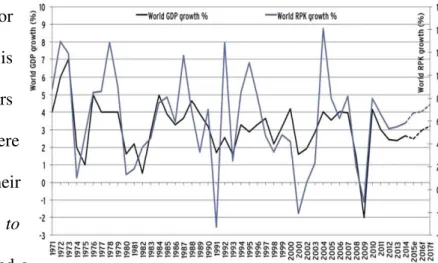
very cyclical one with the growth of Revenue per Kilometre (RPK) well correlated with global GDP growth (Figure 2). On the other hand, jet fuel cost constitutes on average one third of the total cost for
12
airlines3 and therefore, its price fluctuation affects their profits significantly. Despite the 18% increase since the beginning of the year4, oil prices are still relatively low. Also, taking into consideration that airlines procced with large future orders, I believe that we haven’t fully seen the effects of the low oil
prices in their profitability yet. Some other challenges that will be discussed more extensively later are: the high intra-industry competition, the sensitivity in “special events” such as terrorism, seasonality, heavy debt use and the organized and powerful labour.
The most important strength of aviation is the positive global economic and demographic trend that favours long-term demand growth. “Demand for Air Travel in 2015 Surges to Strongest Result in Five Years” (IATA, 2016). More specifically, demand measured in RPK rose by 6.5% compared to 2014 resulting in the strongest increase since 2010 and “well above the 10-year average annual growth rate of 5.5%”. IATA’s forecast that“passengers are expected to double in the next 20 years, from 3.8bn in 2016 to 7.2bn in 2035”, indicates a flourishing industry. Taking into consideration that easyJet operates mostly in Europe, it is essential to take a closer look at the European airline industry. According to the recent European Commission’s forecasts, GDP growth in the Euro area will remain fairly stable; 1.7% this year, 1.5% in 2017 and 1.7% in 2018. Furthermore, passengers in Europe are expected to increase by 570 million per year for the next 20 years, experiencing an annual average growth rate of 2.5%, according to IATA’s forecast. In my opinion, there is space for higher demand for air travel within Europe but not as much as in other regions. This, coupled with industry’s vulnerabilities and the less than 2% projected Euro area GDP growth, leads me to estimate an industry risk rating of BB-.
2.3. Competitive Position
So far the risks associated with the country and the industry of the company have been analysed. In this paragraph, we will discuss the competitive position of EasyJet, taking into account both qualitative and
13 quantitative data. The aim is to recognize the strength of the company in relation to its peers5, which is
its competitive advantage and where there is room for improvement. Market Position
EasyJet is the fifth-largest airline in Europe and second-largest among low-cost carriers, both in terms of passengers carried (Figure 3) and revenues for 2015. It carried 69.9mn people, a 43% increase from 48.8 million people in 2010. Moreover, easyJet operated 735 routes between 136
airports in 31 different countries by September 2015. The fact that 95 new routes were added last year, with more than 90 to be added in 2016, indicates the flexibility of the company and its ability to exploit demand opportunities. According to their annual report6, the British airline “focuses primarily on
Western and Northern Europe, where it flies to a network of primary airports and routes that tap into affluent markets with populations that have a high propensity to travel”. Indeed, one of its competitive advantages is that it operates more of the top 100 routes in Europe than any other airline. The first point of EasyJet’s strategic plan is to establish itself as one of the strongest players in the main European airports by building a strong number one and two network positions. On that note, bearing in mind its low-cost philosophy, EasyJet’s presence in the top 100 European airports is impressive, being one of the two leading airlines in 22 of them in 2015. Regarding its position within markets served, the company has a very strong presence in the UK and Switzerland, with 20% and 23% market share respectively, while its market share in countries like Spain (8%) and Germany (4%) is relatively low. Other main markets are France (14%), Portugal (13%), Italy (12%) and Netherlands (9%). In terms of reputation, EasyJet was voted the favourite low-cost airline in Europe by Telegraph’s readers and Skytrax.
5 As peers were chosen three low-cost airlines as direct competitors, Ryanair which is the largest in its industry, Wizz Air and
Norwegian, along with the three largest legacy carriers, Lufthansa, IAG and Air-France.
6 Published on November 2015 for the financial year ended on the 30th of September 2015.
107.7 101.4 94.9 89.8
69.9
25.8 19.2 Figure 3: Airlines ranked by passengers carried in 2015
14 Given these points, I believe that the company’s plan to “protect its number one position in the UK and Switzerland, to secure a bigger share in France and to invest in lean bases to drive more efficient capacity growth across its network”7, are in alignment with its potentials.
Diversification
EasyJet, as all short-haul airlines by definition, doesn’t enjoy much geographic diversification. However, the British low-cost airline is well diversified in other aspects. Firstly, it refers to both
leisure and business travellers. That is, in events like the recent financial crisis which drove demand for leisure travels down, its significant presence in
business routes shielded the losses. Moreover, its revenues are boosted by the ancillary revenues. A recent report from IdeaWorksCompany, demonstrates the ability of easyJet to generate revenues from optional services, such as on-board sales of food and beverages, checked baggage, premium seat assignment. More precisely, it occupies the fourth place in respect to ancillary revenue generation, among European airlines and the second when compared only to its low-cost rivals (Figure 4). Nevertheless, despite the significant volume of ancillary revenues, there is room for improvement since when it comes to percentage of total revenues the British short-haul carrier does not make it to the top 10 globally. Operating efficiency
One of the most important parts of the business analysis is to evaluate the operating efficiency of the company. To achieve this, the operating performance of easyJey as a standalone during the past years, but also in comparison to its peers, needs to be discussed. Starting with revenue generation, easyJet displays a remarkable improvement, increasing its passenger revenue by 45% per Available Seat Mile
7 As stated in easyJet’s 2015 annual report.
15 (RASM) during the period 2010-2015 (Figure 5). When compared to its peers8, the company’s RASM is
in the second place (Figure 6). I expect that, with larger fleet and stronger demand, easyJet will continue generating high revenues in the following years.
Equally important is the ability of the company to control the operating Cost per ASM (CASM). Two of the main characteristics of the industry are related to the cost structure; these are the high fixed costs
(labour, licenses, airports) as well as the fluctuations in oil prices since, as mentioned above, jet fuel cost comprises 30% of the total cost on average. On that note, easyJet has succeeded in keeping the cost at a fairly stable level (Figure 7).
When compared to its peers, easyJet’s operating cost is, as anticipated, significantly lower than the one of legacy carriers but higher than its low-cost competitors (Figure 8). I believe that this is due to the fact that Ryanair and Wizz Air operate mainly in secondary airports9, while easyJet, as mentioned above,
8 Data extracted from Bloomberg.
9 A secondary airport is usually an under-utilized, back-up airport that complements a city and its main, primary airport and
is often located far away from the city centre.
2010 2011 2012 2013 2014 2015
3.81 3.94
5.26 5.65 5.61 5.51 5.99 5.51 5.48 5.42 5.17
3.09 3.01
6.46 5.47
4.95 4.77 4.26
3.41 2.51
2010 2011 2012 2013 2014 2015
4.43 4.62 4.90
5.10 4.96 4.77 Figure 5:easyJet’s Passenger Revenue per ASM (pence). (Data Source: Bloomberg – own diagram)
Figure 6: Airlines ranked by Passenger Revenue per ASM (pence). (Data Source: Bloomberg – own diagram)
Figure 7:easyJet’s Operating Cost per ASM (pence) (Data Source: Bloomberg – own diagram)
16 utilizes many prime airports. In my point of view, there is not much room left for further cost reductions, and in the near future the airlines should focus more on increasing their revenues.
Fleet
When it comes to fleet evaluation, it is easy to give a high rating to the British carrier, as it has one of the youngest fleets in the industry with an average age of 6.2 years according to Bloomberg. It is important to mention that from the 241 aircraft fleet (until 30 September 2015), a large amount (163) is owned by the company. Moreover, easyJet is focused on efficiently up-gauging its fleet with aircrafts providing more seating, thus further reducing costs by 7% per seat. According to the company’s plan, most of the 156-seat A319 fleet will consist of over 70% 186-seat A320 by 2021. Taking everything into account, I believe that there is a high potential for stronger revenues through bigger capacity, further cost reduction per seat and an even safer fleet.
Management
The last factor we need to assess to come up with a rating regarding easyJet’s competitive position is its administration. Management should be assessed on its ability to run and expand the business efficiently while aligning company’s fundamentals with financial risks. A crucial task in such a labour intense industry, is to maintain good relations with the labour unions. “Our pilots are integral to the airline’s success and we look forward to working closely with them and their union Balpa to deliver the proposal,”
EasyJet said after receiving a positive vote on its proposal that managed to head off a strike threat over pilots’ fatigue10. I trust that EasyJet will continue addressing employees’ demands and prevent losses
that a potential strike could cause.
Taking every aspect into consideration, I consider a competitive position rating of BBB, fair and representative of easyJet.
17
2.4. Profitability
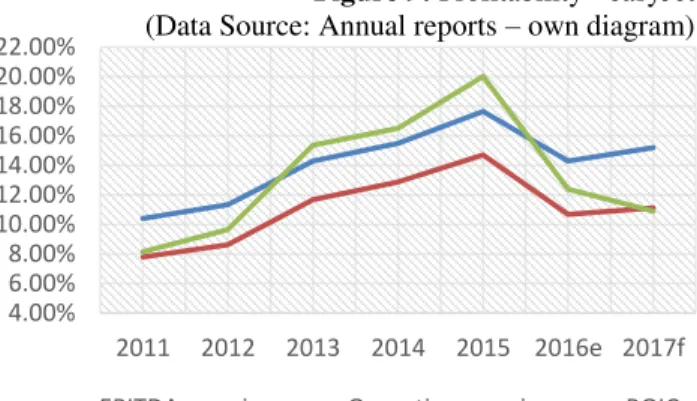
The level of profitability is an important indicator of whether the company is able to protect its credit. As a matter of fact, a strong profit performance implies greater ability of the company to generate capital internally as well as to attract capital externally. The ratios that will be analysed to evaluate easyJet’s profitability are: EBITDA margin, Operating margin and Return on Invested Capital, (ROIC). Figure 9 shows the spectacular improvement on the ability of the
carrier to generate profit. Its EBITDA and operating margin increased significantly the last five years, from 10.40% to 17.65% and from 7.79% to 14.70%, respectively. Furthermore, ROIC surged 146% during the same period. Equally important is the fact that, contrary to its main rival, easyJet managed to achieve a continuous year-over-year growth in each ratio (Table 1), which demonstrates a stably successful business plan.
When compared to its peers11, in terms of margins easyJet clearly outperforms its legacy competitors, while it underperforms Wizz Air and Ryanair. As can be seen in table 2, its ROIC is the second highest and most importantly, much higher than its cost of capital (12.48%)12. Despite its
strong past performance, “Brexit” and terrorism threaten easyJet’s future profits.
Depleted margins forecast for the next couple of years, leads me to a BBB rating of profitability. Ultimately, I assign to easyJet an overall business risk rating of BBB.
11 For simplicity, the number of peers was reduced.
12 Calculated by using dividend capitalization model to compute Cost of Equity. 4.00% 6.00% 8.00% 10.00% 12.00% 14.00% 16.00% 18.00% 20.00% 22.00%
2011 2012 2013 2014 2015 2016e 2017f
EBITDA margin Operating margin ROIC
Figure 9: Profitability - easyJet (Data Source: Annual reports – own diagram)
Table 1: Operating Margin trend, easyJet vs Ryanair (Data Source: Annual reports)
2011 2012 2013 2014 2015
easyJet 7.79% 8.61% 11.67% 12.88% 14.70% Ryanair 15.56% 14.70% 13.10% 18.45% 22.34%
Table 2: Profitability, easyJet vs Peers (Data Source: Annual reports)
Airline EBITDA margin Operating margin ROIC
Ryanair 28.88% 22.34% 16.98%
Wizz air 18.49% 16.48% 31.21%
Lufthansa 10.20% 4.85% 8.13%
Air France 10.54% 4.28% 13.19%
18
3.
Financial Risk Rating
3.1. Cash Flow Adequacy
Analyzing the cash flow competency of an issuer is the most crucial part for credit rating decisions. Evidently there is a high correlation between profitability which was analyzed before and cash flow. However, examining the trend of the latter can be more explicit regarding the debt servicing capability of the borrower. In this paragraph, we will evaluate easyJet’s ability to generate enough cash from internal sources to cover any calls on that cash. The ratios that will be taken into consideration are
EBITDA coverage and funds from operations (FFO) to total debt13.
EBITDA coverage is simply EBITDA over the interest expense and reveals the ability of the company to satisfy interest obligations. On that note, easyJet should be considered a credible obligor with very high ratios,
EBITDA coverage of 75.18x and FFO-to-debt of 1.57 (Figure 10), resulting from continuously increasing earnings coupled with less debt and hence, less interest expenses. However, on 11 October 2016 the company issued €500 million, 1.125%-yield bonds maturing in October 2023. This comes without surprise for a company with such a low leverage and is expected to weaken the cash flow ratios of the following years.
When compared to its peers, the British carrier is in an advantageous position, as can be seen in Table 3. It seems to me that a scenario where easyJet defaults would imply
that most of its competitors will also have defaulted, probably even sooner.
All in all, its high cash flow ratios indicate a strong capability of the company to meet its debt obligations.
13 Total debt = short-term borrowing + long-term borrowings.
14.36 17.48 43.50 63.73 75.18 51.31 27.59 0.33 0.18 1.03 1.25 1.57 0.80 0.58 0.00 0.50 1.00 1.50 2.00 0.00 20.00 40.00 60.00 80.00
2011 2012 2013 2014 2015 2016e 2017f
EBITDA/Interest exp FFO/Debt
Figure 10: Cash flow Adequacy - easyJet (Data Source: Annual reports – own diagram)
Table 3: Cash flow Adequacy, easyJet vs Peers (Data Source: Annual reports)
Airline EBITDA/Interest exp FFO/Debt
Ryanair 26.55 0.46
Wizz air 33.04 8.50
Lufthansa 9.19 0.37
Air France 7.36 0.30
19
3.2. Capital Structure & Leverage
Analyzing easyJet’s leverage ratios is a way to understand how the carrier is financed and therefore, how
tolerant it is towards financial risk. Generally, a company with a strong cash flow generation and market share can hold a higher level of debt than less healthy companies. This is especially the case for airlines. Taking into account leverage ratios, such as debt to EBITDA and debt to capital14, we can assess management’s financial policy.
For instance, the fact that easyJet’s debt-to-EBITDA ratio is 6 times down the last five financial years (0.61x from 3.62x), indicates the firm’s ability to generate strong earnings without using more debt. Similarly, the debt-to-capital ratio experiences a decreasing pattern (Figure 11), from 43% on 30th of
September 2011 to 18% by the same date of 2015, demonstrating company’s intention to mitigate credit exposure and increase shareholder’s return. Generally, the lowest the ratio, the safest the company but too low leverage may suggest too much conservatism. Nevertheless, as mentioned above, the issue of €500mn bonds 3 months ago, is expected to increase
leverage in fair levels.
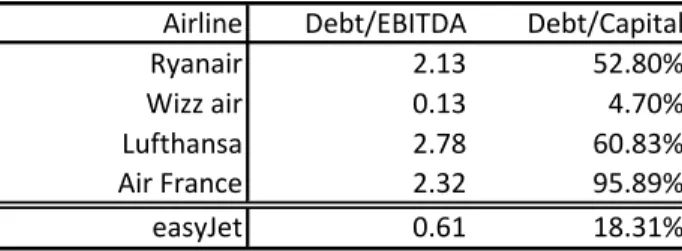
Comparing easyJet’s leverage to its competitors (Table 4), the company’s conservatism is clearly noted. In fact, it has
much lower debt-to-EBITDA ratio than Ryanair, the most profitable airline in Europe. Additionally, a less than one debt-to-EBITDA ratio implies that bondholders should stay confident regarding their compensation, since it takes only the earnings of one year for easyJet to repay its debt.
14Total capital = Shareholders’ Equity + total debt (as specified in the footnote 12)
3.62 2.19 1.11 0.80 0.61 1.13 1.55 43% 35% 25%
21% 18% 22% 28% 0% 10% 20% 30% 40% 50% 0.00 0.50 1.00 1.50 2.00 2.50 3.00 3.50 4.00
2011 2012 2013 2014 2015 2016e 2017f
Debt/EBITDA Debt/Capital
Figure 11: Leverage -easyJet (Data Source: Annual reports – own diagram)
Table 4: Leverage, easyJet vs Peers (Data Source: Annual reports) Airline Debt/EBITDA Debt/Capital
Ryanair 2.13 52.80%
Wizz air 0.13 4.70%
Lufthansa 2.78 60.83%
Air France 2.32 95.89%
20
3.3. Liquidity
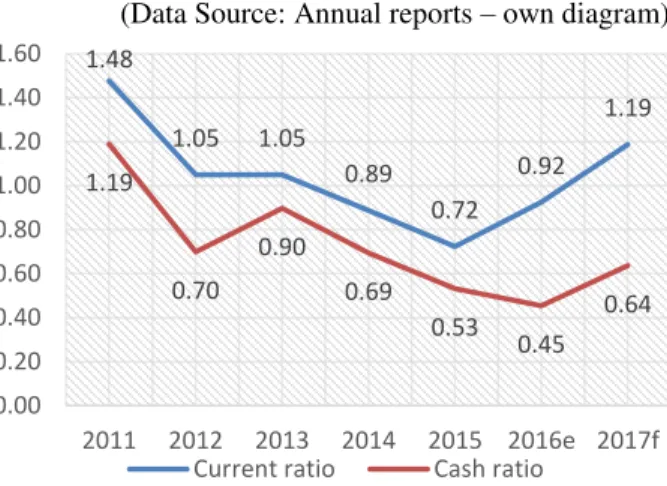
To evaluate the liquidity of the British short-haul airline, we will analyze the trend of current and cash ratio. Current ratio, which is computed by dividing current assets with current liabilities, assesses a company’s ability to cover its short-term obligations by using its assets. On that note, a current ratio less than one may indicate a company which is in trouble. Nevertheless, due to the use of heavy debt that characterizes aviation industry, it is common for an airline to have relatively low liquidity ratios. In the case of easyJet, current ratio is decreasing year by year, reaching 0.72 in the FY 2015 (Figure 12). This is happening, more due to an increase in current
liabilities, and more precisely in hedging cost15, rather
than a decrease in current assets16. By taking a closer look at the balance sheet, we notice an increasing trend of short-term to long-term debt ratio (from 13.5% in 2011 to 56.5% in 2015). Accordingly, the current to non-current liabilities ratio increased from 0.74 to 2.2, indicating an
anticipated period of debt repayment. However, taking into account the recently issued bonds, I believe that cash and thus, current assets along with non-current liabilities will increase. Moreover, the second higher cash ratio (Table 5), when compared to its peers,
demonstrates easyJet’s focus on maintaining a high level of
cash & cash equivalents. According to me, there is no concern regarding liquidity as, due to the anticipated cash
injection the relatively low ratios will be enhanced. I also believe that, a company with such great performance and especially when referring to an airline, will easily raise capital externally if a liquidity problem occurs. Given these points, I suggest an overall financial risk rating of BBB+ for easyJet.
15 Mainly due to losses in jet fuel derivatives instruments.
16 Regarding the period 2011-2015, current liabilities increased by 50% while current assets decreased by 26%.
1.48 1.05 1.05 0.89 0.72 0.92 1.19 1.19 0.70 0.90 0.69 0.53 0.45 0.64 0.00 0.20 0.40 0.60 0.80 1.00 1.20 1.40 1.60
2011 2012 2013 2014 2015 2016e 2017f
Current ratio Cash ratio
Figure 12: Liquidity -easyJet (Data Source: Annual reports – own diagram)
Airline Current ratio Cash ratio
Ryanair 1.43 0.37
Wizz air 1.70 1.38
Lufthansa 0.72 0.09
Air France 0.63 0.26
easyJet 0.72 0.53
21
4.
Implementation of different approaches
In this section we will apply the Merton Distance to Default model to obtain a rating regarding easyJet’s
creditworthiness. Nevertheless, prior to that, we will implement the Altman Z-score approach, which will not be related to a specific rating but is a good indicator of whether a company is in trouble.
4.1. Altman Z-score model
As mentioned in the introduction, Altman’s Z-score is a credit scoring model, which uses five key
financial ratios to detect if there are signs of an imminent bankruptcy within the next two years. These ratios are working capital to total assets (X1), retained earnings to total assets (X2), earnings before
interest and tax to total assets (X3),market value of equity to book value of total liabilities (X4) and sales
to total assets (X5). Therefore, by obtaining values from easyJet’s annual reports and using them in the
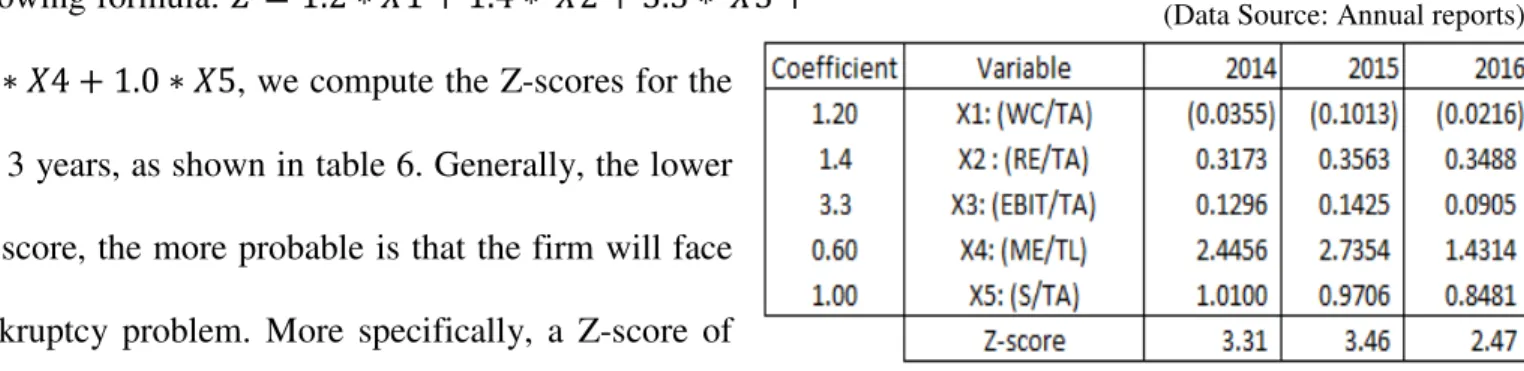
following formula: 𝑍 = 1.2 ∗ 𝑋1 + 1.4 ∗ 𝑋2 + 3.3 ∗ 𝑋3 +
0.6 ∗ 𝑋4 + 1.0 ∗ 𝑋5, we compute the Z-scores for the last 3 years, as shown in table 6. Generally, the lower the score, the more probable is that the firm will face bankruptcy problem. More specifically, a Z-score of
lower than 1.8 indicates a high likelihood of bankruptcy while a company with Z-score above 3 is considered safe based on financial data. Between these two values there is a “gray” area and nothing
more can be said besides that there is necessity for further analysis. Regarding easyJet the results are positive, with some uncertainty arising the last year. More precisely, while Z-scores for 2014 and 2015 are above 3 demonstrating financial health, the one of 2016 is in the “gray” area. That is mainly due to weaken of two ratios. Both, EBIT-to-total assets and the equity-to-liabilities, are down 36% and 47%, respectively when comparing to the previous year. As it is normal, a 42% decrease in share price17 along with the impact of the weaken pound on the earnings, affected significantly company’s ratios.
17 In the period between 30/9/2015 – 30/9/2016.
22
4.2. Merton Distance to Default model
4.2.1. Literature Review
The Merton distance to default model is a particular application of Merton model (1974) and it aims to forecast corporate defaults. According to Merton, “the equity of the firm is a European call option on the underlying value of the firm with a strike price equal to the face value of the firm’s debt”. On that
note, the model produces a probability of default for a specific firm at any point in time. Firstly, we need to define the inputs of the model which are the following: the total value of the firm as well as its volatility, the face value of its debt, the anticipated annual return on the firm’s assets and, finally, the forecasting horizon. As we will see in more details later on, the market value of equity together with its volatility also need to be computed. Once values are inferred, a measure called distance to default (DD)
can be calculated using the following formula: 𝐷𝐷 =ln( 𝑉
𝐷)+(𝜇−0.5∗𝜎(𝑉)2)∗𝑇
𝜎(𝑉)∗√𝑇 . The distance to default is then substituted into a cumulative density function to obtain the probability that the value of the firm will be less than the face value of debt at the forecasting horizon, 𝜋(𝑀𝑒𝑟𝑡𝑜𝑛) = 𝜋(𝑑) = 𝑁(−𝐷𝐷). In their paper18, Bharath and Shumway (2008) concluded that “while the Merton DD model doesn’t produce a sufficient statistic for the probability of default, its functional form is useful for forecasting defaults”.
4.2.2 Probability of Default for easyJet
Having described the model, it is time to apply it to easyJet. Regarding the inputs, some are easily observable while some others need to be assumed or inferred. Starting with the market value of equity
(E), we simply multiply the number of the shares outstanding, according to the annual report, with the price of each share19. As far as risk-free rate is concerned, having discussed the credibility of the UK as
an obligor, I chose the rate of the 10-year UK government bond20. As stated by Bharath and Shumway,
18“Forecasting Default with the Merton Distance to Default Model” , 2008
23 “it is common to use historical returns data to estimate the volatility of equity, σ(E), to assume a forecasting horizon of 1 year (T=1) and to take the book value of the firm’s total liabilities to be the face value of the firm’s debt”. That is, the volatility of equity was calculated as the average annual volatility
of the last two years21 since I expect the next year to be less volatile than 2016, but still more than 2015.
Furthermore, the value of total liabilities was obtained by the latest annual report to be considered as the face value of debt. While the total value of the firm (V) is easily computed as the sum of its debt and equity, the volatility of the firm’s assets σ(V) is more challenging to infer. Bharath and Shumway, in the same paper, proved that their naïve estimate of firm volatility is highly correlated to the one published by Moody’s KMV22, capturing much of its information. That is why, we will use the same approach.
Firstly, they approximated the volatility of each firm’s
debt as σ(D) = 0.05 + 0.25 𝜎(𝛦). The five percentage point term represents structure volatility, while the 25% times equity volatility is included to allow for volatility associated with default risk. Ultimately, we calculate the total volatility of the firm σ(V), proportionally to its equity and debt volatility
based on its leverage.
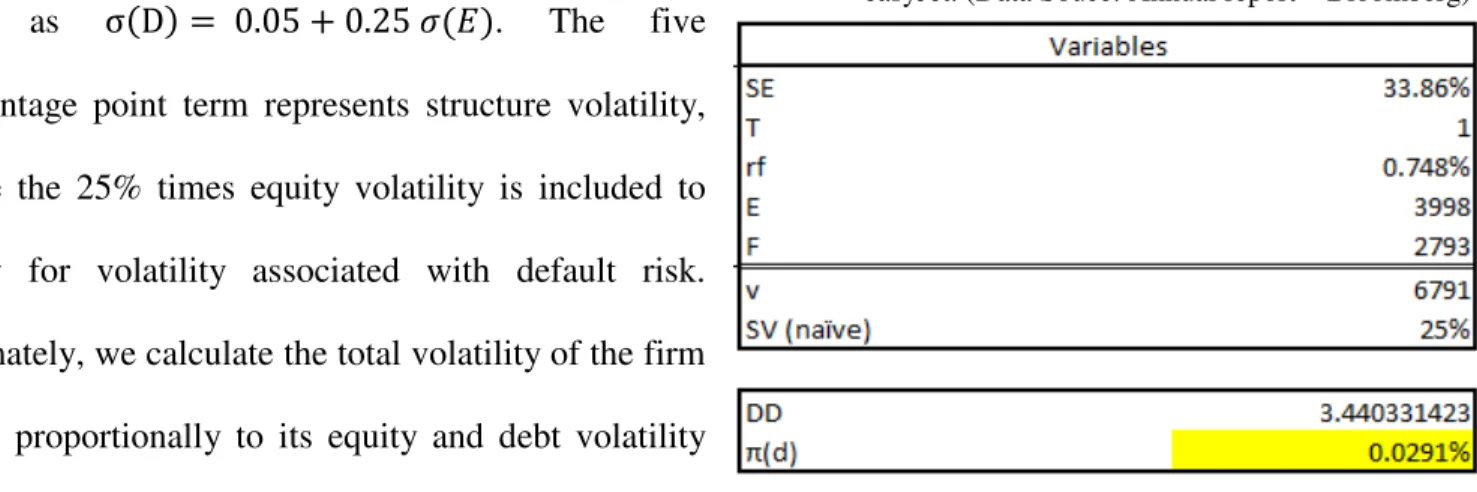
Table 7 shows the values for every variable and we can, therefore, compute the probability of default within the next year {π(d) = 0.022%}. Comparing this
probability with the annual default rates by rating category (table 8), given by an S&P study23 for the past
25 years, we notice that it corresponds to an AA rating.
21 Daily stock returns for the last two financial years were used to compute the annual volatility – Bloomberg. 22The correlation between Moody’s σ(V) and our naïve σ(V) is 0.853 and significant at the 0.1% level or lower.
23“Annual Global Corporate Default Study And Rating Transitions”, 2014
Table 7: Merton DD inputs and probability of default for easyJet. (Data Souce: Annual report – Bloomberg)
24 The British budget carrier may obtained a low probability of default and consequently a high rating but we still don’t know how resilient it is comparing to its competitors. That is why, we will apply the model
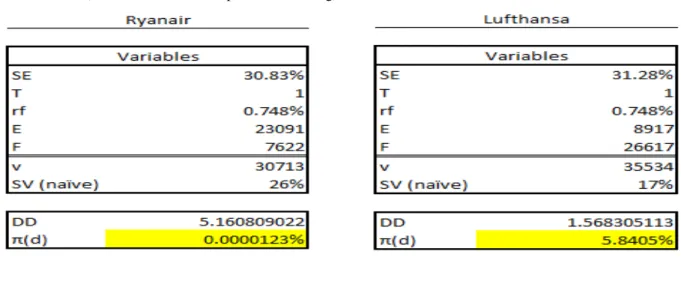
for Ryanair and Lufthansa, as the largest European low-cost and legacy airline, respectively. Following the same assumptions24 and calculations as we did for easyJet, we compute the probabilities of default as can be seen below.
These results correspond to a credit rating of AAA for Ryanair and B for Lufthansa. The big difference in their results relies on the huge market capitalization of Ryanair as well as in the significant amount of liabilities the German airline has. Between the two main short-haul competitors, we conclude that easyJet has a slightly lower rating mainly due to the much smaller number of shares issued (397mn comparing to 1,291mn of Ryanair), but also because of the 3% higher equity volatility, mainly caused by “Brexit”.
24The face value of liabilities was employed by companies’ annual reports. For the market value of equity, the stock price of
the last day of their financial year was used (31/3/2016 for Ryanair, 31/12/2015 for Lufthansa). The volatility of equity was computed as the average volatility of returns of the last two financial years for each company.
Table 10: Merton DD inputs and probability of default for Lufthansa. (Data Souce: Annual report – Bloomberg) Table 9: Merton DD inputs and probability of default for
25
5. References
Paul Sweeting, 2004, “An analysis and Critique of the Methods Used by Rating Agencies”, (Institute and Faculty of Actuaries).
Denise Finney, www.investopedia.com, “A Brief History of Credit Rating Agencies” <http://www.investopedia.com/articles/bonds/09/history-credit-rating-agencies.asp>
Robert A. Jarrow and Philip Protter, 2004,“Structural Versus Reduced form models: A new information based
perspective”.
Edward I. Altman, 1968, “Financial Ratios, Discriminant Analysis and the prediction of Corporate Banking”.
Philip Baggaley, Solomon B Samson, 2010,“Key Credit Factors: Criteria For Rating The Airline Industry”,
(Global Credit Portal, Standard and Poor’s Financial Services)
Standard & Poor’s, 2008,“Corporate Ratings Criteria”.
Ana Boata and Thomas Cardiel, 2016, “Country Report: United Kingdom”, (Euler Hermes).
European Commission, 2016, “European Economic Forecast–Autumn 2016”, Institutional Paper 038, pp. 9.
easyJet plc, 2012, 2013, 2014, 2015, 2016, “Annual report and accounts”.
Shreedhar T. Bharath and Tyler Shumway, 2008, “Forecasting Default with the Merton Distance to Default
Model”.
Diane Vazza and Nick W Kraemer,2015,“2014 Annual Global Corporate Default Study and Rating Transitions”,
(Standard & Poor’s).
Tom Stalnaker, Khalid Usman, Aaron Taylor, 2015,“Airline Economic Analysis”, (Olywer Wyman).
Wi-ling Chen and Leh-chyan So, 2014, “Validation of the Merton Distance to Default Model under Ambiguity”.
Oesterreichische Nationalbank, 2004, “Guidelines on Credit Risk Management –Rating Models and Validation”.
CAPA Centre for Aviation, 2016, “European airline seat capacity growth accelerates - perhaps too quickly: Outlook
for winter 2016/17”.
Kam Hon and Paul Holman,2016, “Rating Companies in the Airline Industry”, (DBRS).
Moritz Geiger, 2016, “Equity Research –easyJet”, (NOVA SBE).
Capital Intelligence, “Rating Methodologies”, < http://www.ciratings.com/page/rating-methodologies/corporate-ratings>.
Juliana C Gallo, 2016, “S&P Global Ratings –easyJet”, (Standard & Poor’s Global Ratings). <https://www.standardandpoors.com/en_US/web/guest/article/-/view/type/HTML/id/1681463>
Publications from IATA:
“Industry Economic Perfromance”, (2015),
<http://www.iata.org/publications/economics/Pages/industry-performance.aspx>
“State of the region: Europe”, (2016)
26
6.
APPENDICES
Consolidated Income Statement - easyJet
Consolidated Balance Sheet - easyJet
Balance Sheet (million £) 2011 2012 2013 2014 2015 2016E 2017F
Goodwill and other intangible Assets 451 456 467 478 492 517 545
Property, Plant & Equipment 2,149 2,395 2,280 2,542 2,877 3,252 3,577 Derivative financial instruments 24 21 13 36 44 154 133
Other Non-current Assets 107 96 204 165 136 128 100
Total Non-current Assets 2,731 2,968 2,964 3,221 3,549 4,051 4,355 Cash & cash equivalents 1,100 645 1,013 424 650 714 1,050 Money Marktet Deposits 300 238 224 561 289 255 400
Derivative financial instruments 83 73 17 23 128 268 210
Excess Cash 255 371 194 253 212 217 300
Total Current Assets 1,738 1,327 1,448 1,261 1,279 1,454 1,960 Total Assets 4,469 4,295 4,412 4,482 4,828 5,505 6,315 Financial Debt 1,145 828 592 472 322 664 1,050 Derivative financial instruments 27 24 41 23 101 49 100
Non-current deferred income 59 46 68 62 47 35 42
Maintenance provisions 177 141 171 147 165 235 255
Deferred Tax 179 198 144 186 176 237 203
Total Non-current Liabilities 1,587 1,237 1,016 890 811 1,220 1,650 Financial Debt 155 129 87 91 182 92 106
Derivative financial instruments 52 26 60 87 368 275 250
Working Capital (Liabilities) 970 1,109 1,232 1,242 1,218 1,206 1,294 Total Current Liabilities 1,177 1,264 1,379 1,420 1,768 1,573 1,650 Total Liabilities 2,764 2,501 2,395 2,310 2,579 2,793 3,300 Equity 1,705 1,794 2,017 2,172 2,249 2,712 3,015 Total Liabilities + Equity 4,469 4,295 4,412 4,482 4,828 5,505 6,315 Income Statement (million £) 2011 2012 2013 2014 2015 2016E 2017F Seats 3,389 3,794 4,194 4,462 4,616 4,587 Non-Seats 63 60 64 65 70 82
Total Revenues 3,452 3,854 4,258 4,527 4,686 4,669 4,903 Fuel (917) (1,149) (1,182) (1,251) (1,199) (1,114) - Airports and ground handling (923) (955) (1,078) (1,107) (1,122) (1,267) - Crew (407) (432) (454) (479) (505) (542) -
Navigation (285) (280) (294) (307) (313) (336) -
Maintenance (179) (203) (212) (212) (229) (237) -
Selling and marketing (102) (104) (101) (103) (102) (107) -
Other costs (171) (200) (226) (245) (276) (296) -
COSS: (2,984) (3,323) (3,547) (3,704) (3,746) (3,899) (4,055) EBITDAL 468 531 711 823 940 770 848
Aircraft dry leasing (109) (95) (102) (124) (114) (103) (103)
EBITDA 359 436 609 699 826 667 745
Depreciation (83) (97) (102) (106) (125) (157) (187)
Amortisation of intangible assets (7) (8) (10) (12) (13) (12) (13)
EBIT 269 331 497 581 688 498 545
Interest receivable and other fin. Income 9 11 5 11 9 10 10
Interest payable and other fin. Charges (30) (25) (24) (11) (11) (13) (27)
EBT 248 317 478 581 686 495 528
Tax (23) (62) (80) (131) (138) (68) (93)
27 Consolidated Cash Flow Statement - easyJet
Key Financial ratios – easyJet & comparables.
Cash Flow statement (million £) 2011 2012 2013 2014 2015 2016F 2017F
OPERATIONS
Cash generated from Operations 449 494 788 793 895 724
Net taxes paid (2) (28) (65) (96) (98) (99)
Net interest paid (23) (9) (22) 5 (8) (19)
Total cash from operations 424 457 701 702 789 606 674
INVESTING Capital expenditures (556) (392) (421) (448) (536) (586) (650)
Other investing and cash flow items, total 78 3 5 3 4 - -
Total cash from investing (478) (389) (416) (445) (532) (586) (650)
FINANCING Financing cash flow items (67) (37) 148 (20) 21 6
Change in Money market deposits (38) 55 41 (338) 277 45
Total cash dividends paid - (196) (85) (308) (180) (219) (214)
Proceeds from Eurobond issue 273 - 316 - - 379 379
Issuance (retirement) of stock, net (5) (13) (25) (56) (91) (22)
Issuance (retirement) of debt, net 83 (314) (283) (112) (91) (240)
Total cash from financing 246 (505) 112 (834) (64) (51) 8
Effects of exc. rate change (4) (18) (29) (12) 33 95 60
Net Increase in Cash & cash Equiv. 188 (455) 368 (589) 226 64 92
Cash (beginning of year) 912 1,100 645 1,013 424 650 714
Cash (end of year) 1,100 645 1,013 424 650 714 806
FYs EBITDA margin Operating margin ROIC EBITDA/Interest exp FFO/Debt Debt/EBITDA Debt/Capital Current ratio Cash ratio
2011 10.40% 7.79% 8.15% 14.36 0.33 3.62 43% 1.48 1.19
2012 11.34% 8.61% 9.65% 17.48 0.18 2.19 35% 1.05 0.70
2013 14.30% 11.67% 15.36% 43.50 1.03 1.11 25% 1.05 0.90
2014 15.48% 12.88% 16.52% 63.73 1.25 0.80 21% 0.89 0.69
2015 17.65% 14.70% 20.02% 75.18 1.57 0.61 18% 0.72 0.53
2016e 14.29% 10.67% 12.39% 51.31 0.80 1.13 22% 0.92 0.45
2017f 15.19% 11.12% 10.90% 27.59 0.58 1.55 28% 1.19 0.64
Financial Ratios - easyJet Plc
Cash flow Adequacy Leverage Liquidity
Profitability
Airline EBITDA margin Operating margin ROIC Airline Debt/EBITDA Debt/Capital
Ryanair 28.88% 22.34% 16.98% Ryanair 2.13 52.80%
Wizz air 18.49% 16.48% 31.21% Wizz air 0.13 4.70%
Lufthansa 10.20% 4.85% 8.13% Lufthansa 2.78 60.83%
Air France 10.54% 4.28% 13.19% Air France 2.32 95.89%
easyJet 17.65% 14.70% 20.02% easyJet 0.61 18.31%
Airline EBITDA/Interest exp FFO/Debt Airline Current ratio Cash ratio
Ryanair 26.55 0.46 Ryanair 1.43 0.37
Wizz air 33.04 8.50 Wizz air 1.70 1.38
Lufthansa 9.19 0.37 Lufthansa 0.72 0.09
Air France 7.36 0.30 Air France 0.63 0.26
easyJet 75.18 1.57 easyJet 0.72 0.53
Profitability
Cash flow Adequacy Liquidity