© 2007 Science Publications
Corresponding Author: Halimah M.K., Ultrasonic Laboratory, Department of Physics, Faculty of Science University Putra Malaysia, 43400 Serdang, Selangor, Malaysia
Structural Analysis of Borotellurite Glass
Halimah M.K., Daud W.M., Sidek H.A.A., Zainal A.S., Zainul A.H. and Jumiah H. Ultrasonic Laboratory, Department of Physics, Faculty of Science, University Putra Malaysia
43400 Serdang, Selangor, Malaysia
Abstract: The average cross-link density, number of the network bonds per unit volume, average stretching force constant, atomic ring size and the ratio Kbc/Ke have been calculated and discussed according to bond compression model for borotellurite glass. The result showed that the connectivity and rigidity of the borotellurite glasses increases with TeO2 content due to the transformation of BO3 units to BO4 and TeO3 units to TeO4. Comparison between theoretical calculated and experimental elastic moduli and Poisson’s ratio has been carried out. The results showed good agreement between experimental and theoretical calculated elastic moduli.
Key words: Borotellurite glass, bond compression model
INTRODUCTION
Tellurite glasses with the unique physical properties and applications were reported by El-Mallawany[1]. Elastic properties are very informative about the structure of solids and are directly related to the interatomic potentials. Elastic properties also provide the information about internal arrangement of the constituent oxides and the mechanical strength of the glass. Elastic moduli of tellurite, binary transition tellurite, rare earth tellurite and multicomponent tellurite glasses including halide, hydrostatic and uniaxial pressure dependencies of ultrasonic waves in these glasses at room temperature have been measured and reported[1]. Recently, elastic properties of (TeO2)50 -(V2O5)50-x(TiO2)x glasses using pulse-echo technique have been studied[2].
TeO2 and B2O3 are known as glass forming oxides. The structure of tellurite glass is a laminar network based on triangular TeO3 pyramids or square TeO4 pyramids[3]. Boron oxide B2O3 in its glassy form is a laminar network consisting of boron atoms 3-fold coordinated with oxygen which can form six-membered boroxol rings (B3O6), as reported earlier by Krogh-Moe[4]. When an alkali oxide modifies the pure boron oxide, the additional oxygen causes a conversion from the trigonal boron atoms BO3 into 4-fold BO4 coordinated boron atoms. Each BO4 structural group is negatively charged and the four oxygens are included in the network as bridging oxygen. These units are responsible for the increase in the connectivity of the glass network. As a result, the degree of the structural compactness and modification of the geometrical configuration in the glass network can vary with a change in the composition[4,5]. In borotellurite glasses, the TeO4 units and BO4 units have a strong tendency to link with each other to form BTeO3,5 units, which
results in a higher connectivity in the glass network just like BPO4 units in borophosphate glasses[6]. In this article the elastic moduli of borotellurite glasses will be discussed. Information about the structure of the glass can be deduced by calculating the number of network bonds per unit volume, the average stretching force constant, the average ring size and the average cross-link density. The theoretical values of ultrasonic activation energy and elastic moduli are calculated and compared with the corresponding experimental values.
MATERIALS AND METHODS
For the present studies, a binary TeO2-B2O3 glass system was prepared with different mol percent TeO2. The binary TeO2-B2O3 glasses were synthesized by the method mentioned elsewhere[7]. The prepared samples were cut into required dimension for ultrasonic velocity measurement. For ultrasonic velocity measurement of the glass sample, MATEC MBS 8000 was used. All measurements were taken at 5 MHz frequency and at room temperature. The density of the glasses was determined by Archimedes method with acetone as buoyant liquid.
Theory: For a three dimensional one component oxide glass of A-O bond (A= cation, O= oxygen), the bulk modulus (Kbc) according to the bond compression model[8] is given by equation
2 b bc
n f
K =
r
9
(1)where r is the bond length between cation and anion,
f
b a
m
n
n = N
V
(2)where Na is Avogadro’s number, nf is the number of network bonds per unit glass formula and Vm is the molar volume. The stretching force constant
f
can be calculated from the equation given by Higazy and Bridge[9].3
17
f
r
=
(3)For a three-dimensional polycomponent oxide glasses, Kbc and nb are given by
(
2)
a
bc f
i i
m
N
K =
x n fr
9 V
∑
(4)(
)
a f i
b
i m
N
x n
n =
V
∑
(
)
a
f
i i
m
N
x n
V
=
∑
(5)where x is the mole fraction of the component oxide i. The theoretical Poisson’s ratio for the polycomponent oxide glasses according to the bond compression model[8] is given by
0.25
cal
= 0.28(n )
cσ
−(6) where
n
cis the average cross-link density of the glassnetwork and is given by
( )( )
c c c
i
1
n =
n
N
η
∑
(7)where nc is the number of cross-link per cation (number of bridging bonds per cation minus two) in oxide i. Nc is the number of cation per glass formula unit and
( )
c ii
=
N
η
∑
is the total number of cations per glass formula unit.The average atomic ring size (l) of a structure consisting of a three-dimensional network according to the ring deformatiom model[10] is expressed in the form
b
e 3.84
0.0106 F
K =
l
(8)where Fb is the bond bending force constant which to a first approximation may be taken as proportional to the stretching force constant
F
and Ke is the experimental bulk modulus. The stretching force constantF
for a three-dimensional polycomponent oxide glasses is given as(
)
(
)
f i f i i
x n f
F =
x n
∑
∑
(9)Bridge and Patel[11] proposed a quantitative empirical equation to correlate between activation
energy V of ultrasonic relaxation and the most important structure of the network that is force constant
F
and atomic ring size l.Abd. Moneim[12] reported the following relationship after using the data of pure tellurite, tricomponent tellurite TeO2-V2O3-Sm2O3 glasses and the data of glasses used in Bridge and Patel analysis
2.6422 cal
V = 113F
l
(10)and
2 -27 1.36 cal cal
K V
=
1.2 x 10
F
l
− (11)These expression gave the values of activation energy in Joule and bulk modulus in GPa when unit of
F
is N/m and l is meter.The other elastic moduli can be obtained from bulk modulus and Poisson’s ratio[1] for each glass system as: Shear modulus
(
)
(
cal)
cal cal
cal
1 2
G
1.5K
1+
σ
σ
−
=
(12)Longitudinal modulus
cal cal cal
L =K
+
1.33G
(13)Young’s modulus
Ecal = 2(1 + σcal) Gcal (14)
RESULTS AND DISCUSSION
Table 1: Parameter adopted from the crystal structure of oxide[18]
Oxide r (nm) F (N/m) nf nc
TeO2 0.1990 216 4 2
B2O3 0.1380 660 3 1
Parameters adopted from the crystal structure of each oxide are listed in Table 1. These parameters are used to calculate the number of network bond per unit volume nb, bond compression bulk modulus Kbc, calculated Poisson’s ratio σcal, average cross-link density
n
c, atomic ring size l, the average stretchingforce constant F and the ratio between bond compression and experimental bulk modulus Kbc/Ke. Table 2 lists the calculated parameters and experimental values of bulk modulus Ke, density ρ and molar volume Vm. of (TeO2)x(B2O3)1-x glass system. The experimental data have been taken from elsewhere[7].
Figure 1 shows the variation of the average cross-link density
n
c with TeO2 content. The average cross-link density increases as the tellurite oxide increases. The value of average cross-link density,n
c changes1.40 1.50 1.60 1.70
60 65 70 75 80
TeO2 (mol% )
C
ros
s
-l
ink
de
ns
it
y
(
nc
)
Fig. 1: Variation of the average cross-link density with TeO2 content for TeO2-B2O3 glass system
8.00 8.10 8.20 8.30
60 65 70 75 80
TeO2(mol% )
N
u
m
b
er
of
net
w
o
rk bon
ds p
e
r un
it
v
o
lu
m
e
, n
b
(1
0
28 m -3)
Fig. 2: Variation of the number of network bonds per unit volume with TeO2 content for TeO2-B2O3 glass system
0.51 0.52 0.53 0.54 0.55 0.56 0.57 0.58 0.59
60 65 70 75 80
TeO2 (mol % )
A
tom
ic
r
ing
si
z
e
,
l
(n
m
)
Fig. 3: Variation of the atomic ring size with TeO2 content for TeO2-B2O3 glass system
bonds per unit volume nb decreases with TeO2 content. The value of nb changes form 8.26 x 1028 m-3 to 8.03 x 1028 m-3. The decrease in the number of network bonds per unit volume is due to the increase in the cross-link density and the increase of molar volume with increasing TeO2 content.
The variation of the atomic ring size l with TeO2 content is shown in Fig. 3. The atomic ring size of (TeO2)x (B2O3)1-x glass decreases as TeO2 content increases. This shows that the network of the glasses become rigid with the increase of tellurium dioxide. The decreased in atomic ring size is from 0.5765 to 0.5377 with increasing TeO2 is due to the increase in
80 82 84 86 88 90 92
0.60 0.65 0.70 0.75 0.80
TeO2 (mol% )
K
bc
(GP
A
)
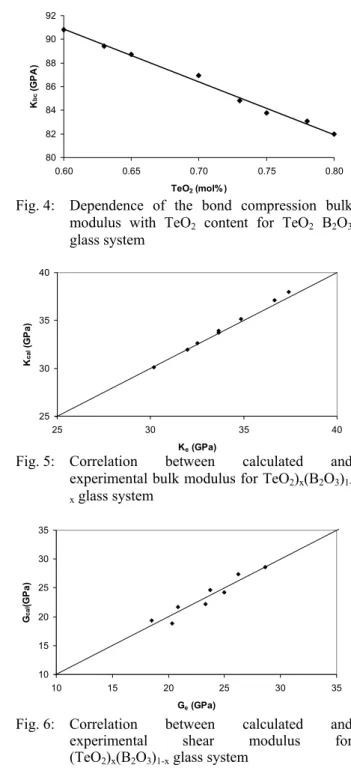
Fig. 4: Dependence of the bond compression bulk modulus with TeO2 content for TeO2 B2O3 glass system
25 30 35 40
25 30 35 40
Ke (GPa)
K
ca
l
(GP
a
)
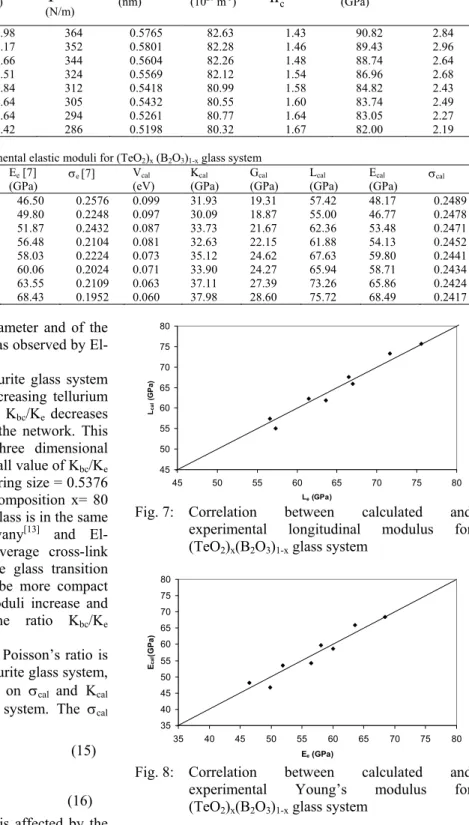
Fig. 5: Correlation between calculated and experimental bulk modulus for TeO2)x(B2O3) 1-x glass system
10 15 20 25 30 35
10 15 20 25 30 35
Ge (GPa)
G
cal
(G
P
a
)
Fig. 6: Correlation between calculated and experimental shear modulus for (TeO2)x(B2O3)1-x glass system
Table 2: The calculated value of the average stretching force constant F, number of network bonds per unit volume nb, bond compression bulk
modulus Kbc, average cross-link density
n
c, atomic ring size l, the ratio of bond compression bulk modulus and experimental bulk modulus Kbc/Ke for (TeO2)x (B2O3)1-x glass systemX mol% ρ[x] (g/cm3)
Vm (cm3)
Ke [7]
(GPa)
F
(N/m)
l (nm)
nb (1028 m-3)
c
n
Kbc (GPa)Kbc/Ke
60 4.71 28.24 31.98 364 0.5765 82.63 1.43 90.82 2.84
63 4.75 26.57 30.17 352 0.5801 82.28 1.46 89.43 2.96
65 4.79 26.72 33.66 344 0.5604 82.26 1.48 88.74 2.64
70 4.89 27.13 32.51 324 0.5569 82.12 1.54 86.96 2.68
73 4.88 27.74 34.84 312 0.5418 80.99 1.58 84.82 2.43
75 4.89 28.04 33.64 305 0.5432 80.55 1.60 83.74 2.49
78 4.96 28.19 36.64 294 0.5261 80.77 1.64 83.05 2.27
80 4.97 28.50 37.42 286 0.5198 80.32 1.67 82.00 2.19
Table 3: Theoretically calculated and experimental elastic moduli for (TeO2)x (B2O3)1-x glass system X
mol%
Ke [7] (GPa)
Ge [7] (GPa)
Le [7] (GPa)
Ee [7] (GPa)
σe [7] Vcal (eV)
Kcal (GPa)
Gcal (GPa)
Lcal (GPa)
Ecal (GPa)
σcal
60 31.98 18.49 56.63 46.50 0.2576 0.099 31.93 19.31 57.42 48.17 0.2489
63 30.17 20.33 57.28 49.80 0.2248 0.097 30.09 18.87 55.00 46.77 0.2478
65 33.66 20.86 61.48 51.87 0.2432 0.087 33.73 21.67 62.36 53.48 0.2471
70 32.51 23.33 63.62 56.48 0.2104 0.081 32.63 22.15 61.88 54.13 0.2452
73 34.84 23.74 66.49 58.03 0.2224 0.073 35.12 24.62 67.63 59.80 0.2441
75 33.64 24.98 66.94 60.06 0.2024 0.071 33.90 24.27 65.94 58.71 0.2434
78 36.64 26.24 71.62 63.55 0.2109 0.063 37.11 27.39 73.26 65.86 0.2424
80 37.42 28.63 75.59 68.43 0.1952 0.060 37.98 28.60 75.72 68.49 0.2417
Kbc/Ke approach those of the ring diameter and of the ratio Kbc/Ke of tellurite based glasses as observed by El-Mallawany[13].
The value of Kbc/Ke for borotellurite glass system decreases from 2.84 to 2.19 with increasing tellurium dioxide. Table 2 shows that the ratio Kbc/Ke decreases with decreasing atomic ring size of the network. This value is attributed to less open three dimensional structure of this glass system. The small value of Kbc/Ke (2.19) is attributed to the very close (ring size = 0.5376 nm) three dimensional structure at composition x= 80 mol%. The behaviour of the studied glass is in the same range as reported by El-Mallawany[13] and El-Moneim[12]. The increase in the average cross-link density results in an increase in the glass transition temperature, thus the structure will be more compact and cross-link so that the elastic moduli increase and both average ring size and the ratio Kbc/Ke decreases[5,10].
The calculated and experimental Poisson’s ratio is tabulated in Table 3. For this borotellurite glass system, there are some modifications made on σcal and Kcal relation to fit for the studied glass system. The σcal relation is
1.4508
cal
= 0.414(n )
cσ
−(15)
and for Kcal is
2 -27 1.3535 cal cal
K V
=
1.2 x 10
F
l
− (16) It is known that Poisson’s ratio is affected by thechanges in the cross-link density of the glass network. Rajendran et al.[3,14] and Bridge et al.[15-17] proposed that a high cross-link density has Poisson’s ratio in the order of 0.1-0.2, while a low cross-link density has Poisson’s
45 50 55 60 65 70 75 80
45 50 55 60 65 70 75 80
Le (GPa)
L
cal
(GP
a
)
Fig. 7: Correlation between calculated and experimental longitudinal modulus for (TeO2)x(B2O3)1-x glass system
35 40 45 50 55 60 65 70 75 80
35 40 45 50 55 60 65 70 75 80
Ee (GPa)
E
cal
(G
P
a
)
Fig. 8: Correlation between calculated and experimental Young’s modulus for (TeO2)x(B2O3)1-x glass system
density (changes from 1.43 to 1.67) when TeO2 content is increased. This supports that bridging oxygen have been created which will strengthen the glass network. Moreover, these cross-links generate strong covalent forces to resist lateral contraction and consequently decrease the Poisson’s ratio values[8].
The activation energy depends on the value of the cation-anion forces. For a given A-O-A bond angle the A-A separation would directly proportional to the stretching force constant of the network[9]. The A-O-A bond force constant decreases, the energy required will decrease to produce a given degree of bond angle or length distortion which leads to a decrease in activation energy. The average stretching force constant
F
for the studied glass decreases from 364.00 N/m to 286.11 N/m and the activation energy decreases from 0.099 eV to 0.060 eV. Results indicate the connectivity and hence rigidity of this glass system increases with increasing TeO2 content.Table 3 shows the calculated and experimental value of elastic moduli for (TeO2)x (B2O3)1-x glass. The values of experimental elastic moduli have been taken from elsewhere[7]. The calculated elastic moduli (shear Gcal, longitudinal Lcal, bulk Kcal and Young’s Ecal) are in the range of the experimental values. Figure 5-8 show the agreement between the theoretical calculated values of bulk, shear, longitudinal and Young’s elastic modulus respectively. The straight line in each figure has a gradient of unity. The figures show that the correlation coefficient between the calculated and the corresponding experimental values changes between 96% to 100% for bulk modulus, between 94% to 100% for Young’s modulus, between 96% to 100% for longitudinal modulus and between 93% to 100% for shear modulus. It is observed that by using Equations (15) and (16), it can be consider that this model gives a good agreement between the calculated and the experimental values of elastic moduli.
CONCLUSION
The elastic moduli and structure of borotellurite glass (TeO2)x (B2O3)1-x has been studied as a function composition by calculating the number of network bonds per unit volume, the average cross-link density, activation energy, bond compression bulk modulus and Poisson’s ratio. The agreement between the theoretically calculated and experimental elastic moduli is excellent for the studied samples.
ACKNOWLEDGEMENT
The financial support of the Ministry of Science, Technology and Innovation, Malaysia under IRPA vote 54061 is gratefully acknowledged.
REFERENCES
1. El-Mallawany, R., 2002. Tellurite Glasses Handbook. Physical Properties and Data, CRC Press, pp: 540.
2. El-Mallawany, R., N. El-Khoshkhany and H. Afifi, 2006. Ultrasonic studies of (TeO2)50-(V2O5) 50-x(TiO2)x glasses. Mater. Chem. Phys., 95: 321-327. 3. Rajendran, V., N. Palanivelu, B.K. Chaudhuri and
K. Goswami, 2003. Characterisation of semiconducting V2O5-BiO3-TeO2 glasses through ultrasonic measurements. J. Non-Cryst. Solids, 320: 195-209.
4. Saddeek, Y.B., 2004. Ultrasonic study and physical properties of some borate glass. Mater. Chem. Phys., 83: 222-228.
5. Saddeek, Y.B., 2005. Elastic properties of Gd3+ -doped tellurovanadate glasses using pulse-echo technique. Mater. Chem. Phys., 91: 146-153. 6. Chowdari, B.V.R. and P. Pramoda Kumari, 1998.
Studies on Ag2O. MxOy TeO2 (MxOy =WO3, MoO3, P2O5 and B2O3) ionic conducting glasses. Solid State Ionics, 113-115: 665-675.
7. Halimah, M.K., H.A.A. Sidek, W.M. Daud, H. Zainul, Z.A. Talib, A.W. Zaidan, A.S. Zainal and H. Mansor, 2005. Ultrasonis study and physical properties of borotellurite glass. Am. J. Appl. Sci., 2: 1541-1546.
8. Bridge, B., N.D. Patel and D.N. Waters, 1983. Elastic constants and structure of the vitreous system. Phys. Stat. Sol., 7: 655-666.
9. Higazy, A. and B. Bridge, 1985. Elastic constants and structure of the vitreous system Co3O4-P2O4. J. Non-Cryst. Solids, 72: 81-108.
10. El-Mallawany, R., 2000. Structural interpretations on tellurite glasses. Mater. Chem. Phys., 63: 109-115.
11. Bridge, B. and N. Patel, 1986. Ultrasonic relaxation studies of the vitreous system Mo-P-O. J. Mater. Sci., 21: 3783-3800.
12. El- Moneim, A.A., 2003. Quantitatively analysis of elastic moduli and structure of B2O3-SiO2 and Na2O-B2O3-SiO2 glasses. Physics B, 325: 319-332. 13. El-Mallawany, R. 1994. Theoretical analysis of
ultrasonic wave attenuation and elastic moduli of tellurite glasses. Mat. Chem. Phys., 39: 161-165. 14. Rajendran, V., N. Palanivelu, D.K. Modak and
B.K. Chaudhuri, 2000. Ultrasonic investigation on ferroelectric BaTiO3 doped 80V2O5-20PbO oxide glasses. Phys. Stat. Sol. A, 180: 467-477.
15. Bridge, B. and A. Higazy, 1985. Elastic constants and structure of the vitreous system Co3O4-P2O4. J. Non-Crystalline Solids, 72: 81-108.
16. Bridge, B. and A. Higazy, 1986. Ultrasonic relaxation studies of the vitreous system Mo-P-O in the temperature range 4 to 300 K. J. Mater. Sci., 20: 3783-3800.
17. Bridge, B., 1989. A model for estimating the bulk modulus of polycomponent inorganic oxide glasses. J. Mater. Sci., 24: 804-810.