Sexual Behavior and Frequency of Antibodies to
Type 1 Human Immunodeficiency
Virus (HIV-l)
in a Group of Peruvian Male Homosexuals1
CARLOS C~CERES l?.,2J4 EDUARDO
GOTUZZO,*STEPHEN WIGNALL,~ & MIGUEL CAMPOS*
444
The most important risk factor for HIV infection in North America and Western Europe is homosexual behavior. This article describes a 1988 survey of active male homosexuals in Lima, Peru, that investigated patterns of homosexual behavior and HIV seropositivity.
V
arious circumstances associatedwith human immunodeficiency vi- rus (HIV) infection throughout the world have been assuming increased health im- portance in recent years. Indeed, if we consider that 273,425 cases of AIDS were reported to WHO up to July 1990 (I), with far higher numbers of HIV-infected people being projected, it is reasonable to conclude that we are in the throes of a pandemic.
Latin America has not remained iso- lated from this problem. To date, Latin American countries have reported 23,971 cases of AIDS, 8.77% of the total cases reported to WHO up to July 1990 (I).
IThis article has previously been published in Span- ish in the Boletin de la Oficina Sanitaria Panamericana,
Vol. 111, No. 3, pp. 218-230, 1991. Correspon- dence should be directed to Dr. Carlos F. Clceres, Instituto de Medicina Tropical Alexander von Humboldt, Universidad Cayetano Heredia, Al’ 5045, Lima 100, Peru.
ZAlexander von Humboldt Institute of Tropical Medicine, Universidad Peruana Cayetano He- redia, Lima, Peru.
sSchoo1 of Public Health, University of California at Berkeley, California, U.S.A.
Wia Libre Association, Lima, Peru.
smstitute of Tropical Disease Research, U.S. Naval Medical Research Institute Detachment (NAM- RID), Lima, Peru.
Since epidemiologic study of AIDS be- gan, certain risk factors have been identi- fied. In North America and Western Eu- rope, the most important of these has been male homosexual behavior (2-4), which in recent years has been linked to approximately 70% of all
AIDS
cases re- ported in the United States (5). In addi- tion, epidemiologic studies comparing infected homosexual men with others free of infection have shown that a higher frequency of infection has been associ- ated with having large numbers of sexual partners and engaging in anal inter- course without using a condom (6).In Peru, the first AIDS case was de- scribed in May 1983 (7). According to Peru’s Special
AIDS
Control Program (a), the total number of AIDS cases reported up to March 1990 was 276, and the esti- mated rate of underreporting was 40%. In this universe, 20% of the reported cases were found in people who had traveled abroad, and who very likely were infected outside the country. Of the 276, 89.5% were adult males, the ratio of adult males to adult females in this popu- lation being 11.2. With respect to risk fac- tors, 193 (78.1%) of the adult males re- ported homosexual or bisexual behavior,while four (1.6%) also reported having used intravenous drugs.
The seroprevalence of HIV infection in Peru was indicated by a survey carried out between March 1987 and March 1988 (9), mainly among healthy blood donors but also to a lesser extent among healthy people at risk and among people clisplay- ing symptoms. This survey revealed a positive response rate of 0.42% (213 in a survey population of 50,719). Of those in- fected, 123 (57.7%) were homosexually active
males,
so that of the 2,500 homo- sexually active males who participated in the survey, 4.9% yielded seropositive re- sults-a rate of HIV seropositivity sur- passed only by hemophiliacs, with 5.2%. In addition, a 1985 study carried out in Lima on a group of 98 middle-aged male homosexuals and bisexuals of high socio- economic status (10) found that 11 (95% CI = 11.22% + 6.25%) had HIV anti- bodies.The preceding findings suggest that HIV infection in Peru continues to be as- sociated primarily with homosexual or bi- sexual behavior. Unfortunately, very little is known about patterns of homosexual behavior in Peru, In view of this, it was proposed that a descriptive cross-sec- tional study be made of a group of homo- sexually active men residing in Lima for the purpose of describing their patterns of sexual activity, investigating the preva- lence of HIV antibodies among them, and exploring possible risk factors for HIV infection. This article reports the re- sults of that study.
METHODS
Sample Size and Eligibility
Criteria
Basing the estimated prevalence of HIV infection in the male homosexual population on the approximate figure of 8% reported in the National Serological
Survey conducted by NAMRID (9) for this group at the end of 1987, and work- ing at the 0.05 level of significance with a confidence interval of 0.1, it was calcu- lated that the minimum sample size
would need to be 113 subjects. Those eli- gible to participate in the study were males over the age of 16 years who were self-described as homosexuals or bisex- uals, or who reported sexual activity in- volving other men. The following were excluded from the study: any person whose clinical picture suggested the presence of stage IV HIV infection; any- one who asked to be tested because he could clearly perceive symptoms; and anyone who was unwilling to participate on a voluntary basis.
Survey Instrument and Laboratory
Procedures
A survey developed specifically for this study, which was first tested in a prelimi- nary fashion on a lo-person sample, gathered data on each subject’s socio- demographic background, patterns of sexual behavior, other epidemiologically relevant factors, possible current symp- tomatology, and knowledge and atti- tudes about AIDS. Since the survey in- cluded information on extrainguinal lymphadenopathy, it involved examina- tion of the subject’s cervical, supra- clavicular, and axillary ganglia.
The subject’s socioeconomic status was determined by totaling points assigned him for his level of education, occupa- tion, income, area of residence, and pos- session of housing. This produced a total point count ranging from 1 to 15. On the basis of this total, the subject’s socio- economic status was judged to be low (l-3 points), lower-middle (4-7), middle (B-11), or upper (12-15).
A point system was also used to assess drug use. Points were assigned for use of marijuana, cocaine, cocaine base, amyl
nitrites, or intravenous drugs (0, 1, or 2 points being assigned for each drug de- pending on whether the patient admitted to no drug use, occasional use, or regular use). Theoretically, up to 10 points could be assigned. A score of 1 signified limited use of recreational drugs, while a score of 2 or more was taken to indicate signifi- cant drug use.
The estimated prevalence of HIV infec- tion among the study subjects was based on detection of HIV serum antibodies. The serum collected from each subject was tested using the Genetic Systems en-
zyme immunoassay kit for HIV-l; those samples that tested positive on two sepa- rate occasions were confirmed by West- ern Blot using the DuPont kit. Upon ex-
amination, those that yielded the
response pattern specified by the labora- tory were declared positive.
Procedure
Between January and April 1988, 124 persons were recruited. This recruitment was based on written and oral informa- tion provided at the premises of the Insti- tute of Tropical Disease Research/US Naval Medical Research Institute Detach- ment (NAMRID); at the offices of the
Movimiento Homosexual de Lima
(MHOL), an organization that provides services to the homosexual community in Lima; in customary gathering places of homosexual men (bars and disco- theques); on public streets; or through contacts made by third parties. The recruiting effort varied according to location.
The NAMRID laboratory, for the pur- poses of another study, had been receiv- ing the general public to provide screen- ing for HIV antibodies. During this screening, participants were asked to fur- nish confidential epidemiologic informa- tion on various matters, including a his- tory of homosexual relations. Therefore,
the people who were recruited at the NAMRID laboratory for the purposes of the study reported here were males who had reported having homosexual rela- tions and who agreed to answer an addi- tional questionnaire. . .
On the other hand, those recruited at the MHOL offices, in public places, on public streets, or through third parties were invited to collaborate in a research project by answering a confidential ques- tionnaire and allowing a blood sample to be drawn for HIV antibody screening. (Those agreeing to participate were not obligated to pick up their HIV test results.)
The questionnaire was administered mainly by the study director or by a
NAMRID laboratory worker who was
given appropriate training for this pur- pose. In a few cases the study subjects filled out the questionnaire themselves, under supervision. The participants were given either oral or written information about AIDS and its prevention after they had completed the survey, as well as an additional counseling session if they came in to learn their test results. When the results were positive, the subjects were given special recommendations, and those in need of medical or psycho- therapeutic support were directed to specialists.
Analysis
The distribution of the study variables within the sample was ascertained, and the prevalence of HIV infection was de- termined. Also, it was felt that the sam- ple size (initially calculated for a descrip- tive study) might be insufficient to support a rigorous analysis of the risk factors for HIV infection. However, a ten- tative assessment was made of the rela- tionship between HIV infection and the other variables involved in order to ob- tain preliminary information that could
be used as a basis for subsequent analytic studies. To that end odds ratios and their 95% confidence intervals were calcu- lated, and the p values of the Fisher exact test were similarly evaluated at a signifi- cance level of 0.05. For this purpose we worked directly with the dichotomous variables, and in instances where the variables were of a discrete or ordinal na- ture, these variables were dichotomized.
RESULTS
Sociodemographic
Patterns
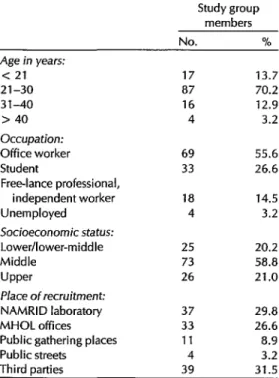
The population sample consisted of 124 subjects with an average age of 25.8 + 11.4 years (x + 2 SD) and an age range of 16 to 49 years. As indicated in Table 1, 70% were between 21 and 30 years old; 79.0% had been born in Lima.
Regarding education, occupation, and
Table 1. Sociodemographic characteristics of the study group.
Study group members
No. %
Age in years: < 21 21-30 31-40 > 40 Occupation: Office worker Student
Free-lance professional,
independent worker Unemployed
17 13.7 87 70.2 16 12.9
4 3.2
69 55.6 33 26.6 18 14.5
4 3.2
Socioeconomic status: Lower/lower-middle Middle
Upper
Place of recruitment: NAMRID laboratory MHOL offices Public gathering places Public streets Third oarties
25 20.2 73 58.8 26 21.0 37 29.8 33 26.6 11 a.9
4 3.2
39 31.5
socioeconomic status, 76.6% reported some primary education and 21.8% said they had received some (complete or in-
complete) secondary schooling. The
questionnaire responses indicated that over half (55.6%) of the subjects were of- fice workers, 14.5% were independent workers or professionals, 26.6% were students, and 3.2% were unemployed. About a quarter (25.8%) said they had no income of their own, while 8.1% said they received the minimum wage, 34.7% said they were paid between one and three times the minimum wage, and 31.4% said their salaries were more than three times the minimum wage. With re- spect to socioeconomic status, the re- spondents’ scores indicated that 0%, 20.2%, 59.2%, and 21%, respectively, be- longed in the lower, lower-middle, mid- dle, and upper categories established by the survey.
Regarding the respondents’ place of recruitment, 29.8% were recruited at the NAMRID laboratory, 26.6% at MHOL, 8.9% at customary male homosexual gathering places (bars and discotheques), 3.2% on public streets, and 31.5% through their contacts with people in the other groups.
Patterns of Sexual Activity
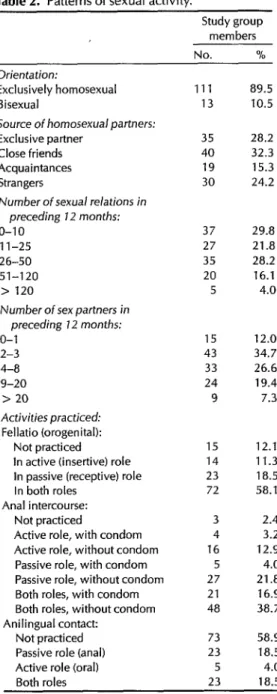
Most of those surveyed (89.5%) re- ported having exclusively homosexual relations over the previous six months, while the remaining 10.5% said they had relations with people of both sexes (Table 2). The reported length of time that they had been homosexually active was most frequently (in 31.5% of the cases) be- tween 5 and 10 years.6 The average num-
‘The following percentages of the study subjects said they had been homosexually active for the in- dicated periods: 0.8% for less than six months, 15.3% for six months to two years, 22.6% for two to five years, 31.5% for five to 10 years, and 29.8% for over 10 years.
Table 2. Patterns of sexual activity.
Study group members hln 01” Orientation:
Exclusively homosexual Bisexual
Source of homosexual partners: Exclusive partner
Close friends Acquaintances Strangers
Number of sexual relations in preceding 12 months: O-10
1 l-25 26-50 51-120
> 120
Number of sex partners in preceding 1.2 months: o-1
2-3 4-8 9-20
> 20
Activities practiced: Fellatio (orogenital):
Not practiced
In active (insertive) role In passive (receptive) role In both roles
Anal intercourse: Not practiced
Active role, with condom Active role, without condom Passive role, with condom Passive role, without condom Both roles, with condom Both roles, without condom Anilingual contact:
Not practiced Passive role (anal) Active role (oral) Both roles
Ill 89.5 13 10.5 35 28.2 40 32.3 19 15.3 30 24.2
37 29.8 27 21.8 35 28.2 20 16.1 5 4.0
15 12.0 43 34.7 33 26.6 24 19.4 9 7.3
15 12.1 14 11.3 23 18.5 72 58.1
3 4 16 27 21 48
73 58.9 23 18.5 5 4.0 23 18.5 2.4 3.2 12.9
4.0 21.8
16.9 38.7
About a tenth of the study group (10.5%) reported some heterosexual ac- tivity during the preceding six months. The average number of reported hetero- sexual relations in that period was 3.5, and the average number of female sex partners was 1.6. Most (61.6%) of those involved said their female partners were friends or acquaintances; none of them reported any contact with prostitutes. ber of homosexual contacts during the Vaginal intercourse was practiced in all previous 30 days was 3.7 (95% CI = of these heterosexual relationships, and * 0.68), while for the previous year it only 23.1% of those involved said they was 38.2 (95% CI = f 7.33). The average had used condoms. Only one person in number of sexual partners was 1.8 (95% the study group reported having any CI = f 0.33) for the previous month children.
(47.6% reported having only one part- ner), and 7.6 (95% CI = f 1.79) for,the previous year.
Most subjects (60.5%) said their sexual partners were exclusive or were drawn from a close circle of friends, while 24.2% said their partners were strangers (from the street or public places) (see Table 2).
With regard to actual practices, 87.9% reported engaging in fellatio, with 76.1% of the respondents assuming the passive (receptive) position or both passive and active positions. Nearly all (97.6%) said they had anal intercourse, while only 24.2% said they had used a condom (81.5% of the respondents said they had assumed the passive position or both ac- tive and passive positions, and of these only 25.7% had used a condom). Only 41.1% of the subjects said they had en- gaged in any anilingual activity.
A few subjects (5.6% of the study group) reported having had relations with an HIV-seropositive person; 20.9% reported having made trips abroad over the preceding seven years during which they had engaged in sexual activity; and 29.8% reported having had sexual rela- tions with foreigners from countries with high HIV prevalences (e.g., Brazil, France, and the United States) during the preceding seven years.
Table 3. The study group’s epidemiologic history with regard to various risk factors.
Study group members History of:
Transfusions Frequent injections Tattoos/acupuncture Alcohol consumption Use of recreational drugs:
No. % 3 2.4 16 12.9 4 3.2 90 72.6 None (no points) 85 68.5 Limited (1 point) 24 19.4 Significant (2-10 points) 15 12.1
Other Risk Factors
As Table 3 shows, 2.4% of the respon- dents reported receiving transfusions. Over half (54%) consumed alcohol as of- ten as twice weekly, and 17.7% did so more often. Regarding drugs, 68.5% re- ported no use of illicit drugs; 19.4% and 12.1%, respectively, indicated limited and significant drug use. None of the study subjects reported using intra- venous drugs.
Regarding sexually transmitted dis- eases, 17.7% of the respondents reported a history of gonorrhea and 9.7% said they had had nongonococcal urethritis. A his- tory of syphilis, venereal warts, or genital herpes was reported by 5% of the sub- jects. A quarter (25%) of the respondents had a history of hepatitis. Extrainguinal lymphadenopathy was found in 11.3%.
Knowledge and Attitudes about AIDS
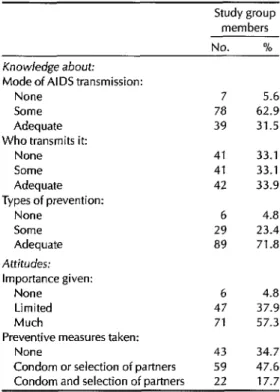
Regarding knowledge of AIDS, as Ta- ble 4 indicates, 31.5% of the participants were found to have a good understand- ing of how the virus is transmitted while an additional 62.9% had some under- standing. A third (33.9%) could tell that the term “seropositive persons” referred to people capable of transmitting the in- fection; and 71.8% correctly explained how to prevent transmission,
With respect to attitudes, 57.3% said
Table 4. Knowledge and attitudes regarding AIDS.
Study group members No. % Knowledge about:
Mode of AIDS transmission: None
Some Adequate Who transmits it:
None Some Adequate Types of prevention:
None Some Adequate Attitudes: Importance given:
None Limited Much
Preventive measures taken: None
Condom or selection of partners Condom and selection of partners
78 39 41 33.1 41 33.1 42 33.9 6 4.8 29 23.4 89 71.8
6 4.8 47 37.9 71 57.3 43 34.7 59 47.6 22 17.7 5.6 62.9 31.5
they considered AIDS a significant dan- ger in their current lives. About a third (34.7%) said they had taken no preven- tive measures, but added that they were inclined to do so after receiving orienta- tion; 47.6% had adopted one of two use- ful measures: care in selection of their sexual partners or condom use; only 2 17.7% had adopted both measures.
Current HIV Serology and Possible
Risk Factors
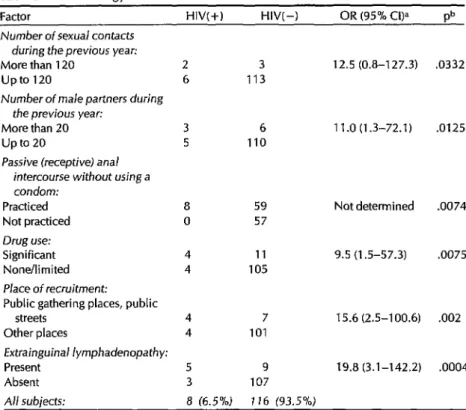
Eight of the 124 subjects (6.5%) were HIV-seropositive, the remaining 116 be- ing seronegative (95% CI = 2.2%-10.8%). Examination of relationships between se- ropositivity and all major variables (see Table 5) yielded the following results:
Subjects’ place of recruitment.
First contingency analysis of this variable’sTable 5. HIV serology and risk factors identified.
Factor HIV(+) HIV( -) OR (95% CI)a pb Number of sexual contacts
during the previous year: More than 120
upto 120
Number of male partners during the previous year:
More than 20 up to 20
Passive (receptive) anal intercourse without using a condom:
Practiced Not practiced Drug use: Significant None/limited Place of recruitment:
Public gathering places, public streets
Other places
Fxtrainguinal lymphadenopathy: Present
Absent
2 3 12.5 (0.8-127.3) .0332 6 113
3 6 11 .O (1.3-72.1) .0125 5 110
8 0 4 4
4 7 15.6 (2.5-100.6) .002 4 101
5 9 19.8 (3.1-142.2) .0004 3 107
59
57
Not determined .0074 11 9.5 (1.5-57.3) .0075 105
A// subjects: 8 (6.5%) I16 (93.5%) aOR (95% Cl) = Odds ratio (95% confidence interval).
bp = p value of Fisher’s exact test.
five categories and the presence of HIV infection revealed that these variables were not independent (p 5 .05). The original five categories for place of re- cruitment were then consolidated into two categories (laboratory, MHOL of- . fices, and third-party contacts versus
public gathering places and public streets) and evaluated relative to HIV in- fection. This indicated that the odds ratio (OR) for obtaining positive results from the subjects who were recruited in bars or along public streets was 15.6 (95% CI = 2.5-100.6; p = .002 according to the Fisher test).
Number of sexual contacts with other
men in the previous 12 months.
The OR of seropositivity for subjects with more than 120 contacts was 12.5 (95% CI = 0.8- 127.3; p = .0332 by Fisher test).312 Bulletin of PAHO 25(4), 1991
Number of male sex partners during the
previous 12 months.
The OR of se- ropositivity for subjects with more than 20 partners was 11.0 (95% CI = 1.3-72.1; p = .0125 by Fisher test).Engaging in passive anal intercourse
without a condom. All
(100%) of the se- ropositives had engaged in passive anal intercourse without using condoms, as compared to 59% of the seronegative subjects. In this case the odds ratio was not determined.Drug use.
When the respondents wereassigned points for drug use and
by Fisher test) for the group with signifi- cant drug use.
Extrainguinal lymphadenopathy,
When seropositives were compared with sero- negatives, the odds ratio for presenting extrainguinal lymphadenopathy was 19.8 (95% CI = 3.1-142.2; p = .0004 by Fisher test).DISCUSSION
It was recognized early in the history of AIDS that homosexual behavior was epi- demiologically linked to what would be- come defined as infection with HIV in much of the world (2-4). This association has been found in Peru, where it has emerged from AIDS case statistics and the results of serologic surveys in the general population (7-20).
No available sociodemographic infor- mation deals with the Peruvian popula- tion’s sexual orientation or behavior. Therefore, it was not possible to design a representative sample of homosexual males coming from various social groups and having various patterns of socializa- tion with other homosexual males. How- ever, anecdotal data suggest that patterns of socialization between homosexual males (probably including sexual behav- ior and its associated risks) are related to such factors as age, socioeconomic sta- tus, and education. For this reason, it is likely that the findings of this study are reasonably generalizable to a population of young homosexual males with middle and lower-middle socioeconomic status and with sufficient concern about the AIDS risk for a considerable proportion to come in voluntarily and request HIV screening.
The declaration of exclusive homosex- uality by nine-tenths of the sample (in response to the question regarding sex- ual orientation during the preceding six months) is difficult to interpret. It may
represent the approximate proportion of homosexuals with exclusively homosex- ual behavior (in contrast to bisexuality) in the reference population. On the other hand, it may be the product of a selection bias-if, for example, exclusively homo- sexual males tend to declare their homo- sexual behavior more readily than bisex- uals, or to have closer ties to other participants who encouraged them to go to the laboratory, or to be more inclined to agree to participate in this study as a result of prior sensitization. However, the possible overrepresentation of exclu- sively homosexual men does not alter the theoretical consequences of the findings, to the extent it can be assumed that a majority of the casual male partners of bisexuals are exclusively homosexual.
Despite the study population’s youth, the most frequently stated duration of homosexual activity was between 5 and 10 years, which suggests early initiation of sexual activity.
Based on the average number of sexual relations in one year, an average fre- quency of one sexual encounter every 9- 10 days was obtained. It was observed that this frequency tended to increase when there was a stable relationship with a partner. At the same time, even though the average number of sexual partners in the previous year had been 7.6 (95% CI = + 1.79)-a figure similar to that reported by Willoughby for nonintervention populations (1 Q-it was very interesting to find that almost 50% of the sample re- ported having had no more than three partners.
These figures suggest that a small number of subjects with a high index of casual contacts is inflating the average in this sample. At the same time, in 60% of the cases the most frequent source of sex partners was said to be those close to the subject (an exclusive partner or close friends). These two findings imply that the study group tended to report mod-
erate numbers of sexual partners, and that these tended to be members of a close social circle.
With regard to the sexual activities practiced, fellatio was very common, be- ing reported by 88% of the subjects. An even larger proportion (98%) engaged in anal intercourse, with 81.5% assuming the passive role or both active and pas- sive roles, but with only 25% habitually using a condom. This low rate of condom use, compared to rates noted in other studies (l&15), is an indicator of the lim- ited extent to which this practice has taken hold-whether because of insuffi- cient condom dissemination or reluc- tance to adopt the practice-and of a need for educational interventions and programs that will increase the availabil- ity of condoms to this population.
Although 6% of the subjects reported having sexual relations with HIV-se- ropositive people, all of them said they were unaware of their partners’ HIV sta- tus at the time of the relations. About a third (30%) of the subjects reported sex- ual contact with someone native to a country with a relatively high prevalence of HIV infection (principally Brazil, France, and the United States).
Our analysis of heterosexual activity was restricted to the 13 respondents who reported sexual contact with women dur- ing the six months preceding the survey. These respondents reported relatively low average numbers of sexual relations (3.5) and sexual partners (1.6) during that period, suggesting that the group as a whole was not very active heterosex- ually. The percentage of subjects habitu- ally using condoms when having vaginal intercourse was similar to the percentage habitually using condoms for homosex- ual anal intercourse.
With regard to use of recreational drugs, including amyl nitrites, only 31.5% reported any drug use, and over three-fifths of these reported only occa-
sional use of one drug, generally mari- juana. Amy1 nitrites (“poppers”), which are extremely popular in North America for their euphoric effect and dilation of the anal sphincter, had been used by only a small proportion of the group (6.5%). The reason appears related to the fact that these drugs were never openly com- mercialized and their use was restricted to people who had lived abroad. It is also noteworthy that none of the respondents reported any intravenous drug use, indi- cating a different situation from that pre- vailing in many countries within as well as outside Latin America. These results are consistent with the NAMRID survey (9), which found that only 15 out of 61,880 people reported a history of intra- venous drug abuse.
As already noted, only 5% of the re- spondents reported a history of oral herpes, genital herpes, venereal warts, or syphilis; 18% reported gonorrhea; 10% reported nongonococcal urethritis; and 25% reported “hepatitis.”
This contrasts with the results of a survey by Rojas et al. (10). In that survey 16% of the subjects reported a history of syphilis, and serologic screening com- bined with the reported information indi- cated that 25% of the subjects either had experienced syphilis or were still suffer- ing from it. In addition, 44%, 34%, and 23% of the Rojas study participants, re- spectively, reported histories of gonor- rhea, viral hepatitis, and nongonococcal urethritis .
Although it is logical that the Rojas study should find more frequent histo- ries of these diseases, given that study population’s higher average age (28.5 years, 95% CI f 1.08 years) and higher level of education, this general trend could indicate that this was a more sexu- ally active group, and therefore more ex- posed to sexually transmitted diseases.
Regarding knowledge and attitudes of our study population, we found an aver-
age to high level of knowledge about AIDS, together with quite a high level of concern about the AIDS danger. With re- spect to measures taken, two-thirds of
the respondents reported having
adopted the practice of using a condom during anal intercourse and/or having ex- ercised care in selecting sexual partners. However, the survey questions did not go into any detail regarding the consis- tency of condom use or the selective ap- proach used in finding partners, and fewer than 20% reported having adopted both measures. One out of every 10 re- spondents reported having undergone HIV screening on previous occasions.
Although our study population was partially self-selected; contained many “worried well”; reported relatively low average numbers of sex partners, many of them selected from a close circle of friends; and exhibited average to high levels of knowledge and anxiety regard- ing AIDS, this population did not show evidence of any particularly striking changes in sexual behavior. This is con- sistent with the fact that exaggerated im- portance is commonly ascribed to HIV screening, to a point where it comes to be regarded as the central preventive mea- sure. Indeed, the experience of being tested for antibodies, promoted by many health professionals, produces uncertain results if it is not accompanied by appro- priate counseling that takes advantage of the subject’s moment of emotional readi- ness in order to provide concrete guide- lines for preventive behavior that are largely independent of the actual test re- sults (16-18).
In addition, the usual contrast between adequate levels of knowledge and slight changes in sexual conduct, which is found particularly in studies of homosex- ual men, is being explained through new AIDS risk reduction models (19). Accord- ing to these models, acquisition of infor- mation about the disease and its modes
of transmission is insufficient by itself to motivate a change in behavior, being only one element in a complex of intellectual, emotional, and social factors. There is thus a very clear need for new meth- odologies of educational intervention among homosexual and bisexual men, ones to be developed as required with the help of the above theoretical models, that will be directed at reducing the inci- dence of HIV infection by encouraging replacement of risky sexual activities with other less risky ones.
The prevalence of HIV seropositivity in our study population was 6.5% (95% CI = 2.2-10.8). Comparing this with the fig- ure of 11.2% (f 6.25%) that was found by Rojas et al. in 1985 (JO), three years ear- lier, we can see that while the numbers differ considerably, the confidence inter- vals do overlap. Therefore, we cannot rule out the possibility that the observed difference is due to chance (p > .05).
It seems appropriate to summarize here the differences between the Rojas study and ours. In the first place, the sample of 98 persons in that study was assembled in order to examine the fre- quency of syphilis in the homosexuallbi- sexual population, a circumstance which introduced a selection bias. In addition, the subjects were recruited mainly from bars. The average age was higher (28.5 years A 5.5), and the socioeconomic level was generally middle to upper. A higher percentage of subjects reported sexually transmitted disease, and the subjects’ av- erage numbers of sexual relations and sex partners during the 12 months preceding the survey was also higher, In addition, all but one of the 11 HIV seropositives in the survey had traveled to or lived in areas where HIV infection was endemic.
The above facts establish that the Rojas study population had different socio- demographic characteristics and higher indexes of sexual activity than our study population, and they suggest that the
former group represented a particular universe within the Peruvian homosex- ual population (relatively well-educated middle- to upper-class homosexuals and bisexuals who had foreign ties and fre- quented bars in 1985). These circum- stances could explain the relatively high rate of seropositivity found in those subjects.
Our seropositivity figure comes from data gathered three years later and does not differ significantly from that of Rojas. It also relates to a broader socio- demographic universe, one whose mem- bers were mostly middle class, typically belonged to younger age groups, and in- cluded a higher proportion of students and office workers. Even so, the ten- dency toward self-selection by sample members (relating to frequent concern about the HIV risk and the subjects’ vol- untary request to be screened for anti- bodies) could have produced an unusu- ally motivated study population, one at lower risk of HIV infection, with the result that the HIV prevalence in the
reference group could have been
underestimated.
On the other hand, our HIV sero- positivity figure does not differ signifi- cantly from that of 7.7% found for the
homosexual group by NAMRID’s Na-
tional Serologic Survey (9), or from the 4.4% figure found by that survey for a group defined in broad terms as having some homosexual behavior.
It is also important to touch on the 1987 work by Cruz et al. (20) that deals with the prevalence of sexually transmitted diseases among homosexual men com- plaining of gastrointestinal symptoms who came in for consultations at the In- fectious Disease Unit of the Cayetano He- redia Hospital. These workers also did serologic screening for HIV and deter- mined that three out of 30 patients exam- ined were positive (lO.O%, 95% CI = + 10.7%). For purposes of comparison
with our results, it should be noted that this was a small group (30 patients) with low socioeconomic status, and that it consisted of people manifesting symp- toms of illness who came to seek medical care.
Comparing these various HIV preva- lences with those found among urban homosexual populations in the United States and Europe (prevalences ranging between 20% and 73% in 1986-11-14, 22, 22), it is reasonable to conclude that the prevalence of HIV infection is still at a moderate level in our Peruvian homosex- ual study population. It should also be noted that 57% of the seropositives found in the National Serologic Survey (9) up to March 1988 and 81% of the people with AIDS found up to May 1988 (23) reported homosexual behavior, this being until now the most important risk factor for HIV infection/disease in Peru. In general, this supports the hypothesis that AIDS transmission in Peru through 1988 con- formed to epidemiologic pattern I estab- lished by WHO (24), pattern I areas being
those where “HIV transmission and
AIDS cases occur mostly in homosexual males and in individuals who use intra- venous drugs” (25).
Finally, regarding the search for epi- demiologic factors associated with greater risk of infection, we need to recall that even though we worked with an ap- propriate sample size for ascertaining se- roprevalence, we did not have the ideal statistical strength for making an analyti- cal study of risk factors (which implies the ability to detect existing associations). For this reason, weaker associations within our study population may have passed unnoticed. Nonetheless, there appears to be no justification for ques- tioning the validity of those factors that were effectively detected. Factors noted in North American and European studies (11-24) as being strongly associated with HIV infection have also been detected in
this study. People having had more than 120 homosexual contacts during the pre- vious year, or more than 20 sexual part- ners during that same time period, showed odds ratios favoring HIV se- ropositivity of 12.5 and 11.0 respectively. By the same token, people who engaged in anal sex in the passive position or in both the passive and active positions without using a condom showed a rate of HIV infection that differed significantly from that of the rest.
It is recognized that the increased risk posed by a high turnover in partners is due to the fact that the more different people an individual has sexual relations with, the more likely that person is to encounter an infected sexual partner. In addition, it may be assumed that even when relations occur with only one infected person, the probability of trans- mission increases as a function of the number of contacts with that person, and also as a function of the infectious poten- tial of the sexual activity. (For this latter reason, penetrative sexual practices in- volving an exchange of fluids continue to be considered the most infectious.)
The amount of recreational drug use also differed between those who were and were not infected with HIV People who occasionally used at least two recre- ational drugs, or who habitually used at least one, showed an odds ratio favoring HIV infection of 9.5. Since intravenous drug use was not detected in any respon- dent, this finding can be interpreted as meaning that higher levels of recreational drug use are generally associated with in- creased social and sexual activity, and with reduced prospects for controlling the safety of sexual practices (26).
Another reason why nonintravenous drug users could be at increased risk of sexual HIV transmission is because, hav- ing reached a certain level of drug depen- dence and experienced some degree of deterioration in their personality and so-
cial functioning (particularly with the use of cocaine base), they may not have the money needed to buy the substance and may thus become involved in clandestine prostitution, independently of their sex (although the clients are usually men). In the case of the group studied here, this practice was not explored, but we do not feel it offers the most obvious explana- tion of the increased risk of HIV infection among recreational drug users.
The association found in our study be- tween extrainguinal adenopathies and HIV seropositivity affirms in our group that a significant proportion of HIV- infected individuals in a determined population will present this symptom, which corresponds to clinical stage III of the infection.
The place of recruitment was another factor that differentiated the serologic groups. Recruitment in a public gather- ing place or on the street (as opposed to
recruitment through NAMRID, MHOL,
or third party contacts) was associated with HIV infection. In general, it appears likely that those recruited in the latter manner were better informed and more motivated regarding AIDS prevention. At the same time, those recruited in bars, discotheques, and on the street were likely to be more socially and sexually ac- tive, and to have made more extensive use of alcohol and recreational drugs.
No association was found between HIV seropositivity and such factors as greater age (three of the seropositives were under age 21); a longer period of homosexual activity; an exclusively ho- mosexual (as opposed to bisexual) orien- tation; receptive fellatio (a practice whose “high risk” continues to be controversial from the point of view of epidemiologic evidence in the literature--12); a history of contacts with seropositives or with people native to regions which through 1988 were considered high-prevalence areas (this indicates that HIV transmis-
sion was occurring fundamentally among Peruvians); alcohol use (as opposed to use of other recreational drugs); patho- logic history; or differences in knowledge or attitudes regarding AIDS. It is very im- portant to continue investigating with more powerful study designs the role of these factors that produced negative re- sults in the study reported here-espe- cially since they include such directly modifiable variables as knowledge and attitudes, whose importance has already been established in other studies.
Acknowledgments.
We would like to thank the NAMRID staff, the Special Pro- gram on AIDS Control of the Ministry of Health of Peru, the MHOL staff, the study participants, and all other people who in one way or another made this work possible.REFERENCES
1.
2.
3.
4.
5.
World Health Organization. Acquired im-
munodeficiency syndrome (AIDS): data
as of 31 July 1990. wkly Epidemiol Rec. 1990;65:237-44.
United States Centers for Disease Con- trol. Pneumocystis pneumonia: Los An- geles. MMWR. 1981;30:2150.
United States Centers for Disease Con- trol. Kaposi’s sarcoma and pneumocystis
pneumonia among homosexual men:
NYC and California. MMWR. 1981;
30:305-08.
Fauci A. The syndrome of Kaposi’s sar- coma and opportunistic infections: an ep- idemiologically restricted disorder of im- munoregulation. Ann Intern Med. 1982; 96:777-79.
United States Centers for Disease Con- trol. Estimates of HlV prevalence and pro- jected AIDS cases: summary of a work-
shop, October 31-November 1, 1989.
MMWR. 1990;39:110-12.
6. Acheson D. Modes de transmission: point de depart des strategies de prevention. In: World Health Organization. Newsletter on the presenfafions af the World Summit
of
7.
8.
9.
10.
11.
12,
13.
14.
15.
16.
Ministers
of
Healfh on Programsfor
AlDS Prevention. London: 26-28 January 1988. Patrucco R. Sfndrome de inmunodeficien- cia adquirida en el Peru: estudios in- munologicos. Diagn&fico. 1985;16(5):122- 34.Peni, Ministerio de Salud. Programa Es- pecial de Control de1 SIDA: registro epi-
demioldgico de cases de SIDA hasta
marzo de 1990. Lima, 1990. (Internally cir- culated document).
Agiiero G, Wignall S, Alexander W, et al. Encuesta serologica national: resumen de 10s resultados entre marzo de 1987 y marzo de 1988. Lima: Ministerio de Sa- lud; 1988.
Rojas G, Gotuzzo E, Yi A, Koster F. Ac-
quired immunodeficiency syndrome in
Peru. Ann Intern Med. 1986;105(3):465-66. Willoughby B, Schechter M, Boyko W, et al. Sexual practices and condom use in a cohort of homosexual men: evidence of
differential modification between se-
ropositive and seronegative men: The
Vancouver Lymphadenopathy AIDS
Study. Paper presented at the III Interna- tional Conference on AIDS. Washington, DC: June 1987. (Abstracts book).
Van Griensven G, Tielman R, Goudsmit J, et al. Risk factors and prevalence of HIV antibodies in homosexual men in the Netherlands. Am j Epidemiol. 1987;125: 1048-57.
McKusick L, Coates TJ, Stall R, Morin S. Psychosocial and behavioral predictors of AIDS risk reduction. Paper presented at the IV International Conference on AIDS. Stockholm: June 1988. (Abstracts book).
McKusick L, Wiley J, Coates T. Predictors of AIDS and behavioral risk reduction: the AIDS Behavioral Research Project. Anaheim, California, 1986. (Paper pre- sented at the meetings of the American Psychological Association).
Stall R, Coates T, Hoff C. Behavioral risk reduction for HIV infection among gay and bisexual men: a comparison of pub- lished results from the United States. Am I Psychol. 1988;43:859-64.
Caceres C, Wignall S, Gotuzzo E. Una ex- periencia de siete meses en consejerfa para la prueba VIH en poblacion homo- sexual peruana. Paper presented at the I International Symposium on AIDS Edu-
cation and Communication. Ixtapa, Mex- ico: 1988. (Abstracts book).
17. CBceres C. Consejerfa para la prueba VIH en varones con conducta homosexual en Lima. Paper presented at the Segundo
Congreso Panamericano sobre SIDA.
Santo Domingo: 1989. (Abstracts book). 18. World Health Organization. Report on
the WHO meeting on criteria for HIV
screening programmes. Geneva: 20-21
May 1987. (Document WHO/SPA/
GL0/87.2).
19. Catania J, Kegeles S, Coates T. Towards an understanding of risk behavior: an
AIDS risk reduction model (ARRM).
Health Educ Q. 1990;17(1):53-72.
20. Cruz M, Carrillo C, Busalleu A, Combe J, ’ Caceres W, Gotuzzo E. Prevalence of sex- ually transmitted diseases in homosexual males with anus rectal pathology and/or diarrhea. International Congress on Infec- tious Diseases. Rio de Janeiro: 1988. (Ab- stracts book).
21. Puckett S. Self-reported behavioral changes among homosexual and bisexual
men in San Francisco. MMWR. 1985:
22. Carlson J, Bryant M, Hinrichs S, et al. AIDS serology testing in low and high- risk groups. JAMA. 1985;253:3405-08. 23. Escalante A. Consolidado de pacientes
afectados por SIDA: Memorando de la Comision T&mica de Calificacion, Certi- ficacion, y Registro de SIDA en el Peti (CTCCR). Lima: Ministerio de Salud; 15
March 1988. (Internally circulated
document).
24. Mann J. Le SIDA dans le monde: Epidem- iologie, impact, projection et strategie mondiale de lutte. In: World Health Or- ganization. Newsleffer on fhe presentations at the World Summit
of
Ministersof
Health on Programsfor
AIDS Prevention. London: 26- 28 January 1988.25. Pan American Health Organization.
Health condifions in the Americas: 1990 edi- fion (vol I). Washington, DC: 1990; 170- 72. (PAHO Scientific Publication 524). 26. Stall R, Ostrow D. Intravenous drug use,
the combination of drugs and sexual ac- tivity and HIV infection among gay and bisexual men: The San Francisco Men’s Health Study. J Dru,q Issues. (In press). 34:40.
+++
T@old hcrease in AWS Cases Predicted by Year 2000
The World Health Organization predicts that the number of AIDS cases in the world will increase over the next eight years from the estimated 1.5 million today to 12-18 million by the year 2000. During the same period, the cumulative number of adults and children infected with the human im- munodeficiency virus will triple or quadruple, rising from the current 9-11 million to 30-40 million.
It was in recognition of the growing size and scope of the AIDS pan- demic that WHO selected “Sharing the Challenge” as the theme for World AIDS Day, observed on 1 December 1991. As WHO’s Director-General, Dr. Hiroshi Nakajima, stated, “A challenge of this magnitude cannot be met by any one community, country, or organization in isolation. Yet expe- ~ rience shows that the AIDS challenge can be tackled successfully by people ~ working in partnership.”
Source: World Health Organization, Press Release WH0/56,28 November 1991.