Protective effect of carboxymethyl-glucan (CM-G) against DNA damage
in patients with advanced prostate cancer
Marciane Magnani
1, Raul Jorge Hernan Castro-Gomez
1, Mateus Prates Mori
2, Hellen Kuasne
2,
Emerson Pereira Gregório
3, Farid Libos Jr.
3and Ilce Mara de Syllos Cólus
21
Departamento de Ciência e Tecnologia de Alimentos, Universidade Estadual de Londrina, Londrina,
PR, Brazil.
2
Departamento de Biologia Geral, Universidade Estadual de Londrina, Londrina, PR, Brazil.
3
Instituto do Câncer de Londrina, Londrina, PR, Brazil.
Abstract
Carboxymethyl-glucan (CM-G) is a soluble derivative fromSaccharomyces cerevisiae (1®3)(1®6)-b-D-glucan. The protective efficiency of CM-G against DNA damage in cells from patients with advanced prostate cancer (PCa), and undergoing Androgen Deprivation Therapy (ADT), was evaluated. DNA damage scores were obtained by the comet assay, both before and after treatment with CM-G. The reduction in DNA damage, ranging from 18% to 87%, with an average of 59%, was not related to the increased number of leukocytes in peripheral blood. The results dem-onstrate for the first time the protective effect of CM-G against DNA damage in patients with advanced PCa. Among smokers, three presented the highest reduction in DNA damage after treatment with CM-G. There was no observ-able relationship between DNA damage scores before and after treatment, and age, alcoholism and radiotherapy.
Key words:antioxidant,b-D-glucan, carboxymethyl-glucan, prostate cancer.
Received: May 28, 2010; Accepted: September 6, 2010.
b-D-glucan from the cell wall of Saccharomyces cerevisiae is a polymer composed of repeating glucose units, and organized into a central skeleton linked by b
(1®3) glycosidic bonds, with side chains of variable sizes joined byb(1®6) linkages (Di Luzioet al., 1979). As the benefits arising from the biological activity of (1 ®
3)(1®6)-b-D-glucan are limited by its insolubility in wa-ter, studies are under way with derivatives of this polymer in an attempt to improve its availability. Soluble derivatives have additional advantages when administered in vivo, such as the absence of toxicity and adverse effects (Miada-kováet al., 2005). Moreover, derivatization may even en-hance certain biological properties, such as antioxidant and immunomodulation activities (Chen and Seviour, 2007; Xu et al., 2009). Another important factor is the maintenance of bioactivity, since (1®3)(1®6)-b-D-glucan soluble derivatives can cross the gastrointestinal wall without caus-ing damage to the digestive system, even when orally ad-ministered (Chorvatovicováet al., 1996; Riceet al., 2005).
Carboxymethyl-glucan (CM-G), one of the most studied among the soluble derivatives of S. cerevisiae
(1®3)(1®6)-b-D-glucan, has been shown to possess sig-nificant bioprotective properties, such as antimutagenic, antigenotoxic, antioxidant, and anticancer activities (Chor-vatovicováet al., 1996; Babincováet al., 2002; Slamenová et al., 2003; Miadakováet al., 2005). The main mechanism proposed for these protective effects of CM-G is the capa-bility of scavenging reactive oxygen species (Koganet al., 2005), even at concentrations as low as 30mM (Babincová et al., 2002).
Prostate cancer (PCa) is the sixth most common can-cer in the world, and represents about 10% of all cancan-cers di-agnosed. In Brazil, it is estimated that 49.530 new cases were diagnosed in 2009. Excluding non-melanoma skin cancer, it is the most frequent type of cancer in males and is prevalent countrywide, and counts with the second highest mortality rate in Brazil (National Cancer Institute of Brazil, 2010).
While a man with localized PCa is more likely to die from other comorbidities, the probability of death from PCa exceeds other causes when clinical metastases occur. At this stage, the aims of medical treatment are to increase the period of short-term survival of patients and, above all, to improve the quality of life, which often declines with pro-gression of the disease. The standard treatment for ad-vanced PCa is Androgen Deprivation Therapy (ADT), during which the administration of hormone analogues of a www.sbg.org.br
Send correspondence to Marciane Magnani. Departamento de Ciência e Tecnologia de Alimentos, Universidade Estadual de Londrina, Rod Celso Garcia Cid, PR 445, km 380, Campus Uni-versitário, Caixa Postal 6001, 86051-990 Londrina, PR, Brazil. E-mail: [email protected].
gonadotropin-releasing hormone (GnRH) leads to receptor desensitization, thus inhibiting the release of LH and FSH, and resulting in chemical castration (Hellerstedt and Pienta, 2002).
The complications arising from chronic treatment, in addition to advanced age and fixed lifestyle habits, make patients with advanced PCa even more vulnerable. There-fore, the use of innocuous, naturally bioactive compounds, capable of improving the quality of life of these patients can be a befitting alternative. Simulations of reactions that oc-cur in the human body due to the administration of CM-G have been reported in several experimental models, al-though evaluation in humans is scarce. Our goal in this study was to evaluate the possible protective effects of CM-G against DNA damage in peripheral lymphocytes of patients with advanced PCa. The nonrandomly selected tar-get population expressed a clinical cancer scenario aggra-vated by age and lifestyle habits.
This study was undertaken after receiving approval from the Ethics Committee for Research Involving Hu-mans, under registration number NTC406800007 in the re-cords of the Brazilian Information on Ethics in Research Involving Humans (SISNEP). Patients at the Londrina Cancer Institute (ICL), with a histological diagnosis of stage T3 (n = 7) and T4 (n = 13) prostate adenocarcinoma according to TNM staging (AJCC/UIAC, 2010), and un-dergoing androgen deprivation therapy (ADT) with gose-relin acetate, were included in this study, after signing a written informed-consent. Individual information was col-lected by a face-to-face questionnaire (Carrano and Nata-rajana, 1988). The patients were kept under observation in order to check for possible side effects from CM-G admin-istration.
CM-G with substituition degree (DS) 0.8 was ob-tained fromS. cerevisiaeinsolubleb-glucan (Magnani et al.2009). 20 mg of CM-G, with starch as the excipient ve-hicle, were inserted into gelatin capsules. This procedure was carried out by Vico Farma® (National Health Surveil-lance Agency in Brazil number 136420-0). Bottles contain-ing between 28 and 35 capsules were labeled with instructions for use. The variable number of capsules was to aid in controlling consumption by patients, return of the bottle being requested after the end of treatment. After daily administration of one capsule of CM-G (Demir et al., 2007), during a period of 28 days, the returned bottle should contain between zero and seven capsules, depending on the initial amount received by each patient.
Peripheral venous blood samples were collected, in a state of fasting, on the 1stday of treatment before ingestion of the first capsule of CM-G, and once again after 28 days of daily administration. The patients were arranged into couples, with no more than two patients having the same 1st or last day of ingestion. Vaccutainer tubes of 4.5 mL con-taining EDTA were used for collecting samples. Leukocyte counts were obtained by an automated method (Abbott Cell
Dyn 3200). Samples for comet assay were kept under re-frigeration and protected from light during transport from the ICL to the Laboratory of Mutagenesis and Oncoge-netics at the University of Londrina, Parana State, Brazil. Comet assays according Singhet al. (1988), with slight modifications, were conducted immediately after arrival of the samples in the laboratory. For the preparation of fresh-blood slides, 20 mL of peripheral blood was mixed with 180mL of 0.5% low melting temperature agarose, and ap-plied to microscope slides pre-coated with 1.5% normal melting temperature agarose. The slides were coverslipped and refrigerated for 5 min at 4 °C. Duplicate coded slides were prepared for each sample, and the samples were pro-cessed in a randomized manner. Cells attached to the aga-rose matrix underwent lysis by immersion in an ice-cold solution containing 1% Triton X-100, 10% DMSO, 2.5 M NaCl, 100 mM EDTA, and 10 mM Tris (pH 10.0), for at least 1 h. The DNA was subsequently denatured for 20 min in an alkaline buffer (300 mM NaOH and 1 mM EDTA, fi-nal pH > 13) and electrophoresed for 20 min at 25 V and 300 mA (1.25 V/cm) in the same buffer. Subsequently, the slides were neutralized (400 mM Tris, pH 7.5) and fixed with 100% ethanol for 10 min. For visual analysis, the slides were coded and stained with ethidium bromide (20 mg/mL), whereupon one hundred cells per patient were immediately scored at 400× magnification using a fluores-cence microscope (Nikon-Brazil) with a blue (488 nm) ex-citation filter and yellow (515 nm) emission (barrier) filter. A single person person was assigned to analyzing the slides throughout the study by visual scoring. The cells were clas-sified into four categories, each representing different de-grees of DNA damage, these ranging from no visible migration (class 0, undamaged cells) to maximum length comet (class 3, maximally damaged cells (DC) (Kobayashi et al., 1995; Forchhammeret al., 2008). DC frequency was obtained by first determining the number of undamaged (class 0) and DCs from each of classes 1, 2 and 3, and then dividing this by the total number of cells analyzed in each treatment. The total score for 100 nucleoids was obtained by multiplying the number of cells in each class by the dam-age class (Manoharan and Banerjee, 1985): Total score = (0´n0) + (1´n1) + (2´n2) + (3´n3), wheren= number of
cells in each class analyzed. Thus, the total score could range from 0 (100 cells presenting no damage) to 300 (all cells presenting class 3 damage). The damage reduction rates for each patient were determined based on scores ob-served before and after CM-G.
The results were analyzed with MEDCAL 9.2 soft-ware using the non-parametric Mann-Whitney test for DNA damage scores before and after CM-G treatment, and the Wilcoxon test for leukocyte counts, considering signifi-cance at p£0.05.
contact, any side effects that could be associated with the use of CM-G were reported. This included typical symp-toms of PCa under chronic treatment for testosterone inhi-bition, such as urinary symptoms and sexual dysfunction. The bone pain was reported by 90% of the patients. These effects of ADT occur due the loss in bone mineral density (BMD), worsened by advanced age (Diamondet al., 2004).
As to diet, all men mentioned the eating of red meat and salad on an average of five and three times a week, re-spectively. Furthermore, 65% of the patients reported unin-tentional weight-loss. When questioned, they responded that the reduction in food intake was attributed to symp-toms such as change in taste, dryness of the mouth, vomit-ing, constipation and nausea. Except for two patients, who reported a decrease in nausea, these symptoms persisted during the treatment with CM-G.
Data for each patient, obtained from medical records and the individual questionnaire (Table 1), show the vari-ous individual lifestyle characteristics, such as smoking, age, alcoholism, and exposure to chemicals and radiation, that exerted an influence on the baseline of DNA damage.
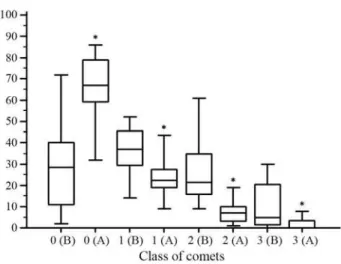
The analysis of data on DNA damage scores, ob-tained both before and after treatment with CM-G, showed significant differences (p£ 0.05), with DNA damage re-duction rates ranging from 18% to 87%, with an average of 59% (Figure 1). The number of DCs in classes 1, 2 and 3 de-creased significantly (p£0.05) after CM-G treatment. On the other hand, there was an increase in the number of un-damaged cells for all patients (Figure 2). Based on reports of increased stimulation of hematopoiesis by CM-G (Pos-pisilet al., 1991), the reduction in DNA damage could be attributed to an increase in the number of cells. In this way, the average numbers of white blood cells counted before (1,789.25±766.1 per mm3) and after (1,827.9±757.8 per mm3) CM-G administration were not statistically different (p = 0.63).
Five patients (25%) were classified as current smok-ers. Nicotine, the most toxic component of cigarettes, is known to cause oxidative stress by inducing the generation of reactive oxygen species (ROS) (Seneret al., 2007). It is known that CM-G is a potent antioxidant, which, besides being effective even at very low concentrations, plays an important role in protecting biological membranes against
Table 1- Data obtained from medical reports of 20 patients of the Cancer Institute of Londrina, Parana State, and from questionnaires completed after for-mal written consent and prior to administration of carboxymethyl-glucan (CM-G).
Patient Age (years) Ethnicity TNM Goserelin
use (months)
Life style Agrochemicalsc Radiotherapy
Smokinga Alcoholicb
1 73 African descendent IV 6 no yes yes* no
2 77 European descendent III 6 no no yes no
3 84 European descendent IV 7 no no yes yes
4 70 Asian descendent IV 7 no no yes yes
5 63 European descendent IV 12 yes yes yes no
6 71 European descendent IV 6 no no yes no
7 71 African descendent III 8 no no yes* no
8 63 African descendent III 10 no yes yes yes
9 71 European descendent IV 19 no no yes no
10 57 European descendent IV 23 yes yes yes no
11 63 European descendent IV 6 no no no no
12 79 Asian descendent IV 36 no no yes no
13 67 African descendent IV 10 no yes yes no
14 70 African descendent III 6 yes no yes yes
15 68 European descendent III 18 no yes yes no
16 63 African descendent IV 6 no no no no
17 62 Asian descendent III 5 no yes yes no
18 52 European descendent IV 5 no no yes yes
19 76 African descendent IV 6 yes no yes yes
20 80 African descendent III 6 yes yes no no
aPatients who had quit smoking for less than one year are considered smokers. b
Patients with behavior in alcohol-dependence.
cYes = patients who have had contact or exposure to agrochemicals for³10 years. *
adverse effects of free radicals (Babincováet al., 2002). Seneret al.(2007) suggested that the oral administration of solubleb-D-glucan fromS. cerevisiaeis effective against chronic nicotine intoxication, thereby reducing oxidative damage. Our data is consistent with these findings, since among the patients appraised, three smokers (5, 19 and 20) showed the three highest rates of reduction in DNA damage after treatment with CM-G.
Eight men (40%) showed alcohol dependence. Etha-nol itself does not induce lesions in the DNA of human lym-phocytes, but its primary metabolite, acetaldehyde, evokes
breaks in single- and double-stranded DNA (Singhet al., 1995). This, together with other factors that generate DNA damage, may have contributed to some of the highest rates of damaged DNA observed in these patients 1, 5, 8 and 10 before CM-G.
Six patients (30%) underwent radiotherapeutic treat-ment prior to starting ADT (Table 1) in order to control lo-calized prostate tumors. The exposure of patients with cancer to therapeutic doses of radiation typically causes free-radical induced changes in the genomic DNA of lym-phocytes, (Olinskiet al., 1996). Morever, the generation of free radicals in the tissues may continue after exposure for several months (Robbins and Zhao, 2004). The high radical scavenging activity of CM-G fromS. cerevisiae, with DS 0.8, was confirmed by paramagnetic resonance spectros-copy (Koganet al., 2005). Therefore, CM-G could be of help in decreasing the oxidative damage caused by radio-therapy.
Of the total number of patients, 85% had been occu-pationally exposed for at least 10 years previously, to a mixture of agrochemicals (Table 1), such as organophos-phates, carbamates and organochlorines. This includes DDT and BHC, both banned in Brazil for over 20 years, due to high toxicity.
We believe that treatment with CM-G can be an effi-cient protection against DNA damage caused by mutagenic compounds through dismutagenic activity, either by its ca-pability of blocking the action of damage-inducing agents, or by bio-antimutagenic activity, which exerts its effect by preventing damage or promoting DNA repair, since Oli-veiraet al.(2007) showed that this is a characteristic of (1®3)(1®6)-b-D-glucan fromS. cerevisiae.
Prostate carcinogenesis may be related to chronic and acute prostate inflammation (De Marzoet al., 2007).The possible chemoprotective effect of antioxidants may be a form of protecting prostate cells from the DNA damage that normally occurs in the setting of inflammatory lesions (Smigel, 1998). Thus, there is a possibility that the DNA damage generated by the typical inflammation process was reduced through the administration of CM-G.
The results presented here highlight the protective ef-fect of CM-G against DNA damage, which was shown for the first time in humans. These results suggest that CM-G is potentially useful for improving the short-term survival of patients with advanced PCa. Studies are underway on the further beneficial effects of CM-G administration, such as those related to immunomodulation, to assess the possibil-ity of CM-G use improving prognosis in these patients.
Acknowledgments
The authors wish to thank the Londrina Cancer Insti-tute for providing patient records and the Brazilian Na-tional Council of Scientific and Technological Development (CNPq) for financial support.
Figure 1- Distribution of damaged cells into different classes of DNA damage, observed through comet assay, for patients with advanced pros-tate cancer before and after 28 days-treatment with carboxymethyl-glucan (CM-G); B = before and A = after. Bars denote minimum and maximum values observed in each damage-class, and the horizontal line inside the box representing the median; *denotes p£0.05, a statistically significant difference from the result before the treatment, as determined by the Mann-Whitney test.
References
Babincová M, Bacova Z, Machova E and Kogan G (2002) Antiox-idant activity of carboxymethyl glucan: Comparative analy-sis. J Med Food 5:79-83.
Carrano AV and Natarajana AT (1988) Considerations for popu-lation monitoring using cytogenetic techniques. Interna-tional Commission for Protection Against Environmental Mutagens and Carcinogens. Mutat Res 204:379-406. Chen R and Seviour J (2007) Medicinal importance of fungal
b-(1-3)(1-6)-glucans. Mycol Res 3:635-652.
Chorvatovicová D, Machova E and Sandula J (1996) Effect of ultrasonicated carboxymethylglucan on cyclophosphamide induced mutagenicity. Mutat Res 371:115-120.
De Marzo AM, Platz EA, Sutcliffe S, Xu J, Grönberg H, Drake CG, Nakai Y, Isaacs WB and Nelson WG (2007) Inflamma-tion in prostate carcinogenesis Nat Rev Cancer 7:256-269. Demir G, Klein HO, Mandel-Molinas N and Tuzuner N (2007)
b-glucan induces proliferation and activation of monocytes in peripheral blood of patients with advanced breast cancer. Int Immunopharm 7:113-116.
Di Luzio NR, Williams DL, Mcnamee RB, Edwards BF and Kithama A (1979) Comparative tumor-inhibitory and anti-bacterial activity of soluble and particulate glucan. Int J Can-cer 24:773-779.
Diamond TH, Bucci J, Kersley JH, Aslan P, Lynch WB and Bryant C (2004) Osteoporosis and spinal fractures in men with prostate cancer: Risk factors and effects of androgen deprivation therapy. J Urol 172:529-532.
Forchhammer L, Br®uner EV, Folkmann JK, Danielsen PH, Nielsen C, Jensen A, Loft S, Friis G and Møller P (2008) Variation in assessment of oxidatively damaged DNA in mononuclear blood cells by the comet assay with visual scoring. Mutagenesis 23:223-231.
Hellerstedt BA and Pienta KJ (2002) The current state of hor-monal therapy of prostate cancer. Cancer J Clin 52:154-179. Kobayashi H, Sugiyama C, Morikawa Y, Hayashy M and Sofuni
T (1995) A comparison between manual microscopic analy-sis and computerized image analyanaly-sis in the single cell gel electrophoresis assay. MMS Commun 3:103-115.
Kogan G, Stasko A, Bauerova K, Polovka M, Soltes L, Brezova V, Navarova J and Mihaloa D (2005) Antioxidant properties of yeast (1®3)-b-D-glucan studied by electron paramag-netic resonance spectroscopy and its activity in the adjuvant arthritis. Carbohydrate Polym 61:18-28.
Magnani M, Calliari CM, de Macedo Jr FC, Mori MP, de Syllos-Cólus IM and Castro-Gomez RJH (2009) Optimized meth-odology for extraction of (1-3)(1-6)-b-D-glucan from
Saccharomyces cerevisiae and in vitro evaluation of the cytotoxicity and genotoxicity of the corresponding carboxy-methyl derivative. Carbohydrate Polym 78:658-665. Manoharan K and Banerjee MR (1985)b-carotene reduces sister
chromatid exchange induce chemical carcinogens in mouse mammary cells in organ culture. Cell Biol Int Rep 9:783-789.
Miadaková E, Svidová S, Vlchová V, Duhová V, Prazmariová E, Tothová K, Nadová S, Kogan G and Rauko P (2005) The
role of natural biopolymers in genotoxicity of mutagens car-cinogens elimination. Biomed Pap Med Fac Univ Palacky 149:493-496.
Olinski R, Zastawny TH, Foksinsti M, Windorbsk W, Jaruga P and Dizdaroglu M (1996) DNA base damage in lympho-cytes of cancer patients undergoing radiation therapy. Can-cer Lett 106:207-215.
Oliveira RJ, Matuo R, da Silva AF, Matiazi HJ, Mantovani MS and Ribeiro LR (2007) Protective effect of b-glucan ex-tracted fromSaccharomyces cerevisiaeagainst DNA dam-age and cytotoxicity in wild-type (k1) and repair-deficient xrs5 CHO cells. Toxicolin Vitro21:41-52.
Pospisil M, Sandula J, Pipalova I, Hofer M and Viklicka S (1991) Hemopoiesis stimulating and radioprotective effects of car-boxymethylglucan. Physiol Res 40:377-80.
Rice PJ, Adams EL, Ozment-Skelton T, Gonzalez AJ, Goldman MP, Lockhart BE, Barker LA, Breuel KF, DePonti WK, Kalbfleisch JH,et al.(2005) Oral delivery and gastrointesti-nal absorption of soluble glucans stimulate increased resis-tance to infectious challenge. J Pharmacol Exp Ther 314:1079-1086.
Robbins ME and Zhao W (2004) Chronic oxidative stress and ra-diation-induced late normal tissue injury: A review. Int J Radiat Biol 80:251-259.
Sener G, Toklu HZ and Cetinel S (2007) b-Glucan protects against chronic nicotine-induced oxidative damage in rat kidney and bladder. Environ Toxicol Pharm 23:25-32. Singh NP, Lai H and Khan A (1995) Ethanol-induced
single-strand DNA breaks in rat brain cells. Mutat Res 345:191-196.
Singh NP, McCoy MT, Tice RR and Schneider EL (1988) A sim-ple technique for quantification of low levels of DNA dam-age in individual cells. Exp Cell Res 175:184-491. Slamenová D, Laaj J, Kriskova L, Kogan G, Sandula J, Bresgen N
and Eckl P (2003) Protective effects of fungal (1-3)-b -D-glucan derivatives against oxidative DNA lesions in V79 hamster lung cells. Cancer Lett 198:153-160.
Smigel K (1998) Vitamin E reduces prostate cancer rates in Finn-ish trial: U.S. considers follow-up. J Natl Cancer Inst 90:416-417.
Xu J, Liu W, Yao W, Pang X, Yin D and Gao X (2009) Carboxy-methylation of a polysaccharide extracted fromGanoderma lucidumenhances its antioxidant activitiesin vitro. Carbo-hydrate Polym 78:227-234.
Internet Resources
American Joint Committee on Cancer/ Union International Against Cancer (AJCC/UICC)
http//www.cancerstaging.org (May, 2010).
National Cancer Institute of Brazil (INCA), http//www.inca.gov.br (April, 2010).
Associate Editor: Carlos F.M. Menck