750 Brazilian Journal of Physics, vol. 33, no. 4, December, 2003
T
c
and
∆
o
in a Phenomenological “Pseudogap” Model
D. Romero, L. S´anchez, J. J. Rodr´ıguez-N´u˜nez,
Departamento de F´ısica-FACYT, Universidad de Carabobo, Venezuelaand H. Beck
Institut de Physique, Universit´e de Neuchˆatel, Switzerland
Received on 23 May, 2003.
We study numerically superconductivity in a system characterized by the presence of a phenomenological ”pseudogap”,Eg, in the energy spectrum, for0≤T≤Ts.T∗is a crossover temperature. As a simplification,
the pseudogap and the superconducting gap have the sames–wave symmetry. We find that for∀Eg 6= 0
we require a critical value of the superconducting interaction,Vd, to produce a finite superconducting critical
temperature,Tcand another one for∆o6= 0.
1
Introduction
After their discovery by Bednorz and Muller[1] in 1986, the high–temperature superconductors (HT SC) are still attract-ing a lot of interest due to their unusual physical proper-ties, both in the normal and in the superconducting phases. For example, theHT SCexhibit a pseudogap in the energy spectrum in the temperature range0 ≤T ≤T∗. T∗is
de-fined by Maier et al.[2] as the crossover temperature where the spin–susceptibility is a maximum.
There is experimental evidence by the group of Tallon and Loram[3] where the pseudogap persists belowTc, being
independent of the superconducting gap. This interpreta-tion is in agreement with the experiment of energy gap evo-lution in the tunneling spectra ofBi2Sr2CaCu28+δ
per-formed by Dipasupil et al.[4]. They find that the pseudogap smoothly develops into the superconducting state gap with no tendency to close atTc. Another proof that the
pseudo-gap and the superconducting pseudo-gap are independent of each other is given in the experiments of Krasnov et al.[5] where they apply a magnetic field to their superconducting samples and they destroy the superconducting gap, but the pseudogap remains. They conclude that the pseudogap and the super-conducting gap coexist inBi–2212 using intrinsic tunneling spectroscopy.
Rubio Temprano, Trounov and Mu¨ller[6] have recently studied the isotope effects on the pseudogap in the high– temperature superconductor La1.81Ho0.04Sr0.15CuO4 by neutron crystal field spectroscopy. They have found evi-dence for the opening of an electronic pseudogap atT∗ ≈
60K, above the superconducting critical temperature,Tc ≈
32K.
We exploit the consequences of the psudogap on two macroscopic quantities in the superconducting state, namely, the superconducting critical temperature, Tc, and
the superconducting order parameter atT = 0,∆o.
This paper is organized as follows. In Section 2, we
present the pseudogap model, following the steps of T¸ ifrea, Grosu and Crisan[7]. In Section 3 we present our numerical results. In Section 4 we present our discussion and conclu-sions.
2
The ”pseudogap” model
We assume[7] that theP Gand the normal one–particle self– energy are given by
Σ(~k, iωn)≡ −Eg2Go(~k,−iωn) , (1)
whereGo(~k, iωn)is the free one–particle Green function.
~k is the wave vector andωn = 2πT(n+ 1/2)is the odd
Matsubara frequency, withnan integer. With this choice of self–energy (Eq. (1)) is easy to show that the ”P G” Green function is given by
G(~k, iωn) =
u2
~k
iωn−E~k
+ v
2
~k
iωn+E~k
, (2)
where we have chosen the pseudogap of pures–symmetry, since we want to look for details overlooked in Ref. [7]. For example, the authors of Ref. [7] did not find critical pairing interactions to haveTc 6= 0and∆o 6= 0. These
considera-tions have been properly taken into account by Pistolesi and Nozi`eres[8] in a similar model to ours. A word of caution is in order here. The model we are discussing here appears to be more of a semiconductor type, as recognized in Ref. [8]. To transform the present model into a real pseudogap model, we should include a damping factor, as it has been done by Andrenacci and Beck[9].
D. Romeroet. al. 751
G−1(~k, iωn)G(~k, iωn) + ∆F†(~k, iωn) = 1
∆∗G(~k, iωn)−G−1(~k,−iωn)F†(~k, iωn) = 0 ,(3)
whereG(~k, iωn)andF†(~k, iωn)are the diagonal and off–
diagonalBCSGreen functions, respectively. This interpre-tation of theP Gis equivalent to make the following choice in theT-matrix approximation[10, 11, 12] for the supercon-ducting self–energy:
X
(~k, iωn) = Ã
Σ(~k, iωn) ∆
∆∗ Σ(~k, iω n)
!
(4)
This assumption produces two gaps, one coming from the
P G and the other one from ∆ in Eq. (4). Our approach is completely different from the one in Refs. [13-16] where they have an effective gap, given by∆ef f =
q
∆2+E2
g.
Their approach is equivalent to taking∆ = 0in our Eq. (4) and substitutingΣ(~k, iωn)by the diagonal self–energy (Eq.
(1)), withEg→ q
E2
g+ ∆2.
Solving Eq. (3), we obtain
G(~k, iωn) =
4 X
i=1
αi(~k)
iωn−ωi(~k)
; (5)
F(~k, iωn) = ∆
4 X
i=1
βi(~k)
iωn−ωi(~k)
, (6)
where
ω2± = E~2k+ |∆|2
2 ± |∆|
r
E2
g+ |∆|2
4 (7)
ω1(~k) = |ω+| ; ω2(~k) =−|ω+| ; ω3(~k) =|ω−|(8) ω4(~k) = −|ω−| ; Ek~2≡ǫ2(~k) +Eg2 , (9)
andǫ(~k) = −2t(cos(kx) + cos(ky))is the free tight
bind-ing band in two dimensions. We are not considerbind-ing here the presence of the chemical potential, which we leave for a future publication [17]. In Section 3 we chooset = 1, as our unit of energy. In Eqs. (5–6), the spectral weights,
αi(~k)(normal ones) andβi(~k)(superconducting ones), with
i= 1,2,3,4, are given by ⌋
α1(~k) = µ
u2
~ k
ω1(~k)+E~k
+ v
2
~ k
ω1(~k)−E~k
¶−1³
(ω1)2−(ǫ(~k))2 ´
4∆ω1(~k) q
E2
g+ |∆|2
4
α2(~k) = µ
u2
~ k
ω1(~k)−E~k
+ v
2
~ k
ω1(~k)+E~k
¶−1 ³
(ω1)2−(ǫ(~k))2 ´
4∆ω1(~k) q
E2
g+ |∆|2
4
α3(~k) = −
µ u2
~ k
ω3(~k)+E~k
+ v
2
~ k
ω3(~k)−E~k
¶−1³
(ω3)2−(ǫ(~k))2 ´
4∆ω3(~k) q
E2
g+ |∆|2
4
α4(~k) = −
µ u2
~ k
ω3(~k)−E~k
+ v
2
~ k
ω3(~k)+E~k
¶−1³
(ω3)2−(ǫ(~k))2 ´
4∆ω3(~k) q
E2
g+ |∆|2
4
β1(~k) = −β2(~k) = (ω1)
2−(ǫ(~k))2
4∆ω1(~k) q
E2
g+ |∆|2
4
β3(~k) = −β4(~k) =
(ω3)2−(ǫ(~k))2
4∆ω3(~k) q
E2
g+ |∆|2
4
. (10)
We have to solve theTcequation and the gap equation,
∆o, atT ≡0. They are given by 1
Vd
= 1
Nx×Ny X
nx,ny
1 2
q
(ǫ(~k))2+E2
g
×tanh
q
(ǫ(~k))2+E2
g
2kBTc
752 Brazilian Journal of Physics, vol. 33, no. 4, December, 2003
1
Vd
= 1
Nx×Ny X
nx,ny
1 2∆o
q
∆2
o+ 4Eg2
×
A2
o q
(ǫ(~k))2+A2
o
− B
2
o q
(ǫ(~k))2+B2
o
(12)
A2
o(Bo2) ≡ Eg2+
1 2
³
∆2
o±∆o q
∆2
o+ 4Eg2 ´
= E2
g+
1 2
¡
∆2
o±∆2ef f ¢
(13) wherekx = 2nxπ/Nx and ky = 2nyπ/Ny, withnx =
0,1, ..., Nx −1, and ny = 0,1, ..., Ny −1, since we are
solving our discrete system in two dimensions. We have chosenNx = Ny = 1000in our numerical calculations.
Vdis the absolute value of the pairing interaction. We have
used a precision of10−5to solve Eqs. (11-12). From these equations we conclude thatA2
o = ∆2o andBo2 = 0 when
Eg= 0.
3
Numerical results
In Fig. 1 we presentTcvs Vdfor several values of the
pseu-dogap parameter,Eg, for the case of pures–wave
symme-try. We observe that there is a critical value of the interac-tion potential,VTc
d,c, in order to haveTc. As we will see in
the results for∆ovs Vd, there is also a critical value of the
pairing potential below which∆o = 0. In the case ofVd,c
coming from the∆o→0, these two critical pairing
interac-tions are different. These critical pairing interacinterac-tions were not discussed in Ref. [7]. However, they were considered in a similar model by Pistolesi and Nozi`eres[8].
0 1 2 3 4 5 6
Vd/t 0.2
0.4 0.6 0.8 1
Tc/t
Eg/t = 0.00 (Tc/t x 10) Eg/t = 0.50 Eg/t = 1.00 Eg/t = 1.50 Eg/t = 2.00
s - wave symmetry
0
Figure 1. Tc/t vs Vd/t for several values of the pseudogap
parameter, Eg/t, for the case of pure s–wave symmetry. For
Eg/t6= 0there is a critical interaction potential,Vd/t=VT
c
d,c/t,
below whichTc/ = 0. For example, forEg/t = 0.50we find
VTc
d,c/t≈2.25in units oft.
In Fig. 2 we present∆ovs Vdfor several values ofEg,
when the pseudogap and the superconducting order param-eter, atT = 0, have the same symmetry, namely, pures– wave. We need a critical interaction potential, V∆o
d,c 6= 0,
whenEg 6= 0, in order to have∆o 6= 0. From Fig. 2, for
Eg= 0.50,V∆
o
d,c ≈3.00. Comparing Figs. 1 and 2, we see
that for a fixed value ofEg,Vd,cTc≤V
∆o
d,c. This result implies
that the ratio2∆o(V, Eg)/kBTc(V, Eg)is well defined only
forV ≥V∆o
d,c, for a fixed value ofEg.
0 2 4 6 8
Vd/t 0.2
0.4 0.6 0.8 1
∆ο/t
Eg/t = 0.5 Eg/t = 1.0 Eg/t = 2.0 Eg/t = 0.0 (∆ο/t x 10)
s - wave symmetry
0
Figure 2.∆o/t vs Vd/tfor several values of the pseudogap
param-eter,Eg/t. The superconducting order parameter, whenEg= 0/t
has been re–escaled by a factor of 10. ForEg/t6= 0there is a
crit-ical interaction potential,Vd/t=Vd,c∆o/t, below which∆o/t= 0.
For example, forEg/t = 0.50we findVd,c∆o/t ≈ 3.00in units
oft.
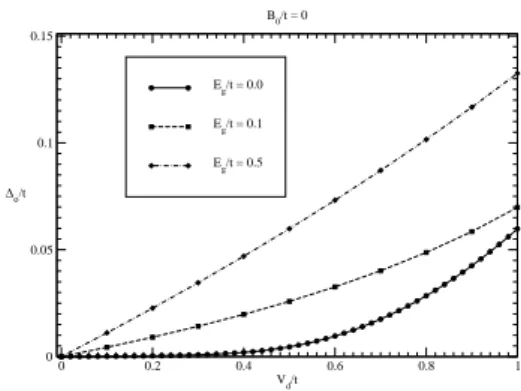
0 0.2 0.4 0.6 0.8 1 Vd/t
0 0.05 0.1 0.15
∆ο/t
Eg/t = 0.0
Eg/t = 0.1
Eg/t = 0.5 B0/t = 0
Figure 3. ∆ovs Vdfor several values of the pseudogap
parame-ter,Eg. Following the approximation of Ref. [7], we have taken
Bo≡0
From Fig. 3 we plot∆o/t vs Vd/tfor several values of
the pseudogap parameter,Eg/t, when we adopt the
aproxi-mation of Ref. [7], namely,Bo/t≡0. This approximation
does not produce a critical value of the interaction potential. In consequence,V∆o
d /t= 0,∀Eg/t. As our Eq. (11) does
not have the presence of the factorBo/t, we cannot perform
this approximation. Because of this,Tc/t always needs a
critical value of the interaction, for∀Eg/t6= 0.
4
Discussion and conclusions
sym-D. Romeroet. al. 753
metry, namely, pures–wave symmetry. This is not a crazy idea, because it has been shown that the observed symmetry of the order parameter cannot be fitted with only the lowest harmonics of the d–wave order parameter[18, 19, 20, 21]. Furthermore, a recent experiment with twisted Josephson junctions in theBi–cuprates[22], is in favor of an extended
s–wave order parameter, and has shown the absence of ad– wave part in the order parameter. However, the inclusion of order parameters with another symmetry is not a difficult task in our working scheme. With this point of view in mind and following the model of T¸ ifrea, Grosu and Crisan[7] we have studied their model to treat delicate points like the crit-ical interaction potential.
In summary, we have numerically implemented a model which has a pseudogap (really, it is a semiconductor gap, since damping effects have been neglected in our calcula-tions) in the one–particle energy spectrum of quasi–particles in the temperature range 0 ≤ T ≤ T∗. We have
in-vestigated the effect of Eg on the two basic parameters
of the BCS theory, Tc and∆o. We have found that for
Eg 6= 0 two critical pairing potentials emerge from our
calculations. In consequence, in order to define the ratio
R ≡ 2∆o(Vd, Eg)/kBTc(Vd, Eg)we need to be above the
bigger of the two critical pairing potentials. WhenEg = 0,
R ≈3.5in theBCS–approximation. We have briefly dis-cussed the case when both order parameters, Eg and∆o,
have the same symmetry, namely, pure s–wave symmetry. However, thed–wave symmetry is not difficult to study and we leave for a future publication. Another aspect we could study is the crossover phase diagram from theBCSlimit to the Bose–Einstei regime[23].
Acknowledgments
We are very grateful to I. T¸ ifrea, J. A. Budagosky– Marcilla, P. Mart´ın, E. V. L. de Mello, J. Ferreira, I. Bonalde, R. Medina, M. Valera, S. Aquino, M. Rodr´ıguez, H. Ma-teu, E. Orozco, J. Konior, C. Chiang, O. Alvarez–Llamoza and M. A. Su´arez, for interesting discussions. The numeri-cal numeri-calculations were performed at SUPERCOMP (Departa-mento de F´ısica–FACYT–UC). We thankC.D.C.H.–U.C.– Venezuela (Project 2001–013), F ON ACY T–Venezuela (Project S1–2002000448) andF AP ERGS–Brazil for par-tial financial support. One of the authors (J.J.R.N.) is a Fellow of the Venezuelan Program of Scientific Research (P P I–II), a Senior Associate (ICT P–Italy(2003–2008)) and a Visiting Scientist atIV IC–Venezuela. We thank M. D. Garc´ıa–Gonz´alez for helping us with the preparation of the manuscript.
References
[1] J. G. Bednorz and K. A. Mu¨ller, Z. Phys. B 64, 189–193 (1986).
[2] Th. A. Maier, M. Jarrel, A. Macridin, and F.-C. Zhang, cond– mat/0208419 (submitted to Phys. Rev. Lett.).
[3] J. L. Tallon and J. W. Loram, Physica C 349, 53 (2001).
[4] R. M. Dipasupil, M. Oda, N. Momono and M. Ido, J. Phys. Soc. Jpn. 71, 1535-1540 (2002).
[5] V. M. Krasnov et al. Phys. Rev. Lett. 84, 5860 (2000)
[6] D. Rubio Temprano, V. Trounov and K. A. Mu¨ller, Phys. Rev. B 66, 184506 (2002). See also, P. H¨afliger, A. Podlesnyak, K. Conder and A. Furrer, PSI–Zu¨rich Internal Report (2003).
[7] I. T¸ ifrea, I. Grosu and M. Crisan, Physica C 371, 104 (2002).
[8] F. Pistolesi and Ph. Nozi`eres, Phys. Rev. B 66, 054501 (2002).
[9] N. Andrenacci and H. Beck, cond–mat/0304084; ibidem, Physica C (to be published, Proceedings of the M2S–HTSC– VII.
[10] M. H. Pedersen, J. J. Rodr´ıguez-N´u˜nez, H. Beck, T. Schnei-der and S. Schafroth, Z. Phys. B 103, 21-28 (1997).
[11] S. Schafroth and J. J. Rodr´ıguez-N´u˜nez, Z. Phys. B 102, 493– 499 (1997).
[12] S. Schafroth, J. J. Rodr´ıguez-N´u˜nez and H. Beck, J. Phys.: Condens. Matter 9, L111-L118 (1997).
[13] Y.-J. Kao, A. P. Iyengar, Q. Chen and K. Levin, Phys. Rev. B 140505(R) (2001).
[14] I. Kosztin, Q. Chen, B. Jank ´o and K. Levin, cond-mat/9805065.
[15] K. Levin, Q. Chen, I. Kosztin, B. Jank ´o and A. Iyngar, cond– mat/0107275.
[16] Y.-J. Kao, A. P. Iyengar, J. Stajic, and K. Levin, cond– mat/0207004 v2.
[17] J. J. Rodr´ıguez-N´u˜nez, L. S´anchez, D. Romero and H. Beck (submitted).
[18] V. M. Loktev, R. M. Quick and S. G. Sharapov, Physics Re-ports 349, 1-123 (2001).
[19] J. Mesot, M. R. Norman, H. Ding et al., Phys. Rev. Lett. 83, 840–843 (1999), ibidem., cond–mat/9812377.
[20] R. Gat, S. Christensen, B. Frazer et al., cond–mat/9906070.
[21] G. G. N. Angilella, A. Sudbo, and R. Pucci, Eur. Phys. J. B
15, 269 (2000).
[22] R. A. Klemm, G. Arnold, A. Bille et al, Int. Mod. Phys. B 13, 3449–3454 1999).
[23] M. B. Soares, F. Kokubun, J. J. Rodr´ıguez-N´u˜nez and O. Rond´on, Phys. Rev. B 65, 174506 (2002); see also, A. Perali, P. Pieri, and G. C. Strinati, Phys. Rev. B 68, 066501 (2003); J. Quintanilla and B. L. Gyo¨rffy, J. Phys. A: Math. Gen. 36, 9375 (2003).