Electrometric Investigations on the System Acid-Molybdate and the
Formation of Heavy Metal Molybdates
Shiva Prasad*, and Thalma L.M. Guimarães
Departamento de Engenharia Química, Centro de Ciências e Tecnologia,
Universidade Federal da Paraíba, 58109-970 Campina Grande - PB, Brazil
Received: September 18, 1997
A natureza precisa dos poliânions formados pela ação de ácido clorídrico sobre soluções de molibdato de sódio foi estudada por meio de titulações de pH e condutométricas. As inflexões e degraus nas curvas de titulações indicaram a formação de ânions polimolibdatos para-Mo7O246- e
octa-Mo8O264- ao redor do pH 5,5 e 4,1, correspondendo às razões 8H:7Mo e 3H:2Mo,
respecti-vamente. Titulações semelhantes de pH e condutométricas entre Hg2+ e MoO42-, Mo7O246- e
Mo8O264- forneceram evidências incontestáveis sobre a formação de molibdato normal HgO.MoO3,
paramolibdato 3HgO.7MoO3 e octamolibdato 2HgO.8MoO3 de mercúrio(II) nas vizinhanças de pH
4,9; 4,2 e 3,7 respectivamente. Estudos analíticos também foram realizados sobre precipitados de molibdatos de mercúrio(II) confirmando os resultados obtidos pelas técnicas eletrométricas.
The precise nature of the polyanions formed by the action of hydrochloric acid on sodium molybdate solutions has been studied by pH and conductometric measurements involving glass electrode and conductometric titrations. The inflections and breaks in the titration curves indicate the formation of para-Mo7O246- and octa-Mo8O264- polymolybdate anions around pH 5.5 and 4.1,
corresponding to the molar ratio 8H:7Mo and 3H:2Mo, respectively. Similar pH and conductomet-ric titrations between Hg2 + and MoO42-, Mo7O246-, and Mo8O264- provide definite evidence for the
formation of normal molybdate HgO.MoO3, paramolybdate 3HgO.7MoO3 and octamolybdate
2HgO.8MoO3 of mercury(II) in the vicinity of the pH 4.9, 4.2 and 3.7, respectively. The analytical
investigations of the precipitates of mercuric molybdates have also been carried out, which substantiate the results of the electrometric study.
Keywords:molybdate anions, mercuric molybdates, electrometric techniques
Introduction
The chemistry of molybdenum is very prominent in both biological and industrial systems1,2. Recent studies have shown that certain molybdates have antiviral, includ-ing anti-AIDS, and antitumor activity3. Altough a large
number of studies have been done in the field of molybdate chemistry, the chemical state of isopolymolybdates, ob-tained on acidification of a molybdate solution, is not well understood because of the complexity in polymerization. Jander et al. claimed existence of Mo3O114-, HMo3O113-,
HMo6O215-, H2Mo6O214-, H3Mo6O213-, H7Mo12O413-,
H7Mo24O785- and H9Mo24O783- from diffusion and optical
experiments4. Bye claimed the existence of Mo7O246-,
Mo6O204-, Mo4O132-, and HMo6O203- by cryoscopic study5.
In 1959, Sasaki et al. deduced from potentiometry that the main complex formed is Mo7O246-6. Subsequently
mathe-matical analysis was applied to potentiometric equilibrium curves, and Sasaki et al. claimed the existence of Mo7O246-,
HMo7O245-, H2Mo7O244-, and H3Mo7O243- up to a value of
Z (average number of H+ being consumed by MoO42-) of
around 1.47,8. Aveston et al.9 by centrifuge data could only tell that in the range studied, the species probably contain more than 6 and less than 9 Mo atoms. Sasaki et al. proposed the presence of large isopolymolybdate anions of the order of 20 Mo in the solution of Z > 1.57. Numerous species such as HMoO4-, H2MoO4, Mo2O72-, HMo3O113-,
Mo6O192-, Mo7O246-, HMoO245-, H2Mo7O244-, Mo8O264-,
HMo8O263-, Mo12O372-, H7Mo24O785-, Mo36O1128-, etc.
have been reported in many recent publications10-12.
Article
On account of the complexity of the relation of equili-bria between the polyanions or due to the experimental difficulty in early works, the conclusions of earlier workers seem to be overstrained and hence it was considered worth-while to make a careful and precise study of the acid-molybdate system by electrometric techniques, which have provided more conclusive evidence on the condensation process of vanadate, antimonate, thiotungstate and tung-state anions13. After establishing the suitable conditions for the stability of different molybdate isopolyanions, the in-vestigations of formation of molybdates of mercury, chro-mium and nickel as a function of the pH were also carried out.
Experimental
Na2MoO4.2H2O, Hg(NO3)2, CrCl3.6H2O, NiCl3.6H2O,
Na2B4O7.10H2O and hydrochloric acid of extra-pure grade
were used, and their solutions were prepared in deionized distilled water. Concentration of sodium molybdate solu-tions was further verified by determining molybdenum with oxine as MoO2(C9H6ON)214a. The hydrochloric acid
solutions were standardized with recrystallized sodium tetraborate decahydrate14b.
The pH measurements were carried out on Metrohm Herisau (Switzerland) pH-meter using a Scott Gerate glass combination electrode. Conductivity values were recorded by employing a Metrohm conductometer. 25 mL of the titre solution was placed in the cell each time and thermostated at 25 ± 0.1 °C. Using different concentrations of the reac-tants, a series of glass electrode and conductometric titra-tions was performed. The observed pH changes were plotted as a function of volume of titrant added. The inflec-tions obtained in the curves were confirmed by the pro-nounced maxima in dpH/dV and zero in d2pH/dV2 graphs.
The breaks in the conductometric titrations were located by plotting corrected conductance as a function of volume of titrant added. The same concentrations of reactants were employed in the two techniques for the sake of comparison
of results. The pH and conductometric titration curves are plotted together in the same figure for similar reasons and also for the sake of brevity. The electrometric titration results for the formation of molybdate polyanions and mercuric molybdates are summarized in Tables 1 and 2, respectively.
Job’s method of continuous variation was employed using electrical conductance measurements for determin-ing the composition of the polyanions formed by the inter-action of sodium molybdate with hydrochloric acid. This consists in plotting the differences in specific conductivi-ties (the sum of observed specific conductiviconductivi-ties of the constituent solutions minus the observed specific conduc-tivities of the mixture) against the composition of the mixtures. From the maxima obtained in such plots, the stoichiometry of the compound formed was established.
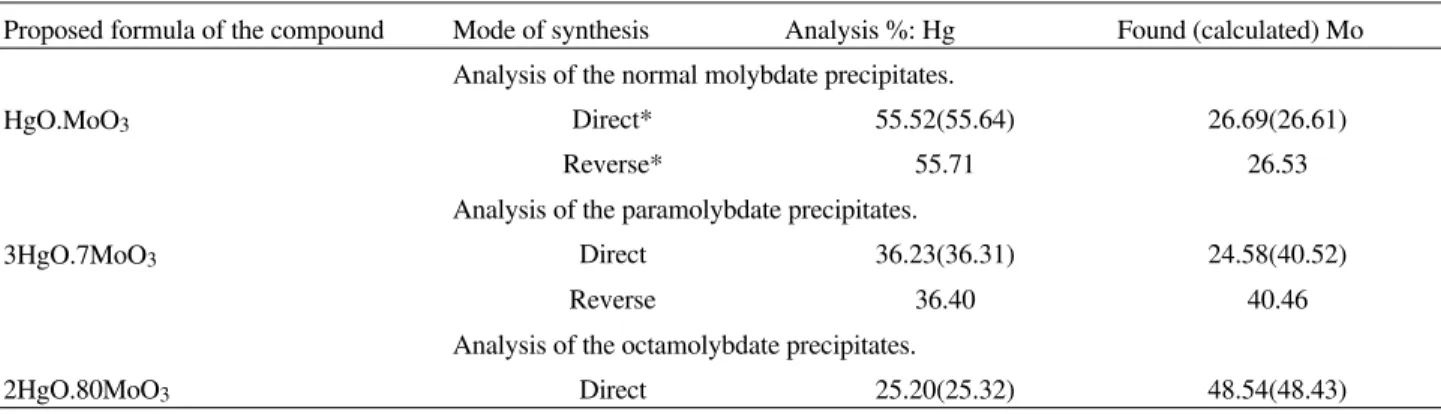
The precipitates obtained at the end-points of titrations between mercuric nitrate and sodium molybdates were also analyzed to substantiate the electrometric results. The dif-ferent mercuric molybdates were prepared by mixing stoichiometric amounts of mercuric nitrate solution with the respective sodium molybdate solutions. The precipi-tates obtained were washed several times with aqueous 20% (v/v) ethanolic solution and dried in a vacuum dessi-cator for 40 h. A known amount (2 g) of each of the above precipitates was dissolved in a minimum quantity of hydro-chloric acid and then analyzed quantitatively for mer-cury14c with ethylenediamine and molybdenum14a with oxine. From the proportion of mercury and molybdenum in the compounds thus obtained their composition was established. The results are summerized in Table 3.
Results and discussion
Isopolymolybdate anions
Figure 1, curve 1 represents the changes occurring in H+ concentration on the addition of HCl to sodium
molybdate solution. It is noted that the smallest addition of the acid in the beginning causes a sharp fall in the pH (not
J. Braz. Chem. Soc.
Table 1. Summary of results of electrometric titrations of the acid-molybdate system. Volume of titre solution taken in the cell = 25 mL.
Molarity of solutions Equivalence points (mL) for the formation of paramolybdate octamolybdate
HCl Na2MoO4 Calc. A* B* Calc. A B
M/5 M/50 2.86 2.85 2.90 3.75 3.75 3.75
M/10 M/80 3.57 3.55 3.55 4.69 4.70 4.70
M/20 M/250 2.29 2.30 2.25 3.00 3.00 3.05
M/40 M/450 2.54 2.55 2.55 3.33 3.35 3.35
M/100 M/1000 2.86 2.85 2.85 3.75 3.75 3.80
M/200 M/2200 2.60 2.60 2.55 3.41 3.40 3.40
shown in the figure), whilst further reaction with HCl produces buffer action between pH 6.2 and 5.7 showing strong affinity for the hydrogen ions in this region; sub-sequent addition of HCl shows a sudden fall in pH at a ratio 8H:7Mo around pH 5.5 corresponding to the stoichiometry for the formation of para-Mo7O246- molybdate anions.
Fur-ther addition of acid yields one more inflection indicating
the consumption of 1.5 moles of HCl per mole of Na2MoO4
and suggesting the formation of octa-Mo8O264- molybdate
anions in the vicinity of pH 4.1. The pH of such acidified solutions became steady after a lapse of some time indicat-ing that the reaction proceeds by way of some intermediate species. Each time the pH value was recorded only after waiting enough for its stabilization. It was noted that in the
Table 2. Summary of results of electrometric study on the formation of mercuric molybdates. Volume of titre solution taken in the cell = 25 mL.
Molarity of solutions Equivalence points (mL) Formula
supported pH Conductance
Hg(NO3)2 Na2MoO4 Direct titrations. Fig. 3, curves 1 and 2
M/10 M/100 2.50 2.50 2.50 HgO.MoO3
M/20 M/250 2.00 2.00 2.05
M/30 M/350 2.14 2.10 2.10
Reverse titrations. Fig. 3, curves 3 and 4
M/125 M/10 2.00 2.00 2.00 HgO.MoO3
M/200 M/20 2.50 2.50 2.55
M/350 M/30 2.15 2.15 2.15
Hg(NO3)2 Na6Mo7O24 Direct titrations. Fig. 4, curves 1 and 2
M/10 M/350 2.14 2.15 2.10 3HgO.7MoO3
M/20 M/750 2.00 2.00 2.05
M/30 M/1000 2.25 2.20 2.20
Reverse titrations. Fig. 4, curves 3 and 4
M/160 M/40 2.08 2.10 2.10 3HgO.7MoO3
M/300 M/80 2.22 2.20 2.15
M/500 M/120 2.00 2.05 2.05
Hg(NO3)2 Na4Mo8O26 Direct titrations. Fig. 5
M/10 M/200 2.50 2.45 2.45 2HgO.8MoO3
M/20 M/500 2.00 2.00 1.95
M/30 M/700 2.14 2.10 2.15
Table 3. Summary of analytical results of the precipitates of mercuric molybdates.
Proposed formula of the compound Mode of synthesis Analysis %: Hg Found (calculated) Mo Analysis of the normal molybdate precipitates.
HgO.MoO3 Direct* 55.52(55.64) 26.69(26.61)
Reverse* 55.71 26.53
Analysis of the paramolybdate precipitates.
3HgO.7MoO3 Direct 36.23(36.31) 24.58(40.52)
Reverse 36.40 40.46
Analysis of the octamolybdate precipitates.
2HgO.80MoO3 Direct 25.20(25.32) 48.54(48.43)
case of moderately concentrated solutions, the curves were steeper than for dilute reactants. Out of the two inflections in the curves, the one corresponding to the conversion into octamolybdate is more pronounced.
Conductometric titrations between HCl and Na2MoO4
solutions were also carried out using similar concentrations as in the pH titrations. The observed breaks (Fig. 1, curve 2) correspond to the formation of the same polyanions, para-Mo7O246- and octa-Mo8O264, as suggested by the
pre-ceding pH study. The slow increase in conductance values on addition of HCl to Na2MoO4 till the point 8H:7Mo may
be ascribed to the formation of the highly charged Mo7O24
6-anions of the relatively weak acid. The break corresponding to the addition of 1.5 moles of HCl per mole of Na2MoO4
is strongly defined, after which a sharp rise in conductance was observed which was determined to be the same as expected for the addition of free HCl to the system.
The course of the isopolyanion formation of molybdate by the acid was also followed by employing Job’s method of continuous variation using electrical condutance meas-urements. The plot of difference in specific conductivity values against composition of mixtures produced a sharp peak (Fig. 2) at the molar ratio 3H:2Mo providing further evidence for the formation of the octamolybdate polyan-ions.
The formation of the polyanions, as suggested by the electrometric study, may be represented as follows:
8H+ + 7MoO42- = Mo7O246- + 4H2O
12H+ + 8MoO42- = Mo8O264- + 6H2O
The existence of Mo7O266- and Mo8O264- is in
conform-ity with the results of the temperature-jump studies by Honing and Kustin15 and the Raman spectra studies by Ozeki et al.16 Murata et al.17, however, claimed that the octamolybdate underwent further reaction with acid (Z ≥ 1.7) to form Mo12O372- and Mo6O196-, but this observation
could not be confirmed by our results.
When a dilute solution of MoO42- (< 10-4 M) is
acidi-fied, it yields HMoO4- and ‘‘H2MoO4’’. It has been
con-firmed10,18 that the tetrahedral ion MoO42- transforms into
an octahedral especies at the stage of second protonation.
MoO42- + H+ = [MoO3 (OH)]
-[MoO3 (OH)]- + H+ + 2H2O = Mo (OH)6 or
MoO2 (OH)2 (H2O)2
When a basic molybdate solution at millimolar or higher concentrations is acidified, the molybdate ions have been found to condense in definite steps, as evidenced by the foregoing electrometric study, to form different isopo-lymolybdate species. The condensation process may be considered as rapid aggregation of the protonated species. Six monoprotonated [MoO3(OH)]- can easily link to the
dipronated species, each one sharing a weak corner of octahedral Mo(OH)6 . And, when six tetrahedra have been
accomodated, all of these peripheral tetrahedra can expand to octahedra simply by folding at the common corners to share the octahedral edge along with a considerable de-crease in enthalpy10,12. This negative enthalpy change can be expected to stabilize the resultant product Mo7O246- .
Mo(OH)6 + 6[MoO4(OH)]- = Mo7O246- + 6H2O
The condensation process, for formation of the unpro-tonated polyanions, may be represented by the following general equation:
J. Braz. Chem. Soc.
Figure 2. Continuous variation study by Job’s method using equimolar (0.02 M) solutions.
aH+ + bMoO42- = ( MoO42- ) b-a/2 ( MoO3)a/2 + ( a/2)H2O
The values of a and b are 8 and 7 for heptamer and 12 and 8 for octamer, respectively.
Mercury molybdates
The solution of Na2MoO4 was prepared in deionized
distilled water. Sodium paramolybdate (pH 5.5) and octa-molybdate (pH 4.1), as suggested by the preceding studies, were prepared by progressive additions of hydrochloric acid to Na2MoO4 solutions in the molar ratios 8H:7Mo and
3H:2Mo, respectively.
8HCl + 7Na2MoO4 = Na6Mo7O24 + 8NaCl + 4H2O
12HCl + 8Na2MoO4 = Na4Mo8O26 + 12NaCl + 6H2O
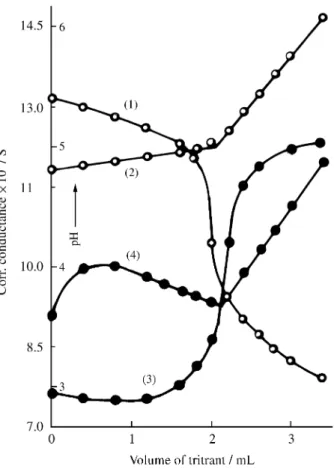
Figure 3 illustrates the curves of the pH and conduc-tometric titrations performed between the solutions of the normal molybdate and mercuric nitrate. In direct titrations (curve 1), when Hg(NO3)2 solution (pH 2.6) was added to
the Na2MoO4 solution (pH 7.6) a sharp fall in pH was noted
with an inflection at the molar ratio of Hg2+:MoO42- as 1:1
in the vicinity of pH 4.9, corresponding to the stoichiometry for the formation of mercuric molybdate, HgO.MoO3. This
sharp fall in pH occurs because of the presence of unreacted acidic (pH 2.6) Hg(NO3)2 in the cell just after completion
of precipitation of mercuric molybdate. In reverse titrations (curve 3), when Na2MoO4 solution was added to the
mer-curic nitrate solution, the pH first changed very slowly, but at the end-point it jumped upwards corresponding to the formation of the same compound in accordance with the following equation:
Hg(NO3)2 + Na2MoO4 = HgO.MoO3 + 2NaNO3
Employing similar concentrations of the reactants, both direct (curve 2) and reserve (curve 4) conductometric titra-tions between the solutitra-tions of Hg(NO3)2 and Na2MoO4
gave well-defined breaks at 1:1 molar ratio of Hg2+:MoO42-,
confirming the formation of the mercuric molybdate HgO.MoO3, as suggested by the pH study.
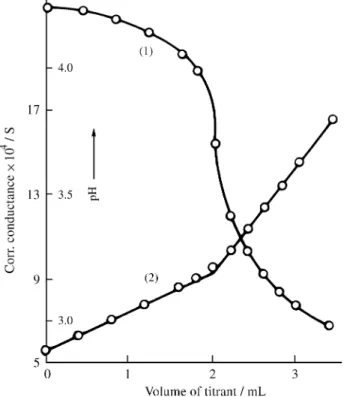
Figure 4 (curves 1 and 3) illustrates the changes occur-ring in H+ concentration when Hg(NO
3)2 solution (pH 2.6)
is treated with Na6Mo7O24 solution (pH 5.5). In direct
titrations, curve 1, when Hg(NO3)2 solution was added
from the microburette to Na6Mo7O24 solution, a gradual
change in pH was observed till at the stoichiometric end-point (the stage at which the reaction ends if simple double decomposition takes place), a sharp fall in pH was noted with the inflection corresponding to the molar ratio of Hg2+:Mo
7O246- as 3:1, suggesting the formation of
mercu-Figure 3. Normal molybdate titrations. (1 and 2) M/20 (HgNO3)2 to 25
mL of M/250 Na2MoO4. (3 and 4) M/10 Na2MoO4 to 25 mL of M/125 Hg(NO3)2.
Figure 4. Paramolybdate titrations. (1 and 2) M/20(HgNO3)2 to 25 mL of M/750 Na6Mo7O24. (3 and 4) M/80 Na6Mo7O24 to 25 mL of M/300
ric paramolybdate 3HgO.7MoO3 in the vicinity of pH 4.2.
In the case of reverse titrations (curve 3) when Na6Mo7O24
solution was used as titrant, the pH first changes slowly but at the stoichiometric end-point a marked jump in pH was observed, suggesting the formation of the same compound. Employing similar concentrations of the reactants a series of direct (Fig. 4, curve 2) and reverse (Fig. 4, curve 4) conductometric titrations were performed between the so-lutions of Hg(NO3)2 and Na6Mo7O24 . The titration curves
provide well-defined breaks at a point (Table 2), where the molar ratio of Hg2+:Mo7O246- is 3:1, confirming the
forma-tion of mercuric paramolybdate as suggested by the pH study. The reaction can be represented as follows:
3Hg(NO3)2 + Na6Mo7O24 = (3HgO.7MoO3) + 6NaNO3
Figure 5 illustrates the changes occurring in the pH and conductance values when Hg(NO2)2 solution is added to
sodium octamolybdate solution. The titration curves pro-vide inflections and breaks at the point where the molar ratio of Hg2+:Mo8O264- is 2:1, which corresponds to the
stoichiometry for the formation of 2HgO.8MoO3 in the
neighbourhood of pH 3.7. The reaction can be represented by the following equation:
2Hg(NO3)2 + Na4Mo8O26 = (2HgO.8MoO3) + 4NaNO3
Reserve titrations on the formation of mercuric octa-molybdate did not give dependable results which may be ascribed to a considerable solubility of the product in excess of mercuric nitrate.
It is noted that after each addition of the titrant, it takes a little time for the pH and conductance values to become steady. A thorough stirring in the neighbourhood of the equivalence point has a favourable effect. The presnce of ethanol (20%) improves the position of the end-points and increases the magnitude of the jump in pH curves, as it decreases the solubility of the precipitates formed and minimises hydrolysis and adsorption. It was found that the presence of 20% ethanol checked the hydrolysis, as a concentration higher than this could not make any change in the results. Similar studies of this system were carried out in the presence of electrolytes such as NaCl and NaNO3.
But the presence of these salts did not have a significant effect on the position of the end points.
Similar investigations on the interaction of solutions of chromium chloride with sodium molybdate at different pH levels confirmed the precipitation of Cr2O3.3MoO3 (pH
5.6), Cr2O3.7MoO3 (pH 4.4) and Cr2O3.24MoO3 (pH 3.8)
molybdates19. Electrometric studies on interaction of nickel chloride and different sodium molybdate solutions did not suggest the formation of nickel molybdates which is in accord with the observations of Sleight and Chamber-land20.
As the structure of these compounds is not known they are represented as double oxides, the manner which is usually adopted for such compounds21,22.
Conclusion
The results of the electrometric investigations on acid-molybdate system, at the studied concentration levels, sug-gest the formation of para-Mo7O246- and octa-Mo8O26
4-molybdate polyanions in the vicinity of pH 5.5 and 4.1, respectively. The electrometric and analytical investiga-tions on the interaction of mercuric nitrate and alkali molybdates indicate the formation of HgO.MoO3,
3HgO.7MoO3 and 2HgO.8MoO3 mercuric molybdates in
the neighbourhood of pH 4.9, 4.2, and 3.7, respectively.
Acknowledgement
The authors wish to express their sincere thanks to CNPq for financial assistance.
References
1. Haber, J. The Role of Molybdenum in Catalysis; Cli-max molybdenum Co., London, 1981.
2. Simpson, C.H. Amer. Paint. Coating J. 1992, 66. 3. Kopf-Maier, P.; Klopotke, T. J. Cancer Res. Clin.
Oncol. 1992, 118, 216.
4. Jander, G.; Jahr, K.F.; Henkesheshoven, W. Z. anorg. Chem. 1930, 194, 383.
J. Braz. Chem. Soc.
5. Bye, J. Ann. Chim. Fr. 1945, 20, 463; C. r. Acad. Sci., Paris. 1954, 238, 239; Bull. Soc. Chim. Fr. 1957, 1023.
6. Sasaki, Y.; Lindeqvist, I.; Sillen, L.G. J. inorg. nucl. Chem. 1959, 9, 93.
7. Sasaki,Y.; Sillen, L.G. Acta Chem. Scand. 1964, 18, 1014.
8. Y. Sasaki and L.G. Sillen, Ark. Khemi. 1967, 29, 253. 9. Aveston, J.; Anacker, E.W.; Johanson, J.S. Inorg.
Chem. 1964, 3, 735.
10. Ozeki, T.; Adachi, H.; Ikeda, S. Bull. Chem. Soc. Jpn.
1996, 69, 619.
11. Ozeki, T.; Kinoshita, Y.; Adachi, H. Bull. Chem. Soc. Jpn. 1994, 67, 1041.
12. Pope, M.T. Molybdenum Oxygen Chemistry: Oxides, Oxo Complexes and Polyanions; in: Progress in Inor-ganic Chemistry, Lippard, S.J.; Ed.; An Interscience Publication, New York, vol. 39, 1991.
13. Prasad, S. An. Acad. bras Ci. 1981, 53, 471; Bull Electrochem. 1990, 6, 163; Can. J. Chem. 1981, 59, 563; Quim. Nova. 1994, 17, 31.
14. Vogel, A.I. In A Textbook of Quantitative Inorganic Analysis; Longmans, London, Third Edition, 1962, p. (a) 508, (b) 238, (c) 488.
15. Honig, D.S.; kustin, Inorg. Chem. 1972, 11, 65. 16. Ozeki, T.; Kihara, H.; Hikima, Anal. Chem. 1987, 59,
945.
17. Murata, K.; Ikeda, S. Spectrochim. Acta 1983, 39A, 787.
18. Cruywagen, J.J.; Rohwer, E.F.C.H. Inorg. Chem.
1975, 14, 3136.
19. Prasad, S. In 20a Reunião Anual da Sociedade Brasileira de Química; Poços de Caldas-MG, 1997, EQ-48.
20. Sleight, A.W.; Chamberland, B.L. Inorg. Chem. 1968, 7, 1672.
21. Standen, A. ex. ed., Kirk-Othmer Encyclopedia of Chemical Technology; Interscience Publishers, New York, Second Edition, 1967, vol. 13, p. 782.