Printed in Brazil - ©2006 Sociedade Brasileira de Química 0103 - 5053 $6.00+0.00
Article
*e-mail: [email protected]
Spectrophotometric Determination of Catecholamines based on their Oxidation Reaction
Followed by Coupling with 4-Aminobenzoic Acid
Tayyebeh Madrakian,* Abbas Afkhami, Lida Khalafi and Massoumeh Mohammadnejad
Department of Chemistry, Faculty of Science, Bu- Ali Sina University, Hamadan, Iran
Um método espectrofotométrico simples e sensível para a determinação de dopamina, metildopa, levodopa e catecol, puros, em formulações farmacêuticas, e em água, é descrito. O método é baseado na reação de oxidação com periodato, seguida pelo acoplamento oxidativo com ácido 4-aminobenzóico em pH 4, levando à formação de produtos coloridos. O gráfico de
calibração foi linear no intervalo de 0,20-18,00 mg L-1, 0,10-20,00 mg L-1, 0,10-20,00 mg L-1 e
0,10-13,00 mg L-1 para dopamina, metildopa, levodopa e catecol, respectivamente. Dados
analíticos para determinação do composto puro são apresentados juntamente com a aplicação do método proposto à análise das formulações farmacêuticas e amostras de água. Os resultados são favoravelmente comparados com métodos relatados.
A sensitive and simple spectrophotometric method for the determination of dopamine, methyldopa, levodopa and catechole in either pure form, pharmaceutical formulations and in water is described. The method is based on their oxidation reaction with periodate followed by oxidative coupling with 4-aminobenzoic acid at pH 4 leading to the formation of colored products.
The calibration graph was linear in the range of 0.20-18.00 mg L-1, 0.10-20.00 mg L-1,
0.10-20.00 mg L-1 and 0.10-13.00 mg L-1 for dopamine, methyldopa, levodopa and catechole,
respectively. Analytical data for determination of the pure compound is presented together with the application of the proposed method to the analysis of some pharmaceutical formulations and water samples. The results compared favorably with reported methods.
Keywords: catechoamines, 4-aminobenzoic acid, pharmaceutical formulations
Introduction
Aromatic vic-diols are catechol derivatives in which 3 or 4 position is unsubstituted and these positions are sterically blocked. These derivatives are drugs and now, are widely used in the treatment of bornchail asthma, hypertension, Parkinson’s disease myocardial infarction and cardiac surgery.1 The quantifying of catecholamines in physicological fluids has an importance in clinical chemistry as these biogenic amines serve as diagnostic marker molecules for a variety of metabolic and neurobiological disorders.2 The determination of plasma catecholamine levels have been proven to be a highly important for diagnosis, therapy and prognosis of cardiovascular diseases, catecholamine-secreting tumers arising from the chromaffin cells of the sympato-adrenalinal system such as neuroblastoma and pheo-chromocytoma, and active disorders.3 Pharmaceutical
preparations containing these catecholamines have been available for many years. On the basis of this background, the determination of trace amounts of catecholamines is becoming increasingly important. In view of their importance, considerable work has been done on their detection and quantification. A number of methods have been reported for the determination of catecholamines by spectrofluorimetry,4 gas chromatography,5 capillary electrophoresis,6 chemiluminescence detection,7 high performance liquid chromatography (HPLC),8 radio-immunoassay9 and voltammmetric determination.10 Most of these methods lack the simplicity needed for routine analysis. Many spectrophotometric methods have been proposed. Some of them either lack sensitivity and specificity11,12 or require long heating13 or involve nonaqueous media.13 Some other spectrophotometric methods have very narrow limits of detection.14
catecholamines were oxidized to their corresponding o-benzoquinone. In the absence of a nucleophile, the produced o-benzoquinone is attacked by the side chain amine group to form cyclized derivatives. But in the presence of 4-aminobenzoic acid, as a nucleophile, an adduct is produced by 1,4 (Michael) addition reaction of 4-aminobenzoic acid on produced o-benzoquinone.
In this study a spectrophotometric method for the determination of the trace amounts of dopamine, methyldopa and levodopa has been introduced based on their oxidation reaction with periodate in the presence of 4-aminobenzoic acid at pH 4. The proposed method is simple, reliable and sensitive, and is suitable for the determination of trace quantities of dopamine, methyldopa and levodopa in pharmaceutical preparations, tap water and waste-water samples.
Experimental
Apparatus
A Perkin-Elmer 45 Lambda spectrophotometer with 1 cm quartz cells was used for recording spectra and absorbance measurements.
Reagents
All catecholamines, catechol, potassium periodate and 4-amiobenzoic acid were obtained from Merck and used without any purification. The structure of dopamine, methyldopa and levodopa are given in Scheme 1.
A stock solution of 0.01 mol L-1 periodate was prepared by dissolving 0.0023 g of KIO4 in water and diluting to the mark in a 100 mL volumetric flask. Dopamine, methyldopa, levodopa and catechol stock solutions (100 mg L-1) were prepared in pH 4 acetic acid-acetate buffer solution, and stored in a dark bottle in refrigerator. A 0.01 mol L-1 of 4-aminobenzoic acid was prepared by dissolving 0.00343 g of reagent in 100 mL volumetric flask. A 0.2 mol L-1 acetic acid-acetate buffer solution of pH 4 was prepared from acetic acid and sodium acetate.
Procedure
An aliquot of catecholamine solution was transferred into a 10 mL volumetric flask containing 1.0 mL of pH 4 acetate buffer solution and 0.4 mL of 0.01 mol L-1 4-aminobenzoic acid. Then 0.3 mL of 0.01 mol L-1 periodate solution was added to the flask, and finally, the solution was diluted to the mark with water. The solution was allowed to stand for 10 min at room temperature and a portion of the solution was transferred into the cell to measure the absorbance at appropriate wavelength (see Table 1).
Results and Discussion
Sequence of the reactions
Figure 1 shows the spectra of dopamine, dopamine in the presence of periodate, and in the presence of periodate and 4-aminobenzoic acid at pH 4. The mechanism of the reaction is given in Scheme 2. The absorption spectrum of dopamine in the presence of periodate (Figure 1b) shows an absorption band with λmax at 388 nm while that in the presence of periodate and 4-aminobenzoic acid (Figure 1c) shows an absorption band with λmax at 458 nm. By oxidation of catecholamine with periodate the corres-ponding o-benzoquinone (1a) is produced. The absorption band with λmax at 388 nm belongs to 1a. In the presence of 4-aminobenzoic acid an adduct (3) is produced by 1,4 [Michael] addition reaction of 4-aminobenzoic acid on 1a. Then 3 is oxidized with periodate to 3a. The absorption with λmax at 458 nm belongs to 3a.
The absorption spectra of the reaction mixture with time were also recorded. As Figure 2 shows the absorption band with the λmax at 388 nm appeared immediately after
Table 1. Linear regression equations and precision for the determination of catecholamines
Catecholamine λmax / (nm) Calibration Linear range / bR2 Detection limit / n RSD / (%)
equationa (mg L-1) (mg L-1) (n=7)
Dopamine 458 0.0165C+0.0021 0.20-18.00 0.998 0.14 14 0.55
Methyldopa 460 0.0169C+0.0035 0.50-20.00 0.999 0.20 11 0.92
Levodopa 456 0.0163C+0.0038 0.50-20.00 0.998 0.20 13 0.85
catechole 500 0.0529C+0.0040 0.10-13.00 0.997 0.09 10 0.65
aC is the concentration analyte in mg L-1. bSquared correlation coefficient.
mixing of the reagents that indicates rapid oxidation of dopamine to dopaquinone. The absorbance of the solution decreased at 388 nm but increased at 458 nm with time. This decrease and increase that took place with a relatively slow rate is due to conversion of 1a to final 3a product by 1,4 [Michael] addition of 4-aminobenzoic acid on dopaquinone followed by oxidation of the produced adduct to final product by periodate. This indicates that conversion of 1a to 3a took place relatively slow. Absorption spectra for Levodopa and methyldopa in the presence of periodate and in the presence of periodate and 4-aminobenzoic acid at pH 4 were also recorded (Figures 3 and 4). The λmax for the absorption spectra of o-benzoquinones and final products correspond to levodopa and methyldopa was 396, 394, 460 and 456 nm, respectively. The results were nearly the same as for dopamine except that the appearance and disappearance
Figure 1. The absorption spectra for (a) 5.00 mg L-1 dopamine, (b) 5.00
mg L-1 dopamine in the presence 3.0 ×10⁻⁴ mol L-1 of periodate and (c) 5.00 mg L-1 dopamine in the presence 3.0 ×10⁻⁴ mol L-1 of periodate and 4.0 ×10⁻⁴ mol L-1 of 4-aminobenzoic acid.
of corresponding o-benzoquinones produced by the oxidation of levodopa and methyldopa at 396 and 394 nm, respectively, was not observed. This indicates higher activity of these o-benzoquinones relative to quinone.
Effect of variables
To take full advantages of the procedures, the reagent concentrations must be optimized. The parameters were optimized by setting all parameters constant and optimizing one each time. The effect of the parameters on the reactions of dopamine, methyldopa and levodopa determination were studied. As the results for the investigated catecholamines were nearly the same, only the results for dopamine as a typical catecholamine will be described.
The results of the investigation of electrochemical behavior of catecholamines in the presence of 4-aminobenzoic acid at different pHs16 showed that at pH 4.0 no competition is observed between the intermolecular (reaction of 4-aminobenzoic acid with o-benzoquinone ring) and intramolecular (reaction of amine group with o-benzoquinone ring) Michael addition reactions for all the investigated catecholamines i.e. while the intermolecular reaction took place, intramolecular reaction did not take place at all. Therefore, we select pH 4.0 for further investigations of the addition reaction of catecholamines with 4-aminobenzoic acid.
Figure 4. Absorption spectra for 5.00 mg L-1 methyldopa in the presence
of 3.0 ×10⁻⁴ mol L-1 periodate ion and 4.0 ×10⁻⁴ mol L-1 4-aminobenzoic acid with time at pH 4. Time intervals, 2 min.
Figure 5. Effect of periodate concentration on the oxidation reaction of
dopamine. Conditions: Dopamine, 5.00 mg L-1; 4-aminobenzoic acid, 4.0 × 10⁻⁴ mol L-1; pH 4.
Table 2. The influence of various ions on the determination of 5.00 mg
L-1 catecholamines by the proposed method
Ions Tolerance Ions Tolerance
added limit / (mg L-1) added limit / (mg L-1)
Na+ 5000 Cl– 5000
K+ 5000 NO
3
– 5000
Mg2+ 250 SO
4
2– 5000
Zn2+ 2500 PO
4
3– 500
Al3+ 100 HPO
4
2– 2500
Pb2+ 10 CO
3
2– 500
Cu2+ 10 Glycine 5000
Figure 2. Absorption spectra for 5.00 mg L-1 dopamine in the presence
of 3.0 ×10⁻⁴ mol L-1 periodate ion and 4.0 ×10⁻⁴ mol L-1 4-aminobenzoic acid with time at pH 4. Time intervals, 2 min.
Figure 3. Absorption spectra for 5.00 mg L-1 levodopa in the presence of
The effect of periodate concentration was studied in the range 0.1-4.0 × 10⁻⁴ mol L-1. Figure 5 shows the results. The absorbance of the solution at 450 nm increased by increasing periodate concentration up to 2.0 × 10⁻⁴ mol L-1 and remained constant at higher concentrations. Therefore, 3.0 × 10⁻⁴ mol L-1 of periodate was selected as optimum concentration.
The effect of the 4-aminobenzoic acid concentration was studied in the range of 0.5-5.0 × 10⁻⁴ mol L-1. Figure 6 shows the results and indicates that the absorbance increased at 450 nm by increasing 4-aminobenzoic acid concentration up to 3.0 × 10⁻⁴ mol L-1 solution and remained constant at higher concentrations. Therefore 4.0 × 10⁻⁴ mol L-1 of 4-aminobenzoic acid was selected.
Analytical parameters
From measurements made under the optimum conditions described above, the calibration graphs were linear in the range 0.20-18.00 mg L-1 for dopamine, 0.10-20.00 mg L-1 for methyldopa, 0.10-20.00 mg L-1 for levodopa and 0.10-13.00 mg L-1 for catechole. The calibration equations, linear
ranges and limit of detections are given in Table 1. The limit of detection, defined as CL = 3 SB/m,17 where C
L, SB and m are the limit of detection, standard deviation, and the slope of the calibration graph, respectively.
To evaluate the accuracy and precision of the method, a series of independent synthetic samples (n=7) containing 10.00 µg mL-1 catecholamines were analyzed by the proposed methods. The results are also given in Table 1.
Interference studies
The influence of various ions on the determination of 5.00 mg L-1 dopamine, methyldopa, levodopa and catechole by the proposed methods was studied. The results are given in Table 2. As Table 2 shows, most of the ions did not interfere even when present in 1000-fold excess over catecholamines. Sodium metabisulfate, and sodium chloride that is commonly present in the dopamine injection, and also commonly used excipients such as starch, talc, glucose, lactose, dextrose and magnesium stearate did not interfere.
Application
In order to evaluate the analytical applicability of the proposed method, it was applied to the determination of
Figure 6. Effect of 4-aminobenzoic acid concentration on the oxidation
reaction of dopamine. Conditions: Dopamine, 5.00 mg L-1; periodate, 3.0 × 10⁻⁴ mol L-1; pH 4.
Table 3. Determination of catecholamines in pharmaceutical
formula-tions
Analyte Formulation mg of analyte in a tablet or aliquot
Declared Proposed Official
amount method method
Dopamine Injection 200 195.2 ± 2.4 195.2 ± 2.4 Levodopa-C Tablet 100 98.9 ± 1.1 102.2 ± 1.6 Methyldopa Tablet 250 244.0 ± 2.4 251.0 ± 1.0
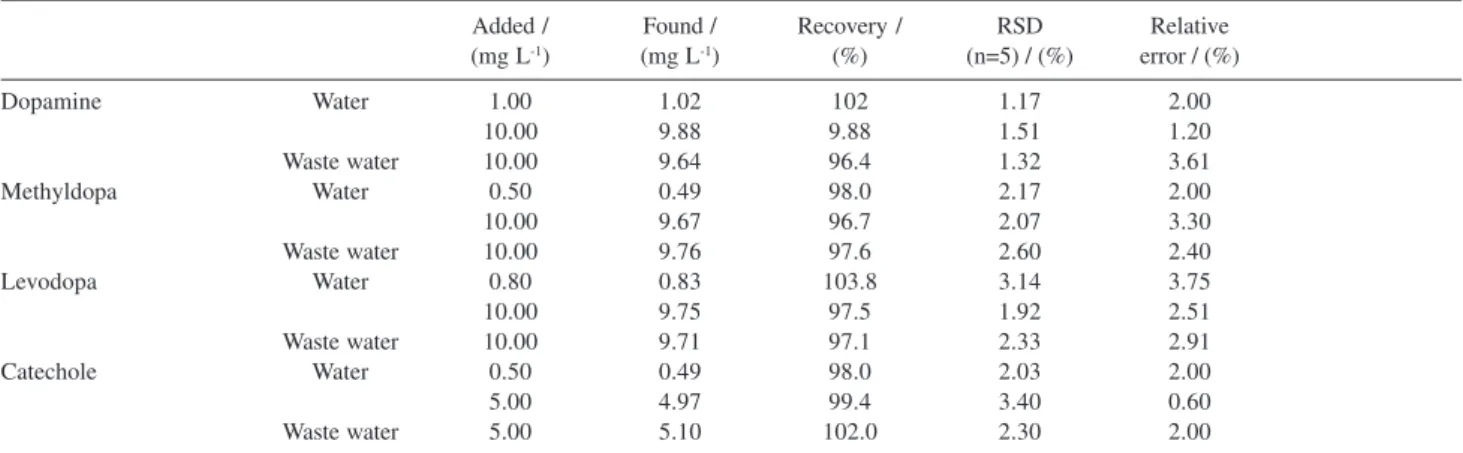
Table 4. Recovery of catecholamines added to water samples
Added / Found / Recovery / RSD Relative
(mg L-1) (mg L-1) (%) (n=5) / (%) error / (%)
Dopamine Water 1.00 1.02 102 1.17 2.00
10.00 9.88 9.88 1.51 1.20
Waste water 10.00 9.64 96.4 1.32 3.61
Methyldopa Water 0.50 0.49 98.0 2.17 2.00
10.00 9.67 96.7 2.07 3.30
Waste water 10.00 9.76 97.6 2.60 2.40
Levodopa Water 0.80 0.83 103.8 3.14 3.75
10.00 9.75 97.5 1.92 2.51
Waste water 10.00 9.71 97.1 2.33 2.91
Catechole Water 0.50 0.49 98.0 2.03 2.00
5.00 4.97 99.4 3.40 0.60
catecholamines in pharmaceutical preparations, tap water and waste water samples.
Catecholamines in injection and tablet formulations were determined by the proposed method. Catecholamines in injection formulations were determined after proper dilution of the sample with water. For determination of catecho-lamines in tablet, 20 tablets were weighed carefully and powdered. An accuratly weighed quantity of powder was shaken with water. After filtration and proper dilution of the solution the recommended procedure was followed. The results are given in Table 3. As Table 3 shows, there is a good agreement between the results obtained by the proposed method with those obtained by the official method.18
The water tested was found to be free from catecho-lamines and thus, synthetic samples were prepared by adding known amounts of catecholamines to the water samples. The results are given in Table 4. As Table 4 shows the obtained recoveries were very close to 100%. This indicates that the proposed method can be applied to the determination of catecholamines in such matrices.
Comparison of the proposed method with other methods
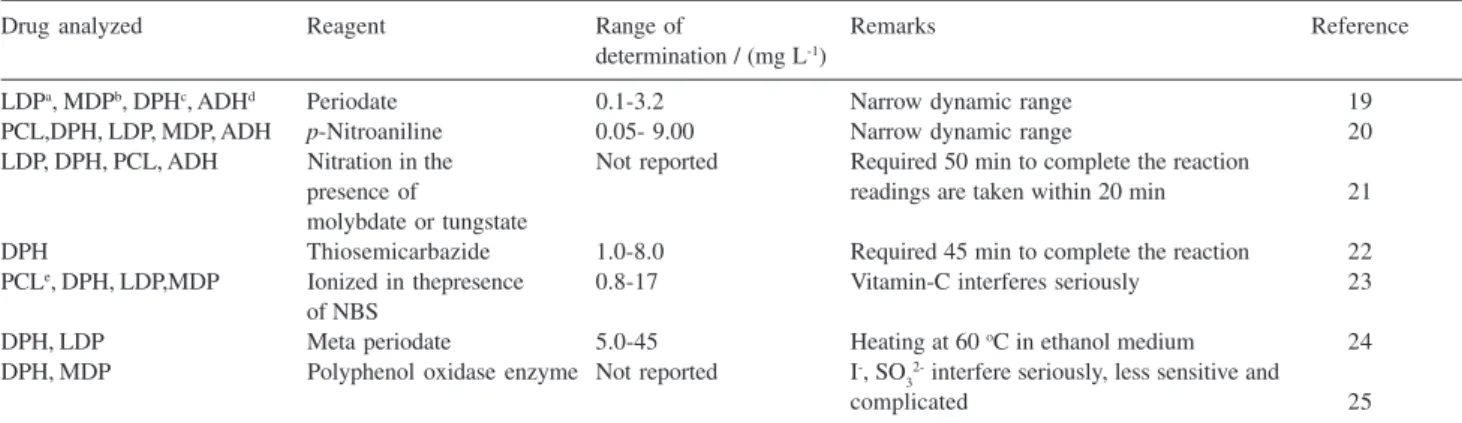
The proposed method was compared with some existing spectrophotometric methods. Table 5 clearly indicates that the proposed method provides wider dynamic range, more sensitive and free from interferences.
Conclusions
Catecholamines are oxidized to their corresponding o-quinones. The quinones are then attacked by 4-aminobenzoic acid to form o-benzoquinone deriva-tives. The o-benzoquinone derivatives can be used to the spectrophotometric determination of catecholamines by spectrophotometric method. The proposed method is
found to be simpler and more sensitive than any reported methods on catecholamines. The statistical parameters and the recovery study data clearly indicate the reproducibility and accuracy of the method. The method can be applied to the accurate determination of catecholamines in pharmaceutical preparations and water samples.
References
1. George, B. K.; Goodman, L. S. The Pharmacological Basis of Therapeutics, 3rd ed., The Macmillan Company: New York, 1965, p. 427.
2. Brandsteterova, E.; Kubalec, P.; Krajnak, K.; Skacani, I.; Neoplasma1996, 43,107.
3. Hollenbach, E.; Schulz, C.; Lehnert, H.; Life Sci. 1998, 63, 737.
4. Lakshmana, M. K.; Raju, T. R.; Anal. Biochem. 1997, 246, 166.
5. Sharma, C.; Mohanty, S.; Kumar, S.; Rao, N. G.; Analyst 1996, 121, 19631.
6. Chang, H. T.; Yeung, E. S.; Anal. Chem. 1995, 67, 1079. 7. Ragab, G. H.; Nohta, H.; Kai, M.; Ohkura, Y.; Zaitsu, K.; J.
Pharm. Biomed. Anal. 1995, 13, 645.
8. Unceta, N.; Rodriguez, E.; de Balugera, Z. G.; Sampedro, C.; Goicolea, M. A.; Barrondo, S.; Salles, J.; Barrio, R. J.; Anal. Chim. Acta2001, 441, 211.
9. Ricebery, L. J.; Vanuis, H. V.; Levin, L.; Anal. Biochem. 1974, 60, 551.
10. Hu, S.; Li, P.B.; Cheng, J. K.; Fenxi. Shiyanshi.1996, 15, 1. 11. Aman, T.; Khan, I. U.; Aslam, N.; Ahmed, I.; Anal. Lett.1998,
31, 1007.
12. Kothari, Y. K.; Srinivasalu, K.; Asian J. Chem. 1989, 1, 42. 13. Biryuk, A.; Petrenko, V. V.; Zorya, B. P.; Farm. Zh. (Kiev)1992,
2, 57.
14. Mohamed, W. I.; Salem, F. B.; Anal. Lett. 1984, 17, 191.
Table 5. Comparison of visible spectrophotometric methods for the determination of some catecholamines
Drug analyzed Reagent Range of Remarks Reference
determination / (mg L-1)
LDPa, MDPb, DPHc, ADHd Periodate 0.1-3.2 Narrow dynamic range 19
PCL,DPH, LDP, MDP, ADH p-Nitroaniline 0.05- 9.00 Narrow dynamic range 20
LDP, DPH, PCL, ADH Nitration in the Not reported Required 50 min to complete the reaction
presence of readings are taken within 20 min 21
molybdate or tungstate
DPH Thiosemicarbazide 1.0-8.0 Required 45 min to complete the reaction 22
PCLe, DPH, LDP,MDP Ionized in thepresence 0.8-17 Vitamin-C interferes seriously 23 of NBS
DPH, LDP Meta periodate 5.0-45 Heating at 60 oC in ethanol medium 24
DPH, MDP Polyphenol oxidase enzyme Not reported I-, SO 3
2- interfere seriously, less sensitive and
complicated 25
15. Afkhami, A.; Nematollahi, D.; Khalafi, L.; Rafiee, M.; Int. J. Chem. Kinet.2005, 37, 17.
16. Afkhami, A.; Nematollahi, D.; Madrakian, T.; Khalafi, L.; Electrochim. Acta2005, 50, 5633.
17. Thomsen, V; Schatzlein, D; Mercuro, D; Spectroscopy2003, 18, 112
18. United States Pharmacopeia, 23rd review, Twinbrook Parkway: Rockville,1995.
19. Afkhami, A.; Khatami, H.; J. Anal. Chem.2003, 58, 135. 20. Nagaraja, P.; Vasantha, R. A.; Sunitha, K. R.; J. Pharm. Biomed.
Anal. 2001, 25, 417.
21. Barnum, D. W.; Anal. Chim. Acta1977, 89, 157.
22. EL-Kommos, M. E.; Journal De Pharmcie De Belgic1987, 42, 371.
23. Nagaraja, P.; Murthy, K. C. S.; Yathirajan, H. S.; Mohan, B. M.; Indian J. Pharm.Sci.1998, 60, 99.
24. EL-Kommos, M. E.; Mohamed, F. A.; Khedr., A. S.; J. Assoc.
Off. Anal. Chem. 1990,73, 516.
25. Da Cruz Vieira, I.; Fatibello- Filho, O.; Talanta1998, 46, 559.
Received: February 20, 2006