Printed in Brazil - ©2006 Sociedade Brasileira de Química 0103 - 5053 $6.00+0.00
Article
*e-mail: [email protected]
Ion Recognition: Synthesis of 2-Methyl-2,4-di(2-thienyl)-2,3-dihydro-1H-1,5-benzodiazepine
and its Application in Construction of a Highly Selective and Sensitive Ag
+Membrane Sensors
Mohammad Reza Ganjali,* Parviz Norouzi, Taher Alizadeh and Mehdi Adib
Department of Chemistry, Tehran University, Tehran, Iran
Uma membrana carregadora plastificada foi preparada a partir de 2-metil-2,4-di(2-tienil)-2,3-diidro-1H-1,5-benzodiazepina (MTHB). Esta membrana é altamente sensível e seletiva a íons Ag+. O sensor mostra um intervalo dinâmico linear de 1,0 × 10⁻⁶ –1,0 × 10⁻¹ mol L-1, com
inclinação Nernstiniana de (58,5±0,3) mV per década, e limite de detecção 5,0 × 10⁻⁷ mol L-1
(~54 ppb). Apresenta rápido tempo de resposta, 10s, e pode ser usado por 8 semanas no mínimo, sem alterações consideráveis no seu potencial. O sensor proposto pode ser usado no intervalo de pH entre 4,0 e 8,0 e foi utilizado com sucesso, como eletrodo indicador, na titulação potenciométrica de Ag+ com NaCl.
A highly selective and sensitive plasticized membrane sensor for Ag+ ions based on
2-methyl-2,4-di(2-thienyl)-2,3-dihydro-1H-1,5-benzodiazepine (MTHB) as membrane carrier was prepared. The sensor shows a linear dynamic range of 1.0 × 10⁻⁶ -1.0 × 10⁻¹ mol L-1, with a
Nernstian slope of (58.5±0.3) mV decade-1, and a detection limit of 5.0 × 10⁻⁷ mol L-1 (~54 ppb).
It has a fast response time of 10 s and can be used for at least eight weeks without any considerable divergences in its potentials. The proposed sensor revealed very good selectivities with respect to the most of common metal ions. The proposed sensor could be used in a pH range of 4.0-8.0. It was successfully used as an indicator electrode in potentiometric titration of Ag+ with NaCl.
Keywords: potentiometric sensor, Ag+ sensor, PVC membrane,
2-methyl-2,4-di(2-thienyl)-2,3-dihydro-1H-1,5-benzodiazepine (MTHB)
Introduction
Silver plays no known natural biological role in humans, and possible health effects of silver are subject of dispute. Silver itself is not toxic but most of its salts are, and some may be carcinogenic. The toxicity of silver is characterized by a severe pulmonary edema, hemorrhage and necrosis of bone marrow, liver, and kidney. Long-term human exposure to silver salts or colloidal silver may cause argyria. Repeated exposure of animals to silver may produce anemia, cardiac enlargement, growth retardation and degenerative changes in the liver. Silver compounds were used successfully to prevent infection in World War I before the advent of antibiotics, and Silver compounds are still widely used externally today to accelerate healing in burn victims. Very low concentrations of silver are present in various complex samples like drinking water (5 µg L-1, soil, rock, coal fly ash, air, cigarettes, alloys,
plants, sea water etcetera).1,2
Some techniques such as atomic absorption spectroscopy,3 inductively coupled plasma,4 spectroscopy
with complexation agents5 and Rayleigh light-scattering6
have been used to determine amount of silver.
Because of the increasing use of silver compounds in industry and medicine the quick determination of trace quantities of Ag+ ion by simple methods is important in
chemical, clinical and environmental analysis.
Potentiometer monitoring based on ion-selective membrane sensor, as a simple method, offers several advantages such as speed and ease of preparation and procedures, simple instrumentation, relatively fast response, wide dynamic range, reasonable selectivity, and low cost. These characteristics have inevitably led to sensors for several ionic species, and the list of available electrodes has grown substantially over the last few years.7
Literature survey revealed that there were some reports on silver-selective membrane sensor.8-13 Chen and
co-workers8,10 reported polymeric membranes based on nitrogen
containing calixarene derivatives; Mahajan et al.9 used
2,6-bis-methylsulfanyl-[1,3,5]thiadiazine-4-thione as a Ag+
Ag+-selective electrodes based on lipophilic thioethers. Also,
some electrodes were constructed by using Schiff base p-tert-butylcalix[4]arene derivatives, bis-pyridine tetramide macrocycle.12,13 In the recent decade, we have also introduced
a number of selective membrane sensors for transition and heavy metal ion.14-28
In this work, we wish to report the construction of a highly selective and sensitive Ag+ membrane sensor based
on 2-methyl-2,4-di(2-thienyl)-2,3-dihydro-1H -1,5-benzodiazepine (MTHB) for the monitoring of Ag+ ion
concentration.
Experimental
Reagents
Reagent grade o-nitrophenyloctyl ether (NPOE), dibutylphthalate (DBP), benzyl acetate (BA), sodium tetraphenylphenyl borate (NaTPB), tetrahydrofuran (THF), and high relative molecular weight PVC were purchased from Merck and Aldrich, used as received. The nitrate and chloride salts of all cations used (all from Merck and Aldrich) were of the highest purity available and used without any further purification except for vacuum drying over P2O5. Triply distilled de-ionized water was used throughout.
Synthesis of the ionophore
The procedure for the preparation of 2-methyl-2,4-di(2-thienyl)-2,3-dihydro-1H-1,5-benzodiazepine, Figure 1 (MTHB): A mixture of 1,2-phenylenediamine (0.01 mol, 1.08 g), 2-acetylthiophene (0.01 mol, 1.26 g) and a catalytic amount of toluene-4-sulfonic acid was refluxed in p-xylene (100 mL) for 24 h. Then the solvent was removed under the reduced pressure and the residue was crystallized from 95% ethanol as orange crystals, mp 136-137 ºC, 3.0 g, yield 92%; IR (KBr) νmax/cm-1:
3339 (NH), 1595, 1574, 1464, 1423, 1371, 1321, 1298, 1225, 1171, 1051, 833, 766, 712; MS, m/z (%): 324 (M+,
33). Anal. Calc. for C18H16N2S2 (324.47): C, 66.63; H, 4.97; N, 8.63. Found: C, 66.8; H, 5.2; N, 8.4%. 1H NMR
(250.1 MHz, CDCl3 solution): δ1.82 (3 H, s, CH3), 2.97 and 3.05 (2 H, 2 d, an AB quartet system, 2JHH 13.3 Hz,
CH2), 3.59 (1 H, br, NH), 6.79 (1 H, m, CH), 6.89-6.93 (2 H, m, 2 CH), 7.00-7.11 (5 H, m, 5 CH), 7.30 (1 H, m, CH), 7.36 (1 H, dd, J 5.0 Hz and J 1.0 Hz, CH). 13C
NMR (62.9 MHz, CDCl3 solution): 30.6 (CH3), 44.3 (CH2), 72.5 (CH), 122.0, 122.5, 122.7, 124.2, 126.1, 126.8, 127.5, 128.0, 128.1, and 130.1 (10 CH), 137.1, 140.9, 146.7, 153.3, and 162.2 (5 C).
Electrode preparation
The general procedure to prepare the PVC membrane was thoroughly mixing 30 mg of powdered PVC, and 63 mg of DBP in 3 mL of THF. To the mixture was added, 2 mg NaTPB and 5 mg MTHB and the solution was mixed well. The resulting mixture was transferred into a glass dish of 2 cm in diameter. The THF content of the mixture was evaporated slowly, until an oily concentrated mixture was obtained. A Pyrex tube (3–5 mm o.d.) was dipped into the mixture for about 10 s, so that a transparent membrane of about 0.3 mm thickness was formed.27,28 The tube was
then pulled out of the solution and kept at room temperature for 10 h. The tube was then filled with an internal filling solution (1.0 × 10⁻³ mol L-1 AgNO
3). The electrode was
finally conditioned for 24 h by soaking in a 1.0 × 10⁻³ mol
L-1 solution of AgNO
3. A silver/silver chloride coated wire
was used as an internal reference electrode.
EMF measurements
Potential measurements were carried out by means of a Corning ion analyzer 250 pH/mV meter at the room temperature.
A cell assembly is:
Ag–AgCl | 1.0 × 10⁻³ mol L-1 AgNO
3 | PVC membrane |
test solution | Hg–Hg2Cl2, KCl (satd.)
Results and Discussion
Conductance study of complexation of MTHB with metal ions in propylene carbonate solution
solution, at (25±0.05) °C, in order to obtain a clue about the stability and selectivity of the resulting complexes. 15 mL of vanadyl solution was titrated with 0.01 mol L-1
of MTHB solution.29
The resulting molar conductance vs. [MTHB]/[Mn+]
mole ratio plots showed the formation of 1:1 complexes between MTHB and silver ions. The complex formation constants, Kf, were evaluated by computer fitting of the molar conductance/mole ratio data with appropriate equations,30 and the results are summarized in Table 1. As
it is obvious, the stability constant of the Ag+-MTHB
complex is higher than other cations-MTHB complexes tested. Thus, MTHB may be used as a suitable selective ionophore in construcrtion of a silver ion-selective membrane electrode.
Thus, in the next step, MTHB was used as a potentially suitable neutral carrier in the fabrication of a number of PVC membrane ion-selective electrodes for Ag+ ion and
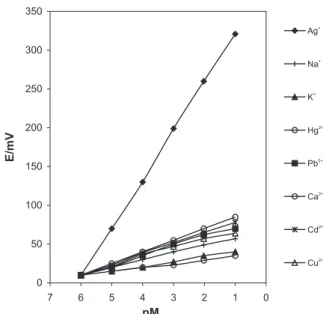
common mono and di-valent metal ions. The potential responses for these metal ions used are depicted in Figure 2. As can be seen from Figure 2, among the metal ions examined, only the resulting Ag+-selective sensor possesses
a Nernstian behavior over a wide concentration range.
Effect of membrane composition on the potential response
of the Ag+ sensor based on MTHB
The sensitivity and selectivity obtained for a given ion-carrier depend significantly on the membrane ingredients; the nature of the solvent mediator and additive used.31-36 Thus, the influences of membrane compositions
on the potential responses of the Ag+ sensor were studied,
and the results are given in Table 2.
Using 5% of MTHB and 2% of NaTPB in the membrane electrode displays Nernstian slope towards silver ion (membrane No. 4). As it is obvious from Table 2 DBP is a more effective solvent mediator than BA and NPOE in preparing the silver ion-selective electrode. It should be noted that the nature of the plasticizer influences both the dielectric constant of the membrane and the mobility of the ionophore and its complex.
Table 2 revealed that addition of 2% NaTPB will increase the sensitivity of the electrode response considerably so that the membrane sensor (No. 4) displays a nice Nernstian behavior. It is well known that the presence of lipophilic anions in cation-selective membranes based on neutral carrier not only diminishes the ohmic resistance and enhances the response behavior and selectivity but also, in cases where the extraction capability is poor, increases the sensitivity of the membrane electrodes.35,36 However, the membrane with
the composition of 30% PVC, 5% MTHB, 2% NaTPB, and 63% DBP displays a very nice Nernstian behavior.
Calibration curve and statistical data
The plot of EMF vs. pAg+ obtained under optimal
membrane ingredients for the sensor (Figure 3), indicate that it has a Nernstian behavior over a very wide concentration ranges of Ag+ ion (1.0 × 10⁻⁶-1.0 × 10⁻¹ mol L-1). The slope
and linear range of the resulting calibration graph was (58.5±0.3) mV decade-1 and 1.0 × 10⁻⁶-1.0 × 10⁻¹ mol L-1,
respectively. The limit of detection (LOD), defined as the concentration of Ag+ ion obtained when the linear regions of
the calibration graph extrapolated to the base line potential, Table 1. The formation constants of MTHB __ Mn+ complexes
Cation log Kf Cation log Kf
Ag+ 5.07 ± 0.15 Cu2+ 2.89 ± 0.12
K+ <2.0 Cd2+ 2.23 ± 0.11
Ca2+ <2.0 Pb2+ 2.44 ± 0.18
Na+ <2.0 Hg2+ 2.09 ± 0.15
Figure 2. Potential responses of various ion-selective electrodes based on MTHB.
Table 2. The optimization of the membrane ingredients
No. Composition / (%) Slope /
PVC Plasticizer MTHB NaTPB (mV decade-1)
1 30 64 NPOE 4 2 45.2±0.3
2 30 64 DBP 4 2 50.9±0.6
3 30 64 BA 4 2 46.3±0.2
4 30 63 DBP 5 2 58.5±0.3
5 30 62 DBP 6 2 50.2±0.5
6 30 64 DBP 5 1 30.3±0.3
is (5.0±0.7) × 10"7 mol L-1 (~54 ppb). The standard deviation
of 8 replicate potential measurements for proposed sensor was at the most ± 0.3 mV.
Effect of pH
The pH dependence of the Ag+ membrane sensor was
tested over a pH range of 3.5-10.5 in a 1.0 × 10⁻³ mol L-1
Ag+ solution, and the results are illustrated in Figure 4. As
it can be seen, the potential remains fairly constant in a pH range of 4.0-8.0. Beyond this range, a gradual change in the potential was detected. This is most probably due to the protonation of two nitrogen atoms of ionophore in some extent. In this case, protonated nitrogen atoms cannot contribute to the interaction of donor atoms of ionophore with silver ions, and so the response of the sensor to silver ions decreases drastically. The main reason for the observed potential drift at the higher pH values could be due to the responds of the membrane sensor to hydroxyl ions by the deprotonation of –NH group of the ionophore and decreasing of silver ion concentration in some extent by formation of insoluble AgOH (with a Ksp of 1.6 ×10⁻⁸).
The potential response of the sensor to the proton ions in the absence of silver ion was also investigated. The
results showed that in the pH range of 4.0-7.5 the sensor has not any response to the proton ions. This is due to the stability of the ionophore in the pH range of 4.0-7.5. At acidic pH values (2.0-3.5), the sensor response was shown a selective behavior to the proton ions with a near-Nernstian slope. In this case due to the protonation of nitrogen atoms of ionophore and formation of a water-soluble ionophore, the stability of the membrane sensor was drastically reduced. The pH of silver ion (as nitrate salt) at very low concentration (10-7 mol L-1 or higher) is
lower than 7.0 (due to the acidic property of silver ion) and therefore, detection limit of the proposed sensor can be determined without adjusting of pH.
Dynamic response time
For analytical purposes, response time is one of the most important factors that are taken into account. In this work, the practical response time was recorded by immediate and successive changing of Ag+ concentration
from 1.0 × 10⁻⁶ to 10 × 10-1 mol L-1 and the results are
shown in Figure 5. As it can be seen, in the whole concentration range, the electrode reaches to its equilibrium response in a very short time (10 s).
Life time study
For investigation the stability and lifetime of Ag+
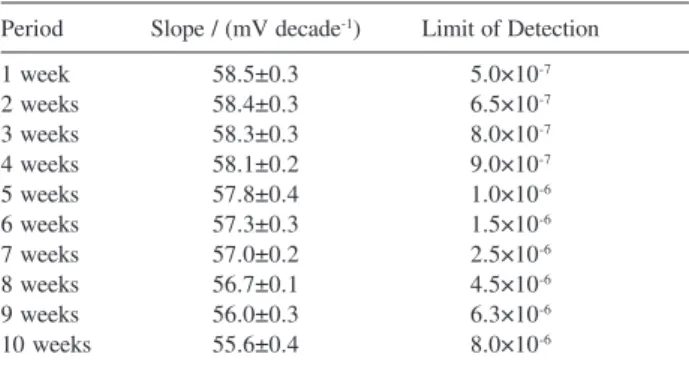
membrane sensor, three sensors were tested over a period of ten weeks. During this period, the sensors were in daily used over extended period of time (one hour per day) and their slopes and detection limits were measured. The results are summarized in Table 3. As can be seen from Table 3, after eight weeks slight changes in the slopes and detection limits (from 58.5 and 5.0 × 10⁻⁷ to 55.6 mV
per decade and 8.0 × 10⁻⁶ mol L-1, respectively) was
observed. It should be mentioned that due to the Figure 3. Calibration curve of the Ag+ membrane sensor based on MTHB.
Figure 4. The effect of the pH of the test solution (1.0 × 10⁻³ mol L-1) on
the potential response of the Ag+ membrane sensor.
Figure 5. Dynamic response time of the Ag+ sensor for step changes in
the concentration of Cr3+ : A) 1.0 × 10⁻⁶ mol L-1, B) 1.0 × 10⁻⁵ mol L-1, C)
independency of the sensor to proton ions in the range of 4.0-7.5, and pH range of 5.5-6.8 of the silver solutions (with concentration range of 10-1-10-7 mol L-1), life time
study was done without adjusting of pH.
Evaluation of selectivity coefficients
The potentiometric selectivity coefficients, which reflected the relative response of the membrane sensor towards the primary ion, over other ions present in solution, perhaps are the most important characteristics of an ion-selective electrode. In this work, the potential responses of the proposed Ag+ membrane sensor to a wide
variety of cations were investigated through the matched potential (MPM)37 and separation solution method
(SSM).38 The resulting selectivity coefficient values
obtained for the Ag+ membrane electrode are summarized
in Table 4. As it is seen, for alkali and alkali earth metal ions tested (Na+, K+, Ca2+) the selectivity coefficients are
less than 7.9 × 10⁻⁶. Selectivity coefficients obtained for
other cations tried (Cd2+, Pb2+, Hg2+, Cu2+) are also very
small, and are smaller than 1.9 × 10⁻⁵.
The obtained selectivity coefficients indicate that the disturbance produced by these cations in the functioning of the proposed Ag+ membrane sensor is negligible.
Table 5, compares the selectivity coefficients, response time, slope, LOD, and LDR of the proposed Ag+ sensor
based on MTHB with those of the previously Ag+
electrodes reported in the literature.8-13 From the data given
in Table 5, it is immediately obvious that the selectivity coefficients of the sensor are superior to those reported by other researchers.
Analytical application
The Ag+ sensor was successfully used as an indicator
electrode in the titration of 25.0 mL of 1.0 × 10⁻⁴ mol L-1
Ag+ solution with a 1.0 × 10⁻² mol L-1 NaCl, and the
resulting titration curve is given in Figure 6. As it is seen, due to the sharp end-point of the titration, the amount of Ag+ ion in the solution can be determined with the sensor
with good accuracy.
Conclusions
The use of the MTHB with DBP as the solvent mediator shows the best response characteristics with Nernstian behavior over a wide concentration range 1.0 × 10⁻⁶-1.0 × 10⁻² mol L-1Ag+ and a fast response time of
10 s. The sensor works well in a pH range of 4.0-8.0. Thus the proposed sensor is superior to the existing sensors in terms of response time, lifetime and for actual analysis and comparable with regard to other parameters such as slope, pH range, concentration range and selectivity. Figure 6. Titration curve of AgNO3 1.0 × 10
-4 mol L-1 with NaCl 1.0 ×
10-2 mol L-1.
Table 5. Comparison of the selectivity coefficients of different Ag+
sen-sors
Linear Dynamic Range LOD Slope K MPM > 10
-5 Ref.
5 × 10⁻⁶ - 5 × 10⁻² 10-5.6 49.53 Cu2+, Cd2+, K+ 8
1.0 × 10⁻⁵ -1 ×10⁻¹
≈10-6 59.0 Cu2+, Cd2+, K+ 9
5×10⁻⁶ -1 ×10⁻² 10-5.3 57 Cu2+, Cd2+, K+ 10
5 × 10⁻⁶ -1 × 10⁻¹
≈10-6 58.6 K+ 11
1 × 10⁻⁶ -1 × 10⁻¹ 5 × 10⁻⁷ 62.05 - This work
Table 4. Selectivity coefficients of various interfering cations for the best composition membrane
Ion Ksel
MPM K
sel SSM
Na+ 6.3×10⁻⁶ 6.1×10⁻⁶
K+ 1.9×10⁻⁶ 2.1×10⁻⁶
Hg2+ 1.9×10⁻⁵ 1.8×10⁻⁵
Ca2+ 7.9×10⁻⁶ 7.8×10⁻⁶
Cu2+ 1.5×10⁻⁵ 1.7×10⁻⁵
Pb2+ 1.0×10⁻⁵ 0.9×10⁻⁵
Cd2+ 1.2×10⁻⁵ 1.3×10⁻⁵
Table 3. The lifetime behavior of the Ag+ membrane sensor
Period Slope / (mV decade-1) Limit of Detection
1 week 58.5±0.3 5.0×10⁻⁷
2 weeks 58.4±0.3 6.5×10⁻⁷
3 weeks 58.3±0.3 8.0×10⁻⁷
4 weeks 58.1±0.2 9.0×10⁻⁷
5 weeks 57.8±0.4 1.0×10⁻⁶
6 weeks 57.3±0.3 1.5×10⁻⁶
7 weeks 57.0±0.2 2.5×10⁻⁶
8 weeks 56.7±0.1 4.5×10⁻⁶
9 weeks 56.0±0.3 6.3×10⁻⁶
Acknowledgement
The authors express their appreciation to the Research Council of the University of Tehran for the financial support of this work.
References
1. Taher, M. A.; Puri, B. K.; Malikc, A. K.; Croat. Chem. Acta
2002, 75, 25.
2. Isikli, B.; Demir, T. A; Özelmas, Ü.; Berber, A.; J. Med. Sci.
1998, 28, 655.
3. Rahman, M. A.; Kaneco, S.; Amin, M. N.; Suzuki, T.; Ohta K.;
Talanta 2004, 62, 1047.
4. Ndung’u, K.; Ranville, M. A.; Franks, R. P.; Flegal, A. R.; Mar. Chem. 2006, 98, 109.
5. Guangyu, Z. H.; Jiayuan, Y.; Talanta 2002, 58, 467. 6. Zhao, Y.; Cao, Q.; Hu Z.; Xu, Q.; Anal. Chim. Acta 1999, 388,
45.
7. Buhlmann, P.; Pretsch, E.; Bakker, E.; Chem. Rev.1998, 98, 1593.
8. Chen, L.; Zeng, X.; Juc, H.; Hea, X.; Zhengzhi Zhang, U.;
Microchem. J. 2000, 65, 135.
9. Mahajan, R. K.; Kaur, I.; Kumar, M.; Sens. Actuators, B 2003,
91, 26.
10. Chen, L.; He, X.; Zhao, B.; Liu, Y.; Anal. Chim. Acta 2000,
417, 51.
11. Wrbblewski, W.; Brzdzka, Z.; Sens. Actuators, B 1995, 24, 183. 12. Chena, L.; Ju, H.; Zengb, X.; Hea, X.; Zhang, Z.; Anal. Chim.
Acta 2001, 437, 191.
13. Mahajan, R. K.; Parkash, O.; Talanta 2000, 52, 691. 14. Ganjali, M. R.; Zamani, H. A.; Norouzi, P.; Adib, M.; Rezapour,
M.; Aceedy, M.; Bull. Korean Chem. Soc. 2005, 26, 579. 15. Ganjali, M. R.; Mizani, F.; Emami, M.; Darjezini, M.; Darvich,
M. R.; Yousefi, M.; Anal. Sci. 2004, 20, 531.
16. Ganjali, M. R.; Qomi, M.; Daftari, A.; Norouzi, P.; Salavati-Niasari, M.; Rabbani, M.; Sens. Actuators, B 2004, 98, 92. 17. Ganjali, M. R.; Emami, M.; Salavati-Niasari, M.; Yousefi, M.;
Anal. Lett. 2003, 36, 2735.
18. Ganjali, M. R.; Fathi, M. R.; Rahimi, H.; Pirelahi, H.;
Electroanalysis 2000, 12, 1138.
19. Ganjali, M. R.; Hosseini, S. M.; Javanbakht, M.; Hashemi, O. R.; Anal. Lett. 2000, 15, 3139.
20. Ganjali, M. R.; Rahimi, H.; Maddah, B.; Moghimi, A.; Borhani, S.; Anal. Sci. 2004, 20, 1427.
21. Ganjali, M. R.; Rasoolipour, S.; Rezapour, M.; Norouzi, P.; Tadjarodi, A.; Hanifehpour, Y.; Electroanalysis 2005, 17, 1534. 22. Ganjali, M. R.; Rasoolipour, S.; Rezapour, M.; Norouzi, P.;
Adib, M.; Electrochem. Commun. 2005, 7, 989.
23. Ganjali, M. R.; Ravanshad, J.; Hosseini, M.; Salavati-Niasari, M.; Pourjavid, M. R.; Baezzate, M. R.; Electroanalysis 2004,
16, 1771.
24. Ganjali, M. R.; Rezapour, M.; Pourjavid, M. R.; Haghgoo, S.;
Anal. Sci. 2004, 20, 1007.
25. Zamani, H. A.; Ganjali, M. R.; Pooyamanesh, M. J. J. Braz.
Chem. Soc. 2006, 17, 149.
26. Ganjali, M. R.; Pourjavid, M. R.; Rezapour, M.; Haghgoo, S.;
Sens. Actuators, B 2003, 89, 21.
27. Ganjali, M. R.; Mizani, F.; Salavati-Niasari, M.; Javanbakht, M.; Anal. Sci. 2003, 19, 235.
28. Ganjali, M. R.; Emami, M.; Salavati-Niasari, M.; Bull. Korean
Chem. Soc. 2002, 23, 1394.
29. Ganjali, M. R.; Zargazi, M. H.; Mohajeri, A.; Pol. J. Chem.
2001, 75, 743.
30. Ganjali, M. R.; Khoshdan, N.; Hashemi, O. R.; Sajjadi, S. A. S.; Pol. J. Chem. 2000, 74, 1389.
31. Teixeria, M. F. S.; Fatibello-Filho, O.; Ramos, L. A.; Quim.
Nova 2005, 28, 817.
32. Gupta, V. K.; Jain, S.; Chandra, S.; Anal. Chim. Acta2003,
486, 199.
33. Teixeria, M. F. S.; Fatibello-Filho, O.; J. Braz. Chem. Soc. 1996,
7, 233.
34. Ganjali, M. R.; Rezapour, M.; Pourjavid, M. R.; Salavati-Niasari, M.; Poursaberi, T.; Anal. Lett. 2003, 36, 881. 35. Teixeria, M. F. S.; Pinto, A. Z; Fatibello-Filho, O.; Talanta 1997,
45, 249.
36. Ammann, E.; Pretsch, E.; Simon, W.; Lindner, E.; Bezegh, A.; Pungor, E.; Anal. Chim. Acta 1985, 171, 119.
37. Umezawa, Y.; Umezawa, K.; Sato, H.; Pure Appl. Chem. 1995,
67, 507.
38. Buck, P. R.; Lindneri, E.; Pure Appl. Chem. 1994, 66, 2527.
Received: April 17, 2006