Introduction
4-Chlorophenoxyacetic acid is a white solid hardly soluble in water (K=7,9.10-4) and easily soluble in ether and ethanol [1]. It is used as growth hormone for plants and is known as herbicide [2]. In some papers the details of its molecular structure was presented [3-5]. From the survey of literature it appears that its com-plexes with Li(I) and Cu(II) ions were synthe-sized and their properties were studied [6, 7].
The carboxylates play an important role in inorganic and bioinorganic chemistry. Many metal cations in a great number of various bio-logical processes are a component of several vita-mins and drugs [8, 9]. The carboxylates of d- and 4f- ion elements may be used as electric materi-als in the modern branches of techniques and technology or they may have applications as
pre-cursors in superconducting ceramic and magnetic field productions. These compounds are used as catalysts, pigments, solvents, food preservatives and plastics productions.
Metal carboxylates are applied for the pro-ductions of high degree purity of metal oxides and polycarboxylic acids are used for supermolecular compound synthesis, which in many cases, form with metal ions the molecular polymers contain-ing in their structures, pores and channels owncontain-ing to them they appear catalytic and adsorption prop-erties. Therefore they may be used for the adsorp-tion of inorganic gases such as: argon, nitrogen and hydrocarbons or small molecules of another inorganic compounds. Polycarboxylic acid may also form the molecules with two- and three-dimentional structures, yielding special magnetic and luminescence properties which let them be used in optical and electronic industries [10-16].
7 Ecl. Quím., São Paulo, 33(1): 7-14, 2008
www.scielo.br/eq www.ecletica.iq.unesp.br
Volume 33, número 1, 2008
The physico-chemical properties of 4-chlorophenoxyacetates
of Mn(II), Co(II), Ni(II) and Cu(II)
W. Ferenc1*, M. Bernat1, J. Sarzynski2, B. Paszkowska1 1Faculty of Chemistry, Maria Curie-Sklodowska University, PL 20-031 Lublin, Poland
2Faculty of Physics, Maria Curie-Sklodowska University, PL 20-031 Lublin, Poland *[email protected]
Abstract: The complexes of 4-chlorophenoxyacetates of Mn(II), Co(II), Ni(II) and Cu(II) have been syn-thesized as polycrystalline solids, and characterized by elemental analysis, spectroscopy, magnetic stud-ies and also by X-ray diffraction and thermogravimetric measurements. The analysed complexes have the following colours: pink for Co(II), green for Ni(II), blue for Cu(II) and a pale pink for Mn(II) compounds. The carboxylate group binds as monodentate and bidentate ligands. On heating to 1173K in air the complexes decompose in several steps. At first, they dehydrate in one step to anhydrous salts, that next decompose to the oxides of respective metals. Their magnetic moments were deter-mined in the range of 76-303K. The results reveal them to be high-spin complexes of weak lig-and fields.
Keywords:4-chlorophenoxyacetates; thermal stability; magnetic properties of Mn(II), Co(II), Ni(II), Cu(II).
As a continuation of our studies on car-boxylates we decided to synthesize 4-chlorophe-noxyacetates with Mn(II), Co(II), Ni(II) and Cu(II) and to study some of their properties not to be investigated so far, such as magnetic proper-ties in the range of 77-300K thermal stability in air at 293-1173K, solubility in water at 293K and to record their FTIR spectra.
Thermal stability investigations give informations about the process of dehydratation and the ways of decompositions, and the magnet-ic susceptibility measurements let study the kinds of the way of coordination of the central ions and ligands. The determination of the solubility is valuable because it informs about the practical use of acid for separation of transition metal ions by extraction or ion-exchange chromatographic methods.
Experimental details
The 4-chlorophenoxyacetates of Mn(II), Co(II), Ni(II) and Cu(II) were prepared by the addition of the equivalent quantities of 0,1 mol/dm3 ammonium 4-chlorophenoxyacetate
(pH≈5) to a hot solutions containing the 0,1 mol/dm3Mn(II), Co(II), Ni(II) and Cu(II) nitrates (V) and crystallizing at 293K (1h). The solid formed were filtered off, washed with hot water and methanol to remove ammonium ions and dried at 303K to a constant mass.
The contents of carbon and hydrogen in the complexes and in the intermediate and final products obtained from their thermal decomposi-tions were determined by elemental analysis using a CHN 2500 Perkin-Elmer analyzer and the content of chlorine by the Schöniger method. The contents of M2+ metals were established gravi-metrically and by XRF method using spectrome-ter of X-ray fluorescence with energy dispersion EDXRF-1510 (CANBERRA firm).
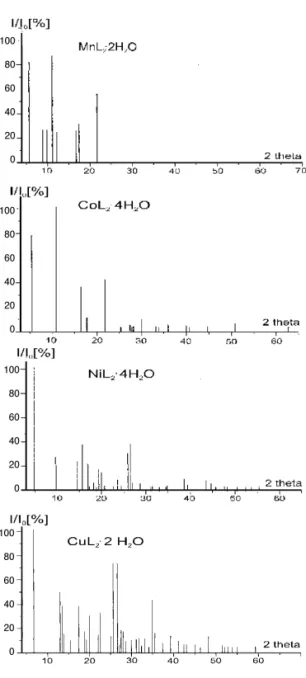
The X-ray diffraction patterns of hydrated and dehydrated complexes, the intermediate and final products of complex thermal decomposi-tions were taken on a HZG-4 (Carl Zeiss Jena) diffractometer using Ni filtered Cu Kαradiation. The measurements were made within the range 2θ=4-80o by means of the Debye-Scherrer-Hull method. The relationships between I/Ioand 2θfor these complexes are presented in Fig. 1.
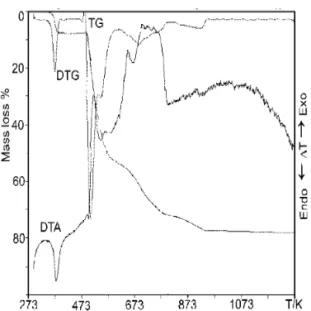
The thermal stability and decomposition of the prepared complexes were determined by Paulik-Paulik-Erday Q-1500D derivatograph with Derill converter, recording TG, DTG, and DTA curvers (Fig. 2). The measurements were made at a heating rate of 10K min-1with a full scale. The samples (100mg) were heated in plat-inum crucibles in static air to 1173K with a sen-sitivity of TG-100mg. DTG and DTA sensitivi-ties were regulated by a Derill computer pro-gram. The products of decomposition were cal-culated from TG curves and verified by the dif-fraction pattern registration and IR spectra. The termogravimetric analysis of DSC/TG was per-formed at temperature 323-723K using a differ-ential thermoanalyzer Netzsch STA 409C 3F. The measurements were carried out under nitrogen flow (99,995% purity) and temperature increase rates of 1-12K min-1.
Magnetic susceptibilities of polycrys-talline samples of 4-chlorophenoxyacetates of Mn(II), Co(II), Ni(II) and Cu(II) were measured by the Gouy method using a sensitive Cahn RM-2 balance.The samples were placed in a long cylindrical tube which was suspended from an analytical balance.The sample tube was posi-tioned between the poles of the magnet such
9 Ecl. Quím., São Paulo, 33(1): 7-14, 2008
that one its end was in the region of homoge-neous field and the other end was in the region of zero field. The force exerted on the sample was a function of the volume occupied by the sample in the region of the field gradient. This force may be written in scalar form as a function of the isotropic volume susceptibility. Measurements were carried out at a magnetic field strength of 9,9 kOe. The calibrant employed was Hg[Co(SCN)4] for which the magnetic susceptibility was assumed to be
Figure 2. TG, DTG and DTA curves for Cu(II) 4-chlorophenoxyacetate in air.
Figure 3.Dependence between magnetic susceptibility values vs temperatures for 4-chlorophenoxyacetate of Co(II).
1,644.10-5cm3g-1. Correction for diamagnetism of the calibrant atoms was calculated by the use of Pascal’s constants [17, 18]. Magnetic moments were calculated from Eq. (1):
µeff= 2,83 (χM .T)1/2 (1)
The solubilities of 4-chlorophenoxyac-etates of Mn(II), Co(II), Ni(II) and Cu(II) in water were measured at 293K. Saturated solu-tions of the obtained compounds were prepared under isothermal conditions. The contents of Mn(II), Co(II), Ni(II) and Cu(II) were
deter-mined using ASA 880 spectrofotometer
Results and discussion
The complexes of 4-chlorophenoxyac-etates of Mn(II), Co(II), Ni(II) and Cu(II) were obtained as polycrystalline products with a metal ion to ligand ratio of 1:2 and the general formula M(C8H6ClO3)2· nH2O, where M(II)=Mn, Co, Ni, Cu and n=2 for Mn(II) and Cu(II) complexes and n=4 for Co(II) and Ni(II).
Their colours are following: pinkish for Mn(II), pink for Co(II), green for Ni(II), and blue for Cu(II) complexes. In these compounds the d→d electron transitions of the central ions are those of the lowest energy and absorption occurs at relatively high wave lengths that depends on the nature of the metal ion [19, 20].
The compounds were characterized by elemental analysis (Table 1), FTIR and FIR spec-tra (Table 2).
The 4-chlorophenoxyacetates of Mn(II), Co(II), Ni(II) and Cu(II) exhibit similar solid state IR spectra. The band at 1708 cm-1originating from the RCOOH group, presented in the acid spectrum, is replaced in the spectra of complexes by two bands at 1608-1569 cm-1and 1346-1334cm-1, which can be ascribed to the asymmetric and symmetric vibra-tions of COO- group, respectively [21-24]. The bands with the maxima at 3494-3074cm-1 charac-teristic for νOHvibrations [21-26] confirm the pres-ence of crystallization water molecules in the com-plexes. The bands of C-H vibrations are observed at 2989-2009cm-1. The bands of ν(C=C) ring vibra-tions appear at 1651-1623cm-1, 1493cm-1, 1174-1172cm-1, 1094cm-1and 670-630cm-1. The valency
ν(C-Cl) vibration bands occur at 740-720cm-1and those of the asymmetric and symmetric ν(C-O-C) at 1260-1217cm-1 and 1060-1058cm-1, respectively. The bands at 458-330cm-1confirm the ionic metal-oxygen bond [27-36]. In the range of 458-439cm-1 they increase in the following way: Mn(II) < Co(II) < Ni(II) < Cu(II), which suggests the stronger M-O bond in the case of Cu(II) complex.
The bands in the range of 117-104cm-1are connected with the O-H…O streching vibrations and they change their shapes according to the rise of atomic number of elements and the degree of hydration, in 4-chlorophenoxyacetates. The bands at 137-135cm-1 confirm the internal C-C torsion vibrations and the bands at 267-216cm-1
arising from the aromatic ring vibrations also change their shapes.
Table 2 presents the values of the two band frequencies of asymmetrical and symmetrical vibrations for carboxylate group of analyzed com-plexes. The separations of the νas(OCO-), and
νs(OCO-) modes in the compounds ∆ν(OCO-) are greater or smaller than that of the sodium salt (∆νOCO-= 271cm-1) indicating a various degree of M-O ionic bonds in 4-chlorophenoxyacetates com-pared to that of the sodium salt. For the complexes the shifts of the frequencies of bands of νas(OCO-), and νs(OCO-) are lower, lower and higher, respec-tively, than those for sodium 4-chlorophenoxyac-etate. Accordingly, taking into account the spectro-scopic criteria [22, 24, 37] the carboxylate ions appear to be monodentate and bidentate groups.
In order to estimate the crystalline forms of the 4-chlorophenoxyacetates the X-ray powder diffraction measurements were done. The diffrac-togram values suggest them to be polycrystalline compounds with various degree of crystallinity [38] (Fig. 1)
The thermal stability of Mn(II), Co(II), Ni(II), and Cu(II) 4-chlorophenoxyacetates was studied in air at 293-1173K (Table 3, Fig. 2). When heated to 1173K the Mn(II) complex is dehydrated in one step. In the temperature range of 350-385K it losses two water molecules in one step and forms anhydrous salt. The loss of mass calculated from TG curve is equal to 8,16% (the-oretical value is 7,79%). The anhydrous salt at 497-868K is gradually decomposed to Mn3O4 that is a final product of complex decomposition. The intermediate compounds formed in this range of temperature is Mn2OCl2. The found mass loss is equal to 84,6% and the calculated value 83,48%. The residue mass estimated from TG curve is equal to 15,4% while that theoreti-cally calculated 16,52%.The dehydration process is connected with endothermic effect whereas the combustion of the organic ligand is accompanied by exothermic one. The final product of complex decomposition was confirmed by IR spectra and X-ray powder diffractogram.
The tetrahydrate of 4-chlorophenoxyacetate of Co (II) during heating in air losses the water molecules in two steps. At first in the range of 371-406K it releases two of them and the rest ones are
expelled during the ligand decompositions at 518-910K. The final product of complex decomposition was identified by elemental analysis and X-ray powder diffractogram as Co3O4 and the Co and Co2O3were estimated to be the intermediate prod-ucts of its decomposition. The found weight loss is equal to 85,28 and calculated one 84,0 %. The residue mass estimated from TG curve is 14,71% and theoretically determined 15,98%. The dehydra-tion process is connected with the endoeffect while that of oxidation with exothermic one.
When heated in air to 1173K the tetrahy-drate of 4-chlorophenoxyacetate of Ni(II) dehy-drates in one step at 347-406K and forms anhy-drous complex. The mass loss calculated from TG curve being equal to 14,12% corresponds to the loss of four molecules of water (theoretical value is equal to 14,35%). The anhydrous 4-chlorophe-noxyacetate of Ni(II) at 583-833K is decomposed to NiO, which is the final product of thermal decomposition. The mass loss calculates from TG curve is equal to 84,6% that corresponds to the NiO formation (calculated value is 85,1%). The dehy-dration process is connected with an endothermic effect seen in DTA curve, while the combustion of the organic ligand is accompanied by exothermic one. Considering the temperature at which the dehydration process of the complex takes place, and the way by which it proceeds it is possible to assume that the water molecules may be also in the outer sphere of complex coordination [27, 39-41].
During heating in air to 1173K the Cu (II) complex dehydrates in one step (Fig. 2). In the temperature range of 357-385K it losses two water molecules and forms anhydrous compound. The loss of mass calculated from TG curve is equal to 7,59% (the theoretical value is 7,65%). The anhy-drous complex at 490-896K is decomposed to CuO that is a final product of complex decomposi-tion. The intermediate compounds formed in this range of temperature may contain Cu2OCl, Cu and Cu2O that being next oxidized to CuO. The residue mass calculated from TG curve is equal to 20,5% while that theoretically calculated 16,00%. This discrepancy probably appears from the rest of Cu2O in the final mass of complex decomposition, which was indicated by elemental analysis, IR spectra, and X-ray powder diffractogram. The mass loss calculated from TG curve is equal to
79,5% (theoretical value is 84,0%). The dehydra-tion process, in this case, is connected with an endothermic effect seen on DTA curve, while the combustion of the organic ligand is accompanied by exothermic one. Considering the temperature of dehydration process and the way in which it pro-ceeds it is possible to assume that the water mole-cules may be in the outer coordination sphere of the complex.
The values of enthalpy of dehydration process were determined with the use of DSC/TG system under nitrogen atmosphere. They are in the range of 129-243 kJ/mol and 75,9-32 kJ/mol per one molecule of water. These values indicate that the water molecule is the strongest bounded in the Mn(II) complex while that the weakest in Cu(II) compound. Taking into account the tem-peratures of dehydration process it appears that Co(II) complex is the most thermally stable while Ni(II) has the least thermal stability.
The solubility of analysed compounds was measured (Table 1). It is in the order of 10-3-10-4 mol·dm3. The Co(II) 4-chlorophenoxyacetate is the most soluble salt, while that of Cu(II) the least soluble one. These compounds are relatively hardly soluble in water and the order value is not sufficient to use 4-chlorophenoxyacetic acid for the separation of some metal ions by ion-exchange chromatography method.
The magnetic susceptibility of 4-chlorophe-noxyacetates of Mn(II), Co(II), Ni(II) and Cu(II) was measured over the range of 76-303K (Table 4, Fig. 3). The values of the Weiss constant, θ, for all complexes were found to have a negative sign which probably arises from the antiferromagnetic spin interaction or from a crystal field splitting of the paramagnetic spin state [42-47].
The magnetic moment values experimen-tally determined at 76-303K for Mn(II), Co(II), Ni(II) and Cu(II) compounds change from 5,57 µB (at 76K) to 5,72 µB (at 303K) for Mn(II) complex, from 4,52 µB (at 76K) to 4.96 µB (at 303K) for Co(II), from 3,09 µB (at 76K) to 3.08 µB (at 293K) for Ni(II) and from 1.71 µB (at 76K) to 1,87 µB (at 303K) for Cu(II) 4-chlorophenoxyacetates.
spin-system. The magnetic moment values calcu-lated at room temperature for Mn(II), Co(II), Ni(II) and Cu(II) ions are equal to 5,9 µB, 3,88 µB, 2,83µB, and 1,73µB, respectively. For Mn(II), Co(II), Ni(II) and Cu(II) ions the magnetic moment values may be different than the spin-only. In the cases of Co(II) and Cu(II) compounds they are higher than the only worth which results from a spin-orbital coupling. For Ni(II) and Mn(II) ions the magnetic moment are lower than the spin-only value. This is due to the fact that the vectors L and S are aligned by the strong field of the heavy atom in opposite directions, and this diminishes the resultant magnetic moment. The experimental data suggest that compounds of Mn(II) and Ni(II) seem high-spin complexes with octahedral symmetry and probably weak ligand fields [42-47].
From the obtained results it appears that in 4-chlorophenoxyacetates of Mn(II), Co(II), Ni(II) and Cu(II) the coordination numbers may be equal to 5 and 6 depending on the dentates of car-boxylate group and the position of water mole-cules in the complex. The coordination numbers of Mn(II), Co(II), Ni(II) and Cu(II) ions could be established on the basis of the complete crystal structure determination of monocrystals but they have not been obtained.
Conclusions
On the basis of the results it appears that 4-chlorophenoxyacetates of Mn (II), Co(II), Ni(II), and Cu (II) were synthesized as hydrated complexes.
Their colours are following: pinkish for Mn (II), pink for Co (II), green for Ni (II), and blue for Cu(II) compounds. The complexes are crystalline compounds and on heating in air to 1173K they decompose in two steps: at first they dehydrate to form anhydrous compounds that next are decomposed to the oxides of respective metals. The values of µBcalculated for analysed complexes in the range of 76-303K reveal that the Mn(II), Co(II) and Ni(II) complexes are high-spins and that of Cu(II) forms monomer.
Received 15 August 2007 Accepted 20 September 2007
References
[1] Beilstein Handbuch der Organischen Chemie, Bd. VI/2, Springer Verlag, Berlin 1942.
[2] Franklin and Jones, American Chemical Paint Co, U.S. 2.390, 941, Dec. 11.1945.
[3] K. N. Goswami, Z. Krist. 121(5), (1965), 400.
[4] Kennard, Colin H. L., Smith, Graham, and White Allan.H., Acta Crystallorg., Sect. B 1981, B37(6), 1317-19. [5] S. Kumar, Vijay, and Rao Leela M., Acta Crystallogr, Sect. B. 1982 B 38(7), 2062.
[6] Denis, Janes C. Ramband Jerome, and Ger Offen. 1.906,199, 11 Sept. 1969, Fr. Appl. 16 Feb. 1968.
[7] G. Plesch, M. Blahova, J. Kratsmar-Smogrovic, and S.. Surka, Z. Naturfors, B, 28, 1973, 521.
[8] S. C. Mojumdar, D. Hudecova, and M. Melnik, Pol. J. Chem. 73 (1999)759.
[9] M. McCann, J. F. Cronin, and M. Devereux, Polyhedron, 17(1955)2379.
[10] C. N. Rao, and S. Natarajan, Angew, Chem. Int. Ed., 43(2004)1446.
[11] E. V. Dikarev, R. G. Gray, and B. Li, Angew. Chem. Int. Ed., 44(2005) 1721.
[12] L. Lewellyn, Jim – Ho Lee, Jong-San Chang, and G. Ferey, Angew. Chem. Int. Ed., 45 (2006) 8227.
[13] C. J. Kepert, T. J. Prior, and M.J. Rosseinsky, J. Sol. State Chem., 152 (2000) 261.
[14] Y. Kim, and D. Y. Yung, Inorg. Chim. Acta, 338(2002)229.
[15] Y. Bao-Hui, T. Ming-Liang, and Xiao-Ming Chem., Kord. Chem. Rev., 249(2005)545.
[16] E. G. Palacios, and A. J. Monchemius, Hydrometallurgy, 62(2001)135.
[17] B. N. Figgs, and R. S. Nyholm, J. Chem. Soc. (1958) 4190. [18] E. König, Magnetic Properties of Coordination and Organometallic Transition Metal Compounds., Springer Verlag, Berlin. 1966.
[19] A. Bartecki, Electronic Spectra of Complex Compounds, Scientific and Technical Publishers, Warsaw, 1987. [20] A. E. Orgel, An Introduction to Transition – Metal Chemistry, Ligand-Field Theory. John Wiley and Sons, New York, 1960.
[21] L. J. Bellamy, The Infrared Spectra of Complex Molecules, Chapman L. Hall Ltd, London. 1975.
[22] K. Nakamoto, Infrared and Raman Spectra of Inorganic and Coordination Compounds, John Wiley and Sons, Toronto, 1997.
[23] A. Cross, and A. R. Jones, An Introduction to Practical Infrared Spectroscopy. Butterworths, London, 1969. [24] R. C. Mehrotr,a and R. Bohra, Metal Carboxylates, Academic Press, London. 1983.
[25] G. E. Walfaren, J.Chem. Phys., 40(1964)3249. [26] W. A. Senior, and W. K. Thompson, Nature, 205(1965)170.
[27] K. Burger, Coordination Chemistry: Experimental Methods, Akademiai Kiado, Budapest, 1973.
[28] R. M. Silverstein and G. C. Bassler, Spektroskopowe metody identyfikacji zwinzków organicznych, PWN, Warszawa 1970 (in Polish).
[29] Y. Kim, and K. Machida, Spectrochim. Acta. 42A(1986)881.
[30] M. Mikami, I.Nakagawa, and T. Simanouchi, Spectrochim. Acta, 23A (1967)1037.
[31] K. Nakamoto, E. Udovich, and J. Takemoto, J. Am. Chem. Soc., 92 (1970) 3973.
[32] M. F. Richardson, W. F. Wagner, and D. E. Sands, Inorg. Chem., 7(1968)2495.
[33] R. C. Fay, and R. N. Lowry , Inorg. Nucl. Chem. Lett. 3(1967) 117.
[34] W. D. Courier, C. J. L. Lock, and G. Turner, Can. J. Chem., 50 (1972) 1797.
[35] A. K. Bridson, Inorganic Spectroscopic Metods, Oxford University Press, New York, 1988.
[36] L. M. Harwood, T. D. Claridge, Introduction to Organic Spectroscopy, Oxford University Press, New York, 1999. [37] B. S. Manhas, and A. K. Trikha, J. Indian. Chem. Soc. 59(1982)315.
[38] E. Lagiewka, and Z. Bojarski, X-Ray Structural Analysis, Polish Sientific Publisher, Warsaw, 1988.
[39] A. V. Nikolaev, A. V. Logvinienko, and L. J. Myachina, Thermal Analysis Vol. 2. Academic Press, New York, 1989.
[40] B. Singh, B. V. Agarwala, P. L. Mourya, and A. K. Dey, J. Indian Chem. Soc. 59 (1992)1130.
[41] F. Paulik, Speciel Trends in Thermal Analysis, Wiley Chichester, 1995.
[42] J. Mrozinski, M. Janik, and T. Nowakowski, Scientic Numbers of Silesian Technical University, 119(1988)125. [43] A. Earnshaw, Introduction to Magnetochemistry, Academic Press, London, 1956.
[44] E. O’Connor, Progress in Inorganic Chemistry, Wiley, New York, 1982.
[45] F. A. Kettle, Inorganic Physical Chemistry, Polish Scientific Publisher, Warsaw, 1999.