0103 - 5053 $6.00+0.00
R
e
v
ie
w
* e-mail: [email protected]
Isomorphic Series of Double Sulfites of the Cu
2SO
3.MSO
3.2H
2O (M = Cu, Fe, Mn, and Cd)
Type – A Review
Luciana A. da Silva and Jailson B. de Andrade*
Instituto de Química, Universidade Federal da Bahia, Campus de Ondina, 40170-290 Salvador - BA, Brazil
Embora o primeiro sulfito duplo de valência mista, Cu2SO3.CuSO3.2H2O, tenha sido preparado no início do século XIX por M. Chevreul, o interesse por compostos dessa natureza ressurgiu só depois da metade do século XX com a determinação da estrutura cristalina deste composto e a caracterização de seu espectro de absorção na região do infravermelho. Nos últimos anos, os estudos referentes a este tema têm se intensificado, especialmente após a descoberta da possibilidade de substituição isomórfica do Cu(II) no sal de Chevreul por diversos cátions com o mesmo estado de oxidação, gerando uma série de compostos cujas propriedades são fortemente dependentes da natureza do cátion M(II). Devido às suas propriedades interessantes, esses sistemas de valência mista podem ser usados como modelos para identificar intermediários em processos de corrosão atmosférica, bem como para avaliar o papel de metais de transição como catalisadores de autooxidação de S(IV) na conversão do SO2 na atmosfera.
Although the first mixed valence double sulfite, Cu2SO3.CuSO3.2H2O, was prepared in the early 19th century by M. Chevreul, interest in this type of compound was only rekindled in the
mid-1960s, when the crystalline structure of Chevreul’s salt was determined and its infrared spectrum characterized. Studies of this type of compound have been intensified in recent years, especially after the discovery that the isomorphic Cu(II) in Chrevreul’s salt could be replaced by a divalent metal ion, forming an isomorphic series whose properties are strongly dependent on the nature of the M(II) cation. Because of their interesting properties, these mixed valence systems can be used as models to identify intermediates in atmospheric corrosion processes, and to evaluate the role of transition metals as catalysts of S(IV) autoxidation in the conversion of SO2 in the atmosphere.
Keywords: Chevreul’s salt, double sulfites, mixed valence systems, isomorphic series
1. Introduction
Mixed valence systems are of considerable interest in chemistry because their properties rarely represent only the sum of the ions separately. The first known mixed valence sulfite complex, Cu2SO3.CuSO3.2H2O, was prepared by M. Chevreul in 1812.1 However, it was only in
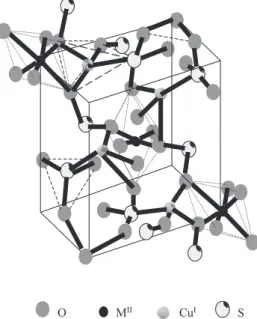
1965 that its crystalline structure was determined by Kierkegaard and Nyberg in terms of coordination polyhedra (Figure 1).2,3 The structure consists of [SO
3]
trigonal pyramids, [CuIO
3S] tetrahedra and [CuIIO4(H2O)2]
octahedra linked together, giving a three-dimensional network pertaining to the P21/n spatial group. The structure is monoclinic, with the unit cell containing two formula units and dimensions of: a = 5.5671 Å; b = 7.7875 Å; c = 8.3635 Å and β = 91.279o.
The first optical approach to identify Chevreul’s salt was published in 1973, when Nyberg and Larson4 studied
sulfite ion coordination types using fundamental active infrared modes. X-ray diffraction results indicate that the free sulfite ion is pyramidal (C3v symmetry), with the sulfur at the apex.5 This model gives rise to four fundamental
active infrared modes: ν1 (symmetric stretch), ν2 (symmetric bend), ν3 (asymmetric stretch), and ν4 (asymmetric bend).
The two asymmetric modes are doubly degenerated. Because the Na-O bonds in Na2SO3 are very weak, this compound can be used as a free sulfite ion standard for comparison with other metal sulfites. The infrared spectrum of the Na2SO3 in the solid state presents the following bands (in cm-1): ν
1 = 1010 (medium), ν2 = 633 (strong), ν3 = 961
(strong), and ν4 = 469 (strong).6
Assuming that the 3d orbitals of sulfur participate in bonding, the S-O bond shows a partially double bond character and two of the resonance structures of the sulfite ion can be written as shown in the Figure 2.
In an oxygen-coordinated compound (Figure 2a), the symmetry of the group changes to Cs and the number of fundamental active infrared modes increases to six, due to the removal of degeneracy from ν3 and ν4. This is a consequence of the decrease in the bond order (S-O) following the decrease in the stretching frequency. If the sulfite group is coordinated with the metal through sulfur
(Figure 2b), the C3v symmetry is preserved, but the
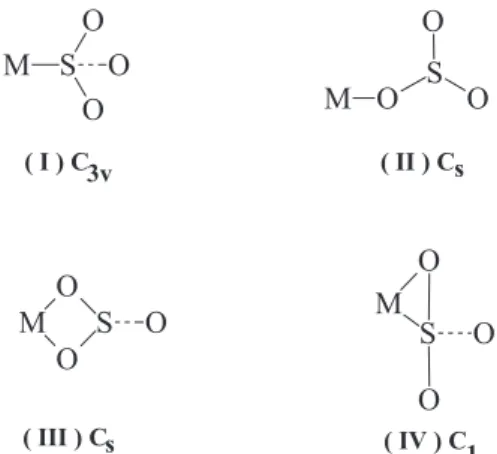
stretching modes should shift to higher frequencies than those of the free ion because of the higher bond order. The sulfite group can coordinate to the metal as a monodentate sulfur (I) or oxygen (II) donor or, in bidentate form, via oxygen (III) or oxygen and sulfur (IV) (Figure 3).7
According to Nyberg and Larson,4 the structure of
sulfite compounds can be divided into three groups after coordination of the sulfite ion: (i) compounds without
sulfur coordination (under 975 cm-1); (ii) compounds with
both sulfur and oxygen coordination (over and under 975
cm-1); and (iii) compounds with dominant sulfur
coordination (over 975 cm-1). Chevreul’s salt spectrum
shows stretching frequencies of high intensity over and under 975 cm-1, suggesting that the compound belongs to
group (ii), with both metal-sulfur bonds and metal-oxygen
bonds.
The presence of both Cu(I) and Cu(II) in the structure of Chevreul’s salt was confirmed by the presence of two
distinct 2p1/2 and 2p3/2 copper bands with their associated satellites in the photoelectron spectrum.8 The binding
energy of the 2p1/2,3/2 sulfur band confirmed the expectation that sulfur is present in only one oxidation state.8 The
magnetic susceptibility of the Cu2+(Cu+)
2(SO32-)2(H2O)2
formula gives the magnetic moment 1.90 M.B. for the paramagnetic Cu2+ ion. The latter value agrees with the
magnetic moment calculated from EPR g factors determined by Inoue et al.9 These magnetic properties
support the formula proposed by Chevreul.1
2. Isomorphic Series
After Chevreul first prepared his salt, several simple sulfites of transition metals – Zn, Ni, Ag, Pd, Co, and Cd – and double sulfites consisting of transition metals and an alkali metal or ammonium ion were prepared and characterized.4,10-13 Although Cu(II) sulfite (CuSO
3) seems
never to have been isolated, the literature contains references14 to two simple sulfites of Cu(I), commonly
distinguished as Étard’s salt, Cu2SO3.1/2H2O, and Rogojski’s salt, Cu2SO3.H2O. The color, diamagnetism, infrared spectrum and elemental analysis of Étard’s salt confirm its formulation.15 However, Dasent and Morrison15
proved that Rogojski’s salt is an approximately equimolar mixture of Cu2SO3.CuSO3.2H2O and metallic copper. They suggested that its preparation method involved a partial disproportionation of the Cu(I) compound:
Cu2SO3→ Cu + CuSO3 (1)
followed by the immediate combination of the resulting Cu(II) sulfite with unchanged Cu2SO3 to form Chevreul’s salt:
CuSO3 + Cu2SO3 + 2H2O → Cu2SO3.CuSO3.2H2O (2) Figure 3. Different possibilities of coordination between the sulfite
ion and a metal ion.
Figure 2. Resonance structures of the sulfite ion.
The resulting red mixture of Cu and
Cu2SO3.CuSO3.2H2O has the same composition as
2Cu2SO3.H2O.15
The accidental discovery of a Cu, Fe, Mn triple sulfite in the mid 60s, when a hydrometallurgical study was designed to obtain precious metals from deep-sea manganese nodules, gave rise to preliminary studies involving complex sulfites, which resulted in preparation of non-stoichiometric compound mixtures, including the Chevreul’s salt.16-18 Almost two centuries after Chevreul’s
salt preparation, Cipriano,18 Miguel and de Andrade19
studied the chemistry and preparation of double sulfites involving Cu(I) and a divalent metal ion, M(II), esta-blishing the best conditions to obtain the complete replacement of Cu(II) by transition metal ions such as Fe(II), Mn(II) and Cd(II) ions. In this case, their X-ray diffraction data were similar to those of Chevreul’s salt, with minor changes in “d” spacings, forming an isomorphic series:
Cu2SO3.CuSO3.2H2O, Cu2SO3.FeSO3.2H2O,
Cu2SO3.MnSO3.2H2O, and Cu2SO3.CdSO3.2H2O.20-22
Sghyar et al.22 determined the structure and
crys-tallographic parameters of isomorphic series of doubles sulfite such as Cu2SO3.MSO3.2H2O (M = Cu, Fe, Mn, and Cd):
The infrared spectra of Cu2SO3.FeSO3.2H2O,
Cu2SO3.MnSO3.2H2O and Cu2SO3.CdSO3.2H2O are similar to that of Chevreul’s salt and may be assigned in a similar way.20,21 The vibrational bands of the sulfite group were
assigned by comparing them with data reported in the literature. The four fundamental bands of the sulfite ion vibrations were identified.
Copper(II) and copper(I) have different bonding characteristics. Copper(I) is a class b metal or soft base and follows the trend of having increased polarizability over Cu(II) and of having a decreased number of coordination sites (four, instead of five or six). Copper(I) preferentially complexes with soft sulfur-containing ligands. Copper(II) is sometimes classified as class b, but it can show
characteristics of both classes (a or b).23-25 In
CuI
2SO3.CuIISO3.2H2O, Cu(I) is bonded to SO32- through
both oxygen and sulfur bonds, while Cu(II) is bonded through oxygen bonds and its hard character prevails. Thus, considering M(II) cations of the isomorphic series, the hardness order is: Cu(II) > Fe(II) > Mn(II) > Cd(II). Pearson26
proposed that a hard acid prefers to combine with a hard base, and a soft acid prefers to combine with a soft base; hence, since M(II) is bonded only through oxygen, which is a hard acid, a preference is expected for the formation of Cu2SO3.CuSO3.2H2O.
Selectivity evaluation studies20 of the incorporation of
M(II) during the formation of salt have shown that, contrary to expectation, the replacement of Cu(II) by M(II) takes place preferentially in decreasing order of hardness. Sghyar
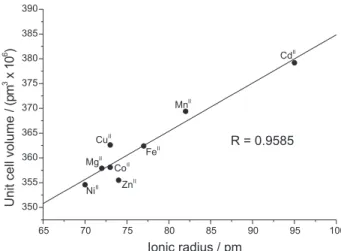
et al.22 calculated the unit cell volumes of several double
sulfites, considering isomorphic substitution (Figure 4). It is worth noting that, in the incorporation of M(II), the unit cell expands proportionally to the increase in ionic radius, confering a supplementary stability on the sulfite network. This fact may justify the preference for Cu(II) replacement by the soft cation. Nevertheless, this replacement only occurs if there is an excess of M(II) cations.
3. Considerations About Synthesis
Chevreul’s salt has been synthesized by various procedures. Up to the 1960s, the most common preparation method described for this substance in the literature consisted of passing sulfur dioxide through an aqueous solution of Cu(II) sulfate at about 70 oC for two hours,2,27
after which the gas stream was interrupted and a brick red solid precipited. In 1967, Scarbo et al.18 described a new
synthesization procedure to obtain Chevreul’s salt from diluted Cu(II) solution, replacing the prolonged heating Table 1. Crystallographic parameters of the isomorphic series of
double sulfites such as Cu2SO3.MSO3.2H2O (M = Cu, Fe, Mn, and Cd) (selected from ref. 22)
M(II) Cu Fe Mn Cd
ri / Å 0.73 0.77 0.82 0.95
a / Å 5.5671 5.694 5.712 5.696
b / Å 7.7875 7.874 7.936 8.065
c / Å 8.3635 8.093 8.156 8.260
β / o 91.279 93.1 92.8 92.4
V / Å3 362.5 362.3 369.3 379.1
ρx / (g cm
-3) 3.57 3.46 3.40 3.82
Note: ri = ionic radii; a, b, c and β = network parameters; V = unit cell volume; ρx = density.
Figure 4. Changes in unit cell volume as a function of the ionic
time by adding an alkali solution. In that protocol, Chevreul’s salt is prepared by precipitation from a copper sulfate solution (1 g/100 mL) by the passage of SO2 at ambient temperature. After saturation with sulfur dioxide, the solution temperature is raised to 78 ± 2 oC and the pH
value is adjusted to 3.0 – 3.5 with the addition of a hydroxide or carbonate solution, at which point Chevreul’s salt precipites.
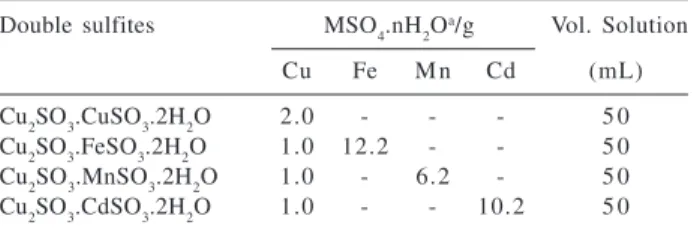
The isomorphic series was prepared according to Skarbo’s procedure, adding, besides Cu(II) sulfate, an excess of M(II) sulfate to each of the initial solutions. The compositions of the starting solutions are given in Table 1. Further details of the steps involved in isomorphic series synthesis are discussed elsewhere.18-22
When carbonate or hydroxide solution is used as a neutralizing agent, a substantial increase of the pH occurs at the point where the drop reaches the solution, causing the cation, usually Na+, K+ or NH
4+, to become incorporated
as an impurity in the sulfite structure. In the specific case when alkali is a sodium carbonate solution, Na+ can replace
Cu+ in the crystalline structure because these two cations
have the same charge, +1, and their ionic radii are very similar (Na+, 97 pm and Cu+, 96 pm).
To avoid incorporation of the base cation, Silva et al.20
suggested two alternative methods to raise the pH, replacing the addition of alkali with the removal of excess SO2: i) by reducing the internal pressure of the system
associated with the ultrasonic bath at 60 oC; ii) by burbling
N2 in the sulfur dioxide saturated solution.
In both cases, the salts obtained displayed high degrees of purity. While the traditional method (the addition of Na2CO3) leads to a contamination by Na+ of about 0,8%
(m/m), the use of the new procedure results in sodium concentrations at blank levels.20
4. Redox Chemistry of Cu(II)-S(IV) Complexes
Transition metal complexes are important in aqueous
atmospheric systems (e.g., cloud droplets and haze
aerosols), where trace metal catalysis of the autoxidation
of S(IV) has been postulated as an important pathway for SO2 conversion.28-41 The Cu(II)-S(IV) system was proposed
by Conklin and Hoffmann29 for use as a model for transition
metals that are active catalysts for SO2 autooxidation. This system is similar to the preparation of Chevreul’s salt.
According to Conklin and Hoffmann,30 copper(II) forms
transient complexes with S(IV) in solution. These complexes react to form a mixture of Cu(I), Cu(II), SO4
2-and SO32- in apparent equilibrium with Chevreul’s salt
(CuI
2SO3.CuIISO3.2H2O). However, the reduction of Cu(II)
by S(IV), in terms of the predominant Cu(II) and S(IV) species, is thermodynamically unfavorable:
Cu2+ + e–
º
Cu+ Eo = 0.153 V (3)HSO3–
º
H+ + e– + SO3– Eo = -0.84 V (4)
The unfavorable ∆Go for this reaction indicates that
other processes must be taken into account. These processes include the stabilization of the products and the energy released by precipitation.
A mechanism for the anoxic reaction between Cu(II) and S(IV) in the formation of Chevreul’s salt was suggested
by Conklin and Hoffmann30 observed that positively
charged dimeric Cu(II)-S(IV) complexes are formed upon mixing solutions of Cu(II) and S(IV); the formation of Cu(II)-S(IV) complexes is pH-dependent; the rate of disappearance of the complexes follows biphasic first-order kinetics; two-electron transfer appears to occur with the formation of S(VI); an equilibrium mixture of Cu(II), Cu(I), S(IV), and S(VI) with precipitated CuI
2SO3.CuIISO3.2H2O is established.
A mechanism that is consistent with the above observations is:30
HSO3–
º
H+ + SO32– (4)
Cu2+ + SO
32–
º
CuSO3 (5)Cu+2 + CuSO
3
º
[CuIISO3CuII]2+ (6)[CuIISO
3CuII]2+ + H2O
º
CuIISO3CuIIOH+ + H+ (7)[CuIISO
3CuII]2+ → [CuISVO3CuII]2+ (8)
CuIISO
3CuIIOH+→ CuISVO3CuIIOH+ (9)
[CuISVO
3CuII]2+ → [CuISVIO3CuI]2+ (10)
CuISVO
3CuIIOH+→ CuISVIO3CuIOH+ (11)
[CuISVIO
3CuI]2+
º
2Cu+ + SVIO3 (12)CuISVIO
3CuIOH+
º
2Cu+ + SVIO3 + OH– (13)SVIO
3 + H2O
º
SO42– + 2H+ (14)2Cu+ + SO
32–
º
CuSO3– (15)2Cu+ + Cu2+ + 2SO
32– + 2H2O
º
CuI2SO3.CuIISO3.2H2O (16)5. Oxidation by Air
There is evidence that a significant portion of the airborne sulfur species emitted into the atmosphere may Table 2. Composition of the starting solutions in mixed valence
sulfite preparations
Double sulfites MSO4.nH2Oa/g Vol. Solution
Cu Fe Mn Cd (mL)
Cu2SO3.CuSO3.2H2O 2.0 - - - 5 0 Cu2SO3.FeSO3.2H2O 1.0 12.2 - - 5 0 Cu2SO3.MnSO3.2H2O 1.0 - 6.2 - 5 0 Cu2SO3.CdSO3.2H2O 1.0 - - 10.2 5 0
be particulate SO32-. Some studies indicate that solid metal
sulfite and sulfite complex in solution may play a role as intermediaries in atmospheric corrosion processes.38 The
kinetics of surface oxidation in particles of Cu2SO3.CuSO3.2H2O, Chevreul’s salt, was monitored by X-ray photoelectron spectroscopy (XPS) and used as a model compound for characterizing sulfite stability on particle surfaces exposed to air.31 Several surface reactions
of Chevreul’s salt exposed to air, including possible oxidation of S(IV) into S(VI) and Cu(I) to Cu(II), were considered. Since no SO42- was detected by XPS in the
final products, the reaction below is most likely to occur:
½O2 + Cu2SO3.CuSO3.2H2O → 2CuSO3 + CuO + 2H2O (17)
This is consistent with the conclusions of Eatough et al.38 that atmospheric S(IV) species, such sulfites, may have
long residence times in the environment.
6. Optical Properties
The isomorphic species present distinct colors. The intense red of Chevreul’s salt changes to yellow-brown after Cu(II) is replaced by Fe(II). If the substitution involves Mn(II) instead of Fe(II), a gradual transition to yellow is observed. On the other hand, if Cu(II) is replaced by Cd(II), a faint yellow color is obtained.
The spectroscopic properties of Chevreul’s salt were investigated recently by Inoue et al.9 based on EPR
measurements and diffuse reflectance absorption spectra. A more complete study was made by Silva et al.,42 involving
the electronic interactions between the constituents of Chevreul’s salt derivatives, particularly insofar as the types of electronic transition responsible for their different colors are concerned, with emphasis on the theoretical evaluation employing molecular modeling calculations.43-46
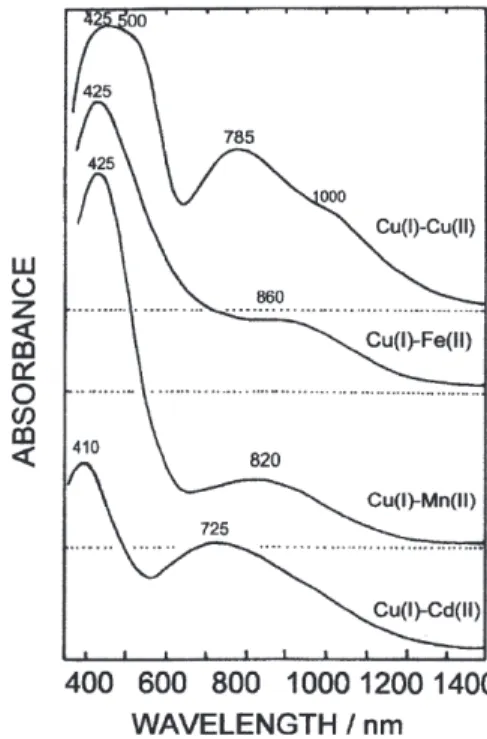
The spectrum of Chevreul’s salt and those of the corresponding derivatives with Fe(II), Mn(II) and Cd(II) ions are shown in Figure 5.
The electronic spectrum of Chevreul’s salt consists of a charge-transfer band around 425 nm associated with the [CuI
2(SO3)2(SO3)2] 6- chromophore,42 and two ligand field
transitions at 785 and 1000 nm involving the Jahn-Teller splitting of the Cu(II) levels, an effect that is associated with d9 ions. An additional intervalence-transfer band, responsible for its red color, can be found at 500 nm. The replacement of the Cu(II) ions by Fe(II), Mn(II) and Cd(II) does not eliminate the absorption band at 425 nm, supporting its assignment as a charge-transfer transition centered on the Cu(I) sites. The less intense band at 860 nm for the Fe(II) derivative is consistent with a Laporte
forbidden ligand field transition, while the bands at 820 nm in the case of Mn(II) and at 725 nm in that of Cd(II) have been tentatively attributed to charge-transfer transitions in the [CuI
2(SO3)2(SO3)2]6- chromophore,
considering the lack of characteristic electronic transitions for these ions in this region.
7. Thermal Properties
To gain a better understanding of the chemical nature of mixed valence compounds, Silva et al.47 investigated
several thermal properties, such as thermal diffusivity (α), heat capacity (ρcP), and thermal conductivity (k), as well
as the non-radiative relaxation time (τR) and the
characteristic diffusion time (τb) of the excited state of ions in the double sulfites of the isomorphic series, using photoacoustic spectroscopy (PAS) and the rising temperature method.48-52
The results in Table 3 show the thermal properties determined by photothermic techniques.47 The thermal
diffusivities have values one order of magnitude higher than some semiconductors and porous silicon.53-55
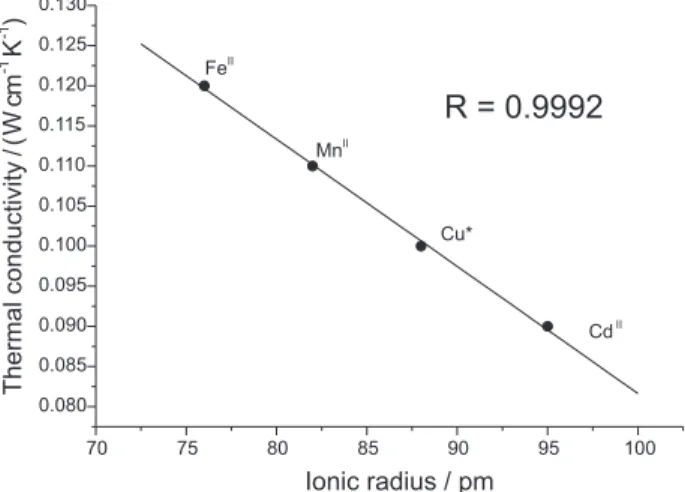
through crystalline materials. It is noteworthy that the thermal conductivity changes according to the ionic radius of M(II) cations. Their behavior is related to increases in the unit cell volume (Figure 4). Figure 6 shows the results of thermal conductivity as a function of the ionic radius.
The trend indicated in the graph seems to indicate a linear dependence, with the thermal conductivity decreasing as the ionic radii of M(II) cations [Cu(II) < Fe(II) < Mn(II) < Cd(II)], except Cu2SO3.CuSO3.2H2O, increase. The electronic spectrum of Chevreul’s salt discussed previously42 shows an intervalence transfer transition band
at 500 nm (see Figure 6) from the tetrahedral Cu(I) ions to the empty 3dx2
-y
2 level of e
gsymmetry of the Cu(II) ions. This band, in addition to being responsible for the salt’s red color, is evidence of the strong Cu(I)-Cu(II) interaction and explains the linear correlation (R = 0.9992) observed when one considers the weighted average (88 pm) of the ionic radius of Cu(I) and Cu(II) (Figure 7).56
The information concerning the non-radiative relaxation time (t
R) and characteristic diffusion time (tb) was obtained from measurements of the PA phase angle as a function of the modulation frequency of the maximum absorbance bands (see electronic spectra – Figure 6) using the thermal diffusivity model51 for a thermally thick
sample.47
The photoacoustically measured relaxation time does not necessarily constitute an appropriate representation of the level initially excited in the absorption process, but rather of the average lifetime of a variety of states before energy is lost in the form of heat. Thus, in general, there is a non-unique relaxation pathway consisting of several successive steps, and the measured lifetime is an average lifetime of heat production. For a powder sample, tR also
contains a contribution from the heat exchange time between the powder particle and the transducing gas of the PA cell.
8. Thermal Decomposition
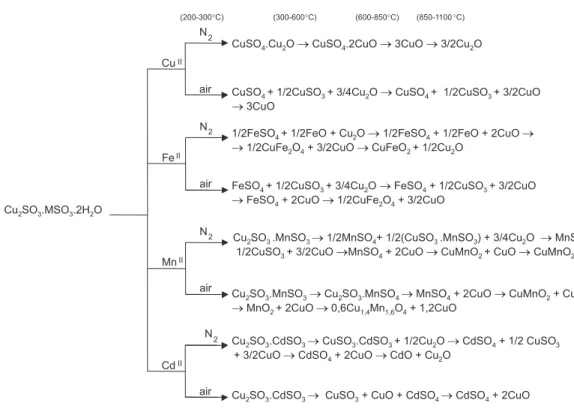
The isomorphic series has been subjected to thermal treatment in helium, nitrogen, air and reductive gaseous mixtures (H2/Ar) in dynamic atmospheres. The studies revealed that double sulfites are thermally stable up to 200oC under all conditions.21 Based on the characterization
of solid intermediary products and to TG and DSC curve
analyses, Silva et al.21 suggested the thermal
decomposition reactions of the double sulfites in air and nitrogen atmospheres presented in Scheme 1:
Table 4. Non-radiative relaxation time, τR, and characteristic
diffu-sion time, τb, of each compound (selected from ref 47)
Double Sulfite Band – 1 Band – 2
τR/ms τb/µs τR/ms τb/µs Cu2SO3.CuSO3.2H2O 8.01 1.4 7.66 2.3 Cu2SO3.FeSO3.2H2O 7.21 3.5 9.68 2.0 Cu2SO3.MnSO3.2H2O 10.0 5.0 6.45 1.0 Cu2SO3.CdSO3.2H2O 7.28 1.0 6.29 1.0
Note: Band –1: 360 – 470 nm; Band – 2: 690 – 750 nm.
Table 3. Thermal diffusivity, heat capacity, and thermal conducti-vity of each compound (adapted from ref. 47)
Double Sulfite α/cm2 s-1 ρc
P/J cm-3 K-1 k/W cm-1 K-1 Cu2SO3.CuSO3.2H2O 0.154 0.62 0.10 Cu2SO3.FeSO3.2H2O 0.203 0.57 0.12 Cu2SO3.MnSO3.2H2O 0.148 0.74 0.11 Cu2SO3.CdSO3.2H2O 0.156 0.55 0.09
Figure 7. Thermal conductivity of the mixed valence sulfite
Cu2SO3.MSO3.2H2O (M = Fe, Mn, Cu, Cd) as a function of the ionic radius. Note: Cu* is the weighted average of the ionic radius of Cu(I) and Cu(II) (data from ref. 47).
The authors21 found that the sulfite ion coordination
structures strongly influence the course of these salts’ thermal decomposition (Figure 8). Sulfite species coordinated to the metal through the oxygen atom (a) are more easily oxidized into sulfate than sulfur coordinated species (b),7,21 leading to the preferential formation of
MIISO
4 and Cu2O at the onset of thermal decomposition. 21
The presence of Cu2O in the solid residue indicates that the evolution of SO2 during the first step of thermal decomposition takes place through the break of Cu(I)-S and Cu(I)O-S bonds.21
Silva et al.21 have reported that the TG curves of all the
double sulfites investigated show a weight gain in the second step of thermal decomposition in inert (N2 and He) and oxidative atmospheres (air) and that they disappear when the salts are heated in a reductive atmosphere (H2/Ar). This weight gain has been ascribed to the oxidation of Cu2O to CuO and/or oxidation of MIISO
3 to MIISO4,
probably by a self-generated atmosphere composed of dense volatile products released in the former step. The oxidation reaction is inhibited in a reductive atmosphere.
9. Final Considerations
Although interest in these types of compounds dates back to the early 19th century, most of the information
about double sulfites found in the literature was published after the 1960s. However, these studies have been intensified in recent years, especially in our group, which has drawn a profile of the isomorphic series Cu2SO3.MSO3.2H2O [M = Cu, Fe, Mn and Cd] in order to gain a better understanding of the chemistry of these compounds.
Acknowledgements
CNPq and FAPESB for financial support.
References
1. Chevreul, M. E. ; Ann. Chim.1812, 83, 187.
2. Kierkgaard, P.; Nyberg, B.; Acta Chem. Scand. 1965, 19, 2189.
3. Dunaj-Jurco, M.; Ondujovic, G.; Melnic, M.; Coord. Chem. Rev.1988, 83, 1.
4. Nygerg, B.; Larson, P.L.O.; Acta Chem. Scand.1973, 27, 63.
Scheme 1.
5. Zachariasen, W. H.; Buckley, H. E.; Phys. Rev., 1931, 37, 1291. 6. Évans, J. C.; Bernstein, H. J.; Can. J. Chem.1955, 33, 1270. 7. Hall, J. P.; Griffith, W. P.; Inorg. Chim. Acta.1981, 48, 65. 8. Brant, P.; Fernado, Q.; J. Inorg. Nucl. Chem.1978, 40, 235 9. Inoue, M.; Grijalva, H.; Inoue, M. B.; Fernando, Q.; Inorg.
Chim. Acta1999, 295, 125.
10. Larsson, L. O.; Acta Chem. Scand. 1969, 23, 581.
11. Nyberg, B.; Kierkgaar, P.; Acta Chem. Scand.1968, 22, 581. 12. Hjerten, I.; Nyberg, B.; Acta Chem. Scand.1973, 27, 345. 13. Lutz, H. D.; El Suradi, S.; Z. Anorg. Allg. Chem. 1976, 425, 134. 14. Sneed, M. C.; Maynard, J. L.; Brasted, R. C.; Comprehensive Inorganic Chemistry, Van Nostrand: New York, 1954, vol. 2. 15. Dasent, W. E.; Morrison, D. ; J. Inorg. Nucl. Chem. 1964, 26,
1122.
16. Stromeyer, A.; Achwefligsaure Kupferoxydul, Liebigs Analen
1959, 109, 237.
17. Skarbo, R. R.;US Pat. 3.515.5121970.
18. Cipriano, C.; MSc. Dissertation,Universidade Federal do Rio de Janeiro, Brazil,1981.
19. Miguel, A. H.; de Andrade, J. B.; Cot, L.; Duran, J.; Proceedings of the II Simpósio Nacional de Química
Inorgânica, São Paulo, Brazil, 1984.
20. Silva, L. A.; Correia, S. J.; Martins, C. R.; de Andrade, J. B.; Quim. Nova 1998, 21, 151.
21. Silva, L. A.; Matos J. R.; de Andrade, J. B.; Thermochim. Acta
2000, 360, 17.
22. Sghyar, M.;, Durand, J.; Miguel, A. H.; Cot, L.; Rev. Chim. Miner. 1984, 21, 710.
23. Gray, H. B.; Chemical Bonds:An Introduction to Atomic and Molecular Structure, 1st ed., W.A. Benjamin Inc.: New York, 1973
24. Huheey, J. E.; Keiter, E. A.; Keiter, R.; Inorganic Chemistry: Principles of Struture and Reactivity, 4th ed., Harper Collins College Publishers: New York, 1993.
25. Porterfield, W. W.; Inorganic Chemistry: A Unified Approach, 1st ed., Addison-Wesley: Reading Massachusetts, 1984. 26. Pearson, R. G.; J. Am. Chem. Soc. 1963, 85, 3533.
27. Pascal, P.; Nouveau Traité de Chimie Minerale1957, 111, 298. 28. Conklin, M. H.; Hoffmann, M. R.; Environ. Sci. Technol.
1988, 22,883.
29. Conklin, M. H.; Hoffmann, M. R.; Environ. Sci. Technol.
1988, 22, 891.
30. Conklin, M. H.; Hoffmann, M. R.; Environ. Sci. Technol.
1988, 22, 899.
31. Cox, X. B.; Linton,R. W.; Miguel, A. H.; de Andrade, J. B.; Atmos. Environ.1986, 20, 1139.
32. Hoffmann, M. R.; Atmos. Environ.1986, 20, 1145. 33. Radojevic, M.; Tyler, B. J.; Wicks, A. J.; Gay M. J.; Choularton,
T. W.; Atmos. Environ.1990, 24A, 323.
34. Xue, H.; Gonçalves, M. L. S.; Reutlinger, M.; Sigg, L.; Stumm, W.; Environ. Sci. Technol.1991, 25, 1716.
35. Grgic, I.; Hudnik, V; Bizjak, M.; Levec, J.; Atmos. Environ.
1991, 25A, 1591.
36. Martin, L. R.; Good, T. W.; Atmos. Environ. 1991, 25A, 2395. 37. Sedlak D. L.; Hoigné, J.; Environ. Sci. Technol.1994, 28,
1898.
38. Eatough, D. J.; Christensen, J. I.; Eatough, N. L.; Hill, M. W.; Major, T. D.; Mngelson, N. F.; Post, M. E.; Ryder, J. F.; Hansen, L. D.; Atmos. Environ.1982, 16,1001.
39. de Andrade, J. B.; Pinheiro, H. C.; Andrade, M. V. S.; J. Braz. Chem. Soc. 1995, 6, 287.
40. Martins, C. R.; Cabral Neto, C. A.; Alves, J. J. F.; de Andrade, J. B.; J. Braz. Chem. Soc. 1999, 10, 45.
41. Martins, C. R.; de Andrade, J. B.; Quim Nova 2002, 25, 259. 42. Silva, L. A.; de Andrade, J. B.; Toma E. H.; J. Braz. Chem. Soc.
2002, 13, 624.
43. Zerner, M. C.; Loew, G. H.; Kirchner, R. F.; Mueller-Westerhoff, U. T.; J. Am. Chem. Soc. 1980, 102, 589.
44. Bacon, A. D.; Zerner, M. C.; Theoret. Chim. Acta1979, 53, 21.
45. Ridley, J. E.; Zerner, M. C.; Theoret. Chim. Acta1976, 42, 223.
46. Ridley, J. E.; Zerner, M. C.; Theoret. Chim. Acta 1973, 32, 111.
47. Silva, L. A.; de Andrade J. B.; Moysés Araújo, C.; Nakamura, O.; Ferreira da Silva, A.; Massunaga, M. S. O.; Vargas, H.; Phys. Chem. Chem. Phys.2001, 3, 4800.
48. Lima, G. A. R.; Baesso, M. L.; Arguello, Z. P.; da Silva, E. C.; Vargas, H.; Phys. Rev. B1987, 36, 9812.
49. Baesso, M. L.; Mansanares, A. M.; da Silva, E. C.; Vargas, H.; Phys. Rev. B1989, 40, 1880.
50. Abritta, T.; Cella, N.; Vargas, H.; Chem. Phys. Lett.1989, 161, 12.
51. Rosencwaig, A.; Gersho, A.; J. Appl. Phys.1976, 47, 46. 52. Alexandre, J.; Saboya, F.; Marques, B. C., Ribeiro; M. L.,
Salles, C.; da Silva, M. G., Sthel, M. S.; Auler, L. T.; Vargas, H.; Analyst1999, 124, 1209.
53. Calderon, A; Alvarado-Gil, J. J.; Garevich, Y. G.; Cruz-Orea, A.; Delgadilho, I.; Vargas, H.; Miranda, L. C. M.; Phys. Rev. Lett.1997, 79, 5022.
54. Silva, T. S.; Alves, A. S.; Pepe, I.; Tsuzuki, H.; Nakamura, O.; d’Aguiar Neto, M. M. F.; Ferreira da Silva, A.; Veissid, N.; An, C. Y.; J. Appl. Phys.1998, 83, 6193.
55. Ferreira da Silva, A.; Souza da Silva, T.; Nakamura, O.; d’Aguiar Neto, M. M. F.; Pepe, I.; Roman, L. S.; Veje, E.; Mater. Res.2001, 4, 23.
56. Silva, L. A.; Vargas, H.; Massunaga, M. S. O.; Ferreira da Silva, A.; de Andrade J. B.; Abstracts of the 26a Reunião Anual da
Sociedade Brasileira de Química, Poços de Caldas, Brazil,2003.
Received: June 17, 2003