0103 - 5053 $6.00+0.00
* e-mail: [email protected]
An Efficient Ethanol-Based Analytical Protocol to Quantify Faecal Steroids in Marine
Sediments
Silvia K. Kawakami and Rosalinda C. Montone*
Instituto Oceanográfico, Universidade de São Paulo, Praça do Oceanográfico, 191, 05508-900, São Paulo - SP, Brazil
A maioria dos métodos para análise de esteróides em sedimentos marinhos é laboriosa, consome grandes volumes de solventes orgânicos (muitas vezes clorados) e produz grandes quantidades de material de descarte. Neste trabalho desenvolveu-se um método de extração com etanol e um “clean up” rápido, que oferece uma alternativa de menor custo e minimiza o uso de solventes clorados. As porcentagens de recuperação de esteróides (coprostanol, epicoprostanol, cholesterol, cholestanol, 5-coprostanona and 5-coprostanona) ficaram na faixa de 70 a 93%, comparáveis às análises mais tradicionais. A eficiência do método foi avaliada através de material de referência e os resultados obtidos para coprostanol, colesterol e colestanol encontram-se próximos aos valores médios certificados e perfeitamente dentro dos valores aceitáveis. Os desvios-padrão relativos para triplicatas foram baixos (6-12%). Os testes indicaram que o “clean-up” simplificado (sem fracionamento) não produz interferência na quantificação dos esteróides fecais.
The majority of the analytical methods for steroids in marine sediments are laborious and time consuming and involve the use of large volumes of organic (frequently chlorinated) solvents. A method has been developed utilising ethanol extraction with a rapid alumina-ethanol elution clean up, providing an environmentally friendly and inexpensive alternative. Recoveries of steroids (coprostanol, epicoprostanol, cholesterol, cholestanol, 5-coprostanone and 5-coprostanone) ranged from 70 to 93% and compared favourably with more traditional analyses. Analytical performance was tested through analysis of reference material and concentrations recorded for coprostanol, cholesterol and cholestanol were close to the mean certified values and were within acceptable values. Relative standard deviations from triplicate analyses were small (6-12%). These initial tests also indicate that the simplified clean up (without fractionation) is not subject to interference in the quantification of the selected faecal steroids.
Keywords: analysis of steroids, coprostanol, cholesterol, sewage contamination, marine sediment
Introduction
Steroids are widely distributed in the marine environ-ment as a result of numerous biological syntheses, diagenetic and degradation transformations, and anthropo-genic inputs of organic matter. The marine biogeo-chemistry of steroids has been extensively studied since
the mid-1970s.1 The behaviour of anthropogenic organic
matter in marine environment plays an important role in our understanding of the effects of marine pollution. A group of steroids, derived from cholesterol in the digestive tract of higher animals, has often been used as biomarkers of
sewage contamination in marine waters and sediments.2-5
All these steps have to be adapted to meet the needs of specific applications. One must choose the most suitable procedures depending on the type and number of samples, type of analysis (only steroids or steroids and a series of other compounds, such as saturated and polycyclic aromatic hydrocarbons, chlorinated pesticides, poly-chlorinated biphenyls, fatty acids), and equipment available. In this work, a method for analysis of steroids commonly used in investigations of sewage contamination
(coprostanol, epicoprostanol, cholesterol, cholestanol, 5
-coprostanone and 5-coprostanone) has been developed.
The method based on ethanol extraction has been compared to the others tested in terms of recoveries of
standards and solvent facilities (i.e. toxicity, storage, costs).
A rapid clean up has also been tested. The analytical performance of the method was assessed through analysis of reference material.
Experimental
Reagents and glassware
All glassware were soaked in solution of alkaline detergent, washed with distilled water and ethanol, dried in oven, and rinsed with organic solvents prior to use. The
adsorbents alumina, Al2O3, (70-230 mesh) and silica gel,
SiO2, (70-230 mesh) were heated overnight to 400 oC for
activation and, after cooling in dissicator, 5% deactivated with pre-extracted water on a w/w basis as described in
Aceves et al.6 Sodium sulphate was also heated to 400 oC
and stored in dissicator. All solvents were pesticide grade except for ethanol, analytical grade, which was distilled. Authentic standards of steroids (Sigma) were dissolved in methylene chloride and diluted in concentrations ranging
from 0.25 to 20.0 mg L-1.
A synthetic matrix was prepared for the extraction tests
with sodium sulphate (Na2SO4) spiked with a mixture of
the steroid standards comprising coprostanol (5
-cholestan-5-ol), epicoprostanol (5-cholestan-3-ol),
cholesterol (cholest-5-en-3-ol), 5-coprostanone (5
-cholestan-3-one), 5-coprostanone (5-cholestan-3-one),
cholestanol (5-cholestan-3-ol), and 5-cholestane in the
concentration range of 10 mg L-1.
Instrumental analysis
The instrumental analysis was performed with a Hewlett-Packard 5890 series II gas chromatograph equipped with flame ionization detector and a splitless injector. The capillary column was of 25 m x 0.32 mm I.D. coated with Ultra-2 (5% phenyl-methyl silicone). The
programmed temperature was 40 to 240 oC (1 min) at
20 oC min-1, 240 oC to 260 oC (1 min) at 1 oC min-1, and
260 oC to 310 oC at 50 oC min-1. The injector and detector
temperatures were 300 and 325 oC respectively. Hydrogen
was used as the carrier gas (2.0 mL s-1) and the injection
volume was 1.0 L. Calibration of the peak area to
concentration was done with the steroid standards in the
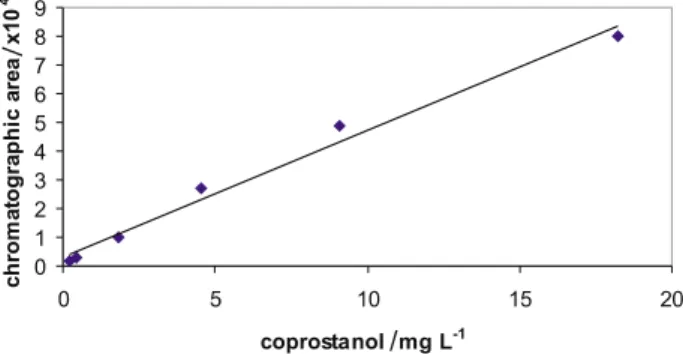
derivatized form within the range of 0.25 to 20.0 mg L-1,
linear response for coprostanol was 0.992 (Figure 1).
Standards of 5-cholestane and 5-androstanol (steroids
frequently used as internal standards) and standards of petroleum and polycyclic aromatic hydrocarbons were also injected in the established chromatographic conditions. Data were acquired and processed on an HP Chemstation data system.
Detection limits (DL), defined as three times the standard deviations of the lowest steroid concentrations
detected7 were in the range of 1 ng g-1 for the steroids.
Extraction of steroids
To check recoveries of steroids, extractions with different solvents were performed in triplicates using the synthetic matrix previously described (25.0 g). In test 1, the extraction was carried out with 80 mL of methanol
(MERCK) reflux for 5 h (adapted from LeBlanc et al.8).
Both tests 2 and 3 were performed for 6 h in a Soxhlet
apparatus. Extraction of test 2 was done with 80 mL of a mixture of 50% acetone (J.BAKER) in methylene chloride (MERCK) and test 3 was extracted with 80 mL of distilled ethanol (Cia Nacional de Álcool). Test 4 (adapted from
Mudge & Bebianno9) was done with 90 mL of 0.5 mol L-1
KOH in ethanol under reflux for 3 h (saponification and extraction simultaneously). Extracts of test 4 were treated
via aqueous/organic liquid-liquid partitioning (1 mL of
n-hexane/10 mL of pre-extracted water) in a separation funnel. The organic phase was reduced by rotary
evaporation with the same following procedures of the previous tests. The resulting extracts of all tests were taken to the derivatisation procedure, described further on, and then analysed by gas chromatography.
Fractionation procedures
Two clean up procedures were assessed in glass columns of 38 x 0.7 cm I.D. The first test consisted of the glass column packed with 1.0 g of alumina and 2.0 g of silica gel (both 5% deactivated), in the top and bottom of the column respectively. It was introduced 1.0 mL of the
steroid standard solution (10 mg L-1). The fractionation
was done with the following increasing polarity gradient: 15.0 mL of n-hexane; 15.0 mL of 20% methylene chloride in n-hexane; and 15.0 mL of 50% acetone in methylene chloride, and provided three fractions with the last one comprising the steroids. The second clean up test was carried out with 2.0 g of alumina and elution with 15.0 mL of distilled ethanol, providing one fraction.
Derivatisation of steroids
The fractions obtained from the extraction and cleanup tests, after reduced by vacuum evaporation and transferred to 1.0 mL vials, were taken to dryness under nitrogen blow and submitted to derivatisation with the commercial mixture N,O,-bis(trimethylsilyl)trifluoracetamide and trimethylchlorosilane, BSTFA/TMCS 99:1 (Supelco),
40 L, 65 oC/1.5 h (adapted from Green et al.10). After
reaction, the final residues were redissolved to 1.0 mL with methylene chloride/n-hexane (1:1) and stored in glass ampoules until gas chromatographic analysis.
Analysis of reference material
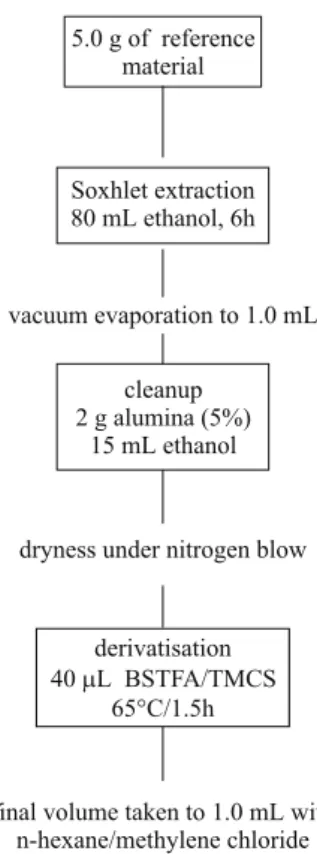
Reference material (lyophilised marine sediment) provided by the International Atomic Energy Agency (IAEA-383) was also analysed for steroids. The solvent of choice for the extraction was ethanol and the clean up procedure consisted of alumina column/ethanol elution. A summary of the analytical protocol is shown in Figure 2.
Results and Discussion
Recovery of steroids
Due to the low concentrations of total and individual steroids in the water column and sediments, these compounds are typically analysed by gas chromatography after forming their trimethylsilyl ether derivatives. In order
to perform gas chromatographic analysis, steroids should be transformed in more volatile compounds. In the case of sterols, hydrogen bonds must be avoided using a derivatisation reaction, which also improves chromato-graphic resolution. Sterol data are presented in the derivatised form throughout this paper.
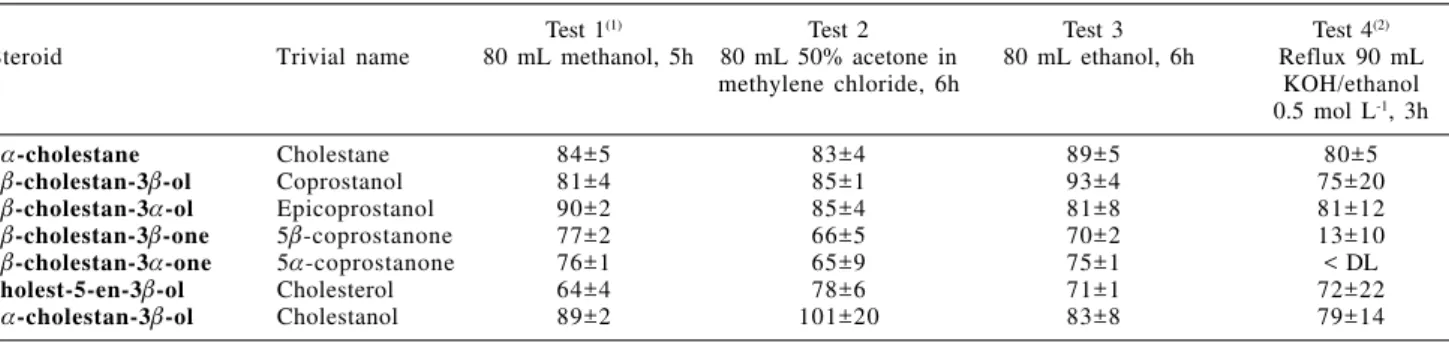
In the extraction tests, compounds were quantified by comparison with external standards. As adsorbents, solvents and glassware are potential sources of organic contami-nation, blanks were performed for each series of 10 extractions and interfering peaks were subtracted from all the sample chromatographic runs. The average recoveries of the steroids with the corresponding standard deviations (SD) were acceptable for all the tests, except for coprostanones in test 4 (Table 1). Considering measurements
in terms of g g-1, the variations in recovery percentages are
very wide, ranging from 50 to 120%. Examples of such
variations were found by LeBlanc et al.8 who obtained
coprostanol recoveries varying between 62-96% processing standard mixture and spiked samples with methanol
extractions. Eganhouse et al.11 determined 30 to 65%
recoveries with spiked blanks through methylene chloride extractions. Tests 1 and 2 using methanol and 50% acetone in methylene chloride respectively, presented steroid recovery ranges from 64 to 90% and 66 to 101%. In test 3, ethanol also showed elevated recoveries, from 70 to 93%,
Figure 2. Summary of the analytical protocol to quantify steroids in
which was expected since ethanol polarity index is between methanol and methylene chloride. Test 4 provided sterol recoveries from 72 to 81%. This test involves saponification and extraction simultaneously which increases the yield of sterols in 30% due to the release of esterified sterols in
sediments8. However, saponification is not suitable when
concerning coprostanone determinations because of reduction reactions leading to low stanone recoveries. Low recoveries in the tests can also be related to loss of compounds during the transference of the extracts, especially for test 4 with the highest SD. Test 4 involves a multi-step process which is laborious to be adopted in analysis with large number of samples.
There is not a preferable solvent and time for the extraction of steroids in the literature so that the analyst must choose the most convenient and efficient procedures. Regarding the steroid recovery results, the methods 1, 2 and 3 presented good results. The most suitable solvent for our purposes showed to be ethanol because it is easier to be acquired and stored in our laboratory conditions and is less toxic and volatile than methanol or methylene
chloride. Other advantage is the lower costs of ethanol, ca.
three times cheaper than the other solvents. In addition, the ethanol distillation is part of our laboratory routine in order to use this solvent for cleaning glassware for trace analyses of PCBs, organochlorine pesticides, aliphatic and polycyclic aromatic hydrocarbons.
Internal standards for faecal steroid analyses
Steroids are more accurate quantified based upon internal standards, which must have the same analyte physical-chemical properties, good resolution within the elution time of the steroids under investigation and cannot be present in the sample. Two common internal standards for steroid
analysis are 5-cholestane and 5-androstanol. In our tests,
the elution of 5-androstanol (in its derivatised form)
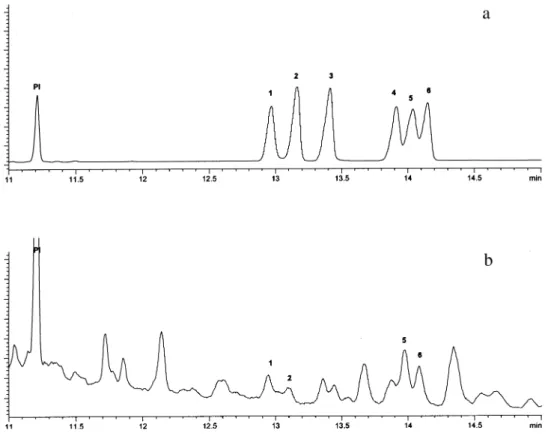
occurred at the beginning of the run coinciding with impurities of the ethanol blank, as shown in Figure 3.
Although the absence of hydroxyl group in 5-cholestane,
not characterising this compound as an alcohol, it is used as
internal standard in several studies12-17 and presented
Table 1. Average recovery percentages and standard deviations for the steroids from the extraction tests performed in triplicates
Test 1(1) Test 2 Test 3 Test 4(2)
Steroid Trivial name 80 mL methanol, 5h 80 mL 50% acetone in 80 mL ethanol, 6h Reflux 90 mL
methylene chloride, 6h KOH/ethanol
0.5 mol L-1, 3h
5-cholestane Cholestane 84±5 83±4 89±5 80±5
5-cholestan-3-ol Coprostanol 81±4 85±1 93±4 75±20
5-cholestan-3-ol Epicoprostanol 90±2 85±4 81±8 81±12
5-cholestan-3-one 5-coprostanone 77±2 66±5 70±2 13±10
5-cholestan-3-one 5-coprostanone 76±1 65±9 75±1 < DL
cholest-5-en-3-ol Cholesterol 64±4 78±6 71±1 72±22
5-cholestan-3-ol Cholestanol 89±2 101±20 83±8 79±14
DL = detection limit, < 1 ng g-1
1 Adapted from LeBlanc et al., 1992, 2 Adapted from Mudge & Bebianno, 1997
Figure 3. Chromatogram of the ethanol blank and internal standards for steroids analyses: (a) interfering peak for androstanol; (b)
recoveries very close to the steroids as observed in the
extraction tests. 5-cholestane was chosen as internal
standard for the tests with reference material because of its good resolution and suitable retention time. This compound was added at the beginning of the subsequent experiments. The most suitable internal standards would be deuterated steroids with combined GC-MS instrumentation, however they were not available during the tests.
Clean up of extracts containing steroids
A number of compounds other than steroids are co-extracted under the extraction conditions and a previous removal of co-extracted compounds may be necessary. The adsorption column chromatography with alumina removes
interfering compounds while silica gel can both handle and separate compounds. Some steroid analyses also include determinations of a series of organic pollutants which require long and careful fractionation
proce-dures.2,13,14,18 At the established gas chromatographic
conditions, pollutants such as aliphatic and polycyclic aromatic hydrocarbons do not elute in the retention time of interest (from 15 to 35 min). It implies that these compounds do not interfere in the steroid chromatographic profile. The fractionation with silica/alumina column showed the first two fractions, eluted respectively with n-hexane and 20% methylene chloride in n-n-hexane, did not
contain steroids, except for 5-cholestane in the first
fraction (F1), while the third fraction (F3) comprised all the steroids of the spiked matrix (Figure 4). This silica/
Figure 4. Chromatograms of the cleanup fractions of a synthetic matrix: a) F1 - eluted with n-hexane, 5-cholestane is eluted in this fraction;
alumina clean up appear to be useful in fractionating steroids from other compounds, however another internal
standard is needed for this clean up since 5-cholestane is
eluted apart from the other steroids. The clean up with alumina column and ethanol elution provided suitable results, mainly because of the reduced time for the analysis. This clean up can retain fine sediment particles and precipitates eventually formed during extraction as observed for reference material. As this study was concerning only steroid analysis it was preferred to perform the last test consisting on a simplified clean up – alumina column and ethanol elution – in the following experiments.
Analytical performance of the method based on ethanol
Synthetic matrices are useful and practical to provide preliminary results to evaluate methods in terms of recoveries although they are not a perfect approach for marine sediments due to the matrix effects. One has to consider that organic compounds added to the sample may be more easily extractable than the ones incorporated into samples through normal biological processes. The performance of the method relies upon the efficiency with which the solvent systems breakdown the environmental matrices to release the steroids. To validate the method
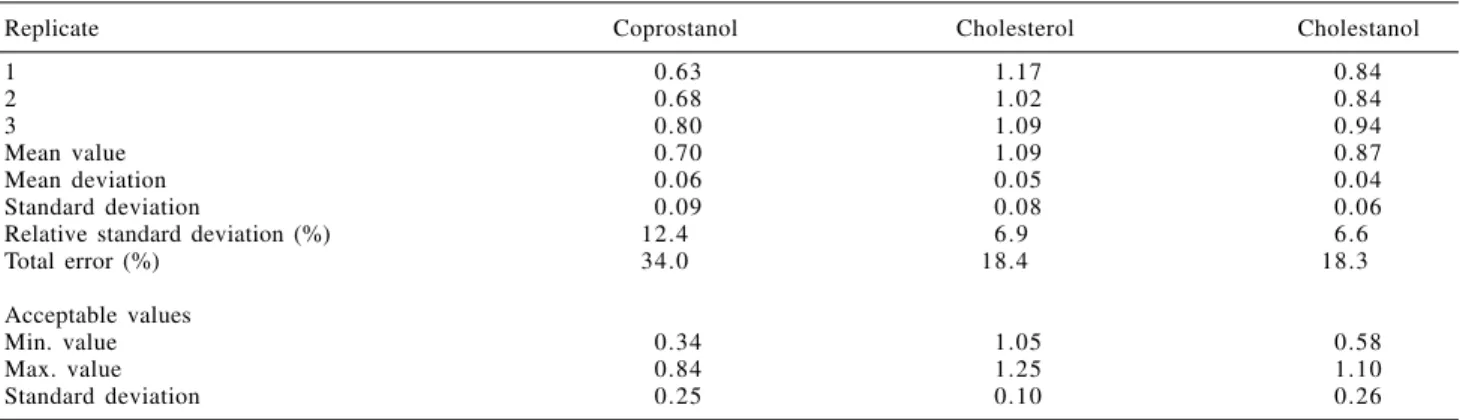
using ethanol extraction and alumina/ethanol clean up, the analytical performance was tested through analysis of reference material. Figure 5 shows the chromatogram of the reference material. The steroid concentrations (based
on the internal standard 5-cholestane) presented
satisfactory results. Coprostanol, cholesterol and cholestanol concentrations were close to the mean certified values and well within acceptable values (Table 2). Analytical errors were between 18 to 34% and relative standard deviations ranged from 6 to 12%, values
comparable to similar studies.8,19-21
Optimisation and evaluation of analytical methods are essential to improve both analytical and economical results and should minimise hazardous wastes (as chlorinated chemicals) as well. This is especially important for studies involving environmental monitoring, which require analyses of large number of samples resulting in large volumes of wastes. This work demonstrates that extraction of faecal steroids using ethanol followed by rapid clean up with alumina-ethanol elution can be applied successfully in routine laboratory analyses. It showed to be a rapid, quantitative and reproducible analytical method for steroids, offering an environmentally friendly and inexpensive alternative in comparison to methods based on methanol or methylenechloride extractions.
Figure 5. Chromatograms of steroids standards (a) and reference material IAEA-383 (b). PI = 5-cholestane, 1 = coprostanol, 2 = epicoprostanol,
Acknowledgements
The authors would like to thank the financial support provided by Fundação de Amparo à Pesquisa do Estado de São Paulo, FAPESP, proc. 97/09690-5. The authors are grateful for the helpful comments of the two anonymous reviewers.
References
1. Millero, F. J.; Sohn, M. L.; Chemical Oceanography, CRC Press: Boca Raton, Florida, 1992.
2. Grimalt, J. O.; Fernández, P.; Bayona, J. M.; Albaigés, J.;
Environ. Sci. Technol. 1990, 24, 363.
3. Mudge, S. M.; Norris, C. E.; Mar. Chem. 1997,57, 61. 4. Santos, B. F.; M.Sc. Dissertation, Universidade Federal da Bahia,
Brazil, 1997.
5. Kawakami, S. K.; M.Sc. Dissertation, Universidade de São
Paulo, Brazil, 1999
6. Aceves, M.; Grimalt, J.; Albaigés, J.; Broto, F.; Comellas, L.; Gassiot, M.; J. Chromat. 1988,436, 503.
7. ACS-American Chemical Society. Anal. Chem. 1983, 55, 2210.
8. LeBlanc, L. A.; Latimer, J. S.; Ellis, J. T. ; Quinn, J. G.; Est. Coastal Shelf Sci. 1992, 34, 439.
9. Mudge, S. M. ; Bebianno, M. J.; Mar. Pollut. Bull. 1997, 34, 163.
10. Green, G. ; Nichols, P. D.; Antarctic Sci. 1995, 7, 137.
Table 2. Steroid concentrations in the reference material IAEA 383 (g g-1 of dry sediment weight) and statistical parameters
Replicate Coprostanol Cholesterol Cholestanol
1 0.63 1.17 0.84
2 0.68 1.02 0.84
3 0.80 1.09 0.94
Mean value 0.70 1.09 0.87
Mean deviation 0.06 0.05 0.04
Standard deviation 0.09 0.08 0.06
Relative standard deviation (%) 12.4 6.9 6.6
Total error (%) 34.0 18.4 18.3
Acceptable values
Min. value 0.34 1.05 0.58
Max. value 0.84 1.25 1.10
Standard deviation 0.25 0.10 0.26
11. Eganhouse, R. P.; Olaguer, D. P.; Gould, B. R.; Phinney, C. S.;
Mar. Environ. Res.1988, 25, 1.
12. McCalley, D. V.; Cooke, M.; Nickless, G.; Wat. Res. 1981, 15, 1019.
13. Readman, J. W.; Preston, M. ; Mantoura, R. F. C.; Mar. Pollut. Bull. 1986, 17, 298.
14. Readman, J. W.; Mantoura, R. F. C.; Llewellyn, C. A.; Preston, M. R.; Reeves, A. D.; J. Environ. Anal. Chem.1986,27, 29.
15. Bartlett, P. D.; Mar. Pollut. Bull. 1987, 18, 27. 16. Quéméneur, M.; Marty, Y.; Wat. Res. 1994, 25, 1217.
17. Marty, Y.; Quéméneur, M.; Aminot, A.; Le Corre, P.; Wat. Res.
1996, 30, 1127.
18. Nichols, P. D.; Espey, Q. I.; Aust. J. Mar. Freshwater Res.
1991, 42, 327.
19. Sherwin, M.; Van Vleet, E. S. Fossato, V. U.; Dolci, F.; Mar. Pollut. Bull. 1993, 26, 501.
20. Hatcher, P. G.; McGillivary, P. A.; Environ. Sci. Technol. 1979,
13, 1225.
21. Nichols, P. D.; Leeming, R.; Rayner, M. S.; Latham, V.; J. Chromatogr. A 1996, 733, 497.
22. Nguyen, D.; Bruchet, A.; Arpino, P.; Environ. Sci. Technol.
1995, 29, 1686.
Received: March 13, 2001 Published on the web: February 25, 2002