Oral versus intravenous steroid therapy for relapses
in patients with multiple sclerosis: an updated
meta-analysis of six randomized controlled trials
Wenjing Luo I, Min Han I, Chunying Wei I, Bo Liu I, Yi Du II
DOI: 10.5935/MedicalExpress.2017.02.01
I The Cadre Ward in Department of Neurology, the People’s Hospital of Guangxi Zhuang Autonomous Region, Nanning, Guangxi, China. II Department of Ophthalmology, the First Ailiated Hospital of Guangxi Medical University, Nanning, Guangxi, China.
PURPOSE: To systematically evaluate whether oral steroids can be used with the same eicacy and safety in comparison with the intravenous regimen for treatment of multiple sclerosis relapses.
METHOD: We searched Medline, Embase and Cochrane Library and systematically reviewed articles comparing outcomes of oral versus intravenous steroids for acute relapses in patients with a clinically deinite diagnosis of multiple sclerosis.
RESULTS: Six articles with 414 participants in total were analyzed. Five of the included trials reported the proportion of patients experiencing improvement in Expanded Disability Status Scale after receiving either oral or intravenous methylprednisolone treatment at four weeks; the pooled results showed that there was no statistically signiicant diference (OR 0.96; 95% CI 0.60, 1.54; p=0.86) between treatments. Three trials reported the detailed results of adverse events, indicating the two treatments appear to be equally safe. Two trials revealed that there was no signiicant diference in gadolinium enhancement activity on magnetic resonance imaging. One trial showed that the mean area under the concentration-time curve (AUC) at 24 and 48 hours did not difer between groups.
CONCLUSION: No signiicant diferences were found in terms of clinical (beneits and adverse events), radiological and pharmacological outcomes in multiple sclerosis relapses in patients after oral or intravenous steroids treatment. Our meta-analysis provides evidence that oral steroid therapy is not inferior to intravenous steroid therapy. Thus oral administration may be a favorable substitute for intravenous medication of multiple sclerosis relapses.
KEYWORDS: Multiple sclerosis, relapses, methylprednisolone, meta-analysis.
Luo W, Han M, Wei C, Liu B, Du Y. Oral versus intravenous steroid therapy for relapses in patients with multiple sclerosis: an updated meta-analysis of six randomized controlled trials. MedicalExpress (São Paulo, online). 2017 Apr;4(2):M170201.
Received for Publication on February 6, 2017; First review on March 1, 2017; Accepted for publication on March 14, 2017; Online on
March 24, 2017
E-mail: [email protected]
■
INTRODUCTIONM u l t i p l e s c l e r o s i s ( M S ) i s a c o m p l e x neurodegenerative autoimmune disorder whose cause is currently known as demyelination and inflammation of the white matter;1 MS patients are believed to have suffered from recurrent relapses of central nervous system (CNS) inflammation ranging from mild to severely disabling. In the past few decades, it has been proved that intravenous steroids may hasten functional recovery in
Methodological quality assessment
Two review authors assessed the quality of each included articles independently. We used a critical review of the Cochrane handbook to appraise the randomized controlled trials.13
Data extraction and management
Two investigators extracted the information regarding study: authors, publication year, country, participants, gender rate, follow-up period, mean age, disease duration, time from relapse onset to treatment, interventions, outcomes and so on. Outcomes of interest in this meta-analysis include dichotomous and continuous measurement parameters. For dichotomous outcomes, we extracted the number of patients and events within each group, while continuous outcomes were analyzed by the mean and standard deviation between groups.
Statistical analysis
For dichotomous outcomes, we calculated the outcome measures in terms of odds ratios (OR) with 95% confidence intervals (CIs); continuous outcomes were measured by mean difference (MD) with 95% confidence intervals. All analyses were conducted using Review Manager (version 5.3 for Windows, the Nordic Cochrane Centre, Copenhagen, Denmark) or using Stata version 9.2 for assessing the publication bias (Stata Corporation, College Station, TX, USA). Statistical tests with P<0.05 were considered significant. For the meta-analysis, tests of heterogeneity between studies were assessed using Cochrane Q statistics and I2 statistics; P< 0.1 or I2>50% were
judged as heterogeneity. A fixed effect model was used to calculate pooled estimates of efficacy if heterogeneity was notsignificant; if there was significant heterogeneity, we changed to random effect model. Per-protocol analyses and intention-to-treat analyses were done. Publication bias was evaluated by using both the Begg and Egger funnel plots. A two-tailed P<0.05 was considered as statistically significant.
■
RESULTSCharacteristics of included studies
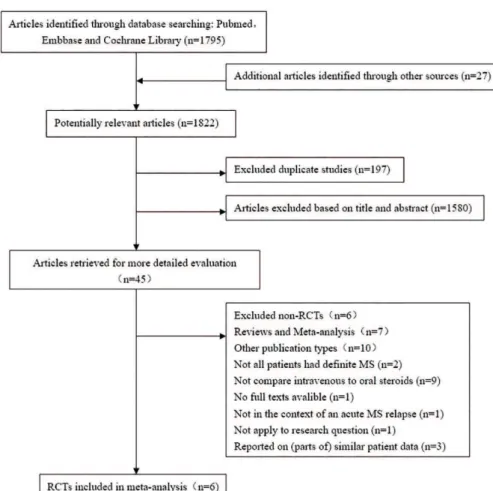
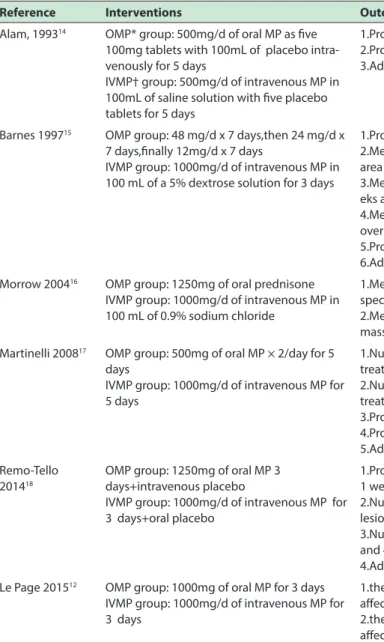
The literature search yielded 1795 articlesl out of which six studies met the inclusion criteria and were accepted into this meta-analysis,12,14-18 Figure 1 shows the process of study selection. The details of included trials are provided in Tables 1 and 2. These six eligible randomized controlled trials enrolled a total of 414 participants including withdrawals and drop-outs. Five of the studies were from the Europe,12,14,15,17,18 one was from North America.16 Three studies were multicenter.12,15,18 The follow-up time ranged from 48 hours to 200 days. Mean age ranged from 31.0-41.5 years throughout the groups. Some trials reported the mean or median disease costs and may have a negative impact on family and social
life. There is the perception that patients are inclined to prefer oral therapy over intravenous administration.8-10 If oral steroid therapy is a reasonable treatment substitute for intravenous steroid for MS relapse, it would be more convenient and timely for care response at home or in hospital, interfering less with quality of life and could probably minimize lost productivity and expenses. Burton and colleagues conducted a meta-analysis in 2012 which contained five randomized trials with 215 patients.11 Their results did not show any significant differences in clinical, radiological, or pharmacological outcomes when oral versus intravenous steroids for the treatment of relapses in MS were compared. However, some limitations (i.e. small sample sizes of patients, methodological weaknesses of included trials) cause concern. Recently, many larger scale and high quality trials such as COPOUSEP 2009 including 199 patients have examined the two regimens for treating MS relapses.12 It may have solved the design weaknesses of previous trials and provided sufficient power to clarify whether oral steroids can be used with the same efficacy and safety compared with their intravenous counterparts for the treatment of MS relapses. Nonetheless, we have decided to carry out an updated meta-analysis of this problem.
■
METHODSData sources and selection criteria
Two reviewer authors independently searched relevant studies published before July 2015 including the databases as follows: Medline, Embase, and the Cochrane Library. The overall search strategy included the key words ‘multiple sclerosis’, ‘demyelinating disease’, ‘corticosteroids’, ‘steroids’, ‘methylprednisolone’, ‘prednisone’, ‘prednisolone’, ‘dexamethasone’, ‘ACTH’ and ‘Adrenal Cortex Hormones’. Not only the electronic database search, but also hand searches were performed. We searched reference lists of retrieved articles for additional studies to make sure that no studies were missed. There was no language restriction.
Figure 1 - Flow diagram of the process of study selection.
Table 1 - Quality assessment of the included trials
Studies
Adequate sequence generation?
Allocation
concealment? Blinding?
Incomplete out-come data
addressed?
Free of selective reporting?
Free of other
bias? Risk of bias
Alam 199314 unclear unclear yes unclear unclear unclear unclear
Barnes 199715 yes yes yes yes unclear yes low
Morrow 200416 unclear unclear unclear unclear unclear unclear unclear
Martinelli 200817 yes no unclear yes yes yes potentially
high
Ramo-Tello 201418 yes yes yes yes yes yes low
Le Page 201512 yes yes yes yes yes yes low
duration,14-17 while some trials reported the mean or median time from relapse onset to treatment;12,15,17 data ranged from 3.8-9.8 years and 6.6-13.0 days, respectively. Five of six trials used oral methylprednisolone (OMP) versus intravenous methylprednisolone (IVMP) for comparison,12,14,15,17,18 but the methylprednisolone dose and the time of treatment varied between trials. Bioequivalent MP dosing was used in four trials while one trial15 started with a low but lengthy dosing regimen of Oral MP (3 weeks: 48 mg/day x 7 days, followed by a 24 mg/day x 7 days, finally with a 12mg/day x 7 days); this was compared to 1,000 mg/d x 3 days of IVMP. Only one
trial used oral prednisone versus IVMP.16 All trials assessed more than one outcome. Expanded Disability Status Scale (EDSS) scores were the most frequent clinical outcome to measure disability. Two trials17,18 examined the MRI outcome, one trial16 assessed the pharmacological outcome and three trials12,17,18 reported adverse events to assess tolerability and safety
Quality assessment
Table 2 - Characteristics of included studies.
Reference Interventions Outcomes
Alam, 199314 OMP* group: 500mg/d of oral MP as ive
100mg tablets with 100mL of placebo intra-venously for 5 days
IVMP† group: 500mg/d of intravenous MP in 100mL of saline solution with ive placebo tablets for 5 days
1.Proportion of patients with improvement on EDSS‡ at day 28 2.Proportion of patients with improvement on EDSS at day 5 3.Adverse event rates
Barnes 199715 OMP group: 48 mg/d x 7 days,then 24 mg/d x
7 days,inally 12mg/d x 7 days
IVMP group: 1000mg/d of intravenous MP in 100 mL of a 5% dextrose solution for 3 days
1.Proportion of patients with improvement on EDSS at 4 weeks
2.Median EDSS at 0-1 weeks,0-4 weeks,0-12 weeks,0-24 weeks and over all area under the curve
3.Median ambulatory index at 0-1 weeks,0-4 weeks,0-12 weeks,0-24 we-eks and over all area under the curve
4.Median arm index at 0-1 weeks,0-4 weeks,0-12 weeks,0-24 weeks and over all area under the curve
5.Proportion discharged from hospital at week 1 and week 4 6.Adverse event rates
Morrow 200416 OMP group: 1250mg of oral prednisone
IVMP group: 1000mg/d of intravenous MP in 100 mL of 0.9% sodium chloride
1.Mean absorption of steroid absorption by liquid chromatography/mass spectrometry at 1, 2, 4, 8, 24 and 48 hours following treatment
2.Mean area under the curve for absorption by liquid chromatography/ mass spectrometry at 1, 2, 4, 8, 24 and 48 hours following treatment
Martinelli 200817 OMP group: 500mg of oral MP × 2/day for 5
days
IVMP group: 1000mg/d of intravenous MP for 5 days
1.Number of gadolinium-enhancing lesions on MRI§ 1 week after steroid treatment
2.Number of gadolinium-enhancing lesions on MRI 4 weeks after steroid treatment
3.Proportion of patients with improvement on EDSS at 1 week 4.Proportion of patients with improvement on EDSS at 4 weeks 5.Adverse event rates
Remo-Tello 201418
OMP group: 1250mg of oral MP 3 days+intravenous placebo
IVMP group: 1000mg/d of intravenous MP for 3 days+oral placebo
1.Proportion of patients with improvement on EDSS of at least one poin at 1 week,4 weeks and 12 weeks
2.Number and volume of new and persistent T1 gadolinium-enhancing lesions on MRI at 1 week and 4 weeks
3.Number and volume of new and persistent? T2 lesions on MRI at 1 week and 4 weeks
4.Adverse event rates
Le Page 201512 OMP group: 1000mg of oral MP for 3 days
IVMP group: 1000mg/d of intravenous MP for 3 days
1.the proportion of patients who decrease of at least one point in most afected score on EDSS by day 28
2.the proportion of patients who decrease of at least one point in most afected score on EDSS by day 180
3.Adverse event rates
* OMP=oral methylprednisolone; † IVMP=intravenous methylprednisolone; ‡ EDSS=Kurtzke’s expanded disability status scale; § MRI=magnetic resonance imaging.
adequate randomization procedures, whereas for the other trials14,16 the method of randomization and concealment of allocation were not clearly reported. Three trials12,15,18 were judged to have indicated clear evidence of concealment of allocation but such methods were not clear for two trials;14,16 one trial17 was judged to have a potentially high risk of bias related to the utilized method of concealment of allocation. Four of the six trials used “double-blinding”; one trial17 only employed blinding of the evaluating physicians and radiologists, but did not clearly report blinding of the clinical evaluators or patients; one trial was thought to be unclear in terms of bias since there was no apparent evidence showing the blinding used in clinical evaluators or patients.16 Four trials had no missing data, but two trials14,16 lacked detailed
information about patient losses. Three of the six trials were considered free of selective outcome reporting,12,17,18 one trial did not report the results at day 5 and no further details were available on adverse events; one trial did not show details of adverse events,15 whereas one trial did not show the data values for outcomes in the original publication.16 Quality assessment of all the included trials is shown in Table 1.
Eicacy
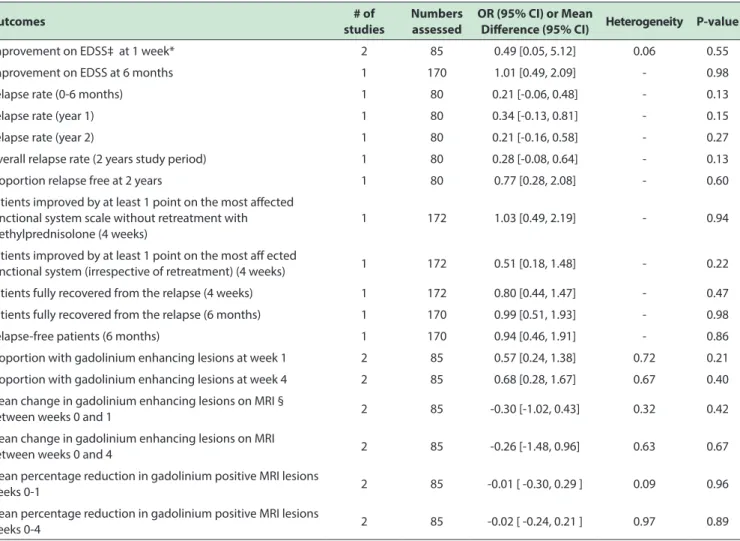
Table 3 - Summary of results.
Outcomes # of
studies
Numbers assessed
OR (95% CI) or Mean
Diference (95% CI) Heterogeneity P-value
Improvement on EDSS‡ at 1 week* 2 85 0.49 [0.05, 5.12] 0.06 0.55
Improvement on EDSS at 6 months 1 170 1.01 [0.49, 2.09] - 0.98
Relapse rate (0-6 months) 1 80 0.21 [-0.06, 0.48] - 0.13
Relapse rate (year 1) 1 80 0.34 [-0.13, 0.81] - 0.15
Relapse rate (year 2) 1 80 0.21 [-0.16, 0.58] - 0.27
Overall relapse rate (2 years study period) 1 80 0.28 [-0.08, 0.64] - 0.13
Proportion relapse free at 2 years 1 80 0.77 [0.28, 2.08] - 0.60
Patients improved by at least 1 point on the most afected functional system scale without retreatment with methylprednisolone (4 weeks)
1 172 1.03 [0.49, 2.19] - 0.94
Patients improved by at least 1 point on the most af ected
functional system (irrespective of retreatment) (4 weeks) 1 172 0.51 [0.18, 1.48] - 0.22
Patients fully recovered from the relapse (4 weeks) 1 172 0.80 [0.44, 1.47] - 0.47
Patients fully recovered from the relapse (6 months) 1 170 0.99 [0.51, 1.93] - 0.98
Relapse-free patients (6 months) 1 170 0.94 [0.46, 1.91] - 0.86
Proportion with gadolinium enhancing lesions at week 1 2 85 0.57 [0.24, 1.38] 0.72 0.21
Proportion with gadolinium enhancing lesions at week 4 2 85 0.68 [0.28, 1.67] 0.67 0.40
Mean change in gadolinium enhancing lesions on MRI §
between weeks 0 and 1 2 85 -0.30 [-1.02, 0.43] 0.32 0.42
Mean change in gadolinium enhancing lesions on MRI
between weeks 0 and 4 2 85 -0.26 [-1.48, 0.96] 0.63 0.67
Mean percentage reduction in gadolinium positive MRI lesions
weeks 0-1 2 85 -0.01 [ -0.30, 0.29 ] 0.09 0.96
Mean percentage reduction in gadolinium positive MRI lesions
weeks 0-4 2 85 -0.02 [ -0.24, 0.21 ] 0.97 0.89
Note: A ixed- efects model was used in almost all of these analysis of odds ratios (ORs) or mean diference; * a random-efects model was used. ‡ EDSS=Kurtzke’s expanded disability status scale. § MRI=magnetic resonance imaging
Figure 2 - Odds ratios (ORs) of improvement on EDSS after steroid treatment at 4 weeks using a ixed- efects model
improvement with OMP versus IVMP was OR 0.96 (95% CI [0.60, 1.54]; p=0.86) which is not statistically significant, with no heterogeneity between trials (p = 0.52); results were similar when we used a random-effects model (OR 0.99; 95%CI: 0.61, 1.61; p=0.98). Figure 2 shows the ORs of improvement on EDSS after steroid treatment at 4 weeks using a fixed-effects model. In the intention-to-treat population, pooled results also showed there was no statistically significant difference (OR 0.89; 95% CI: 0.56, 1.41; p=0.63, figure not shown). Two trials17,18 reported
the proportion of patients experiencing improvement in EDSS status after MP therapy at one week while only one trial12 reported the result at 6 months. The estimated ORs indicated no statistically significant difference between groups (OR 0.49; 95% CI: 0.05, 5.12; p=0.55) and (OR 1.01; 95% CI: 0.49, 2.09; p=0.98), respectively.
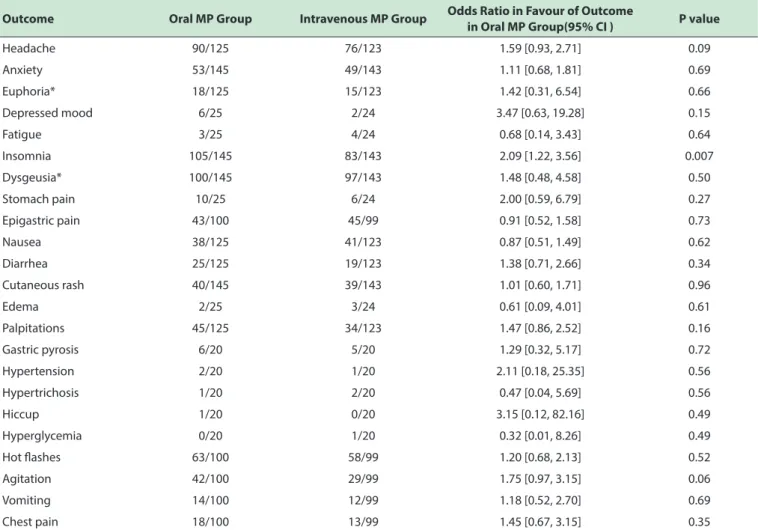
Table 4 - Patients with Adverse Event Outcomes.
Outcome Oral MP Group Intravenous MP Group Odds Ratio in Favour of Outcome
in Oral MP Group(95% CI ) P value
Headache 90/125 76/123 1.59 [0.93, 2.71] 0.09
Anxiety 53/145 49/143 1.11 [0.68, 1.81] 0.69
Euphoria* 18/125 15/123 1.42 [0.31, 6.54] 0.66
Depressed mood 6/25 2/24 3.47 [0.63, 19.28] 0.15
Fatigue 3/25 4/24 0.68 [0.14, 3.43] 0.64
Insomnia 105/145 83/143 2.09 [1.22, 3.56] 0.007
Dysgeusia* 100/145 97/143 1.48 [0.48, 4.58] 0.50
Stomach pain 10/25 6/24 2.00 [0.59, 6.79] 0.27
Epigastric pain 43/100 45/99 0.91 [0.52, 1.58] 0.73
Nausea 38/125 41/123 0.87 [0.51, 1.49] 0.62
Diarrhea 25/125 19/123 1.38 [0.71, 2.66] 0.34
Cutaneous rash 40/145 39/143 1.01 [0.60, 1.71] 0.96
Edema 2/25 3/24 0.61 [0.09, 4.01] 0.61
Palpitations 45/125 34/123 1.47 [0.86, 2.52] 0.16
Gastric pyrosis 6/20 5/20 1.29 [0.32, 5.17] 0.72
Hypertension 2/20 1/20 2.11 [0.18, 25.35] 0.56
Hypertrichosis 1/20 2/20 0.47 [0.04, 5.69] 0.56
Hiccup 1/20 0/20 3.15 [0.12, 82.16] 0.49
Hyperglycemia 0/20 1/20 0.32 [0.01, 8.26] 0.49
Hot lashes 63/100 58/99 1.20 [0.68, 2.13] 0.52
Agitation 42/100 29/99 1.75 [0.97, 3.15] 0.06
Vomiting 14/100 12/99 1.18 [0.52, 2.70] 0.69
Chest pain 18/100 13/99 1.45 [0.67, 3.15] 0.35
Note: A ixed- efects model was used in almost all of these analysis of odds ratios; * a random-efects model was used.
patients at 2 years following intervention; results showed there were no statistically significant difference between the OMP group and IVMP group with the estimated MD 0.21(95% CI: -0.06, 0.48; p=0.13), MD 0.34 (95% CI: -0.13, 0.81; p=0.15) , MD 0.21 (95% CI: -0.16, 0.58; p=0.27), MD 0.28 (95% CI: -0.08, 0.64; p=0.13) and OR 0.77 (95% CI: 0.28, 2.08; p=0.60),respectively. Le Page et al12 analyzed the results of patients fully recovered from the relapse after OMP or IVMP treatment at 4 weeks, 6 months and relapse-free patients at 6 months; no statistically significant differences were found in patients fully recovered from the relapse at 4 weeks (OR 0.80; 95% CI: 0.44, 1.47; p=0.47) or at 6 months (OR 0.99; 95% CI: 0.51, 1.93; p=0.98), as well as relapse-free patients at 6 months (OR 0.94; 95% CI: 0.46, 1.91; p=0.86). Le Page et al12 also analyzed the results of patients improved by at least 1 point on the most affected functional system scale (FSS) without retreatment or irrespective of retreatment at 4 weeks, and results did not differ significantly between the two routes of steroid administration with the estimated OR 1.03 (95% CI: 0.49, 2.19; p=0.94), OR 0.51 (95% CI: 0.18, 1.48; p=0.22), respectively.
authors showed that there was no difference between the AUC of oral prednisone group and intravenous methylprednisolone group at 24 hours (p=0.122) or at 48 hours(p=0.185).
Five trials focused on adverse events after MP treatment,12,14,15,17,18 but only three trials demonstrated the detailed results.12,17,18 After treatment of oral MP and intravenous MP, almost all the adverse event outcomes were not statistically significant, except for insomnia with a pooled OR of 2.09 (95% CI 1.22, 3.56; p=0.007), as shown i Table 4.
Publication bias
We did not assess the publication bias in the present meta-analysis, because the number of included studies was less than 10.
■
DISCUSSIONAccording to WHO, it is believed that there are more than 2.5 million Multiple Sclerosis (MS) patients all over the world, but the prevalence of MS varies widely. In different countries such as France, the United States and the United Kingdom, where the prevalence of MS has been presumed to be 94.7/100,000, 100/100,000 and 203.4/100,000, respectively.20,21 In Asian population, the estimated prevalence of MS is 3.9/100,000 in Japan, 3.5/100,000 in Korea and 5.2/100,000 in China.22-24 MS has become a significant health, social, and economic problem, worldwide. Therefore, the development of practical and effective treatment for MS is necessary and beneficial in preventing the progress of the disease.
In the present meta-analysis, there was no statistically significant difference between the OMP group and IVMP group with respect to the outcome of EDSS improvement at 1 week and 4 weeks. Sharrack’s study,19 which was, as previously noted, based on the patient groups in Barnes’s study15 compared the effect of oral and intravenous methylprednisolone treatment in promoting recovery from acute relapses of MS up to two years, showed that the two routes of steroid administration did not differ significantly. Two randomized control trials17,18 used MRI as a surrogate outcome and reported no significant difference between OMP group and IVMP group on MRI findings such as the degree of improvement in Gd+ lesion burden at 4 weeks. These results are similar to a previous meta-analysis conducted by Burton and colleagues.11 Three trials clearly reported adverse event rates:12,17,18 tolerability was similar for both regimens. Burton et al11 demonstrated that there was a trend towards more cases of dysgeusia with oral methylprednisolone treatment; in contrast, our meta-analysis found that insomnia was more frequent in the OMP group than in the IVMP group and thus recommend giving the oral steroid in the morning.
In the last 10 years, many larger scale trials have examined the oral versus intravenous steroids for treatment of relapses in MS such as COPOUSEP 2009 conducted by Le Page and colleagues12, which is the first adequately powered, randomized, double-blind, non-inferiority trial. The trial provided further data and sufficient power that OMP was non-inferior to IVMP, no matter in improvement of disability scores 4 weeks or 6 months after a relapse, or in the proportion of patients fully recovered from the relapse. For the sake of rigor, Le Page et al.12 not only focus on overall EDSS scores but also on the Kurtzke Functional System Scale scores. But unfortunately, no MRI outcomes are available. A randomized, blinded, multi-center trial named OMEGA 2007 was supposed to compare the relative efficacy of treating acute exacerbations of relapsing forms of MS with equivalent doses of oral and intravenous methylprednisolone, but this study has been terminated for low enrollment.25
Some studies detail pharmacological or laboratory outcomes, and results were in agreement with the clinical outcomes, such as the small trial conducted by Morrow et al, included in our meta-analysis.16 It demonstrated that there was no significant difference in the measured absorption of bioequivalent doses of oral prednisone vs. intravenous methylprednisolone. Two studies7,26 suggested that no significant differences were found in peripheral blood T lymphocyte adhesion molecule expression, T cell subset distribution, TNFα concentrations or cytokine levels in patients of MS relapses whether treated with OMP or IVMP, providing further support to the concept that the two regimens are equivalent and their biological effect similar. Several potential limitations of our meta-analysis merit consideration. Firstly, the trial number and number of patients in this meta-analysis is limited. And the study population of the six eligible trials was all from Europe or North America; therefore, comparisons of the efficacy of oral versus intravenous steroid therapy for MS relapses in different ethnicity is not available. Secondly, some of included studies did not use rigorous methodological techniques (i.e. steroid dosing of two regimens was not bioequivalent, and failed to use reliable concealment of allocation or non-inferiority design and methods), so these results should be taken with some caution. Thirdly, although there’s a point of view that the real benefit and the usefulness of steroids for MS relapses was mainly documented on clinical grounds,5 only two of the six studies employed the MRI outcomes; obviously, future trials comparing radiological endpoints will be welcome.
provide evidence that oral steroid therapy is not inferior to intravenous steroid therapy; therefore oral administration may be a favorable substitute for intravenous medication of MS relapses.
■
ACKNOWLEDGEMENTSThis research was supported by the National Natural Science Foundation of China (No. 81560162) and Guangxi Natural Science Foundation (No. 2016GXNSFAA380301).
■
AUTHOR CONTRIBUTIONSWenjing Luo, Min Han, Chunying Wei and Bo Liu performed the bibliographical research, analyzed the data and wrote the draft manuscript; Wenjing Luo and Yi Du devised the project, revised the analysis and the draft manuscript; Yi Du proposed the project and approved the completed manuscript.
TERAPIA ORAL VERSUS INTRAVENOSA PARA RECAÍDAS DE PACIENTES COM ESCLEROSE MÚLTIPLA: UMA METANÁLISE ATUALIZADA DE SEIS ENSAIOS CLÍNICOS RANDOMIZADOS
PROPÓSITO: Avaliar de forma sistemática se
esteroides orais podem ser utilizados com a mesma eficácia e segurança em comparação com o regime intravenoso para o tratamento de recaídas da esclerose múltipla (MS).
MÉTODO: Foram pesquisados Medline, Embase
e Cochrane Library e sistematicamente revistos artigos comparando resultados de esteroides orais versus intravenosos para recaídas agudas em pacientes com diagnóstico de esclerose múltipla clinicamente definida.
RESULTADOS: Seis artigos com 414 participantes
no total foram analisados. Cinco dos estudos incluídos relataram a proporção de doentes com melhoria através de “Expanded Disability Status Scale” depois de receber um ou outro tratamento: metilprednisolona oral ou intravenosa por quatro semanas. Os resultados combinados mostraram que não houve diferença estatisticamente significativa (OR 0,96; 95% 101 0,60, 1,54 ; p = 0,86). Três estudos mostraram os resultados detalhados de eventos adversos, indicando que os dois tratamentos parecem ser igualmente seguros. Dois ensaios revelaram que não havia nenhuma diferença significativa no aumento de atividade de gadolínio via imagens por ressonância magnética. Um estudo mostrou que a área média sob as curvas de concentração-tempo (AUC) às 24 horas e 48 horas não diferiram entre os grupos.
CONCLUSÃO: Não foram encontradas diferenças
significativas em termos de clínicos (benefícios e eventos adversos) ou nos resultados radiológicos e farmacológicos em pacientes pós-esteroides por via oral ou intravenosa
no tratamento de várias recaídas de esclerose. Nossa metanálise fornece evidências de que a terapia com esteroides por via oral não é inferior à terapia com esteroides por via intravenosa. Assim, a administração oral pode ser um substituto favorável para medicação intravenosa de recidivas da esclerose múltipla.
PALAVRAS-CHAVE: esclerose múltipla, recaídas,
metilprednisolona, metanálise
■
REFERENCES1. Noseworthy JH, Lucchinetti C, Rodriguez M, Weinshenker BG. Medical
Progress: Multiple sclerosis. The New England journal of medicine. 2000;343(13):938-52. DOI: 10.1056/NEJM200009283431307
2. Miller H, Newell DJ, Ridley A. Multiple sclerosis. Treatment of acute exa
-cerbations with corticotrophin (A.C.T.H.). Lancet.
1961;2(7212):1120-2.
3. Durelli L, Cocito D, Riccio A, Barile C, Bergamasco B, Baggio GF, et
al. High-dose intravenous methylprednisolone in the treatment of
multiple sclerosis: clinical-immunologic correlations. Neurology. 1986;36(2):238-43.
4. Milligan NM, Newcombe R, Compston DA. A double-blind controlled trial of high dose methylprednisolone in patients with multiple sclero-sis: 1. Clinical effects. J Neurol Neurosurg Psychiatry. 1987;50(5):511-6. DOI: 10.1136/jnnp.50.5.511
5. Beck RW. Oral versus intravenous corticosteroids in acute relapses of multiple sclerosis. Lancet. 1997;349(9066):1696; author reply 1697. DOI: 10.1016/S0140-6736(05)62663-3
6. Filippini G, Brusaferri F, Sibley WA Citterio A, Ciucci G, Midgard R, et al.
Corticosteroids or ACTH for acute exacerbations in multiple sclerosis.
Cochrane Database Syst Rev. 2000;(4):CD001331.
7. Pitzalis C, Sharrack B, Gray IA, Lee A, Hughes RA. Comparison of the
effects of oral versus intravenous methylprednisolone regimens on peripheral blood T lymphocyte adhesion molecule expression, T cell subsets distribution and TNF alpha concentrations in multiple sclerosis. J neuroimmunol. 1997;74(1-2):62-8. DOI: 10.1016/S0165-5728(96)00206-8
8. Liu G, Franssen E, Fitch MI, Warner E. Patient preferences for oral ver-sus intravenous palliative chemotherapy. J clin oncol. 1997;15(1):110-5.
9. Metz LM HCaMA. MS patients’ choice of oral rather than IV steroid
therapy results in savings to health care system. Int J MS Care 2000 March (cited 2010 Sept) www.mscare.org.
10. Morrow SA, McEwan L, Alikhani K, Hyson C, Kremenchutzky M. MS
patients report excellent compliance with oral prednisone for acute relapses. Can j neurol sci. 2012;39(3):352-4.
11. Burton JM, O’Connor PW, Hohol M, Beyene J. Oral versus intravenous
steroids for treatment of relapses in multiple sclerosis. Cochrane Database Syst Rev. 2012;12:CD006921. DOI: 10.1002/14651858. CD006921.pub3..
12. Le Page E, Veillard D, Laplaud DA, Hamonic S, Wardi R, Lebrun C, et
al. Oral versus intravenous high-dose methylprednisolone for treat-ment of relapses in patients with multiple sclerosis (COPOUSEP): a randomised, controlled, double-blind, non-inferiority trial. Lancetet al. Oral versus intravenous high-dose methylprednisolone for treat-ment of relapses in patients with multiple sclerosis (COPOUSEP): a randomised, controlled, double-blind, non-inferiority trial. Lancet. 2015;386(9997):974-81. DOI: 10.1016/S0140-6736(15)61137-0.
13. Higgins JPT GSe. Cochrane Handbook for Systematic Reviews of Inter -ventions. Chichester: John Wiley & Sons, 2011.
15. Barnes D, Hughes RA, Morris RW, Wade-Jones O, Brown P, Britton T,
et al. Randomised trial of oral and intravenous methylprednisolone in acute relapses of multiple sclerosis. Lancet 1997;349(9056):902-6. DOI: 10.1016/S0140-6736(96)06453-7
16. Morrow SA, Stoian CA, Dmitrovic J, Chan SC, Metz LM. The bioavailabi-lity of IV methylprednisolone and oral prednisone in multiple sclerosis. Neurology. 2004;63(6):1079-80.
17. Martinelli V, Rocca MA, Annovazzi P, Pulizzi A, Rodegher M, Mar-tinelli Boneschi F, et al. A short-term randomized MRI study of high-dose oral vs intravenous methylprednisolone in MS. Neurology. 2009;73(22):1842-8. DOI: 10.1212/WNL.0b013e3181c3fd5b. 18. Ramo-Tello C, Grau-Lopez L, Tintore M, Rovira A, Ramió i Torrenta L,
et al. A randomized clinical trial of oral versus intravenous methyl-prednisolone for relapse of MS. Mult scler. 2014;20(6):717-25. DOI: 10.1177/1352458513508835.
19. Sharrack B, Hughes RA, Morris RW, Soudain S, Wade-Jones O, Barnes D,
Brown P, et al. The effect of oral and intravenous methylprednisolone treatment on subsequent relapse rate in multiple sclerosis. J Neurol Sci. 2000;173(1):73-7. DOI: 10.1016/S0022-510X(99)00304-4 20. Leray E, Moreau T, Fromont A, Edan G. Epidemiology of multiple
sclerosis. Rev neurol (Paris). 2016;172(1):3-13. DOI: 10.1016/j.neu-rol.2015.10.006.
21. Mackenzie IS, Morant SV, Bloomfield GA, MacDonald TM, O’Riordan J.
Incidence and prevalence of multiple sclerosis in the UK 1990-2010: a descriptive study in the General Practice Research Database. J Neurol Neurosurg Psychiatry. 2014;85(1):76-84. DOI: 10.1136/jnnp-2013-305450
22. Kira J. Multiple sclerosis in the Japanese population. Lancet Neurology. 2003;2(2):117-27. DOI: 10.1016/S1474-4422(03)00308-9
23. Kim NH, Kim HJ, Cheong HK, Kim BJ, Lee KH, Kim EH, et al. Prevalence
of multiple sclerosis in Korea. Neurology. 2010;75(16):1432-8. DOI: 10.1212/WNL.0b013e3181f88191.
24. Liu X, Cui Y, Han J. Estimating epidemiological data of Multiple sclerosis
using hospitalized data in Shandong Province, China. Orphanet j rare dis. 2016;11(1):73. DOI: 10.1186/s13023-016-0457-4.
25. Study to Evaluate Intravenous and Oral Steroids for Multiple Sclerosis Attacks. https://clinicaltrials.gov/ct2/show/NCT00418145. Accessed March 5, 2017.