Functional priorities reported by parents of children
with cerebral palsy: contribution to the pediatric
rehabilitation process
Marina B.Brandão1, Rachel H. S.Oliveira2, Marisa C.Mancini3
ABSTRACT | Background: Collaborative actions between family and therapist are essential to the rehabilitation process, and they can be a catalyst mechanism to the positive outcomes in children with cerebral palsy (CP). Objectives: To describe functional priorities established by caregivers of CP children by level of severity and age, and to assess changes on performance and satisfaction on functional priorities reported by caregivers, in 6-month interval. Method: 75 CP children, weekly assisted at Associação Mineira de Reabilitação, on physical and occupational therapy services. The
following information was collected: gross motor function (Gross Motor Function Classiication System-GMFCS) and
functional priorities established by caregivers (Canadian Occupational Performance Measure-COPM). Data were collected in two moments, with a 6-month interval. Results: The main functional demands presented by caregivers were related
to self-care activities (48.2%). Parents of children with severe motor impairment (GMFCS V) pointed higher number of
demands related to play (p=0.0036), compared to the other severity levels. Parents of younger children reported higher number of demands in mobility (p=0.025) and play (p=0.007), compared to other age groups. After 6 months, there
were signiicant increase on COPM performance (p=0.0001) and satisfaction scores (p=0.0001). Conclusions: Parents
of CP children identiied functional priorities in similar performance domains, by level of severity and age. Orienting the pediatric rehabilitation process to promote changes in functional priorities indentiied by caregivers can contribute
to the reinforcement of the parent-therapist collaboration.
Keywords: functional priorities; cerebral palsy; rehabilitation; children.
HOW TO CITE THIS ARTICLE
Brandão MB, Oliveira RHS, Mancini MC. Functional priorities reported by parents of children with cerebral palsy: contribution
to the pediatric rehabilitation process. Braz J Phys Ther. 2014 Nov-Dec; 18(6):563-571. http://dx.doi.org/10.1590/bjpt-rbf.2014.0064
1Núcleo de Ensino e Pesquisa, Associação Mineira de Reabilitação (AMR), Faculdade de Ciências Médicas de Minas Gerais, Belo Horizonte, MG, Brazil
2Curso de Terapia Ocupacional, Núcleo de Ensino e Pesquisa, AMR, Faculdade de Ciências Médicas de Minas Gerais, Belo Horizonte, MG, Brazil 3Programa de Pós-graduação em Ciências da Reabilitação, Departamento de Terapia Ocupacional, Universidade Federal de Minas Gerais (UFMG), Belo
Horizonte, MG, Brazil
Received: 02/11/2014 Revised: 05/23/2014 Accepted: 08/12/2014
Introduction
Cerebral palsy (CP) is a health condition that primarily affects musculoskeletal functions and structures, resulting from damage to the brain in the prenatal, perinatal, or early childhood period1.
These changes may have repercussions on the different ways of performing daily living activities, ranging from the need for total caregiver assistance to performing functional activities independently, even if in an alternative fashion and/or using assistive technologies1,2. In this context, current knowledge of
neuromusculoskeletal manifestations and symptoms
of this health condition is not suficient to predict
the functionality of the child in self-care activities, functional mobility, play, and school3,4.
The literature has shown that the functional performance of a child with CP is not a direct consequence of the characteristics of the health condition. Mancini et al.3 analyzed the impact
of motor function severity on the functional performance of children with CP. When comparing children with different motor function severity, children with moderate motor severity (level III of
the Gross Motor Function Classiication System [GMFCS]) demonstrated a functional repertoire
similar to that of children with mild motor function
severity (GMFCS levels I and II). In terms of independence, the moderate group (GMFCS level III)
children (GMFCS levels IV and V)3. These results
are corroborated by Chagas et al.4, who analyzed the functional proile of children with CP according to classiication systems of gross motor function severity (GMFCS)5,6 and manual function (MACS-Manuals Skills Classiication System)7. They found that children classiied as moderate in gross motor function (GMFCS level III) had a functional proile similar to that of children classiied as mild (GMFCS
levels I and II)4. However, considering the severity
of the manual function, children with moderate
impairment (MACS level III) showed greater functional similarity to children classiied as severe (MACS levels IV and V)4.
In addition to variability in the functional proile
of children with CP across different levels of motor severity, nonlinearity can be observed regarding limitations in performing activities in different functional areas, such as self-care, mobility, and social function. Mancini et al.3 found that children with moderate severity (GMFCS level III) had a similar functional skills proile to that of children with mild severity (GMFCS levels I and II) in
terms of self-care activities and social function, whereas in the area of mobility, these same children resembled children with severe motor
impairment (GMFCS levels IV and V). These
results illustrate the heterogeneity of functional manifestations of children with CP and underline the fact that a combination of factors, including physical, attitudinal, social, and technological
characteristics, can inluence the functional proile
of a child in his/her daily routine8, restricting the
exclusive predictive power of neuromusculoskeletal disorders. Thus, considering the variability of the functional limitations that can arise from CP, rehabilitation actions with measures of individual outcomes can promote the participation of children in their different life contexts.
Collaborative actions between family and therapists are essential for developing individualized rehabilitation strategies that effectively promote the child’s functionality1,9-13. Egilson10 analyzed parents’
perceptions regarding rehabilitation actions for children with physical disabilities, and emphasized the desire reported by parents to be kept informed and to participate in the therapeutic decision-making process. Thus, parents seek information that is useful for improving the child’s functional performance in daily living activities and they are
concerned with the transfer of the learning acquired in the therapeutic environment to domestic and school contexts10. Hurlburt et al.11, investigating
the characteristics of a child rehabilitation service, observed that incongruence between the perceptions of therapists and family members regarding the rehabilitation process could hinder the family’s understanding regarding intervention, potentially reducing therapeutic results in terms of the child’s functional performance. Øien et al.13 explored
parents’ and professionals’ perspectives about establishing meaningful goals for families of children with CP. The authors noted that the involvement of parents in establishing therapeutic goals could increase feelings of competence and participation and could contribute to the partnership between parents and professionals13.
A central goal of rehabilitation is related to the
promotion of the child’s participation in signiicant
life contexts. Therefore, it is important that therapists be aware of the priorities and needs of the child from the perspective of the caregiver, as, in terms of daily living, the parents are highly knowledgeable regarding the child’s skills and needs1,9,14. Knowledge
of these priorities by means of using instrumentation that captures functional demands can, therefore, help the therapist to develop individualized rehabilitation strategies that are meaningful and appropriate to the family’s priorities. The main goal of this study was to identify functional goals established by caregivers of children with CP assisted at a rehabilitation center and to relate this information to the child’s severity of CP and age. In addition, the study also sought to evaluate changes in performance and satisfaction reported by caregivers regarding the functional priorities over a period of six months.
Method
This retrospective longitudinal study reviewed the medical records of 75 children with CP who attended the Associação Mineira de Reabilitação (AMR) on a weekly basis in Belo Horizonte, MG, Brazil, during the period from July to December 2011. This study, along with the terms of free and informed consent, was approved by the Núcleo de Ensino e Pesquisa da AMR and the Universidade Federal de Minas Gerais
Participants
Participants were children with CP between 3 and 16 years of age, with a clinical diagnosis established by neurological examination, who attended weekly physical therapy and occupational therapy sessions. Children who were on sick leave during the collection period or who followed a different attendance regime, such as biweekly or monthly monitoring, were excluded. Children who missed three or more sessions during the reporting period were also excluded.
Instrumentation
Initially, information was collected from medical
records regarding children’s GMFCS gross motor
function severity level4,5. The GMFCS classiies gross motor function on ive levels based on the
sitting, standing and walking skills of the children with CP as well as their use of support devices and adaptive equipments4,5. At level I, the child is able to walk without dificulty in different environments
and has skills such as running and jumping. At level II, the child can walk on stable surfaces but can have
dificulties and may need support or equipment for
long distances. Children at Level III make use of a support apparatus in indoor environments and a wheelchair in outdoor environments. Children at
level IV have limited mobility and can propel a wheelchair. Finally, children at level V have severe
motor impairment and require the constant use of a wheelchair and assistance4,5.
Information regarding the functional demands established by the family were obtained using the Canadian Occupational Performance Measure (COPM)15. For this study, data were collected from
children in two stages, with an interval of six months between data collection periods, via an interview with the child’s caregiver. The interviews were held by the same examiners, occupational therapists previously trained to apply the instrument.
The COPM is a standardized tool that assists therapists in intervention based on the priorities established by the client15. In the AMR’s evaluation
routine, the COPM is administered through interviews with caregivers. In this evaluation, there are scores of activity importance on a 10-point scale (1 = not important, 10 = very important) in different occupation areas (self-care, productivity, leisure)15. Caregivers were asked to list the ive activities they
felt were the most important and to rate the child’s performance and their level of satisfaction with the way he/she performed each activity on a scale of 1to 1015. Studies report that the COPM has good validity
and reliability15,16. Revaluation was performed with the same caregiver who responded to the irst
interview.
Intervention procedures
Rehabilitation sessions were conducted at AMR and included weekly physical therapy and occupational therapy interventions. Frequency of rehabilitation sessions and children’s treatment goals in each specialty were determined semi-annually in a discussion among the professionals serving the child. Intervention planning was based on data obtained from the application of the COPM. At the time of discussion, the professionals, knowing the parents’ priorities as described by the COPM, established the intervention goals for the next six months of rehabilitation. Appointments were individual and lasted 45 minutes. Table 1 shows the appointment frequency in the physical therapy and occupational therapy services.
Data analysis
Frequency, percentage, and mean are used to describe the characteristics of children with CP, for
age, gender, diagnosis, and GMFCS level data4,5. The ive main functional activities mentioned by parents
in implementing the COPM were categorized into groups of activities: personal care, mobility, play, school, socialization/communication, participation in household chores, and independence outdoors. In addition, chi-square tests were used to ascertain the association between the functional goals established by the caregiver in the COPM and the severity of motor impairment as well as between functional goals and age group. Chi-square tests were also used
Table 1. Frequency (%) of children assisted weekly at physical
therapy and occupational therapy services at the AMR (Associação Mineira de Reabilitação), from July to December, 2011.
Number of weekly
sessions*
Physical Therapy
Occupational Therapy
2 37 (49.3%) 15 (20%)
1 38 (50.7%) 60 (80%)
to investigate the association between the frequency
of weekly sessions and clinically signiicant changes
that, in the COPM test, correspond to two points or more between longitudinal measures15.
The analysis of the changes in COPM scores over the six-month period was preceded by normality tests. The nonparametric Wilcoxon test was used because the data did not show a Gaussian
distribution. The signiicance level adopted in all
analyses was α=0.05.
Results
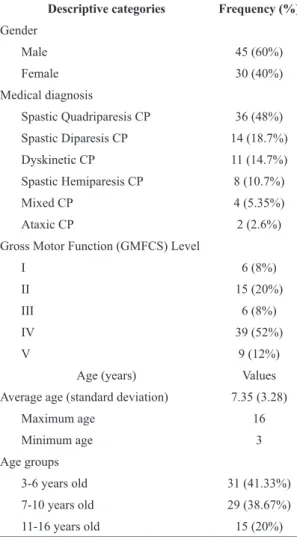
Table 2 presents the principal descriptive characteristics of gender, age, clinical diagnosis, and gross motor function level of the children in the study.
Functional priorities and gross motor function severity
Of the 278 demands reported, 134 (48.2%) referred to personal care activities, followed by school activities (19.78%), play (14.39%), and mobility (12.95%). Other demands included socialization activities, household chores, and independence outdoors (4.68%).
Table 3 presents the functional priorities
identiied by the caregivers of children with CP
during application of the COPM at different levels of gross motor function, by occupation area. It was observed that priorities relating to personal care were the most frequent at all levels of motor
severity, except for children at GMFCS level V.
Analysis of the relationship between priorities
identiied by the children’s motor function level and
occupational area revealed that parents of children
classiied as GMFCS V reported priorities relating
to play as the most important (c2=10.30, p=0.036). No signiicant associations between gross motor
function severity and other occupation areas were observed.
Functional priorities and age groups
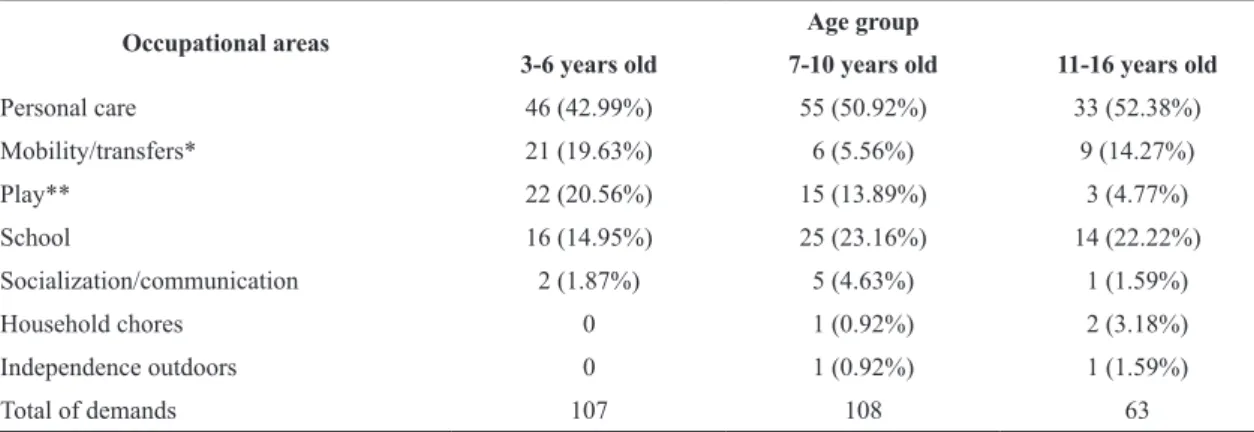
Table 4 presents functional priorities identiied by the caregivers of children with CP in different age groups. The activities with the greatest frequency of parental demand across all age groups were in the category of personal care. Analysis of the relationship between priorities
identiied according to age and occupational area
revealed that children in the youngest age group (3-6 years) more often had priorities relating to mobility (c2=7.35, p=0.025) and play (c2=9.99,
p=0.007) when compared to other age groups. No
signiicant associations between age group and
other occupational areas were observed.
Functional outcome in children after six months
In the six-month period between the two stages
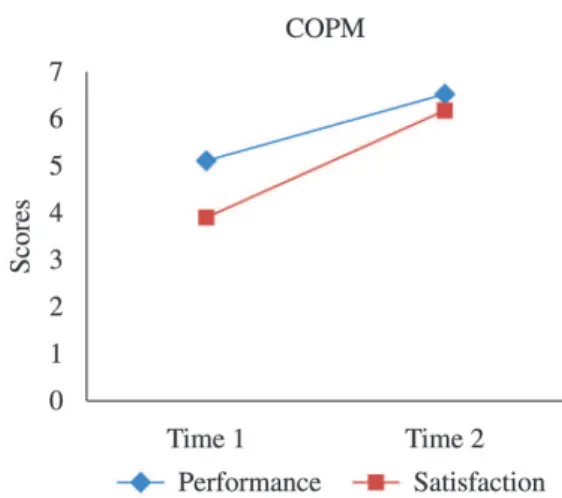
of data collection, there was a signiicant increase
in COPM score, in terms of both performance (p=0.0001) and satisfaction (p=0.0001) (Figure 1). No association was found between the frequency of sessions (twice or once per week) and the magnitude
of clinically signiicant gains in COPM performance
Table 2. Description of children with cerebral palsy regarding
gender, age, diagnosis, and gross motor function level, according
to the Gross Motor Function Classiication System (GMFCS).
Descriptive categories Frequency (%)
Gender
Male 45 (60%)
Female 30 (40%)
Medical diagnosis
Spastic Quadriparesis CP 36 (48%)
Spastic Diparesis CP 14 (18.7%)
Dyskinetic CP 11 (14.7%)
Spastic Hemiparesis CP 8 (10.7%)
Mixed CP 4 (5.35%)
Ataxic CP 2 (2.6%)
Gross Motor Function (GMFCS) Level
I 6 (8%)
II 15 (20%)
III 6 (8%)
IV 39 (52%)
V 9 (12%)
Age (years) Values
Average age (standard deviation) 7.35 (3.28)
Maximum age 16
Minimum age 3
Age groups
3-6 years old 31 (41.33%)
7-10 years old 29 (38.67%)
Table 3. Frequency (%) of activities (n=278) grouped in occupational areas listed as priorities by the caregivers of children with cerebral
palsy from different levels of gross motor function according to the Gross Motor Function Classiication System (GMFCS).
Occupational Areas GMFCS Level
GMFCS I GMFCS II GMFCS III GMFCS IV GMFCS V
Personal Care
Feeding 4 (18.18%) 5 (8.19%) 2 (9.52%) 19 (12.94%) 3 (11.11%)
Dressing 4 (18.18%) 17 (27.87%) 3 (14.29%) 26 (17.69%)
-Hygiene 2 (9.09%) 4 (6.56%) 2 (9.52%) 13 (8.85%)
-Taking a shower 3 (13.63%) 3 (4.92%) 1 (4.76%) 9 (6.12%) 3 (11.11%)
Sphincter control - 2 (3.28%) 3 (14.29%) 5 (3.40%) 1 (3.70%) Total of demands 13 (59.08%) 31 (50.82%) 11 (52.38%) 72 (49%) 7 (25.92%)
Mobility Transfers 2 (3.28%) 7 (4.76%) 7 (25.93%)
Locomotion 3 (13.63%) 3 (4.92%) 2 (9.52%) 11 (7.48%) 1 (3.70%)
Total of demands 3 (13.63%) 5 (8.2%) 2 (9.52%) 18 (12.24%) 8 (29.63%)
School Educational concepts - 3 (4.92%) 1 (4.76%) 5 (3.40%) -Pencil use 2 (9.09%) 7 (11.47%) 4 (19.06%) 18 (12.24%) 1 (3.70%)
Use of other school Materials 1 (4.55%) 5 (8.19%) 1 (4.76%) 3 (2.04%)
-Attention - 1 (1.64%) - 3 (2.04%)
-Total of demands 3 (13.64%) 16 (26.22%) 6 (28.58%) 29 (19.72%) 1 (3.70%)
Play Play Structure - - - 6 (4.08%) 2 (7.41%)
Play Interaction - - - 3 (2.04%) 1 (3.70%)
Hand use while playing - 3 (4.92%) - 7 (4.76%) 5 (18.53%)
Attention - - - 1 (0.68%) 1 (3.70%)
Speciic play 1 (4.55%) 2 (3.28%) 2 (9.52%) 4 (2.72%)
-Play positioning - 1 (1.64%) - 1 (0.68%)
-Total of demands 1 (4.55%) 6 (9.84%) 2 (9.52%) 22 (14.96%) 9 (33.34%)
Socialization Socialization /Communication 1 (4.55%) - - 5 (3.40%) 2 (7.41%) Household chores Household chores 1 (4.55%) 1 (1.64%) - 1 (0.68%)
-Independence outdoors
Independence outdoors - 2 (3.28%) - -
-% were calculated regarding the total of functional demands per gross motor function level (GMFCS).
Table 4. Frequency of priorities (n=278) in different occupational areas with respect to the age group of children with cerebral palsy.
Occupational areas Age group
3-6 years old 7-10 years old 11-16 years old
Personal care 46 (42.99%) 55 (50.92%) 33 (52.38%)
Mobility/transfers* 21 (19.63%) 6 (5.56%) 9 (14.27%)
Play** 22 (20.56%) 15 (13.89%) 3 (4.77%)
School 16 (14.95%) 25 (23.16%) 14 (22.22%)
Socialization/communication 2 (1.87%) 5 (4.63%) 1 (1.59%)
Household chores 0 1 (0.92%) 2 (3.18%)
Independence outdoors 0 1 (0.92%) 1 (1.59%)
Total of demands 107 108 63
*Signiicant association between age group and mobility/transfers (c2=7.35; p=0.025); **Signiicant association between age group and play
scales (pPhysical therapy = 0.197, pOccupational Therapy = 0.149) or satisfaction scales (pPhysical therapy = 0.514, pOccupational
Therapy = 0.221).
Discussion
This study presents the main functional priorities indicated by caregivers of children with CP in different occupation areas and functional changes over a period of six months. Personal care activities were more important for parents and caregivers, followed by school activities and play. Priorities related to play occurred mainly in children with
greater motor severity (GMFCS level V) and in the
youngest age group (3-6 years). There was also an increase in performance and satisfaction scores in functional activities deemed important by caregivers over the period of six months.
With regard to functional demands of the COPM,
the priorities identiied by parents were principally
personal care activities, such as dressing, feeding, bathing, hygiene, and toilet training. These results are corroborated by data from Chiarello et al.’s study2, which also found that personal care activities
were important for all parents of children in their study2. The focus on personal care activities relects parents’ expectations for the child to obtain
greater independence, autonomy, and efficiency in carrying out those activities2. According to
Barrett and Kielhofner17, performing personal care
activities ensures the satisfaction of basic needs and independence in the home environment17. Moreover,
the child’s performance in these activities allows him/ her to experience independence and to develop skills for participating in other performance areas, such as education, work, and leisure2.
Functional mobility activities were not the main demand of the parents of children in this study. Although mobility is related to changes in neuromusculoskeletal function and structures in children with CP, it was not reported by caregivers as a priority outcome. These results are contrary to the results presented by Knox18, who conducted
a retrospective study by reviewing the records of 121 children with CP to determine the functional performance interests of parents as reported to the professionals. In Knox’s study, the main demands
identiied by parents of children with CP at GMFCS
level I focused on standing, walking, and manual
function, while at levels II to IV, the main demands
were related to activities such as standing and walking18. Parents of children classiied as GMFCS level V prioritized mobility (i.e. sitting, mobility
on the ground) and communication skills18. The
differences between the results of this study and the results reported by Knox18 could be attributed
to different characteristics of the instrumentation used and age associated with the participants’ motor function severity. The present study used the COPM to discuss the functional demands of the child’s daily routine considered important by parents, whereas Knox’s18 used data from medical records to
identify parents’ priorities. In addition, the majority of Knox’s study participants18 were children at GMFCS IV and V motor severity levels (57%)
and were younger than 6 years (68%), whereas
in th present study, most children had GMFCS severity level IV and were aged over seven years
(58.67%). In the present study, mobility demands in the 3-6 year age group were more frequent than mobility demands in older age groups. According to Rosenbaum et al.19, children with greater motor
severity tend to stabilize their acquisition of gross motor function after 5 years of age. It is possible therefore, that the parents of the children in this study, especially of children over the age of 7, were aware of the child’s gross motor function stability and therefore prioritized meeting personal care, play, and school demands, focusing on the greater
Figure 1. Changes in the performance (p=0.001) and satisfaction
participation of their children in these functional domains.
Demands related to play were identiied as most
important by caregivers of young children and children with severe motor impairment. Considering the importance of play as a primary childhood activity20, this outcome illustrates an important
functional goal for therapeutic intervention21. During
play, the child has the opportunity to discover relationships among objects, people, and actions, to explore the environment, and to develop social and occupational roles20. Pfeifer et al.22, in evaluating the
spontaneous play skills of children with CP between 3 and 6 years of age, described characteristics of spontaneous play, such as starting a game on their own, exploring a toy, preparing and sequencing the activity, and pretending play. In this study, children
with greater motor severity had signiicant dificulties
in developing more sophisticated playful actions and had a limited repertoire of symbolic play22. Mobility
restrictions might, therefore, hinder participation in certain play activities, for example, those that require motor skills or more complex cognitive functions, without completely restricting the recreational engagement of these children. It is important to identify alternative forms and adaptations that might promote the engagement of children with CP at different motor function severity levels in recreational experiences and interactions with parents and other children23.
In the present study, there was improvement in the children’s performance and the parents’ satisfaction with regard to functional objectives over a six-month period. This result illustrates the importance of using standardized instrumentation to document functional
gains deined as priorities for families of children
with CP and also to serve as a facilitator in the family-therapist collaborative relationship. Parental involvement in decision-making about therapeutic goals to be achieved is considered an important element in the rehabilitation process1,9-13. Øien et al.13
studied parents’ and professionals’ perceptions about setting goals for the rehabilitation of children with CP and stressed that the family’s establishment of priorities contributed to the ability of parents to position themselves and communicate the needs and preferences of the children and family. This cooperative action with parents in the development of therapeutic strategy enhances the practice of these goals in the family context13. Anderson and
Hinojosa24 claimed that intervention with the child
could be optimized through the development of a positive relationship between therapists and family members. In this partnership, professionals must recognize the role of parents in the therapeutic process, understand the characteristics of the parent-child relationship, and adapt actions by guiding therapy in an effective collaboration with parents
for the beneit of the child’s rehabilitation process24.
By interviewing caregivers to identify important functional goals for the family, professionals can make therapy more effective and meaningful for the child and family25.
Limitations of the study
This study showed improvements in parents’ perception of children with CP in terms of the functional objectives prioritized over a six-month period. However, as the study was retrospective, it was not possible to control of the training
intensity of each functional demand identiied as
important by parents. Thus, it is not possible to say that the observed changes were solely the result of rehabilitation actions. Future prospective and controlled studies might elucidate the effects of
interventions focused on speciic needs identiied by
caregivers of children with CP.
Clinical implications
The present study described and characterized the major functional priorities of caregivers of children with CP treated at a rehabilitation center. The most frequent priorities were related to personal care activities. There was improvement in functional performance and parental satisfaction with functional objectives considered important. This information underlines the importance of using an individualized functional measure focused on the expectations and priorities of the family to understand the child’s daily routine and to establish meaningful interventions in his/her life context.
Acknowledgements
References
1. Law M, DarrahJ, PollockN, RosenbaumP, RussellD,
Walter SD, et al. Focus on Function - a randomized controlled trial comparing two rehabilitation interventions for young children with cerebral palsy. BMC Pediatr.
2007;7(1):31. http://dx.doi.org/10.1186/1471-2431-7-31.
PMid:17900362
2. ChiarelloLA, PalisanoRJ, MaggsJM, OrlinMN, Almasri N, Kang LJ, et al. Family priorities for activity and participation of children and youth with cerebral palsy. Phys Ther. 2010;90(9):1254-64. http://dx.doi.org/10.2522/ ptj.20090388. PMid:20576716
3. Mancini MC, AlvesACM, SchaperC, FigueredoEM,
Sampaio RF, CoelhoZA, et al. Gravidade da paralisia cerebral e desempenho funcional. Rev Bras Fisioter. 2004;8(3):253-60.
4. Chagas PSC, DefilipoEC, Lemos RA, Mancini MC,
FrônioJS, CarvalhoRM. Classificação da função motora e do desempenho funcional de crianças com paralisia cerebral.Rev Bras Fisioter. 2008;12(5):409-16. http://
dx.doi.org/10.1590/S1413-35552008000500011.
5. PalisanoR, RosenbaumP, WalterS, RussellD, WoodE,
GaluppiB. Development and reliability of a system to classify gross motor function in children with cerebral palsy. Dev Med Child Neurol. 1997;39(4):214-23.
http://dx.doi.org/10.1111/j.1469-8749.1997.tb07414.x.
PMid:9183258
6. SilvaDBR, PfeiferLI, FunayamaCAR. Gross Motor
Function Classification System Expanded & Revised (GMFCS E & R): reliability between therapists and
parents in Brazil. Braz J Phys Ther. 2013;17(5):458-63.
http://dx.doi.org/10.1590/S1413-35552012005000113.
PMid:24173347
7. EliassonAC, Krumlinde-SundholmL, RösbladB, Beckung E, Arner M, Ohrvall AM, et al. The Manual Ability
Classification System (MACS) for children with cerebral
palsy: scale development and evidence of validity and reliability. Dev Med Child Neurol. 2006;48(7):549
-54. http://dx.doi.org/10.1017/S0012162206001162.
PMid:16780622
8. de Brito BrandãoM, de Cássia GonçalvesS, CarvalhoLA,
Crepaldi PV, AbrahãoLC, de Melo MambriniJV, et al.
Clusters of daily functioning and classification levels: agreement of information in children with cerebral palsy. J Pediatr Rehabil Med. 2012;5(3):151-8. PMid:23023247.
9. King S, Teplicky R, KingG, Rosenbaum P. Family-centered service for children with cerebral palsy and their families: a review of the literature. Semin Pediatr Neurol. 2004;11(1):78-86. http://dx.doi.org/10.1016/j. spen.2004.01.009. PMid:15132256
10. EgilsonST. Parent perspectives of therapy services for their children with physical disabilities.Scand J Caring
Sci. 2011;25(2):277-84. http://dx.doi.org/10.1111/j.1471-6712.2010.00823.x. PMid:20704688
11. HurlburtMS, GarlandAF, NguyenK, Brookman-FrazeeL.
Child and family therapy process: concordance of therapist
and observational perspectives.Adm Policy Ment Health.
2010;37(3):230-44. http://dx.doi.org/10.1007/s10488-009-0251-x. PMid:19902347
12. LammiBM, LawM. The effects of family-centred functional therapy on the occupational performance of children with cerebral palsy.Can J Occup Ther. 2003;70(5):285-97. http:// dx.doi.org/10.1177/000841740307000505. PMid:14753071
13. ØienI, FallangB, ØstensjøS. Goal-setting in paediatric rehabilitation: perceptions of parents and professional. Child Care Health Dev. 2010;36(4):558-65. http://dx.doi. org/10.1111/j.1365-2214.2009.01038.x. PMid:20030659
14. LawM, DarrahJ, PollockN, KingG, RosenbaumP, Russell D, et al. Family-centred functional therapy for children with cerebral palsy: an emerging practice model.Phys Occup Ther Pediatr. 1998;18:83-102.
15. LawM, BaptisteS, CarswellA, McCollMA, PolatajkoH,
PollockN. Canadian occupational performance measure.
2nd ed. Ottawa: CAOT Publicatioins ACE; 1998.
16. McCollMA, PatersonM, DaviesD, DoubtL, LawM. Validity
and community utility of the Canadian occupational performance Measure.Can J Occup Ther. 2000;67(1):22
-30. http://dx.doi.org/10.1177/000841740006700105.
PMid:10695166
17. BarrettL, KielhofnerG. Uma visão geral do comportamento ocupacional. In: NeistadtME, CrepeauEB. Willard &
Spackman terapia ocupacional. 9th ed. Rio de Janeiro:
Guanabara Koogan; 2002. p. 488-90.
18. KnoxV. Do parents of children with cerebral palsy express different concerns in relation to their child’s type of cerebral palsy, age and level of disability? Physiotherapy. 2008;94(1):56-62. http://dx.doi. org/10.1016/j.physio.2007.04.005.
19. RosenbaumPL, WalterSD, HannaSE, PalisanoRJ, Russell DJ, RainaP, et al. Prognosis for gross motor function in cerebral palsy: creation of motor development curves. JAMA. 2002;288(11):1357-63. http://dx.doi.org/10.1001/ jama.288.11.1357. PMid:12234229
20. Ostensjø S, Carlberg EB, Vøllestad NK. Everyday functioning in young children with cerebral palsy: functional skills, caregiver assistance, and modifications of the environment.Dev Med Child Neurol. 2003;45(9):603
-12. http://dx.doi.org/10.1111/j.1469-8749.2003.tb00964.x.
PMid:12948327
21. FettersL. Measurement and treatment in cerebral palsy: an argument for a new approach.Phys Ther. 1991;71(3):244
-7. PMid:2000440.
22. PfeiferLI, PacciulioAM, SantosCA, SantosJL, Stagnitti
KE. Pretend play of children with cerebral palsy.Phys Occup Ther Pediatr. 2011;31(4):390-402. http://dx.doi.org/ 10.3109/01942638.2011.572149. PMid:21574911
23. Hestenes LL, Carroll DE. The play interactions of young children with and without disabilities: individual and environmental influences. Early Child
Res Q. 2000;15(2):229-46. http://dx.doi.org/10.1016/
24. Anderson J, Hinojosa J. Parents and therapists in a professional partnership.Am J Occup Ther. 1984;38(7):452
-61. http://dx.doi.org/10.5014/ajot.38.7.452. PMid:6205590 25. RandallKE, McEwenIR. Writing patient-centered functional
goals.Phys Ther. 2000;80(12):1197-203. PMid:11087306.
Correspondence Marina Brito Brandão
Rua Professor Otávio Coelho de Magalhães, 111, Mangabeiras CEP 30210-300, Belo Horizonte, MG, Brazil