Arq Neuropsiquiatr 2009;67(4):1057-1061
ClassifiCation of Cerebral Palsy
Association between gender, age, motor type,
topography and Gross Motor Function
Luzia Iara Pfeifer¹, Daniela Baleroni Rodrigues Silva¹,
Carolina Araújo Rodrigues Funayama², Jair Lício Santos³
abstract – The goal of this study was to assess the relation between gender, age, motor type, topography and gross motor function, based on the Gross Motor Function System of children with cerebral palsy. Trunk control, postural changes and gait of one hundred children between 5 months and 12 years old, were evaluated. There were no significant differences between gender and age groups (p=0.887) or between gender and motor type (p=0.731). In relation to body topography most children (88%) were spastic quadriplegic. Most hemiplegics children were rated in motor level I, children with diplegia were rated in motor level III, and quadriplegic children were rated in motor level V. Functional classification is necessary to understand the differences in cerebral palsy and to have the best therapeutic planning since it is a complex disease which depends on several factors.
Key wordS: cerebral palsy, disabled children, motor skills, classification system, gross motor function.
Classificação da paralisia cerebral: associação entre gênero, idade, tipo motor, topografia e função Motora Grossa
resumo – este estudo teve como objetivo avaliar a relação entre gênero, idade, tipo motor, topografia e Função Motora Grossa, baseado no Sistema de Função Motora Grossa em crianças com paralisia cerebral. Participaram desta pesquisa 100 crianças com idade entre 5 meses a 12 anos que foram observadas em relação ao controle de tronco, trocas posturais e marcha. Não houve diferenças significativas entre gêneros e grupos etários (p=0,887) e entre gênero e tipo motor (p=0,731). em relação à topografia corporal, houve predomínio de crianças com quadriplegia, sendo que a maioria (88%) era do tipo espástico. Quanto ao nível motor, as crianças hemiplégicas pertenciam em sua maioria ao nível I, as diplégicas ao nível III e as quadriplégicas ao nível V. Sendo a paralisia cerebral uma condição complexa que depende de diversos fatores, beneficia-se de classificações funcionais para compreensão da diversidade e melhor planejamento terapêutico.
PAlAVrAS-chAVe: paralisia cerebral, criança deficiente, sistema de classificação, habilidade motora, função motora grossa.
ribeirão Preto Medical School, University of São Paulo, ribeirão Preto SP, Brazil: 1 division of occupational Therapy, department of Neurosciences and
Behavioral Sciences; 2 division of Neurology, department of Neurosciences and Behavioral Sciences; 3departament of Social Medicine.
received 31 March 2009, received in inal form 28 July 2009. Accepted 5 August 2009.
Dra. Luzia Iara Pfeifer – Av. Anhanguera 597- 14025-480 Ribeirão Preto SP - Brasil. E-mail: [email protected]
cerebral palsy (cP) is described as a range of disorders of motor and postural development which causes func-tional limitations attributed to non-progressive disorders that occur in fetal development or child’s brain1. It has
tra-ditionally been described based on the kind of damage (spasticity, dyskinesia and ataxia) and its location, or topog-raphy (hemiplegia, diplegia and tetraplegia)2. Until
recent-ly there were not standardized methods to classify
cere-bral palsy in relation to subtypes and severity of motor im-pairments3-5. The Gross Motor Function System (GMFcS)6
The goal of this study was to evaluate the relation between gender, age, motor level, topography, and gross motor function of children with cerebral palsy based on the GMFcS.
MetHoD
Subjects
one hundred children between 5 months and 12 years and 10 months old participated in this study. They were divided in four groups according to their age in accordance with the GM-FcS: 18 children under 2 years old, 21 children between 2 and 4 years old, 24 children between 4 and 6 years old and 37 children between 6 and 12 years old. A sample calculation made for this study indicated that at least 18 children in each age group sug-gested by the GMFcS would be necessary to evaluate interest ratios with a maximum 20% of error under 90% of probability8.
Data collection
The children were analyzed during the procedures for re-ferral to the occupational therapy service of a university hospi-tal in a city in São Paulo state with their parents’ consent. Their trunk control, postural changes and gait were observed since those items are part of the assessment form used for children with cerebral palsy.
Data analysis
The information collected was organized by groups accord-ing to age, and the relation between gender, topography, motor level and age was observed using Fischer’s exact test. cramer’s coeficient was used to evaluate how strong the association was9.
Ethical matters
This study is part of a larger study entitled “The inluence of motor levels and social support on daily activities in the life of children with cerebral palsy” which was approved by the ethics committee of hospital das clínicas at the University of ribeirão
Preto Medical School – São Paulo – USP, through proceeding no
2565/2008 in 05/25/2008.
resUlts
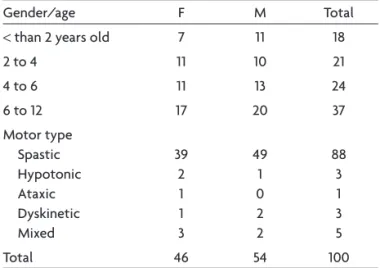
out of 100 children who participated in this study, 54 were male and 46 were female. distribution of genders (Table 1) in relation to the age groups suggested by the GMScF was equivalent and there were no signiicant dif-ferences according to Fisher’s exact test (p=0.887). The as-sociation between gender and motor type did not pres-ent signiicant differences according to Fisher’s exact test either (p=0.731).
relative to topography, ifty-two children were quadri-plegic, thirty three diplegic and ifteen hemiplegics. As for motor type, all hemiplegics and diplegics children were spastics and among the ifty two quadriplegics children, three had hypotonia, one presented ataxic, ive had spas-ticity and dyskinesia, three had only dyskinesia, and forty presented only spasticity. There were no signiicant dif-Table 1. Number of participants in each age group suggested by the GMFCS according to gender and age.
Gender/age F M Total
< than 2 years old 7 11 18
2 to 4 11 10 21
4 to 6 11 13 24
6 to 12 17 20 37
Motor type Spastic hypotonic Ataxic dyskinetic Mixed
39 2 1 1 3
49 1 0 2 2
88 3 1 3 5
Total 46 54 100
Table 2. Distribution of participants according to body topography and motor type in relation to the age in accordance with the age groups suggested by the GMFCS.
Type of cP younger than 2 years old 2 to 4 years old 4 to 6 years old 6 to 12 years old Total Topography
hemiplegic diplegic Quadriplegic
2 (12.5%) 3 (9.4%) 13 (25%)
1 (6.3%) 8 (25%) 12 (23.1%)
7 (43.8%) 7 (21.9%) 10 (19.3%)
5 (31.3%) 15 (46.9%) 17 (32.7%)
15 33 52
Motor Type Spastic hypotonic Ataxic dyskinetic Mixed
14 (15.9%) 3 (100%)
0 0 1 (20%)
20 (22.8%) 0 0 0 1 (20%)
23 (26.2%) 0 1 (100%)
0 0
31 (35.3%) 0 0 3 (100%)
3 (60%)
88 3 1 3 5
ferences in relation to topography and distribution of age groups suggested by the GMFcS according to Fisher’s ex-act test (p=0.112), even though most of the children in the hemiplegic group were aged 4 to 6 years and in the diplegic and quadriplegic groups they were between 6 and 12 year. In relation to motor type, spastic children predomi-nated in all age groups and there was a signiicant differ-ence between motor type and age group according to Fisher’s exact test with p=0.032 (Table 2).
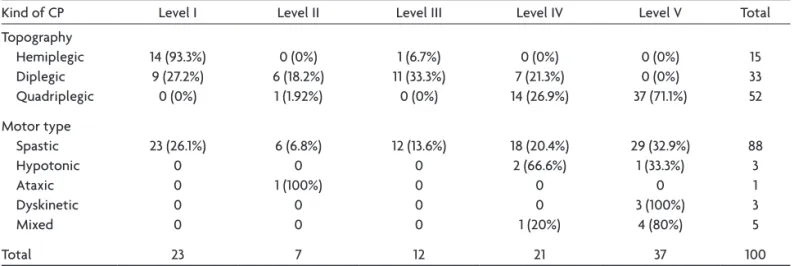
As for motor types, there was a predominance of level I in hemiplegic children, level III in diplegic children, and level V in quadriplegic children. Through statistical anal-ysis it was clear that there was a strong association be-tween body topography and motor level, with cramer’s coeficient=0.744, which is signiicant according to Fisher’s exact test (p<0.000) (Table 3).
As for the distribution of subjects by age and motor level (Table 4), Fisher’s exact test was not signiicant, but it indicated some tendency to association (p=0.075) and that there were more children under 4 years old in level V.
DisCUssion
The classiication in this study was based on clinical changes in muscle tonus and on the kind of movement disorder which could be categorized under the follow-ing types of motor dysfunction: spastic, dyskinetic or athetoid, ataxic, hypotonic and mixed10 and quadriplegia,
diplegia and hemiplegia in relation to body topography10,11,
besides the Gross Motor Function classiication System (GMFcS)6. Such system has been widely used in clinical
practice and in research and it is considered valid, reliable and stable for 2 to 12 year- old children4,12,13.
Most of the children who participated in the present study were male and that fact has often been reported in the literature14,15.
As for the distribution of body topography, quadriple-gic children were in larger numbers. Quadriplegia is the type of dysfunction most often cited in the international16
and national literature17. This form of cP affecting muscular
strength in different levels results from its location associ-ated with the cause (the most frequent is hypoxic-ischemic encephalopathy) followed by defects of cortical cerebral development)5. The study was performed in a high
com-plexity health center where only the most complex cases are assisted, which is also consistent with the data found. other studies report that diplegic children are the majority14,18-20. diplegia affects principally, or especially
the lower limbs because of the serious injury in periven-tricular areas and subcortical white matter; its main causes are cerebral ischemic and hemorrhagic phenomena and fetal or post-natal hydrocephaly especially in preterm newborn children5,17.
Spasticity stood out as regards motor type and that is consistent with several studies14-16, 19, 21.
Table 3. Division of participants in relation to body topography and motor level.
Kind of cP level I level II level III level IV level V Total
Topography hemiplegic diplegic Quadriplegic
14 (93.3%) 9 (27.2%) 0 (0%)
0 (0%) 6 (18.2%)
1 (1.92%)
1 (6.7%) 11 (33.3%)
0 (0%)
0 (0%) 7 (21.3%) 14 (26.9%)
0 (0%) 0 (0%) 37 (71.1%)
15 33 52
Motor type Spastic hypotonic Ataxic dyskinetic Mixed
23 (26.1%) 0 0 0 0
6 (6.8%) 0 1 (100%)
0 0
12 (13.6%) 0 0 0 0
18 (20.4%) 2 (66.6%)
0 0 1 (20%)
29 (32.9%) 1 (33.3%)
0 3 (100%)
4 (80%)
88 3 1 3 5
Total 23 7 12 21 37 100
Table 4. Distribution of participants in relation to motor level, in accordance with the age groups suggested by the GMFCS.
Age level I level II level III level IV level V Total
< than 2 years old 1 (5.5%) 2 (11.1%) 2 (11.1%) 4 (22.2%) 9 (50%) 18
2 to 4 2 (9.5%) 1 (4.7%) 5 (23.8%) 5 (23.8%) 8 (38%) 21
4 to 6 12 (50%) 1 (4.1%) 1 (4.1%) 2 (8.3%) 8 (33.3%) 24
6 to 12 8 (21.6%) 3 (8.1%) 4 (10.8%) 10 (27%) 12 (32.4%) 37
As long as the relation between topography and age groups are concerned it is important to observe that the hypotonic group is found among children under the age of 2 and the dyskinetic group is identiied later in life. There are few studies trying to establish the moment when the child moves from hypotonia to spastic hipertonia or dys-kinesia22-24. According to those authors spasticity occurs
during the three irst months and dyskinesia occurs in up to three years in most of the cases. Just few children stay hypotonic and there were no children over 2 classiied as hypotonic cP in the present study.
As for the relation between body topography and mo-tor levels, most hemiplegic children were predominant-ly motor level I, which has also been found in other stud-ies17-19,25. In this study there was only one child with
hemi-plegics cP different from level I and she was classiied in Motor level III according to the GMFcS. The child was 8 months old and had late development; it is possible that such condition reaches the lowest lower limbs because of its neurological maturation. himmelmann et al.25 found
out cases of hemiplegia in all motor levels; Beckung et al.19
established that the cases varied between levels I and IV; howard et al.16 found levels I, II, III and V and Voorman et
al.18 classiied the cases under levels I, II and III.
diplegic children in this study were similar (with no signiicant difference) in the irst four levels and there were no examples of level V; in their study Voorman et al.18 had the same results and only 3 cases (6.4%) were
lev-el V. In their study himmlev-elmann et al.25 had diplegic
chil-dren in all levels, most of them were level II (37.5%) and only 4.9% of the children were classiied in level V. Sim-ilar results were found in the study of Beckung et al.19 in
which they observed that most children were classiied in the irst two levels while only 4% were classiied in lev-el V. The results in the study of howard et al.16 were very
similar in the irst three levels; only 4 cases (5%) were lev-el IV and no diplegic children were levlev-el V.
In this study most quadriplegic children were level V. The quadriplegic child in level II had ataxia which affects all body but does not prevent trunk control or support-ed gait. hypotonic, dyskinetic and mixsupport-ed ones did not inluence in the relation between body topography and motor level. In the studies of Beckung et al.19 the
partici-pants were divided according to motor type and the spas-tic ones were divided according to topography; quadriple-gic spastic ones were all level V, dyskinetic children were classiied from level I to V, with a predominance of lev-el III and the ataxic ones were classiied in levlev-els I and II; there were no cases of mixed cerebral palsy. himmelmann et al.25 had similar results, in that quadriplegic spastic
chil-dren were classiied in levels IV and V and most of them were level V; diskinetic children were classiied in all lev-els but the majority was levlev-els IV and V. The study of
how-ard et al.16 reported that most of quadriplegic spastic
chil-dren were level IV and V, diskinetic chilchil-dren were levels II, III and IV and the mixed ones were all levels; the atax-ic children were classiied in the irst three levels and the hypotonic ones were all levels except level II.
regarding the relation between motor level and age, our study found a certain tendency to association through Fisher’s exact test (p=0.075) although it did not present sig-niicance. The study of Beckung et al.19 used the GMFM26
to evaluate children’s motor performance and it showed that age is important in motor prognosis in children with cerebral palsy. children were evaluated every 6 months up to 4 years old and every year afterwards; development graphs were drawn for 258 spastic children. level I chil-dren (75%) got 90% of maximum score of GMFM up to 5 years old. The best performance was reached at age 7. lev-el II children got 90% of the score at age 5 on average and 75% of children got it at age 7. Most level III children got 80% of GMFM at age 7 and most level IV children (30%) got it at 5 and did not change anymore.
The goal of a recent study of Gorter et al.27 was to
evaluate the stability (predictive validity) of the GMFcS up to age 2, that is, they evaluated how 77 children, under 2, were reclassiied using the classiication of children be-tween 2 and 4 years suggested by the GMFcS. The results showed that 42% of the children moved one or two levels and most of them were reclassiied in a lower motor level. The results indicate that classifying children younger than 2 years old is less accurate after some time than when it is done with older children. GMFcS6 development experts
had already reported that it is dificult to accurately clas-sify gross motor function of children at 1 or two years of age. It happens because children at this age have a very limited number of gross motor activities, they depend more on the quality of the movement and on how easy it is to sit, crawl, and stand up than on the ability to walk.
It is important to mention that children were divided into age groups because in the development of GMFcS it is recognized that motor function classiication depends on age, especially for babies and infants6.
cerebral palsy depends on several pre-, peri- and post natal aspects. Besides, different levels of motor damage (topography) and changes in tonus are observed (motor type) according to the kind of cerebral injuries. So, re-searchers have been trying to elaborate classiication stan-dard systems based on the complexity of clinical exam-ples of cP and the difficulties classifying them, as it is proposed by the european Surveillance of cerebral Palsy3
therapeutic planning and to have stronger clinical and sci-entiic agreement in relation to the classiication of cere-bral palsy, considering the functional level of the child.
The GMFcS can help health professionals working with children with cerebral palsy make sure they receive appro-priate care for their functional level and age. It would not be appropriate, for example, to perform a complex cor-rective surgery on a six year-old child classiied under lev-el V aiming the child’s gait because even though the child will take steps, albeit in a limited way, her main means of movement will still be a wheelchair. It is also known that the rate of hip subluxation increases linearly from level I (0% risk) to level V (90% increased risk). This fact high-lights how the GMFcS can, in fact, serve as a guide for health professionals to be able to monitor and treat ce-rebral palsy- related problems28.
The GMFcS also makes it possible to set functional rehabilitation goals for each motor level in different age groups. Therefore, the treatment of a child in level I aged 0–2 aims to stimulate the child to move to and from a sit-ting position, use the upper limbs to handle objects, crawl, move to a standing position with support, and walk under supervision. Between ages 2 and 4, the functional goals fo-cus improving sitting position for handling objects, mov-ing to standmov-ing position with support, and indoors walk-ing. At ages 4 and 6, the goal are to stimulate moving from the loor and chair to a standing position, climbing up and down stairs, and running and jumping.
on the other hand, a motorly impaired child classi-ied under level V, from age 0 to 2 would be stimulated to keep her head in the median line and turn it 180o in
su-pine position, and roll over with support. Between ages2 and 4, therapeutic goals would be to facilitate acquisition
of basic skills for anti gravitational positions of the head and trunk with support and moving around with support. Because functional prognoses for such children are very limited, such goals also hold for older subjects.
referenCes
1. Bax M, Goldstein M, Rosenbaum P, Leviton A, Paneth M. Proposed
def-inition and classiication of cerebral palsy. Dev Med Child Neurol 2005; 47:571-576.
2. Hagberg B, Hagberg G.The origins of cerebral palsy. In: David TJ (Ed). Recent advances in paediatrics XI. Edinburgh: Churchill Livingstone 1993:67-83.
3. Surveillance of Cerebral Palsy in Europe. Surveillance of cerebral palsy in Europe: a collaboration of cerebral palsy surveys and registers. Dev Med Child Neurol 2000;42:816-824.
4. Wood E, Rosenbaum P. The Gross Motor Function Classiication Sys
-tem for cerebral palsy: a study of reliability and stability over time. Dev Med Child Neurol 2000;45:292-296.
5. Stanley FJ, Blair E, Alberman E. Cerebral Palsies: Epidemiology and
causal pathways: clinics in developmental medicine n. 151. London: Mac Keith Press, 2000:9-14.
6. Palisano R, Rosenbaum P, Walter S, Russel D, Wood E, Gallupi D. De
-velopment and reliability of a system to classify gross motor function in children with cerebral palsy. Dev Med Child Neurol 1997;39:214-223. 7. Morris C, Bartlett D. Gross Motor Function Classiication System: im
-pact and utility. Dev Med Child Neurol 2004;46:60-65.
8. Berquo ES; Souza JMP, Gotlieb SLD. Bioestatística. 1ª Ed. São Paulo: EPU, 1980.
9. Siegel S, Castellan NJ. Estatística não paramétrica para as ciências do comportamento. 2ª Ed. Porto Alegre: Artmed, 2006.
10. Olney SJ, Wright MJ. Cerebral palsy. In: Campbell SK (Ed). Physical therapy for children. Philadelphia: Saunders, 1995:489-524.
11. Petersen MC, Kube DA, Palmer FB. Classiication of developmental de
-lays. Sem Ped Neurol 1998;5:2-14.
12. Palisano RJ, Hanna SE, Rosenbaum PL, et al. Validation of a model of gross motor function for children with cerebral palsy. Phys Ther 2000; 80:974-985.
13. Palisano RJ, Cameron D, Rosenbaum PL, Walter SD, Russel D. Stability of the gross motor function classiication system. Dev Med Child Neu
-rol 2006;48:424-428.
14. Romeo DMM, Cioni M, Scoto M, Mazzone L, Palermo F, Romeo MG. Neuromotor development in infants with cerebral palsy investigated by the Hammersmith Infant Neurological Examination during the irst year of age. Eur J Paediatr Neurol 2008;12:24-31.
15. Ostenjo S, Carberg EB, Vollestad NK. Everyday functioning in young chil
-dren with cerebral palsy: functional skills, caregiver assistance, and mod
-iications of the environment. Dev Med Child Neurol 2003;45:603-612. 16. Howard J, Soo B, Graham HK, et al. Cerebral palsy in Victoria: motor
types, topography and gross motor function. J Paediatr Child Health 2005;41:479-483.
17. Caram LHA, Funayama CAR, Spina CI, Giuliani LR, Pina Neto JM. In
-vestigation of neurodevelopment delay etiology: resources and chal
-lenges. Arq Neuropsiquiatr 2006;64:466-472.
18. Voorman JM, Dallmeijer AJ, Knol DL, Lankhorst GJ, Becher JG. Pro
-spective longitudinal study of gross motor function in children with cerebral palsy. Arch Phys Med Rehabil 2007;88:871-876.
19. Beckung E, Carlsson G, Carlsdotter, Uvebrant P. The natural history of gross motor development in children with cerebral palsy aged 1 to 15 years. Dev Med Child Neurol 2007;49:751-756.
20. Ostenjo S, Carlberg EB, Vollestad NK. Motor impairments in young children with cerebral palsy: relationship to gross motor function and everyday activities. Dev Med Child Neurol 2004;46:580-589. 21. Imms C, Reilly S, Carlin J, Dodd K. Diversity of participation in chil
-dren with cerebral palsy. Dev Med Child Neurol 2008;50:363-369. 22. Hanson RA, Berenberg W, Byers RT. Changing motor patterns in cere
-bral palsy. Dev Med Child Neurol 1970;12:309-314.
23. Burke RE, Fahn S, Gold AP. Delayed-onset dystonia in patients with “static” encephalopathy. J Neurol Neurosurg Psychiatr 1980;43:789-797. 24. Funayama CAR. Anoxia neonatal e seqüelas neurológicas. Campinas:
Átomo, 2005.
25. Himmelmann K, Beckung E, Hagberg G, Uvebrant P. Gross and ine motor function and accompanying impairments in cerebral palsy. Dev Med Child Neurol 2006;48:417-423.
26. Russel DJ, Rosenbaum PL, Avery LM, Lane M. Gross Motor Function Measure (GMFM 88 & GMFM 66). User’s manual clinics in develop
-mental medicine, n.159. London: Mac Keith Press, 2002.
27. Gorter JW, Ketelaar M, Rosenbaum P, Helders PJM, Palisano R. Use of the GMFCS in infants with CP: the need for reclassiication at age 2 years or older. Dev Med Child Neurol 2009;51:46-52.