*e-mail: [email protected], [email protected], [email protected]
Trabalho apresentado no I Simpósio Mineiro de Ciências dos Materiais, Ouro Preto, Novembro de 2001.
Analysis of Bioactive Glasses Obtained by
Sol-Gel Processing for Radioactive Implants
Wanderley dos Santos Robertoa,b, Marivalda Magalhães Pereirab, Tarcísio Passos Ribeiro de Camposc
aHospital Eng. Center - CEFET/MG, Belo Horizonte - MG, Brazil
bMetallurgical and Materials Engineering Dept. UFMG
cNuclear Engineering Dept. UFMG
Received: November 11, 2001; Revised: March 24, 2003
This paper presents the chemical and physical characterizations of SiO2 and SiO2-CaO bioactive glasses incorporated with samarium atoms, produced by sol-gel synthesis. The objective is to provide biocompatible and biodegradable radioactive seeds as an alternative to be used in Brachytherapy for the treatment of prostate cancer. The glasses were produced and analyzed by X-ray fluorescence spectroscopy (XRF), energy dispersive X-ray spectroscopy (EDS), scanning electron microscopy (SEM), He picnometry and nitrogen adsorption analysis. A theoretical evalu-ation of the specific activity of the samples upon neutron activevalu-ation is proposed. The XRF and EDS results demonstrate the incorporation of samarium atoms in the glass matrix. The experi-mental data coupled with the theoretical studies in neutron activation suggest that it is possible to obtain radioactive seeds with activities equivalent to 125I seeds used in brachytherapy prostatic.
Keywords: sol-gel, biodegradable glasses, biodegradable seeds, brachytherapy, radioactive seeds, samarium seeds
The present approach proposes the production of bioactive and biodegradable glasses incorporated with ra-dioactive elements, seeking an alternative for the treatment of prostate cancer. The technique is denominated brachytherapy. Indeed brachytherapy on the prostatic gland applies radioactive metallic wires or seeds, containing ra-dioisotopes such as 103Pd, 137Cs, 192Ir, 125I. These implants may be temporary (in which case they must be removed after treatment) or permanent9. Relevant tumor control has been obtained with 125I seeds, that emits 27-keV γ-rays at a half-life of 59.4 days10. Considering the high cost of the treatment, the sophisticated technology involved in the me-tallic seeds production, and the fact that the seeds should stay or be removed from the prostatic gland after the therapy, the idea of a bioactive and biodegradable material in substi-tution for the metallic seeds is attractive. Bioactive seeds, manufactured by the sol-gel technique, with the isotope
152Sm incorporated, may be activated by neutrons. The
choice of this radioisotope is justified by its short half-life of 46.27 h, which will impart more energy on the gland in a shorter time compared to 125I 5. The reduced volume of the organ (~25 cm3) and the high number of seeds usually
im-1. Introduction
planted (~200) justify the introduction of biodegradable materials that can recompose the original structure of the organ after treatment.
The possibility of obtaining glasses with controlled com-position and structures makes the sol-gel processing a po-tential technique for the encapsulation of radioactive mate-rials for therapeutic applications. The higher porosity and surface area associated with the typical structure of the glasses produced by sol-gel, allied to the compositional variation, allows to obtain materials with different solubil-ity and, therefore, different degradation rates and absorp-tion in vivo. Previous work show the largest degradability of bioactive glasses produced by sol-gel compared to dense glasses obtained by conventional processing8.
The goal of the present work is the characterization of SiO2 and SiO2-CaO glasses incorporated with the element Sm, produced through sol-gel route. The viability of incor-poration of this element, the amount of Sm incorporated in the seeds, and the physical and structural characteristics of the materials produced are evaluated. Also, an analysis of the activation potential of the seeds is presented.
2. Materials and Methods
Pure silica (SiO2) or silica-calcia (SiO2-CaO) glasses, with nominal compositions presented in Table 1, were pre-pared via sol-gel technique. The systems were chosen due to a possibility of selecting an adequate solubility and, there-fore, potentially, acceptable degradation rates and absorp-tion in vivo. Each synthesis was repeated three times. The samples were prepared from tetraethylorthosilicate (TEOS), deionized water, samarium oxide, nitric acid (2N) and cal-cium nitrate. All reagents were analytic grade. The samar-ium was introduced during the sol-gel synthesis as a solu-tion prepared by solubilizasolu-tion of the oxide with nitric acid. After mixing, the sol was cast in polyethylene containers, and placed in an oven for gelation and aging at 60 °C. The samples were then dried with a schedule ending at 130 °C and thermally treated for 4 h at 700 °C.
After the processing stages, the samples were photo-graphed and than grinded. To verify the samarium incorpo-ration and the chemical composition, the samples were analyzed by X-ray fluorescence spectroscopy (XRF),
en-ergy dispersive X-ray spectroscopy (EDS), and neutron ac-tivation analysis (NAA). X-ray diffraction (XRD), N2 ad-sorption and He picnometry were used for determination of the phases present, characterization of the pore structure and density of the samples.
The activity of the seeds in units of
mg.n .s mCi.cm2
was
evaluated theoretically versus the samarium concentration in the samples. For such, Eq. 1 provides the activity, Am is after the neutronic activation (in Ci), as follows
Am = 0,6025 (φepσep + φthσth)(1 - e-λt)e-λθ (1)
in which m is the mass of the activated material (g); a is the isotopic abundance (%); A is the atomic mass (g); φep and
φth represent the thermal and epthermal neutron flux
(n/cm2s), respectively; σ
ep and σth represent the thermal and epthermal neutron cross-sections (barns), respectively, λ is the disintegration constant expressed in s-1; t is the exposi-tion time (s) of the material to the neutrons flux and θ is the decaying time (s) to of the material after the activation proc-ess11. The theoretical evaluation of the neutronic activation allows to estimate the ideal amount of Sm in the seeds, to obtain activities equivalent to values used in brachytherapy of prostatic cancer.
3. Results And Discussion
Figure 1 illustrates the aspect of the samples. Samples synthesized with and without samarium presented distinct colors. The appearance of the samples suggests the presence of samarium atoms when compared with the samples of pure SiO2 and pure SiO2-CaO. The presence of samarium atoms was detected in the samples by XRF analysis, confirming the incorporation and maintenance of these elements in the vit-reous matrix, after thermal treatment at 700 °C.
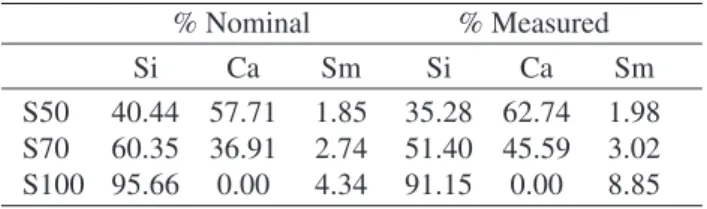
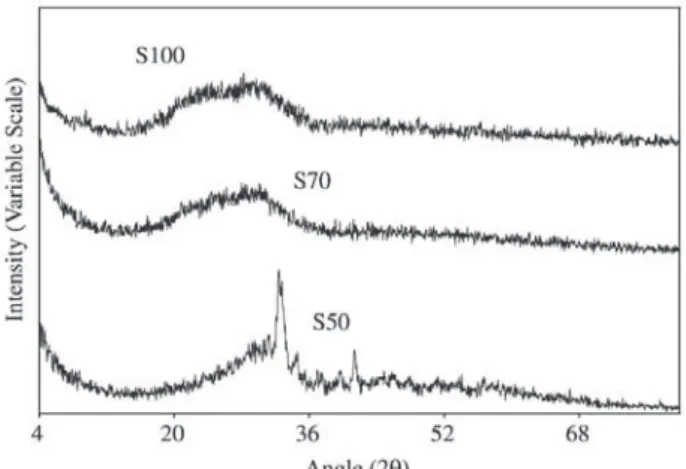
Table 1 presents the semi-quantitative results of the chemical composition obtained by the EDS analysis. The measured samarium content differs from the nominal value in less than 10% in the samples S50 and S70. In the sam-ples S100 however, the measured value differs from the nominal in 100%. It was possible to observe in the EDS analyses that there is a heterogeneous distribution of the chemical elements in the samples with higher content of calcium. In agreement with Pereira et al.3 this heterogene-ity is due the use of the salt of calcium as precursor of the CaO in the sol-gel glass. Adjustments in the drying cycle of the material can be made to reduce the heterogeneity level. Figure 2 shows the diffraction patterns for samples S50, S70 and S100. Low intensity peaks are observed indicating the presence of a small amount of a crystalline phase in the sample with larger calcium content. These peaks were
ob-Table 1. Nominal and measured (EDS) composition of the samples
%Nominal % Measured
Si Ca Sm Si Ca Sm
S50 40.44 57.71 1.85 35.28 62.74 1.98
S70 60.35 36.91 2.74 51.40 45.59 3.02
served in all the samples S50 and the analysis suggests that they represent the phase Ca2SiO4. These peaks were also identified in samples with similar SiO2 and CaO content of in the SiO2-CaO-P2O5 system, reported by Li et al.8. The diffraction pattern for the other compositions studied in this work S70 and S100 showed that there are not crystalline phases present.
Table 2 presents the N2 adsorption and He picnometry results. Figure 3 exhibits the pore size distribution in the produced glasses. The total surface area of the samples was in the range of 50 to 531 m2/g while the total pore volume
in the range of 0.06 to 0.37 cm3/g. The work of
Saravanapavan et al.1 and Li et al.8 indicates that the
sur-face area increases and the pore size decreases with the Si content, in samples in the SiO2-CaO-P2O3 system. Similarly, it is also observed a smaller surface area and a larger pore size in the produced samples with smaller Si content. How-ever, this tendency is not proportional to the Si content. The sample with intermediate Si content presented a pronouncedly increase in the medium pore size. It can be observed in the Fig. 3 that the distribution of pore sizes was different for the several compositions. Samples S100 and S50 presented a decreasing pore size distribution, with me-dium pore size of 1.2 and 2.5 nm, respectively. The range of pore sizes is narrower in the sample S100. The sample S70, however, presented two different pore size ranges, one of smaller pores, below about 1.7 nm, and another of larger pores centered around 6.0 nm.
Figure 4 shows the possibility to generate radioactive
seeds with activities similar to values used in 125I
brachytherapy, based on a theoretical evaluation. Natural samarium has 152Sm and 144Sm nuclides with large neutron Figure 2. X-ray diffraction spectra of the samples S50, S70 and
S100.
Table 2. N2 adsorption and He picnometry results for sol-gel glasses obtained.
Sample Surface Pore Average Pore Density
Area (m2/g) Volume (cm3/g) Size (nm) (g/cm3)
S50 50.39 0.06 2.55 2.77
S70 92.49 0.37 7.85 2.61
S100 531.53 0.29 1.1 2.31
Figure 4. Theoretical activity as a function of natural and enriched Samarium concentration in the seeds. The terms t90 and t80 mean time at which 90 and 80% of the maximum activity were reached. The marked area indicates the 125I seed activity used in
brachytherapy.
Figure 3. Pore size distribution for the samples S50, S70 and S100, obtained by N2 adsorption
Table 3.153Sm content in the sol-gel glasses, determined by EDS
and NAA.
EDS NAA
Sample % natural Sm % natural Sm % 152Sm
S70 3.02 4.08 1.09
S100 8.85 5.65 1.51
cross section, among others. Neutronic activation will lead the production of the radioisotopes 153Sm and 145Sm, with half-life of 46.27 h and 340 days respectively. 153Sm is sug-gested here for the permanent implants. In this case, 145Sm should be considered as a contaminant. Figure 4a and 4c exhibits the area namely as “125I implants” whose activities values in the vertical axis are similar to those found 125I seeds, The adopted neutrons flux was in the order of
.s cm
n 10
2 12
. Figures 4a and 4c show that the Sm
concentra-tions in the samples must be between 4.5 and 11.5% for natural Sm, or between 1.5 and 4.5% for enriched one, to present activities similar to the 125I seeds.
it is possible to obtain seeds with activities similar to the 125I currently used seeds.
4. Conclusions
The XRF and EDS analysis demonstrated the incorpo-ration of samarium atoms in the SiO2 and SiO2-CaO ma-trixes obtained by sol-gel processing. The XRD analysis indicated that the materials produced are non-crystalline, with the presence of a small amount of a crystalline phase in the samples with higher calcium content, identified as Ca2SiO4. The glasses have high surface areas and pore size distribution dependent on the composition of the glass. The theoretical and experimental neutronic activation studies allowed the determination of the appropriate Samarium concentrations in the sol-gel glasses to produce seeds with activities equivalent to 125I seeds used in current prostate cancer brachytherapy treatment.
Acknowledgments
We acknowledge Maria Adelaide R. Veado of the CCTN/ UFMG and CDTN/CNEN for NAA analysis made in two samples, and acknowledge the laboratories of DEMET/
UFMG for XRF, EDS, SEM, He picnometry and N2
ad-sorption analysis. Acknowledgments are also made to FAPEMIG financial support.
References
1. Saravanapavan, P.; Hench, L.L. Key Engineering Materi-als, v. 192-195, p. 609-612, 2001.
2. Hamadouche, M.; Meunier, A.; Greenspan, D.C.; Blanchat, C.; Zhong, J.P.; La Torre, G.P.; Sedel, L. Key Engineering Materials, v. 192-195, p. 593-596, 2001. 3. Pereira, M.M.; Clarck, A.E.; Hench, L.L. Journal of
Mate-rials Synthesis and Processing, v. 2, n. 3, p. 189-195, 1994. 4. Pereira, M.M.; Clarck, A.E.; Hench, L.L. Journal of
Bio-medical Materials Research, v. 28, p. 693-698, 1994. 5. Roberto, W.S.; Pereira, M.M.; Campos, T.P.R. Anais do
V Regional Congress on Radiation Protection and Safety, Recife, Pe, publicação em CD- ROM, abril/2001. 6. Lan, E.H.; Dave, B.C.; Fukuto, J.M.; Dunn, B.; Zink, J.I.
Journal Mater. Chem., v. 9, p. 45-53, 1999.
7. Silva, R.F.; Vanconcelos, W.L. Materials Research, v. 2, n. 3, p. 197-200, 1999.
8. Li, R.; Clarck, A.E.; Hench, L.L. Journal of Applied Biomaterials, v. 2, p. 231-239, 1991.
9. Blue, T.E. Nuclear Technology, v. 82, p. 304-310, 1988. 10. Duggan, D.M.; Jonhson, B.L. Dosimetry of the I-Plant
Model 3500 iodine-125 brachytherapy source. Med.
Phys., v. 28, n. 4, p. 661-670, 2001.