Sintering of anorthite based ceramics prepared from kaolin
DD2 and calcite
(Sinterização de cerâmicas à
base de anortita preparadas
com caulim DD2 e calcita)
S. Zaiou, A. Harabi, E. Harabi, A. Guechi, N. Karboua, M.-T. Benhassine, S. Zouai, F. Guerfa Ceramics Lab., Faculty of Exact Science, Physics Department, Mentouri University of Constantine,
Constantine 25000, Algeria
[email protected], [email protected], [email protected], [email protected], [email protected], [email protected], [email protected], [email protected]
Abstract
In this work, the preparation of anorthite based ceramics using a modiied milling system and 80 wt% kaolin (DD2 type) and 20 wt% calcium oxide extracted from CaCO3 is shown. The choice of these raw materials was dictated by their natural abundance. Previous studies have shown that a simple and vibratory multidirectional milling system using a bimodal distribution of highly resistant ceramics can be successfully used for obtaining ine powders. The prepared samples were sintered at different temperatures ranging between 800 and 1100 °C. It has been found that the relative density of samples sintered at 900 °C for 1 h with a heating rate of 5 °C/min was about 96% of the theoretical density of anorthite (2.75 g/cm3). Finally, the prepared samples were also characterized by scanning electron microscopy, X-ray diffraction and Raman spectroscopy.
Keywords: anorthite, kaolin, calcite, sintering.
Resumo
Neste trabalho é mostrada a preparação de cerâmicas à base de anortita usando um sistema de moagem modiicado e 80%
em massa de caulim (tipo DD2) e 20% de óxido de cálcio obtidos de CaCO3. Estas matérias-primas foram escolhidas devido às
suas abundâncias naturais. Estudos prévios mostraram que um sistema simples de moagem vibratória multidirecional usando uma distribuição bimodal de cerâmicas de alta resistência pode ser usado com sucesso para obtenção de pós inos. As amostras preparadas foram sinterizadas em diferentes temperaturas variando entre 800 e 1100 °C. Observou-se que a densidade das amostras sinterizadas a 900 °C por 1 h com taxa de aquecimento de 5 °C/min foi de cerca de 96% da densidade teórica da anortita (2,75 g/cm3). As amostras
preparadas foram caracterizadas por microscopia eletrônica de varredura, difração de raios X e espectroscopia Raman.
Palavras-chave: anortita, caulim, calcita, sinterização.
INTRODUCTION
In recent years, a great deal of research has been devoted to the development of new technical ceramics, using raw materials instead of industrial chemicals and it is becoming of more and more interest mainly due to the lower price of new and raw materials available. Many countries in the world have abundantly available raw materials, such as dolomite (CaCO3.MgCO3), bones [natural derived hydroxyapatite, HA, Ca10(PO4)6(OH)2], feldspar, quartz, calcite (CaCO3) and kaolin [1, 2]. Many works have already been published in three main interesting research topics for the valorization of these native raw materials. These topics are bioceramics [3-14], advanced ceramics [15-23] and ceramic membranes [24-40]. Most of these publications are closely related to this work and clearly highlight their possible applications. As far
as ceramic membranes publications are concerned, many low-price materials were also fabricated using the abundantly available raw materials as mentioned above. Recently, many studies were carried out on porous anorthite based ceramics using kaolin and limestone native raw materials [26-33]. One can notice the importance of these prepared porous products when used as membrane supports. Besides this, the relatively higher porosity ratios (42-52%) of these porous
bioceramics may also be qualiied as membrane supports.
Moreover, these supports were applied for elaboration of
low cost ceramics microiltration membranes applied to
the sterilization of plant tissue culture media [37]. Indeed, replacing expensive starting materials by other low-cost raw
materials has a signiicantly important impact. In particular,
These materials are in abundance, economically important and another advantage is the possibility of decreasing the sintering temperature below that of certain metals [41, 42].
Anorthite (2SiO2.Al2O3.CaO) is a mineral of the feldspar group consisting of aluminum and calcium silicate (CaAl2Si2O8). In feldspars, anorthite is a part of the group called plagioclase, which means that it contains sodium or calcium, and triclinic crystalline structure. Its theoretical density is 2.75 g/cm3. Additionally, anorthite is an important
technical ceramic material that has good physical properties,
such as a very low thermal expansion coeficient, a high
thermal shock resistance, a high creep resistance at high temperatures and a low dielectric constant [43-45]. For these excellent characteristics, several studies were carried out to improve these properties in the last few years. Usually,
anorthite is prepared by controlled devitriication of glass,
sometimes with addition of a nucleation agent [46, 47], or from kaolin and calcium carbonate mixtures [48, 49]. Nevertheless, the sintering of these mixtures can not be proceeded below 1200 °C, unless inely ground materials are used [48], while the glass ceramics process is energy consuming.
Anorthite was prepared from raw materials (kaolin and
limestone) for the irst time by Kobayashi and Kato [48], where the relative density was about 94.0% after iring at
1000 °C and the crystallization began at 900 °C. In order to decrease the anorthite cost and evaluate native natural resources, many works have been carried out using Algerian raw materials. Achour et al. [50] prepared dense anorthite samples from local kaolin (DD3) and calcium hydroxide, where a relative density of about 94.5% was reached at 950 °C. The main aim of this work is to utilize native natural materials (kaolin DD2, Al2O3.2SiO2.4H2O) and calcium carbonate (CaCO3) mixtures for the fabrication of anorthite
based ceramics by using a modiied milling system (which
is further economic and environmental advantageous, highly recommended and encouraged nowadays). This study is also focused on the effect of temperature (800-1100 °C) on the relative density of anorthite based ceramics.
EXPERIMENTAL PROCEDURES
In this study, the anorthite was prepared from domestic kaolin (DD2, Al2O3.2SiO2.4H2O) and calcium oxide extracted from calcium carbonate (CaCO3) obtained from the Algerian sites of Guelma and Constantine, respectively.
Kaolin DD2 halloysite type was chosen as a raw material
in this study because of its low impurity content, low price and availability [51]. The chemical composition of kaolin (DD2) is given in Table I. The obtained results reveal that this kaolin is mainly composed of silica (SiO2) and alumina (Al2O3), where the main impurities are Na2O, K2O, CaO, TiO2 and Fe2O3 [52]. The kaolin powder was obtained
by calcination of the inally ground mineral at 520 °C.
Afterwards, the CaCO3 powder was calcined at 900 °C for 12 h then hydrated in bi-distilled water and followed by a second calcination at 800 °C for 2 h. The quantitative analysis of calcium carbonate showed that the purity of this raw material is about 99.6% [30, 53]. The chemical composition of CaCO3 is shown in Table I.
All anorthite samples were elaborated using 80 wt% kaolin (DD2) mixed with CaO (20 wt%) extracted from local CaCO3, after its calcination at 900 °C for 12 h, milled using an original homemade vibratory milling system for 17 h, dried and calcined at 800 °C, for 1 h. After that, the
test specimens for iring tests, shaped as discs of about 13
mm in diameter and 2 mm in thickness, were obtained after uniaxial pressing of powders at 75 MPa. The dried samples
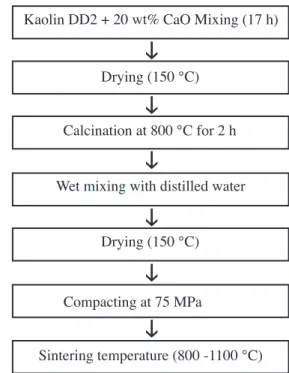
Kaolin DD2 + 20 wt% CaO Mixing (17 h)
Drying (150 °C)
Drying (150 °C) Calcination at 800 °C for 2 h
Wet mixing with distilled water
Compacting at 75 MPa
Sintering temperature (800 -1100 °C)
Oxide SiO2 Al2O3 TiO2 Fe2O3 K2O Na2O CaO MgO SrO P2O3 Cl CO3 IL*
DD2 45.00 33.43 0.22 0.23 0.95 1.12 0.32 0.03 0.19 0.00 0.00 0.00 18.73 CaCO3 0.145 0.088 0.00 0.00 0.007 0.013 99.692 0.011 0.013 0.003 0.037 0.011 0.00 Table I - Chemical compositions (wt %) of kaolin DD2 and calcium carbonate, CaCO3, by X-ray luorescence analysis.
[Tabela I - Composições químicas (% em massa) do caulim DD2 e carbonato de cálcio, CaCO3, por análise de luorescência
de raios X.]
* Ignition loss.
Figure 1: Main route used in this work for anorthite samples elaboration.
were sintered at 800, 850, 900, 1000 and 1100 °C for 1 h. The main steps for preparation of samples used in this work are shown in Fig. 1. The sintering of samples was carried out in a conventional (electrical)furnace (LH 30/14, Nabertherm, Lilienthal, Germany).
The bulk density was determined by weight and volume measurement [54] using the following equation:
ρexp= M/V (A)
where ρ (g/cm3) is the bulk density, M (g) is the mass of the
sample, and V (cm3) is the total volume of the sample. The
relative density was calculated by the following relation:
RD = (ρexp / ρtheo).100 (B)
where ρtheo (g/cm3) is the theoretical density of the sample.
The morphology and the microstructure of kaolin, calcite powders and sample surfaces were observed by a scanning electron microscopy, SEM (JSM-6301 F, Hitachi, Japan) working at 7 kV of accelerating voltage. Before SEM observation, all samples were gold coated. The phase
compositions of the prepared samples were identiied by
X-ray diffraction, XRD (D8 Advance, Bruker, Germany),
with CuKα radiation (λ = 0.154 nm) and a Ni ilter, working voltage of 40 kV, and working current of 30 mA. A Raman micro-spectrometer (Senterra R200L, Bruker, Germany) was optimized for maximum throughout, detection sensitivity
and luorescence suppression. The argon ion laser provided
a 25 mW incident light at 785 nm.
RESULTS AND DISCUSSION
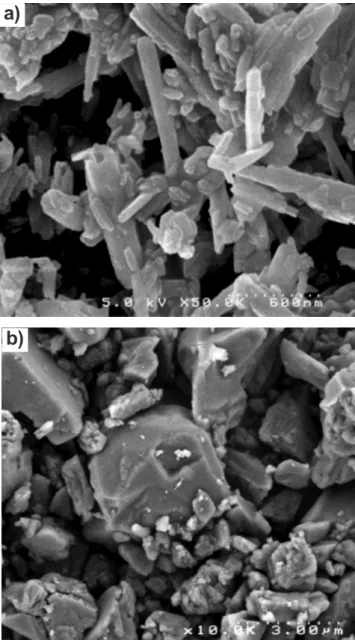
SEM images of natural kaolin (DD2) and calcium carbonate (CaCO3) are shown in Fig. 2. The SEM micrograph shows that the natural kaolin (DD2) powder had stick shaped particles with almost the same mean size and a homogeneous distribution. It crystallizes nicely in the form of naturally hallow nano-rods halloysite crystals. On the other hand, the calcite does not have a particular form, but its distribution remains homogeneous.
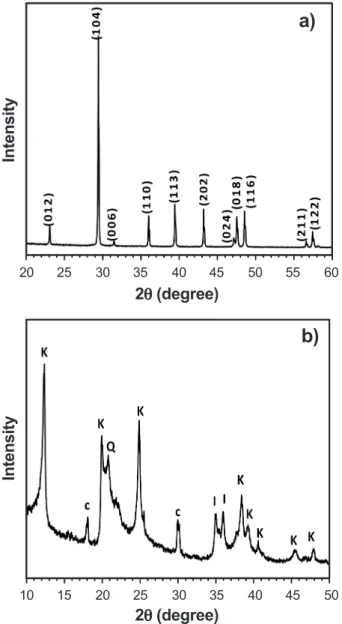
The XRD pattern of the kaolin (Fig. 3a) shows that
kaolinite (K), illite (I), calcite (C) and quartz (Q) are the main
minerals present in this clay. Fig. 3b shows XRD spectrum of calcium carbonate powder, where only CaCO3 phase
is present. This spectrum conirms also that the calcium
carbonates powder is well crystallized.
The relative density of samples sintered at different temperatures is illustrated in Fig. 4. A preliminary study showed that the anorthite samples, as prepared, are easy to sinter. Their relative density was about 96% of the theoretical one even for samples sintered at 900 °C for 1 h. This value is much higher than those reported by [48, 50] for samples sintered under the same conditions. This result highlights
the importance of using the modiied milling system and
native natural materials (kaolin DD2 type and CaCO3). When this process was applied, the powder particles were
drastically reduced. Moreover, the morphology of particles had elongated and spherical shapes.
Fig. 4 illustrates that the bulk density increases with the increase in the sintering temperature (800-1100 °C). In fact, the bulk density increases sharply between 800 and 900 °C, where the bulk density varies from 1.68 to 2.64 g/cm3. In contrast, this bulk density increases slowly
from 2.64 to 2.61 g/cm3, between 900 and 1000 °C.
Indeed, the variation in bulk density value (0.96 g/cm3)
in the irst stage was greater than that in the second stage
(0.03 g/cm3). Afterwards, the relative density decreases
signiicantly at 1000 °C. Additionally, a relative density
of about 96% of the theoretical one was reached for anorthite samples, sintered at 900 °C for 1 h, using the proposed activating process. Consequently, this process is,
Figure 2: SEM micrographs of: (a) natural kaolin (DD2) powder, and (b) calcium carbonate (CaCO3) powder.
[Figura 2: Micrograias obtidas por microscopia eletrônica de varredura do: (a) pó de caulim natural (DD2) e (b) pó de carbonato de cálcio (CaCO3).]
a)
effectively, the main cause of densiication enhancement. A typical SEM micrograph of the fracture surface of sample sintered at 900 °C for 1 h is given in Fig. 5. This image
indicates that the more densiied samples can correspond to
the more resistant one. Furthermore, the decrease in relative density for samples sintered at temperatures higher than 1000 °C may be due to the formation of volatile compounds in connection with some foreign impurities, existing in the starting material (kaolin). These compounds may lead to the pore formation at high temperatures.
Several mechanisms may be distinguished, by which the phase transformation contributes to the sintering. The presence of liquid phase may lead to the rearrangement of particles and may become consequently more mobilized. The presence of the liquid phase may also encourage atoms
of small particles to move through it towards the concave regions of larger grains or particles in order to promote grain
growth and therefore greater densiication of the material.
However, the semi-stability was observed in the second stage for anorthite samples. This may be due to the fact that
sintering reached its inal stage, where the formed pores
were closed, and the increase in temperature cannot increase the density. By contrast, the relative density decreased for samples sintered at temperatures higher than 1000 °C. This decrease may be attributed to the formation of an excessive amount of liquid phase. In fact, the increase in the sintering temperature encourages excessive formation of the liquid phase which inhibits sintering in its turn. In addition, higher sintering temperatures may lead to some gases involved in the chemical composition of raw materials, which leaves
behind it large pores dificult to be driven out. So, this may
be the main factor controlling this decrease in sintering rate.
Figure 5: SEM micrograph illustrating submicron anorthite grains for sample sintered at 900 °C for 1 h.
[Figura 5: Micrograia obtida por microscopia eletrônica de
varredura mostrando grãos submicrométricos de anortita para
amostra sinterizada a 900 °C por 1 h.] Figure 3: X-ray diffraction patterns of: (a) kaolin (DD2) powder
and (b) calcium carbonate powder. C - carbonate, I - illite, K - kaolinite, Q - quartz.
[Figura 3: Difratogramas de raios X do: (a) pó de caulim (DD2) e (b) pó de carbonato de cálcio. C - carbonato, I - ilita, K - caulinita,
Q - quartzo.]
20
10
2q (degree)
2q (degree)
Intensity
Intensity
40
30 30
20
50
40 25
15
45
35 35
25
55
45 60
50
a)
b)
Figure 4: Bulk density of anorthite samples sintered at different temperatures for 1 h.
[Figura 4: Densidade aparente de amostras de anortita sinterizadas em diferentes temperaturas por 1 h.]
Sintering temperature (ºC)
Bulk density (g.cm
-3 )
Relative density (%)
800
2.6
2.2
1.8 2.4
2.0
1.6 60
70 80 90 100
900 1000 1100
Finally, another interesting controlling parameter in favor
of this signiicantly lower sintering temperature is the iner
microstructure of the used kaolin powder (Fig. 2a). Indeed, the sintering temperature is generally closely related to the average particle size of starting powders.
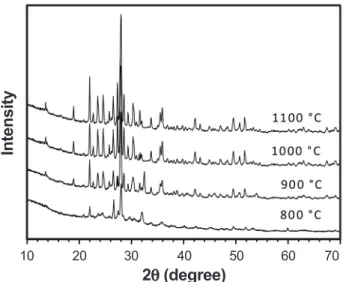
The XRD patterns for samples sintered at different temperatures are illustrated in Fig. 6. Apart from XRD pattern of sample sintered at 800 °C which contains only
few more intense peaks (conirming its partial crystallization
at this temperature), all diffraction peaks belong to the anorthite phase. In general, sintering produces a series of reactions or phase transformations that may lead to the anorthite formation [55]. It has also been noticed an evolution in the number and intensity of diffraction peaks with the increase in temperature. This may clearly explain the role of the temperature in the crystallization and sintering of anorthite. Moreover, after a careful examination of these XRD patterns, one can remark that fortunately there are no
any free CaO traces. This result is a good conirmation of
the large application domains of these elaborated anorthite based ceramics. This crystallization behavior is also closely
related to the densiication process.
Additionally, Fig. 7 conirms again a typical anorthite
structure sintered at different temperatures for 1 h, using Raman spectroscopy. Indeed, all the vibration regions,
shown in this igure, entirely coincide with those reported
in the literature [56], in the low wavenumber region of 400-1200 cm-1. The prominent peaks in this region
represent vibrations within the anorthite [56]. The results of Raman spectroscopy of the anorthite (Fig. 7) show the characteristic bands: the band at 503 cm-1 in the spectrum
of crystalline anorthite corresponds to the motion of the oxygen atom along a line bisecting the T-O-T angle (where T: Si or Al) is characteristic of the feldspar structure, which contains four-membered rings of tetrahedra. The bands
in the 600-800 cm-1 region are due to Al or Si vibrations
within tetrahedral units. In general, the modes between 900 and 1200 cm-1 are assigned to antisymmetric stretching
motions within the T-O-T linkages [ns(T-O-T)]. The highest
frequency bands in this range can be attributed primarily to
nas(Si-O-Si), and the bands at lower frequency to nas(Si-O-Al)
modes. The width, position and relative intensity of these high frequency modes are indicative of the degree of Al/Si. The presence of weak bands at 1125 cm-1 possibly indicates that a
small degree of Al-Si disorder exists in the synthetic anorthite sample and the Al-Si order was incomplete [56-58].
CONCLUSIONS
It can be concluded that anorthite (CaO.Al2O3.2SiO2)
based ceramics have been prepared from kaolin (DD2) and calcium carbonate as starting materials and using a modiied milling system. The prepared samples sintered at relatively low temperatures (800, 850, 900, 1000 and 1100 °C) were also characterized by scanning electron microscopy, X-ray diffraction and Raman spectroscopy. The main phase identiied in all samples was only anorthite, which is a stable phase. A relative density of about 96% was obtained for sample sintered at 900 °C for 1 h. It has also been conirmed that the relative density of anorthite samples is closely related to sintering temperatures. Moreover, it has been demonstrated that this modiied milling system is also a good mixing system.
REFERENCES
[1] R.D. Sahnoun, J. Bouaziz, Ceram. Int. 38 (2012) 7. [2] A. Boulmokh, Y. Berredjem, K. Gueri, A. Gheid, J.
Appl. Sci. 2 (2007) 440.
[3] J. Zhang, M. Iwasa, N. Kotobuki, T.Tanaka, M. Hirose,
H. Ohgushi, D. Jiang, J. Am. Ceram. Soc. 89 (2006) 3348. Figure 6: X-ray diffraction patterns of anorthite samples sintered at
different temperatures for 1 h.
[Figura 6: Difratogramas de raios X de amostras de anortita
sinterizadas em diferentes temperaturas por 1 h.]
10
2q (degree)
Intensity
30
20 40 50 60 70
Figure 7: Raman spectra of anorthite samples sintered at different temperatures for 1 h.
[Figura 7: Espectros Raman de amostras de anortita sinterizadas em diferentes temperature por 1 h.]
400 500 600 700 800 900 1000 1100 1200
Raman shift (cm-1)
[4] A. Harabi, E. Harabi, S. Chehalatt, S. Zouai, N. Karboua,
L. Foughali, Des. Wat. Treat. 57 (2016) 5309.
[5] E. Harabi, A. Harabi, F.Z. Mezahi, S. Zouai, N. Karboua,
S. Chehalatt, Des. Wat. Treat. 57 (2016) 5302.
[6] E. Harabi, A. Harabi, L. Foughali, S. Chehlatt, S. Zouai, F.Z. Mezahi, Acta. Phys. Pol. A, 127 (2015) 1161.
[7] L. Foughali, A. Harabi, J.P. Bonnet, D. Smith, B. Boudaira, Cerâmica 60 (2014) 546.
[8] F.Z Mezahi, H. Oudadesse, A. Harabi, A. Lucas-Girot, Int. J. Appl. Ceram. Technol. 9 (2012) 529.
[9] A. Harabi, S. Chehlatt, J. Therm. Anal. Calorim. 111
(2013) 203.
[10] A. Harabi, S. Zouai, Int. J. Appl. Ceram. Technol. 11
(2014) 31.
[11] S. Chehlatt, A. Harabi, E. Harabi, S. Zouai, H. Oudadesse, S.E. Barama, Des. Wat. Treat. 57 (2016) 5296.
[12] S. Chehlatt, A. Harabi, H. Oudadesse, E. Harabi, Acta. Phys. Pol. A, 127 (2015) 925.
[13] A. Harabi, E. Harabi, Mater. Sci. Eng. C, 51 (2015) 206. [14] S. Zouai, A. Harabi, N. Karboua, E. Harabi, S. Chehlatt,
S.E. Barama, S. Zaiou, F. Bouzerara, F. Guerfa, Mater. Sci. Eng. C Mater. Biol. Appl. 61 (2016) 553.
[15] A. Harabi, S. Achour, J. Mater. Sci. Lett. 18 (1999) 955.
[16] M.R. Boudchicha, S. Achour, A. Harabi, J. Mater. Sci. Lett. 20 (2001) 215.
[17] A. Mecif, J. Soro, J.P. Bonnet, A. Harabi, J. Am. Ceram. Soc. 93 (2010) 1306.
[18] A. Harabi, N. Karboua, S. Achour, Int. J. Appl. Ceram.
Technol. 9 (2012) 124.
[19] A. Harabi, T.J. Davies, Br. Ceram. Trans. J. 94 (1995)
79.
[20] A. Harabi, T.J. Davies, Br. Ceram. Trans. J. 94 (1995)
97.
[21] S. Kitouni, A. Harabi, Cerâmica 57 (2011) 453.
[22] O. Toumiat, S. Achour, A. Harabi, N. Tabet, M. Boumaour, M. Maallemi, Nanotech. 17 (2006) 658.
[23] O. Bourbia, S. Achour, N. Tabet, M. Parlinska, A. Harabi, Thin Solid Films 515 (2007) 6758.
[24] F. Bouzerara, A. Harabi, S. Achour, A. Labrot, J. Eur. Ceram. Soc. 26 (2006) 1663.
[25] A. Harabi, F. Bouzerara, S. Condom, Des. Wat. Treat.
6 (2009) 222.
[26] B. Boudaira, A. Harabi, F. Bouzerara, S. Condom, Des. Wat. Treat. 9 (2009) 142.
[27] F. Bouzerara, A. Harabi, S. Condom, Des. Wat. Treat.
12 (2009) 415.
[28] A. Harabi, A. Guechi, S. Condom, Procedia Eng. 33
(2012) 220.
[29] F. Bouzerara, A. Harabi, B. Ghouil, N. Medjemem, B. Boudaira, S. Condom, Procedia Eng. 33 (2012) 278.
[30] A. Harabi, F. Zenikheri, B. Boudaira, F. Bouzerara, A. Guechi, L. Foughali, J. Eur. Ceram. Soc. 34 (2014) 1329.
[31] L. Foughali, A. Harabi, S.E. Barama, F. Bouzerara, A. Guechi, B. Boudaira, Des. Wat. Treat. 57 (2016) 5291.
[32] F. Bouzerara, S. Boulanacer, A. Harabi, Ceram. Inter.
41 (2015) 5159.
[33] A. Harabi, B. Boudaira, F. Bouzerara, L. Foughali, F. Zenikheri, A. Guechi, B. Ghouil, S. Condom, Acta. Phys. Pol. A, 127 (2015) 1164.
[34] L.F. Han, Z.L. Xu, Y. Cao, Y.M. Wei, H.T. Xu, J. Membr. Sci. 372 (2011) 164.
[35] J. Bai, Ceram. Int. 36 (2010) 678.
[36] T. Mohammadi, A. Pak, J. Sep. Purf. Sci. 30 (2003)
241.
[37] B. Ghouil, A. Harabi, F. Bouzerara, B. Boudaira, A. Guechi, M.M. Demir, A. Figoli, Mater. Charact. 103 (2015)
18.
[38] N. Mdjemem, A. Harabi, F. Bouzerara, L. Foughali, B. Boudaira, A. Guechi, N. Brihi, J. Taiwan. Inst. Chem. Eng.
59 (2016) 85.
[39] I. Ganesh, J.M.F. Ferreira, Ceram. Int. 35 (2009) 15.
[40] F. Bouzerara, S. Boulanacer, A. Harabi, B. Boudaira, S. Achour, S. Condom, Phys. Procedia 2 (2009) 449.
[41] S. Masmoudi, R. Ben Amar, A. Larbot, H. El Feki, A. Ben Salah, L. Cot, J. Membr. Sci. 247 (2005) 1.
[42] S. Rakib, M. Sghyar, M. Raiq, D. Cot, A. Larbot, L.
Cot, Ann. Chim. - Sci. Mat. 25 (2000) 567.
[43] G. Balakrishnan, F.C. Reid, D. Bruhn, L. Kohlstedt, J.
Am. Ceram. Soc. 84 (2001) 2617.
[44] S. Kavalci, E. Yalamac, S. Akkurt, Ceram. Int. 34
(2008) 1629.
[45] S. Kurama, E. Ozel, Ceram. Int. 35 (2009) 827.
[46] B. Ryu, I. Yasui, J. Mater. Sci. 29 (1994) 3323.
[47] H.C. Park, S.H. Lee, B.K. Ryu, M.M. Son, H.S. Lee, I.
Yasui, J. Mater. Sci. 31 (1996) 4249.
[48] Y. Kobayashi, E. Kato, J. Am. Ceram. Soc. 77 (1994)
833.
[49] Y. Kobayashi, K. Sumi, E. Kato, J. Am. Ceram. Soc. 105 (1997) 723.
[50] S. Achour, M.R. Boudchicha, A. Harabi, Polish. Ceram. Bull. 60 (2000) 357.
[51] S. Masmoudi, A. Larbot, H. El Feki, R. Ben Amar, Desalination 190 (2006) 89.
[52] B. Boudaira, A. Harabi, F. Bouzerara, F. Zenikheri, A. Guechi, Des. Wat. Treat. 57 (2016) 5265.
[53] A. Guechi, A. Harabi, S. Condom, F. Zenikheri, B. Boudaira, F. Bouzerara, L. Foughali, Des. Wat. Treat. 57
(2016) 5252.
[54] W. Ming, Z. Ruzhong, M. Weiqing, L. Yi, J. Mater. Sci.
22 (2011) 843.
[55] A. Guechi, S. Achour, A. Harabi, Key Eng. Mater. 268
(2012) 57.
[56] I. Daniel, P. Gillet, P.F. Mcmillan, P. Richet, Mineralogical Magazine 59 (1995) 25.
[57] S.K. Sharma, B. Simons, H.S. Yoder, Amer. Mineral. 68 (1983) 1113.
[58] R.L. Frost, Clay. Miner. 32 (1997) 65.