Experimental investigation on the use of steel-concrete
bond tests for estimating axial compressive strength of
concrete. Part 2: APULOT
Investigação experimental sobre o uso de ensaios de
aderência aço-concreto para estimativa da resistência
à compressão axial do concreto. Parte 2: APULOT
a Univesidade Federal do Rio Grande do Sul, Programa de Pós Graduação em Engenharia Civil, Porto Alegre, RS, Brasil; b Univesidade Estadual Paulista, Departamento de Engenharia Civil, Ilha Solteira, SP, Brasil;
c Institut National des Sciences Apliquées, Département de Génie Civil, Toulouse, França.
Received: 15 Mar 2014 • Accepted: 15 Jul 2014 • Available Online: 02 Oct 2014
Abstract
Resumo
The scope of this research investigates the feasibility to use steel-concrete bond tests for estimating the compressive strength of concrete to
supplementary use it in the quality control of reinforced concrete. Lorrain and Barbosa (2008)[1] and Lorrain et al. (2011)[2] justify the use of a modiied bond test, called APULOT, to estimate the compressive strength of concrete, thereby increasing the possibilities for the technological control of reinforced concrete at construction sites. They propose an adaptation of the traditional pull-out test (POT) method, standardized by CEB/ FIP RC6:1983[3], as this is a low complexity test with the advantage of reduced costs. The use of the APULOT test as a technological control test of concrete at construction sites requires determining a standard and also adapting it from the experimental laboratory practice to the ield. The irst part of this work evaluated the potential to perform compressive strength estimates from the bond strength data obtained by the POT test. The second part of this paper will present and discuss the test results achieved by the APULOT method. Two concrete compositions of different classes (25 MPa and 45 MPa) were tested at 3, 7 and 28 days. Ribbed bar specimens (nominal diameters of 8, 10 and 12.5 mm) were also used in the preparation stage of the specimens, totaling 144 APULOT tests. The results show that under standard test conditions, the correlation between the maximum bond strength and the compressive strength of concrete is satisfactory at all ages tested, corroborating the objective of consolidating
this test as a complementary alternative for controlling the quality of reinforced concrete.
Keywords: bond steel-concrete; pull-out; APULOT; compressive strength of concrete.
EA presente pesquisa se propõe a estudar a viabilidade do uso de ensaios de aderência aço-concreto para estimativa da resistência à compressão axial do concreto, com o objetivo de empregá-los como um complemento no controle de qualidade do concreto armado. Lorrain e Barbosa (2008) [1]e Lorrain et al. (2011)[2]justiicam a utilização de um ensaio de aderência modiicado, denominado APULOT, para estimar a resistência à com
-pressão do concreto, incrementando as possibilidades de controle tecnológico do concreto armado em canteiros de obras. Os mesmos propõem uma adaptação do método pull-out test (POT) tradicional, normalizado pela CEB/FIP RC6:1983[3], por ser este um ensaio de baixa complexidade e de custo reduzido. Para viabilizar o uso do ensaio APULOT como ensaio de controle tecnológico do concreto em canteiro de obras é necessário deinir um padrão para o mesmo e adaptá-lo da prática experimental do laboratório para o campo. A primeira parte deste trabalho buscou avaliar a potencialidade de efetuar estimativas da resistência à compressão a partir dos dados da tensão de aderência obtidos com uso do POT. Na segunda parte deste trabalho serão apresentados e discutidos resultados de ensaios realizados com o método APULOT. Foram ensaiadas 2 composições de concreto de classes distintas (25 MPa e 45 MPa), aos 3, 7 e 28 dias. Foram, ainda, usadas na confecção dos corpos de prova barras nervuradas com diâmetros nominais de 8, 10 e 12,5 mm, totalizando 144 ensaios do tipo APULOT. Os resultados obtidos mostram que, sob condições padro
-nizadas de ensaio, a correlação entre a tensão máxima de aderência e a resistência à compressão do concreto é satisfatória, em todas as idades ensaiadas, fortalecendo o propósito de consolidar este ensaio como uma alternativa complementar para controle de qualidade do concreto armado.
Palavras-chave: aderência aço-concreto; pull-out; APULOT; resistência à compressão do concreto.
B. V. SILVA a
M. P. BARBOSA b
L. C. P. SILVA FILHO a
M. S. LORRAIN c
1. Introduction
This study was conducted at UNESP/SP and is inserted in the APULOT research group composed of researchers from France, Brazil and other countries, which has been working on the improve
-ment of a new test method based on the steel-concrete bond test: the pull-out test (POT), originally proposed as a recommendation from CEB/FIP RC6:1983[3], which is characterized by its simplicity and low cost. In continuity to Part 1 of this article presented in Vale Silva et. al (2013)[4], which addressed standardized POT tests and
its perspectives in determining the compressive strength of
con-crete, the objective of this second part is to analyze the results of another series of tests performed by the authors, which addressed the proposal of the APULOT method, however using PET bottle
molds as sample specimens, thus demonstrating that the tests can
be performed in a simple manner, not entailing major technological
devices. The same concrete compositions, test ages and types of
reinforcement bars presented in part 1 of this article [4] were used, however the anchorage length calculation was based on the new premise developed by Lorrain and Barbosa (2008) [1].
2. Considerations of
the APULOT methodology
The essential characteristic of the APULOT method (Appropriate Pull-Out Test) is the possibility to use it at construction sites in
a suitable pull-out type steel-concrete bond test in order to esti-mate the compressive strength of concrete, thereby obtaining a
complement for the technological control of concrete from a bond test.
There are numerous bond test conigurations found in the literature, as illustrated in Figure 1: (a) Direct “pull-out test” (POT), (b) Eccen
-tric pull-out test, (c) Direct “push-in test” (PIT), (d) Modiied pull-out test to minimize the effects of compression, (e) Direct Tensile test, (f) Direct Tensile Test with 3 bars, (g) Extreme Beam End Test, (h) Bending tests in modiied beam (beam best), (i) Bending beam test
to study anchoring effects, coatings and transfer reinforcement.
According to ACI 408R:2003[6] the test that best reproduces the be
-havior of steel-concrete bond is the bending test in modiiedbeams (beam-test) (Figure 1(h)). But the most used, due to its simplicity, is the direct pull-out test [3] (Figure 1(a)). Although the pull-out test
did not reproduce the bending effects on the steel-concrete bond,
resulting in restrictions when the effective bond strength of struc -tural components must be determined, it is interesting for the tech-nological control of concrete, because the pull-out is effective for
comparing concretes with different strengths in relation to the bond strength of steel-concrete. Lorrain and Barbosa (2008)[1], aware
of this important pull-out feature and to demonstrate that the bond tests could be performed in a simple manner at the construction
site, proposed the new APULOT method, using discarded PET bottles as mold specimens and a leaking hydraulic jack piston for
the pull-out tests, thus demonstrating this is an easy to implement
method and with the advantage of low costs.
The various research details of the APULOT tests are under investi
-gation by the research group designated as the APULOT Group, con
-sisting of various research centers of Excellence1. The group believes that by implementing this type of bond test, complementary or as an
857
IBRACON Structures and Materials Journal • 2014 • vol. 7 • nº 5
Figure 1 – Schematic drawings of some steel-concrete bond tests
found in the literature (ALVAREZ, 1998)[5]
IBRACON Structures and Materials Journal • 2014 • vol. 7 • nº 5
alternative to compression tests traditionally used in civil construction, it
could lead to signiicant improvements in the quality control of construc
-tion works, enabling to perform the quality control of concrete at shorter ages, quickly and safely at the construction site itself. Within this objec
-tive, there are studies that seek to determine the inluence of several
variables on the response of bond tests in order to consolidate a test
method, for example: evaluation of the inluence of surface corrosion on bond [7]; analysis of the procedure to remove the bar from the concrete (pull-out or push-in) [8]; comparison between different geometrical con
-igurations of steel bars on the test response [9], [10]; evaluation of the effect of changes in the concrete cover around the steel bar [11], [12]; analysis of the bond test results using artiicial neural networks [13]; evaluation of the mechanical strength inluence of the concrete on the bond tests [14], [15]; evaluation of the molds geometry inluence on the bond test [16]; Among the studies, besides the experimental activities, there are also numerical simulations [17], [18], which propose to pa
-rameterize simpler ways to implement the test at construction sites; and inally the Research Group LEME/UFRGS has been testing the push-in instead of the pull-out system and the parameters for the standardiza -tion of the method at construc-tion sites.
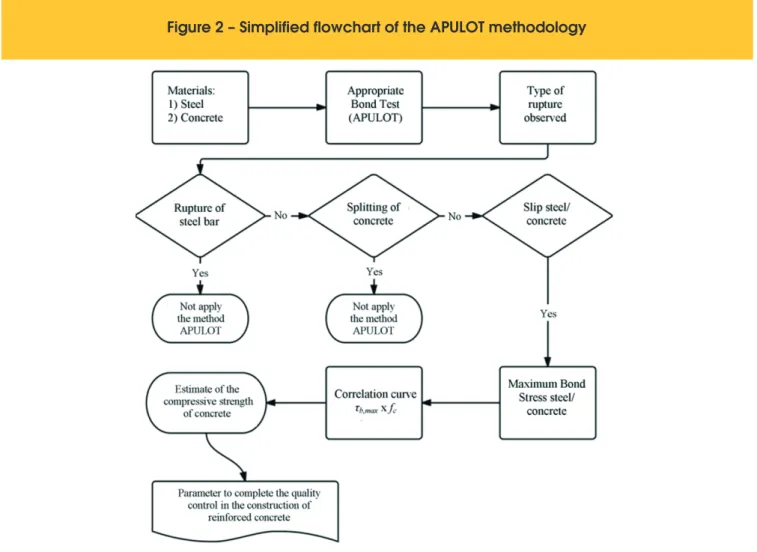
It is important that for a satisfactory bond test response, the steel bar slip relative to the concrete must occur, excluding from the correla
-tion curve the results where the steel bar rupture or concrete splitting
occurs. Figure 2 illustrates a lowchart for the proper application of the APULOT methodology.
3. Experimental development
The characteristics of the materials used in the experimental pro
-gram and the procedures employed in the bond tests were present
-ed in part 1 [3] of this article. The proc-edures of the APULOT method
Figure 2 – Simplified flowchart of the APULOT methodology
859
IBRACON Structures and Materials Journal • 2014 • vol. 7 • nº 5
with PET bottle molds will be discussed in part 2 of the article. Figure 3 illustrates the dimensions of the specimens for the APULOT test method with anchorage length of 10Ø. The PET bottle molds used as test specimens were prepared as illustrated in Figure 4(a)
and positioned on the support for their concreting, as illustrated in
Fig-ure 4(b). After 24 h, the test specimens were placed in a temperatFig-ure and humidity controlled chamber until the failure dates (3 days, 7 days
and 28 days), note that for a later application of the method at the con-struction site, the curing procedure in a saturated solution can be used
as it is usually employed in the ield. Another aspect of the method is that the plastic casing of the PET bottle used as a mold is not removed during curing and is kept there until the end of the pull-out test. For the irst estimate of the experimental anchorage length (lexp) of this
test, the basic premise used was that the steel bar slip occurs in re -lation to the surrounding concrete. To satisfy this condition, the bond stress should not cause concrete splitting and the steel stress should
not reach the breaking point. Therefore, we used the maximum bond
stress values (τb,max) obtained experimentally in the tests in which slip occurred, [1] and [2]. Thus, through the correlation between the com
-pression strength and maximum bond stress, together with the applica
-tion of Equa-tion 1, an experimental anchorage length of 10Ø was set, where Ø is the diameter of the steel bar for the concrete of class 25 MPa (T25) and the value of 6Ø for the concrete of class 45 MPa (T45).
(1)
In Equation 1: fsy is the yield stress of the steel; Ø is the diameter of
the steel bar; lexp is the length of the experimental anchorage of the
test specimens; τb,max is the maximum bond stress obtained from the correlation curve proposed by Lorrain and Barbosa (2008)[1]. It should be noted that the values used for the anchorage length in this experimental research are part of the irst attempts to deine this param
-eter in the APULOT method, which can be reformulated in accordance with the research advances. Another change introduced, compared to the pull-out recommended by RILEM, is that the steel bar has two
non-bond areas positioned at the ends of the test specimen, in order to ensure a more uniform bond distribution over the anchorage length.
The pull-out system used was the same used in the POT tests and previously described in the previous article: part 1 [4], as illustrated in Figure 5 and the schematic of Figure 6. A leaking hydraulic jack
Figur
4 – (a) PET bottle mold (b) Concr eting
e
of the PET bottle mold on the metal support
A
B
Figure 5 – Pull-out system of
the APULOT test method
IBRACON Structures and Materials Journal • 2014 • vol. 7 • nº 5
was used to apply the force with 600 kN piston capacity, connected to a manual pressure pump where a traction force was applied at one end of the bar, which reacted against the test specimen. The pull-out strength was measured by the load cell and linear dis
-placement by LVDT (Linear Variable Differential Transformer) as il
-lustrated in Figure 6. These data were transmitted to a “QuantumX” data acquisition system and viewed through the “CatmanEasy” soft
-ware, both from HBM. This system enabled to obtain force curves versus displacement curves. The decision to use a load cell with a displacement transducer (LVDT) was to obtain additional test re
-sults with respect to load increases with the relative steel and con -crete slips and types of ruptures. The main goal of the method is
to achieve the maximum force required to remove the bar from the concrete, which at a later ield implementation stage, only one load cell can be used with a reading ability equivalent to the load of the
hydraulic cylinder coupled to a digital or analog load display.
To study the APULOT steel-concrete bond, two concrete composi
-tions (T25 and T45) three rupture ages (3 days, 7 days and 28 days) and three steel bar diameters CA-50 (8 mm and 10 mm and 12.5
mm)were tested. Eight test specimens were tested for each combi -nation described above, totaling 144 tests. For all types of concreting
performed, the compressive strength of the concrete was checked
using cylindrical test specimens (Ø10x20cm), whose results were
presented in the previous article (Part1)[4]. The tests performed en -abled to obtain the intensities of the forces due to the steel bar slip.
In accordance with the recommendations of CEB/FIP RC6:1983[3], with this force value divided by the lateral anchorage area of the bar,
the bond stress (τb) was calculated, as shown in Equation 2.
(2)
Where F is the pull-out force, Ø is the diameter of the steel bar and
lexp is the anchorage length of the test. It should be noted that the
maximum bond stress (τbmax) was calculated based on the maxi -mum pull-out strength.
4. Results and discussions
This section presents the results obtained in the APULOT tests, which analyzes the mechanical behavior of the steel bars pulled
from the concrete through slip curves, according to the bond
strength and the correlation between the maximum bond stress and the axial compressive strength of the concrete.
int
int
Figure 7 – Type of rupture by slip of steel bar
in the APULOT method with PET
mold. (a) before and (b) after test
A
B
Figure 8 – Type of rupture by concrete splitting in the APULOT method
with PET mold. (a) front view and (b) side view of test specimens
861
IBRACON Structures and Materials Journal • 2014 • vol. 7 • nº 5
4.1 Bond-stress curves vs. steel bar slip curves
Through the slip curves vs. the bond stress, the mechanical
behav-ior the test specimens’ rupture was evaluated, verifying in which
test specimens the steel bar slip occurred relative to the concrete,
the concrete splitting or steel bar rupture. Different types of rupture were found: for the 8.0 mm diameter steel bars most of the speci
-mens (96%) showed steel bar slip relative to the concrete; the 10.0 mm bars had steel bar slip relative to the concrete (75%); while in
the 12.5 mm bars all specimens had concrete splitting rupture.
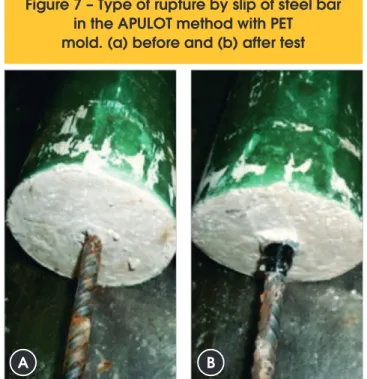
Fig-ures 7(a) and 7(b) show the steel bar slip relative to the concrete before and after the APULOT test and Figures 8(a) and 8(b) show the type of concrete splitting rupture in the APULOT test.
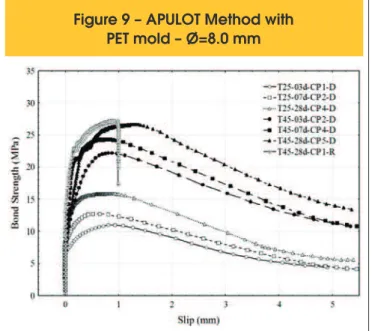
Figures 9, 10, 11 and 12 show the differences in the bond stress
curves vs. slip curves for the APULOT method according to the concrete composition and age, using PET mold and 8 mm, 10 mm
and 12.5 mm bars, respectively.
Figure 9 illustrates the curves obtained for the tests using 8.0 mm bars, which shows the steel bar slip in relation to the concrete at all ages for the T25 samples, and for the T45 specimens there was slip rupture at 3 and 7 days, and at 28 days, in addition to slip, there was yielding of the steel, and in the series there was steel rupture of one test specimen, as shown in Figure 9.
Figure 10 illustrates the curves obtained for the test using 10.0 mm
bars which show the type of slip rupture of the steel bar relative
to the concrete, for T25 and T45. Figure 11 illustrates the curves
obtained for the tests using 10.0 mm bars, showing the type of rup
-ture by splitting of the concrete, for T25 and T45, and also shows
Figure 9 – APULOT Method with
PET mold – Ø=8.0 mm
Figure 10 – APULOT Method
with PET mold – Ø=10.0 mm (D)
Figure 11 – APULOT Method with
PET mold – Ø=10.0 mm (F)
IBRACON Structures and Materials Journal • 2014 • vol. 7 • nº 5
the steel rupture in one specimen of the series. Figure 12
illus-trates the curves obtained for the tests using 12.5 mm bars, which show the type of rupture by splitting of the concrete in all tests. Table 1 shows the types of ruptures observed in the APULOT test specimens, where the letter “D” means that there was slip of the steel bar relative to the concrete; the letter “F” means that splitting occurred in the concrete specimen and the letter “R” means that there was rupture of the steel bar.
It is observed that splitting occurred in 100% of the 12.5 mm bars, and in 23% of the 10.0 mm bars, and only in 4% of the 8.0 mm bars, hence showing a transition zone between the steel bar slip and concrete splitting for the relationship between dec/Ø>4.5 and c/Ø<5.75, where c/Ø is the relationship of the concrete cover around the steel bar. This fact is related to the PET bottle mold used, which did not have the suitable dimensions to withstand the
stresses caused by the increasing diameter of the bars. These
re-sults are consistent with those obtained by Makini et al. (2010)[12], which showed that for the rupture by slip to occur the ratio should be c/Ø ≥ 5. Other authors, such as Torre-Casanova et al. (2013) [20], showed that the c/Ø > 4.5 ratio is required for the occurrence
of rupture by slip of the steel bar.
Figure 13 shows an example of the type of rupture by slip and the type of rupture by splitting, evidencing that in the POT or APU
-LOT test the maximum bond stress is equivalent, provided that the proper containment conditions (c/Ø ratio) and the type of rupture
by slip are maintained.
With the mechanical behavior of the test specimens analyzed
through the slip curves according to the bond strength, the
correla-tion between the maximum bond strength and the compressive strength of the concrete was studied. However, as shown in the lowchart of Figure 2, the APULOT method is not applicable to the test specimens that exhibited rupture by splitting of the concrete and/or rupture of the steel bar, thus these results are excluded
from the correlation curve.
4.2 Analysis of the correlation between
the maximum bond strength (
τ
bmax)
and compressive strength (f
c)
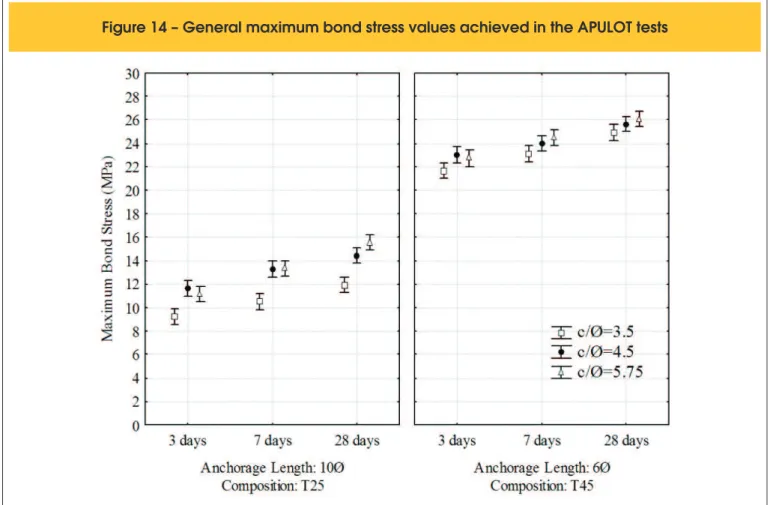
Table 2 and Figure 14 show the results obtained from the APULOT bond tests, as well as the composition and age of the concrete, the axial compression results and the diameter of the steel bar. Note that the correlation analysis between the variablesfc and τbmax
is valid only for the results where the steel bar slip of the concrete was found, so the results with Ø=10 mm and Ø=12.5 mm were
compromised because in these results the splitting and rupture of
the steel bar were observed in some cases.
In order to apply the APULOT method, keeping to the results where steel slip was observed on the concrete, the graph in Figure 15 shows the two compositions (T25 and T45) for the results using
Ø=8 mm. Figure 15 shows the occurrence of non-linearity between
the change in anchor length of 6Ø to 10Ø, where this change in anchoring length generated two families of correlation curves be
-tween the variables τbmax x fcm, whereby the results clearly explain that there is a need to set this parameter in the test methodology, because there is a better correlation if the anchorage length is set.
In order to correlate the compressive strength of concrete with the maximum steel-concrete bond strength, linear regressions were per
-Table 1 – Types of ruptures observed
in the APULOT test specimens
Description Composition - Ø (mm)
Description Composition - Ø (mm)
Description Composition - Ø (mm)
(c/Ø) (c/Ø) (c/Ø) Age (days) Age (days) Age (days) D D D F F F R R R
T25 - 8.0
T25 - 10.0
T25 - 12.5 T45 - 8.0
T45 - 10.0
T45 - 12.5 TOTAL TOTAL TOTAL 5.75 4.50 3.50 5.75 4.50 3.50 3 7 28 3 7 28 3 7 28 3 7 28 3 7 28 3 7 28 7 8 8 8 8 7 96% 6 7 4 7 7 5 75% 0 0 0 0 0 0 0% 0 0 0 0 0 0 0% 1 0 0 0 0 0 2% 2 1 4 1 1 2 23% 0 0 0 0 0 1 2% 0 0 0 0 0 1 2% 8 8 8 8 8 8 100%
863
IBRACON Structures and Materials Journal • 2014 • vol. 7 • nº 5
formed between the compressive strength and bond values. As previ
-ously explained, a speciic linear regression was carried out for each anchorage length. Table 3 shows the regressions and the values of the determination coeficients obtained for the 8.0 mm bars. It can be seen that the coeficients of determination (R2) achieved satisfactory
values, that is, values close to value 1. Similarly, it was found that all angular coeficients are always positive, that is, in the strength range tested there was a signiicant behavior tendency which was charac
-terized by an increase in the maximum bond strength proportional to the increasing axial compression strength of the concrete.
4.3 Standardization of the APULOT methodology
Most methods used in the quality control of reinforced concrete
have predeined methodologies based on speciic standardiza
-tions. The objective of these standardized methodologies is to standardize the tests, in other words, to improve the reproducibility
and accuracy of their responses, reducing the usual errors and
uncertainties underlying in the procedure. It can be said that the APULOT methodology is still in the experimental stage, therefore it is crucial to test the parameters that inluence the test response for
Table 2 – Maximum bond stress values achieved in the APULOT tests and
axial compressive strength values together with the standard deviation
Concrete
composition (days)Age (MPa)fcm t (MPa)
bmax tbmax (MPa) tbmax (MPa)
Ø=8 mm Ø=10 mm Ø=12.5 mm
T25 T25 T25 T45 T45 T45
3 7 28
3 7 28
16.7±1.1 21.1±1.6 28.0±1.8 33.1±1.5 40.5±1.7 49.9±1.8
11.16±0.92 13.34±1.00 15.55±0.76 22.73±1.66 24.48±0.83 26.06±1.16
11.66±0.53 13.27±0.37 14.43±0.47 23.02±0.90 23.98±0.77 25.65±1.12
9.25±0.25 10.53±0.34 11.94±0.95 21.69±1.09 23.11±0.78 24.91±1.41
IBRACON Structures and Materials Journal • 2014 • vol. 7 • nº 5
the correct development of the method. Thus, it is known that the
preparation procedures of the mold, preparation of steel bar, con-crete density in the mold, unmolding procedures, and the storage and curing of test specimens before the test date are essential for
the correct response of the method. Given these points, parame
-ters were set for the APULOT test as a measure of standardization and comparison for future tests, as shown in Table 4.
As can be seen in Table 4, the APULOT method requires the deini
-tion of certain parameters, and results with different models cannot be compared. In other words, setting parameters is critical for the proper performance of the APULOT methodology in order to esti -mate the compressive strength.
5. Conclusions
The correlation curves obtained in this study substantiate the method
proposed by Lorrain and Barbosa (2011)[1] and [2], which is to trans
-form the bonding tests into qualiication tests of reinforced concrete due to the good proportionality of the axial compressive strength and maxi
-mum bond stress. The correlation analysis between the maxi-mum bond strength and compressive strength for the APULOT test with Ø=8 mm
allows to conclude that the bond tests are suitable for estimating the axial compressive strength of the concrete, provided they comply with the parameters listed in Table 4, particularly the relationship between the concrete cover around the bar and the bar diameter (c/Ø), which
must be greater than 5 for the occurrence of rupture by slip.
The application of the APULOT method with 10.0 mm and 12.5 mm
bar diameters requires increasing the concrete cover around the
bars, ensuring the rupture by slip. In other words, increasing the
diameter of the molds is indispensable in order to implement the methodology, as illustrated in Figure 2.
The response of the method for concrete tested at 7 days makes it speciically interesting when decision making support is needed re
-garding nonconforming concrete at early ages. The standardization of
the method presented in Table 4 is vital for its proper implementation and for comparing the results of subsequent research endeavors.
Finally, it is believed that demystifying the bond test will be of a great assistance to the quality control of concrete works, enabling to increase the control at construction sites and at lower costs. However, to standardize the method to safely implement it at con -struction sites requires numerous tests and repetitions in order to verify the limitations and ranges regarding the different types of materials used in different locations.
6. Acknowledgements
We are grateful to FAPESP (Fundação de Amparo à Pesquisa do Estado de São Paulo); To CNPQ (Conselho Nacional de Desen
-volvimento Cientíico e Tecnológico); To LCEC (Laboratório CESP de Engenharia Civil - Ilha Solteira/SP); To the Central Civil Enge
-neering Laboratory of UNESP - Ilha Solteira/SP; To the company ArcelorMittal that provided the steel bars; To the company Holcim do Brasil for providing the cement; and to the company Grace Con
-crete Products for supplying the superplasticizer.
7. References
[01] LORRAIN, M. S.; BARBOSA P. M. Controle de qualidade dos concretos estruturais: ensaio de aderência aço-concre
-to. In: Revista Concreto& Construções, São Paulo, Nº51, 3º
trimestre, p. 52-57, 2008.
[02] LORRAIN, M. S. ; BARBOSA, M. P. ; SILVA FILHO, L. C. P. Estimation of compressive strength based on Pull-Out bond test results for on-site concrete quality control. Revista IBRACON de Estruturas e Materiais, v. 4, p. 4, 2011. [03] COMITÉ EURO-INTERNATIONAL DU BÉTON. RILEM/
CEB/FIP RC6: Bond test for reinforcement steel - 2 Pull-out test. Paris, 1983.
Figure 15 – Correlation between compressive
strength (f ) and maximum bond stress
cm(
t
b,max)
Table 3 – Equations of linear regression lines and their respective determination coefficients
Diameter (mm)
Concrete composition
Range compressive strength (MPa)
Anchorage
length determinationCoefficient of Linear
regression
8 8
T25 T45
16.7 to 28.0 33.1 to 49.9
10Ø 6Ø
2 R = 0.98
2 R = 0.97 tbmax= 0.38 f + 4.9cm
865
IBRACON Structures and Materials Journal • 2014 • vol. 7 • nº 5
Mold
Preparation
and molding
of tests
Steel Bars
Concrete
Demolding,
Curing and
Storage
Execution
of tests
1
2
3
4
5
6
7
8
9
10
11
12
13
14
15
16
17
18
Material of the mold for the
test specimen
Format of the mold for the
test specimen
Anchorage length (le)
Ratio of concrete cover
around the steel bar (c/Ø)
Layout of the bar at
concreting time
Concrete density
in the mold
Number of test specimens
Type of geometrical
configuration of the CA-50
ribbed bars
Diameter of the CA-50
steel bar
State of the bar surface
Compressive strength
of concrete
Characteristic maximum
dimension of the aggregates
Demolding time
Curing and storage
of test specimens
Rupture age
Type of loading
Loading rate
Type of rupture
(a) Metal, (b) nylon fiber,
(c) wood or (d) PET
(a) Cylindrical, (b) cubic
or (c) prismatic
3Ø
≤
le
≤
10Ø
c/Ø>5
(a) Horizontal or
(b) Vertical
(a) Mechanic with
vibrating table or (b)
Manual with metal rod
≥
2 test specimens
per example
Type 1, 2, 3 ... etc.
(a) Ø=8 mm;
(b) Ø=10 mm;
(c) Ø=12.5 mm...etc.
(a) No surface oxidation or
(b) with surface oxidation
Group 1: fc
≤
50 Mpa
Group 2: 50
˂
fc
≤
100 Mpa
ABNT NBR 8953:2011
4x smaller than the
minimum size of the mold
≥
24h
(a) Only stored away from
weather conditions; (b)
Humid chamber with
temperature of 23±2ºC
and relative air humidity
higher than 95%; (c)
Saturated solution of
calcium hydroxide
with temperature of
23±2ºC
≥
3 days
(a) Pull-out or (b) Push-in
Controlled speed or not
(a) Slip; (b) Concrete
splitting; (c) Rupture of bar
(d) PET
(a) Cylindrical
5Ø
5.75
(b) Vertical
(b) Manual with metal rod.
–
Type 1
(illustrated in part 1
of this paper [4])
(a) 8 mm
(a) No surface oxidation
Group 1: C15; C20; C25;
C30; C35; C40; C45; C50.
Group 2: C55; C60; C70.
D
max≤
25 mm
24h
(c) saturated solution
of calcium hydroxide
with temperature
of 23±2ºC
7 days
(a) Pull-out
Manually controlled speed.
Test duration not
less than 60s
(a) Slip
Table 4 – Parameters for the standardization of the test method in the field
IBRACON Structures and Materials Journal • 2014 • vol. 7 • nº 5
[04] VALE SILVA, B.;BARBOSA, M.P.; SILVA FILHO, L. C. P.; LORRAIN, M.S.. Experimental investigation on the use of steel-concrete bond tests for estimating axial compressive strength of concrete: part 1. Revista IBRACON de Estruturas e Materiais, v. 6, p. 715-736, 2013.
[05] ALVAREZ, M.: Einluss des Verbundverhaltens auf das Ver
-formungsvermögen von Stahlbeton. ETH Zürich, Diss., Ba
-sel: Birkhäuser (IBK Bericht 236), 1998.
[6] AMERICAN CONCRETE INSTITUTE. ACI 408R: Bond and
development of straight reinforcing bars in tension.
Farming-ton Hills, 2003.
[07] BARBOSA, M.P. ; GASPARETO, K. ; VALE SILVA, B. ; SIL
-VA FILHO, L. C. P. ; LORRAIN, M. . Experiências sobre a in
-luência da corrosão supericial das armaduras nos ensaios de aderência APULOT. In: CONPAT 2011 - Congreso Latino americano de Patología de la Construcción y el Congreso de Control de Calidadenla Construcción, 2011, ANTIGUA-GUATEMALA. ANAIS DO CONPAT 2011. GUATEMALA, p.
17-24.2011.
[08] DAL BOSCO, V. I. ; VALE SILVA, B. ; TROIAN, P. ; BAR
-BOSA, M.P. ; SILVA FILHO, L. C. P. Comparativo experi
-mental entre os métodos de ensaios pull-out e push-out para determinação da tensão de aderência aço-concreto. In: 54º Congresso Brasileiro do Concreto, 2012, Maceió/AL. Anais do 54º CBC. São Paulo/SP: IBRACON, 2012.
[09] LORRAIN, M. ; CAETANO, L. F. ; VALE SILVA, B. ; GOMES, L.E.S. ; BARBOSA, M. P. ; SILVA FILHO, L. C. P. . Bond strength and rib geometry: a comparative study of the inlu -ence of deformation patterns on anchorage bond strength.
In: PCI Annual Convention & 3rd International FIB Congress FIB, WASHINGTON, D C. CHIGACO: 3rd FIB International Congress FIB, 2010.
[10] SILVA FILHO, L. C. P. ; VALE SILVA, B. ; DAL BOSCO, V. I. ; GOMES, L.E.S. ; BARBOSA, M.P. ; LORRAIN, M. Analy
-sis of the inluence of rebar geometry variations on bond
-ing strength in the pull-out test. In: Bond in Concrete 2012 - Bond, Anchorage, Detailing, 2012, Brescia, Italy. General
aspects of bond, Vol. 1. 2012.
[11] VALE SILVA, B. ; BARBOSA, M.P. ; SILVA FILHO, L. C. P. ; LORRAIN, M. ; DAL BOSCO, V. I. Correlação entre a tensão última de aderência e a resistência do concreto us
-ando ensaio APULOT : avaliação do efeito de variação do cobrimento do concreto ao redor da barra de aço. In: 53º Congresso Brasileiro do Concreto, 2011, Florianópolis/SC. Anais do 53º CBC. São Paulo/SP: IBRACON, 2011. [12] MAKNI, M.; DAOUD, A.; KARRAY, M. A.; LORRAIN, M.. To
-wards a standard pull-out test specimen: geometrical speci
-ications. 3rd ib International Congress. Washington D. C., FIB, 2010.
[13] VALE SILVA, B. ; LORENZI, A. ; BARBOSA, M.P. ; SILVA FIL
-HO, L. C. P. Análise dos resultados de ensaios de aderência aço-concreto através da utilização de redes neurais artiiciais. In: 55º Congresso Brasileiro do Concreto, 2013, Gramado/ RS. Anais do 55ºCBC. São Paulo/SP: IBRACON, 2013. [14] BARBOSA, M. P. ; PEREIRA, J.B.;LORRAIN, M.; Análise ex
-perimental e avaliação da inluência da resistência àcom
-pressão do concreto no ensaio de aderência APULOT. In: 55º Congresso Brasileiro do Concreto, 2013, Gramado/RS. Anais do 55ºCBC. São Paulo/SP: IBRACON, 2013.
[15] GARCÍA-TAENGUA E.; MARTÍ-VARGAS J. R.; SERNA-ROS P.. Bond of reinforcement in concrete applied to con
-crete quality control: The Bottle Bond Test. Strain, v.50,
p.57–67, 2014
[16] CALDERARO, R. P.; BARBOSA, M.P. Aderência Aço-Con
-creto: Análise experimental da inluência da variação da geometria da garrafa PET e do cobrimento do concreto ao redor da barra de aço. In: 54º Congresso Brasileiro do Con
-creto, 2012, Maceió/Al, Anais do 54ºCBC. São Paulo/SP: IBRACON, 2013.
[17] TAVARES, A. J. Aderência aço-concreto: Análise numérica dos ensaios pull-out e APULOT. 2012. 141 f. Dissertação (Mestrado em Engenharia) - Faculdade de Engenharia da Universida de Estadual Paulista (UNESP), Ilha Solteira,
2012.
[18] TAVARES, A. J.; BARBOSA, M. P.; BITTENCOURT T. N.; LORRAIN, M.. Bond steel-concrete: simulation analysis of the pull-out tests and APULOT using the program ATENA. Revista IBRACON de Estruturas e Materiais, v. 7, p.
138-157, 2014.
[19] VALE SILVA, B. Investigação do potencial dos ensaios APU
-LOT e pull-out para estimativa da resistência a compressão do concreto. 2010. 178 f. Dissertação (Mestrado em Engen
-haria) - Faculdade de Engenharia da Universidade Estadual Paulista (UNESP), Ilha Solteira, 2010.
[20] TORRE-CASANOVA A.; JASON L.; DAVENNE L.; PINELLI X.. Coninement effects on the steel–concrete bond strength and pull-out failure. Engineering Fracture Mechanics, v.97, p 92–104, 2013.
8. Nomenclature
APULOT – Appropriate PULL-Out Test; F - Force applied to the pull-out (kN);
lexp- Experimental anchorage length (mm);
Ø- Diameter of the steel bar (mm);
POT - Pull-Out Test (RILEM/CEB/FIP RC6: 1983 [4]);
fc - Axial compressive strength (MPa); fcm - Mean axial compressive strength (MPa); fsy - Steel yield strength (MPa);
τ
b- Bond strength between the steel and the concrete (MPa); τ
![Figure 1 – Schematic drawings of some steel-concrete bond tests found in the literature (ALVAREZ, 1998)[5]](https://thumb-eu.123doks.com/thumbv2/123dok_br/18860496.417841/2.892.67.834.651.1136/figure-schematic-drawings-steel-concrete-tests-literature-alvarez.webp)
![Figure 6 – Scheme of the APULOT pull-out test method [19]](https://thumb-eu.123doks.com/thumbv2/123dok_br/18860496.417841/4.892.62.836.844.1131/figure-scheme-apulot-pull-test-method.webp)