Introduction
By deinition, a medical device is any machine, tool, mechanism, apparatus, implant, in vitro reagent, contrivance or other similar item intended for use in medical or healthcare procedures that has no metabolic, immunological or pharmacological effects (World..., 2003). Medical devices that enter in contact with sterile tissue or vascular system are classiied as critical items and must be sterilized because of high risk of infection (Rutala and Weber, 2016). Sterilization is deined as any method or process where microorganisms present in the material are killed or turned unviable, without changing the initial material properties (Killeen and
McCourt, 2012; Rutala and Weber, 2013). The most
common sterilization process in medicine uses saturated
steam as sterilant (Govindaraj and Muthuraman, 2015). However, this process is only possible when the material to be sterilized withstands high temperatures and humidity. Moisture-sensitive or heat-sensitive materials should be sterilized at low temperatures (Ackert-Burr, 2010). Gases such as ethylene oxide (EtO), hydrogen peroxide and low temperature steam/formaldehyde mixture (LTSF) are the most common low temperature chemical sterilants employed in hospitals (Rutala and Weber, 2016). Each sterilization method presents both advantages and disadvantages, especially concerning the material compatibility and penetrability in narrow lumens (Govindaraj and Muthuraman, 2015). Other low temperature methods include the use of chemical compounds (glutaraldehyde, alcohol, paracetic acid etc.), chlorine dioxide, gas plasmas or ozone (O3) (Rutala and
Weber, 2013). The relevance of O3 gas as sterilant has
increased in the last two decades, mainly owing to the good compatibility with some polymers of medical use and advances in its generation technology.
Ozone is a strong oxidizing gas, colorless in low concentrations, with a characteristic odor (Batakliev et al., 2014) and that can be obtained by electrical gas discharge, ultraviolet light, electrolysis or radiochemical processes (Somalwar et al., 2014). The most common method used for generation of O3 is the electrical gas discharge known
as dielectric barrier discharge (DBD) (Kogelschatz, 2003).
Evaluation of disposable medical device packaging materials under
ozone sterilization
Gerson Roberto Luqueta
1*
, Everton Diniz dos Santos
1, Rodrigo Sávio Pessoa
1,2, Homero Santiago Maciel
1,21Laboratory of Nanotechnology and Plasma Processes, Paraíba Valley University, São José dos Campos, SP, Brazil. 2University Brasil, São Paulo, SP, Brazil.
Abstract Introduction: Ozonization is an alternative sterilization process for heat-sensitive medical devices. However, the side effects of this process on packaging materials should be veriied. Methods: Four types of commercial disposable packaging for medical devices were evaluated after undergoing ozone sterilization: crepe paper sheet, non-woven fabric sheet (SMS), medical grade paper-plastic pouch and Tyvec©-plastic pouch. For each material, the
gas penetration through the microbiological barrier was measured. Other packaging properties, such as chemical composition, color, tactile and mechanical resistance, were also evaluated after sterilization, by using characterization techniques, namely microbiological indicators, infrared spectroscopy, tensile test and optical microscopy. Results: All commercial disposable packaging showed good ozone penetration. Crepe paper and SMS were chemically and mechanically modiied by ozone, while Tyvec© only suffered mechanical modiication. Paper-plastic pouch was the
packaging material which just experienced an acceptable reduction in tensile resistance, showing no variations on chemical or visual properties. Conclusion: The results suggest that medical grade paper-plastic pouch is the most appropriate disposable medical device packaging to be sterilized by ozone when compared to other materials. Keywords Ozone, Packaging, Medical device, Sterilizer, FTIR, Tensile test.
This is an Open Access article distributed under the terms of the Creative Commons Attribution License, which permits unrestricted use, distribution, and reproduction in any medium, provided the original work is properly cited.
How to cite this article: Luqueta GR, Santos ED, Pessoa RS, Maciel
HS. Evaluation of disposable medical device packaging materials under ozone sterilization. Res Biomed Eng.2017; 33(1):58-68. DOI: 10.1590/2446-4740.03216
*Corresponding author: Laboratory of Nanotechnology and Plasma
Processes, Paraíba Valley University, Rua Arquiteto Jose Antonio Cipriano, 85, Bairro Portal Luiza, CEP 13801-512, Mogi Mirim, SP, Brazil. E-mail: [email protected]
In this method, two metal electrodes are separated by a short gap (generally lower than 1 mm) and at least one of them is covered with a dielectric material. Streamer or microdischarges are created along the electrode gap when oxygen (O2) or air is injected and a high voltage
(ac or pulsed waveform) is applied. The dielectric material forms a barrier, which hinders the development of the arc discharge and the breakdown of the gas lowing into the gap (Peeters et al., 2016). In the case of DBD using O2
as gas source, electrons dissociate the oxygen molecules into atoms that, through three-body reactions, generate O3 species (Samaranayake et al., 2000).
Although O3 has been discovered in 1840, practical
applications were only possible with the development of its irst generator by Wener von Siemens in 1857. Subsequently, the irst therapeutic application for the puriication of blood was reported in 1870 (Grootveld et al., 2004). Due to its high oxidation potential, several studies and applications have been performed using ozone such as water, soil and waste treatment (Ebihara et al., 2012; Mitsugi et al., 2014; Rice, 2012), surface treatment of polymeric materials (Walzak et al., 1995), industrial production with special use in food industry (Varga and Szigeti, 2016), health care, among others. Moreover, O3 is considered an effective sterilant for various
microorganisms. Several studies showed that the use of O3 promotes the inactivation of a number of pathogenic
agents, such as Escherichia coli (Hunt and Marinas, 1997), Enterococcus sp., Clostidium botulinum (Foegeding, 1985), Bacillus subtilis, Clostidiumsporogenes (Rickloff, 1987), viruses (Srinivasan and Chitra, 2015), and spores. It is important to emphasize that some spores, such as Geobacillusstearothermopilus (Sakurai et al., 2003) and Bacillus atrophaeus (Mahfoudh et al., 2010), are resistant to several sterilization processes, which suggests their application as bioindicators in sterilization routine monitoring. Despite the microbiocide eficiency, the use of O3 in health care related sterilization is quite
recent and the effects in some materials and packaging properties are still under investigation, which consequently limits its use in many countries (Iwamura et al., 2013; Ohkawa et al., 2004). In the United States and Canada, the irst commercial ozone sterilization equipment for reprocessing of health care devices was released only in 2003. In this ield of application, one problem concerning the use of O3 is the compatibility with packaging materials.
Before sterilization, medical devices are cleaned and must be appropriately packaged. Packaging is an important step in the completion of the sterilization because the materials and tools have to remain sterile and safe from external contaminants until their use. Sterilization is required to: (i) prevent contamination after processing; (ii) allow the chemical sterilant action (not applicable to ionizing radiation or dry heat); (iii) eliminate toxic
components, ibers or particles emission; (iv) maintain the color of the packaging; and (v) confer mechanical resistance to punctures, tears and transportation stress (Burlingame et al., 2016).
Packagings are classiied into two basic types: reusable and single use. Reusable containers are typically made of stainless steel, anodized aluminum or plastic, and have a box-shape with removable lids, a gasket to secure a tight seal and ilters that allow vacuum and sterilant penetration without compromising the microbiological barrier (Seavey, 2009). Alternatives to ilters are pressure-sensitive or thermostatic valves that open and close during the sterilization. Single use packagings are typically wraps, bags or pouches. They are made of several materials, which include woven fabrics, nonwoven materials, peel pouches, etc. Among woven fabrics, 100% cotton, synthetic blends and cotton-polyester blends are commonly used. Usually nonwoven materials include plastic polymers, cellulose ibers or special processed papers. Bags or pouches are made mainly of paper. However, often the pouches have been manufactured from laminated paper with polyolein layers (Seavey, 2008). The choice of packaging depends, among other factors, on the type of sterilant (Billings, 2005) and each packaging must be developed, tested and monitored following a special procedure (Fuente and Bix, 2009). Typical single use packaging in hospitals include crepe paper, nonwoven fabric sheet, medical grade paper-plastic pouch, that are often sterilized either by steam, EtO or LTSF; and Tyvec-plastic pouch, usually sterilized by hydrogen peroxide, since this process is not compatible with materials that contain cellulose.
To our knowledge, there have been no studies about the compatibility of disposable medical device packaging materials with O3 gas sterilization, specially investigating
the direct correlation between packaging and sterilization cycle. Ozen et al. (2002) concluded that O3 could modify
(depending on the treatment type) the mechanical and chemical characteristics of polymers as polyethylene, polypropylene and polyethylene terephthalate ilms, commonly applied to food and medical pouches. Eto et al. (2008) demonstrated that Tyvec bags were submitted to DBD plasma sterilization under different O2 and
N2 gas concentrations, allowing good microbiological
Methods
A homemade ozone sterilizer system with a pre-validated cycle was applied in this study. Herein, sterilant penetration was evaluated by using biological indicators. Chemical modiications were veriied by Fourier-Transform Infrared Spectroscopy (FTIR), structural barrier changes by microscopy, and mechanical resistance by tensile test.
Ozone sterilizer
The ozone gas sterilization procedure for medical devices was designed in agreement with ANSI/AAMI/ISO 14937:2009 standard. Microbiological performance qualiication study was performed in accordance to Annex D of this standard. The cycle design was based on the work
of Sakurai et al. (2003). The variables that affect the sterilization process are concentration, temperature, exposure time, relative humidity (when it is present in the cycle) and resistance of biological indicator. In the present work, the ozone concentration was ixed in 15000 ± 1500ppm with dry air (relative humidity lower than 25%), the temperature was maintained at 37 ± 2 °C, according to Ohkawa et al. (2004), and the biological indicator used was the Geobacillus stearothermophilus ATCC 7953 with population of 106. Exposure time was
determined in accordance with the standard method (240 min per pulse) and represents the overkill method.
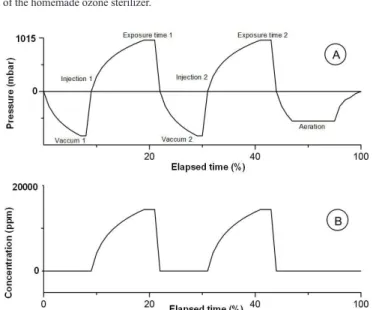
Figure 1 shows the schematic diagram of the ozone sterilizer system. Figures 2A and 2B show the cycle proile and the concentration level for the same proile, respectively. The cycle was divided in seven steps: irst
Figure 1. Schematic diagram of the homemade ozone sterilizer.
Figure 2. Standard sterilization time-pressure and concentration curves during the ozone cycle. (A) Pressure versus elapsed time cycle;
vacuum, irst O3 injection, irst exposure, second vacuum,
second O3 injection, second exposure, and aeration.
The main components of the system are the cylindrical stainless steel chamber with 60 L (total volume), ozone generator and vacuum pump. The chamber has a heater surrounding the entire structure that maintains a uniform temperature across its surface. The ozone DBD generator from Plasma Technics Inc. (PTI), Plasma Blo3ck
(model PBA-20g-E1-UNIV-1Ǿ-245w-D31), is illed withO2 gas (purity of 99.5 %) and injects O3 gas in the
chamber. Between the chamber and the vacuum pump, a catalyst converts ozone in oxygen during the vacuum process. Moreover, sensors connected to the chamber measure the process variables and a humidiier controls the humidity in the chamber according to the cycle program. A Programmable Logic Controller (PLC) controls the whole system. Directional valves and other minor components (suppressed in schematic diagram) are responsible to control all the low during the cycle.
When the cycle starts, initial vacuum removes the air from the chamber, providing a good condition for ozone penetration in the material to be sterilized. Before the vacuum phase, ozone is generated in a dielectric barrier discharge generator (DBD), by using the oxygen supplied to the chamber. When the ozone concentration reaches the preset value, the exposure time phase is started. This phase is repeated twice. At the end of the second exposure time, vacuum-air pulses promote the aeration,
and the catalyst destroys the non-reacted ozone. During the whole cycle, the chamber temperature was monitored and controlled by PLC, as well as the concentration and humidity during the ozone exposure time. If any variable does not reach the preset value or if it oscillates out of a tolerance level, an alarm is displayed in the human interface machine and the cycle is cancelled. For more details concerning the ozone sterilization system, see the reference (Luqueta et al., 2016).
Material preparation and sterilant penetration
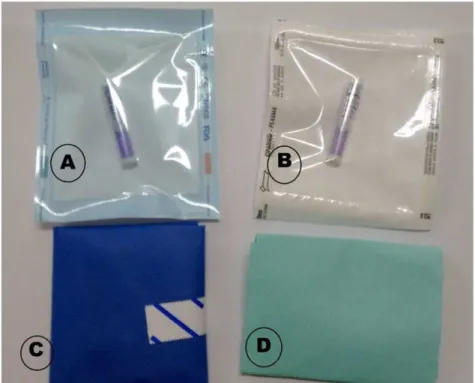
Four materials were prepared for sterilization: two types of bags and two different sheets. All samples are commercial products, designed according to ISO 11607-1 (International..., 2006). Figure 3 shows the samples. Sample A consists of a paper-plastic bag with one side made by medical grade paper, and the other side made by a thin plastic ilm (PET/PE). Paper and plastic are bonded in the corner by heating, and by sealing the pouch. Sample B consists of another type of bag, whereas the paper is replaced with a synthetic material called Tyvec (from Dupont Co.). Tyvec-plastic pouch is the preferable disposable medical device packaging in H2O2 sterilization processes. Sample C is
a Spunbond+Meltblown+Spunbond nonwoven fabric (SMS) (55gsm) sheet and the sample D consist of a crepe paper (60gsm) sheet.
A self-contained biological indicator (BI) was placed inside the packaging and, subsequently, this was sealed. In the sheets, the BI was placed in the center and was folded in two directions, and then sealed with self-adhesive latex free tape. The samples were sterilized and, after sterilization, the indicator was extracted and incubated at 57 °C during 48 h. A non-sterilized BI was incubated as positive reference.
Tests after ozone sterilization
After sterilization process, all samples were compared with the non-sterilized reference and qualitative differences in color, appearance and tactile of each material were observed.
In order to investigate the chemical bonds of the non-treated and treated samples, infrared measurements were performed on an attenuated total relection (ATR) FTIR Perkin Elmer 400 spectrometer at a resolution of 2 cm-1. Each ATR spectrum was recorded with the blank
ATR cell as the background.
In the packaging where no visual and relevant chemical modiications were observed, microscopy and tensile tests were executed. In microscopy, the non-treated and treated samples were analyzed by optical microscopy using a Carl Zeiss microscope model A1. The AxioVision software was used to treat digital images and to compare iber integrity and barrier conditions before and after sterilization process. The tensile test was conducted according to the ASTM D882-02 standard (American..., 2002). This test aims to determine tensile properties of plastics in ilm form similar to that of the bag side. The procedure result is the Breaking Factor expressed in N/mm that must be calculated by dividing the maximum load by the original minimum width of the sample. To compare results, both plastic ilm and paper were tested by using the same method. The equipment used for this test was a computer controlled universal testing machine from Time, model WDW-100E, with a load cell Celtron, model STC-500kg. By following the standard procedure, ive samples of each sample were cut into rectangles of 160x20mm, ixed by clamps in the equipment and tested with a displacement of 15mm/min.
Results
Microbiological challenge
After incubation time, the self-contained BI was examined to verify if the media has suffered color modiication. The original media color is purple. If the media color turns from purple to yellow it means that the microorganisms are viable (positive) and if color does not change, they are not viable (negative). All samples
presented negative results in comparison with references that demonstrated positive results.
Fourier-Transform Infrared Spectroscopy
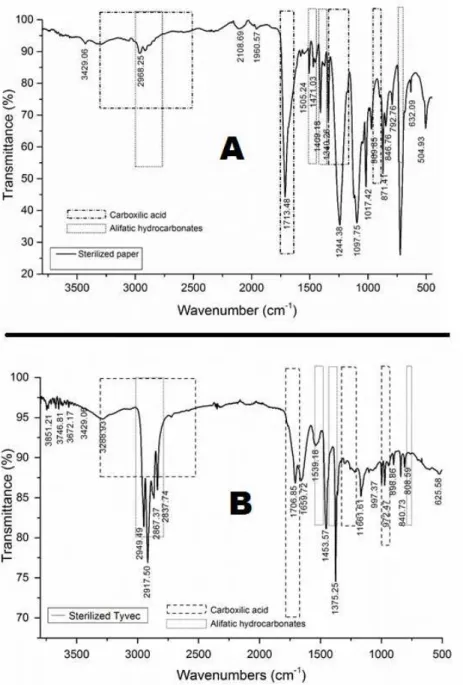
Figure 4A presents the FTIR spectrum for the paper side of paper-plastic pouch for sterilized and non-sterilized samples. The highlighted peaks in the spectrum indicate aliphatic hydrocarbons and carboxylic acids. The curves overlap, due to the same results for sterilized and non-sterilized samples. Figure 4B shows the FTIR spectrum in both sterilized and non-sterilized Tyvec samples (curves overlap). It was also observed in this spectrum the presence of carboxylic acids and aliphatic hydrocarbons. No color change was visible after sterilization, but, differently than medical grade paper, the tactile veriication revealed that the Tyvec’s mechanical resistance was affected by ozone, generating a fragile and crumbly surface, which could compromise the microbiological barrier after sterilization during manipulation and transportation stress.
The FTIR spectra of non-sterilized and sterilized SMS sheets are presented in Figures 5A and 5B, respectively. Results show the presence of tertiary amide and aliphatic hydrocarbon groups in non-sterilized material. Tertiary amide was removed after sterilization, while carboxylic acid was added. After sterilization, the color changed from blue to light blue and, when touched, the material was slightly crumbly, exactly as Tyvec was.
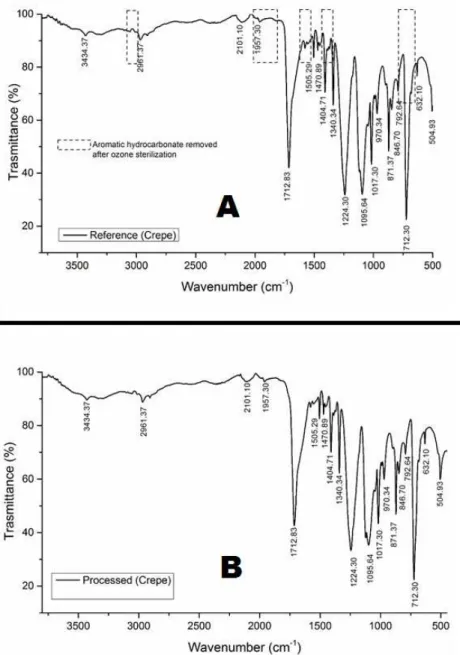
Figures 6A and 6B present the FTIR spectra of the non-sterilized and sterilized crepe paper, respectively. Results indicate that the reference material has carboxylic acids, aromatic and aliphatic hydrocarbons in the structure and that sterilization caused the removal of the aromatic hydrocarbons. By concerning the visual aspect, crepe paper changed the color, from green to soft green, with ozone sterilization. There were no tactile changes.
Tensile and optical tests
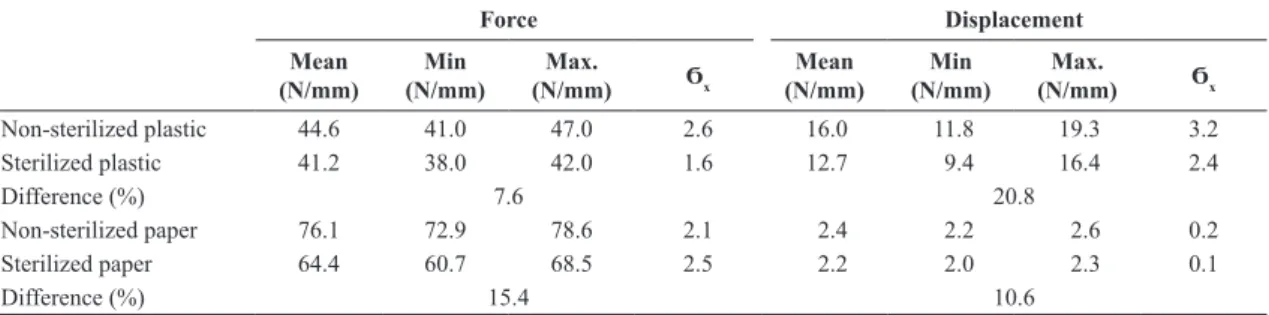
If one considers that medical device packaging should be mechanically resistant to punctures, tears and transportation stress, SMS and Tyvec could not proceed to the next step of the analysis. In the same way, crepe paper had its color changed, demonstrating it is incompatible to ozone. Only the paper-plastic pouch was approved in all previous tests and thus it was analyzed mechanically. Table 1 demonstrates the results of tensile test in paper and plastic portion. The number of samples was limited to ive specimens, following procedure described in section 8 of the ASTM D882-02 standard (American..., 2002).
Figure 4. (A) = The FTIR spectra of the paper-plastic pouch (paper side) in the sterilized material with peaks values; and (B) = The FTIR spectra of the Tyvec-plastic pouch (Tyvec side) in the sterilized material with peaks values. Both materials present carboxylic acid and aliphatic hydrocarbonates in sterilized and non-sterilized samples. No changes were observed in non-sterilized materials and the curves are overlapped.
12.7 mm. The decrease in standard deviation suggests that the plastic has become more rigid after sterilization. Accordingly, the mechanical resistance of the plastic decreases in 7.6% and the displacement in 20.8%. In the paper side, as the results show the mean rupture force is reduced from 76.1 N/mm to 64.4 N/mm and mean displacement decreases from 2.4 mm to 2.2 mm. Therefore, the resistance of the paper experiments a reduction of 15.4% and a displacement of 10.6%. It is
important to note that there was no statistical treatment for the differences pointed out, and the number of samples was restricted to the minimum deined by the standard, which may restrict the results to the studied event.
Figure 5. The FTIR spectra of the SMS: (A) = non-sterilized sample with peaks values and tertiary amide groups regions that were removed after the sterilization; (B) = sterilized sample with peaks values and carboxylic acid groups regions that were added after the sterilization.
Table 1. Results of the tensile test in the plastic and paper portion of the plastic-paper pouch.
Force Displacement
Mean (N/mm)
Min (N/mm)
Max.
(N/mm) Ϭx
Mean (N/mm)
Min (N/mm)
Max.
(N/mm) Ϭx
Non-sterilized plastic 44.6 41.0 47.0 2.6 16.0 11.8 19.3 3.2
Sterilized plastic 41.2 38.0 42.0 1.6 12.7 9.4 16.4 2.4
Difference (%) 7.6 20.8
Non-sterilized paper 76.1 72.9 78.6 2.1 2.4 2.2 2.6 0.2
Sterilized paper 64.4 60.7 68.5 2.5 2.2 2.0 2.3 0.1
Difference (%) 15.4 10.6
Figure 6. The FTIR spectra of the crepe paper: (A) = non-sterilized sample with peaks values and aromatic hydrocarbonate groups regions that were removed after sterilization; (B) = sterilized crepe paper sample with peaks values.
Discussion
Sterilant permeability, non-toxic residues after sterilization, color preservation, microbiological barrier integrity and mechanical resistance were considered as evaluation criteria for ozone sterilization compatibility. The four materials demonstrated penetrability to ozone sterilant according to the microbiological challenge: the biological indicator was negative for processed materials reaching the sterile assurance level (Von Woedtke and Kramer, 2008). Crepe paper and SMS showed changes in their appearance and surface color before and after sterilization. SMS and Tyvec had changes in the mechanical resistance, presenting a brittle surface when touched. The result of the SMS degradation is in agreement with the pertinent literature, if compared to data presented for a series of synthetic materials used in packaging (Ozen et al., 2002). In disagreement with our results, Tyvec was applied by Ohkawa et al. (2004) in disinfection by ozone and no changes were observed. The manufacturer of the Tyvec mentions in the technical guide the compatibility with EtO, gamma radiation, electron-beam, steam (under controlled conditions) and sterilization oxidation processes at low temperature (speciically compatible with hydrogen peroxide from a particular manufacturer) (DuPont, 2011). The differences between our results and other works demonstrate that exposure time and ozone concentration enhance material degradation.
Paper-plastics showed no variations either in color or in the visual appearance, and it was not possible to observe structural changes through tactile examination. FTIR analysis of the non-sterilized and sterilized papers shows the same results or, in other words, the ozone has not changed the chemical structure. The literature demonstrates similar peaks in the FTIR spectrum of the reference and treated material. This result agrees with the studies of Polovka et al. (2006) that investigated a similar material. In microscopy analysis, it was possible to observe that the medical grade paper preserved the ibers and macro barrier after the ozone sterilization process. As in the literature, Tyvec did not present aggregations nor supericial chemical changes. FTIR analysis revealed chemical alteration in crepe paper and in SMS, while no changes in paper-plastic and Tyvec©-plastic pouch.
The tensile test demonstrates that the paper-plastic pouch’s mechanical resistance decreases in 20.8% after the ozone sterilization. By considering that, in the bag construction, paper and plastic are ixed together, the tensile and displacement are limited by the paper. As far as we know, no other studies were conducted to determine the best result for this purpose. But, by considering the requirements of BS EN 868-5 “Packaging for terminally sterilized medical devices - Part 5: Sealable pouches and reels of porous materials and plastic ilm construction -
Requirements and test methods” (British..., 2009) for the tensile test in sealed portion paper-plastic (determined with limit of 1.5N/15mm), sterilized paper and plastic portion could resist the procedure. The experiment revealed that SMS, crepe paper and Tyvec©-plastic
pouch were more affected by ozone sterilization than medical grade paper-plastic pouch and that this last one, despite a decrease in the tensile resistance, maintained the characteristics for a convenient disposable packaging system for medical devices when sterilized by ozone.
As a inal remark, we conclude that ozone is an eficient sterilant with effective penetration in all studied materials and strong sporicidal activity but, as other chemical agents, affects some materials used in disposable medical device packaging. It is important to highlight some limitations: the applied proile cycle promotes a strong oxidation on the materials, with high ozone concentration, low humidity and large cycle time that maximizes the effects in packaging material. For lower time and concentration and high humidity the results could be different.
The results suggest that medical grade paper-plastic pouch is the most appropriate disposable medical device packaging to be sterilized by ozone when compared to the other materials analyzed in this study. Further study with an adequate sample size is necessary in order to show that the observed effects are statistically signiicant. Despite the limitations, the present work can contribute with the correct application of ozone sterilization of materials in the medical and research areas, since the correct choice of packaging material can maintain medical device sterile and avoid subsequent contamination after sterilization.
Acknowledgements
The authors would like to thank Baumer S.A. company for donation of materials used in this research.
References
Ackert-Burr C. Low-temperature sterilization: are you in the know? Perioperative Nursing Clinics. 2010; 5(3):281-90. http:// dx.doi.org/10.1016/j.cpen.2010.05.002.
American Society for Testing and Materials. Designation D882-02: standard test method for tensile properties of thin plastic sheeting. West Conshohocken: ASTM; 2002. Batakliev T, Georgiev V, Anachkov M, Rakovsky S, Zaikov GE. Ozone decomposition. Interdisciplinary Toxicology. 2014; 7(2):47-59. PMid:26109880.http://dx.doi.org/10.2478/ intox-2014-0008.
Billings S. Medical packaging design. Design Week. 2005; 20(44):8.
reels of porous and plastic film construction: requirements and test methods. London: BSI; 2009.
Burlingame B, Denholm B, Link T, Ogg MJ, Spruce L, Spry C, Wood SAVWA. Guideline for selection and use of packaging systems for sterilization. Guidelines for Perioperative Practice AORN. 2016; 1:1-6. http://dx.doi.org/10.6015/psrp.15.01.651. DuPont. Dupont technical reference guide for medical and pharmaceutical packaging. Wilmington; 2011. 44 p. Ebihara K, Stryczewska HD, Mitsugi F, Ikegami T, Sakai T, Pawlat J, Teii S. Recent development of ozone treatment for agricultural soil sterilization and biomedical prevention. Przegl Elektrotech. 2012; 88(6):92-4.
Eto H, Ono Y, Ogino A, Nagatsu M. Low-temperature sterilization of wrapped materials using flexible sheet-type dielectric barrier discharge. Applied Physics Letters. 2008; 93(22):221502. http://dx.doi.org/10.1063/1.3039808. Foegeding PM. Ozone inactivation of bacillus and clostridium spore populations and the importance of the spore coat to resistance. Food Microbiology. 1985; 2(2):123-34. http:// dx.doi.org/10.1016/S0740-0020(85)80005-8.
Fuente J, Bix L. Medical device packaging. In: Yam KL. The Wiley encyclopedia of packaging technology. Hoboken: John Wiley & Sons; 2009. p. 713-27.
Govindaraj S, Muthuraman MS. Systematic review on sterilization methods of implants and medical devices. Int J ChemTech Res. 2015; 8(Jun):897-911.
Grootveld M, Baysan A, Siddiqui N, Sim J, Silwood C. History of the clinical applications of ozone. Ozone: The revolution in dentistry. London: Quintessence Publishing; 2004.
Hunt NK, Marinas BJ. Kinetics of escherichia coli inactivation with ozone. Water Research. 1997; 31(6):1355-62. http://dx.doi. org/10.1016/S0043-1354(96)00394-6.
International Organization for Standardization. BS EN ISO 11607-1:2006 packaging for terminally sterilized medical devices. Part 1: requeriments for materials, sterile barrier systems and packaging systems. Geneva: ISO; 2006. Iwamura T, Nagano K, Nogami T, Matsuki N, Kosaka N, Shintani H, Katoh M. Confirmation of the sterilization effect using a high concentration of ozone gas for the bio-clean room. Biocontrol Science. 2013; 18(1):9-20. PMid:23538847.http:// dx.doi.org/10.4265/bio.18.9.
Killeen S, McCourt M. Decontamination and sterilization. Surgery. 2012; 30(12):687-92. http://dx.doi.org/10.1016/j. mpsur.2012.10.008.
Kogelschatz U. Dielectric-barrier discharges: their history, discharge physics, and industrial applications. Plasma Chemistry and Plasma Processing. 2003; 23(1):1-46. http:// dx.doi.org/10.1023/A:1022470901385.
Luqueta GR, Santos ED, Pessoa RS, Maciel HS. Wireless sensor network for ozone sterilization monitoring. Revista IEEE América Latina. 2016; 14(5):2167-74. http://dx.doi. org/10.1109/TLA.2016.7530410.
Mahfoudh A, Moisan M, Séguin J, Barbeau J, Kabouzi Y, Kéroack D. Inactivation of vegetative and sporulated bacteria
by dry gaseous ozone. Ozone Science and Engineering. 2010; 32(3):180-98. http://dx.doi.org/10.1080/01919511003791971. Mitsugi F, Nagatomo T, Takigawa K, Sakai T, Ikegami T, Nagahama K, Ebihara K, Sung T, Teii S. Properties of soil treated with ozone generated by surface discharge. IEEE Transactions on Plasma Science. 2014; 42(12):3706-11. http:// dx.doi.org/10.1109/TPS.2014.2350533.
Ohkawa H, Akitsu T, Ohtsuki K, Ohnishi M, Tsuji M. High-grade disinfection using high-density ozone. Journal of Advanced Oxidation Technologies. 2004; 7(2):154-60.
Ozen BF, Mauer LJ, Floros JD. Effects of ozone exposure on the structural, mechanical and barrier properties of select plastic packaging films. Packaging Technology and Science. 2002; 15(6):301-11. http://dx.doi.org/10.1002/pts.602. Peeters FJJ, Rumphorst RF, Van De Sanden MCM. Dielectric barrier discharges : evidence for mobile surface charge. Plasma Sources Science & Technology. 2016; 25(3):1-6. http://dx.doi. org/10.1088/0963-0252/25/3/03LT03.
Polovka M, Polovková J, Vizárová K, Kirschnerová S, Bieliková L, Vrška M. The application of FTIR spectroscopy on characterization of paper samples, modified by Bookkeeper process. Vibrational Spectroscopy. 2006; 41(1):112-7. http:// dx.doi.org/10.1016/j.vibspec.l.01.010.
Rice RG. Applications of ozone for industrial wastewater treatment: a review. Ozone Science and Engineering. 2012; 2010(18):37-41.
Rickloff JR. An evaluation of the sporicidal activity of ozone. Applied and Environmental Microbiology. 1987; 53(4):683-6. PMid:3579276.
Rutala WA, Weber DJ. Current principles and practices: new research; and new technologies in disinfection, sterilization, and antisepsis. American Journal of Infection Control. 2013; 41(5 Suppl):S1. PMid:23622739.http://dx.doi.org/10.1016/j. ajic.2012.12.003.
Rutala WA, Weber DJ. Disinfection, sterilization, and antisepsis: an overview. American Journal of Infection Control. 2016; 44(5 Suppl):e1-6. PMid:27131128.http://dx.doi.org/10.1016/j. ajic.2015.10.038.
Sakurai M, Takahashi R, Fukunaga S, Shiomi S, Kazuma K, Shintani H. Several factors affecting ozone gas sterilization. Biocontrol Science. 2003; 8(2):69-76. http://dx.doi.org/10.4265/ bio.8.69.
Samaranayake WJM, Miyahara Y, Namihira T, Katsuki S, Hackam R, Akiyama H. Ozone production using pulsed dielectric barrier discharge in oxygen. IEEE Transactions on Dielectrics and Electrical Insulation. 2000; 7(6):849-54. http:// dx.doi.org/10.1109/94.891999.
Srinivasan K, Chitra S. The application of ozone in dentistry: a systematic review of literature. Scholar Journal of Dental Sciences. 2015; 2(6):373-7.
Varga L, Szigeti J. Use of ozone in the dairy industry: a review. International Journal of Dairy Technology. 2016; 69(2):157-68. http://dx.doi.org/10.1111/1471-0307.12302.
Walzak MJ, Flynn S, Foerch R, Hill JM, Karbashewski E, Lin A, Strobel M. Uv and ozone treatment of polypropylene and poly(ethylene-terephthalate). Journal of Adhesion
Science and Technology. 1995; 9(9):1229-48. http://dx.doi. org/10.1163/156856195X01012.
World Health Organization. Medical device regulations global overview and guiding principles. Journal of Healthcare Information Management. 2003; (3):36-40.