Gender-related differences in the
effects of nitric oxide donors on
neuroleptic-induced catalepsy in
mice
Departamento de Ciências Fisiológicas, Centro Biomédico, Universidade Federal do Espírito Santo, Vitória, ES, Brasil J.G.P. Pires, P.G. Costa,
F.P. Saraiva, V. Bonikovski and H.A. Futuro Neto
Abstract
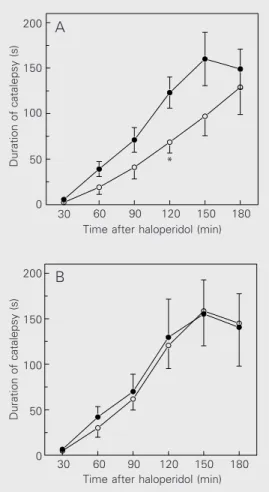
It has been suggested that nigrostriatal dopaminergic transmission is modulated by nitric oxide (NO). Since there is evidence that gonadal hormones can affect extrapyramidal motor behavior in mammals, we investigated the effects of isosorbide dinitrate (ISD), linsidomine (SIN-1) and S-nitroso-N-acetylpenicillamine (SNAP), three pharma-cologically different NO donors, on neuroleptic-induced catalepsy in 60- to 80-day-old male and female albino mice. Catalepsy was in-duced with haloperidol (1 mg/kg, ip) and measured at 30-min intervals by means of a bar test. Drugs (or appropriate vehicle) were injected ip 30 min before haloperidol, with each animal being used only once. ISD (5, 20 and 50 mg/kg) caused a dose-dependent inhibition of catalepsy in male mice (maximal effect 120 min after haloperidol: 64% inhibition). In the femalesonly at the highest dose of ISD was an attenuation of catalepsy observed, which was mild and short lasting. SIN-1 (10 and 50 mg/kg) did not significantly affect catalepsy in female mice, while a significant attenuation was observed in males at the dose of 50 mg/kg (maximal inhibition: 60%). SNAP (20 mg/kg) significantly attenuated catalepsy in males 120 min after haloperidol (44% inhibition), but had no significant effect on females. These results basically agree with literature data showing that NO facilitates central dopaminergic transmission, although the mechanisms are not fully understood. They also reveal the existence of gender-related differences in this nitrergic modulation in mice, with females being less affected than males.
Correspondence J.G.P. Pires
Centro Biomédico, UFES Av. Marechal Campos, 1468 29042-755 Vitória, ES Brasil
Fax: +55-27-3335-7330 E-mail: [email protected]
Research partially supported by FINEP, PRPPG-UFES and FCAA. P.G. Costa and F.P. Saraiva were medical students receiving PIBIC-CNPq studentships. V. Bonikovski was the recipient of a M.Sc. scholarship from CAPES. H.A. Futuro Neto is the recipient of a CNPq Productivity Fellowship (No. 520109196-1).
Received May 28, 2002 Accepted November 11, 2002
Key words
·Neuroleptic-induced
catalepsy
·Nitric oxide donors ·Gender differences ·Linsidomine ·SNAP
·Isosorbide dinitrate
Introduction
Antipsychotic drugs like haloperidol and chlorpromazine (the so-called typical neuro-leptics) induce abnormal motor behaviors in experimental animals and humans, includ-ing catalepsy in rats and mice (1). Neurolep-tic-induced catalepsy in rodents is a robust behavioral method for studying nigrostriatal
dopaminergic function and its modulation by other transmitter systems (1-4).
in-volve either dopamine release, uptake or metabolism (9). Some studies suggest that endogenous NO increases dopamine release in the striatum and other areas of the CNS (10-12), while other authors suggest the op-posite (13,14). If NO increases the release of dopamine in the striatum, we would expect that drugs that release or are metabolized into NO (i.e., NO donors) are able to attenu-ate neuroleptic-induced catalepsy, which is mainly caused by blockade of striatal dopa-minergic receptors (1). Consistent with this hypothesis, Krzascik and Kostowski (15) showed that molsidomine, a pro-drug of the NO donor linsidomine (SIN-1), attenuated haloperidol-induced catalepsy in male rats, while we have shown that another NO do-nor, isosorbide dinitrate (ISD), did the same in male mice (16).
There is a large body of evidence show-ing sexual dimorphisms with regard to some aspects of the extrapyramidal motor system, both in humans and in experimental animals (17,18). In addition, gender-related differ-ences are a common feature of the pharma-cological properties of most centrally active drugs (19-21); for instance, drug-induced parkinsonism in humans exhibits a female-to-male predominance ratio of about 2:1 (22). Nevertheless, there is no information con-cerning gender dimorphism in the effects of nitrergic agents on the phenomenon of neu-roleptic-induced catalepsy.
The present study was designed to inves-tigate the effects of three centrally active NO donors, ISD, SIN-1 and S-nitroso-N-acetyl-penicillamine (SNAP), on neuroleptic-in-duced catalepsy in male and female mice. Preliminary accounts of these observations were published in abstract form (23,24).
Material and Methods
Animals
Experiments were performed on 60- to 80-day-old albino mice weighing 26-36 g,
obtained from our breeding stock. Animals, separated by sex, were housed two per cage (20 x 18 x 13 cm high) with free access to standard pellet food and filtered water, at 23-26ºC. All observations were made between 9:00 and 17:00 h in a quiet room, with each animal used only once. Female mice were tested without monitoring the estrous cycle, since the major interest of this study was to investigate the possibility of NO donors differ-entially affecting male and female animals.
Drug administrations
The drugs used were haloperidol (Hal-dol®
, Janssen, São Paulo, SP, Brazil), ISD (Sigma, St. Louis, MO, USA; molecular weight = 236.1), SIN-1 hydrochloride (RBI, Natick, MA, USA; molecular weight = 206.63), and SNAP (Tockris Cookson Inc., Ballwin, MO, USA; molecular weight = 220.25). Haloperidol was diluted with saline (0.9% NaCl). SIN-1 was dissolved by cation in saline, ISD was dissolved by soni-cation in a 5% solution (v/v) of ethanol in saline, and SNAP was dissolved in a 20% solution (v/v) of DMSO in saline. The drugs were freshly prepared and solutions were protected from light.
The NO donors were injected ip with a 27.5 G needle, in a volume of 6 ml/kg body weight, 30 min before haloperidol. The doses used were ISD: 5, 20 and 50 mg/kg; SIN-1: 10 and 50 mg/kg; SNAP: 20 mg/kg. When-ever possible, the doses were chosen accord-ing to those commonly used in the literature. For each experimental group, appropriate vehicle (6 ml/kg, ip) was used as control.
Procedure
be detected (1,16). The phenomenon was measured as the time the animal maintained an imposed position with both front limbs extended and resting on a 3-cm high wood bar (0.9 cm in diameter). The end point of catalepsy was considered to occur when both front paws were removed from the bar or if the animal moved its head in an exploratory manner. A cut-off time of 720 s was used. The animals were returned to their home cages between determinations.
Statistical analysis
Data are reported as means ± SEM for 10 mice per group. For statistical purposes, the durations of catalepsy were transformed to logarithmic (ln x+1) values in order to normalize the data. Significant differences were initially assessed by two-way ANOVA with repeated measures (treatment and time as factors); if significance was detected for treatment x time interactions, one-way ANOVA with repeated measures followed by the two-tailed Dunnett test was performed for each time point to determine differences be-tween control and other experimental groups. The level of significance was set at P<0.05.
Results
Effects of isosorbide dinitrate on neuroleptic-induced catalepsy
ISD (5-50 mg/kg) caused a dose-depend-ent attenuation of neuroleptic-induced cata-lepsy in male mice (Figure 1A). The maxi-mal effect obtained was 64% inhibition, ob-served at 120 min after haloperidol. In con-trast, for female mice, the doses of 5 and 20 mg/kg of ISD failed to modify the dura-tion of catalepsy. In the females, only at the highest dose (50 mg/kg) did ISD cause an attenuation of catalepsy, which was mild (45% inhibition) and short lasting, since it attained statistical significance only at 90 min after haloperidol (Figure 1B).
Effects of linsidomine on neuroleptic-induced catalepsy
In contrast to male mice, in which the higher dose of SIN-1 significantly inhibited neuroleptic-induced catalepsy by about 60% (Figure 2A), the NO donor did not signifi-cantly modify the duration of catalepsy in the females (Figure 2B). In six separate male mice (data not shown), which received 10 mg/kg SIN-1 at 110 min after haloperidol (instead of 30 min before), the NO donor caused a short-lasting but statistically sig-nificant attenuation of catalepsy.
Effects of SNAP on neuroleptic-induced catalepsy
Pretreatment of male mice with SNAP (20 mg/kg) caused a short-lasting but statis-tically significant inhibition (about 44%) of
Figure 1. Effects of isosorbide dinitrate (ISD) on neuroleptic-in-duced catalepsy in male (A) and female (B) mice. ISD, or appro-priate vehicle as control, was in-jected ip 30 min before haloperi-dol (1 mg/kg, ip). Data are re-ported as means ± SEM, N = 10 mice per group. Filled circles, vehicle; triangles, 5 mg/kg ISD; squares, 20 mg/kg ISD; open circles, 50 mg/kg ISD. *P<0.05 compared to vehicle (Dunnett test).
*
300
250
200
150
100
50
0
Duration of catalepsy (s)
30 60 90 120 150 180
Time after haloperidol (min) B
Duration of catalepsy (s)
200
*
* *
*
*
* *
150
100
50
0
30 60 90 120 150 180
Time after haloperidol (min) A
*
* *
* **
Mechanisms of action and central effects of nitric oxide donors
One possible criticism about our experi-mental design is that peripheral administra-tion of NO donors does not guarantee the manifestation of a central effect. Therefore, in order to justify our protocol, including the use of three chemically different agents, we would like to briefly discuss some as-pects of the pharmacology of the drugs. For instance, organic nitrates (e.g., ISD) and SNAP require in vivo transformations to release NO (25). The organic nitrates react with certain endogenous thiols, while SNAP, which is a stable analogue of endogenous S-nitroso compounds, does not need this step to release NO. SIN-1 can release NO directly (no co-factor required) in a complex nonenzymatic way (25). There are also phar-macokinetic differences among NO donors, mainly related to their different lipophilicity (6,25,26). More importantly, in addition to their peripheral vasodilating and antiplatelet effects, there is evidence that most NO-do-nating compounds can cross the blood-brain barrier after peripheral administration (27-29), a fact that may explain their central effects, including the interference with neu-roleptic-induced catalepsy (16). As an ex-ample of the complexity of the CNS pharma-cology of NO donors, it should be mentioned that peripherally administered sodium nitro-prusside, a distinct NO donor, was recently shown to induce catalepsy in male mice, possibly via adenosine release (29).
Sex steroids and the basal ganglia
Our results suggest that, at least in mice, the nigrostriatal pathway of females is less affected by the nitrergic modulation, since a small attenuation of catalepsy was obtained under some circumstances (Figure 1B). Sev-eral studies have suggested that gonadal hor-mones (mainly estrogens) modulate not only dopaminergic but also nitrergic and
seroto-Figure 2. Effects of linsidomine (SIN-1) on neuroleptic-induced catalepsy in male (A) and female (B) mice. SIN-1, or appropriate vehicle as control, was injected
ip 30 min before haloperidol (1 mg/kg, ip). Data are reported as means ± SEM, N = 10 mice per group. Filled circles, vehicle; tri-angles, 10 mg/kg SIN-1; open circles, 50 mg/kg SIN-1. *P<0.05 compared to vehicle (Dunnett test).
300
250
200
150
100
50
0
Duration of catalepsy (s)
30 60 90 120 150 180
Time after haloperidol (min) B
haloperidol-induced catalepsy (Figure 3A), while no significant effect was demonstrable on female animals (Figure 3B).
Discussion
The present data show that drugs able to release NO donors attenuate haloperidol-induced catalepsy in mice. Therefore, this confirms and extends two previous studies showing that such drugs inhibit neuroleptic catalepsy in male rats (15) and mice (16), basically agreeing with the findings that NO facilitates central dopaminergic transmission (10-12). In addition, the present results sug-gest the existence of gender-related differ-ences in the effects of NO donors (and pre-sumably also of NO) on the nigrostriatal dopaminergic pathway of mice.
Duration of catalepsy (s)
200
150
100
50
0
30 60 90 120 150 180
Time after haloperidol (min) *
* A
*
nergic systems (17,18,30,31). Therefore, we may speculate that the reason(s) for the quan-titative dimorphism shown here may be re-lated to the action of endogenous estrogens on the extrapyramidal system.
Nitric oxide and dopaminergic transmission
The anatomical association of dopamine neurons and NOS-containing (i.e., nitrergic) interneurons in the rat striatum has been previously described (32). It has been shown that NO released in the striatum is able to control the neuronal activity of midbrain dopamine neurons (12). It seems that, in most cases, NO increases the activity of dopamine neurons (11,12). These latter re-sults, however, were obtained on resting do-pamine neurons, whereas after haloperidol administration an excitation of these cells occurs (33). For this reason, the attenuation of catalepsy described here could be due to interference of NO with other neurotrans-mitter systems and/or with the striatal neu-rons located post-synaptically with respect to dopaminergic terminals. Concerning the former possibility, it has been shown that NO is able to modulate striatal release of serotonin, glutamate and GABA (9). It has been demonstrated in male mice that NOS inhibitors are able to induce catalepsy and also to potentiate neuroleptic-induced cata-lepsy (34), an effect that seems to involve serotonin receptors (35). To further empha-size the complexity of this topic, it should be mentioned that, under some circumstances, endogenous NO can decrease the release of dopamine (13,14). Nevertheless, the precise mechanisms involved in the modulation of dopamine release by NO (and NO donors) remain to be determined.
Influence of gender on central nitrergic transmission
There is some evidence that nitrergic ac-tivity in some areas of the CNS(e.g., cortex,
hippocampus) is higher in male than in fe-male rats (31). However, similar studies in mice, especially involving the striatum, are lacking. It should be mentioned that the lit-erature on this topic is rather confusing; for instance, studies focusing on the neuroendo-crine system have shown that the activity of neuronal NOS is increased by estrogen (36) and decreased by androgens (37). In any case, if these influences were present at the level of the nigrostriatal system, they could possibly account for the differential sensitiv-ity of female mice to the ‘anticataleptic’ effect of NO donors.
Acknowledgments
The authors are indebted to Dr. Andrew G. Ramage (UCL and Royal Free Medical
Duration of catalepsy (s)
200
150
100
50
0
30 60 90 120 150 180
Time after haloperidol (min) B
*
Duration of catalepsy (s)
200
150
100
50
0
30 60 90 120 150 180
Time after haloperidol (min) A
School, Royal Free Campus, London, UK) for his support. We also thank Mr. Mário A. Dantas (UFES, Brazil) and Mr. N.F. Silva
References
1. Sanberg PR, Giordano M, Bunsey MD & Norman AB (1988). The catalepsy test: its ups and downs. Behavioral Neuroscience, 102: 748-759.
2. Silva SR, Futuro Neto HA & Pires JGP (1990). Inhibition of chlor-promazine-induced catalepsy by the 5-HT-1A ligands pindolol and buspirone in mice. Brazilian Journal of Medical and Biological Re-search, 23: 869-871.
3. Silva SR, Futuro Neto HA & Pires JGP (1995). Effects of 5-HT3 receptor antagonists on neuroleptic-induced catalepsy in mice. Neu-ropharmacology, 34: 97-99.
4. Pires JGP, Silva SR & Futuro Neto HA (1996). Effects of losartan on neuroleptic-induced catalepsy in mice. Brazilian Journal of Medical and Biological Research, 29: 1045-1047.
5. Moncada S, Palmer RMJ & Higgs EA (1991). Nitric oxide: physiolo-gy, pathophysiolophysiolo-gy, and pharmacology. Pharmacological Reviews, 43: 109-142.
6. Garthwaite J & Boulton CL (1995). Nitric oxide signalling in the central nervous system. Annual Review of Physiology, 57: 683-706. 7. Liu Y (1996). Nitric oxide influences dopaminergic processes.
Ad-vances in Neuroimmunology, 6: 259-264.
8. Prast H & Philippu A (2001). Nitric oxide as modulator of neuronal function. Progress in Neurobiology, 64: 51-68.
9. Segovia G & Mora F (1998). Role of nitric oxide in modulating the release of dopamine, glutamate, and GABA in striatum of the freely moving rat. Brain Research Bulletin, 45: 275-279.
10. Levent-Buyukuysal R (1997). Effect of nitric oxide donors on endog-enous dopamine release from rat striatal slices. II: The role of voltage dependent sodium channels, calcium channel activation, reverse transport mechanism, guanylate cyclase and endogenous glutamate. Fundamentaland Clinical Pharmacology, 11: 528-536. 11. West AR & Galloway MP (1997). Endogenous nitric oxide facilitates
striatal dopamine and glutamate efflux in vivo: role of ionotropic glutamate receptor-dependent mechanisms. Neuropharmacology, 36: 1571-1581.
12. West AR & Grace AA (2000). Striatal nitric oxide signaling regulates the neuronal activity of midbrain dopamine neurons in vivo. Journal of Neurophysiology, 83: 1796-1808.
13. Silva MT, Rose S, Hindmarsh JG, Aislaitner G, Gorrod JW, Moore PK, Jenner P & Marsden CD (1995). Increased striatal dopamine efflux in vivo following inhibition of cerebral nitric oxide synthase by the novel monosodium salt of 7-nitro indazole. British Journal of Pharmacology, 114: 257-258.
14. Wegener G, Volke V & Rosenberg R (2000). Endogenous nitric oxide decreases hippocampal levels of serotonin and dopamine in vivo.
British Journal of Pharmacology, 130: 575-580.
15. Krzascik P & Kostowski W (1997). Nitric oxide donors antagonize N-nitro-L-arginine and haloperidol catalepsy: potential implication for the treatment of Parkinsonism? Polish Journal of Pharmacology, 49: 263-266.
16. Pires JGP, Fonseca FCG, Woelffel AB & Futuro Neto HA (1998). Evidence of interaction between fluoxetine and isosorbide dinitrate on neuroleptic-induced catalepsy. Brazilian Journal of Medical and
Biological Research, 31: 417-420.
17. Van Hartesveldt C & Joyce JN (1986). Effects of estrogen on the basal ganglia. Neuroscience and Biobehavioral Reviews, 10: 1-14. 18. Di Paolo T (1994). Modulation of brain dopamine transmission by
sex steroids. Reviews of Neuroscience, 5: 27-41.
19. Fernández-Guasti A & Picazo O (1990). The actions of diazepam and serotonergic anxiolytics vary according to the gender and the es-trous cycle phase. Pharmacology, Biochemistry and Behavior, 37: 77-81.
20. Pires JGP, Monteiro KC, Alvarenga SO, Costa MG, Gomes MAS & Futuro Neto HA (1998). Evidence suggesting that gonadal hormones influence benzodiazepine withdrawal-induced weight loss in rats.
Progress in Neuro-Psychopharmacology and Biological Psychiatry, 22: 425-433.
21. Futuro Neto HA, Costa PG, Amorim SC, Saraiva FP, Ribeiro CA & Pires JGP (1999). Evidence of sex related differences in the effects of calcium channel blockers on neuroleptic-induced catalepsy in mice. Progress in Neuro-Psychopharmacology and Biological Psy-chiatry, 23: 301-316.
22. Montastruc JL, Llau ME, Rascol O & Senard JM (1994). Drug-induced parkinsonism: a review. Fundamental and Clinical Pharma-cology, 8: 293-306.
23. Pires JGP, Costa PG, Saraiva FP, Silva NF & Futuro Neto HA (1998). Differential effects of L-arginine and nitric oxide donors on neurolep-tic-induced catalepsy in mice. Society for Neuroscience Abstracts, 24: 661.
24. Pires JGP, Saraiva FP, Costa PG, Bonikovski V, Silva NF & Futuro Neto HA (1999). Sex differences in the nitrergic modulation of neuroleptic-induced catalepsy in mice. Society for Neuroscience Abstracts, 25: 60.
25. Feelisch M (1991). The biochemical pathways of nitric oxide forma-tion from nitrovasodilators: Appropriate choice of exogenous NO donors and aspects of preparation and handling of aqueous NO solutions. Journal of CardiovascularPharmacology, 17: S25-S33. 26. Southam E & Garthwaite J (1991). Comparative effects of some
nitric oxide donors on cyclic GMP levels in rat cerebellar slices.
Neuroscience Letters, 130: 107-111.
27. Tassorelli C & Joseph SA (1995). Systemic nitroglycerin induces Fos immunoreactivity in brainstem and forebrain structures of the rat.
Brain Research, 682: 167-181.
28. Nurminen M-L & Vapaatalo H (1996). Effect of intracerebroventricu-lar and intravenous administration of nitric oxide donors on blood pressure and heart rate in anaesthetized rats. British Journal of Pharmacology, 119: 1422-1426.
29. Dall’Igna OP, Dietrich MO, Hoffman A, Neto W, Vendite D, Souza DO & Lara DR (2001). Catalepsy and hypolocomotion induced by a nitric oxide donor: attenuation by theophylline. European Journal of Pharmacology, 432: 29-33.
30. Attali G, Weizman A, Gil-Ad I & Rahavi M (1997). Opposite modula-tory effects of ovarian hormones on rat brain dopamine and seroto-nin transporters. Brain Research, 756: 153-159.
31. Taskiran D, Kutay FZ, Sozmen E & Pogun S (1997). Sex differences
in nitrite/nitrate levels and antioxidant defense in rat brain. NeuroRe-port, 8: 881-884.
32. Fujiyama F & Masuko S (1996). Association of dopaminergic termi-nals and neurons releasing nitric oxide in the rat striatum: an electron microscopic study using NADPH-diaphorase histochemistry and ty-rosine hydroxylase immunohistochemistry. Brain Research Bulletin, 40: 121-127.
33. Bunney BS (1988). Effects of acute and chronic neuroleptic treat-ment on the activity of midbrain dopamine neurons. Annals of the New York Academy of Sciences, 537: 77-85.
34. Del Bel EA, da Silva CA & Guimarães FS (1998). Catalepsy induced by nitric oxide synthase inhibitors. General Pharmacology, 30:
245-248.
35. Nucci-da-Silva LP, Guimarães FS & Del Bel EA (1999). Serotonin modulation of catalepsy induced by N(G)-nitro-L-arginine in mice.
European Journal of Pharmacology, 379: 47-52.
36. Wang H & Morris JF (1999). Effects of oestrogen upon nitric oxide synthase NADPH-diaphorase activity in the hypothalamo-neurohy-pophyseal system of the rat. Neuroscience, 88: 151-158.