ABSTRACT: Although root rot is one of the major diseases affecting Brazilian cassava (Manihot esculenta Crantz.), little is known about the diversity of root rot pathogens. In this study, dis-eased plants exhibiting root rot symptoms were collected from cassava-producing regions in five Brazilian states: Bahia, Sergipe, Paraíba, Maranhão, Tocantins, and Paraná. Seventy isolates were obtained and assigned to species complexes based on rDNA’s ITS (internal transcribed spacer of the ribosomal DNA) region (ITS1, ITS2 and 5.8S). A total of seven species complexes was found belonging to the genus Fusarium (56/74), followed by Lasiodiplodia (8/74), Neos-cytalidium (6/74), and Diaporthe/Phomopsis complex (2/74), Phytophthora, and Corallomyce-tella (1/74 each). These species were distributed differently according to sample locations and states, but overall, the F. solani species complex (FSSC) was the most prevalent. A number of phylogenetic lineages had not been previously reported as being associated with cassava-root rot disease, such as: F. graminearum (FGSC), F. incarnatum-equiseti (FIESC) and F. chlamydos-porum (FCSC) complexes, and a phylogenetic lineage most closely related to P. phaseolorum. Results suggest the need to improve knowledge of the species associated with cassava, includ-ing multilocus phylogeny for a more specific characterization, and differences in the resistance background associated with these species, as a strategy to incorporate resistance to multiple pathogens in cassava breeding programs.
Keywords: Manihot esculenta, ITS barcode, phylogeny, soil-borne diseases
1Federal University of Bahia Reconcavo − Center of
Agricultural, Environmental and Biological Sciences, R. Rui Barbosa, 710 − 44380-000 − Cruz das Almas, BA − Brazil.
2Embrapa Cassava & Fruits, R. Embrapa, s/n – 44380-000
− Cruz das Almas, BA − Brazil.
*Corresponding author <[email protected]>
Edited by: Emerson Medeiros Del Ponte
Survey of fungi associated with cassava root rot from different producing regions in
Sandielle Araújo Vilas Boas1, Saulo Alves Santos de Oliveira2, Carlos Augusto Dórea Bragança1, Juliana Barros Ramos1, Eder Jorge de Oliveira2*
Received September 23, 2015 Accepted April 15, 2016
Introduction
Cassava is a major source of carbohydrates for mil-lions of people in several regions, particularly in devel-oping countries. The cassava crop plays a vital role in reducing poverty and rural exodus because the use of technology required is minimal (Akinbo et al., 2012). In addition to the social impact, cassava has attracted the interest of the agriculture business due to its multiple industrial uses of starch (Tonukari, 2004).
In Brazil, different diseases affect cassava produc-tion, namely, root rot disease (CRRD), a major constraint responsible for up to 80 % of losses in yield. Symptoms of CRRD vary according to the causal agent and can be divided into dry, soft, and black rot (Bandyopadhyay et al., 2006). In general, dry rot is characterized by the appearance of dark brown streaks in the roots with no aqueous aspect, while soft rot is characterized by the darkening of the affected tissues with liquid exudation and is foul-smelling. On the other hand, black rot is characterized by dark lesions (blackened) in the roots and stems and may evolve into soft rot but without the unpleasant odor.
The main pathogens associated with CRRD in Brazil are Fusarium spp. causing dry rot (F. solani, F.
oxysporum, and F. verticillioides); Phytophthora spp. (P.
nicotianae and P. drechsleri), Pythium scleroteichum, as-sociated with soft rot, and Neoscytalidium hyalinum and
Lasiodiplodia spp. causing black rot (Oliveira et al., 2013; Machado et al., 2014a). Knowledge of the diversity and
geographical distribution of root rot pathogens may be useful to breeders targeting root rot resistance. This study aimed to identify the main species complex associ-ated with cassava root rot samples in several regions in Brazil based on a phylogenetic approach.
Materials and Methods
Diseased roots and stems of cassava were col-lected from different producing regions in the states of Bahia (seven fields), Sergipe (two fields), Paraíba (one field), Maranhão (two fields), Tocantins (one field), and Paraná (two fields). Isolates were collected from 1991 to 2014, with the majority of the isolates being col-lected from 2012 to 2014 (Table 1). The sampled loca-tions were chosen by information of CRRD outbreaks obtained from the plant disease clinic of Embrapa Cas-sava and Fruit and producers, and based on previous history of CRRD incidence in experimental and/or com-mercial areas.
In the laboratory, symptomatic tissues were cut into small pieces of approximately 0.5 cm, dipped for 2 min in 70 % ethanol, sterilized for 2 min in 0.5 % sodium hypochlorite solution, and then washed with sterilized distilled water three times. The fragments were laid out to dry on sterile filter paper, and afterwards they were placed on potato dextrose agar (PDA) and incubated at 24 °C for 5-7 days, for a 12-h photoperiod.
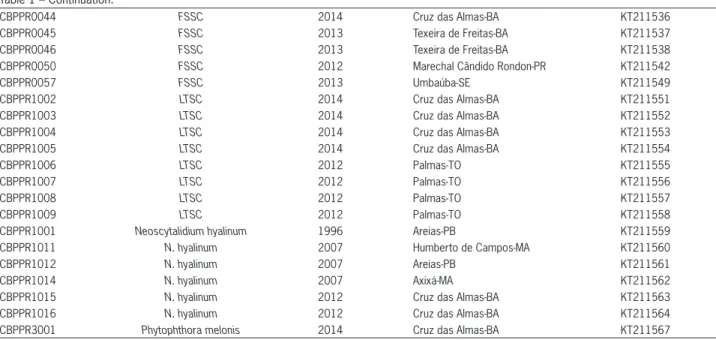
Table 1 − Cassava root rot pathogens studied, with collection details and GenBank accession number for the ITS rDNA region.
Voucher Species/complex Year Location* GenBank accession number
CBPPR0002 Corallomycetella repens 2013 Umbaúba-SE KT211495
CBPPR2001 DPMSC 2013 Cruz das Almas-BA KT211565
CBPPR2002 Diaporthe phaseolorum 2013 Cruz das Almas-BA KT211566
CBPPR0008 FCSC 1991 São Miguel das Matas-BA KT211501
CBPPR0047 FCSC 2014 Cruz das Almas-BA KT211539
CBPPR0051 FCSC 2012 Marechal Cândido Rondon-PR KT211543
CBPPR0031 FIESC 2014 Cruz das Almas-BA KT211523
CBPPR0032 FIESC 2014 Cruz das Almas-BA KT211524
CBPPR0058 FIESC 2013 Umbaúba-SE KT211550
CBPPR0049 FGSC 2012 Diamante do Norte-PR KT211541
CBPPR0052 FGSC 2012 Marechal Cândido Rondon-PR KT211544
CBPPR0053 FGSC 2012 Diamante do Norte-PR KT211545
CBPPR0003 FOSC 2013 Umbaúba-SE KT211496
CBPPR0004 FOSC 2013 Umbaúba-SE KT211497
CBPPR0005 FOSC 2013 Umbaúba-SE KT211498
CBPPR0006 FOSC 1994 São Miguel das Matas-BA KT211499
CBPPR0007 FOSC 1990 Ribeirópolis-SE KT211500
CBPPR0010 FOSC 2013 Cruz das Almas-BA KT211503
CBPPR0011 FOSC 2013 Cruz das Almas-BA KT211504
CBPPR0013 FOSC 2013 Cruz das Almas-BA KT211506
CBPPR0017 FOSC 2013 Cruz das Almas-BA KT211510
CBPPR0019 FOSC 2013 Cruz das Almas-BA KT211512
CBPPR0021 FOSC 2013 Cruz das Almas-BA KT211513
CBPPR0028 FOSC 2013 Cruz das Almas-BA KT211520
CBPPR0035 FOSC 2007 Vitória da Conquista-BA KT211527
CBPPR0037 FOSC 2007 Cachoeira-BA KT211529
CBPPR0038 FOSC 2007 Vitória da Conquista-BA KT211530
CBPPR0039 FOSC 2007 Ribeirópolis-SE KT211531
CBPPR0041 FOSC 2008 Guaratinga - BA KT211533
CBPPR0043 FOSC 2013 Cruz das Almas-BA KT211535
CBPPR0054 FOSC 2012 Diamante do Norte-PR KT211546
CBPPR0055 FOSC 2012 Diamante do Norte-PR KT211547
CBPPR0056 FOSC 2013 Umbaúba-SE KT211548
CBPPR0015 FFSC 2013 Cruz das Almas-BA KT211508
CBPPR0048 FFSC 2012 Cruz das Almas-BA KT211540
CBPPR0001 FSSC 2013 Umbaúba-SE KT211494
CBPPR0009 FSSC 2013 Cruz das Almas-BA KT211502
CBPPR0012 FSSC 2013 Cruz das Almas-BA KT211505
CBPPR0014 FSSC 2013 Cruz das Almas-BA KT211507
CBPPR0016 FSSC 2013 Cruz das Almas-BA KT211509
CBPPR0018 FSSC 2013 Cruz das Almas-BA KT211511
CBPPR0022 FSSC 2013 Cruz das Almas-BA KT211514
CBPPR0023 FSSC 2013 Cruz das Almas-BA KT211515
CBPPR0024 FSSC 2013 Cruz das Almas-BA KT211516
CBPPR0025 FSSC 2013 Cruz das Almas-BA KT211517
CBPPR0026 FSSC 2013 Cruz das Almas-BA KT211518
CBPPR0027 FSSC 2013 Cruz das Almas-BA KT211519
CBPPR0029 FSSC 2013 Cruz das Almas-BA KT211521
CBPPR0030 FSSC 2013 Texeira de Freitas-BA KT211522
CBPPR0033 FSSC 2007 Porto Seguro-BA KT211525
CBPPR0034 FSSC 2007 Humberto de Campos-MA KT211526
CBPPR0036 FSSC 2007 Axixá-MA KT211528
CBPPR0040 FSSC 2008 Guaratinga - BA KT211532
CBPPR0042 FSSC 2008 Cruz das Almas-BA KT211534
spores and mycelia, PDA + pine acicula for fungi and ‘carrot agar’ + Beta-sitosterol for oomycetes. Isolates were grouped, based on the morphology of the colony and spores, and then the cassava-root slices (Onyeka et al., 2005b) were inoculated to confirm pathogenic-ity. Monosporic cultures were preserved in tubes with culture medium according to the Castellani method and with mineral oil. Only those isolates considered as pathogenic, based on the cassava root-slice inoculation, were used in this study.
DNA extraction
Monosporic cultures of each isolate of fungi and oomycetes were placed to grow in sucrose and yeast ex-tract broth (10 g sucrose, 2 g yeast exex-tract, 1 g KH2PO4, 0 , 1g MgSO4.7H2O, 0.44 mg of ZnSO4.7H2O, and 1000 mL distilled water) for 15 days, and then the mycelium was filtered, arranged so as to dry out, and then mac-erated with liquid nitrogen and mixed with 700 μ ex-traction buffer (1 % CTAB, 20 mM Tris, pH 8.0; 10 mM EDTA; 0.7 M NaCl) and 10 μL of β-mercaptoethanol). The mixture was kept at 65 °C for 45 min and homog-enized gently every 15 min. Subsequently, 500 μL of Chloroform:Isoamyl Alcohol (24:1 v/v) was added, and the mixture was centrifuged for 10 min at 10,000 rpm. Supernatant was transferred to a new tube containing 500 μL of isopropanol and 100 μL of sodium acetate and was centrifuged at 10,000 rpm for 12 min.
Finally, the precipitate was washed twice with 1 mL of 70 % ethanol, placed so as to dry at room tem-perature, resuspended with Tris-EDTA buffer (TE) (10 mM Tris-HCL + 1 mM EDTA) and 2 μL of ribonuclease
A [RNAse] (10 mg mL−1), and incubated at 37 °C for
1 h. After extraction, the solution containing DNA was stored at –20 °C. The quality and quantity of total DNA was measured by visual comparison with phage λ DNA at concentrations of 50 and 100 ng electrophoreses in agarose gel (1 % 80V 60 min−1) stained with ethidium
bromide (1.5 μL 100 mL−1).
Amplification and sequencing
Amplification of the ITS region of the rDNA from isolates was performed using the universal primers ITS1 (5'TCC GTA GGT GAA CCT GCG G3') and ITS4 (5'TCC TCC GCT TAT TGA TAT GC3'). In 200 μL mi-crotubes the following was added: 50 ng DNA; 1X Tris-HCl / KCl pH 8.3 (10 mM / 50 mM); MgCl2 (1.5 mM); 0.1 μM of each dNTP; 0.2 μM of each primer; 1.5 U Taq polymerase, and ultrapure water to complete the volume of 50 μL. The reactions consisted of an initial denaturation phase at 94 °C for 4 min, followed by 35 cycles at 94 °C for 30 s, 30 s annealing at 50 °C, exten-sion at 72 °C for 1 min, and a final extenexten-sion of 72 °C for 7 min. Amplification was performed in a 96-Well Thermal Cycler.
The amplified products in the reaction were sepa-rated by agarose gel electrophoresis at 1 % to 100V in 0.5X TAE buffer (Tris-acetate-EDTA) for approximately 2 h and stained with ethidium bromide solution 1.5 μL 100 mL−1. The amplified fragments were visualized and
photographed under ultraviolet light. The PCR reaction products were purified by a commercial column purifi-cation kit and then sent for sequencing in two directions (forward and reverse).
CBPPR0044 FSSC 2014 Cruz das Almas-BA KT211536
CBPPR0045 FSSC 2013 Texeira de Freitas-BA KT211537
CBPPR0046 FSSC 2013 Texeira de Freitas-BA KT211538
CBPPR0050 FSSC 2012 Marechal Cândido Rondon-PR KT211542
CBPPR0057 FSSC 2013 Umbaúba-SE KT211549
CBPPR1002 LTSC 2014 Cruz das Almas-BA KT211551
CBPPR1003 LTSC 2014 Cruz das Almas-BA KT211552
CBPPR1004 LTSC 2014 Cruz das Almas-BA KT211553
CBPPR1005 LTSC 2014 Cruz das Almas-BA KT211554
CBPPR1006 LTSC 2012 Palmas-TO KT211555
CBPPR1007 LTSC 2012 Palmas-TO KT211556
CBPPR1008 LTSC 2012 Palmas-TO KT211557
CBPPR1009 LTSC 2012 Palmas-TO KT211558
CBPPR1001 Neoscytalidium hyalinum 1996 Areias-PB KT211559
CBPPR1011 N. hyalinum 2007 Humberto de Campos-MA KT211560
CBPPR1012 N. hyalinum 2007 Areias-PB KT211561
CBPPR1014 N. hyalinum 2007 Axixá-MA KT211562
CBPPR1015 N. hyalinum 2012 Cruz das Almas-BA KT211563
CBPPR1016 N. hyalinum 2012 Cruz das Almas-BA KT211564
CBPPR3001 Phytophthora melonis 2014 Cruz das Almas-BA KT211567
DPMSC: Diaporthe (Phomopsis) melonis species complex;FCSC: F. chlamydosporum species complex; FIESC: F. incarnatum-equiseti species complex; FGSC: F. graminearum species complex; FOSC: F. oxysporum species complex;FFSC: F. fujikuroi species complex;FSSC: Fusarium solani species complex;LTSC: Lasiodiplodia theobromae species complex.*States from the Northeast region of Brasil: BA: Bahia; MA: Maranhão; PB: Paraíba; SE: Sergipe. *State from the Northern region of Brasil: TO: Tocantins. *State from the South region of Brasil: PR: Paraná.
The DNA sequences obtained were evaluated for sequencing quality, aligned pair-to-pair, and manually edited to obtain a consensus sequence for each isolate. The consensus sequences generated were compared with those deposited in the GenBank (National Center for Biotechnology Information website - http://www. ncbi.nlm.nih.gov) through the BLASTn tool for confir-mation of the genus of each of the isolates. The verifica-tion of the identity of the species causing CRRD was car-ried out using phylogenetic analyses of Neighbor-Joining (NJ) and Bayesian inference, and was compared to refer-ence sequrefer-ences deposited in the Genbank.
Phylogenetic analyses
The rDNA ITS regions (comprising the ITS1, 5.8S and ITS2) were aligned with isolates from different spe-cies complexes using the "Muscle" algorithm implement-ed in the software MEGA v.6. Although the ITS may not be appropriate for accurate identification of strains at the species level, it can be used to classify them into species complexes. In the alignment matrices, sequences from the GenBank database were included based on index similarity. Outgroups used for each genus were Micro-dochium nivale - CBS 116205 (Fusarium), Spencermartinsia viticola - CBS 117009 (Lasiodiplodia and Neoscytalidium),
Pythium citrinum - 221 743 (Phytophthora), Diaporthella corylina - CBS 121124 (Phomopsis).
Phylogenetic analyses based on NJ were per-formed using MEGA v.6 with a "Kimura 2-parameter" model and 10,000 bootstrap replicates to determine the support of the branches. For the Bayesian inference anal-ysis, the evolution model for each genus was chosen us-ing hierarchical likelihood tests considerus-ing the Akaike Information Criterion (AIC) using the MrModeltest v.2.3 program. The consensus trees were generated using the MrBayes software v.3.2, with 5,000,000 generations (convergence 0.001) through two independent runs; each used four Markov Monte Carlo Chains (MCMC), two hot and two cold chains, sampling a tree every 1,000 genera-tions, and burn-in of the initial 1,250,000 generations. The trees were visualized and edited using the FigTree software v.1.2.2.
Results
From a total of 115 isolates obtained from diseased cassava plants, only the 74 considered as pathogenic were used. These isolates were obtained from differ-ent producing regions (Table 1). Isolates were separated based on the genus defined by BLAST search in the Gen-Bank database (National Center for Biotechnology Infor-mation) and phylogenetic analyses. The most frequent species were of the genus Fusarium (56), followed by
Lasiodiplodia (8), Neoscytalidium (6), and Diaporthe/Pho-mopsis complex (2), Phytophthora and Corallomycetella (1 each).
According to the phylogenetic analysis of ITS rDNA region, the Fusarium-like isolates, associated with
dry root-rot symptoms, were divided into six groups (Figure 1). Five of them had more than one isolate per group, and one group had a single isolate. ‘Group 1’ (F.
solani species complex - FSSC) comprised a total of 24 isolates which were clustered and divided into three clusters inside the FSSC, but all considered as F. solani
sensu lato (Table 1).
For the isolates clustered in ‘Group 2’ (F. oxyspo-rum species complex – FOSC) (Figure 1), a high posterior probability was found (0.92). This indicated that 21 of the isolates represented lineages of FOSC, from this 15 were from crops in the state of Bahia, six were from Ser-gipe, and two were from Paraná, corresponding to 50 % of the states sampled.
‘Group 3’ was composed of six isolates each grouped into F. incarnatum-equiseti (FIESC) and F. chla-mydosporum (FCSC) complexes (Figure 1). In contrast, ‘Group 4’ was composed of three isolates belonging to
F. graminearum complex (FGSC), and two isolates were placed in ‘Group 5’ with species from F. fujikuroi com-plex (FFSC). In Group 6 an isolate relating to the species
Corallomycetella repens (teleomorph = Nectria mauriti-icola) was identified.
Seven lineages associated with dry root rot symptoms with different frequencies were identified: FSSC (24/56), FOSC(21/56), FGCS (3/56), FCSC(3/56), FIESC(3/56), FFSC(2/56), plus one isolate characterized as Corallomycetella repens (teleomorph = Nectria mauritiicola) and not Fusarium (Figure 1).
A total of 15 isolates associated with black root rot were classified within the Botryosphaeriaceae fam-ily, being nine isolates clustered as Lasiodiplodia theo-bromae species complex and six isolates were identi-fied as Neoscytalidium hyalinum (Figure 2), originating from the states of Bahia, Maranhão, Paraiba and To-cantins.
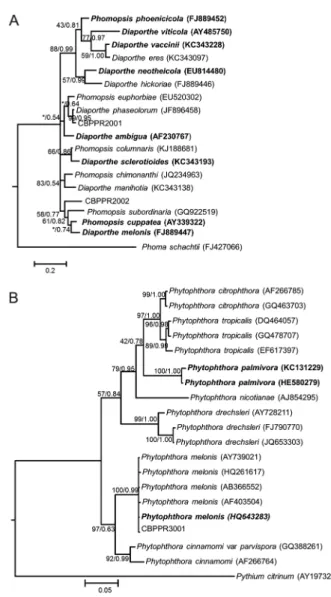
Two of the strains obtained showed a high similar-ity to Phomopsis sp. in a BLASTn search. These sequenc-es came from fields located in the state of Bahia and the city of Cruz das Almas. According to phylogenetic analysis of ITS-barcoding, they were clustered in a sin-gle clade within the Diaporthe/Phomopsis complex (pos-terior probability = 0.63), and the CBPPR2001 isolate had a 99 % identity to Diaporthe (Phomopsis) phaseolorum
(Figure 3A). The CBPPR2002 isolate was set in a differ-ent branch in the same clade, but it was not possible to determine the species to which it belonged because ad-ditional molecular sequences from other regions would have been required.
The CBPPR3001 isolate was obtained in the state of Bahia (Cruz das Almas), causing soft root rot symptoms, and was grouped together with the species
P. melonis (99 % similarity), according to the phyloge-netic analysis based on the ITS region of rDNA (Figure 3B).
Discussion
Isolates in F. solani (FSSC) and F. oxysporum (FOSC) complexes are often reported as the most prevalent asso-ciated with CRRD, FSSC being the most widely distrib-uted among the different producing regions worldwide.
Fusarium solani sensu lato was also reported as a cassava pathogen in Colombia. Based on morphological charac-teristics, this fungus is considered to be more common than the F. oxysporum as a causal agent of CRRD (On-yeka et al., 2005a).
FSSC and FOSC showed a frequency of 45 % in a survey of pathogens occurring in Nigeria in 1998 and 1999. They occurred more frequently in areas with more than 1,600 mm of rain per year (Bandyopadhyay et al., 2006). In addition to Colombia, F. solani has also been reported in association with cassava in India, Malay-sia, Nigeria, and New Guinea (Adisa, 1983; Shaw, 1984; Cheari et al., 2014.). In fact, in several African countries,
Figure 1 − A Bayesian inference phylogenetic tree of the genus Fusarium of the ITS rDNA region. Bootstrap values ≥ 50 and Bayesian posterior probability ≥ 0.5 are shown at the nodes (Neighbor Joining/Bayesian). Ex-type cultures are emphasized in bold font. Microdochium nivale (AB58698) was used as outgroup. The scale bar indicates the number of expected changes per site. FSSC = Fusarium solani species complex; FOSC = F. oxysporum species complex;FIESC = F. incarnatum-equiseti species complex; FCSC = F. chlamydosporum species complex; FGSC = F. graminearum species complex; FFSC = F. fujikuroi species complex; ANF =species where the “Anamorph is not Fusarium”. Isolates beginning with “CBPPR” are from this study.
different Fusarium spp. are commonly associated with cassava root rot disease. The F. oxysporum is one of the most widespread species and is associated with large losses in the productivity of cassava (Bandyopadhyay et al., 2006).
C. repens is a saprophytic species, but it can also be parasitic in plant roots. Generally, this is a problem in soils with drainage problems, causing yellowing and leaves with decay accompanied by a bad odor (Seifert, 1985). Another synonym of C. repens is Sphaerostilbe re-pens,which has also been observed in African countries causing CRRD (Obilo and Ikotun, 2008).
dif-ferent species and the isolates classified in this work as
L. theobromae, additional studies should be conducted to more assertively identify the species found through polyphasic characterization, including the sequencing of other genetic regions such as the elongation factor alpha (EF1-α) and beta tubulin (βt).
The name Scytalidium lignicola is applied to certain pathogens causing cassava root rot in Brazil (Machado et al., 2014a). However, several species of Scytalidium are now classified under the genus Neoscytalidium, whose morphology is similar to Scytalidium but differs in the presence or absence of pycnidia and conidia between genera and belongs to different orders of Ascomycota (Crous et al., 2006; Seifert et al., 2011; Phillips et al., 2013; Machado et al., 2014a).
The species N. hyalinum previously classified as
Neoscytalidiumdimidiatum refers to a Botryosphaeriaceae fungus family, which includes several pathogenic fungi, endophytes, and saprophytes found in all geographic and climatic areas of the world, except for the polar regions (Crous et al., 2006; Phillips et al., 2013). N. hyalinum has previously been reported in association with physic nut (Jatropha curcas L.), mango (Mangifera indica L.), and cassava in Brazil (Machado et al., 2012; Marques et al., 2013; Machado et al., 2014a; Machado et al., 2014b).
The Diaporthe genus includes plant pathogenic species in many woody and herbaceous hosts that are found mainly in its anamorphic state Phomopsis. Many
of its species cause major losses to infected plants of economic interest such as fruit, and cause cancers, rot, diebacks, and necrosis, among other pathologies. These fungi can survive as endophytes, without causing any damage to the host, and they may become pathogenic when the host is senescent or under stress conditions; there are a lot of species with saprophytic behavior.
Examples of pathogens are P. amygdali (Delacr.) JJ Tuset & MT Portilla, which are responsible for stem dis-coloration and death of peach (Farr et al., 1999), D. heli-anthi Munt.-Cvetk., Mihalj . & M. Petrov, that cause
Pho-Figure 2 − A Bayesian inference phylogenetic tree of the family Botryosphaeriaceae of the ITS rDNA region. Bootstrap values ≥ 40 and Bayesian posterior probability ≥ 0.5 are shown at the nodes (Neighbor Joining/Bayesian). Ex-type strains are emphasized in bold font. Spencermartinsia viticola (AY905554) was used as outgroup. The scale bar indicates the number of expected changes per site. Isolates beginning with “CBPPR” are from this study.
Figure 3 − A Bayesian inference phylogenetic tree of the Diaporthe/ Phomopsis complex (A) and Phytophthora (B) of the ITS rDNA region. Bootstrap values ≥ 40 and Bayesian posterior probability ≥
mopsis stem canker in sunflower (Muntanola-Cvetkovic et al., 1991), D. phaseolorum (Cooke and Ellis) Sacc., which is the causal agent of soybean stem canker (Black et al., 1996), and P.viticola (Sacc.) Sacc., is an important pathogen of grape (Mostert et al., 2001). However, even though D. phaseolorum is a notorious rot and stem patho-gen in other plant species, this is the first report of its kind associated with CRRD.
Species of the genus Phytophthora have been asso-ciated with soft root rot in cassava such as P. palmivora, which was recently reported to have attacked cassava plants in China and whose symptoms were character-ized by widespread wilting in the upper leaves and death of the plant (Guo et al., 2012). In Brazil, P. drechsleri and
P. melonis species have also been associated with CRRD, and P. drechsleri isconsidered the main causal agent of soft root rot.
Species of the genus Fusarium were found in al-most all locations sampled, except for Areia, the state of Paraíba and Palmas, and the state of Tocantins, where the species N. hyalinum and L. theobromae were pre-dominant, respectively. Therefore, in general, there was a wide distribution of Fusarium species. On the other hand, different compositions of species were found, in some cases restricted to a geographical region such as the occurrence of species of the complex F. graminearum
in the municipalities of the state of Paraná (Diamante do Norte and Marechal Cândido Rondon).
Fungi that cause black root rot disease such as N.
hyalinum and L. theobromae were mainly identified in the municipalities in the north and northeast of Brazil. According to Aigbe et al. (2008), there is an association between species causing root rot and edaphoclimatic pa-rameters as well as the stage of development of the cul-ture, and in the early stages of plant development there is a common occurrence of Fusarium species, while in the later stages, there is a predominance of black rot pathogens.
CRRD is difficult to manage because is caused by a complex of soil-borne fungi/oomycete species, which makes chemical control infeasible due to environmen-tal damage and its high treatment costs for producers. These limitations require the identification of alterna-tive ways to managing the disease including sustainable practices that are more accessible to farmers and less harmful to the environment. Different studies showed that the use of resistant varieties, together with crop ro-tation and changes in the cropping systems, enabled a reduction of about 60 % in CRRD (Bezerra and Sousa, 2003) and contribute significantly to increasing produc-tivity, thus improving the quality and the aspect of cas-sava, and obtaining a better final product.
Data from this study support the need for a deeper understanding of the genetic resistance of cassava acces-sions in germplasm banks. Likewise, they indicate the need for evaluation based on observation of the reaction of cassava genotypes from different species of pathogens individually and based not only on observations in the
field, since the pathogens can vary according to location. Problems related to the selection of plants resis-tant to CRRD were reported by Bandyopadhyay et al. (2006), who considered that the geographical differences related to the diversity of the populations of root rot fungi pose a challenge to the genetic improvement since that genotypes considered resistant in one region may not be in another.
Thus, because of the diversity of lineages found in this study, breeding programs must include selection for multiple resistant cassava root rot pathogens, mainly for the FSSC and FOSC and for the isolates associated with black root rot (Lasiodiplodia spp. and Neoscytalidium hyalinum lineages), either in individual evaluations (each species complex versus each of access) or by directly challenge by different groups of pathogens (e.g.: dry and black root rot pathogens). Consequently, the results ob-tained in this study will be used to conduct experiments aiming to select genotypes resistant to cassava root rot disease through the cassava breeding program, and for other Brazilian research companies and/or universities.
Acknowledgements
We are grateful to the Brazilian Agricultural Re-search Corporation (Embrapa), National Council for Scientific and Technological Development (CNPq), and The Bahia State Research Support Foundation (Fapesb) for financial support of this project and to the office of the Coordination for the Improvement of Higher Level Personnel (CAPES) for the fellowship (Master Degree) of Sandielle Araújo Vilas Boas.
References
Adisa, V.A. 1983. Surface mycoflora of Manihot esculenta and M.
utilissima tubers in Nigeria. Indian Phytopathology 36: 533-538. Akinbo, O.; Labuschagne, M.; Fregene, M. 2012. Introgression of
whitefly (Aleurotrachelus socialis) resistance gene from F1 inter-specific hybrids into commercial cassava. Euphytica 183: 19-26. Bandyopadhyay, R.; Mwangi, M.; Aigbe, S.O.; Leslie, J.F. 2006.
Fusarium species from the cassava root rot complex in West Africa. Phytopathology 96: 673-676.
Black, B.D.; Padgett, G.B.; Russin, J.S.; Griffin, J.L.; Snow, J.P.; Gerggren, J.R.G.T. 1996. Potential weed hosts for Diaporthe phaseolorum var. caulivora, causal agent for soybean stem canker. Plant Disease 80: 763-765.
Cheari, K.; Salleh, B.; Zakaria, L.2014. Fusarium virguliforme, a soybean sudden death syndrome fungus in Malaysian soil. Australasian Plant Disease Notes 9: 1-7.
Crous, P.W.; Slippers, B.; Wingfield, M.J.; Rheeder, J.; Marasas, W.F.O.; Phillips, A.J.L.; Alves, A.; Burgess, T.; Barber, P.; Groenewald, J.Z. 2006. Phylogenetic lineages in the Botryosphaeriaceae. Studies in Mycology 55: 235-253.
Farr, D.F.; Castlebury, L.A.; Pardo-Schultheiss R.A. 1999.
Guo, H.; Li, C.P.; Shi, T.; Fan, C.J.; Huang, G.X. 2012. First report of Phytophthora palmivora causing root rot of cassava in China. Plant Disease 96: 1072.
Machado, A.R.; Pinho, D.B.; Dutra, D.C.; Pereira, O.L. 2012. Collar and root rot caused by Neoscytalidium dimidiatum in the biofuel plant Jatropha curcas. Plant Disease 96: 1697.
Machado, A.R.; Pinho, D.B.; Oliveira, S.A.S.; Pereira, O.L. 2014a. New occurrences of Botryosphaeriaceae causing black root rot of cassava in Brazil.Tropical Plant Pathology 39: 464-470. Machado, A.R.; Pinho, D.B.; Pereira, O.L. 2014b. Phylogeny,
identification and pathogenicity of the Botryosphaeriaceae associated with collar and root rot of the biofuel plant
Jatropha curcas in Brazil, with a description of new species of
Lasodiplodia. Fungal Diversity 67: 231-247.
Marques, M.W.; Lima, N.B.; Morais, J.R.M.A.; Barbosa, M.A.G.; Souza, B.O.; Michereff, S.J.; Phillips, A.J.L.; Câmara, M.P.S. 2013. Species of Lasiodiplodia associated with mango in Brazil. Fungal Diversity 61: 181-193.
Mostert, L.; Crous, P.W.; Kang, J.C.; Phillips, A.J.L. 2001. Species of Phomopsis and a Libertella sp. occurring on grapevines with specific reference to South Africa: morphological, cultural, molecular and pathological characterization. Mycologia 93: 146-167.
Muntanola-Cvetkovic, M.; Vukojevic, J.; Mihaljčevic, M. 1991. The systemic nature of the sunflower disease caused by
Diaporthe helianthi. Canadian Journal of Botany 69: 1552-1556. Netto, M.S.B.; Assunção, I.P.; Lima, G.S.A.; Marques, M.W.; Lima
W.G.; Monteiro, J.H.A.; Balbino, V.Q.; Michereff, S.J.; Phillips, A.J.L.; Câmara, M.P.S. 2014. Species of Lasiodiplodia associated with papaya stem-end rot in Brazil. Fungal Diversity 67: 127-141.
Obilo, O.P.; Ikotun B. 2008. Effect of canker size on availability of cassava planting materials in Nigeria. African Crop Science Journal16: 203-209.
Onyeka, T.J.; Dixon, A.G.O.; Ekpo, E.J.A. 2005a. Field evaluation of root rot disease and relationship between disease severity and yield in cassava. Experimental Agriculture 41: 357-363. Onyeka, T.J.; Dixon, A.G.O.; Ekpo, E.J.A. 2005b. Identification of
levels of resistance to cassava root rot disease (Botryodiplodia theobromae) in African landraces and improved germplasm using in vitro inoculation method. Euphytica 145: 281-288. Phillips, A.J.L.; Alves, A.; Abdollahzadeh, J.; Slippers, B.;
Wingfield, M.J.; Groenewald, J.Z.; Crous, P.W. 2013. The Botryosphaeriaceae: genera and species known from culture. Studies in Mycology 76: 51-167.
Seifert, K.A.; Morgan-Jones, G.; Kendrick, W.B.; Gams, W. 2011. The genera of hyphomycetes. CBS-KNAW, Utrecht, The Netherlands.
Seifert, K.A. 1985. A monograph of Stilbella and some allied Hyphomycetes. Studies in Mycology 27: 1-235.
Shaw, D.E. 1984. Microorganisms in Papua New Guinea. Research Bulletin of the Department of Primary Industries Port Moresby 3: 1-344.