ORIGINAL ARTICLE
In major affective disorders, early life trauma predict increased
nitro-oxidative stress, lipid peroxidation and protein
oxidation and recurrence of major affective disorders, suicidal behaviors
and a lowered quality of life
Juliana Brum Moraes1&Michael Maes1,2,3,4,5,6 &Chutima Roomruangwong2&Kamila Landucci Bonifacio1& Decio Sabbatini Barbosa1&Heber Odebrecht Vargas1&George Anderson7&Marta Kubera8&Andre F. Carvalho9& Sandra Odebrecht Vargas Nunes1
Received: 9 October 2017 / Accepted: 25 February 2018
#Springer Science+Business Media, LLC, part of Springer Nature 2018
Abstract
Early life trauma (ELT) may increase the risk towards bipolar disorder (BD) and major depression (MDD), disorders associated with activated neuro-oxidative and neuro-nitrosative stress (O&NS) pathways. It has remained elusive whether ELTs are associated with O&NS and which ELTs are associated with distinct affective disorder phenotypes. This case-control study examined patients with BD (n= 68) and MDD (n= 37) and healthy controls (n= 66). The Child Trauma Questionnaire (CTQ) was used to assess specific ELT. We measured malondialdehyde (MDA), lipid hydroperoxides (LOOH), superoxide dismutase (SOD), catalase, advanced oxidation protein products (AOPP); NO metabolites (NOx), paraoxonase 1 activity, zinc, albumin, high density lipoprotein cho-lesterol and -SH groups and computed z-unit weighted composite scores. Physical neglect significantly predicts higher z-unit weighted composite scores of LOOH+SOD, LOOH+SOD+NOx, LOOH+SOD+NOx + MDA and LOOH+SOD+NOx + AOPP. Sexual abuse was associated with a significantly lower composite score of zinc+albumin+SH. Emotional abuse was associated with severity of depression and anxiety, number of depressive and manic episodes, alcohol and hypnotics use, lifetime suicidal behavior and lowered quality of life. Sexual abuse was associated with an increased risk towards BD, but not MDD. ELT, especially physical neglect, may drive increased (nitro-)oxidative stress coupled with lipid and protein oxidation, which - together with emotional abuse - may play a role in severity of illness, lowered quality of life and MDD. ELTs are also associated with the onset of BD, but this link did not appear to be related to activated O&NS pathways. These novel findings deserve confirmation in prospective studies.
Keywords Depressive disorder . Bipolar disorder . Child abuse . Oxidative stress . Antioxidants . Suicide
* Michael Maes
[email protected];http://scholar.google.co.th/citations? user=1wzMZ7UAAAAJ&hl=th&oi=ao&cstart=100&pagesize=100
Juliana Brum Moraes [email protected]
Chutima Roomruangwong [email protected]
Kamila Landucci Bonifacio [email protected]
Decio Sabbatini Barbosa [email protected]
Heber Odebrecht Vargas [email protected]
George Anderson
Marta Kubera
Andre F. Carvalho [email protected]
Sandra Odebrecht Vargas Nunes [email protected]
Extended author information available on the last page of the article
Introduction
The major affective disorders (MAFD) bipolar disorder (BD) and major depressive disorder (MDD) are heteroge-neous clinical phenotypes, whose patho-etiology appears to be explained by a complex interaction of genetic and environmental factors (Murray et al. 2013; Walker et al. 2015). Both MAFD types are highly prevalent and recur-ring disorders with a higher risk for suicidal behavior (American Psychiatric Association 2013; Bolton et al. 2015; Miret et al. 2013; Novick et al. 2010). Replicated evidence indicates that both MDD and BD are associated with impairments in health-related quality of life (HRQoL) and significant disabilities (Birnbaum et al. 2010; Dean et al. 2004; Depp et al. 2012; GBD 2015 DALYs and HALE Collaborators2016).
Early life trauma (ELT), defined as early life adverse experiences including physical, sexual and emotional abuse and neglect, are putative environmental risk factors for BD and MDD (Alvarez et al. 2011; Bergink et al. 2016: Heim et al., 2010). Different types of childhood adversity, such as parental discord and bullying may con-tribute to the onset of psychopathology (Catone et al. 2015; Fisher et al. 2010; Takizawa et al. 2014). Meta-analytic evidence indicates that a history of childhood maltreatment has a significant deleterious impact on the long-term course of both MAFD, including a more recur-ring course (Agnew-Blais and Danese2016; Jansen et al. 2016), greater illness severity, higher rates of co-occurring substance misuse disorders (Agnew-Blais and Danese 2016; Schoedl et al. 2010) and increased risk towards suicidal behaviors (Heim et al. 2010; Kendler et al. 2002; Runyan et al. 2002; Schoedl et al. 2010). In chil-dren and adult survivors of child abuse, ELT has a nega-tive impact on HRQoL while affecting disability even decades after the experienced trauma (Afifi et al. 2007; Chahine 2014). Nevertheless, it is emphasized that the investigation of possible mechanisms underpinning the consequences of ELT among patients with affective disor-ders remains relatively unexplored (Aas et al.2016).
There is now replicated evidence that MAFD is accompanied by activated neuro-oxidative and neuro-nitrosative stress (O&NS) pathways, lowered levels of antioxidants and antioxi-dant enzymes, which are often interrelated with activated immune-inflammatory pathways (Anderson and Maes2015; Andreazza et al.2008; Berk et al. 2011; Brown et al. 2014; Kohler et al.2017a, b; Liu et al. 2015; Maes et al.2009, 2011). The key findings are: a) lowered protection against lipid peroxidation as indicated by lower levels of high-density lipo-protein (HDL) cholesterol, cholesterol esters, omega-3 polyunsatutared fatty acids and paraoxonase 1 activities (Bilici et al.2001; Bortolasci et al.2014; Maes et al.2000,1999,1994, 1997; Moreira et al.2017; Nunes et al.2015; Peet et al.1998;
Sobczak et al.2004; Tsuboi et al.2006); b) increased reactive oxygen species (ROS, including superoxide radicals and hy-droxyl) as indicated by increased levels of superoxide dismutase (SOD) and peroxides coupled with lowered levels of catalase (Liu et al.2015; Maes et al.2010); c) oxidative damage to lipids as indicated by increased malondialdehyde (MDA) levels and IgG/IgM-mediated autoimmune responses to oxidized low-density lipoprotein (LDL) cholesterol, MDA and anchorage molecules, including palmitic and myristic acid (Bengesser et al. 2015; Bilici et al. 2001; Chowdhury et al. 2017; Khanzode et al.2003; Kunz et al.2008; Machado-Vieira et al. 2007; Maes et al.2013a,b; Ozcan et al.2004; Ranjekar et al. 2003; Sarandol et al.2007); d) increased reactive nitrogen spe-cies (RNS) as indicated by increased production of nitric oxide (NO) metabolites (NOx) and inducible NO synthase (Galecki et al.2011; Liu et al.2015; Maes et al.2011; Morris et al.2017); e) lowered levels of key antioxidants including albumin, zinc and sulfhydryl (-SH) groups on proteins (Gomes et al.2017; Liu et al.2015; Maes et al.1991; Nowak2015; Swardfager et al. 2013); and f) increased protein oxidation as indicated by higher advanced oxidation protein products (AOPP) (Gomes et al. 2017), which may be induced by increased peroxynitrite (as a consequence of increased superoxide and NO) and myeloperxidase increasing hypochlorous acid (HOCl) (Vaccarino et al.2008).
Methods
Study population
This cross-sectional study examined participants with Bipolar Disorders (n= 68) and Major Depressive Disorder (n= 37) recruited from the Psychiatry outpatient clinics at the University Hospital of the Universidade Estadual de Londrina (UEL), Parana, Brazil. All patients were in remission or partial remission and none of the BD patients was in a manic phase. A sample of healthy con-trols (HC,n= 66) was recruited from the same catchment area. Participants of either gender, ages 18 to 65 years and from all ethnicities were included. The study was con-ducted from June 2015 through March 2016. All partici-pants provided written informed consent to take part in the study, with the experimental procedures being ap-proved by the Research Ethics Committee at UEL (proto-col number: CAAE 34935814.2.0000.5231).
The following exclusion criteria were applied: a) partici-pants with mental retardation, schizophrenia, neurocognitive disorders, or otherwise cognitively impaired, b) pregnant women, c) individuals using nonsteroidal anti-inflammatory drugs, glucocorticoids, interferon, omega-3 polyunsaturated fatty acids and antioxidant agents, such as N-acetylcysteine during the past 4 weeks prior to study enrollment, and d) participants with medical conditions, which are known to in-volve peripheral inflammation and cell-mediated immune ac-tivation, including HIV infection, hepatitis B and C virus in-fection, the postpartum period, chronic and acute renal failure, neurodegenerative disorders (e.g. Alzheimer’s and Parkinson’s disease), cancers, chronic obstructive pulmonary disease, inflammatory bowel disease, and autoimmune dis-eases including Crohn’s disease, rheumatoid arthritis, multiple sclerosis, systemic lupus erythematosus and type I diabetes (Maes et al.2011).
Methods
All participants completed a semi-structured interview, which comprised socio-demographic data (education, work status, marital status, etc) and clinical data, including the number of depressive and manic episodes, the use of drugs of abuse, first-degree family history of mood disorders and substance-related disorders, as well as first-degree family history of sui-cide, use of psychopharmacological agents, namely antide-pressants, antipsychotic drugs and mood stabilizers, including lithium and anticonvulsants.
Diagnoses of BD, MDD and tobacco use disorder (TUD) were established by trained research psychiatrists using the Structured Clinical Interview for the DSM-IV-TR clinical version translated and validated for applica-tion in Brazilian samples (Del-Ben et al. 2001).
Depression symptom severity was measured with the 17-item Hamilton Depression Rating Scale (HAM-D), which was previously translated and adapted for use with Brazilian samples (Moreno and Moreno1998). The sever-ity of anxiety symptoms was assessed by means of the Hamilton Anxiety Rating Scale (HAM-A) (Hamilton 1959), and the severity of manic symptoms was evaluated using the Brazilian Portuguese version of the Young Mania Rating Scale (YMRS) (Vilela et al. 2005). Current suicidal ideation and previous suicide attempts were assessed using the Columbia Suicide Rating Scale (Posner et al.2011). In this study, we used three items of this scale, namely current and lifetime suicidal ideation and lifetime suicidal attempts (all scored as yes or no).
The Childhood Trauma Questionnaire (CTQ) is a self-administered instrument for adolescents and adults that investigates a history of abuse and neglect during child-hood. The instrument features scores on a five point Likert scale as to the frequency of reported events in childhood. It rates childhood maltreatment in 5 domains, namely sexual abuse, physical abuse, emotional abuse, emotional neglect and physical neglect (Bernstein et al. 2003). Its 28-item version has been validated to Brazilian Portuguese (Grassi-Oliveira et al.2006).
The assessment of substance misuse was made through the ASSIST (Alcohol, Smoking and Substance Involvement Screening Test), a screening questionnaire developed by the World Health Organization (WHO ASSIST Working Group 2002), translated and adapted to Brazilian Portuguese (Henrique et al.2004). This study used items pertaining to the use of alcohol and hypnotics. The Sheehan Disability Scale is a widely employed measure of disability used for research in populations with mood disorders. It is a self-administered scale which rates three main areas: 1) occupa-tional, 2) social life, leisure, 3) family life, activities, house-hold activities. A score of 0–10 is rated in each domain. Scores of 0–3 indicate mild psychosocial dysfunction, 4–6 moderate dysfunction and 7–10 severe disability (Sheehan et al.1996). We used the WHO Quality of Life Instrument-Abbreviated Version (WHOQOL-BREF) (Skevington et al.2004) in a val-idated Brazilian Portuguese translation (Fleck et al.2000) to assess HRQL. In this study, we used the sum of the 26 items as an overall index of HRQL. Body mass index (BMI) was cal-culated as weight (kg) divided by square of height (m2).
MDA estimation through high performance liquid chromatog-raphy (HPLC Alliance e2695, Waters’, Barueri, SP, Brasil) (Bastos et al.2012). Experimental conditions included the use of a column Eclipse XDB-C18 (Agilent, USA); mobile phase consisting of 65% phosphate buffer (50 nM pH 7.0) and 35% HPLC grade methanol; flow rate of 1.0 mL/min; temperature of 30øC; wavelength of 532 nm. MDA concentration in the sam-ples was quantified based on a calibration curve and are expressed in æmol of MDA/mg proteins. Lipid peroxides (LOOH) are assayed by chemiluminescence (CL-LOOH) (Gonzalez Flecha et al.1991; Panis et al.2012). This method uses the compound tert-butyl hydroperoxide to start a lipid chain reaction that can be detected by photon emission during the formation of lipid hydroperoxides. Readings were per-formed in a Glomax luminometer (TD 20/20 Turner Designers, USA) over 1 h at 1 reading per second. Results are expressed as relative units of light. SOD activity in erythrocytes was determined using the pyrogallol method described by Marklund and Marklund (1974). This technique is based on the inhibition of pyrogallol self-oxidation by SOD in aqueous solution. The assay was conducted in a spectrophotometer Helios à, Thermo Spectronics (Waltham, MA, USA) at 420 nm and 37øC. During 5 min, variation in optical density (OD) was recorded every minute. The level of SOD that inhibited 50% of the pyrogallol oxidation was defined as one unit of enzymatic activity. The results were expressed U/mg Hb. Measurement of catalase activity was estimated through the difference between the initial reading and the reading con-ducted 30 s after the addition of 200 mM H2O2 30% at 240 nm in a microplate reader (model EnSpire, Perkin Elmer, USA) with the temperature maintained at 25 °C. The catalase values are expressed as U/mg of hemoglobin (Hb). AOPP was quan-tified using the method described by Hanasand et al. (2012) in a microplate reader, Perkin Elmer, model EnSpire (Waltham, MA, EUA) at a wavelength of 340 nm (Hanasand et al. 2012). AOPP concentration was expressed inμM of equivalent
chloramine T. NO metabolite (NOx) levels were assessed indi-rectly by determining the plasma nitrite concentration using an adaptation of the technique described (Navarro-Gonzalvez et al. 1998). This method is based on the reduction of the nitrate present in the sample to nitrite by oxidation-reduction reactions mediated by the system cadmium-copper reagent. Thereafter, Griess reagent was added to induce diazotization, forming a colored complex and subsequent detection at 540 nm. The quantification of NOx was made in a microplate reader Asys Expert Plus, Biochrom (Holliston, MA, USA). The nitric oxide concentration was expressed inμM.
Total plasmatic activity of PON1 was determined by the method described by Richter et al. (2008). The rate of hydro-lysis of phenyl acetate was determined in a microplate reader EnSpire, Perkin Elmer (Waltham, MA, USA) at 270 nm and the temperature maintained at 25 °C. Measures were recorded for 4 min each 15 s. The activity was expressed in U/mL based
on the phenyl acetate molar extinction coefficient of 1.31 mMol/L cm-1. PON1 activity was adjusted for Q192R poly-morphism, which was determined through kinetic assays (Richter et al.2008) in a spectrophotometer microplate reader (EnSpire, Perkin Elmer, USA). Individuals were stratified in functional genotypes for PON1 Q192R polymorphism (QQ, QR and RR). Total plasmatic PON1 activity was determined by measuring rates of phenylacetate (PA, Sigma, USA) hydro-lysis at low salt concentration since under this assay condition, the PON1 Q192R polymorphism does not influence PON1 catalytic activity against PA (Furlong et al. 2006; Moreira et al.2017). Zinc was assayed using a method described by Barceloux and Barceloux (1999). Briefly, 0.5 mL of serum sample was diluted with 2.0 mL ultrapure water (PureLab Ultra, ELGA, USA), and carried out using an Analyst model 5110 (Perkin Elmer, USA) atomic absorption spectrometer with flame atomization (8= 213.9 nm, slit 0.7), operating with ultra air and acetylene (99.999%, Air Liquid, Brazil). The accuracy of the results was evaluated using the standard ref-erence material BioRad serum (Biorad 26,400, level 1). All the analyses were performed in an ISO Class 7 cleanroom facility. Albumim was assayed using an automated method in a clinical chemistry system (Dimension RxL,Siemens Healthcare Diagnostics Inc., Newark, DE, USA). HDL-C was assayed by automated methods using the Dimension RxL (Deerfield, IL, USA) and i2000SR Architect (Abbott, IL, USA). Sulfhydryl (-SH) groups from proteins were eval-uated by the method described by Hu (1994), which is based on the reaction of 5,5-dithiobis-2 nitrobenzoic acid (DTNB) with sulfhydryl groups. Determination was conducted in a spectrophotometer Helios à, Thermo Spectronic (Waltham, MA, USA) at 412 nm. Results are expressed as :M/mg of plasmatic protein. The inter-assay coefficients of variability for all analytes were less than 10%.
Raw O&NS biomarker data were converted in z scores and consequently used to compute z-unit weighted composite scores reflecting different pathways:
& zLOOH+SOD: index of ROS, computed as z value LOOH (zLOOH) + zSOD. The rationale is that increased superoxide induces SOD thereby catalyzing superoxide radicals into peroxides and lead to production of lipid hydroperoxides ((Hayyan et al.2016).
& zLOOH+SOD+NOx: index of nitro-oxidative stress reflecting ROS and NO production, and thus the potential to form peroxynitrite (Pacher et al.2007).
& zLOOH+SOD+NOx + MDA: an index of nitro-oxidative stress coupled with lipid peroxidation reflecting the path-way from nitro-oxidative stress to lipid peroxidation (Maes et al.2011);
peroxynitrite production, myeloperoxidase activity and hypochlorous acid (HOCl) production (Marsche et al.2009). & zLOOH+SOD+NOx + MDA + AOPP: index of overall nitro-oxidative stress with damage to lipids and proteins, including superoxide, NO and (probably) peroxynitrite, myeloperoxidase and HOCl production.
& zCAT+PON1 + HDL: index of anti-lipid peroxidation po-tential. Catalase catalyzes peroxides into water thereby removing peroxides (Chelikani et al.2004). Both PON1 and HDL-cholelesterol protect lipids against oxidation (Moreira et al.2017).
& zAlb+Zn + SH: index of general anti-oxidant potential consisting of three major antioxidant defenses, namely albumin (Maes et al.2011), zinc (Nowak2015) and -SH groups (Cichońet al.2015).
& All values were computed as the sums of the z transformed biomarkers. In another study, we will report on the effects of BD and MDD and other relevant predictors on the separate oxidative and antioxidant markers.
Statistics
We used analyses of contingency Tables (X2-test) to assess associations between categorical variables and analyses of variance (ANOVA) to check differences among clinical, socio-demographic and biomarker data between categories. Automatic stepwise (forward entry) multinomial logistic re-gression analyses were employed to delineate the significant explanatory variables separating BD from MDD and controls. We used automatic forward (LR method, entry probability 0.05 and removal probability 0.051) binary logistic regression analyses with suicidal ideation/attempts or MAFD as depen-dent variables and with O&NS biomarkers and ELT domains (and other relevant clinical variables) as explanatory variables. We employed multivariate general linear model (GLM) anal-yses to delineate the associations between interrelated depen-dent variables (e.g. the CTQ subscales or clinical variables) and explanatory variables, while controlling for background variables where needed. Tests for between-subject effects were employed to examine the univariate effects of significant predic-tor variables on dependent variables. We entered the 5 ELT sub-types and the total CTQ score in all multivariate analyses in order to delineate the most significant predictors of clinical phenome-nology. Automatic (forward) stepwise (entry probability 0.05 and removal probability 0.051) linear regression analyses were employed to examine the effects of predictor variables (including ELT subtypes) on dependent variables (including the bio-markers). All regression analyses were checked for multicollinearity. All tests were two-tailed, and an alpha level of 0.05 was regarded as statistically significant. All analyses were performed using the IMB-SPSS software version 22 for Windows.
Results
Descriptive statistics
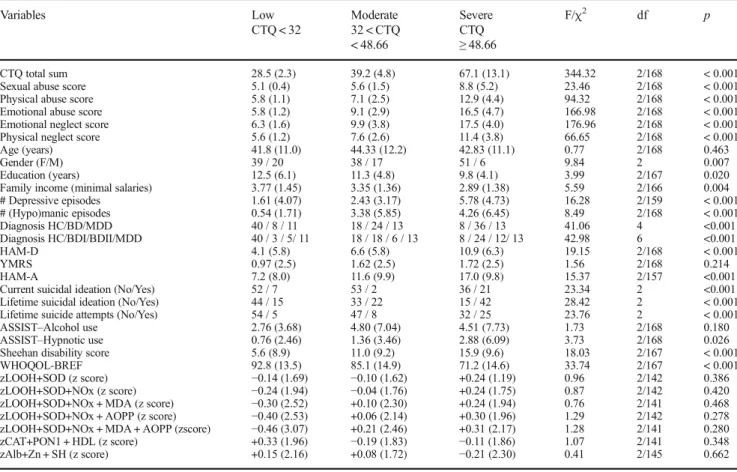
Table1shows the socio-demographic, clinical and biomarker data in all individuals subdivided into three subgroups accord-ing to q25 and q75 values of the total CTQ score. We did not use any p-corrections as we did not aim to assess the multiple statistical analyses on socio-demographic, clinical and bio-marker data. Indeed, these univariate statistical data (together with their intercorrelation matrices) were employed to select independent variables that were considered as possible inde-pendent variables in multivariable GLM analyses. Therefore, we did not compute post-hoc analyses to determine the mul-tiple comparisons between treatment means.
Associations between ELT and O&NS
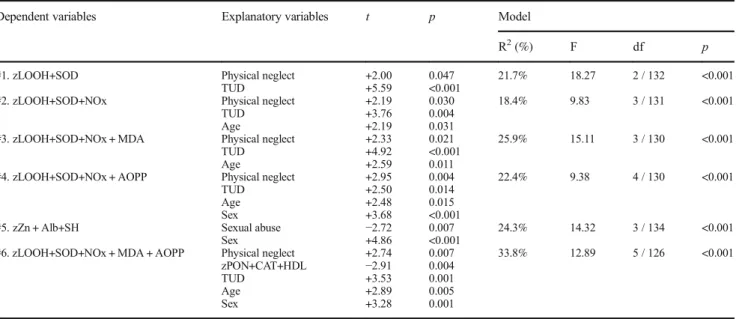
Table2shows the results of automatic stepwise linear regression analysis with the O&NS biomarkers are dependent variables and ELT subtypes as explanatory variables (while also entering age, sex, and TUD). Regression #1, 2, 3 and 4 show that zLOOH+ SOD, zLOOH+SOD+NOx, zLOOH+SOD+NOx + MDA and zLOOH+SOD+NOx + AOPP are significantly and positively as-sociated with physical neglect. Bivariate correlations showed that the other ELT subtypes were not significantly associated with the biomarkers. Regression #5 shows that the zZinc+Albumin+SH score was significantly and inversely associated with sexual abuse (after adjusting for sex). Bivariate correlations did not show that the other ELTs were significantly associated with this biomarker. Regression #6 shows that the overall index of nitro-oxidative damage to lipids and proteins is predicted by physical neglect coupled with lowered antioxidant defenses, which protect against lipid peroxidation (namely zPON+CAT+HDL).
Association between ELT, O&NS and number
of episodes
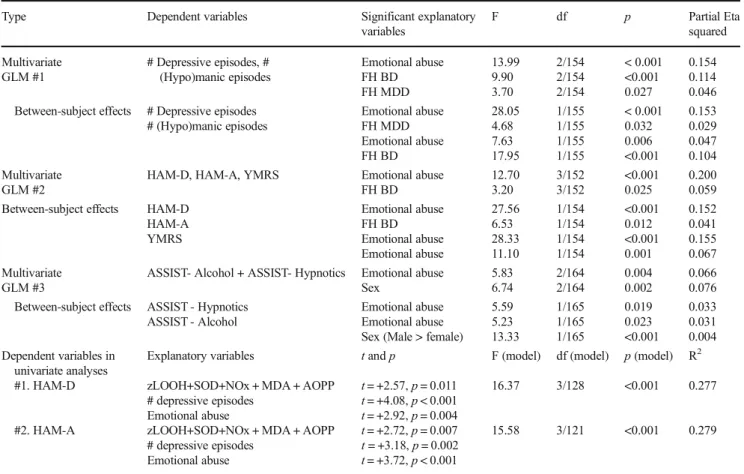
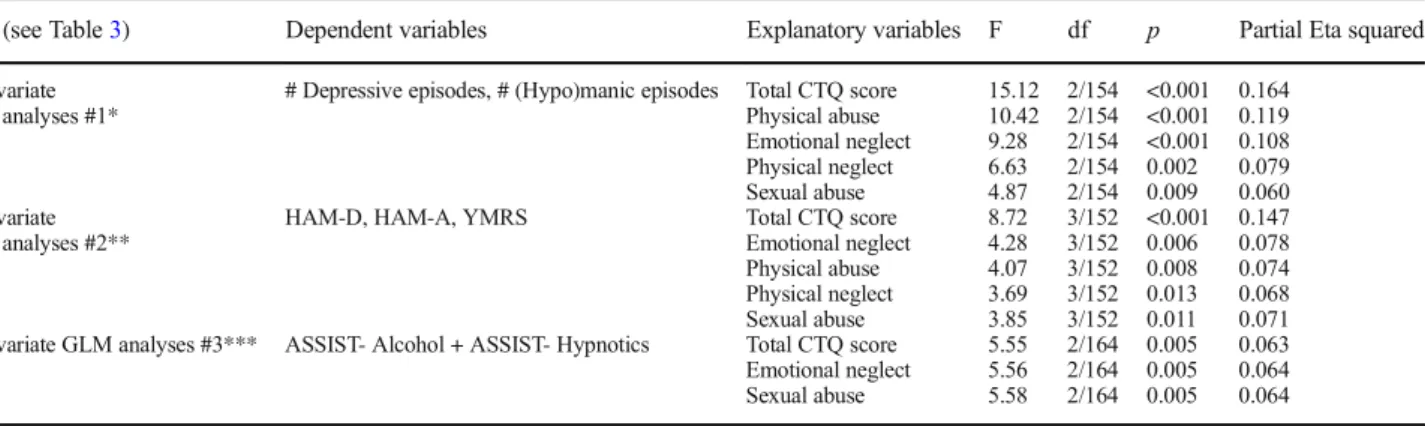
In Table4we compare the effects of emotional abuse (par-tial eta squared of 0.154, see Table3) with that of the other ELT types using GLM regression #1. The effects of total CTQ score was also highly significant, whereas the impact of emo-tional neglect, physical abuse, physical neglect and sexual abuse were less important.
Association between ELT, O&NS and severity of illness
Table 3 multivariate regression #2 shows the outcome of multivariate GLM analysis with three severity of illness rating scales (HAM-A, HAM-D, YMRS) as dependent var-iables and ELT subtypes and familial histories of MDD and BD as explanatory variables. The multivariate test showed a highly significant effect of emotional abuse and a mild
effect of familial history of BD. Tests of between-subject effects showed strong positive associations of emotional abuse with HAM-D, HAM-A and YMRS. A familial his-tory of BD was associated with HAM-D only. In Table 4 we compare the effects of emotional abuse (partial eta squared 0.200, see Table 3) with that of the other ELT types using multivariate regression #2. The effects of total CTQ score was also highly significant, whereas the impact of emotional neglect, physical abuse, physical neglect and sexual abuse were less significant.
Table3shows also the outcome of automatic stepwise univariate regression analyses. We found that 27.7% of the variance in HAM-D (regression #1) and 27.9% of the variance in HAM-A (regression #2) was explained by zLOOH+SOD+NOx + MDA + AOPP, number of Table 1 Socio-demographic, clinical and biomarker data in patients with mood disorders and healthy controls (HC) subdivided into three subgroups according to the total Childhood Trauma Questionnaire score (CTQ)
Variables Low
CTQ < 32
Moderate 32 < CTQ < 48.66
Severe CTQ
≥48.66
F/χ2 df p
CTQ total sum 28.5 (2.3) 39.2 (4.8) 67.1 (13.1) 344.32 2/168 < 0.001 Sexual abuse score 5.1 (0.4) 5.6 (1.5) 8.8 (5.2) 23.46 2/168 < 0.001 Physical abuse score 5.8 (1.1) 7.1 (2.5) 12.9 (4.4) 94.32 2/168 < 0.001 Emotional abuse score 5.8 (1.2) 9.1 (2.9) 16.5 (4.7) 166.98 2/168 < 0.001 Emotional neglect score 6.3 (1.6) 9.9 (3.8) 17.5 (4.0) 176.96 2/168 < 0.001 Physical neglect score 5.6 (1.2) 7.6 (2.6) 11.4 (3.8) 66.65 2/168 < 0.001
Age (years) 41.8 (11.0) 44.33 (12.2) 42.83 (11.1) 0.77 2/168 0.463
Gender (F/M) 39 / 20 38 / 17 51 / 6 9.84 2 0.007
Education (years) 12.5 (6.1) 11.3 (4.8) 9.8 (4.1) 3.99 2/167 0.020
Family income (minimal salaries) 3.77 (1.45) 3.35 (1.36) 2.89 (1.38) 5.59 2/166 0.004 # Depressive episodes 1.61 (4.07) 2.43 (3.17) 5.78 (4.73) 16.28 2/159 < 0.001 # (Hypo)manic episodes 0.54 (1.71) 3.38 (5.85) 4.26 (6.45) 8.49 2/168 < 0.001 Diagnosis HC/BD/MDD 40 / 8 / 11 18 / 24 / 13 8 / 36 / 13 41.06 4 <0.001 Diagnosis HC/BDI/BDII/MDD 40 / 3 / 5/ 11 18 / 18 / 6 / 13 8 / 24 / 12/ 13 42.98 6 <0.001
HAM-D 4.1 (5.8) 6.6 (5.8) 10.9 (6.3) 19.15 2/168 < 0.001
YMRS 0.97 (2.5) 1.62 (2.5) 1.72 (2.5) 1.56 2/168 0.214
HAM-A 7.2 (8.0) 11.6 (9.9) 17.0 (9.8) 15.37 2/157 <0.001
Current suicidal ideation (No/Yes) 52 / 7 53 / 2 36 / 21 23.34 2 <0.001 Lifetime suicidal ideation (No/Yes) 44 / 15 33 / 22 15 / 42 28.42 2 < 0.001 Lifetime suicide attempts (No/Yes) 54 / 5 47 / 8 32 / 25 23.76 2 < 0.001 ASSIST–Alcohol use 2.76 (3.68) 4.80 (7.04) 4.51 (7.73) 1.73 2/168 0.180 ASSIST–Hypnotic use 0.76 (2.46) 1.36 (3.46) 2.88 (6.09) 3.73 2/168 0.026 Sheehan disability score 5.6 (8.9) 11.0 (9.2) 15.9 (9.6) 18.03 2/167 < 0.001 WHOQOL-BREF 92.8 (13.5) 85.1 (14.9) 71.2 (14.6) 33.74 2/167 < 0.001 zLOOH+SOD (z score) −0.14 (1.69) −0.10 (1.62) +0.24 (1.19) 0.96 2/142 0.386 zLOOH+SOD+NOx (z score) −0.24 (1.94) −0.04 (1.76) +0.24 (1.75) 0.87 2/142 0.420 zLOOH+SOD+NOx + MDA (z score) −0.30 (2.52) +0.10 (2.30) +0.24 (1.94) 0.76 2/141 0.468 zLOOH+SOD+NOx + AOPP (z score) −0.40 (2.53) +0.06 (2.14) +0.30 (1.96) 1.29 2/142 0.278 zLOOH+SOD+NOx + MDA + AOPP (zscore) −0.46 (3.07) +0.21 (2.46) +0.31 (2.17) 1.28 2/141 0.280 zCAT+PON1 + HDL (z score) +0.33 (1.96) −0.19 (1.83) −0.11 (1.86) 1.07 2/141 0.348 zAlb+Zn + SH (z score) +0.15 (2.16) +0.08 (1.72) −0.21 (2.30) 0.41 2/145 0.662
HC, healthy controls;BD, Bipolar Disorder (Types I and II);BD I, Bipolar Disorder Type I;BD II, Bipolar Disorder Type II;MDD, Major Depression;
HAM-D, Hamilton Depression Rating Scale;YMRS, Young Mania Rating Scale;HAM-A, Hamilton Anxiety Rating Scale;ASSIST–Alcohol, Alcohol, Smoking and Substance Involvement Screening Test score for alcohol;ASSIST–Hypnotics, Alcohol, Smoking and Substance Involvement Screening Test score for hypnotics;BMI, Body Mass Index;Sheehan DS, Sheehan Disability Scale total score;WHOQOL-BREF, World Health Organization Quality-of-Life Scale total score;LOOH, lipid hydroperoxides;SOD, superoxide dismutase;NOx, nitric oxide metabolites;MDA, malondaldehyde;
depressive episodes and emotional abuse (all positively) (age and sex were not significant in this regression).
Association between ELT, O&NS and ASSIST scores
Table3, regression #3 shows the results of a multivariate analysis with ASSIST hypnotics and alcohol use as dependent variables and the ELT subtypes as explanatory variables, while adjusting for gender (age and education were not significant). We found that emotional abuse was again the most significant predictor variable, while also sex had a significant effect. Tests for between-subjects effects showed that use of hypnotics and alco-hol was positively associated with emotional abuse and that sex had a significant effect on alcohol use. In Table4we compare the effects of emotional abuse with that of the other ELT types. The total score, emotional neglect and sexual abuse had signif-icant effects, while physical abuse and physical neglect were not significant. We have also examined whether there were any as-sociations between the O&NS biomarkers measured here and the ASSIST scores but none could be detected.
Associations between ETL, O&NS and suicidal
behaviors
In Table5 we examine whether ELT may predict suicidal behaviors. Toward this end we have performed logistic
regression analyses with suicidal behaviors as dependent variables and ELT subtypes as primary explanatory vari-ables while also entering HAM-D, diagnosis, number of depressive and (hypo)maniac episodes, and familial histo-ries (see Table3) as explanatory variables. Current suicidal ideation was significantly predicted by physical abuse, HAM-D and number of depressive episodes (X2= 34.63, df = 3, p< 0.001, Nagelkerke = 0.321). Lifetime suicidal ideation was predicted by emotional abuse and a diagnosis o f m o o d d i s o r d e r ( X2= 5 8 . 8 9 , d f = 2 , p< 0 . 0 0 1 , Nagelkerke = 0.392). Lifetime suicide attempts were pre-dicted by emotional abuse and a family history of suicide (X2= 38.39, df = 2, p < 0.001, Nagelkerke = 0.313). We have also examined whether there were any associations between the O&NS biomarkers measured here and suicidal behaviors but none could be detected when controlling for the other predictors.
Associations between ELT, O&NS, HRQol
and disabilities
Table6examines the effects of ELT on quality of life and disabilities. Toward this end we have adjusted the regres-sion analysis for possible confounding variables, namely number of depressive and manic episodes, age, sex, in-come, education, TUD, severity of illness. The first Table 2 Results of automatic stepwise regression analyses with oxidative and nitrosative stress biomarkers as dependent variables and early life trauma as explanatory variables
Dependent variables Explanatory variables t p Model
R2(%) F df p
#1. zLOOH+SOD Physical neglect +2.00 0.047 21.7% 18.27 2 / 132 <0.001
TUD +5.59 <0.001
#2. zLOOH+SOD+NOx Physical neglect +2.19 0.030 18.4% 9.83 3 / 131 <0.001
TUD +3.76 0.004
Age +2.19 0.031
#3. zLOOH+SOD+NOx + MDA Physical neglect +2.33 0.021 25.9% 15.11 3 / 130 <0.001
TUD +4.92 <0.001
Age +2.59 0.011
#4. zLOOH+SOD+NOx + AOPP Physical neglect +2.95 0.004 22.4% 9.38 4 / 130 <0.001
TUD +2.50 0.014
Age +2.48 0.015
Sex +3.68 <0.001
#5. zZn + Alb+SH Sexual abuse −2.72 0.007 24.3% 14.32 3 / 134 <0.001
Sex +4.86 <0.001
#6. zLOOH+SOD+NOx + MDA + AOPP Physical neglect +2.74 0.007 33.8% 12.89 5 / 126 <0.001 zPON+CAT+HDL −2.91 0.004
TUD +3.53 0.001
Age +2.89 0.005
Sex +3.28 0.001
(all values are computed as the sums of the z transformed biomarkers)
multivariate regression shows that emotional abuse had significant effects (partial eta squared 0.125) on WHOQol-BREF and disability ratings (after adjusting for the significant confounding variables, namely depressive episodes, age, income, and HAM-D). Tests for between-subject effects showed that WHOQOL-BREF score was significantly predicted by these 5 explanatory variables, whereas disability was associated with emotional abuse, age, income and severity of depression. Total CTQ score (F = 8.11, df = 2/150,p< 0.001; partial eta squared 0.098), emotional neglect (F = 6.51, df==2/150,p= 0.002; partial eta squared 0.080) and physical neglect (F = 4.60, df = 2/ 150,p= 0.011; partial eta squared 0.058) had less impact than emotional abuse, whilst physical abuse and sexual abuse were not significant.
Table6 shows (univariate regression) that 9.7% of the variance in WHOQOL-BREF score was explained by zLOOH+SOD+NOx + MDA + AOPP after controlling for sex (age and TUD were not significant in this analysis).
Nevertheless, after introducing the ELT subtypes in this auto-matic stepwise regression analysis these associations with ELT disappeared with emotional abuse being highly signifi-cant (t=−8.01, p < 0.001).
Associations between ELT, O&NS and MAFD
In order to examine whether there are differences between MDD and BD in ELT we have carried out multivariate GLM analyses. Table7shows the outcome of these regression anal-yses. We found significant effects of diagnosis (BD versus MDD versus controls) (F = 5.03, df = 10/326, p< 0.001) on the 5 ELTs and the total CTQ score, while there were no sig-nificant effects of sex (F = 1.86, df = 5/162,p= 0.104). Tests for between-subject effects and protected post-hoc effects showed that total CTQ score was significantly different between the three groups with the lowest values in controls and the highest values in BD patients. Sexual abuse was significantly higher in BD patients than in controls and MDD patients. The physical Table 3 Results of three different multivariate GLM analyses with number of depressive episodes, and number of hypo(manic) episodes; severity of illness as measured with the Hamilton Depression rating Scale (HAM-D), Hamilton Anxiety score (HAM-A) and the Young Mania rating Scale (YMRS), or two ASSIST scores, namely - Alcohol and use of Hypnotics - as dependent variables
Type Dependent variables Significant explanatory
variables
F df p Partial Eta
squared
Multivariate GLM #1
# Depressive episodes, # (Hypo)manic episodes Emotional abuse FH BD FH MDD 13.99 9.90 3.70 2/154 2/154 2/154 < 0.001 <0.001 0.027 0.154 0.114 0.046 Between-subject effects # Depressive episodes
# (Hypo)manic episodes
Emotional abuse FH MDD Emotional abuse FH BD 28.05 4.68 7.63 17.95 1/155 1/155 1/155 1/155 < 0.001 0.032 0.006 <0.001 0.153 0.029 0.047 0.104 Multivariate GLM #2
HAM-D, HAM-A, YMRS Emotional abuse
FH BD 12.70 3.20 3/152 3/152 <0.001 0.025 0.200 0.059 Between-subject effects HAM-D
HAM-A YMRS Emotional abuse FH BD Emotional abuse Emotional abuse 27.56 6.53 28.33 11.10 1/154 1/154 1/154 1/154 <0.001 0.012 <0.001 0.001 0.152 0.041 0.155 0.067 Multivariate GLM #3
ASSIST- Alcohol + ASSIST- Hypnotics Emotional abuse Sex 5.83 6.74 2/164 2/164 0.004 0.002 0.066 0.076 Between-subject effects ASSIST - Hypnotics
ASSIST - Alcohol
Emotional abuse Emotional abuse Sex (Male > female)
5.59 5.23 13.33 1/165 1/165 1/165 0.019 0.023 <0.001 0.033 0.031 0.004 Dependent variables in
univariate analyses
Explanatory variables tandp F (model) df (model) p(model) R2
#1. HAM-D zLOOH+SOD+NOx + MDA + AOPP
# depressive episodes Emotional abuse
t= +2.57,p= 0.011
t= +4.08,p< 0.001
t= +2.92,p= 0.004
16.37 3/128 <0.001 0.277
#2. HAM-A zLOOH+SOD+NOx + MDA + AOPP
# depressive episodes Emotional abuse
t= +2.72,p= 0.007
t= +3.18,p= 0.002
t= +3.72,p< 0.001
15.58 3/121 <0.001 0.279
ASSIST–Alcohol, Alcohol, Smoking and Substance Involvement Screening Test score for Alcohol;ASSIST–Hypnotics, Alcohol, Smoking and Substance Involvement Screening Test score for Hypnotics;FH-BD/MM, familial history of bipolar disorder and major depression, respectively;
abuse score was significantly higher in BD patients than in controls, while MDD took up an intermediate position. Scores of emotional abuse, emotional neglect and physical neglect were higher in both BD and MDD than in controls. There were no significant differences in any of these ELTs between bipolar 1 and bipolar 2 patients. In order to delineate the best predictor of MAFD versus controls we performed an automatic binary logistic regression analysis with diagnosis as dependent vari-able and the 5 ELT as explanatory varivari-ables. Emotional abuse was the single best predictor of MAFD (X2 = 39.04, df = 1, p < 0.001; Nagelkerke = 0.278; Odds ratio = 3.62, 95% confidence interval: 2.19–5.97).
In order to examine whether ELT and the O&NS bio-markers may have a cumulative effect explaining differ-ences among MDD and BD and controls, we have
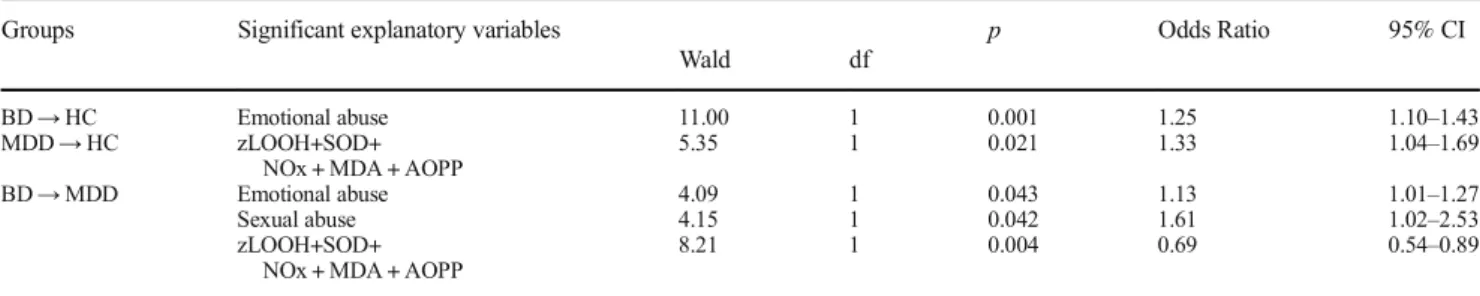
performed automatic stepwise multinomial logistic regres-sion analysis with BD and MDD as dependent variables (and normal controls) and sexual abuse and emotional abuse (the two most significant ELT separating these groups in Table 7) together with zLOOH+SOD+NOx + MDA + AOPP as explanatory variables (while controlling for HAM-D, TUD, age and sex). Table 8shows that sex-ual abuse (X2= 9.77, df = 2, p= 0.008), emotional abuse (X2= 13.30, df = 2, p= 0.001) and the composite score zLOOH+SOD+NOx + MDA + AOPP (X2= 10.21, df = 2, p= 0.006) were significant in this multinomial logistic regression analysis. Parameter estimates show that BD was best separated from normal controls using emotional abuse, while the O&NS index was the best predictor var-iable of MDD versus controls. BD was best differentiated Table 4 Results of different multivariate GLM analyses (see Table3)
with number of depressive episodes, and number of hypo(manic) episodes; severity of illness as measured with the Hamilton Depression rating Scale (HAM-D), Hamilton Anxiety score (HAM-A) and the Young
Mania rating Scale (YMRS), or two ASSIST scores, namely - Alcohol and use of Hypnotics - as dependent variables and early lifetime trauma (ELT) other than emotional abuse as explanatory variables
Tests (see Table3) Dependent variables Explanatory variables F df p Partial Eta squared
Multivariate GLM analyses #1*
# Depressive episodes, # (Hypo)manic episodes Total CTQ score Physical abuse Emotional neglect Physical neglect Sexual abuse
15.12 10.42 9.28 6.63 4.87
2/154 2/154 2/154 2/154 2/154
<0.001 <0.001 <0.001 0.002 0.009
0.164 0.119 0.108 0.079 0.060 Multivariate
GLM analyses #2**
HAM-D, HAM-A, YMRS Total CTQ score Emotional neglect Physical abuse Physical neglect Sexual abuse
8.72 4.28 4.07 3.69 3.85
3/152 3/152 3/152 3/152 3/152
<0.001 0.006 0.008 0.013 0.011
0.147 0.078 0.074 0.068 0.071 Multivariate GLM analyses #3*** ASSIST- Alcohol + ASSIST- Hypnotics Total CTQ score
Emotional neglect Sexual abuse
5.55 5.56 5.58
2/164 2/164 2/164
0.005 0.005 0.005
0.063 0.064 0.064
ASSIST–Alcohol, Alcohol, Smoking and Substance Involvement Screening Test score for Alcohol;ASSIST–Hypnotics, Alcohol, Smoking and Substance Involvement Screening Test score for Hypnotics;HAM-D, Hamilton Depression Rating Scale score;HAM-A, Hamilton Anxiety Rating Scale;YMRS, Young Mania Rating Scale;Total CTQ score, total Childhood Trauma Questionnaire (CTQ) score
*This regression adjusted data for familial history of bipolar disorder and major depression (see regreesion#1, Table3)
**This regression adjusted data for Hamilton Depression Rating Scale score and Hamilton Anxiety Rating Scale (see regression #2, Table3) ***This regression adjusted data for sex (see regression #3, Table3)
Table 5 Results of 3 different automatic stepwise binary logistic regression analyses with suicidal ideation or attempts as dependent variables and early life trauma as explanatory variables, while adjusting for characteristics of major affective disorders
Dependent variables Explanatory variables
Wald df
P OR 95% CI
#1. Current Suicidal Ideation Physical abuse HAM-D
# Depressive episodes
5.35 8.56 4.53
1 1 1
0.021 0.003 0.033
1.12 1.12 1.11
1.02–1.24 1.04–1.21 1.01–1.23 #2. Lifetime Suicidal Ideation Emotional abuse
Diagnosis
20.28 16.67
1 1
< 0.001 < 0.001
1.20 2.86
1.11–1.30 1.73–4.73 #3. Lifetime Suicide attempts Emotional abuse
FH Suicide
20.08 7.50
1 1
< 0.001 0.006
1.19
3.44 1.10–1.281.42–8.35
from MDD using sexual abuse and emotional abuse (both positively) and the z composite score of general O&NS (inversely associated) as predictor variables.
We have also examined whether the drug state of the patients may affect the O&NS results. Therefore we have entered use of antidepressants (n= 39), antipsychotics (n= 23), lithium (n= 27) and mood stabilizers (n= 25) as explanatory variables in a multivariate GLM analysis. Tests for between-subject effects did not show significant effects of the 4 dug state variables on any of the 7 O&NS biomarkers (even at thep= 0.05 level).
Discussion
The first major finding of this study is that physical neglect, but not the other ELT types, is significantly associated with increased O&NS biomarkers, including indices of ROS, RNS,
nitro-oxidative stress and lipid and protein oxidation. Thus, the first composite score, which is associated with physical neglect, is an index of increased SOD and lipid hydroperox-ides thus indicating increased ROS production (Hayyan et al. 2016). The second composite score, which was predicted by physical neglect, reflects increased ROS and NO production and thus the potential to form peroxynitrite (Pacher et al. 2007). Other composite scores, which are associated with physical neglect, indicate nitro-oxidative stress coupled with lipid peroxidation and/or protein oxidation, the latter reflecting increased peroxynitrite- and myeloperoxidase-induced HOCl production (Marsche et al.2009). In addition, sexual abuse, but not the other ELT subtypes, predicts lowered levels of antioxidants, namely zinc, albumin and -SH groups. Our findings extend those of do Prado et al. (2016) who reported that childhood adversity is associated with an imbalance between antioxidant defenses and increased oxidative stress. Thus, these authors detected that in individuals without Table 6 Results of multivariate GLM analyses with the total scores on the WHOQoL-BREF (WHOQoL) scale and Sheehan scale as dependent variables
Type tests Dependent variable Significant explanatory variables F df p
Multivariate WHOQOL-BREF
+ Sheehan DS
Emotional abuse # Depressive episodes Age
Family income HAM-D
10.69 5.98 6.21 11.86 40.85
2/150 2/150 2/150 2/150 2/150
< 0.001 0.003 0.003 < 0.001 < 0.001 Between-subject effects WHOQOL-BREF Emotional abuse
# Depressive episodes Age
Income HAM-D
20.85 12.00 13.36 23.49 77.85
1/151 1/151 1/151 1/151 1/151
< 0.001 0.001 0.001 < 0.001 < 0.001 Between-subject effects Sheehan DS Emotional abuse
Age HAM-D Income
6.47 5.32 28.96 23.49
1/151 1/151 1/151 1/151
0.012 0.022 <0.001 0.014 Dependent variables in univariate
analyses
Explanatory variables tandpvalues F (model) df (model) p(model)
WHOQOL-BREF zLOOH+SOD+NOx + MDA + AOPP
Sex
t=−2.88,p= 0.005
t= +3.30,p= 0.001
7.37 2/138 0.001
WHOQOL-BREF, World Health Organization Quality-of-Life Scale total score;Sheehan DS, Sheehan Disability Scale total score;HAM-D, Hamilton Depression Rating Scale score;HAM-A, Hamilton Anxiety Rating Scale;LOOH, lipid hydroperoxides;SOD, superoxide dismutase;NOx, nitric oxide metabolites;MDA, malondaldehyde;AOPP, advanced oxidation protein products;zLOOH+SOD+NOx + MDA + AOPP, index of nitro-oxidative stress which caused damage to lipids and proteins
Table 7 Model-predicted marginal mean values of the total Childhood Trauma Questionnaire score (CTQ) and subscores
Variables HCA
n= 67
BDB
n= 68
MDDC
n= 37
F/χ2 df p
CTQ total sum* 34.7 (2.0)B,C 51.2 (2.2)A,C 43.8 (2.9)A,B 16.58 2/166 < 0.001 Sexual Abuse score* 5.3 (0.4)B 7.9 (0.4)A,C 5.2 (0.6)B 13.20 2/166 < 0.001 Physical Abuse score* 7.0 (0.5)B 9.6 (0.5)C 8.3 (0.7) 6.39 2/166 0.002 Emotional Abuse score* 7.1 (0.6)B,C 12.2 (0.6)A 10.5 (0.9)A 18.70 2/166 < 0.001 Emotional Neglect score* 8.7 (0.7)B,C 12.7 (0.7)A 11.6 (1.0)A 9.26 2/166 < 0.001 Physical Neglect score* 6.7 (0.4)B,C 8.8 (0.5)A 8.2 (0.6)A 6.13 2/166 0.003
All results are shown as estimated marginal means (SE)
*obtained by multivariate GLM analysis with diagnosis and sex as independent variables
psychiatric problems, the CTQ was associated with higher SOD, protein carbonylation and reduced glutathione peroxidation, al-though no significant changes in -SH groups could be found. Nevertheless, our findings show that physical neglect and sexual abuse may induce long-lasting effects in ROS and RNS produc-tion and protein/lipid oxidaproduc-tion coupled with lower antioxidant defenses. Also, in mouse models, maternal separation with early weaning (an ELT model) activates superoxide production and increased expression of NADPH oxidase subunits in aortae (Ho et al.2016). Future research should further examine the effects of physical neglect versus other ELT subtypes on O&NS biomarkers.
Our findings also extend previous reports that, in humans, psychosocial stressors may induce O&NS path-ways, including a pro-oxidant state thereby causing lipid peroxidation (Aleksandrovskii et al. 1988; Pertsov et al. 1995; Sosnovskiii and Kozlov 1992). Sivonova et al. (2004) found that examination stress is accompanied by lowered antioxidant activities, increased sensitivity to lipid peroxidation and oxidation of DNA (Sivonova et al.2004). In women, elevated perceived stress and inability to cope with stress are associated with increased oxidative damage to DNA (Irie et al.2001). In animal studies, different stress or depression models (including chronic mild stress, swim-ming and restraint stress, chronic social isolation, olfactory bulbectomy) are accompanied by a) increased brain lipid peroxidation (TBARS/MDA) and damage to proteins (de Souza et al.2006; Lucca et al.2009a,b; Lucca et al.2009a, b; Shao et al. 2015; Zhang et al. 2009); and b) lowered antioxidant defenses in the CNS, including glutathione, glutathione peroxidase, SOD, catalase and total antioxidant capacity (de Souza et al. 2006; Eren et al. 2007a, b; Gutteridge and Halliwell 1994; Pal and Dandiya 1994; Song et al.1994; Zhang et al.2009).
Another major finding of this study is that the O&NS bio-markers were associated with clinical characteristics of MAFD, which were also predicted by ELTs (especially emotional abuse), including severity of illness, clinical diagnosis and
WHOQoL-BREF, but not with the number of depressive and manic epi-sodes, substance use or suicidal behaviors. The results that ELTs are associated with these characteristics are consistent with pre-vious studies, showing that ELT subtypes in BD and MDD are associated with more severe depressive symptoms, suicidal be-haviors, alcohol use, disabilities and HRQoL (Daruy-Filho et al. 2011; Garno et al.2005; Nanni et al.2012; Sfoggia et al.2008). Our results on significant relationships between emotional abuse and severity of illness extend those of previous investiga-tions showing that there is a greater risk of increased severity of anxiety and depressive symptoms in those who experienced sexual and emotional abuse (Etain et al. 2010). In our study, we found that ELTs together with O&NS had cumulative effects on severity of depression and anxiety, suggesting that ELT may influence O&NS pathways with consequent long-term and neg-ative effects on severity of depression and anxiety. The signifi-cant associations between specific ELT subtypes and suicidal behaviors extend those of previous studies showing that child-hood trauma may be independently associated with subsequent suicidal behaviors (Hadland et al.2012; Roy and Janal2005; Sfoggia et al.2008). A previous study showed that, in BD, at least one subtype of childhood trauma was associated with in-creased numbers of depressive episodes (Etain et al.2008). In
Emoonal abuse Sexual abuse
Nitro-oxidave stress
MDD
HAM-D andHAM-A
ELT
Physical neglect
Manic and depressive episodes
Suicidal behaviors
BD
HRQoL
Fig. 1 A new hypothesis how early lifetime trauma (ELT) are associated with nitro-oxidative stress, major depression (MDD) and characteristics of mood disorders including bipolar disorder (BD).
Table 8 Results of automatic stepwise multinomial logistic regression analyses with diagnosis of Bipolar Disorders (BD) and Major Depression (MDD) as dependent variables and emotional and sexual abuse and the composite score of general O&NS as explanatory variables (while controlling for severity of illness, tobacco use disorder, age and sex
Groups Significant explanatory variables
Wald df
p Odds Ratio 95% CI
BD→HC Emotional abuse 11.00 1 0.001 1.25 1.10–1.43
MDD→HC zLOOH+SOD+ NOx + MDA + AOPP
5.35 1 0.021 1.33 1.04–1.69
BD→MDD Emotional abuse Sexual abuse zLOOH+SOD+
NOx + MDA + AOPP
4.09 4.15 8.21
1 1 1
0.043 0.042 0.004
1.13 1.61 0.69
1.01–1.27 1.02–2.53 0.54–0.89
our study, however, we could not find associations between number of depressive episodes or suicidal behaviors and the O&NS biomarkers, which were associated with ELTs. Nevertheless, previous research showed that individuals with a prior history of suicide attempts have higher serum LOOH and NOx levels and lowered total radical trapping antioxidant po-tential (TRAP) than those without suicidal attempts (Vargas et al.2013). We found ELTs to be associated with poorer quality of life and higher degree of disability, findings which are in accordance with those of previous studies (Afifi et al.2007; Chahine2014; Simon et al.2009). In our study, O&NS was significantly associated with HRQoL, although this relationship was no longer significant after entering ELT in the analysis.
We found that emotional abuse was the single best predic-tor of MAFD versus controls. This is consistent with previous studies showing that emotional abuse is the most frequently reported trauma by 37% of the patients, while 24% report physical abuse, 24% emotional neglect, 21% sexual abuse, and 12% physical neglect (Al-Fayez et al.2012; Garno et al. 2005; Leverich and Post2006). Moreover, we detected that BD was significantly discriminated from MDD by significant higher levels of sexual abuse. These findings add to the knowledge that ELTs are risk factors for MAFD and addition-ally show that different ELT subtypes may be differentiaddition-ally associated with BD and MDD.
All in all, our results show that ELT may cause activated O&NS pathways and damage to lipids and proteins thereby increasing the risk to develop MDD, but not BD. One possible factor that may explain the difference between MDD and BD is that some ELTs may have beneficial effects on resilience to stress in later life (Monaghan and Haussmann2015) and that these protective effects could play a role in BD. Given these differences between MAFD subtypes, it is too early to gener-alize findings of animal models that ELT (e.g. early maternal separation) may cause increased oxidative stress in the brain and that this process enhances the risk to develop“psychiatric disorders” and “mental illnesses” (Mhillaj et al. 2015; Schiavone et al.2015; Ventriglio et al.2015).
The results of this study should be interpreted with regards to its strengths and limitations. Our study is a case control study and therefore no causal deductions can be made. We employed the CTQ, a self-report scale, to measure ELT and therefore this measurement may be modulated by memory and mood biases induced by the current psychopathological state. Nevertheless, analyses were adjusted for the effects of illness severity thereby minimizing the impact of the psychopathological state on our results. We included subjects between 18 and 65 years old and, therefore, we cannot generalize our findings to older or younger populations. One of the composite scores, namely zLOOH+ SOD+NOx + AOPP, would be more complete if we had mea-sured myeloperoxidase and hypochlorous acid. Future research should explore the association of ELT with O&NS and
immune-inflammatory pathways in mediating the association of ELT subtypes with MAFD subtypes. The results suggest that many of the previous studies linking increases in such immune-inflammatory and oxidative stress biomarkers to MDD and BD, including in a number of meta-analyses, may have to be re-evaluated in association with more extensive investigation of early abusive events.
In summary, the ELT subtypes may have different effects on phenomenological and biological characteristics of MAFD. Therefore, it is necessary to examine the effects of separate ELT subtypes in addition to the total CTQ score. Fig.1provides a new hypothesis based on the major findings of this study. There was a strong association between early life trauma (ELT) and major affective disorders (MAFD) and clinical char-acteristics of MAFD, including course modifiers, severity of depression and anxiety, suicidal behaviors, lowered quality of live, increased disability, alcohol and hypnotics use and oxida-tive and nitrosaoxida-tive stress (O&NS) biomarkers. As such, a his-tory of childhood maltreatment may aid in the identification of ecophenotypic variants of psychopathology as clinically and neurobiologically distinct subtypes of MAFD (Teicher and Samson2013). Nevertheless, the ELT subtypes may have differ-ent effects: while physical neglect was associated with O&NS pathways, emotional abuse was related to MAFD characteristics including recurrence of episodes, suicidal behaviors and severity of depression (HAM-D) and anxiety (HAM-A) and lowered health-related quality of life (HRQoL) and greater disabilities. Increased O&NS, in turn, affects severity of illness, HRQol and major depression (MDD), suggesting that ELT may exert part of its effects on these characteristics via modulating O&NS path-ways. While emotional abuse is the single best predictor of MAFD with an odds ratio of 3.62, sexual abuse predicts BD and not MDD. The findings suggest that the association between ELT and BD cannot be explained by activated O&NS pathways. Therefore, it is too early to conclude that ELT may enhance the risk to develop“psychiatric disorders”or“mental illnesses”.
Acknowledgements The authors wish to thank the Centre of Approach and Treatment for Smokers, Psychiatric Unit at UEL, Clinical Laboratory of the University Hospital and Laboratory of Research and Graduate College Hospital (LPG), Brazil.
Author contribution All authors contributed to the writing up of the paper. The work was designed by SOVN, MM, HOV and JBM. Data were collected by SOVN, JBM and HOV. Laboratory analyses were conducted by KLB and DSB. Statistics were performed by MM. MM, GA, CR, MK and AFC revised the manuscript and provided relevant intellectual content. All authors revised and approved the final draft.
References
Aas M, Henry C, Andreassen OA, Bellivier F, Melle I, Etain B (2016) The role of childhood trauma in bipolar disorders. Int J Bipolar Disord 4:2
Afifi TO, Enns MW, Cox BJ, de Graaf R, ten Have M, Sareen J (2007) Child abuse and health-related quality of life in adulthood. J Nerv Ment Dis 195:797–804
Agnew-Blais J, Danese A (2016) Childhood maltreatment and unfavourable clinical outcomes in bipolar disorder: a systematic review and meta-analysis. Lancet Psychiatry 3:342–349
Aleksandrovskii IA, Poiurovskii MV, Neznamov GG, Seredeniia SB, Krasova EA (1988) Lipid peroxidation in emotional stress and neurotic disorders. Zh Nevropatol Psikhiatr Im S S Korsakova 88:95–101 Al-Fayez GA, Ohaeri JU, Gado OM (2012) Prevalence of physical,
psy-chological, and sexual abuse among a nationwide sample of Arab high school students: association with family characteristics, anxi-ety, depression, self-esteem, and quality of life. Soc Psychiatry Psychiatr Epidemiol 47:53–66
Alvarez MJ, Roura P, Oses A, Foguet Q, Sola J, Arrufat FX (2011) Prevalence and clinical impact of childhood trauma in patients with severe mental disorders. J Nerv Ment Dis 199:156–161
American Psychiatric Association (2013) Diagnostic and Statistical Manual of Mental Disorders, Fifth Edition (DSM-5®). American Psychiatric Association Publishing, Arlington
Anderson G, Maes M (2015) Bipolar disorder: role of immune-inflammatory cytokines, oxidative and nitrosative stress and trypto-phan catabolites. Curr Psychiatry Rep 17:8
Andreazza AC, Kauer-Sant'anna M, Frey BN, Bond DJ, Kapczinski F, Young LT, Yatham LN (2008) Oxidative stress markers in bipolar disorder: a meta-analysis. J Affect Disord 111:135–144
Barceloux DG, Barceloux D (1999) Zinc. J Toxicol 2:179–192 Bastos AS, Loureiro AP, de Oliveira TF, Corbi SC, Caminaga RM, Junior
CR, Orrico SR (2012) Quantitation of malondialdehyde in gingival crevicular fluid by a high-performance liquid chromatography-based method. Anal Biochem 423:141–146
Bengesser SA, Lackner N, Birner A, Fellendorf FT, Platzer M, Mitteregger A, Unterweger R, Reininghaus B, Mangge H, Wallner-Liebmann SJ, Zelzer S, Fuchs D, McIntyre RS, Kapfhammer HP, Reininghaus EZ (2015) Peripheral markers of oxidative stress and antioxidative defense in euthymia of bipolar disorder–Gender and obesity effects. J Affect Disord 172:367–374 Bergink V, Larsen JT, Hillegers MH, Dahl SK, Stevens H, Mortensen PB,
Petersen L, Munk-Olsen T (2016) Childhood adverse life events and parental psychopathology as risk factors for bipolar disorder. Transl Psychiatry 6:e929
Berk M, Kapczinski F, Andreazza AC, Dean OM, Giorlando F, Maes M, Yucel M, Gama CS, Dodd S, Dean B, Magalhaes PV, Amminger P, M c G o r r y P, M a l h i G S ( 2 0 11 ) P a t h w a y s u n d e r l y i n g neuroprogression in bipolar disorder: focus on inflammation, oxida-tive stress and neurotrophic factors. Neurosci Biobehav Rev 35: 804–817
Bernstein DP, Stein JA, Newcomb MD, Walker E, Pogge D, Ahluvalia T, Stokes J, Handelsman L, Medrano M, Desmond D, Zule W (2003) Development and validation of a brief screening version of the Childhood Trauma Questionnaire. Child Abuse Negl 27:169–190 Bilici M, Efe H, Koroglu MA, Uydu HA, Bekarolu M, Deger O (2001)
Antioxidative enzyme activities and lipid peroxidation in major de-pression: alterations by antidepressant treatments. J Affect Disord 64:43–51
Birnbaum HG, Kessler RC, Kelley D, Ben-Hamadi R, Joish VN, Greenberg PE (2010) Employer burden of mild, moderate, and se-vere major depressive disorder: mental health services utilization and costs, and work performance. Depress Anxiety 27:78–89
Bolton JM, Gunnell D, Turecki G (2015) Suicide risk assessment and intervention in people with mental illness. BMJ 351:h4978 Bortolasci CC, Vargas HO, Souza-Nogueira A, Barbosa DS, Moreira EG,
Nunes SO, Berk M, Dodd S, Maes M (2014) Lowered plasma par-aoxonase (PON)1 activity is a trait marker of major depression and PON1 Q192R gene polymorphism-smoking interactions differen-tially predict the odds of major depression and bipolar disorder. J Affect Disord 159:23–30
Brown NC, Andreazza AC, Young LT (2014) An updated meta-analysis of oxidative stress markers in bipolar disorder. Psychiatry Res 218:61–68 Catone G, Marwaha S, Kuipers E, Lennox B, Freeman D, Bebbington P, Broome M (2015) Bullying victimisation and risk of psychotic phe-nomena: analyses of British national survey data. Lancet Psychiatry 2:618–624
Chahine EF (2014) Child Abuse and its Relation to Quality of Life of Male and Female Children. Procedia Soc Behav Sci 159:161–168 Chelikani P, Fita I, Loewen PC (2004) Diversity of structures and
prop-erties among catalases. Cell Mol Life Sci 61:192–208
Chowdhury MI, Hasan M, Islam MS, Sarwar MS, Amin MN, Uddin SM, Rahaman MZ, Banik S, Hussain MS, Yokota K, Hasnat A (2017) Elevated serum MDA and depleted non-enzymatic antioxidants, macro-minerals and trace elements are associated with bipolar dis-orders. J Trace Elem Med Biol 39:162–168
Cichoń N, Bijak M, Miller E, Niwald M, Saluk J (2015) Poststroke depression as a factor adversely affecting the level of oxidative dam-age to plasma proteins during a brain stroke. Oxidative Med Cell Longev 2015:408745
Coelho R, Viola TW, Walss-Bass C, Brietzke E, Grassi-Oliveira R (2014) Childhood maltreatment and inflammatory markers: a systematic review. Acta Psychiatr Scand 129:180–192
Dargel AA, Godin O, Kapczinski F, Kupfer DJ, Leboyer M (2015) C-reactive protein alterations in bipolar disorder: a meta-analysis. J Clin Psychiatry 76:142–150
Daruy-Filho L, Brietzke E, Lafer B, Grassi-Oliveira R (2011) Childhood maltreatment and clinical outcomes of bipolar disorder. Acta Psychiatr Scand 124:427–434
Dean BB, Gerner D, Gerner RH (2004) A systematic review evaluating health-related quality of life, work impairment, and healthcare costs and utilization in bipolar disorder. Curr Med Res Opin 20:139–154 Del-Ben CM, Vilela JAA, Crippa JAS, Hallak JEC, Labate CM, Zuardi AW (2001) Confiabilidade da“Entrevista Clínica Estruturada para o DSM-IV - Versao Clinica”traduzida para o portugues. Rev Bras Psiquiatr 23:156–159
Depp CA, Mausbach BT, Harmell AL, Savla GN, Bowie CR, Harvey PD, Patterson TL (2012) Meta-analysis of the association between cog-nitive abilities and everyday functioning in bipolar disorder. Bipolar Disord 14:217–226
Eren I, Nazirogglu M, Demirdass A (2007a) Protective effects of lamotrigine, aripiprazole and escitalopram on depression-induced oxidative stress in rat brain. Neurochem Res 32:1188–1195 Eren I, Nazirogglu M, Demirdass A, Celik O, Ugguz AC, Altunbassak A,
Ozmen I, Uz E (2007b) Venlafaxine modulates depression-induced ox-idative stress in brain and medulla of rat. Neurochem Res 32:497–505 Etain B, Henry C, Bellivier F, Mathieu F, Leboyer M (2008) Beyond
genetics: childhood affective trauma in bipolar disorder. Bipolar Disord 10:867–876
Etain B, Mathieu F, Henry C, Raust A, Roy I, Germain A, Leboyer M, Bellivier F (2010) Preferential association between childhood emo-tional abuse and bipolar disorder. J Trauma Stress 23:376–383 Fernandes BS, Steiner J, Molendijk ML, Dodd S, Nardin P, Gonzalves
Fisher HL, Jones PB, Fearon P, Craig TK, Dazzan P, Morgan K, Hutchinson G, Doody GA, McGuffin P, Leff J, Murray RM, Morgan C (2010) The varying impact of type, timing and frequency of exposure to childhood adversity on its association with adult psychotic disorder. Psychol Med 40:1967–1978
Fleck MP, Louzada S, Xavier M, Chachamovich E, Vieira G, Santos L, Pinzon V (2000) Application of the Portuguese version of the ab-breviated instrument of quality life WHOQOL-bref. Rev Saude Publica 34:178–183
Furlong CE, Holland N, Richter RJ, Bradman A, Ho A, Eskenazi B (2006) PON1 status of farmworker mothers and children as a pre-dictor of organophosphate sensitivity. Pharmacogenet Genomics 16: 183–190
Galecki P, Maes M, Florkowski A, Lewinski A, Galecka E, Bienkiewicz M, Szemraj J (2011) Association between inducible and neuronal nitric oxide synthase polymorphisms and recurrent depressive dis-order. J Affect Disord 129:175–182
Garno JL, Goldberg JF, Ramirez PM, Ritzler BA (2005) Impact of child-hood abuse on the clinical course of bipolar disorder. Br J Psychiatry 186:121–125
GBD 2015 DALYs and HALE Collaborators (2016) Global, regional, and national disability-adjusted life-years (DALYs) for 315 diseases and injuries and healthy life expectancy (HALE), 1990-2015: a sys-tematic analysis for the Global Burden of Disease Study 2015. Lancet 388:1603–1658
Gomes C, Martinho FC, Barbosa DS, Antunes LS, Póvoa HCC, Baltus THL, Morelli NR, Vargas HO, Nunes SOV, Anderson G, Maes M. (2017) Increased root canal endotoxin levels are associated with chronic apical periodontitis, increased oxidative and nitrosative stress, major depression, severity of depression, and a lowered qual-ity of life. Mol Neurobiol. https://doi.org/10.1007/s12035-017-0545-z
Gonzalez Flecha B, Llesuy S, Boveris A (1991) Hydroperoxide-initiated chemiluminescence: an assay for oxidative stress in biopsies of heart, liver, and muscle. Free Radic Biol Med 10:93–100 Grassi-Oliveira R, Stein LM, Pezzi JC (2006) Translation and content
validation of the Childhood Trauma Questionnaire into Portuguese language. Rev Saude Publica 40:249–255
Gutteridge JMC, Halliwell B (1994) Antioxidants in Nutrition, Health and Disease. Oxford University Press, Oxford
Hadland SE, Marshall BD, Kerr T, Qi J, Montaner JS, Wood E (2012) Suicide and history of childhood trauma among street youth. J Affect Disord 136:377–380
Hamilton M (1959) The assessment of anxiety states by rating. Br J Med Psychol 32:50–55
Hanasand M, Omdal R, Norheim KB, Gransson LG, Brede C, Jonsson G (2012) Improved detection of advanced oxidation protein products in plasma. Clin Chim Acta 413:901–906
Hayyan M, Hashim MA, AlNashef IM (2016) Superoxide Ion: Generation and Chemical Implications. Chem Rev 116:3029–3085 Heim C, Shugart M, Craighead WE, Nemeroff CB (2010) Neurobiological and psychiatric consequences of child abuse and neglect. Dev Psychobiol 52:671–690
Henrique IFS, De Micheli D, Lacerda RB, Lacerda LA, Formigoni MLOS (2004) Validacao da versao brasileira do teste de triagem do envolvimento com alcool, cigarro e outras substancias (ASSIST). Rev Assoc Med Bras 5:199–206
Ho DH, Burch ML, Musall B, Musall JB, Hyndman KA, Pollock JS (2016) Early life stress in male mice induces superoxide production and endothelial dysfunction in adulthood. Am J Physiol Heart Circ Physiol 310:H1267–H1274
Hu ML (1994) Measurement of protein thiol groups and glutathione in plasma. Methods Enzymol 233:380–385
Irie M, Asami S, Nagata S, Miyata M, Kasai H (2001) Relationships between perceived workload, stress and oxidative DNA damage. Int Arch Occup Environ Health 74:153–157
Jansen K, Cardoso TA, Fries GR, Branco JC, Silva RA, Kauer-Sant'Anna M, Kapczinski F, Magalhaes PV (2016) Childhood trauma, family history, and their association with mood disorders in early adult-hood. Acta Psychiatr Scand 134:281–286
Kendler KS, Sheth K, Gardner CO, Prescott CA (2002) Childhood pa-rental loss and risk for first-onset of major depression and alcohol dependence: the time-decay of risk and sex differences. Psychol Med 32:1187–1194
Khanzode SD, Dakhale GN, Khanzode SS, Saoji A, Palasodkar R (2003) Oxidative damage and major depression: the potential antioxidant action of selective serotonin re-uptake inhibitors. Redox Rep 8:365– 370
Köhler CA, Freitas TH, Stubbs B, Maes M, Solmi M, Veronese N, de Andrade NQ, Morris G, Fernandes BS, Brunoni AR, Herrmann N, Raison CL, Miller BJ, Lanctôt KL, Carvalho AF (2017) Peripheral alterations in cytokine and chemokine levels after antidepressant drug treatment for major depressive disorder: systematic review and meta-analysis. Mol Neurobiol. https://doi.org/10.1007/s12035-017-0632-1
Kohler CA, Freitas TH, Stubbs B, Maes M, Solmi M, Veronese N, de Andrade NQ, Morris G, Fernandes BS, Brunoni AR, Herrmann N, Raison CL, Miller BJ, Lanctot KL, Carvalho AF (2017b) Peripheral alterations in cytokine and chemokine levels after antidepressant drug treatment for major depressive disorder: systematic review and meta-analysis. Mol Neurobiol
Kunz M, Gama CS, Andreazza AC, Salvador M, Cereser KM, Gomes FA, Belmonte-de-Abreu PS, Berk M, Kapczinski F (2008) Elevated serum superoxide dismutase and thiobarbituric acid reactive sub-stances in different phases of bipolar disorder and in schizophrenia. Prog Neuro-Psychopharmacol Biol Psychiatry 32:1677–1681 Leverich GS, Post RM (2006) Course of bipolar illness after history of
childhood trauma. Lancet 367:1040–1042
Liu T, Zhong S, Liao X, Chen J, He T, Lai S, Jia Y (2015) A Meta-Analysis of Oxidative Stress Markers in Depression. PLoS One 10:e0138904
Lucca G, Comim CM, Valvassori SS, Réus GZ, Vuolo F, Petronilho F, Dal Pizzol F (2009a) Effects of chronic mild stress on the oxidative parameters in the rat brain. Neurochem Int 54:358–362
Lucca G, Comim CM, Valvassori SS, Reus GZ, Vuolo F, Petronilho F, Gavioli EC, Dal-Pizzol F, Quevedo J (2009b) Increased oxidative stress in submitochondrial particles into the brain of rats submitted to the chronic mild stress paradigm. J Psychiatr Res 43:864–869 Machado-Vieira R, Andreazza AC, Viale CI, Zanatto V, Cereser VJ, da
Silva Vargas R, Kapczinski F, Portela LV, Souza DO, Salvador M, Gentil V (2007) Oxidative stress parameters in unmedicated and treated bipolar subjects during initial manic episode: a possible role for lithium antioxidant effects. Neurosci Lett 421:33–36
Maes M, Vandewoude M, Scharpe S, De Clercq L, Stevens W, Lepoutre L, Schotte C (1991) Anthropometric and biochemical assessment of the nutritional state in depression: evidence for lower visceral pro-tein plasma levels in depression. J Affect Disord 23:25–33 Maes M, Delanghe J, Meltzer HY, Scharpe S, D'Hondt P, Cosyns P
(1994) Lower degree of esterification of serum cholesterol in depres-sion: relevance for depression and suicide research. Acta Psychiatr Scand 90:252–258
Maes M, Smith R, Christophe A, Vandoolaeghe E, Van Gastel A, Neels H, Demedts P, Wauters A, Meltzer HY (1997) Lower serum high-density lipoprotein cholesterol (HDL-C) in major depression and in depressed men with serious suicidal attempts: relationship with immune-inflammatory markers. Acta Psychiatr Scand 95:212–221 Maes M, Christophe A, Delanghe J, Altamura C, Neels H, Meltzer HY
(1999) Lowered omega3 polyunsaturated fatty acids in serum phos-pholipids and cholesteryl esters of depressed patients. Psychiatry Res 85:275–291