RESUMO: “Bilavonas e triterpenóides isolados de Ouratea castaneifolia (DC.) Engl., Ochnaceae”. O presente trabalho trata da investigação química das folhas e caule da espécie Ouratea castaneifolia (DC.) Engl., sobre a qual não há registros de estudos químicos ou farmacológicos anteriores. O estudo itoquímico clássico dos extratos orgânicos do caule e das folhas de O. castaneifolia foi aliado à técnica da cromatograia líquida de alta eiciência (CLAE) e resultou na identiicação de dezessete metabólitos: sete triperpenos (friedelina, 3β-friedelinol, α-amirina, β-amirina, lupeol, taraxerol e germanicol), quatro esteróides (sitosterol, estigmasterol e os glucosídeos sitosteril 3-O-β-D-glicopiranosídeo e estigmasteril 3-O-β-D-glicopiranosídeo), uma isolavona (5,7,4´-trimetoxiisolavona), uma lavona (5,4´-diidroxi-7,3´,5´-trimetoxilavona), quatro bilavonas (amentolavona, 7,7”-O-dimetil-amentolavona, hevealavona e tetrametilamentolavona). A identiicação das substâncias foi feita com base na análise de espectros de RMN de 1H, 13C e técnicas bidimensionais. As classes dos metabólitos identiicados estão de acordo com aquelas citadas em estudos químicos do gênero Ouratea.
Unitermos: Ouratea castaneifolia, Ochnaceae, bilavonas, lavonóide, terpenóide.
ABSTRACT: This paper presents the chemical investigation of the leaves and stems of Ouratea castaneifolia (DC.) Engl.. There are no chemical or pharmacological studies with this species. Classic phytochemical investigation of the organic extracts together with high pressure liquid chromatography (HPLC) procedures lead to the identiication of seventeen metabolites: seven triterpenes (friedelin, 3β-friedelinol, α-amyrin, β-amyrin, lupeol, germanicol and taraxerol), four steroids (sitosterol, stigmasterol and the glycosides sitosteryl 3-O-β-D-glucopyranoside and stigmasteryl 3-O-β-D-glucopyranoside), one isolavone (5,7,4’-trimethoxyisolavone), one lavone (5,4’-dihydroxy-7,3’,5’-trimethoxylavone) and four bilavones (amentholavone, 7,7”-O-dimethylamentholavone, hevealavone and tetramethylamentholavone). The structures of the compounds were established by the analysis of 1H, 13C NMR spectra including bidimensional techniques. The classes of the identiied metabolites are in agreement with previous studies of the Ouratea genus.
Keywords: Ouratea castaneifolia, Ochnaceae, bilavones, lavonoid, terpenoid.
triglycerides and chloroisolavones were also reported from
this genus (Velandia et al., 1998a and 1998b; Carvalho
et al., 2000; Manga et al., 2001; Mbing et al., 2003a and 2003b; Felício et al., 2004; Estevam et al., 2005). Some bilavonoids, as well as extracts of the Ouratea species showed important biological activities, as was previously
published (Suzart et al., 2007).
Ouratea castaneifolia (DC.) Engl. Ochnaceae
19(4): 823-827, Out./Dez. 2009
A
rt
igo
Received 25 July 2008; Accepted 29 November 2008
Bilavones and triterpenoids isolated from
Ouratea
castaneifolia
(DC.) Engl., Ochnaceae
Luís Adriano S. do Nascimento,
1Giselle M. S. P. Guilhon,
*,1Mara S. P. Arruda,
1Lourivaldo S. Santos,
1Alberto C. Arruda,
1Adolfo H. Müller,
1Milton N. da Silva,
1Silvane T. Rodrigues,
2Mário G. de Carvalho
31Faculdade de Química, Instituto de Ciências Exatas e Naturais, Universidade Federal do Pará,
Av. Augusto Corrêa, 1, 66075-110 Belém-PA, Brazil
2Departamento de Botânica, Embrapa Amazônia Oriental, Tv. Enéas Pinheiro s/n, 66077-530 Belém-PA, Brazil 3Departamento de Química, Instituto de Ciências Exatas, Universidade Federal Rural do Rio de Janeiro, BR-465,
km 7, 23851-970 Seropédica-RJ, Brazil
INTRODUCTION
Ouratea and other genera of Ochnaceae are a
rich source of lavonoids and bilavonoids and according to Suzart et al. (2007), the bilavonoids can be used as chemotaxonomic markers of the genus Ouratea as well as of Luxemburgia from the same botanic family. Lignans,
was collected in Marajó Island in the North of Brazil. This species is known in the Amazon region of Brazil as “farinha-seca”, “mangue-do-mato” or “pau-de-serra” and its wood is used in small constructions and its bark is tonic and adstringent and contains tannins (Le Cointe, 1934). This work describes the phytochemical study of the extracts from the leaves and stems of O. castaneifoila.
MATERIAL AND METHODS
General procedures
Melting points are uncorrected. NMR spectra were recorded on a Mercury-300 Varian spectrometer (300 MHz for 1H and 75 MHz for 13C) using the solvent
(DMSO-d6, Me2CO-d6, CD3OD or CDCl3) and TMS as
internal standard. Silica gel (Merck and Vetec 0.05-0.20 mm) or Sephadex LH-20 was used on separations by column chromatography (CC). Silica gel HF (Merck) was used for TLC and revealed by UV (254 and 366 nm), acid solution of ceric sulphate and exposure to iodine vapor. HPLC-UV analyses were performed using a Shimadzu (Shimadzu, Tokyo, Japan) liquid chromatography modular system consisting of two LC-10AD pumps, an UV-Vis Shimadzu SPD-10AV detector, and an LC Workstation Class LC-10 system for data processing. The samples were introduced using an injection valve itted with 20 µL loop (Rheodyne, California, USA). The mobile phase consisted of water:methanol:acetonitrile (24:40:36, isocratic mode) at a low rate of 1 mL.min-1. A C18 column (Gemini, 250
mm x 4.6 mm x 5 µm) itted with guard column (Gemini, C18, 4 mm x 3 mm x 5 µm) was utilized. UV detection
was performed at 330 nm.
Plant material
Leaves and stems of Ouratea castaneifolia (DC.)
Engl. Ochnaceae were collected in Salvaterra (Marajó Island, State of Pará, Brazil) and identiied by one of the
authors (S.T.R.). A voucher specimen (IAN 172171) is deposited at the herbarium of Embrapa-Amazônia Oriental (Belém, Brazil).
Extraction and isolation
Dried and powdered leaves (2500 g) and stems (1880 g) were extracted with n-hexane, dichloromethane
and methanol by percolation at room temperature. The
solutions of leaves (L) and stems (S) were concentrated
under vacuum to yield the n-hexane (H), dichloromethane
(D) and methanolic (M) extracts from the leaves (extract LH: 28.25 g, extract LD: 51.85 g and extract LM: 238.10 g) and stems (extract SH: 3.40 g, extract SD: 2.30 g, extract SM: 32.00 g). Extracts LH (28.25 g), LD (25.00 g) and SD (2.30 g) were fractionated by CC on silica gel using mixtures of hexane with EtOAc and MeOH gradually increasing polarity as elluents. The fractions were puriied
using similar CC procedures.
The fractions from LH extract eluted with
n-hexane:EtOAc (6:8) afforded two mixtures of substances,
one of compounds 7-11 (102 mg) and the other of 12-13
(11 mg). The fraction from LD extract eluted with EtOAc (100%), named as BF, was analyzed by 1H NMR spectrum
and characteristics signals of a mixture of bilavonoids were identiied. After successive CC procedures, including the use of Sephadex LH-20 and methanol as elluent, no separation was achieved; fraction BF was than submitted to HPLC (chromatogram on Figure 1) yielding compounds
14 (4 mg), 15 (4 mg), 16 (4 mg) and 17 (7 mg). Compound
4 was further identiied by HPLC from fraction BF. Part
of the extract LM (20 g) was suspended on MeOH:H2O
(3:1) and successively extracted with CHCl3, EtOAc and
n-BuOH yielding the CHCl3, EtOAc and n-BuOH phases.
During concentration of the CHCl3 phase from LM extract, a pale yellow solid precipitated and was washed with methanol affording compound 17 (53 mg). The HPLC
chromatogram of the CHCl3 phase from methanolic extract
partition was similar to BF fraction.
Figure 1. Chromatogram of fraction BF from Ouratea castaneifolia (DC.) Engl., Ochnaceae, eluted with H2O:MeOH:MeCN (24:40:36). Flow 1 mL/min. UV Detection: λ=330 nm.
During the concentration of the n-hexane solution
of the stems (solution SH), a solid material precipitated and was puriied by recristalization with n-hexane and
EtOAc affording a mixture of substances 1 and 2 (16 mg).
Repeated CC procedures of the fractions of extract SD
elluted with n-hexane:EtOAc (2:8) afforded compound 3
(25 mg); the fraction elluted with n-hexane:EtOAc(1:1)
yielded compound 4 (5 mg). The fractions from the
SM extract (32.00 g) were puriied by CC eluting with hexane:EtOAc (25:75) and EtOAc:MeOH (9:1) affording
additional quantities of compound 10 (8 mg) and a mixture
of compounds 5 and 6 (20 mg).
RESULTS AND DISCUSSION
The chemical study of the stems of Ouratea castaneifolia (DC.) Engl. Ochnaceae lead to the
identiication of the triterpenes friedelin (1) (Mahato &
Kundu, 1994) and 3β-friedelinol (2) (Salazar et al., 2000),
the isolavone 4’,5,7-trimethoxyisolavone (3) (Jha et
al., 1980; Wang, 2005) and the lavone 4’,5-dihydroxy-3’,5’,7-trimethoxylavone (4) (Zahir et al., 1996) and two
glycosides 5 and 6 identiied sitosteryl and stigmasteryl
3-O-β-D-glucopyranosides (Chaurasia & Wichth, 1987),
respectively.
C HMQC (
1J
CH)
HMBC (2,3JH-C)
δCH δH (mult,Hz)
3 103.3 6.76(s) C-2,C-4,C-10,C-1’
3” 102.7 6.68(s) C-2”,C-4”,C-10”,C-1’”
6 98.2 6.31(d, 2.4) C-7,C-8,C-10
8 92.9 6.66(4, 2.4) C-6,C-9,C-10
6” 95.6 6.60(s) C-7”,C-8”,C-10”
2’ 131.5 8.09(s, 2.4) C-2,C-4’,C-6’,C-8”
5’ 128.3 7.26(d, 8.7) C-1’,C-3’
6’ 128.2 8.05(dd, 8.7, 2.4) C-2’
2”’,6”’ 128.4 7.65(d, 8.7) C-3’”,5’’’,C-2”,C-4’”
3”’,5”’ 116.0 6.84(d, 8.7) C-2’”,6’”,C-1’”
MeO-7 56.6 3.82(s) C-7
MeO-7” 56.2 3.83)s) C-7”
HO-5 - 12.95(s) C-6,C-10
HO-5” - 13.24(s) C-6”,C-10”
Chemical shift of quaternary carbons
C δC C δC C
2 164.2 8” 105.0 10” 104.2
2” 16164.2 7 165.3 1’ 121.1
4 182.1 7” 162.8 3’ 119.8
4” 182.5 9 157.7 4’ 159.6
5 161.4 9” 153.7 1” ’ 121.3
5” 161.5 10 104.8 4”’ 161.3
Table 1.1H (300 MHz) and 13C (75 MHz) NMR spectral data of 1 in DMSO-d
6. Chemical shifts are in δ (ppm) and coupling constants
(J) in Hz.
aHomonuclear 2D-1H-1H-COSY spectra were also used in these assignments.
The triterpenes, α-amyrin (7), β-amyrin (8),
lupeol (9), taraxerol (10) and germanicol (11) (Mahato
& Kundu, 1994) and the steroids mixture, sitosterol (12)
(Nes et al., 1992) and stigmasterol (13) (Forgo & Kövér,
2004), were identiied in the extract from the leaves of
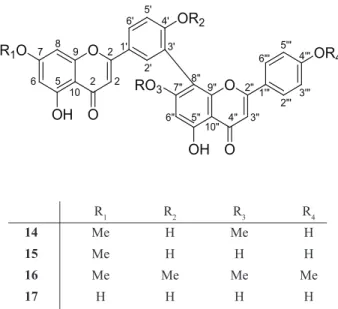
O. castaneifolia. The bilavones 14-17 were also isolated
from the leaves of the plant and were identiied as
7,7”-di-O-methylamentholavone (Gu et al., 1990), hevealavone
(4”’,7,7”-tri-O-methylamentholavone) (Carbonezi et
al., 2007), 4’,4”’,7,7”-tetra-O-methylamentholavone
O
O OH
R1O
OR2
O
OR4
O OH
RO3
2
2 2 10 5 6
7 8 9 1'
6' 5'
4'
3'
2'
2"
3" 4" 10" 5" 6"
7" 8"
9"
1'" 2"'
3'" 4'" 5'"
6"'
R1 R2 R3 R4
14 Me H Me H
15 Me H H H
16 Me Me Me Me
17 H H H H
Compound 3 was isolated from O. hexasperma
(Moreira et al., 1994) and hevealavone (15) from O.
multilora (Carbonezi et al., 2007); amentholavone (15)
is common in Ouratea (Felicio et al., 2004; Felicio et al.,
2001; Velandia et al., 2002). To our knowlegment, this is the irst occurrence of germanicol (11),
4’,5-dihydroxy-3’,5’,7-trimethoxylavone (4) and of the bilavone 7,7”-di-O-methylamentolavone (14) in the Ouratea genus.
All the NMR data of compound 15 (hevealavone)
were in agreement with the literature data (Carbonezi et al., 2007), except for the attribution of the HO-5 and HO-5” that were changed. In the HMBC of 15, the signal
at δH 12.95 (OH-5) showed 2,3JCH correlation with δC 98.2 (C-6) and the signal at δH 13.21 (OH-5”) showed 2,3JCH correlation with δC 95.6 (C-6”).
The 13C NMR data of compound 14 are being
published for the irst time. It were made by the 1D (BBD and DEPT) and 2D (HMQC and HMBC) NMR experiments analysis (Table 1). The 1H NMR spectra [1D
and 2D (1H-1H-COSY)] of compound 14 showed signals
of two chelated hydroxyls (δH 12.95 and 13.24), hydrogens of two aromatic methoxyl groups, two hydrogens of ring A (meta coupled), one non coupled hydrogen (ring A”),
the hydrogens of a 1,3,4-trisubstituted aromatic ring (ring B) and the hydrogens of a para-substituted aromatic ring
(Ring B’”). These 1H NMR data are in accordance to those
published by Gu et al. (1990). The 13C NMR spectrum
of compound 14 showed thirty signals, ten signals were
attributed to twelve sp2 CH (including the two signals
atributted to C-2’” and C-6’” and to C-3’” and C-5’”), two
sp3 carbons (δCH3 56.2 and 56.6), sixteen sp2 quaternary
carbons and two carbonyl groups (δC 182.1 and 182.5).
The structure of 14 was conirmed on the basis of HMBC
spectrum (Table 1, Figure 1), which showed heteronuclear long range couplings 2,3JCH of H-2’ with C-8” and of
H-6” with C-8”. These data together with the absence of
O
M
eO
OH
OH
O
O
M
eO
OH
OH
O
Figure 2. Some 2,3J
CH long-range correlations on the HMBC of compound 14.
correlations with C-9”, are characteristic of bilavonoids with an amentholavone skeleton (Goh et al., 1992). The localization of the methyl groups on compound 14 was
deduced by comparison of the chemical shifts on the 13
C-NMR spectra with those of amentholavone taking in
account the protection effect caused by the presence of these groups on the vicinal carbons as described in the
literature (Markham et al., 1987). The HMBC experiments also showed correlations of the quaternary carbons C-7’’ (δC 162.8) and C-7 (δC 165.2) with the hydrogens of the
methoxyl groups at δH 3.83 (OMe-7’’) and 3.82 (OMe-7),
respectively.
ACKNOWLEDGEMENTS
REFERENCES
Carbonezi CA, Hamerski L, Gunatilaka AAL, Cavalheiro A, Castro-Gamboa1 I, Silva DHS, Furlan M, Young MCM, Lopes MN, Bolzani VS 2007. Bioactive lavone dimers from Ouratea multilora. Rev Bras Farmacogn 17: 319-324.
Carvalho MG de, Carvalho GJA de, Braz-Filho R 2000. Chemical constituents from Ouratea loribunda: complete ¹H and ¹³C NMR assignments of atranorin and its new acetyl derivative. J Braz Chem Soc 11: 143-147.
Chaurasia N, Wichth MJ 1987. Sterols and steryl glycosides from Urtica dioica. J Nat Prod 50: 881-885.
Dora G, Edwards JM 1991. Taxonomic status of Lanaria lanata and isolation of a novel bilavone. J Nat Prod 54: 796-801.
Estevam CS, Oliveira FM, Conserva LM, Lima LF, Barros ECP, Barros SCP, Rocha EMM, Andrade EHA 2005. Constituintes químicos e avaliação preliminar in vivo da atividade antimalárica de Ouratea nitida Aubl (Ochnaceae). Rev Bras Farmacogn 15: 195-198. Felicio JD, Rossi MH, Braggio MM, Gonçalez E, Pak A, Cordeiro
I, Felicio RC 2004. Chemical constituents from Ouratea
parvilora. Biochem Syst Ecol 32: 79-81.
Felicio JD, Rossi MH, Park HR, Gonçalez E, Braggio MN, David JN, Cordeiro I 2001. Bilavonoids from Ouratea
multilora. Fitoterapia 72: 453-455.
Forgo P, Kövér KE 2004. Gradient enhanced seletive experiments in the 1H NMR chemical shift assignment of the skeleton and side-chain resonances of stigmasterol, a phytosterol derivative. Steroids 69: 43-50.
Goh SH, Jantan I, Waterman PG 1992. Neolavonoid and bilavonoid constituents of Calophyllum inophylloide. J Nat Prod 55: 1415-1420.
Gu YL, Xu YM, Fang SD, He QM 1990. The chemical constituents from Podocarpus imbricatus. Acta Bot Sin 32: 631-636.
Jha HC, Zilliken F, Breitmaier E 1980. Carbon-13 NMR shifts and carbon-hydrogen coupling constants of deoxybenzoins and related acetophenones. Can J Chem 58: 1211-19. Le Cointe P 1934. Árvores e plantas úteis (indígenas e
aclimatadas). Série: A Amazônia Brasileira, nº 3. Livraria Clássica, Belém.
Mahato SB, Kundu AP 1994. 13C NMR spectra of pentacyclic triterpenoids-A compilation and some salient features. Phytochemistry 37: 1517-1575.
Manga SSE, Messanga BB, Sondengam BL 2001. 7,8-Dihydrobenzofuranones from Ouratea reticulata. Fitoterapia 72: 706-708.
Markham KR, Sheppard C, Geiger H 1987. 13C NMR Studies of some naturally occurring amentolavone and hinokilavone bilavonoids. Phytochemistry 26: 3335-3337.
Mbing JN, Bassomo MY, Pegnyemb DE, Tih RG, Sondengam BL, Blond A, Bodo B 2003a. Constituents of Ouratea
lava. Biochem Syst Ecol 31: 215-217.
Mbing JN, Pegnyemb DE, Tih RG, Sondengam BL, Blond A, Bodo B 2003b. Two bilavonoids from Ouratea lava
stem bark. Phytochemistry 63: 427-431.
Moreira IC, Sobrinho DC, Carvalho MG de, Braz-Filho R 1994. Isolavanone dimers hexaspermone A, B and C from Ouratea hexasperma. Phytochemistry 35: 1567-1572.
Nes WD, Norton RA, Benson M 1992. Carbon 13C NMR studies on sitosterol biosynthesized from [13C] mevalonates. Phytochemistry 31: 805-811.
Salazar GCM, Silva GDF, Duarte LP, Vieira Filho SA, Lula IS 2000. Two epimeric friedelane triterpenes isolated from Maytenus truncata Reiss: 1H and 13C chemical shift assignments. Magn Reson Chem 38: 977-980.
Suzart LR, Daniel JFS, Carvalho MG, Kaplan MAC 2007. Biodiversidade lavonoídica e aspectos farmacológicos em espécies dos gêneros Ouratea e Luxemburgia (Ochnaceae). Quim Nova 30: 984-987.
Velandia JR, Carvalho MG de, Braz Filho R 1998a. Ácido ent-16α,17-diidroxicauran-19-óico isolado de Ouratea semiserrata e os desaios estereoquímicos dos carbonos quirais C-4 e C-16. Quim Nova 21: 397-404.
Velandia JR, Carvalho MG de, Braz Filho R 1998b. Novel trichloro- and tetrachloroisolavone isolated from Ouratea semiserrata. Nat Prod Lett 12: 191-198. Velandia JR, Carvalho MG de, Braz Filho R, Werle AA 2002.
Bilavonoids and a glucopyranoside derivative from Ouratea semiserrata. Phytochem Analysis 13: 283-292. Wang GSF, Jiang Q, Ye YH, Li Y, Tan RX 2005. Genistein
derivatives as selective strogen receptor modulators: Sonochemical synthesis and in vivo anti-osteoporotic action. Bioorgan Med Chem 13: 4880-4890.