Digitalization and its impact on
competences, jobs, and the
workplace
Sam Denishin
Dissertation written under the supervision of Géraldine Galindo
Dissertation submitted in partial fulfilment of requirements for the
International MSc in Management, at Universidade Católica Portuguesa
and for the Diplôme Master Grande École (MSc in Management), at
ESCP Europe Paris, 04-06-2020.
Abstract in English
Digitalization is having a profound impact on the world, and the people and businesses in it. It is imperative that digitalization and the impact this will have on competences, jobs, and the
workplace be properly understood. A thorough and deep diving literature review has been
done on this subject.
Digitalization and its impact have not been properly understood by the business community. There is a lot of confusion on the terminology in this field, nevertheless there is widespread understanding that digitalization is going to enormously impact companies. The importance of competences is going to change in the coming decades. The value of competences relating to physical strength will plummet. Jobs that are routine and manual have the highest likelihood of disappearing due to digitalization. This does not mean that there will be no jobs for people. In the future, people, robots, and software are going to work side-by-side. Competences dealing with social intelligence and creativity will become more important as these are harder to automate. Individuals must however focus on combining a wide variety of competences in order to become more valuable in the labour market. The future marketplace will be one where consolidation is rampant and data-opolies reign supreme. A few companies will have most of the power, these are the ones with the most data. They will be forced to become more sustainable and socially responsible. These companies will also use these new traits to attract new employees as people will judge companies based on social criteria.
Abstract in Portuguese
A digitalização está a ter um impacto profundo no mundo, e nas pessoas e empresas que nele vivem. É imperativo que a digitalização e o impacto que esta terá nas competências, nos empregos e no local de trabalho sejam devidamente compreendidos. Foi feita uma profunda revisão da literatura sobre este tema.
A digitalização e o seu impacto não são ainda devidamente entendidos pelo mundo empresarial. A terminologia neste campo ainda gera muitas dúvidas, no entanto, há um
consenso geral de que a digitalização vai ter um enorme impacto nas empresas. A importância das competências vai mudar nas próximas décadas. O valor das competências relacionadas com a força física vai perder relevância. Os empregos de rotina e manuais têm a maior probabilidade de desaparecer devido à digitalização. Isto não significa que não haverá empregos. No futuro, as pessoas, os robôs e o software vão trabalhar lado a lado. As
competências de inteligência social e criatividade tornar-se-ão mais importantes, uma vez que estas são mais difíceis de automatizar. No entanto, os indivíduos devem combinar uma grande variedade de competências, a fim de se tornarem mais valiosos no mercado de trabalho. No mercado do futuro, a consolidação será exponencial e em que os data-opolies prevalecerão. As empresas que têm mais dados, serão as mais poderosas. As empresas serão obrigadas a tornar-se mais sustentáveis e socialmente responsáveis. Estas empresas também utilizarão estas novas características para atrair novos trabalhadores, uma vez que as pessoas julgarão as empresas com base em critérios sociais.
Acknowledgements
I would like to thank my supervisor Ms Galindo for her patience and supervision during this process. Her willingness to discuss and meet has been incredibly valuable. Furthermore, I would like to thank my parents Kanishka and Soonia, and my sister Milla. They have always supported me, and their love is something that I will always treasure.
Contents
1. Introduction ... 1
1.1. Background ... 1
1.2. Purpose ... 2
1.3. Problem Analysis and Research Questions ... 2
1.4. Limitations... 3
2. Methodology ... 4
2.1. Research Strategy and Design ... 4
2.2. Research Method: Literature Review ... 4
2.3. Validity and Reliability ... 5
3. Understanding Digitization, Digitalization, Digital Transformation, and Data ... 6
3.1. Digitization ... 6
3.2. Digitalization ... 6
3.3. Digital Transformation ... 7
3.4. Data ... 8
4. Competences ... 10
4.1. American Method of Competencies ... 11
4.2. European Models of Competences ... 11
4.3. Unified European Method of Competences ... 12
4.4. Overview of Competence Methods ... 13
5. The Impact of Digitalization on Competences ... 15
5.1. Switzerland ... 15
5.2. USA and UK ... 15
5.3. Digitalization’s Impact on Knowledge ... 16
5.4. Digitalization’s Impact on Skills ... 17
5.5. Digitalization’s Impact on Abilities ... 17
5.6. The Most Useful Combination of Competences ... 18
6. The Impact of Digitalization on Jobs ... 20
6.1. Digitalization’s Impact on Industry ... 20
6.2. Digitalization’s Impact on Jobs ... 21
6.3. Digitalization’s Impact on New Job Creation ... 21
7. The Workplace of the Future ... 23
7.1. Consolidation versus Fragmentation ... 24
7.2. Collectivism versus Individualism ... 26
7.3. Green World ... 28
9. Future Research ... 33 Bibliography ... 34 Declaration of Originality and Integrity ... 35
1
1. Introduction
The aim of this chapter is to show the reader the background, purpose, research questions, and limitations of this research. It will begin with a background so that the context of the research topic can be explained. This will be followed with understanding the purpose of this research. Afterwards, the problem analysis and research questions will be discussed to know what exactly this paper will handle. Finally, some limitations will be put forward so that it can be clear which barriers were faced in researching this topic.
1.1. Background
Digitalisation is one of the biggest forces in the world today, and it is reshaping the way business operate (Michael Rachinger, 2018). Just in France, firms that have digitalized have increased its revenue with up to 40%, whilst firms that did not are looking at losing about 20% of their revenue to competitors (McKinsey, 2014). On a global scale, digitalisation could lead to a 14% increase of GDP by 2030 – equalling about 15 trillion USD in today’s terms (PWC, 2017). For OECD economies, digitalisation has the potential to create gigantic
increases in productivity, however it will also bring disruption with it. The nature of work will change and so will the competencies required for employees (PWC, 2018).
In order to compete in this world, companies need to understand the value of digitalization and especially the value of data. The amount of data continues to increase twofold every three years as more and more information comes from all kinds on new platforms, phones, and new technological inventions (Henke, et al., 2016). Furthermore, the capacity to store data has increased, whilst on the other hand the cost for this has decreased tremendously (Rosenthal, 2012). Companies now have large amounts of computing power, together with great amounts of data disposable to them, and are using this to innovate in novel ways.
Yet even though there is a consensus about the power of digitalization and the fact that it will completely alter industries, there is still a lot of confusion about what it is and how it will affect people (Venkatraman, 2017). Having a better understanding of digitalization will thus be imperative for companies that wish to compete in the coming years. Companies are made up of people, so it will be important to understand how digitalization will impact people as digitalization will change jobs and the competences necessary for those jobs. Furthermore, knowing what the workforce and the workplace of the future will look like because of digitalization will be important as well.
2
1.2. Purpose
Looking at the above presented information in the background section it is clear that digitalization is great force with a big impact. It is important for both companies and
individuals to know how to deal with digitalization in order to have an edge over others. So, the purpose of this master thesis will be to understand digitalization and the impact this will
have on competences, jobs, and the workplace. This will be done by looking at literature
currently available on a variety of related topics, putting them together, and analysing them.
1.3. Problem Analysis and Research Questions
It is evident that digitalization will be impactful, but what exactly is digitalization? There are many misunderstandings regarding this term and other terms close to this one. In order to proceed it must be clear what those terms mean exactly. So for the first question it is important to know:
• RQ1 - What are digitization, digitalization, digital transformation, and data?
Having understood what these terms mean and why they are significant one can proceed with competences. There are many different ways to define competences. Numerous theories have developed over the years. These will be discussed and finally one method of defining
competences will be chosen. Using this method one can find out how digitalization will affect them. But, before that is important to know:
• RQ2 - What are competences?
After having answered this question one can put digitalization and competences together. Because there is a definition of competences one is able to see how the value of these has changed over the years. The value of certain competences will have changed over the years and it will be possible to reason which will be valuable in the future. Thus, it is important to know:
• RQ3 – How will digitalization affect competences?
Once it is known how digitalization will affect competences it will become easier to
understand how this will affect jobs. Jobs and competences go hand-in-hand. Knowing which competences have become more valuable will also show which the structure and make-up of future jobs. For this question the biggest focus point will be where the biggest job gains and losses are. So, it becomes imperative to understand:
3
• RQ4 – How will digitalization affect jobs?
When it is known how digitalization will have affected competences and jobs only one more area remains – the workplace. Understanding how the workplace looks like means having to take a wider look at how the future will pan out. It means combining different factors on how technology will manifest itself as well as how people-centric the future will be. Using all of these different factors one is able to see:
• RQ5 – How will digitalization affect the workplace?
After all these questions have been answered, a good understanding of the wide impacts of digitalization will be had.
1.4. Limitations
This paper does have its limitations. The reason that that only a literature review is possible is because of coronavirus which is an infectious disease and has caused a global pandemic (WHO, 2020). This has caused 81% of the 3.3 billion global workforce to deal with a partly closed or fully closed job (BBC, 2020). This research is thus built on the work that others have done. I was unable to personally speak with experts within the field to find out what they think about digitalization, and to see if they agree with the literature that has already been released.
4
2. Methodology
This chapter deals with the methodology used in creating this research. The first part deals with the research strategy and design. Herein the strategy for creating this research will be discussed followed by the way it is designed. Afterwards the method for this research will be deliberated as well as the reason this method was chosen. Finally the validity and reliability will be discussed.
2.1. Research Strategy and Design
This research will use findings from research that has already been done, put them together, analyse them and so create new insights. This kind of approach is called a deductive
approach. This refers to a process where a researcher can come to new insights based on already established theory (Bell, Bryman, & Harley, 2018). This research focuses on understanding digitalization and the impact this will have on competences, jobs, and the workplace. So, the research will be based on existing literature dealing with these topics – therefore signifying deduction. This research has been done in a qualitative manner as to understand digitalization and its impacts. The reason that this is a fitting approach it because this method is advantageous when seeking to understand the details of a phenomena, as well as examining findings that have already been done (Queirós, Faria, & Almeida, 2017). This is especially useful seeing as digitalization and its impacts is a relatively new subject. The research only uses secondary findings seeing as the coronavirus caused a global pandemic therefore making it impossible to get primary findings. Nevertheless, using literature that is currently available and putting them together new and interesting insights can be discovered after analysing them. However, not having access to primary findings does limit the study. This is also discussed in the limitation sub-chapter.
2.2. Research Method: Literature Review
The reason that this literature review was done is because it allows the researcher to identify what the current findings are in the digitalization domain (Fink A. , 2014). The setup of the review started with choosing what needed to be researched. This was done by looking at the central research questions. In this research the topics of digitalization, competences, and workplace of the future were very relevant. These topics were used in EBSCO, Emerald Insights, Google Scholar, and Science Direct. This led me to relevant articles and books. Those were read and using those sources new ones discovered. The summation of all the relevant literature allowed for the research to contain a wide array of insights. These where then analysed to create new learnings.
5
2.3. Validity and Reliability
For a research to be considered trustworthy, it is important that it is both valid and reliable (Bell, Bryman, & Harley, 2018). This research is a literature review and therefore the following must be seen keeping that in mind. The research design started with a POA where the outline and the structure and content of the research was created. This was in tandem with the ESCP supervisor ensuring that there is a valid research construct. Going through all of these different phases ensured that the research design would be valid. The research itself uses academic level sources including reports, journal articles, books, and studies ensuring that a good balance of sources was maintained. The sources that were used are all relevant to the topic of the thesis. Special attention was paid to the data of the studies to ensure that the latest most studies were used. Reliable research means it must be possible to replicate the research at another time. Using the sources and steps that were taken the research can be replicated in other scenarios. If the research were to be done again the same answers would arise again. So the research is reliable and can be replicated.
6
3. Understanding Digitization, Digitalization, Digital
Transformation, and Data
The world is becoming more connected with each other, everywhere companies in various sectors want to use new technologies to create new opportunities for themselves and their customers. Understanding technology and its progress is thus vital for these companies. Nevertheless, with new technology comes new terminology, and this can be confusing. In this report three terms will be mentioned specifically: digitalization, digitalization, and digital transformation. These terms have different meanings, but have been used interchangeably within the past years causing some confusion as to what means what (Dörner & Edelman, 2015). Understanding what they means is important because it affects successful
communication and understanding of these concepts. In this section the three definitions will be explained and examples will be provided for them.
3.1. Digitization
Digitization means taking information that is analog and encoding that into zeroes and ones in order for computers to store, process, and transmit that information. Gartner’s IT Glossary defines in the following way: “digitization is the process of changing from analog to
digital form” (Gartner, 2020). In practice, the easiest way to understand digitization is to look
at various forms of content that were transformed from analog to digital format. The
introduction of high resolution scanners led to a gigantic conversion of analog data to a digital one when paper archives went to digital ones. Another example would be the invention of the first CD (Savić, 2019). This allowed a cheap way to store and distribute documents that were once only in paper. What matters here is that it is information that is being digitized, not the processes.
3.2. Digitalization
Defining digitalization is a bit more difficult than digitization. Two definitions will be provided and then discussed. The first definition is from Gartner, it defines digitalization as: “the use of digital technologies to change a business model and provide new revenue and
value-producing opportunities; it is the process of moving to a digital business” (Gartner,
2020). This definition looks at digitalization from a business perspective. When companies implement digital technologies it is evident that the nature of people’s jobs change. Taking a factory as an example, factory workers instead of working an assembly line themselves would use computer controlled tools and direct robots to do their old job. At the heart of
7
digitalization is the change of jobs and therefore the competences necessary to do new and old jobs. This also goes hand in hand with automation. When a company digitalizes a certain process it is very likely that jobs get automated. The second definition is an academic definition from Brennen and Kreiss who define digitalization as: “the way in which many
domains of social life are restructured around digital communication and media infrastructures” (Brennen & Kreiss, 2016). This definition does not solely focus on the
business aspect of digitalization but also on the social domain. Interactions shift from analog means such as writing letters to incorporating digital ones such as email and online chats. In short digitalization can affect any stage of the lives of people including the way that people talk, interact, and how they work by integrating digital technologies into the daily live. Nevertheless in the paper the focus will lie on the Gartner definition as this paper deals more with business areas rather than including a social one as well. That definition stresses that processes within a certain company change, however when taking a complete organisational approach the following term will matter more.
3.3. Digital Transformation
The final step is the digital transformation. Hewlett Packard defines it as: “the process of
integrating digital technology into all aspects of business, requiring fundamental
changes in technology, culture, operations, and value delivery” (Hewlett Packard, 2020).
The difference between digitalization and digital transformation are quite significant. A company may choose to do a digitalization process: automating a process to retrain factory workers to let them use robots to perform an assembly line job. However, digital
transformation is not something that a company can just implement as another project. In a digital transformation everything about a company changes. The entire strategy and business must be digitally transformed.
To put it all together, companies have the capacity to digitize information, digitalize the parts and processes which constitute the procedures of a company, and digitally transform the company and the strategy of the company. Every step is required nonetheless not adequate for the proceeding. Digitization and digitalization deal with technology, however digital
transformation deals with more than this. It is a complete reinvention of the company and the strategy with the end goal in mind to provide more value to the customer.
8
Figure 1 – An overview of Digitization, Digitalization, and Digital Transformation (Savić,
2019)
3.4. Data
A key aspect of digitalization is the data and the value of it. “Data are characteristics or
information, usually numerical, that are collected through observation” (OCED, 2008).
In order to demonstrate how and why this matters a practical example of a digitalization process will be given which shows why data matters and how this can be secured. Digitalization is different for every company but in all of them data does matter. In this example the introduction of a spam filter will be examined. Before the current spam filters existed, email providers created rules for users so that they could differentiate between spam and regular email. Some of the rules were about if the subject was written in capital letters or whether certain words were used such as Viagra (Schatsky, 2013). However this a flawed method with limitations as there will be many decisions requiring being able to know when an email is meant for the recipient or when it is spam. Some people may be good at this whereas others not so much. What the email providers then did was quite simple – digitalize it. They invented the spam filter. A nifty piece of software that can tell whether an incoming email if spam or not. In 2012 Microsoft said that its software was able to detect spam in 97% of cases (Richmond, 2012). Google has said it was able to detected 99.9% of spam going to one’s inbox (Lardinois, 2017). This makes the process a lot easier and better, whilst delivering a
9
higher customer value. These companies were able to create them using machine learning. “Machine learning is the science (and art) of programming computers so they can learn from data” (Géron, 2017). Machine learning automatically learns how to identify complex patterns and will make smart decisions based on data. A very potent machine learning approach is called neural network. “Neural nets are a means of doing machine learning, in which a computer learns to perform some task by analyzing training examples” (Hardesty, 2017). Often times, examples will have been pre-labelled beforehand. In the case of spam filters, spam emails will have been labelled as spam so it is able to recognise it. As great benefit of neural networks are its self-learning capabilities. The email providers took thousands of emails that they knew where spam and fed these into the neural network. From that point onwards the more data the neural network has the better it is able to become. In due time, it will not need to rely on the pre-fed examples but it will be able to learn and detect new forms of spam itself. It can create new rules as it goes along (Aski & Sourati, 2016). Thus the more people keep using the email provider, the better the spam filter will become. The more data one has the easier it is to create great products and so become more powerful.
As this data gives companies such a big advantage, it is vital to understand how this data is stored. Data is stored in data centres, these are a physical facilities that companies utilize to store their important applications and data (Cisco, 2020). Contemporary data centres are different from those in the past. The infrastructure has changed from old-fashioned physical servers to virtual networks. There are two main ways to protect them: physical security and software security (Forcepoint, 2020). The physical security of data centres are the measures taken which prevent any physical damage being done to the machine which store the data. The virtual security of data centres are the measures taken which avert remote illicit access that will harm the data stored on the servers.
10
4. Competences
This report will talk a great deal about competences, however in order to do so, a light must be shed on what exactly a competence is. There is a lot of literature on competences that individuals should have, however human resource management is not an exact science. Different researchers have come up with different frameworks for which frameworks should best be applied.
Several theories and frameworks regarding competences that managers should possesses will be mentioned and their merits will be discussed. Afterwards there will be a comparison made between them so it can be known which could be seen as the most useful in from the
perspective of this research. With this framework the research will then continue. The origin of competences dates back to the USA where competence categories where developed because normal cognitive intelligence test had shown to be a bad predictor of future job performance (White, 1959). Instead of measuring cognitive intelligence a new method had to be developed, one where the psycho-social traits of people were mapped that were linked with great job performance. This method was introduced to Europe by American companies that also had divisions in Europe. One of most noteworthy cases is by David McCelland, he was a big proponent of the term “competency” (McClelland, 1973). However, the development of this shift has led to two different terms being developed: competency and competence.
Competency (which has the plural competencies) was utilised to show certain traits of individuals that are linked with great job performance. This definition and explanation were used by McCelland and many other noteworthy researchers in this field (Boyatzis, 1982) (Klemp, 1982). This is generally seen as the American interpretation.
On the other hand competence (which has the plural form competences) was generally used to mention what an individual needed to be able to do, and what an individual needed to know, so that he or she may perform the tasks that were necessary to perform for a certain job. This is generally seen as the British interpretation. Here the focus point lies in whether a person possess the ability to perform the tasks required to do a certain job (Knasel, 1994) (Mansfield, 1993).
The difference between the two methods have been categorized as input versus output methods. Where the American method focuses on traits that individuals have to possess in
11
order to do a job in a great fashion, but where the British method focuses on output where the focus area lies in meeting the demand of the profession (Boak, 1991) (Burgoyne, 1988). This tacit understanding of both terms has led to a bit of confusion within literature as sometimes there are used interchangeably (Boam, 1992) (Dale, 1992). This has meant that if one want to understand the literature, one must be able of how these two terms have been used. The natural consequence is that there lies some confusion regarding the research and its comprehension for readers (Norris, 1991).
4.1. American Method of Competencies
In the US the competencies were even further developed alongside the traditional method. This encompasses methods where competencies that also had the individual traits and job activities included in it (Rothwell, 1999).
This is especially clear when the O*NET database is consulted. This is the most used database of job information in the United States. Here one can see job oriented description as well as worker oriented descriptions. The job-oriented descriptors looks at: tasks, activities and job characteristics, whereas the worker oriented descriptors looks at psycho social characteristics. One can then see three categories of competencies: knowledge, skills and abilities (Deloitte, 2017). Knowledge and skills are competencies that people can learn through experience and/or training. Knowledge contains practical and theatrical knowledge of general areas. Skills are about attributes that enhance the acquisition of knowledge and that can be acquired through training. Abilities are qualities that are generally native and that cannot therefore be learned, however they can be advanced and polished. Abilities also have an effect on the aptitude of people to gain skills and knowledge, and in this way can influence job performance. These are then divided into smaller sub divisions.
4.2. European Models of Competences
In the 1980s, competence models began appearing that were different from the American method. As mentioned before this was first spearhead by the British, however subsequent methods appeared in France and Germany as well. The area that all three had in common was that there was a bigger emphasis on the job rather than the individual, however each has a different idea to competence. These three models have become the leading European models which have in turn strongly influenced how other countries in Europe perceive competences and as well as across the world.
12
In order to mention the UK it must be noted that there was a difference in the system that that England and Wales used, when compared to what Scotland used. For this research, the model in England and Wales will be used and will be mentioned as the UK model. The UK created a national framework with qualifications that were necessary for various professions. Based on this framework the competences were created. The definition of competences became then “the ability to apply knowledge, understanding and skills in performing to the standards required in employment. This includes solving problems and meeting changing demand” (Beaumont, 1996).
Having a stronger focus on competences became more popular in France during the 1990s. In this time, the employment agency of the State embraced a competence based methodology for categorizing all of its professions. The French model contains: savoir (knowledge), savoir-faire (functional competences), and savoir être (behavioural competences) (Defelix, 2006). In Germany the term competence was already more wide-spread. The German education system introduced a competence based method in 1996 with three key areas
(Fachkompetenz), personal competence (Personalkompetenz) and social competence (Sozialekompetenz) (Winterton, 2006).
4.3. Unified European Method of Competences
In 2002 the TWG was established – the Technical Working Group – by the EU Commission in order to develop a unified European method. In preparing thus unified European method the systems of the above mentioned European countries were examined (Winterton J. , 2008). The TWG also paid special attention to a model developed by Bloom which differentiated three different areas of educational activities (Bloom, 1964). These three areas are:
psychomotor, affective, and cognitive. The psychomotor area deals with physical or manual labour skills. The cognitive are deals with knowledge. The affective are deals will the
attitudes that individuals possess, mainly the feelings and emotional areas. Bloom’s model has in fact also strongly influenced the Qualifications Framework of Ireland.
Combining all of these areas the TWG came up with the holistic competence model which combines attitudes, knowledge, and skills. The holistic competence model has thus three main areas: cognitive competence (knowledge), functional competence (skills), and social
competence (behavioural). The model was represented as a tetrahedron with meta-competence resting as the base, which contributes to the others (Le Deist and Winterton, 2005).
13
This holistic model was then proposed to the EU Commission. However rather than taking accepting this model the Commission decided to use “knowledge, skills, and competences”. Afterwards the Commission then invited another expected group to take a look at their new model and then decided to change it a bit. Knowledge and skills were kept, however
competences were changed into “personal and professional competence”. This last category had four sub-categories: learning competence, communication and social competence, autonomy and responsibility, and professional and vocational competence. This led to some confusion which led the Commission to invite another group of experts to take a look. In the end the model that was decided upon contained knowledge, skills, and responsibility and autonomy (European Commission, 2020).
4.4. Overview of Competence Methods
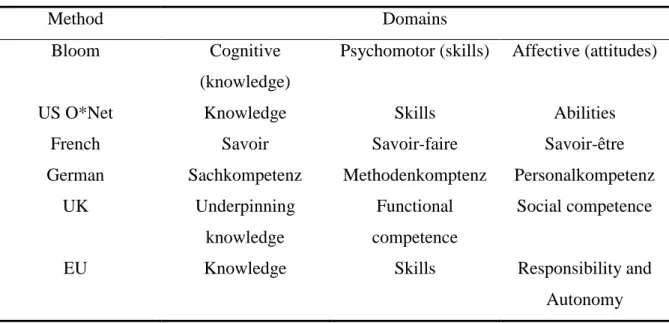
After having explained the different methods for explaining and defining competences an overview will be made and finally a conclusion will be drawn upon which to continue.
Table 1 – Overview of the different competence methods throughout time
Method Domains Bloom Cognitive
(knowledge)
Psychomotor (skills) Affective (attitudes)
US O*Net Knowledge Skills Abilities French Savoir Savoir-faire Savoir-être German Sachkompetenz Methodenkomptenz Personalkompetenz
UK Underpinning knowledge
Functional competence
Social competence
EU Knowledge Skills Responsibility and Autonomy
When comparing the methods with each other the conclusion can be drawn that they are actually quite similar. The first two competences of all the methods focus on the requirements that are necessary for the job namely knowledge and skills, and the third focuses on the individual and the traits that he or she possesses. The names that are given for each category may differ but the domains that are pursued are quite similar. It seems that that throughout
14
time the development of the competences models that theories and ideas have gone in the same direction.
For this rapport I will chose the American approach simply for the fact the US O*Net is the biggest database in the world regarding competences which means there is more data
available and subsequently more literature available (Deloitte, 2017). Seeing as there is more literature available it will be easier to do research.
15
5. The Impact of Digitalization on Competences
In the previous chapter it has been established with which model of competences this paper will utilize, namely the American method. This model will then be used to establish the impact that digitalization will have on competences. Within academia and the corporate world there is a consensus that digitalization is here to stay and its impact will be significant (ECB, 2018). However, as we are dealing with a future scenario, having a clear-cut answer for what it will look like will be hard to estimate. Nevertheless, even within the uncertainty one can still analyse the current literature and develop a future scenario.
In order to see what the impact of digitalization on competences will be different studies will be used to find out the effects. In order to have an accurate picture, three countries will researched to see if digitalization will have a different role, but also to get a more complete picture, as one country may be a potential outlier.
Three countries were chosen that are sufficiently developed enough so that digitalization may take place. Also, it is imperative to choose countries where there is plenty of sound research available on. Keeping this in mind three countries have been chosen: Switzerland, the UK, and the US. After the findings are noted an analysis will be made on what these findings mean and why they are relevant.
5.1. Switzerland
Deloitte has done a study on the Swiss labour market in order to identify the effect on digitalization on competences and it has used two indicators to asses this (Deloitte, 2017). Firstly, it has performed an extrapolation of employment figures of the time period 1990 until 2013 to forecast competence requirements that would be present from now until 2030. This is done in order to predict which sector will have the biggest growth. Secondly, the capacity to protect oneself against job losses due to digitalization. Competences that are particularly digitalization resistant are those that give individuals an edge over the machines or software programmes which means that it will be less likely for them to disappear, and those for which there will be a high demand in the market.
5.2. USA and UK
A study was conducted with Pearson using trends and the help of domain experts in order to predict what the future of competences would be in both the USA and the UK (Bakhshi, 2017). Again using the O*Net competences as was done in the previous study. Using these
16
competences they looked at whether the value of a certain competence would go increase or whether it would decrease. The timespan that was chosen was the world by 2030.
5.3. Digitalization’s Impact on Knowledge
Which areas of knowledge will become more important and which will become less important?
In Switzerland, the areas whose value will increases there are two clear winners: knowledge of languages and knowledge of computers and electronics. Firstly, knowledge of language will increase in value as the amount of jobs that need this will increase, and this offers a sufficient protection against automation. Moreover, this are knowledge will furthermore be imperative for over 90% of the jobs that will exist by 2030. Secondly, knowledge of
computer and electronics will become ever more imperative. It is estimated that about half of the professions in 2030 will require this knowledge.
In the USA, the area whose value will increases are: psychology, sociology and anthropology, and education and training. When taking a look at the competences which increase in value one can see that having strong interpersonal competences matter a lot. As the work
environment gets more digitalized, being able to relate to another person becomes more important.
In the UK, there areas whose value will increase are: education and training, administration and management, and sociology and anthropology. As in the other examples this reflects that fact that interpersonal competences will become imperative in the coming years. Also, there are linked with professions that are likely to increase in the coming years, which underlines the value of generic knowledge requirements.
In all three countries the areas whose value will decrease will lie in professions where production knowledge matters, especially in food and mechanical production as there is a high likelihood of automation. In other words, these professions will become more vulnerable as it is easier to automate them (McKinsey Company, 2019). To put it in a practical way, the higher the importance of this knowledge competence in a particular job, the higher that this job would disappear due to digitalization. It is likely that job losses will endure in these sectors, nevertheless this forecast does not adhere to all professions which require mechanical knowledge. The reasons for this is that there will be professional opportunities should this specialist knowledge be combined with other skills. A good example here relates to mechanical engineers and electricians.
17
5.4. Digitalization’s Impact on Skills
Which areas of skills will become more important and which will become less important? In Switzerland, the collection of skills that will become especially valuable are: critical thinking, reading comprehension, speaking, and writing. These skills matter because they allow individuals to attain other newer more specific skills. When deep diving into specific skills two sub-categories can be discovered. The first is skills that could be assembled into creative skills such as social perceptiveness, social intelligence, and complex
problem-solving. The second is system skills, where both system analysis and evaluation become more important. Narrowing down skills such as complex problem-solving and social intelligence and social perceptiveness become more important. In general in can be noted that skills will relate to coding and maths are quite automation proof and can be seen as quite secure. In the USA, the collection of skills that will become especially valuable are: learning
strategies, instructing, social perceptiveness, coordination, and active learning. There is here as well a strong emphasis on strong interpersonal competences but also learning skills. This is consistent with research that shows that having stronger social and learning skills will become more and more important in the labour market (Deming, 2017). It is logical to assume that this trend will continue seeing as organisations aim to decrease coordination costs, and as they strive to thrive within the intercultural context of globalisation where digitalization is an ever increasing force (Tett, 2020).
In the UK, abilities whose value increase are similar to the aforementioned. One that it is more unique is systems evaluation and analysis. This reflects the ability to identify and comprehend the connections between socio-technical systems. This could indicate that
collaborative problem solving on a more technical level could become more important (Nesta, 2017).
In all three countries the skills that lose in value are: equipment maintenance, repairing, troubleshooting, operation and control, and installation. The reason for this is that these are most prone to automation.
5.5. Digitalization’s Impact on Abilities
Which areas of abilities will become more important and which will become less important? In Switzerland, the abilities that will become even more valuable can be collected in two different categories – these being: basic abilities, and logic and creativity. The situation that
18
one could see in abilities happens here as well, the first category allows one to obtain what is in the second. Basic abilities allow one to develop logical and creative abilities. If a person has a higher aptitude in verbal and written expression, then the better this person will fare in deductive/inductive reasoning and problem sensitivity. Some niche abilities that are also seen as quite valuable are: originality, fluency of ideas. These are abilities which are quite
automation proof. Also, quantitative and perceptual abilities are also unlikely to be automated. In the USA, abilities whose value will increase are those with logic and creativity as well. Two big benefactors here are: originality and fluency of ideas. As digitalization increases abilities that are linked with creativity become more valuable. The fact that individuals can come up with original out-of-the-box ideas is a fact that software and machines simply cannot copy (as of yet).
In the UK, abilities whose value will increase are those that deal with creativity, originality, and logical reasoning. These will become more valuable for the same reason as mentioned above.
In Switzerland, the USA, and the UK, the abilities whose value will decrease are physical and psychomotor abilities as these tend to be more prone to automation. Abilities which include extent flexibility and dynamic strength are easier to automate and are thus more likely to disappear.
5.6. The Most Useful Combination of Competences
After having mentioned which competences will increase in value one key are still needs to be discovered – the interaction and interplay between the competences. These competences can be divided into basic ones: active learning, critical thinking, speaking, and reading
comprehension. There are the ones that allow individuals to gain more advanced
competences, namely social intelligence and creativity. These two are both mass competences that are needed for a huge number of varying professions, and niche competences, which are important for a lower amount of specialist professions. Social intelligence and creativity are for the most part mass competences that are presently important in many professions and will become, in the future, even more important.
Creativity includes making something novel whilst solving difficult problems with innovative solutions. Where these kind of decision making areas are important, people will have an edge
19
over machines and software. Thus will be safer in the age of digitalization. This is also true for individuals with a higher level of social intelligence in combination with basic
competencies.
Social intelligence involves negotiation, persuasion, and social perceptiveness. Even though machines and software can recreate aspect of person to person interaction, they still will face a lot of difficulties in identifying human emotions and reacting to them. (Carl Benedikt Frey, 2013).
When it comes to niche competences, these are grouped into three different fields: communications, training, and health. These will however be more important for a more meagre group of profession. Regarding these fields, knowledge alone has a higher capacity to be automated, but when this is combined with a higher level of social intelligence the value of an employee increases tremendously.
This combination of knowledge and social intelligence is also true for jobs in the technology sector. When ICT skills are combined with creatively or social skills the value of the
individual rises and he or she will possess a very automation proof competences (OECD, 2013).
20
6. The Impact of Digitalization on Jobs
In the previous chapter the impact of digitalization has been shown upon competences. However, what would then as a consequence be the impact of digitalization on sectors within industry, and jobs within those industries. In order to find this out a dataset analysis by the OECD has been done that look at the tasks that comprise a job of over 200.000 employees over the 27 OECD countries plus Russia and Singapore and how technology will impact them (John Hawksworth, 2018). This will be supplemented with the research that explains why this change happens. The timeframe that will be used is roughly from now to about the mid-2030s. The reason for this is that within this time-frame one can find good and accurate data.
6.1. Digitalization’s Impact on Industry
What would the impact of digitalization be on different industries? This is the first question that must be asked. Using the source mentioned beforehand the following can be learned. When looking at the impact of digitalization across the different industries in the target countries it can be gleaned that the biggest hits will to transportation and storage, and manufacturing industry. Respectively, a job loss of 52% and 45% will happen due to digitalization. However, the industry that will be the least affected by this the education industry, here only 8%.
When taking a glance at jobs that will be lost due to digitalization in absolute numbers the biggest lost will be in the manufacturing sector, where 45% will be lost. The reason for this is that this industry has a median employment of 14% across the target countries, whereas the transportation and storage industry only has one of 5%. This process will have an impact on the industries over a different timeframe. Transportation and storage, and manufacturing will suffer the greatest losses as it is then that the use of driverless automobiles will most likely be adopted globally.
The difference between an industry facing losses due to digitalization are the competences that are necessary in the jobs in that particular industry (Arntz, 2016). Individuals in
transportation and storage, and manufacturing spend most of their time on competences that are related to manual and routine tasks, whereas in the education industry the most important competences are related to social and literary tasks. The reasons that the transportation and storage, and the manufacturing industries will face such loses are again related to the fact that those competences will become less valuable. This is in the complete opposite for the
21
digitalization manual and routine tasks can easier be taken over by machines and robots who will do a much better jobs in terms of speed, accuracy and precision, whereas it will be much more difficult for them to take over certain interpersonal competences (Gustein & Sviokla, 2018).
6.2. Digitalization’s Impact on Jobs
After having examined the industry level, the individual jobs within the industries will be examined. This will be done in order to increase the level of precision, so one can see exactly which professions will be impacted by digitalization. Again the (John Hawksworth, 2018) report will be used.
When looking at job disciplines one can see that roughly 64% of machine operators and assemblers will see a job loss due to digitalization. Within the transportation and storage sector these people make up the biggest group with around 43% of jobs. When looking at the manufacturing sector one can see that this group of people makes up 20% of the jobs. The professions that are relatively speaking the most resistant to digitalization are individuals that are in a senior management position – this figure for them is 6%.
The impacts of digitalization on job losses is not surprising given the findings so far. When a job has competences that relate mainly to competences whose value will decrease that profession will suffer greater losses. In this case, one can see again that those competences relate to physical labour which will lose value. On the other hand, managers and professionals are the group that fares the best. This is because for this group the competences that matter the most are related to social and literacy skills as well as difficult technological tasks that are less likely to disappear to due digitalization. This group of people is also much more educated than the rest, this means that they are more able to adapt to new advancements to technology (McKinsey Global Institute, 2018). In practice they would become a complement to machine or to software rather than be replaced by them. What is very probable is that the nature of their work would change due to digitalization.
6.3. Digitalization’s Impact on New Job Creation
Even though jobs will disappear due to digitalization, this does not mean that employment will dissipate. Old jobs will disappear, however there is also research that suggest that new jobs will be created – in fact, 85% of jobs that will be present during the third timeframe presently do not exist (Institute for the Future, 2017). Furthermore, job losses due to
22
digitalization will be in a mostly likely be offset because of the new jobs that will arise because of the emergence of new technology (WEF, 2018).
The largest area for future jobs will be in industries where technology would amplify demand. This would be through increasing both wealth and income, in a direct or in an indirect
fashion. These new incomes would be spent on services and on goods. This means that this will create new and higher labour demand. As this is a future scenario it is hard to very accurately forecast what would happen. The primary beneficiaries would be in the education and health as this is where an older and richer society would need and it is here were the fewest job losses would happen due to digitalization.
The reason that the health sector would increase in size has primarily to do with the fact that in the target countries one can observe an ageing population that will require more healthcare. Furthermore, for education one can notice that both the old and the younger education wants to retrain as the advancement of technology means that many people will have to retrain, both for professional purposes, but also for personal enjoyment. A lot of this can be delivered digitally, however there would also be a need for interpersonal contact to help students in the learning process. Moreover, as average incomes will grow, the demand for a wide array of personal services will also increase.
As technological developments will increase, jobs in industries that relate to this will also increase. The jobs will primarily be for educated people and will have a high remuneration (McKinsey Global Institute, 2019).
23
7. The Workplace of the Future
Taking the previous chapters in mind, it would be useful to know how the future workplace would be like. When speaking about future scenarios there will always be a certain degree of uncertainty. It is hard to know exactly what is going to happen in the future, however using research one is able to extrapolate and paint a picture of how a future world would be like. There is sparse research available on how digitalization would affect the workplace of the future in practical terms. This is logical as the development of digitalization can cause the world to move towards different directions making it difficult to come up with precise scenarios.
In order to get a better picture, it would be best to create some structure. This way one can have a good overview of all the different kinds of future scenarios. So, In order to figure out how digitalization will shape the future of the workplace four different criteria will be
examined. These criteria are found in the report by Brown who examines the workplace of the future (Justine Brown, 2018). In that research the world can be divided into four quadrants:
1. Individualism 2. Collectivism 3. Consolidation 4. Fragmentation
On the x-axis there is individualism and collectivism, and on the y-axis there are
fragmentation and consolidation. This means that there will be four different scenarios with the following combinations:
1. Blue World: Individualism and Consolidation 2. Red World: Individualism and Fragmentation 3. Green World: Collectivism and Consolidation 4. Yellow World: Collectivism and Fragmentation
In the rapport there is a description of what the world could be like for each scenario. Which of the four scenarios would be most realistic can be found out by taking a look at data and literature available. After analysing the work available an outcome will be given as to which direction the world is most likely headed. This will be useful in knowing which of the four combinations is the most likely to happen.
24
7.1. Consolidation versus Fragmentation
Is digitalization going to help or big companies or will it place them at a disadvantage? The advent of technology has allowed smaller companies to access vast arrays of data, funding, and skills that were first only available to big companies. This has allowed smaller companies to growth at tremendous speeds. These smaller companies are better able to serve smaller groups in society. However, it has also ensured that big companies can greatly reduce their costs. Companies can reach higher productivity with a fewer employees and use contractors instead if necessary without having to spend a long time and a large amount of money. The state also had a role to play when it comes to this. Is it going to encourage to creation of national champions, or rather focus on smaller start-ups and companies?
Should fragmentation be more realistic then large companies would lose their power and dominance and customers would find more value in other companies not burdened by size. Should consolidation be more realistic then big companies would get even bigger and more powerful and approach the influence of nation states. In order to answer this question it is important to take a look at the economy and see what has been happening, is there a bigger concentration or have the bigger companies been losing relevance?
The coronavirus spelled the end of the longest equity bull market in the history of the United States. In February the sale in equity indices ensures that the S&P 500 index fell into a bear market. This is defined as a 20% drop from the latest high. Nevertheless there was also a quick rebound. The S&P 500 recovered 30% since the March low in May (Oppenheimer, 2020).
What led this is a group of companies whose value has increased tremendously over the past year – big tech. A group of data-driven companies has benefited a lot in this crisis: Microsoft, Apple, Facebook, Amazon, and Alphabet. Alphabet and Apple are currently making tools that are able for governments to provide important health services (Dwoskin, 2020). Amazon and Facebook are benefiting from the reality that they are essential services for countries in lockdown. This group of companies has increased the S&P 500 index by about 400% from 2009 to the start of 2020 (Wigglesworth, 2020). What should also be noted that the Nasdaq – who is more tech-oriented – rose by more than 700% in the same period. Presently, these five companies make up a fifth of the market capitalisation of the S&P 500. Concentration wise this is a modern day record (Wigglesworth, 2020).
25
Firstly, network externalities will create economies of scale. Using the above mentioned companies as an example this will be demonstrated: selection platforms, search engines, social media, and shopping engines can all improve their service the more people use them. This means that it is hard for any new player to compete with these existing players. In short, having more data means a better end product/service (McGee & Sammut-Bonnici, 2015). Secondly, these technology companies also enjoy economies of scale from what they do outside of the network effects (Haucap & Heimeshoff, 2013). Taking Amazon as an example, its scale and global reach allow it to reduce its cost per unit, regardless of how many
customers it has. Moreover, internet-based activities that allow these companies to match sellers and buyers, instead of selling its owns stock is a lot cheaper to scale up.
Thirdly, these tech companies also actively collect a large amount of data of their customers which ensures the creation of both economies of scope and scale (Sandbu, 2019). Scale in one of the two creates an advantage in the other. Google - which is owned by Alphabet – was fined €2.4 billion by the European Commission when it misused its supremacy in search engines to create advantages in comparison shopping (European Commission, 2017). In short network externalities, economies of scale, and economics of scope makes these companies so powerful and these are all driven by of data. Furthermore, the more data they have to more powerful they become and the harder it becomes to challenge them.
Such a huge concentration is leading to what some are calling data-opolies. Companies that are able to control a crucial platform and able to create an ecosystem with users, advertisers, seller, developers, accessory makers, and apps (Stucke, 2018). Amazon is able to control the world’s largest online merchant platform. Facebook is able to control the social networks platforms. Alphabet is able to control search engines as well as operating platforms with Apple.
Through these platforms a gigantic amount of data is available to them. The speed in which they have been able to acquire has led to generate huge amounts of market power and has led to the concentration we have now. With this much power and consolidation behaviour, the question of anti-trust also pops up. In the United States this question has not caused a lot of worries, whereas in the EU this matters a lot more.
The European competition watchdog has targeted four data-opolies: Alphabet, Amazon, Apple, and Facebook. An example has already been mentioned regarding a €2.4 billion fine
26
for Google’s abuse to strengthen its shopping service. This is also true for Alphabet’s Android operating system as well as with AdSense (European Commission, 2016) (European
Commission, 2016). Facebook has been found abusing its powerful position by forcing third party websites that use Facebook to share all data with Facebook (Bundeskartellamt, 2017). In the United States the perception on trust is different. The head of the American anti-trust agency acknowledged the difference between the US and the EU. The reason for the relative inaction on the side of the US is because in their opinion there’s no harm done to competition and consumers. They do not want to impose any measures on these companies for fear of stifling innovation the benefits the consumers (Makan Delrahim, 2018). Normally in monopolies the danger lies in higher prices for consumer, reduced quality products or services, and less output. According to the Americans, these companies pose little to any risk. To them, these companies pose almost no risk and very few of these bad effects are present. Most of Alphabet’s and Facebook’s consumer products are free for consumer. Amazon has been able to drop the price of a lot of products for consumers (Profitero, 2018). As mentioned before, the more people use their products, the more data is available, the better the products quality becomes. Furthermore it is argued that these companies are not true monopolies because consumers are free to switch to a competitor with a simple click – they are not being restricted (Bork, 2012).
All of this shows that the trend is definitely moving towards consolidation as companies that are able to benefit off tremendous amounts of data are becoming more and more powerful.
7.2. Collectivism versus Individualism
Will the individual deserve the spotlight, or will mankind embrace a more collective approach focusing on the collective responsibility? Will the state place a higher value on the economy or on its people? Balancing the needs of the individual compared to the collective is going to become more important as the rate of digitalization increases.
Individualism means a focus on what the individual wants; an answer to the unlimited choices obtainable to consumers. Collectivism means a focus on the common good over personal preference. Here collective responsibility for our planet and environment, the social good and fairness trump individual interest.
One of the key groups of people to look at to answer this question are millennials. The reason for this is that the they became the largest generation in the labour market in 2016, and will make up 75% of the workforce world-wide in 2025 (Brookings, 2014). This group of people
27
largely believes that companies do not behave ethically and are not committed to helping improving the society (Deloitte, 2019). In fact, both Millennial and Generation Z said that being a good employer was the most important CSR issue that they care about. This group finds purpose driven companies more important than older generations.
Another study found that three quarters of millennials said that they find that a company’s environmental and social pledges are important in deciding an employer, and two thirds said that they would not consider working for an employer if it did not have a solid sustainability programme (LiveCareer, 2018).
A study looking at millennials in the US, China, and India, citizens of countries that account for two-fifth of the ecological footprint of the world, and found a large majority of them interested in environmental and sustainability issues, and they align their values to these causes (Hanson-Rasmussen, 2018). Furthermore, in a research done by Gallup, it was found that millennials are incredibly purpose driven, and expect people senior to them to adapt to their vision both in work and in society (Gallup, 2019)
The business community is also moving towards a more common good approach. Larry Fink, the CEO of BlackRock, the largest asset management firm in the world said: "Society is demanding that companies, both public and private, serve a social purpose. To prosper over time, every company must not only deliver financial performance, but also show how it makes a positive contribution to society” (Fink L. , 2018). He has also come out and said that from BlackRock will make investment decisions where environmental sustainability will be the core goal and would exit investment that have a risky sustainability profile (Sorkin, 2020). Such a powerful firm will also stimulate companies to take a more collective approach. A research by HSBC where 2500 global companies were surveyed found that 69% will focus their budget to make manufacturing more sustainable, 63% will update buildings and equipment to become more sustainable, and 66% will improve internal practices to become more socially conscious (HSBC, 2019).
Governments have also worked together to ensure that the collective approach trumps the individual approach. The Paris agreement was made by all governments in the world to limit worldwide emission and tackle climate change (United Nations, 2015). Moreover,
governments worldwide have begun focusing on sustainable development and created a sustainable development goals to be achieved in 2030 (United Nations, 2015). The EU has also created a directive obligating companies that have more than 500 employees operating in
28
the EU to report on a wide array of non-financial information such as sustainability, social responsibility, and the environment by 2016 (DIRECTIVE 2014/95/EU of the European Parliament and the Council of the European Union, 2014).
7.3. Green World
After having learnt that in the future the trend points towards consolidation and collective responsibility, the scenario that seems most realistic is the Green World. In this scenario social responsibility, demographic changes, and environmental sustainability become important drivers in the business world. Companies become more responsible, open and collaborative organisation that see themselves playing a bigger role in the lives of their employees and communities. In a reaction to public opinion, companies will behave more responsibly towards using scare natural resources, and regulations push companies towards a greener and more ethical agenda. Companies will be judged on more than just their financial performance, things such as impact on the environment will play a role as well. Automation will be a big question as well. Technology and automation allow a lot of the green and
sustainable agenda to happen, it also replaces the need for travel, and allows mankind to make new and innovative discoveries. However, those technologies also allow certain groups of people to become unnecessary in a professional capacity. Solving this dilemma will become ever more important.
The report looked at four areas of life in the green scenario. These four will be put forward and then examined to see if they hold up.
Finding, sourcing and attracting talent
Companies look for people that share their values, hiring only those whose behaviours fit in with their own. People are attracted to companies who have the same values as them and care about their mission. People related decisions are more controlled: diversity quotas, wellbeing support, and the amount of redundancies that companies can make when a downturn appears. People’s behaviour should match the values that the employer expects. There would be no difference between the private life and the professional life – a measure of consistency is expected.
By 2025 Millennial will make up 75% of the workforce, and by 2030 Millennial and
Generation Z will make up 60% (Ernst & Young, 2015). When looking at attracting talent it is vital to understand what these people want in an employer. It is true that in the future the role of values will become more and more important. The future generation want to be with people
29
whose values are the same, in fact these people should be close to them, 71% of Millennial want their fellows employees to be like a second family (PGI, 2013). Even now, 89% of people believe that it’s important for a company to have a clear purpose, 77% consider a company’s purpose before applying, and 56% say that a company’s culture matters more than salary (Glassdoor, 2019). When it comes to people related decisions, it is likely that there will be more control in the future. Already 80 nations have set up quotas for women in legislatures (Long, 2019). Moreover, there are 8 countries and California where there are quotas for women to be in the boards of publicly traded companies or face punishment (The Economist, 2019).
Reward and performance
Companies will shift their focus on the total reward package rather than just remuneration. This acknowledges corporate citizenship, good behaviour, and performance. The incentive package will be an instrument whose value in attracting and retaining employees will become more valuable. More attention will be given to working on charity and social projects.
When looking at a study from Deloitte as to why Millennials and Generation Z leave companies then the biggest reason is that the remuneration is disappointing them, 43% and 34% respectively (Deloitte, 2019). This suggest that the proposed finding would not be correct as remuneration still tops the list for both new generations.
Learning and development
There will be a fusion in personal and professional development with volunteering.
Organisations will educate and train people in ethical dilemmas. There will be more attention on making decision that deal balancing business and social concerns.
No paper has been found that indicates that there will be a trend towards a fusion towards volunteering. However, there is proof that education and training in ethical dilemmas will become more important. The future workforce finds ethics increasingly important, in fact ethical and social concerns are the most common reason that millennials change their relation with business. 36% will deepen their relationship if a company makes good ethical decision, and 37% will stop a relationship if a company makes bad ethical decisions (Deloitte, 2019). It is also in the interest for companies to become more ethical, as unethical decision making will hurt the brand, and could also even lead to criminal behaviour (Wedell-Wedellsborg, 2019).
30
The HR department will be a protector of the brand of the company. The focus will lie on creating a proper culture with desirable behaviours where sustainability will be important. The HR job description will change to “people and society” where it will welcome a combination of HR, marketing, CSR, and data analytics. Furthermore, a new priority will be to minimise travel and do as much as possible in virtual working spaces.
Studies do show that in the future the role of HR will become more important and that a focus will lie on sustainability and CSR (Chris Ogbechie, 2016). The role of data analytics will become more important as well. Data analytics will be used to make predictions regarding human behaviour and to optimize performance and hiring decisions (Mohammed, 2019).