Policy-effective Financial Knowledge and Attitude Factors
Abstract
In this paper, we consolidate two objectives of the financial inclusion literature: producing meaningful measures of financial knowledge and financial attitudes and providing guidance to policymakers in cost-benefit analysis for the comparison of financial education interventions. We call them policy-effective factors. For this, we estimate a system of equations in which the dependent binary variables represent financial behavior and explanatory variables include knowledge and attitude variables and controls. Using Brazilian data from OECD/INFE survey 2015, we find one knowledge factor and two attitude factors that help predict behavior outcomes.
Keywords: financial inclusion, financial literacy, financial knowledge
JEL Classification: D83, G29, A20, D12, D14, I28
1. Introduction
It is an established fact in literature that financial development and economic development go hand in hand (see, for example, Levine, 1997). In order to reap the benefits from financial markets, individuals need to have access to financial products and to be able to use them in a way that enhances their choice set and improves their expected outcomes. They need, for instance, a set of skills to use credit properly to smooth shocks instead of becoming prey of overconsumption. This is why countries are recently devoting resources to measure and improve financial knowledge and attitudes of the population.
In spite of the ongoing significant progress in the field, some questions remain not fully answered. What are most relevant questions to ask in surveys about financial knowledge and financial attitudes? How to combine them in indexes that allow analysts to measure improvement along time and compare populations? At the same time, how to select the right targets for financial educations programs? In this paper, we argue that financial behavior outcomes should play the main role in providing guidance for this research, since they are the bridge to improved welfare.
We propose to address these themes with a new methodology that estimates a system of equations with behavioral outcomes related to financial inclusion as a function of knowledge, attitude and control variables. Our first contribution is to generate a framework to aggregate survey questions into outcome-relevant indexes. This differs greatly from the techniques that the literature has used so far, as we discuss in section 2.
The second contribution, relevant for financial education policy, is simplifying comparison between the benefits that may be reaped from enhancing different aspects of population knowledge (or attitude). We argue that this may be achieved by using the policy-effective factors that we build as intermediate policy targets.
A third, more limited, contribution we offer concerns the search econometric for instruments. As we discuss in the next section, the literature has struggled to find adequate econometric instruments to deal with endogeneity in estimations that use behavioral outcomes and knowledge or attitude explanatory variables. We take advantage of the system structure to select instruments from the set of controls, and show that they have similar performance than most additional questions or natural experiments used in the literature.
Bherman et al (2012) understand the term financial literacy as “the ability to process economic information and make informed decisions about household finances”. A growing line of papers1 has structured the study of financial
literacy and its relationship with financial behavior in frameworks that fit the Knowledge-Attitude-Behavior (KAB) approach. Schrader and Lawless (2004) explain in detail the KAB framework. Knowledge refers to all information that
individuals have. Attitudes (which seem to be the most complex to define) are generally understood as concerning how people feel (emotional), although the authors point out that they may include some aspects relating to knowledge (beliefs) and to behavior (predispositions)2. Finally, behaviors are observable actions. The authors find in the literature that the
relationship between knowledge and behavior may be reciprocal and dynamic, but it seems that the literature generally understands one affecting the other through attitudes.
Generally, policymakers expect changes induced though financial education initiatives to be able to affect financial knowledge, which in turn, should affect attitudes and behavior. This fact divides the problem into two parts: linking educational actions to knowledge, and liking knowledge to all the rest. This paper focuses on the latter, and thus, assumes it is possible to affect knowledge3.
Consider the simplified motivational example of a policymaker with two objectives regarding financial behavior: she would like people to have some sort of bank account and to plan for retirement. She is aware of two abilities that contribute for people to behave that way: being able to perform compound interest calculations and knowing that inflation affects the purchasing power of savings. These are tools to obtain behavioral goals. Since resources are scarce, the policymaker is trying to decide which of these two abilities will be targeted by a financial education program.
Some different configurations may arise from this example. First, as depicted in Panel A of Figure 1, it is possible that, say, performing compound interest calculations increases the probability that an individual plans retirement while being innocuous for the probability of holding a bank account, whereas the inverse happens for knowing about inflation. Then, there is a tradeoff between goals, and the choice of the tool will depend upon which behavioral objective is regarded as more important. Defining that is very complex, since it should reflect preferences.
2 Hung, Parker & Yoong (2009) draw attention to the fact that attitudes are derived, at least in part, from preferences. 3 See Lusardi & Mitchell (2014) about papers on interventions and their results.
Yet, as depicted in Panel B of Figure 1, the situation is quite different if both tools affect the objectives in a “similar” way. Then, there is no tradeoff between objectives and the decisions hinges only on comparing the tools effectiveness with their cost. If being able to perform compound interest rate calculation increased the probability of individuals having a bank account and of planning for retirement twice as much as knowing the consequences of inflation, and teaching both to the population costs the same, the policymaker would choose to teach compound interest.
In this paper, we propose a way to test in data4 which of these two situations is relevant for the setting. Since
many of the goals in financial behavior are related, it makes sense that at least some tools have “similar” impacts on many of them, and this simplifies policy choice a great deal.
This discussion is also relevant for the definition of indexes that measure financial knowledge or financially desirable attitudes. If we have available the survey answers for a set of questions regarding financial knowledge, the simplest and ex ante most reasonable way to compute a score by summing the number or right answers. We do this in the next section. However, if we find out that the “compound interest” question has twice the impact on policy goals of the “inflation” question, we should give the former a weight twice as large as the latter, in order to obtain an index that is more meaningful in predicting the financial behavioral outcomes.
We estimate knowledge and attitudes factors that explain the most out of the financial behavior outcomes5. We
call these policy-effective factors. This is a very different approach than using traditional factor analysis, which relies on the communality of variable groups, whereas the methodology we propose combines variables that contribute in a similar way to outcomes, without requiring them to be correlated among themselves.
The next section presents the most relevant literature regarding financial knowledge measures. Section 3 formalizes a policymaker model in order to show the gains from using policy-effective factors and how to estimate them. In section 4, we explain the Brazilian dataset, make some international comparisons and explore it with traditional factor analysis. Section 5 presents the empirical results of the new technique and section 6 addresses endogeneity. Section 7 concludes.
2. Literature
Lusardi & Mitchell (2014) provide a comprehensive survey of the literature concerning several aspects of financial literacy. Our work relates to the literature that investigates whether high financial knowledge and good financial attitude measures predict desirable behavior outcomes. In short, several studies document that the level of financial
4 A drawback, prevalent in most of literature relating financial knowledge (or literacy) to inclusion, is endogeneity. We
come back to that point ahead.
5 A further gain comes from the fact that one may be concerned about a certain subject being overrepresented in surveys,
when there are potentially similar questions. If the answers to two questions are highly correlated, naturally the econometric estimation of equations explaining outcomes requires the exclusion of one.
knowledge relates to holding precautionary savings, planning for retirement, using less costly financing and avoiding fees.
In this section, we focus another aspect: the literature that combined survey questions into knowledge and attitude measures. Two direct ways of combining the answers to financial knowledge questions are commonly used in the literature. First, authors have used the definition of a dummy variable that takes on the value of one if the individual gets all the questions right and zero otherwise. This approach is taken, for example, in Lusardi and Mitchell (2011)6. Since
this is generally applied on a short list of questions (the first three in Lusardi & Mitchell (2008) have become classics), which address the pillars of financial knowledge, it makes sense to give 0 to anyone who is unable to get all questions right. The main caveat is that while everyone being assigned 1 had actually the same answer profile, there is heterogeneity in the group getting 0, which is lost by the measure.
This calls for the other widely applied method of turning answer profiles into scores: giving 1 point for every questions properly answered. Atkinson and Messy (2012) and Finke, Howe and Huston (2011) compute measures based on this sort of score7. This approach has the merit of preserving heterogeneity and being more appealing to surveys with
longer lists of questions. If you ask ten questions, you probably would not want to group people who erred just one question together with those that got all wrong. The problem with this way of computing scores is that all questions get the same weight. Then, everyone that gets 4 right answers is attributed the same score, no matter which subset of the financial knowledge body the subject is signaling to know, and it may be hard to believe that all of them matter the same. This is clear in Lusardi and Mitchell (2011), who compare this sort of score with including dummies for each question. Still, it is a simple direct and transparent way of computing a score.
On the other hand, although this path has been less frequent, some studies used factor analysis as way to group questions that are correlated, for example Lusardi & Mitchell (2007b) and van Rooij et al (2011)8. This is useful since it
avoids arbitrarily summing points and, at the same time, account for the answers as possibly resulting from different pieces of underlying knowledge. However, this approach emphasizes commonality among variables, and this may be a drawback if we are interested in behavioral outcomes, because if all variables are highly correlated (which is good as long as factor analysis is concerned), it may mean that other uncorrelated dimension might add discriminatory and explanatory power. Behrman et al.(2012) make an interesting progress on this issue, proposing a measure of financial knowledge based on a two-step procedure: the first generates weights that punish more the individuals who get wrong something that most of other get right, while the second uses principal components analysis to take into account correlation between questions. We propose that it is more useful to have a measurement of financial knowledge that can combine different (potentially uncorrelated) signals of knowledge and weight them according to their importance in predicting behavior.
6 Check Lusardi & Mitchell (2014), table 2, for a list of papers that employed this approach around the world. 7 Hung, Parker & Yoong (2009) provide a table including several papers and the scales they used.
3. Model and Econometric Implementation
3.1. Model
Assume a policymaker with a vector of behavioral outcomes [𝑦1, 𝑦2, … , 𝑦𝑛] which affect the objective
function 𝑌 = 𝑓(𝑦1, 𝑦2, … , 𝑦𝑛).
Now, imagine that the 𝑦𝑖 are affected by policy variables [𝑥1, 𝑥2, … , 𝑥𝑚] in the following manner (for simplicity,
we temporarily ignore controls):
𝑦1= 𝑔1(𝑎11𝑥1+ 𝑎12𝑥2+ ⋯ + 𝑎1𝑚𝑥𝑚) + 𝜀1
𝑦2= 𝑔2(𝑎21𝑥1+ 𝑎22𝑥2+ ⋯ + 𝑎2𝑚𝑥𝑚) + 𝜀2 (1)
⋮
𝑦𝑛= 𝑔𝑛(𝑎𝑛1𝑥1+ 𝑎𝑛2𝑥2+ ⋯ + 𝑎1𝑚𝑥𝑚 ) + 𝜀𝑛
where, 𝑔𝑖(∙) are possibly nonlinear functions and 𝜀𝑖 are zero mean random shocks, which may be correlated to one another
but are independent of the 𝑥𝑗.
Finally, assume that increasing 𝑥𝑗 by one unit has a cost 𝑝𝑗 and the policymaker’s budget is limited to amount 𝐵.
Assuming regularity conditions, first order conditions of the policymaker’s problem are given by: ∑𝜕𝑌(∙) 𝜕𝑦𝑖 𝜕𝑦𝑖 𝜕𝑥𝑗− 𝜆𝑝𝑗 = 0 𝑛 𝑖=1 ∴ ∑𝜕𝑌(∙) 𝜕𝑦𝑖 𝑔𝑖 ′(∙)𝑎 𝑖𝑗− 𝜆𝑝𝑗= 0 𝑛 𝑖=1 where 𝑗 = 1, … 𝑚.
While comparing two instruments, this implies a no arbitrage condition given by:
∑ (𝜕𝑌(∙) 𝜕𝑦𝑖𝑔𝑖′(∙)𝑎𝑖𝑗) 𝑛 𝑖=1 ∑ (𝜕𝑌(∙) 𝜕𝑦𝑖𝑔𝑖′(∙)𝑎𝑖𝑘) 𝑛 𝑖=1
=
𝑝𝑗 𝑝𝑘 (2)The implementation of such solution in a real context requires full knowledge of function 𝑌(∙) and of the specific impacts of each 𝑥𝑗 on each 𝑦𝑖. Thus, from a surface in ℝ𝑚, the policymaker needs to find the best attainable outcome
in ℝ𝑛.
But what if objectives happened to be somewhat aligned? In particular, instead of (1), assume: 𝑦1= 𝑔1(𝛾1(𝑐1𝑥1+ 𝑐2𝑥2+ ⋯ + 𝑐𝑚𝑥𝑚)) + 𝜀1
𝑦2 = 𝑔2(𝛾2(𝑐1𝑥1+ 𝑐2𝑥2+ ⋯ + 𝑐𝑚𝑥𝑚)) + 𝜀2 (3)
⋮
Then, the first order condition implies: ∑ (𝜕𝑌(∙)𝜕𝑦 𝑖 𝑔𝑖 ′(∙)𝛾 𝑖) 𝑎𝑗 𝑛 𝑖=1 ∑ (𝜕𝑌(∙)𝜕𝑦 𝑖 𝑔𝑖 ′(∙)𝛾 𝑖) 𝑛 𝑖=1 𝑎𝑘 =𝑝𝑗 𝑝𝑘
∴
𝑎𝑗 𝑎𝑘=
𝑝𝑗 𝑝𝑘 (4)Hence, given that (3) is a restricted version of (1), if such restriction of the problem is not rejected by data, it is useful to employ this latter version, since (4) is much simpler than (2). It dispenses with the full knowledge of 𝑌(∙) and, at the time of decision making, all that matters is how each 𝑥𝑗 affects the intermediate target or, as we call it,
policy-effective factor:
𝑓 = [ 𝑐1𝑥1+ 𝑐2𝑥2+ ⋯ + 𝑐𝑚𝑥𝑚] (5)
3.2. Econometric Implementation
Since in our dataset the behavioral outcomes are binary, we model outcomes as coming from a logistic distribution9, thus, each equation in (1) takes the form:
𝐸(𝑦𝑖/𝑋) = 𝑔𝑖(𝑋) = 𝑔(𝑋𝛽𝑖) =1+𝑒1−𝑋𝛽𝑖 (6)
𝑋𝛽𝑖= 𝑎𝑖0+ 𝐷𝛽𝐷𝑖+ 𝐾𝛽𝑘𝑖+ 𝐴𝛽𝑎𝑖
where 𝑋 represents the matrix of regressors, which we break down into a vector of ones, a matrix of demographic controls (𝐷), a matrix of knowledge variables (𝐾) and a matrix of attitude variables (𝐴 ).
We estimate a system with 𝑖 = 1, … ,12 using nonlinear SUR, with robust standard errors. This allows us to implement directly restriction Wald tests to verify if the coefficients of a knowledge (or attitude) variable are proportional the coefficients of another variable along the equations of the system, i.e. if we can write (1) as (3). In case the hypothesis of proportional coefficients is not rejected, both variables generate a factor. Then the inclusion of other variables in the factor is tested along the same lines.
Coefficients that multiply variables inside the factors are estimated using all equations, while a coefficient multiplying a factor is unrestricted in each equation. Identification requires fixing one of these coefficients. We choose to set the coefficient of each factor in the first equation equal to one. At each step the inclusion of all remaining variables in the factors are tested, and we select the next variable to include using two criterions: we give priority to variables that are significant in a larger number of equations and that result in not rejection of the inclusion hypothesis with higher p-value.
9 We choose this distribution because it yields a closed form cdf (unlike the Gaussian distribution), while it keeps generally
desirable properties like not producing estimated probabilities outside the [0,1] interval and a decreasing pdf as the argument moves away from the mean.
In terms of equations, consider system (6) in the current application and, assume, in particular, that we are building a knowledge factor. Two knowledge variables were already determined to belong in it, while other two are still candidates. Then, the system would look like:
𝑦1= 𝑔(𝑎10+ 𝐷𝛽𝐷1+ 1[𝑐1𝑘1+ 𝑐2𝑘2] + 𝑎13𝑘3+ 𝑎14𝑘4+ 𝐴𝛽𝑎1) + 𝜀1
𝑦2= 𝑔(𝑎20+ 𝐷𝛽𝐷2+ 𝛾2[𝑐1𝑘1+ 𝑐2𝑘2] + 𝑎23𝑘3+ 𝑎24𝑘4+ 𝐴𝛽𝑎1) + 𝜀2 (7)
⋮
𝑦𝑛= 𝑔(𝑎𝑛0+ 𝐷𝛽𝐷𝑛+ 𝛾𝑛[𝑐1𝑘1+ 𝑐2𝑘2] + 𝑎𝑛3𝑘3+ 𝑎𝑛4𝑘4+ 𝐴𝛽𝑎1 ) + 𝜀𝑛
At this point, we would want to test if 𝑘3 may be included in the knowledge factor currently formed by
[𝑐1𝑘1+ 𝑐2𝑘2], and the null hypothesis would be:
𝐻
0:
𝛾1 2=
𝑎13 𝑎23;
1 𝛾3=
𝑎13 𝑎33; … ;
1 𝛾𝑛=
𝑎13 𝑎𝑛3 (7)Since the system is quite large (fully unrestricted estimation would mean too many parameters) we employ stepwise procedure. First, we include only controls, and exclude the ones that are not significant at 10% confidence interval. Then we include knowledge variables and specify the knowledge factors, excluding them from the equations in which they are not significant. Then we proceed in the same way with attitude variables. Finally, we test the inclusion of knowledge and attitude variables that are not included in factors. After each inclusion of a variable in a factor, the significance of the modified factor is tested again in all equations, and the whole system is cleaned of not significant variables.
4. Data and the Brazilian Landscape
Adequately measuring financial knowledge is complex issue. Given that most measurements are implemented using surveys and asking people what they know and how they feel about statements, not only deciding which aspects to try to assess, but also the wording of questions (see van Rooij et al., 2011) and how the subjects are approached may dramatically influence the outcomes. We start our empirical application from OECD/INFE survey, which is already the result of substantial research in relevance of questions and design, and we estimate a nonlinear equation system model, using the 2015 application for Brazil.
The OECD/INFE survey provides a framework to survey financial capabilities, and its use in several countries is of the utmost importance, since it is building a large set of internationally comparable data. In 2015, following a directive from INFE’s technical committee, OECD performed a second international comparison. The instrument was used in 30 countries in order to gather information and guide policy regarding the theme, including Brazil for the first time. In Brazil, the survey was conducted by a partnership among Banco Central do Brasil, Serasa Experian and IBOPE
inteligência. A sample of 2.002 individuals, representative of the Brazilian population older than 16 years was surveyed. Sample representativeness was obtained using a three-stage stratification by conglomerate. This makes the sample self-weighting.
The OCDE/INFE survey comprises 40 questions, out of which 31 constitute a minimum mandatory core to be applied by all countries that participate in this second international comparison10. The Brazilian version includes,
additionally to this core, other 16 questions intended, on the one hand, to assess the use credit instruments and to qualify this use according to the financial health of the households and, on the other hand, to complement information about savings and financial knowledge considered relevant at the national level. Nine of these questions allowed us to identify more precisely financed goods and knowledge of the surveyed individuals.
Generally speaking, the distribution according to gender, income level, federation unit and municipality of residence size are adherent to data obtained from the 2010 census, thus confirming the representativeness of the sample for the Brazilian population. When the age dimension is considered, the sample results are close to the census data, except for the most extreme groups: the group of 16 and 17-year-olds is slightly subsampled (they represent only 1% of the sample while the participation in Brazilian population is 4.8% in the corresponding group), while the group aged 55 or more have a sample participation 2.8% above the one observed in the 2010 census (20.4%). Finally, in what concerns education, the sample is slightly more educated than the population, featuring a participation of only 33.2% of individuals with no formal education, while in Brazilian population this figure is of 45.2%. On the other hand, the group with complete secondary school represents 38.6% of the sample, against 26.4% in the 2010 census data.
The behavior variables comprise information regarding saving habits, whether the family keeps a budget, retirement planning and resilience to unexpected shocks, in addition to the use of financial products. It interesting to note that when individuals were directly asked if they save, approximately one third of them answered yes. This number rose to 43.9%11 when this question was asked so as to explicitly account for savings in the financial system and also for
alternative strategies (e.g. keeping cash at home, having money kept by a relative, partaking in informal saving groups, storing goods, etc.). The information about resilience to shocks seems to confirm the one about savings obtained by the direct question. This may imply that alternative saving strategies are smaller than monthly income or present some sort of illiquidity. Only 44% of the surveyed individuals claim to monitor household finances using a budget. As for retirement planning, in Brazil formal employees contribute compulsorily to the official social security program. When we exclude these, only 35.8% of the surveyed individuals spontaneously plan for retirement. Finally, credit cards are the product that reached the widest adoption in surveyed individuals (45%)12, followed by credit given by retailers to their customers
(23.4%) and savings accounts (20.3%).
10 More detailed information about the OCDE / INFE survey can be found in INFE (2015). 11 Obtained from the use of at least one of the instruments.
Turning to knowledge variables, the OECD/INFE survey features a question asking the individual to assess his own level of financial knowledge and other 8 questions regarding subjects from basic arithmetic to notions of inflation, risk and return and investment diversification. In Brazil, in addition to these, other 4 questions about knowledge were included, aiming to evaluate daily life issues, like notions of consumer rights and current level of inflation (economic outlook).
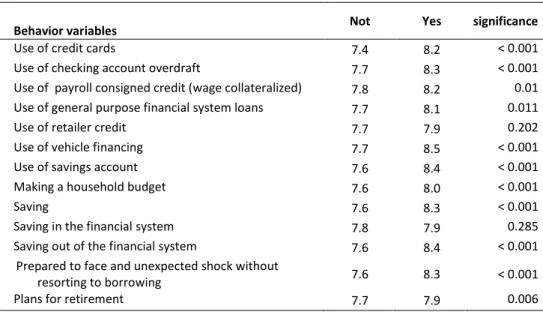
In order to build a simple indicator for the knowledge level, we attribute a point for each right answer, thus generation a score that may vary between 0 a 12. Since we seek to understand the relationship between behavior and knowledge, for each financial behavior variable we break the sample in two (whether the behavior is reported to happen or not) and perform t tests to compare the average of the knowledge score between these groups. Except for the use of retailer credit and for saving out of the financial system, always the group that uses the financial product in question or presents a desirable financial behavior (making a household budget, being resilient to unexpected shocks and planning for retirement) presented a higher score than the one obtained by the other group, in which these characteristics are absent. Although these results cannot identify causality, they point towards the existence of a relationship between financial behavior and financial knowledge of these individuals.
Table 4.1 – Comparison between the knowledge score and behavior variables
Behavior variables Not Yes significance
Use of credit cards 7.4 8.2 < 0.001
Use of checking account overdraft 7.7 8.3 < 0.001
Use of payroll consigned credit (wage collateralized) 7.8 8.2 0.01 Use of general purpose financial system loans 7.7 8.1 0.011
Use of retailer credit 7.7 7.9 0.202
Use of vehicle financing 7.7 8.5 < 0.001
Use of savings account 7.6 8.4 < 0.001
Making a household budget 7.6 8.0 < 0.001
Saving 7.6 8.3 < 0.001
Saving in the financial system 7.8 7.9 0.285
Saving out of the financial system 7.6 8.4 < 0.001
Prepared to face and unexpected shock without
resorting to borrowing 7.6 8.3 < 0.001
Plans for retirement 7.7 7.9 0.006
Regarding attitude variables, in order to make comparisons between questions more direct, we adopted for each of them a score ranging between 1 and 5, increasing with the desirability of the answer. We employ factor analysis to identify set of constructs that may underlie sets of variables. Results are shown in table 4.2. Even though this analysis does not present adequate results, given the small portion of variability explained by the factors and the low communality of many variables (total variance explained by the set of factor is only 68%, with a Cronbach’s Alpha of 63%, indicating that the variables do not measure a common underlying factor), it allows us to identify some groupings. The first one, composed of items 3, 7,8,9,10,15 and 16 of question 1B seems to relate to financial management, while items 1,2,6,11
and 14 share the common idea of concern with the current situation as opposed to the future (carpe diem). Items 12, 13 and 19 reveal an underlying factor of planning ability. Items 4 and 5 seem to convey the idea of appearance / social status and items 17, 18 and question 15 reveal the concern with the financial situation. It is useful to have these groups for comparison. As we show, the technique we propose in this paper groups variables in a very different fashion. Detailed tables containing all descriptive statistics are available upon request.
Table 4.2 – Attitude Variables Factorial Analysis
Attitude variable
Factors Initial communality 1 2 3 4 5
Q1B_10) Before I buy something I carefully consider
whether I can afford it 0.762 -0.007 0.038 0.139 0.095 0.611
Q1B_16) I usually feel worried about the payment of
common everyday expenditure -0.759 0.094 0.020 -0.080 0.136 0.611
Q1B_7) I pay my bills on time 0.693 0.028 0.179 0.063 0.327 0.623
Q1B_8) I keep a close personal watch on my financial
affairs 0.671 0.103 0.265 -0.004 0.376 0.672
Q1B_9) I talk about financial decisions with other people in my family (e.g. spouse, brothers, parents, children)
0.576 0.102 0.238 -0.047 -0.193 0.438 Q1B_3) In general, I feel capable of managing my
personal finances by myself 0.564 -0.106 0.130 -0.053 0.241 0.407
Q1B_15) My financial situation limits my capacity of
doing things that are important to me. -0.528 0.327 0.102 0.041 0.204 0.440 Q1B_14) Money is there to be spent -0.144 0.695 -0.114 -0.079 0.006 0.524 Q1B_11) I tend to live for today and let tomorrow take
care of itself 0.063 0.664 -0.207 -0.059 0.004 0.491
Q1B_1) I find it more satisfying to spend money than to
save it for the long term -0.077 0.638 0.135 0.316 -0.110 0.543
Q1B_2) I prefer to pay for a purchase in instalments
than to wait until I have the money to pay for it upfront. -0.041 0.532 0.057 0.184 0.134 0.340 Q1B_6) I tend to shop in an immediate and
spontaneous way, without thinking a lot 0.093 0.483 -0.106 0.427 0.031 0.437 Q1B_12) I am prepared to risk some of my own money
when saving or making an investment 0.019 -0.123 0.753 -0.063 -0.020 0.586 Q1B_13) I set long term financial goals and strive to
achieve them 0.308 -0.100 0.656 0.102 0.016 0.546
Q1B_19) I am confident on my plans for retirement 0.237 0.014 0.465 -0.202 0.372 0.452 Q1B_5) When I buy something, I generally choose a
brand that my friends/relatives will approve of. 0.163 0.035 -0.176 0.748 0.085 0.625 Q1B_4) I admire people who own goods, like expensive
clothes or luxury cars -0.051 0.154 0.077 0.722 0.031 0.555
Q.15) How would you rate your level of financial stress? -0.007 -0.070 0.063 0.045 0.626 0.403 Q1B_17) I have too much debt right now 0.082 0.232 -0.139 0.287 0.602 0.525 Q1B_18) I am satisfied with my present financial
situation 0.116 0.079 0.500 -0.216 0.525 0.592
5. Results
We present the results of applying our technique to the Brazilian OECD/INFE dataset divided accordingly to our main two contributions. In subsection 5.1 we display the composition of the knowledge and both the attitude factors that we identify in the data. We are interested in them as financial knowledge and attitude measurements. We also explore the distribution of these factors along controls that are widely used in the literature.
In section 5.2 we show the coefficients that multiply the factors in each equation, which contribute in analyzing the relationship between the financial knowledge and attitude factors and the behavioral outcomes.
5.1. Factors
Again, we draw attention to the fact that we reverse the scale of some explanatory variables in order to make their values increase as they assume more “desirable” outcomes. This is meant only to make interpretation more direct. Tables 5.1.1 through 5.1.3 present the coefficients in the policy-effective factors, i.e., the 𝑐𝑗 in equation (5). We identify
one factor for knowledge and two factors for attitudes.
Table 5.1.1 – Questions entering the Financial Knowledge Factor
Question Value assigned Coefficient (Std. Dev.) OECD survey Suppose 3 friends win together R$1500 in a lottery. If they
decide to share the money equally, how much does each one get? (3 alternatives or not know)
dummy =1 if right
0.9841652****
(0.2397367) Yes A good way to control monthly expenditure is to make a budget.
(True or false)
dummy =1 if right
0.2699594*
(0.1585419) No Having the information about the interest included if a sale is
made in instalments is a basic consumer right. (True or false)
dummy =1 if right
0.7296669****
(0.2271173) No In Brazil, in 2013 what was the level of inflation? (3 alternatives
or not know)
dummy =1 if right
0.4625293****
(0.0978709) No How would you rate your level of financial knowledge on a scale
of 1 to 5 where 1 is not at all knowledgeable and 5 is very knowledgeable?
(1 through 5, not know or refusal)
1 through 5 0.2480314****
(0.0506277) Yes Suppose you borrow R$100 from a friend and pay him back
R$100 after a week. How much interest have you paid on this loan? (3 alternatives or not know)
dummy =1 if right
0.3791915***
(0.1286657) Yes An investment with a high return is likely to be high risk. (True or
false) dummy =1 if right 0.3570646*** (0.1301839) Yes significant at: **** 0.1%, ***1%, **5%, *10%
Endogeneity aside, from Table 5.1.1 we can infer, for example, that the ability to divide is 3.6 times more effective in increasing the factor than knowing that is a good idea to have a budget.
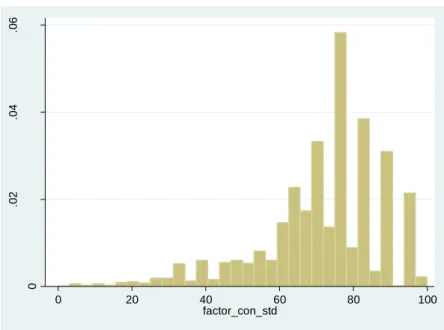
We use the minimum and maximum theoretical values of the knowledge and standardize it to vary between 0 and 100, we obtain the distribution in Graph 5.1.1, corresponding to a mean of 71.58203 and a standard deviation of 16.40562.
Graph 5.1.1
Table 5.1.2 contains the questions used to compute attitude factor 1 and their coefficients. Interestingly, these questions are concentrated in the topic of expenditure control and the perception of financial welfare and indebtedness.
Table 5.1.2 – Questions entering the Financial Attitude Factor 1
Question Value assigned Coefficient (Std. Dev.) OECD survey How would you rate your level of financial stress? (1 through 5,
not know or refusal) 1 through 5
0.2529825****
(0.0498475) Yes I keep a close personal watch on my financial affairs (How much
do you agree, 1 through 5) 1 through 5
0.1129368***
(0.0437404) Yes I prefer to pay for a purchase in instalments than to wait until I
have the money to pay for it upfront. (How much do you disagree, 1 through 5)
1 through 5 0.0636214
**
(0.0315477) No I find it more satisfying to spend money than to save it for the
long term (How much do you disagree, 1 through 5) 1 through 5
0.1067229****
(0.0333349) Yes I have too much debt right now (How much do you disagree, 1
through 5) 1 through 5
0.1110599***
(0.0350242) Yes I am satisfied with my present financial situation (How much do
you agree, 1 through 5) 1 through 5
0.1346513**** (0.0353915) Yes significant at: **** 0.1%, ***1%, **5%, *10% 0 .0 2 .0 4 .0 6 D e n si ty 0 20 40 60 80 100 factor_con_std
Graph 5.1.2
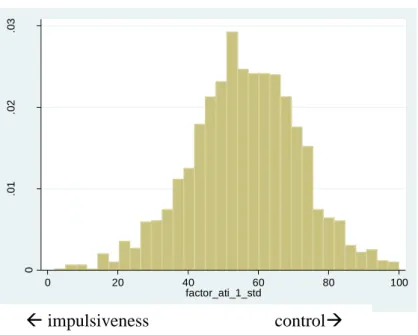
Following the same standardization procedure used for the knowledge factor, we obtain the distribution in graph 5.1.2 for Attitude 1 coefficient. It presents a mean of 56.17893 and a standard deviation of 15.53539. Table 5.1.3 contains the questions that the procedure selected for attitude factor 2. In this case we notice the main common topic is planning.
Table 5.1.3 – Questions entering the Financial Attitude Factor 2
Question Value assigned Coefficient (Std. Dev.) OECD survey
In general, I feel capable of managing my personal
finances by myself
(How much do you agree, 1 through 5) 1 through 50.1002954***
(0.0345982) No How confident are you that you have done a good job of making
financial plans for your retirement? (How much do you agree, 1 through 5)
1 through 5 0.0875806***
(0.0314241) Yes I set long term financial goals and strive to achieve them (How
much do you agree, 1 through 5) 1 through 5
0.0573925**
(0.026377) Yes Q1B_14 Money is there to be spent
(How much do you disagree, 1 through 5) 1 through 5
0.0738186***
(0.0285882) Yes I pay my bills on time (How much do you agree, 1 through 5) 1 through 5 0.0988449***
(0.0351348) Yes My financial situation limits my ability to do the things that are
important to me (How much do you disagree, 1 through 5) 1 through 5
0.0672984**
(0.0271841) Yes I must admit that I purchase things because I know they will
impress others (slightly different phrasing13)
(How much do you disagree, 1 through 5)
1 through 5 0.0662278**
(0.0265752) Yes significant at: **** 0.1%, ***1%, **5%, *10%
Graph 5.1.3 displays the distribution for the standardized Attitude 2 factor, which has a mean of 56.29458 and a standard deviation of 12.72397.
13 Literal translation is “When I buy something, I generally choose a brand my friends/relatives will approve of”.
0 .0 1 .0 2 .0 3 D e n si ty 0 20 40 60 80 100 factor_ati_1_std
impulsiveness control
Graph 5.1.3
Correlation between factors is low. It is 0.09 and 0.20 between the knowledge factor and, respectively, attitude factors 1 and 2. We would expect the correlation to be high between both the attitude factors, since we relate control with the ability to plan, but it is only 0.49. The observed joint distribution is plotted in Graph 5.1.4.
Graph 5.1.4 -Joint distribution of attitude factors
We follow van Rooij et al (2011) and show how the factors we identified vary across demographics in tables 5.1.4 through 5.1.6. 0 .0 1 .0 2 .0 3 .0 4 D e n si ty 0 20 40 60 80 100 factor_ati_2_std
short-sightedness planning
Table 5.1.4 - Knowledge Factor across demographics
Knowledge Factor quartiles
Education
1(low)
2
3
4 (high)
Mean
N
Illiterate 62.86 18.57 7.14 11.43 53.39701 70
Literate with no formal education 45.45 18.18 9.09 27.27 63.01518 11
Some primary level school 40.82 25.13 19.79 14.26 66.36166 561
Complete primary level school 30.23 19.07 28.37 22.33 71.06362 215
Some secondary level school 24.69 25.93 26.54 22.84 71.72241 162
Complete secondary level school 20.74 23.1 24.79 31.37 74.18523 593
Some university level education 14.04 21.91 24.16 39.89 77.74717 178
Complete university level 8.89 14.44 22.22 54.44 81.26779 180
Pearson chi2(27) = 253.9777 Pr = 0.000
Knowledge Factor quartiles
Age
1(low)
2
3
4 (high)
Mean
N
16-19 years 28.47 22.63 20.44 28.47 71.68813 137 20-29 years 25.86 24.03 23.34 26.77 72.50594 437 30-39 years 23.96 20.88 23.52 31.65 72.92571 455 40-49 years 25.75 23.85 23.85 26.56 72.64131 369 50-59 years 30.8 19.38 21.45 28.37 70.89494 289 60-69 years 33.18 23.04 23.96 19.82 68.28699 217
70 years and older 45.45 24.24 18.18 12.12 63.90118 66
Pearson chi2(18) = 32.0591 Pr = 0.022
Knowledge Factor quartiles
Gender
1(low)
2
3
4 (high)
Mean
N
Female 31.88 23.84 21.32 22.97 69.6275 1032
Male 23.24 20.79 24.63 31.34 73.73244 938
Pearson chi2(3) = 30.3935 Pr = 0.000
Table 5.1.5 - Attitude Factor 1 across demographics
Attitude Factor 1 quartiles
Education
1(low)
2
3
4 (high)
Mean
N
Illiterate 8.96 17.91 25.37 47.76 64.19915 67
Literate with no formal education 10 40 30 20 58.28978 10
Some primary level school 24.82 24.46 26.63 24.09 56.10494 552
Complete primary level school 28.91 27.01 24.64 19.43 54.45728 211
Some secondary level school 24.39 31.71 22.56 21.34 55.49169 164
Complete secondary level school 25.57 25.39 26.43 22.61 55.36477 575 Some university level education 29.94 24.29 20.34 25.42 55.08551 177
Complete university level 21.47 19.21 22.6 36.72 59.68195 177
Pearson chi2(27) = 55.1231 Pr = 0.001
Attitude Factor 1 quartiles
Age
1(low)
2
3
4 (high)
Mean
N
16-19 years 28.24 27.48 17.56 26.72 55.82609 131 20-29 years 25.93 25 26.39 22.69 55.37239 432 30-39 years 29.53 27.29 22.82 20.36 53.97741 447 40-49 years 27.47 23.63 26.1 22.8 54.73367 364 50-59 years 23.93 22.5 27.5 26.07 56.97328 280 60-69 years 15.35 24.65 26.05 33.95 61.0329 215
70 years and older 3.13 23.44 26.56 46.88 66.1599 64
Table 5.1.5 - Attitude Factor 1 across demographics (cont.)
Attitude Factor 1 quartiles
Gender
1(low)
2
3
4 (high)
Mean
N
Female 29.24 24.38 22.6 23.79 54.82469 1009
Male 20.35 25.65 27.71 26.3 57.65775 924
Pearson chi2(3) = 21.8146 Pr = 0.000
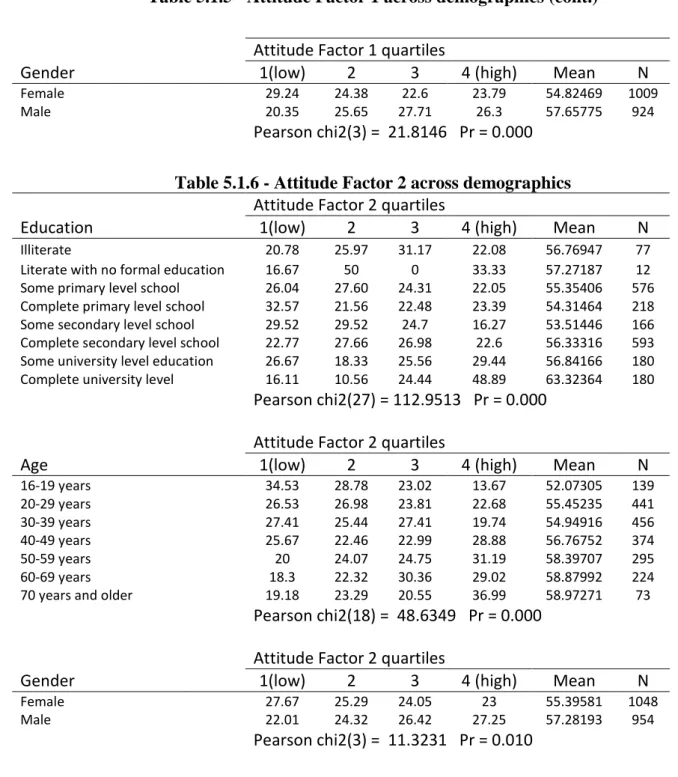
Table 5.1.6 - Attitude Factor 2 across demographics
Attitude Factor 2 quartiles
Education
1(low)
2
3
4 (high)
Mean
N
Illiterate 20.78 25.97 31.17 22.08 56.76947 77
Literate with no formal education 16.67 50 0 33.33 57.27187 12
Some primary level school 26.04 27.60 24.31 22.05 55.35406 576
Complete primary level school 32.57 21.56 22.48 23.39 54.31464 218
Some secondary level school 29.52 29.52 24.7 16.27 53.51446 166
Complete secondary level school 22.77 27.66 26.98 22.6 56.33316 593 Some university level education 26.67 18.33 25.56 29.44 56.84166 180
Complete university level 16.11 10.56 24.44 48.89 63.32364 180
Pearson chi2(27) = 112.9513 Pr = 0.000
Attitude Factor 2 quartiles
Age
1(low)
2
3
4 (high)
Mean
N
16-19 years 34.53 28.78 23.02 13.67 52.07305 139 20-29 years 26.53 26.98 23.81 22.68 55.45235 441 30-39 years 27.41 25.44 27.41 19.74 54.94916 456 40-49 years 25.67 22.46 22.99 28.88 56.76752 374 50-59 years 20 24.07 24.75 31.19 58.39707 295 60-69 years 18.3 22.32 30.36 29.02 58.87992 224
70 years and older 19.18 23.29 20.55 36.99 58.97271 73
Pearson chi2(18) = 48.6349 Pr = 0.000
Attitude Factor 2 quartiles
Gender
1(low)
2
3
4 (high)
Mean
N
Female 27.67 25.29 24.05 23 55.39581 1048
Male 22.01 24.32 26.42 27.25 57.28193 954
Pearson chi2(3) = 11.3231 Pr = 0.010
Some general features are worth pointing out. First, the knowledge factor increases monotonically with the level formal education, whether both attitude factors follow a U-shaped curve, reaching the lowest averages around complete primary - some secondary schooling. When age in concerned, although this cannot be separated from a cohort effect, the knowledge factor follows and inverse U-shaped curve, peaking at people in their thirties, the same group that displays the lowest average value of attitude factor 1. Attitude factor 2 seems to generally increase with age. Finally, gender indicates higher average values for men. Regarding financial knowledge, the general patterns of these variations along formal education, age and gender are common findings in the literature, as reported by Lusardi & Mitchell (2014), including van Rooij et al. (2011).
5.2. Factor coefficients
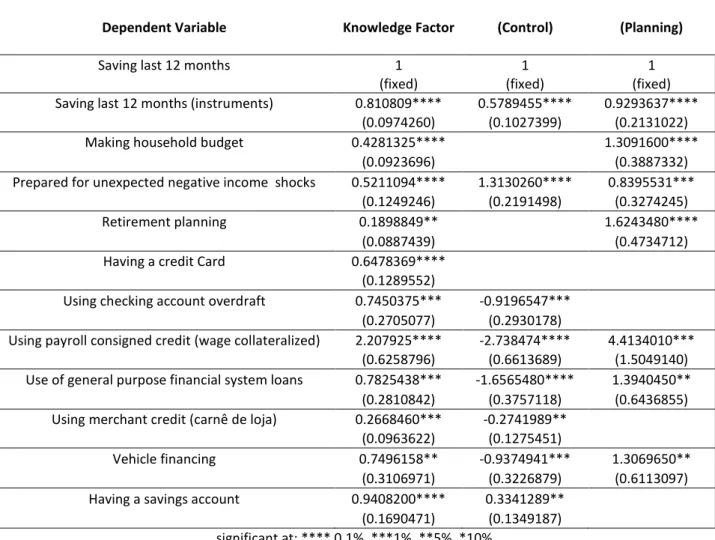
Table 7.2.1 – Factor Coefficients in Behavior Equations
Dependent Variable Knowledge Factor
Attitude Factor 1 (Control)
Attitude Factor 2 (Planning)
Saving last 12 months 1 1 1
(fixed) (fixed) (fixed)
Saving last 12 months (instruments) 0.810809**** 0.5789455**** 0.9293637**** (0.0974260) (0.1027399) (0.2131022)
Making household budget 0.4281325**** 1.3091600****
(0.0923696) (0.3887332)
Prepared for unexpected negative income shocks 0.5211094**** 1.3130260**** 0.8395531*** (0.1249246) (0.2191498) (0.3274245)
Retirement planning 0.1898849** 1.6243480****
(0.0887439) (0.4734712)
Having a credit Card 0.6478369****
(0.1289552)
Using checking account overdraft 0.7450375*** -0.9196547*** (0.2705077) (0.2930178)
Using payroll consigned credit (wage collateralized) 2.207925**** -2.738474**** 4.4134010*** (0.6258796) (0.6613689) (1.5049140) Use of general purpose financial system loans 0.7825438*** -1.6565480**** 1.3940450**
(0.2810842) (0.3757118) (0.6436855) Using merchant credit (carnê de loja) 0.2668460*** -0.2741989**
(0.0963622) (0.1275451)
Vehicle financing 0.7496158** -0.9374941*** 1.3069650**
(0.3106971) (0.3226879) (0.6113097) Having a savings account 0.9408200**** 0.3341289**
(0.1690471) (0.1349187) significant at: **** 0.1%, ***1%, **5%, *10%
In this section, we present the coefficients obtained for each factor in each financial behavior equation. They correspond to the 𝛾𝑖 in equation system (3).
The knowledge factor is significant and positive in all the equations. Broadly speaking, in Brazil a payroll consigned credit costs about half of using personal loans and this cost less than a third than using checking accounts overdrafts. The coefficients preserve this ordering, meaning that a knowledge factor increase should incentive more the use of cheaper credit.
As we have mentioned, the desirability of using credit is not clear-cut. While it is easy to argue that generally having access to credit increases welfare, we cannot say the same about its usage, especially in environments with high interest rates, given the possibility of losing control of consumption. Interestingly, it seems that this ambiguity is captured by the attitude factors. Both attitude factors relate to saving and preparedness variables, while credit usage variables are negatively affected by attitude factor 1 (control) and positively affected by factor 2 (planning). Additionally, Factor 2 in
not significant for either checking account overdraft use (the most expensive credit line included) or for retailer credit, which is most frequently used for consumption.
Another remarkable feature is that financial knowledge and attitude are significant, while controlling for one another. This rejects the hypothesis that knowledge affected behavior only by having an effect on attitudes.
5.3. Other relevant knowledge and attitude questions
Although the variables of knowledge and attitude that were not presented in the previous subsections did not enter the knowledge or attitude factors, we allow them to affect behavior attitudes separately, thus keeping them as extra controls where significant. These results are available upon request.
6. Endogeneity and Instrumentation
The literature on financial literacy and inclusion has drawn attention to the fact that attitudes and knowledge variables are probably endogenous to behavioral outcomes. First, both the regressors and the outcomes may be affected simultaneously from other variables. This would generate omitted variables bias and the standard way to deal with it is by including controls, especially demographics, to proxy individuals characteristics (see, for example, Lusardi & Mitchell(2007a), van Rooij et al(2011) ).
Secondly, there may be reverse causality since outcomes regarding financial behavior may affect knowledge and attitude. For example, this happens if having a savings account helps individuals to learn how to perform compound interest calculations. Bachmann & Hens (2015) show concern that it might be that, instead of more informed individuals being more prone to seeking expert advice for investments, it could be that individuals who use their services become more informed.
Both sources of endogeneity may be addressed by finding a proper set of instruments, which is a complex task. Some very smart instruments have been found by the literature. For example, Lusardi and Mitchell (2011) use the mandated financial literacy high-school education as an instrument for financial literacy to measure its impact on retirement planning, while Alessie, Van Rooij & Lusardi (2011) use as instrument the individual´s assessment of parents and sibling financial knowledge.
In spite of the diversified set of instrument variables employed in different studies, the pattern of finding an impact (much) larger14 of financial knowledge when using instruments is recurrent in the literature, as seems to be the
general performance of first stage regressions, which is generally not outstanding15. Our results are in line with these
aspects, although we do not have natural experiments or questions designed to work as instruments in the survey. We use the system of equations structure to find exogenous variables that can become “instruments”. All variables seem ex-ante to belong in the equations. However, many profile variables (gender, formal education, age, income, activity, size of the municipality, etc.) are not significant in some equations. This means that a combinations of these observables, is not perfectly collinear with controls. Intuitively, this is like saying that we can use as instrument an exogenous variable that was not significant as control in the endogenous version of the equation. Although we cannot expect much from this approach, since correlation between these variables and those we want to instrument (namely the knowledge and attitude) is not foreseeably high, it seems that the performance of this approach depends on the particular application.
For the present application, a first stage regression of the knowledge factor on “instruments” (after excluding those with p-value higher than 0.10) attained and R2 of 0.16 (and an F statistic of 28.9616). For the other factors, this was
below 0.10.
Thus, we try to explore the instrumentation of the knowledge factor to add some knowledge about the endogeneity of our previous results. We proceed in the following steps:
1 – Estimate the endogenous regression presented before; 2 – Obtain the predicted values for the knowledge factor; 3 – Bootstrap steps 3.1 through 3.317:
3.1 – Regress the predicted knowledge factor against selected controls; 3.2 – Predict knowledge factor in sample
3.3 – Run a nonlinear SUR substituting the predicted knowledge factor for the combination of variables used to obtain the knowledge factor in step 1.
The results are presented in table 6.1, paired with the previous results for comparison. Most of the coefficients that multiply the knowledge factors become not significant. It is hard to tell whether this results from former endogeneity or from the weakness of the instruments.
However, 5 coefficients are found significant, and all of them seem to indicate a downward bias in the regression without instruments, following the pattern of many studies, as we have pointed out. Although the literature has
15 This happens in Fornero and Monticone (2011), Klapper, Leora F., Georgios A. Panos. (2011), and in Sekita (2011)
and Agnew, J., Bateman, H., & Thorp, S. (2013).
16 This compares with the first stage results in Alessie, van Rooij & Lusardi(2011)a, see their table 6. They use two
specific questions to instrument financial knowledge: how the surveyed individual compares his oldest sibling´s financial knowledge to his own and how he rates his parents’ knowledge. In first stage regressions with different definitions of the dependent variable, the authors obtain R2 of 0.170 and 0.237 and F-statistics of 9.608 and 19.37, similar to Agnew,
Bateman & Thorp, S. (2013). Fornero and Monticone (2011) use other instruments, with similar performance.
emphasized omitted variables and measurement error as the main possible sources of this bias18, this is what we would
expect if there were a positive feedback effect from learning by participating in mind. Suppose increases in financial knowledge increase the chance that individuals present behaviors related to financial inclusion, but that, once these behaviors take place, people learn more about the theme. Thus, our dataset would pair the financial behavior with inflated knowledge, as compared with the knowledge level that “caused” the behavior. Thus the larger the feedback, the larger (in absolute value) the downward bias in the regression without instruments.
Our estimations indicate the largest downward bias in the credit-card equation, which is reasonable since this product has presented very high expansion in the last few years, representing the first contact with a financial product for many people. Considering the period between the first quarter of 2008 and the last quarter of 2014, the expansion of issued general-purpose credit cards was 34% (25% if we consider only cards with at least one transaction in the preceding year) 19. Remember, as pointed out in section 4, that this is the most widely used instrument in the sample (45%). In Brazil,
the process for obtaining a credit card does not involve a long period to obtain a credit score, as opposed to the US. On contrary, in many situations it is simpler to obtain a credit card than a bank account. Issuer banks have the incentive to offer credit cards, since the make the interchange fee revenue on purchases and they do not incur in the cost of the money in time, since on average, they receive bill payments before they pay merchants. This is very different from the setting in other countries and has historical reasons related to high inflation periods in the late 20th century. In addition, high interest
rates20 in revolving credit and several service charges provide extra incentives to issuer banks and make an environment
where customers need to learn fast21. The estimations also indicate a relevant feedback to knowledge from making a
budget. Still, some coefficients are very close, namely those in the equations explaining “Saving last 12 months (instruments)” and “Having a savings account”.
18 See, for example, Behrman et al.(2012)
19 Data from the Brazilian Central Bank, available at http://www.bcb.gov.br/?SPBADENDOS .
20 For example, in the period of 10 to 16 February 2016 the annual percent rates posted by the Central Bank ranged
between 60.59% and 887.04%, depending on the creditor. The Central Bank publishes this information to aid individuals in financial institution choice.
Table 6.1 – Knowledge Factor Coefficients: Original X Instrumented
Dependent Variable Knowledge Factor Original Knowledge Factor instrumentedSaving last 12 months 1 1
(fixed) (fixed)
Saving last 12 months (instruments) 0.810809**** 0.8604073**** (0.0974260) (0.2217725) Making household budget 0.4281325**** 0.7621918***
(0.0923696) (0.283045) Prepared for unexpected negative income shocks 0.5211094**** 0.8257046**
(0.1249246) (0.3586319)
Retirement planning 0.1898849** -.0241579
(0.0887439) (0.3079852)
Having a credit Card 0.6478369**** 3.64547***
(0.1289552) (1.175741) Using checking account overdraft 0.7450375*** 2.176868
(0.2705077) (12.69759) Using payroll consigned credit (wage collateralized) 2.207925**** 1.439248
(0.6258796) (79.09333) Use of general purpose financial system loans 0.7825438*** 0.9357506 (0.2810842) (1.983203) Using merchant credit (carnê de loja) 0.2668460*** 0.3241551 (0.0963622) (0.234084)
Vehicle financing 0.7496158** 5.157396
(0.3106971) (93.91503) Having a savings account 0.9408200**** 1.090267****
(0.1690471) (0.2336668) significant at: **** 0.1%, ***1%, **5%, *10%
7. Conclusion
In the present paper, we build a new regression based technique that serves two purposes. The first one is to combine variables and generate measures of knowledge and attitude designed to be good predictors of policy objective (behavior) variables, in the presence of controls. In the case of financial behaviors, this is interesting because it ensures we are analyzing questions that really matter. When we compare our results with the commonly used factor analysis for attitude variables, we find that the new technique selects variables from different traditional factors, without requiring them to be correlated among themselves and, at the same time, provides a natural way to obtain weights and to avoid skewing measures with several questions that convey similar information. On the other hand, factors keep the distributions features along observables found in the literature.
The other purpose is to provide coefficients that, endogeneity aside, may be used to compare in a simple and direct way among different policy instruments that influence different policy objectives. In our econometric application, we find that several variables that indicate behaviors related to financial inclusion are affected in a “proportional” way by
variables of financial knowledge that could be targeted by financial education programs. This means that teaching people a certain content may serve many purposes and it is not necessary to choose among them.
At the same time, the technique can be used to provide some guidance about contents that are not correlated with policy objective, which are less interesting to have resources spent on, although we should be cautious about endogeneity. The treatment for endogeneity that we provide indicates the expected downward bias in non-instrumented estimations, which can be explained by the learning by using financial products or by presenting other financial behaviors.
Finally, taking advantage of the system structure to find instruments allows us to obtain instrumented results that are in line with those in the literature for financial knowledge, both in first stage regressions performance and in the fact that instrumented coefficients are larger. The latter result is expected, because of the feedback of inclusion behavior to financial knowledge.
As a future research agenda, it would be interesting to apply the technique to other datasets, where we can find some genuine instruments to obtain improved results combining both approaches.
Furthermore, we believe the technique we propose is flexible enough to be applied to several other settings, by adequately choosing the function relating the factors and controls to the outcomes. Thus, event count could be represented as Poisson and a Gamma distribution could be used for strongly asymmetric outcomes. Interesting applications would be relating economic outlook variables and profile variables to delinquency; relating organizations structures (like governance, management type, supplier structure, human resources policy, etc.) to firm performance (profitability, market value, growth, market share, etc.); or combining expectation variables into factors that predict macroeconomic outcomes, like inflation, unemployment and investment.
References
Agarwal, S., Driscoll, J. C., Gabaix, X., & Laibson, D. (2008). Learning in the credit card market (No. w13822). National Bureau of Economic Research.
Agnew, J., Bateman, H., & Thorp, S. (2013). Financial literacy and retirement planning in Australia. Numeracy 6 (2). Alessie, R., van Rooij, M. and Lusardi, A. (2011)a Financial literacy, retirement preparation and pension expectations in the Netherlands. DNB Working Paper No. 289. http://www.dnb.nl/binaries/Working%20Paper%20289_tcm46-252983.pdf
Alessie, R., van Rooij, M., & Lusardi, A. (2011)b. Financial literacy and retirement preparation in the Netherlands. Journal of Pension Economics and Finance, 10(04), 527-545.
Ameriks, J., Caplin, A., & Leahy, J. (2003). Wealth Accumulation and the Propensity to Plan. The Quarterly Journal of Economics, 1007-1047.
Atkinson, A. and Messy, F. (2012) Measuring Financial Literacy: Results of the OECD / International Network on Financial Education (INFE) Pilot Study, OECD Working Papers on Finance, Insurance and Private Pensions, No. 15, OECD Publishing. http://dx.doi.org/10.1787/5k9csfs90fr4-en
Bachmann, K., & Hens, T. (2015). Investment competence and advice seeking. Journal of Behavioral and Experimental Finance, 6, 27-41.
Behrman, J. R., Mitchell, O. S., Soo, C. K., & Bravo, D. (2012). How financial literacy affects household wealth accumulation. The American economic review, 102(3), 300.
Finke, Michael S., Howe, John S. and Huston, Sandra J. (2011) Old Age and the Decline in Financial Literacy. Forthcoming in Management Science. Available at SSRN: http://ssrn.com/abstract=1948627 or
http://dx.doi.org/10.2139/ssrn.1948627
Fornero, Elsa, and Chiara Monticone (2011). Financial literacy and pension plan participation in Italy. Journal of Pension Economics and Finance 10.04: 547-564.
Hung, A., Parker, A. M., & Yoong, J. (2009). Defining and measuring financial literacy. RAND Corporation Publications Department, Working Papers: 708.
Huston, Sandra J., Michael S. Finke, and Hyrum Smith. A financial sophistication proxy for the Survey of Consumer Finances. Applied Economics Letters 19.13 (2012): 1275-1278.
INFE (2014) Finacial literacy measurement note,
INFE (2015) Survey for measuring financial literacy and financial inclusion,
IBGE (2013) Metodologia do censo demográfico 2010, Coleção Ibgeana, Relatórios metodológicos (IBGE), Rio de Janeiro. Link: http://biblioteca.ibge.gov.br/index.php/biblioteca-catalogo?view=detalhes&id=281634
Klapper, Leora F., and Georgios A. Panos. (2011) Financial Literacy and Retirement Planning: The Russian Case. Journal of Pension Economics and Finance 10 (4): 599–618.
Levine, R. (1997). Financial development and economic growth: views and agenda. Journal of economic literature, 35(2), 688-726.
Lusardi, A., Mitchell, O. S. (2007a) Baby boomers retirement security: the role of planning, financial literacy and housing wealth. Journal of Monetary Economics 54, 205–224.
Lusardi, A., & Mitchell, O. S. (2007b). Financial literacy and retirement planning: New evidence from the Rand American Life Panel. Michigan Retirement Research Center Research Paper No. WP, 157.
Lusardi, A., & Mitchell, O. S. (2008). Planning and Financial Literacy: How Do Women Fare?. American Economic Review, 98(2), 413-17.
Lusardi, A., & Mitchell, O. S. (2011). Financial literacy and retirement planning in the United States. Journal of pension economics and finance, 10(04), 509-525.
Lusardi, A., & Mitchell, O. S. (2014). The Economic Importance of Financial Literacy: Theory and Evidence. Journal of Economic Literature, 52(1), 5-44.
Schrader, P. G., & Lawless, K. A. (2004). The knowledge, attitudes, & behaviors approach how to evaluate performance and learning in complex environments. Performance Improvement, 43(9), 8–15. doi:10.1002/pfi.4140430905.
Sekita, S. (2011). Financial literacy and retirement planning in Japan. Journal of Pension Economics and Finance, 10(04), 637-656.
Van Rooij, M., Lusardi, A., & Alessie, R. (2011). Financial literacy and stock market participation. Journal of Financial Economics, 101(2), 449-472.