Barclaycard: a “Go-To” Brand for Payments and Lending in the Iberian Peninsula: Strategies of Portfolio Optimization in the Portuguese Market and New Customer
Engagement in Spain
Maria Beatriz Miranda Peres Negrão
Masters student number 14521 – CEMS-MIM student number 1525
A project carried out on the CEMS Business Project, under the supervision of: Professor Carlos Santos (Nova School of Business and Economics)
Table of Contents
0. ABSTRACT 2
1. BRIEF CONTEXT 3
A. CLIENT 3
B. MARKET OVERVIEW 3 C. CURRENT CLIENT SITUATION 5 D. THE BUSINESS PROJECT CHALLENGE 7
2. REFLECTION ON THE WORK DONE 7
A. PROBLEM DEFINITION 7 B. METHODOLOGY 8 C. WORK PLAN 10 D. RESULTS 10 E. RECOMMENDATIONS 14 F. LIMITATIONS 18
3. REFLECTION ON LEARNING 20
A. MASTERS KNOWLEDGE APPLIED AND ADJUSTED 20 B. NEW KNOWLEDGE 22 C. PERSONAL EXPERIENCE 23 D. BENEFIT OF HINDSIGHT 24
4. CONCLUSION 25
5. REFERENCES 26
6. APPENDIXES 28
0. ABSTRACT
The CEMS-MIM Business Project carried in partnership with Barclaycard implied the creation of strategies to increase the customer database value, which highly depends on consumer loyalty levels and new customer acquisition rate. In a first stage, the current competition was assessed. Secondly, by studying consumers’ preferences through the creation of two distinct surveys, it was possible to derive the main priorities for Barclaycard’s product portfolio development. Generally, customers highly value immediate benefits and financial benefits. Therefore, Barclaycard is advised to implement cashback, E-mail/SMS alerts, and keep flexible repayment conditions, in order to achieve its goals.
Keywords: credit card, product portfolio management, customer loyalty, new customer acquisition
1. BRIEF CONTEXT
A. ClientBarclaycard was first launched in 1966, in the UK. Being the first UK’s credit card, the following years represented a very rapid growth to Barclaycard, due to the implementation of new technologies and to the expansion to new markets around the globe. Today, Barclaycard is one of the leading payment providers in the world. Its main goal is “to become the “Go-To” bank for its clients, customers, colleagues and stakeholders”. By achieving this, Barclaycard will be able to reduce risk and improve performance. According to the Annual Report of 2014, the goal of becoming the “Go-To” bank lies on the adaptation to the operating environment, and on the approach to risk, implying proactivity in adjusting to a constantly changing external environment. This external setting is becoming more and more fast-paced, and comprises changes in the economic environment, the regulatory systems, technology expectations, and also in matters of trust and conduct (Source: Barclaycard Annual Report 2014).
Barclaycard claims to be the European leading issuer of credit cards, with 10.4 million customers in the UK and 10.8 million outside the UK, operating in more than 60 different countries. 1999 was the year of entry in the Spanish market, and 5 years later (2004), Barclaycard entered the Portuguese credit card market.
B. Market Overview
When analyzing the market in which Barclaycard is currently operating, it is important to make two major distinctions.
First of all, the distinction between credit card and debit card needs to be clarified, as Barclaycard only offers the first type mentioned. A credit card gives the holder the option to borrow funds, usually at point of sale. Credit cards charge interest and are primarily used for short-term financing. Interest usually begins one month after a purchase is made and borrowing ceilings are pre-set according to the individual’s credit history and rating. On the other hand, a debit card is simpler, deducting money directly from a consumer’s checking account. Unlike credit cards, debit cards do not allow to go into debt, except for small negative balances in some specific situations (Source: Investopedia).
Secondly, and as this project involved Barclaycard in Portugal and Barclaycard in Spain, two separate analyses must be done when it comes to market overview.
Portuguese Market Overview
Despite the economic downturn in Portugal since 2010, Portugal has one of the most developed financial markets in the European Union. Throughout the years, card and mobile payments have been gaining importance, despite the fact that some retailers still limit the acceptance of cards below a certain amount (typically €5 or €10). For the future, and considering the expectation of financial recovery, the number of transactions and financial cards in circulation is expected to rise. In 2013, the total number of cards in the Portuguese economy was 19.77 million, being 31.66 percent of those cards credit cards. From 2012 to 2013, the number of debit cards issued grew by 32.1 percent, while the number of credit cards issued experienced a decline of 37.9 percent. The same trend can be seen when evaluating the value of card payments: in 2013, the debit card value per capita was €4,810.4 (growing by 11.8 percent since 2012); in parallel, the credit card value per capita was (only) €547.6, falling 39.5 percent since 2012. The most important banks in Portugal are Caixa Geral de Depósitos (CGD), Millennium BCP, BPI, and Santander Totta, which together hold 78.6 percent of market share (Source: Portugal Payment Statistics 2014-2015).
The product portfolio offered by the main credit card providers in Portugal usually includes classic, gold and premium cards. Extra features, like cashback1, bonus points, or card usage control (e.g. by SMS, E-Mail, among others) are used to attract cardholders.
Barclaycard in Portugal issues VISA Classic, VISA Gold, VISA Platinum and also VISA Electron MB cards (Source: Portugal Payment Statistics 2014-2015).
Spanish Market Overview
In Spain, a similar economic conjuncture to the Portuguese one can be found. Currently recovering from a very challenging economic downturn period, the Spanish market is very promising when it comes to financial products. The public in general is eager about the turning of the economy, wanting to invest and restart it. To some extent, this motivation to relight the economy can be seen by the total amount of cards in Spain – in 2013, there were 69.75 million cards, representing an increase of 1.38 percent, compared to 2012.
1 Cashback is defined as an incentive program offered by credit card providers, in which a certain percentage
Contrary to the Portuguese trend, credit cards have a bigger importance in Spain, not only in terms of absolute value but also in terms of annual growth. From the 69.75 million cards in the Spanish economy in 2013, 62 percent of them are credit cards, and compared to 2012 the number of credit cards grew 4.68 percent, while the number of debit cards fell 3.58 percent. As mentioned, the general increase of cards in the economy is due to the positive expectations about the future and also due to the rough period of economic restructuring (Source: Banco de España). In contrast to the situation in Portugal, card usage as a payment method is also growing in Spain. The lower operating and transaction costs, and the abandonment of the minimum amount set by retailers for card payment is making cards (specifically credit cards) a more and more used payment mode. In addition, and connected to the growing importance of mobile and online banking tools, the number of ATMs available in Spain is being reduced, making it harder for people to withdraw cash; also note that, in Spain, people have to pay a commission if they withdraw money from an ATM that is not of the same bank as the card they hold (Source: El País).
The major competitors in the Spanish payment cards market are Bankia, Santander, Caja España, Obsidiana, and Sabadell (market shares not available).
All in all, two culturally and geographically close countries present some important differences when it comes to the financial context, having also implications on the way Barclaycard manages its portfolios.
C. Current Client Situation
After this analysis that allowed us to get a better picture of the markets of credit cards in Portugal and Spain, Barclaycard clearly stated the current problem they were facing in the two different markets. The current situation in both countries can is shortly described next. Current Client Situation in Portugal
Barclaycard in Portugal currently offers four different credit cards2:
a. Barclaycard Classic – it includes a basic set of features (i.e TAEG of 20.4 percent, free annuity, free interest rate period of 50 days, basic insurance, and contactless technology); b. Barclaycard Gold – it offers the same features as the Classic card, plus travel insurance;
2 The analysis here presented dates back to March 2015. Today, Barclaycard offers five different credit cards
c. Barclaycard Platinum Travel – it offers the same features as the Gold card, plus each euro spent with the card counts as a point that can be spent with the tour operator GeoStar; d. Barclaycard AMI – it offers the same features as the Classic card, however Barclaycard donates 20€ to AMI by the time of the first purchase, and after that 1 percent of all the purchases done are also donated to AMI.
Evaluating alongside with what the competition offers, the main conclusion is that Barclaycard does not differentiate itself from the others, but it also does not stay behind its competitors. Overall, the credit card market in Portugal is very homogeneous with little variations when it comes to TAEG, free interest rate period, and types of insurance offered. Nevertheless, even though the relatively high brand awareness and overall recognition of the brand, Barclaycard customers show very little usage rates, being Barclaycard a secondary card, which is most of the times under the dormancy state.
Current Client Situation in Spain
Barclaycard’s product portfolio in Spain is smaller, offering only two different credit cards: a. Barclaycard Nueva Visa – this credit card offers its customers free annuity, TAEG of 26.70 percent and a free interest rate period of 59 days. In addition, customers also get 1 percent in cashback and basic insurance;
b. Barclaycard Oro – this card offers the same as the previous one (except for the cashback possibility), as well as online control tools and travel insurance.
Barclaycard brand awareness is rather low in Spain, not having been Barclaycard able to differentiate from its competitors. Also, competition is Spain is more concentrated in specific banks, a trend that is not that visible in the Portuguese market.
Therefore, contrarily to the current situation in Portugal, Barclaycard in Spain needs to develop a product portfolio that better stands out from the competition, allowing for greater brand awareness. This should be a top priority for Barclaycard right now, giving the rejuvenating of the Spanish economy, which is leading people to become more financially active.
D. The Business Project Challenge
Taking into account the current state of both economies, which are both experiencing a period of financial optimism, Barclaycard needs to focus on improving its product portfolios (in Portugal and in Spain) in order to better leverage the opportunities that the market is providing/will provide in a very close future.
In Portugal, Barclaycard needs to understand what is driving credit card usage. If customers do hold Barclaycard, but if those cards are in a dormancy state, it is necessary to understand the reasons behind this behavior.
In Spain, on the other hand, Barclaycard awareness is very low. It is therefore important to grasp consumer preferences, in order to build on the current credit card portfolio, trying to meet to the best extent customers’ needs and preferences.
The next few years will be of revitalizing the Portuguese and the Spanish economies, and Barclaycard should not miss the chance to benefit from the opportunities ahead. Hence the relevance of this Business Project, which tries to deliver recommendations for the future, that will allow Barclaycard to expand its market importance and profits.
2. REFLECTION ON THE WORK DONE
A. Problem DefinitionAs mentioned above, Barclaycard in the Iberian Peninsula is currently facing two different problems.
On the one hand, in Portugal, even though Barclaycard is an important player in the credit card market, holding a large market share, a significant part of its customers is not using Barclaycard credit cards, leaving them in an inactivity state. This dormancy hurts Barclaycard’s success, as no income is generated, nor is word-of-mouth spread, as there is no experience (good or bad) to be shared with other people. Alongside with this fact, we know that Barclaycard is not the main credit card to most of its customers. As a first step in this project, we have assumed that this point was due to the lack of connection to the main bank account. This means that, for example, a customer that holds a credit card from Barclaycard and another from CGD, where he/she also has her/his main bank account, will give preference to CGD credit card over Barclaycard credit card.
Given these low usage rates of Barclaycard in Portugal, the first part of the Business Project was aimed at answering the first research question (RQ):
RQ.1: Why do people prefer one credit card to another when it comes to frequency of usage and amount spent per usage occasion?
The goal is therefore to understand how can Barclaycard create additional value for its customers in order to encourage them to increase Barclaycard usage.
In Spain, on the other hand, low brand awareness (and brand recognition) results in a small market share, and Barclaycard struggles to stand out from competition. Just before the revitalization of the economy, as we have seen now, it is the time to develop a product portfolio able to get customers that are thirsty for new investment possibilities and financial diversification.
Consequently, Barclaycard needs to improve its product portfolio (which is constituted only by two different credit cards), but it needs to understand previously what stands as more attractive for the Spanish population. Therefore, the second research question, and second part of study of the Business Project:
RQ.2: Which attributes do Spanish customers value the most in a credit card?
By understanding these features, Barclaycard will be able to adapt its current product portfolio, in order to attract more customers and grow its brand awareness and market share.
B. Methodology
Similarly to the whole structure of the Business Project, also the methodology can be divided in two different parts – Portugal and Spain – even if the methodology used was to some extent alike.
Methodology for the Portuguese Market Study
In a first instance, and in order to better understand what the market currently offers, we analyzed 60 different Portuguese credit cards, provided by 14 of the largest brands operating in Portugal (Appendix 1). The most important features compared were: TAEG3, regular annuity, special offers included and types of insurance offered.
3 TAEG is defined as the annual interest rate that includes all the costs related to credit financing (i.e. interest,
Secondly, and as a preparation for the survey development, landscaping interviews were done to 7 individuals. All the interviews followed a semi-structured system, including segmentation questions provided by the Project Eagle4 (by Marketing Agency: Truth, March 2014). The goal of these interviews was to get a first insight on how people feel towards borrowing, credit cards, and payment habits. The interviews were also important, as they gave different perspectives on the topic, on which we were able to build on during the following survey.
The survey (the main source of findings of the research) featured a set of questions that explored credit card usage drivers among Portuguese respondents. The sample was composed by 743 Barclaycard customers (individuals currently in the customer base), and the target group was focused on Barclaycard customers who currently own two or more credit cards. In addition to the questions created for this study, the end of the survey included segmentation questions by the Project Eagle, in order to build conclusions per segment as well.
Methodology for the Spanish Market Study
Likewise the Portuguese study methodology, the first step for the Spanish study was an analysis of the market, comparing 32 credit cards provided by 9 of the largest brands operating in Spain (Appendix 2). The most relevant features compared were: TAEG, regular annuity, special offers included and cashback offers.
The second step was the running of a conjoint study, in a form of a behavioral-like survey. The survey was composed by 23 different pairs of credit cards with different features. Those features included 6 attributes, each one of them with 2 or 3 different levels. The attributes (and levels) were: TAEG (23 percent, 26 percent, 29 percent), travel insurance (yes, no), skip payment (yes, no), email/SMS alerts (yes, no), free financial advice (yes, no), money management tool (yes, no). This study was developed by XLSTAT, following the rules of level balance, orthogonality, minimal level overlap, and utility balance. The sample size was 681, being our target group Spanish individuals aged between 18 and 80 years old. In addition, the end of the survey included segmentation questions by the Project Toledo
4 Project Eagle was a customer insight study done by Truth for Barclaycard in Portugal. This study focused on
consumers’ attitudes, behaviors and needs across credit cards, payments and unsecured lending. The goal of the study was to build customer segments, in order to prioritize the potential for growth. The 6 segments generated by Project Eagle were used in this Business Project
(equivalent to Project Eagle, but in Spain), in order to build conclusions per segment as well.
C. Work Plan
The work plan was not clearly defined from the beginning of the project. As the process of defining the goal of the Business Project took longer than expected, the definition of a work plan was also left behind. Also, the Spanish part of this study was only defined three weeks after the commencement date of the Business Project.
After this, all the progress ran smoothly, always with the phases of the Portuguese study one step ahead than the Spanish ones.
D. Results
Results of the Portuguese Study
When landscaping the current credit card offers in the market some conclusions were derived5:
§ Most credit cards offer TAEGs close to the legal TAEG permitted by Banco the Portugal in Q1 (20.5 percent) – and so does Barclaycard (20.4 percent) (Appendix 3).
§ The majority of credit cards in the analysis have annuities ranging from €30 to €80, and only 20 percent of the credit cards in our analysis offer free annuity (like Barclaycard). Also, it was discovered that some credit cards exempt their customers from paying the annuity, whenever a certain credit card transaction amount is reached within the period of one year (Appendix 4).
§ 58 percent of the credit cards included in this analysis offer the possibility of receiving cashback and/or miles as a reward for usage. Some other benefits Portuguese credit card providers offer include cash advance, credit fractioning, discounts, among others. The remaining 42 percent do not offer any special features.
§ Regarding the types of insurance offered, all credit cards in the analysis offered card and credit and fraud protection. 55 percent of them provide the cardholder with personal accident and liability insurance and 42 percent with travel insurance. Only 20 percent of the
cards analyzed cover health insurance. As expected, premium cards were the ones offering a bigger insurance coverage.
Regarding the landscaping interviews, it is only important to mention only that they were useful to confirm some previously conceived ideas about people’s behaviors towards credit and payment behaviors, not having added any new relevant information.
The survey that comprised 743 individuals was the most important source of information and basis of research of the Business Project. Many conclusions about behaviors related to credit card usage were inferred, and they are listed below:
§ An important starting point for these conclusions needs to refer to the target group. As mentioned before, the target group was Barclaycard customers who currently own two or more credit cards. Assuming that all the respondents are currently Barclaycard customers (because they are in the customer base), we have that 453 of the respondents are indeed in our target limits – they affirm to have two or more credit cards. From this point on, most of the results were derived from a sample size of 453.
§ First looking at the demographics of the survey, 68 percent of the respondents were female, and the majority of the participants were aged from 35 to 54 years old.
§ Even though currently in the Barclaycard customer database, only 73% of the respondents admit to own a Barclaycard credit card. Analyzing the people that said to currently hold a customer relationship6 with Barclaycard, it was possible to derive that the most common combinations together with Barclaycard include store branded credit cards (e.g. Auchan, Worten, Fnac, etc.), BPI, CGD, Millennium BCP and Unibanco (Appendix 5). § From these brands, which are believed to be the biggest threat for Barclaycard (if Barclaycard is the second preferred credit card by its customers, than the most common combinations with should be of focus), a comparative analysis in terms of frequency and value of usage was made opposing Barclaycard to these brands. BPI was the bank with a better position, when compared against Barclaycard – more than 50 percent of the respondents use more frequently and a bigger amount with BPI credit card than with Barclaycard. The opposite happens with respondents that hold Unibanco or store brands credit cards together with Barclaycard – in these cases, Barclaycard is preferred, not only in terms of frequency of usage, but also in terms of monthly value spent (Appendix 6).
6 For an easier analysis, it was assumed that having a relationship with a specific credit card brand, means that
§ Regarding satisfaction levels, Montepio and BPI are the credit card brands that scored a higher satisfaction levels among the respondents, with 76 and 74 percent respectively. Important to note that Barclaycard does not stand far from these top 2 brands, scoring 70 percent (Appendix 7). The best measure however for satisfaction is the Net Promoter Score7 (NPS) – according to the responses available8, Barclaycard scored +4 percent in this measure.
§ Now in detail on the focus of this project, some analysis was made regarding the credit card preferred in different situations (respondents were asked to state if they preferred Barclaycard, another credit card or if they were indifferent). Barclaycard was preferred for online travel reservation, while another credit card was preferred for the categories of daily purchases, clothes and big purchases (Appendix 8).
§ To understand how the Barclaycard portfolio can be improved in order to increase usage rates, respondents were asked about the product features they value the most. The possibility of cashback and special discounts (i.e. in supermarkets) revealed to be the two most valued features. Travel insurance and flexible repayments sit on the second place of importance (Appendix 9). Respondents were also questioned about factors of preference between two different credit cards. Alongside with the previous question’s result, discounts, cashback and flexible repayment were the features with a higher impact, as well as the connection to the main bank account (Appendix 10).
§ Using regression models, it was possible to observe that some factors of preference between different credit cards have an impact on credit card loyalty levels: the easiness to understand conditions9 has a positive impact on loyalty levels, while discounts10 on the other hand have a negative impact (meaning that individuals constantly change the credit cards they use according to the discounts they are looking for) (Appendix 11).
§ To derive what influences the differentiation ability, factors of preference between credit cards were used as independent variables. Cashback and miles are two features that help individuals to distinguish between credit cards, while the force of habit and the possibility to donate for charity actually have a negative impact on the differentiation ability (Appendix 12).
7 NPS is an index ranging from -100 to 100 that measures the willingness of customers to recommend a
company’s products or services to others.
8 Sample for the NPS calculation was 332 – respondents that currently hold two or more credit cards, being
Barclaycard one of them.
Results of the Spanish Study
The market analysis based on 32 credit cards provided by 9 of the largest brands operating in Spain (including Barclaycard), brought us the following conclusions10:
§ As there is no TAEG limit established by Banco de España, the TAEG rates are significantly higher than in Portugal, ranging most of them between 24 and 28 percent (Appendix 13)
§ Regarding annuities, 47 percent of the credit cards analyzed offer free annuity, and 37 percent of them do not. From these credit cards that require the payment of an annual fee, it was possible to observe that the annual value requires usually ranges from €25 to €120 (Appendix 14).
§ Contrary to the trend in Portugal, where most credit cards offer the possibility of cashback and/or other discounts, in Spain these practices are not that common. In fact, 59 percent of the credit cards in our analysis do not offer any kind of special offer (Appendix 15).
The second step, of our analysis was based on 681 responses (demographics of participants on Appendix 16) to the conjoint survey, in which respondents had to chose between “credit card A”, “credit card B”, or “indifferent between A and B”. In this survey, it was tested the relative importance and utility levels of the following features: interest rate, flexible repayment, travel insurance and credit card control tools (CCCTs) – including E-mail/SMS alerts, personal financial assistance (FA), and money management tools (MMT) (mobile app, and online banking). The main results derived from this survey were:
§ Considering utility levels11 of the features just mentioned, the lowest level of interest rate (23 percent) was the feature showing a higher utility for our respondents (0.71), followed by flexible repayment (0.36) and E-mail/SMS alerts (0.31). Against expectations, travel insurance only scored a utility level of 0.22. Looking in detail at the CCCTs, it is possible to observe that, when alone, the only feature with a positive utility is the E-mail/SMS alerts (0.31). When combined with other CCCTs, only E-Mail/SMS alerts combined with FA show a positive utility of 0.26. Given the possible overload of alerts, and tools to control
10 All the information used for this competition analysis was obtained from the banks’ websites, in March
2015.
11 The utility levels are scaled to zero-sum within each attribute – for example, if having travel insurance
provides a positive utility level of 0.22, this means that not having travel insurance will have a negative utility of 0.22. The same reasoning applies in attributes with more that two levels.
credit card usage, combining CCCTs in general shows a negative utility for our respondents (Appendix 17).
§ As in Spain Barclaycard needs to attract new customers, it was important to study how the relative importance of credit card features changes according to the willingness of acquiring a new credit card. Even though showing very similar results, some differences are observed between respondents that are considering acquiring a new credit (27 percent) card and those who are not (73 percent). Respondents who consider getting a new credit card give a higher importance to travel insurance than people who do not consider acquiring a new card. This group of respondents also does not put much importance on the interest rate levels (Appendix 18).
§ Across segments (provided by Project Toledo), slight differences in the relative importance given to credit card attributes were observed. Active maintainers, cautious controllers and relaxed managers are the segments that put a higher importance to interest rate. For the two first segments just mentioned, travel insurance is not important at all, only scoring 2.2 and 3.7 percent. Mindful limiters are the ones giving a smaller importance to interest rates (Appendix 19).
E. Recommendations
Recommendations for Barclaycard in Portugal
According the main results of the competitor analysis and of the survey to Barclaycard customers and aiming at achieving a greater usage rate of Barclaycard in Portugal, the Business Project presented 5 main recommendations:
§ Improve the clarity of conditions: given that the understandability of conditions is a factor improving customer loyalty, Barclaycard should prioritize this action. Free annuity, usage abroad, and gasoline discounts need to be very clearly communicated, as they are also factors for acquiring a new credit card. By following this suggestion (through the improvement of the website functionalities and the promotion of the better communication of the (support) services provided), Barclaycard is not only able to improve the loyalty levels of current customers but also attract new customers. Nonetheless, if on the one hand this action might attract less financially literate people (able to provide Barclaycard with higher income, by not paying credit balances on time, for example), this action will also turn disadvantages more visible to the public.
§ Focus on flexible repayment conditions: nowadays Barclaycard offers one of the most competitive product portfolios in terms of repayment flexibility. Given that this feature is highly valued among customers, Barclaycard should focus on it as one of the core messages in its marketing campaigns. This proposal will very likely increase revenues, given that this feature attracts revolvers12, which are customers that very often have to pay interest to the bank. However, it is also a risky measure, as it might also attract clients with a high default risk.
§ Offer cashback: similarly to repayment flexibility, cashback is very valued by customers. However, Barclaycard is not offering it yet, falling behind most of its competitors that already offer cashback (Appendix 20). Our suggestion was to reallocate the 1 percent currently donated to charity, to direct cashback (donation to charity did not stand as an important feature). This action would benefit Barclaycard in the sense that it increases credit card usage. Also, cashback offers a much broader usage range, compared to discounts which are already highly valued. However, and even though it does not require any extra effort to establish partnerships with third parties, it is important to notice that implementing cashback might require an expensive process, given the high costs of maintenance and the need to educate population about a new product feature in the market.
§ Restructure the miles program: currently Barclaycard offers a miles program in a partnership with the tour operator Geostar. Not only this scheme is becoming outdated (tour operators are gradually losing importance), but also Millennium BCP currently offers a very competitive miles program, in partnership with TAP, which is very hard to compete with. Given these two constraints, we suggested the restructuring (or extinction) of the current miles program. This way, Barclaycard can focus on other (more promising) features, like cashback, which attracts the same customer segments, while appealing to other segments as well. Obviously, a major drawback relates to the loss of appeal to certain customers who value this kind of feature, and that will still be able to find it in some other Portuguese credit card providers.
§ Keep travel insurance: Barclaycard’s current product portfolio offers travel insurance in the two premium credit cards (Gold and Platinum). As this is a feature that is positively correlated with the NPS, and as it is an important factor for customers to obtain a second credit card, this is definitely something to keep in the Barclaycard product strategy.
From all the recommendations above, the first two (focus on improving clarity of conditions and on flexible repayment conditions as a core message) were considered to be top-priority recommendations, given that those are the ones presenting a greater (positive) impact on Barclaycard usage, at the same time that they are of easy implementation and the cost associated are also low (Appendix 21).
Recommendations for Barclaycard in Spain
Taking into account the main findings derived from the competitor analysis and from the conjoint study, 4 recommendations were considered, in order to help Barclaycard growing its customer base in the Spanish market.
§ Provide E-Mail/SMS alerts as credit card control tools: among the respondents of the conjoint survey, CCCTs were the third most important feature in a credit card, and among the CCCTs presented, E-Mail/SMS alerts was the attribute most valued and with a higher utility. Therefore, Barclaycard should definitely build on this feature; this kind of alerts might include notifications about approaching deadlines for credit repayment, or about abnormal usage, for example. Since this is a feature valued by all segments, Barclaycard will be able to grow, considering that it will increase customer satisfaction and loyalty and attract new customers (the current main goal), in a cost-efficient way. Nevertheless, important to notice that this strategy might cause less delayed payments, leading to lower revenues stemming from interest paid by customers.
§ Consider an increase of interest rate: contrarily to what happens in Portugal, the credit card market in Spain lacks transparency. Most of the times, it is hard to find information about all conditions different credit cards provide (including interest rates). This fact, together with detail that in Spain there is no interest rate ceiling set by Banco de España, brought us to the idea of (slightly) raising the interest rate. If today the current TAEG applied by Barclaycard is of 26.7 percent, we suggest an increase up to a TAEF of 28 percent. This increase would be advantageous to finance other benefits to be implemented (such as the Email/SMS alerts), and it would also increase revenues from existing (revolving) customers. Alongside with this action, cashback should also be raised to 3 percent, in order not to hurt customers, and in order to match other competitors, like Obsidiana, which already offer a competitive system of cashback to its customers. Some disadvantages and risks can however be pointed out to this first recommendation: Barclaycard is already in the upper range when it comes to TAEG on the competitor analysis provided by this study. Increasing this rate, which is important to all customer
segments, might result in a loss of market share. Other than that, there are also a few competitors that offer a higher TAEG, but that compensate the high rate by adding cashback or miles program to their offerings; in case Barclaycard goes for this recommendation, a further action needs to be taken in the direction of product improvement.
§ Reduce travel insurance offerings: “Barclaycard Oro”, the Barclaycard premium credit card in Spain, offers one of the best options in terms of travel insurance in the Spanish market. However, we have seen that travel insurance is not a highly valued feature, leading us to conclude that Barclaycard could lose up a little bit on the current travel insurance offerings. Nonetheless, this downgrade needs to be carefully planned and implemented, as people who are currently considering acquiring a new credit card (target group of Barclaycard in Spain) consider this type of insurance more important. If Barclaycard is able to reduce its offerings to a minimum of what is expected from a premium credit card, then savings will be achieved, at the same time that the new customer acquisition rate will not be hurt.
§ Keep current flexible repayment system: the possibility of repayment the current credit balance in a flexible way was pointed as the second most valued feature by the respondents of this study. In addition, in general, competition in Spain offers this flexibility condition, making it crucial for Barclaycard to keep this offering as it is. Even though this is a strategy that might attract high default risk customers, the income by it generated (given the interest paid by clients who miss the free interest rate repayment period – revolvers) is a great advantage of this feature.
Given that there are constraints in terms of time, effort and resources, the four recommendations should be prioritized, so that Barclaycard can focus firstly on actions of high impact, easiness of implementation and low cost. According to the prioritization matrix (Appendix 22), the implementation of E-Mail/SMS alerts and keeping the flexible repayment conditions are the two strategies that have a more powerful impact on Barclaycard market share (and on new customer acquisition), at the same time that they are easier to implement and less costly than the two other suggested strategies. Therefore, these are the recommendation that Barclaycard should adopt in a first instance, leaving the changes in interest rates and travel insurance offering as a second priority.
F. Limitations
Even though most of the results presented by this study seem rational and make sense, there should be a margin for error, mainly because of some limitations on how the surveys were elaborated. Given a more extended time frame, most of the limitations mentioned below would have been overcome, by doing consecutive trial and error attempts. Nevertheless, and in order to help building on future studies, below follows a list of the main limitations of this project:
Limitations to the Portuguese Study
When analyzing main concerns and limitations of the methodology and results of the Portuguese part of this project, the main problem that came up was that the survey was only conducted among existing customers of Barclaycard. Even though this was our target group, a broader analysis can still be done, including different types of consumers of credit cards. This fact also biased the results to some extent: for example, the results derived from appendix 8 (Preferred credit card by situation), might be amplifying the results for Barclaycard. This is because most of the respondents say to currently hold a Barclaycard credit card. In the end, if 73 percent of the respondents that currently hold two or more credit cards own a Barclaycard card, and if only 13 percent of those respondents say to own a credit card from Santander, then the likelihood that Barclaycard is preferred more often is obviously larger. Also, and as some brands were statistically underrepresented, it was observed a very unequal distribution in some brand subsets. In addition, the sample might also be biased in the sense that customers that like Barclaycard are more likely to answer the survey. Barclaycard invited ca. 26.000 customers to answer the survey, however, by the time the survey was closed, only 743 individuals completed it (and probably only the people that are more satisfied with Barclaycard). From these 743 individuals, only 453 matched our target group (owning two or more credit cards), making the sample size relatively small. Specifically when analyzing different customer segments, some did not have enough respondents13, undermining the significance of the statistical results derived.
Another problem connected to the survey, relates to brand recognition. Even though currently in the Barclaycard customer database, only 73 percent of the respondents with two or more credit cards say to own a Barclaycard credit card, decreasing their overall credibility. It might mean that they did not recognize that they currently own a Barclaycard
card (even if after receiving and email from Barclaycard immediately should awake that awareness), or it might also be that they selected Barclays, considering it to be the same as Barclaycard. It is impossible to determine the ability of respondents to distinguish between Barclaycard and Barclays. Not only in this aspect, but overall the respondent’s knowledge about their current credit card conditions was not tested, just like the commitment with the survey (if an individual took 20 minutes to complete the survey, that does not imply that he/she was focused and committed to generate good and truthful responses)
In addition, and for the ease of analysis, it was assumed that customers hold only one credit card from each brand in their portfolio. This might also have lead to some wrong conclusions, as there is an overgeneralization and a very big step assumed here.
Limitations to the Spanish Study
Regarding the sample of the respondents of the Spanish survey, a major drawback was that it was not controlled for regional distribution of participants, which can be a flaw given considerable differences across Spanish regions in terms of income, standards of living and (financial) education. It was also impossible to control the level of commitment to the survey by the respondent – this survey, much more than the Portuguese one, invited customers to a lazier and more disregarded behaviour, as the questions were very similar (for example, there was an individual who picked credit card A for all the 23 comparison, and other individuals who completed the survey in ca. 5 minutes), and when analysing the data those responses were not ignored. Also, this sample has some underrepresented customer segments provided by Project Toledo, weakening some conclusion in terms of segment analysis.
The relatively wide range of interest rates in the survey might have caused interest rates to have larger importance in the results. The quality of a conjoint study is dependent not only on the sample size, but also on the number of attributes and levels being tested. As the sample size could not be big enough to test all the possible features Barclaycard could consider offering, the study focused only on 4 main features (interest rate, travel insurance, credit card control tools, and flexible repayments). This low number of attributes being tested might, on the one hand have inflated the importance of interest rates, and, on the other hand, lessened the importance for the other features presented. Nevertheless, attributes with little meaning might have been biased upward in importance, and that is because the calculation of relative importance capitalizes on random error, according to XLSTAT.
One last remark should be done, and it comprises both Portuguese and Spanish studies: both markets are evolving in a very fast pace. Today, and only 2 months after the competitor analyses were carried out, a lot has changed already (for example, TAEG for Barclaycard in Portugal is now different, and Barclaycard product portfolio is now constituted by 5 different credit cards, instead of 4 as mentioned in the beginning). This means that results, conclusions and recommendations by the time of the publication of this paper might not be as accurate as possible, bringing up to the importance of constant evaluation of the market and of the competitors’ product portfolios – a fast changing market environment, like the one of credit cards, requires companies to evaluate, act and react fast to changes.
3. REFLECTION ON LEARNING
A. Masters Knowledge Applied and AdjustedLooking back at knowledge obtained throughout the two years of the masters in Management program, it was possible to observe the influence of mainly two courses in this project: Customer Relationship Management14 and Statistics for Managers15.
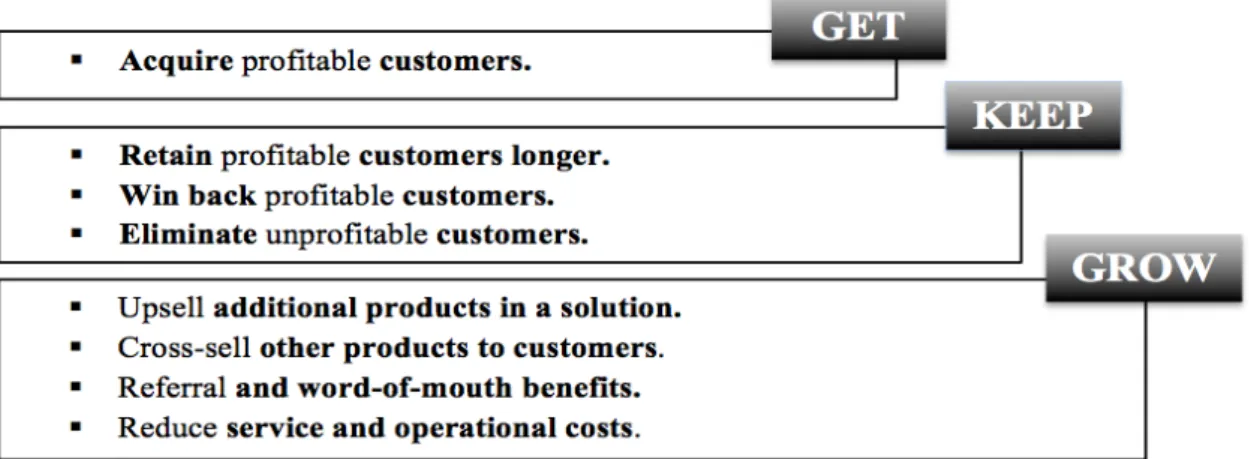
Customer relationship management (CRM) is defined as the process of making managerial decisions with the end goal of increasing the value of the customer base, through better relationships with customers, usually on an individual level (Peppers and Rogers, 2011). The process of increasing the value of the customer includes the three steps of Get – Keep – Grow, which in turn have the following purposes:
Figure 1: Get, Keep, Grow: A Model for Increasinf the Value of the Customer Database
14 Course led by Prof. Elizabete Cardoso, Fall/Winter Semester 2013/2014 at Nova SBE 15 Course led by Prof. Robert Stinerock, Fall/Winter Semester 2013/2014 at Nova SBE
In this project, it was possible to generally cover most of these topics that build the basis of CRM. In the Barclaycard Portugal part of the project, the main goal was related to keeping and growing the value of the customer base, by increasing loyalty of current customers and by acquiring new customers. Barclaycard in Spain had to focus still on the first step of the CRM, which relates to new customer acquisition. Nevertheless, some recommendations were also made including the keep and growth parts.
Furthermore, within the content I have learned in CRM classes, this project can be analyzed through the IDIC Model – Identify, Differentiate, Interact, and Customize (Appendix 23). First of all, customers and potential customers were identified and differentiated via the surveys developed and via the segmentation questions provided by agency Truth. This first part is the most analytical part of CRM processes and it is this initial approach that allows companies to gain insights about the current (and potential) customer database. With these insights, it was possible to derive recommendations in order to better interact with customers in the most cost-efficient way. Part of this interaction is about creating customized solutions for customers, adapting them to customers’ preferences and behaviors. All in all, this project was about understanding those preferences and behaviors in order to adapt the current product portfolio of Barclaycard in Portugal and in Spain, with the final aim of increasing the customer database value.
The basis for this analysis used statistical methods, such as in-depth interviews, descriptive statistics, and regression models, as instruments of analysis. This kind of tools allows for more certainty of results that either confirm or reject preconceived beliefs about consumer preferences and behaviors.
a. In-depth interviews: this was the first step towards understanding people’s feelings and opinions about credit cards. In fact, and according to Malhotra and Bricks (2007), this technique allows researchers to question and probe in great depth and obtain a quality understanding of individuals’ behaviors and feelings.
b. Descriptive statistics: for this type of statistical methods, two online surveys were created. The main reason for choosing this kind of survey technique is related to the low cost associated, and to the high level of anonymity provided to the respondent (given that borrowing and credit behaviors might be a delicate issue for some respondents, it was important to find a method that assured anonymity) (Malhotra and Bricks, p.p. 276, 2007). c. Regression models: in order to better understand relationships between variables evaluated in the Portuguese survey, some regressions were run. Statistical knowledge is
always present throughout a master’s degree in management: it is the basis for investigating financials, consumer behavior or even market structures. Therefore, it is knowledge that is to some extent already embedded in the way of thinking and deriving of a master’s student in this field. The type of regressions used in this project was multiple regression: a statistical technique that develops a mathematical relationship between two or more independent variables and a dependent variable (Malhotra and Bricks, 2007).
B. New Knowledge
From my perspective, new knowledge in this project came in two distinct forms: practical knowledge and theoretical knowledge.
Even though the courses previously mentioned – CRM and Statistics for Managers – provided me with good insights that were useful for this project, I never had the chance to apply the concepts like it was possible with this study. The possibility to put into practice this kind of knowledge represented a great learning experience. Specifically in this type of subjects, it is important to complement theory with practice, and the study of Barclaycard allowed me to develop the knowledge previously obtained to a great extent.
The elaboration of a conjoint study also represented new knowledge for me. As this was never covered in any statistic course I have had before, it was crucial to understand the foundations, processes and goals of this type of study. A conjoint analysis is a technique that attempts to determine the relative importance and utility consumers attach to different attributes and to different attribute levels. To study this, respondents are presented with stimuli that consist of combinations of attribute levels, constituting different products (Malhotra and Bricks, 2007). Having to develop this kind of study was very beneficial for me, as I had the opportunity to learn and get confortable with a type of study that is able to provide extremely valuable information and insights in a very user-friendly way. Compared to descriptive and regression-kind of analysis, this statistical method requires more preparation, because there are certain criteria that should be respected (i.e. level balance, orthogonality, minimal level overlap, and utility balance), however the quality of the results presented is much more likely to be relevant and of easy interpretation.
C. Personal Experience
When working in a demanding project like this one, not only theory and practical knowledge is applied and gained, but also there is a big impact on personal development and learning.
For me, it was the first time I was developing such an important project for a big corporation like Barclaycard (in fact, this project not only embraced one firm, but two: Barclaycard Portugal, and Barclaycard Spain, which presented us with different problems which we had to analyze from different perspectives). The rigor, high performance, and quality that Barclaycard stands for demanded from this project a high quality of results delivered. I believe that the pressure to stand out and provide the company with good and useful recommendation had a big impact on how the group worked through the course of time. Also related to the fact that Barclaycard is a big corporation, I understood that sometimes deadlines and time plans do not go as planned. In our specific case, we had to manage a delay of almost three weeks for the launching the surveys due to bureaucracies by the part of legal and marketing departments.
In a group level analysis, I confirmed some previous skills I have had developed throughout my past experience. Working in a group is very beneficial for a project like this, but it can also be very challenging. This project definitely benefited from the variety of backgrounds and experiences each member provided. When it comes to bringing up new ideas and suggestions, a diverse group like the one that was working on this project is a plus. New ideas, perspectives and solutions were identified, discussed and improved together with clashing ideas from other group members. I believe that this type of experience and work method is very constructive and can bring out much more than when working on an individual level. Nevertheless, I am also able to point out challenges coming from this organization of the team: different motivation and commitment levels, together with different discipline standards made it sometimes hard to work in a group. From this experience, I learned that it is very important to understand each other’s motivations, difficulties and strengths since the first moment. Clarifying team expectations from the beginning is crucial, in order to better deal with stress, conflict and successes as the project evolves.
On an individual level, I can say that even though this was an academic experience, it felt very much like a professional one, given the demanding criteria and expectations set by
Barclaycard. I consider this experience very valuable for my future professional path, not only because of learning it terms of corporate environment and group behavior, but also individually, when it comes to stress and time management, critical thinking and feedback competence.
D. Benefit of Hindsight
After analysis the entire project, since planning, methodology, results and even learning insights, it is now possible to evaluate it as a whole, identifying what went well, and what should have been done differently, in order to help future studies.
Looking firstly at what could have been done differently, I believe that the most important drawbacks and limitations of this study are related to the design and implementation of the surveys. As I have mentioned before, the analysis of results could have been better if more time had been dedicated to testing the surveys; not only in terms of respondents’ experience and doubts that can come up while doing the survey, but also in term of data analysis. For the future, and when planning studies like this, I am now aware that it is necessary to dedicate some time and effort to these error and trial processes (that somehow lacked in this project).
In the positive aspects of this project, I think that the success of this it is mainly due to the following reasons: firstly, the commitment, knowledge and experience of the Barclaycard team and of the academic advisor that worked on this project and guided us, proved to be of great advantage. Experienced individuals, with practical knowledge on the topics covered, helped the group to approach problems and recommendations in a very good way. Secondly, as I mentioned before, the variety of backgrounds inside the team devoted to this project was also a very good reason for the quality of the final result. Having people with different mindsets, regarding borrowing and credit card matters, but also regarding generalities as well, provided us with very complete and fruitful discussion and following conclusions. It was therefore proved that multicultural teams can bring great advantages to challenging projects.
4. CONCLUSION
This project was aimed at providing recommendations that help addressing two different challenges Barclaycard in Portugal and Barclaycard in Spain currently face: low usage rates (Portugal), and low market share (Spain). Therefore, it was necessary to understand what drives customer loyalty when it comes to credit cards, and what attracts new customers. By applying Customer Relationship Management theories and statistical methods to better understand customers’ needs and preferences, a set of recommendations was produced. In Portugal, Barclaycard should center its attention on introducing cashback as a core feature of its product portfolio. Simultaneously, improving communication efforts need to be improved, focusing on flexible repayment, and other general conditions. The current miles program ideally would also be reevaluated.
In the neighbor country, Spain, Barclaycard needs to consider different solutions, in order to grow the size of its customer base. In this sense, the recommendations presented in this paper include the implementation of E-Mail/SMS alerts as credit card control tools, and the continuation of flexible repayment conditions. In addition, Barclaycard Spain should consider increasing the current TAEG applied, and, at the same time, reduce the existing travel insurance package.
All in all, and after evaluating the impact on the customer base value, and the cost and easiness of implementation of these strategies, together with the assessment of limitations of the two studies, the final result of this project is of great value for Barclaycard. Nevertheless, and given the fast-pace of the evolution of the credit card market in the Iberian Peninsula, this is a study that should be constantly under reevaluation and adaptation to the business environment changes.
5. REFERENCES
Published Articles
§ Banco de España. 2015. Sistemas de Pago – Estadisticas. Retrieved from: http://www.bde.es/f/webbde/SPA/sispago/ficheros/es/estadisticas.pdf
§ Barclays. 2015. Barclaycard Annual Report 2014. Retrieved from: http://www. barclays.com/annual-report-2014.html
§ El País. 2015. Jimenez, M. Las compras con tarjeta pulverizan récords en España. Retrieved from: http://economia.elpais.com/economia/2015/03/19/actualidad/
1426769756_280489.html (May, 2015)
§ Euromonitor International Report. 2015. Banking Industry in Portugal. § Euromonitor International Report. 2015. Credit Cards in Portugal.
§ Payments - Cards and Mobile. 2014. Portugal Payment Statistics. 2014-2015. Retrived from: http://www.paymentcardyearbooks.com/wp-content/uploads/2013/11/
yearbook_profile_sample.pdf (May, 2015)
§ Truth Agency. 2014. Consumer landscaping validation / Project Eagle (Portugal) § Truth Agency. 2014. Detailed segment profiles / Project Eagle (Portugal)
§ Truth Agency. 2014. Consumer landscaping validation / Project Toledo (Spain)
Books
§ Malhotra, Naresh K., and Birks, David F. 2007. Marketing Reseacrh: an applied approach. Essex: Pearson Education Limited.
§ Peppers, D., and Martha R. 2011. Managing Customer Relationships: a strategic framework. New Jersey: John Wiley & Sons, Inc.
Online Sources
§ Banco Best main page. Retrieved from: https://www.bancobest.pt/ (March, 2015) § Banco BIG main page. Retrieved from: https://www.bigonline.pt/ (March, 2015) § Banco BPI main page. Retrieved from: http://www.bancobpi.pt/ (March, 2015)
§ Banco Montepio main page. Retrieved from: https://www.montepio.pt/ (March, 2015) § Banco Popular (Portugal) main page. Retrieved from: www.bancopopular.pt/ (March, 2015)
§ Banco Popular (Spain) main page. Retrieved from: www.bancopopular.es/ (March, 2015)
§ Banco Sabadell main page. Retrieved from: https://www.bancsabadell.com/ (March, 2015)
§ Banco Santander (Portugal) main page. Retrieved from: https://www.santandertotta.pt/ (March, 2015)
§ Banco Santander (Spain) main page. Retrieved from: https://www.bancosantander.es/ (March, 2015)
§ Caja España main page. Retrieved from: http://www.cajaespana-duero.es/ (March, 2015)
§ Bankia main page. Retrieved from: http://www.bankia.es/ (March, 2015)
§ Barclaycard (Portugal) main page. Retrieved from: http://www.barclaycard.pt (March, 2015)
§ Barclaycard (Spain) main page. Retrieved from: http://www.barclaycard.es/tarjeta-credito.html (March, 2015)
§ BBVA (Portugal) main page. Retrieved from: http://www.bbva.pt/ (March, 2015) § BBVA (Spain) main page. Retrieved from: http://www.bbva.es/ (March, 2015) § Caixa Geral de Depósitos main page. Retrieved from: https://www.cgd.pt/ (March, 2015)
§ Deutsche Bank (Portugal) main page. Retrieved from: http://www.deutsche-bank.pt/ (March, 2015)
§ Deutsche Bank (Spain) main page. Retrieved from: http://www.deutsche-bank.es/ (March, 2015)
§ ING main page. Retrieved from: http://www.ingdirect.es/ (March, 2015) § Investopedia. Credit Card Definition. Retrieved from:
http://www.investopedia.com/terms/c/creditcard.asp (May, 2015) § Investopedia. Debit Card Definition. Retrieved from:
http://www.investopedia.com/terms/d/debitcard.asp (May, 2015)
§ Millenium BCP main page. Retrieved from: http://www.millenniumbcp.pt/ (March, 2015)
§ Novo Banco main page. Retrieved from: http://www.novobanco.pt/ (March, 2015) § Obsidiana main page. Retrieved from: https://www.obsidiana.com/ (March, 2015) § Unibanco main page. Retrieved from: http://www.unibanco.pt/ (March, 2015)
6. APPENDIXES
Appendix 1: Credit cards used for market analysis in Portugal Brand Credit Cards used for Analysis
Best Bank Gold Plus Visa /American Express, Best Gold American Express (Amex), Best Gold Visa
Santander Classic, 10.10Tsi, Desconto, Premium Travel, Light, Ferrari, Titanium, Gold
Novo Banco NB Verde, NB Gold, NB Branco, @NB Caixa Geral de
Depósitos
Classic, Gold, Platina, Made By, Caixa In, Woman, Caixa Activa, Caixa ISIC, Miles & More Classic, Miles & More Gold, Leve, LA Card Visa, Caixadrive, Visabeira Exclusive, Benfica Adepto
Deutsche Bank Classic, Gold
BPI Cartão BPI, BPI Prémio, BPI Gold Millennium
BCP
TAP Classic Visa/Amex, TAP Gold Visa/Amex, TAP Platinum Amex, Amex Blue, Millennium BCP Go!, Amex, Amex Platinum, Amex Gold, Classic Gémeos Visa/MasterCard/Amex, Gold Gémeos
Visa/MasterCard/Amex
Unibanco Life, Attitude, Attitude Oxygen, Classic Visa, Clássico + Montepio Sentidos, +Vida, Classic, Premier
Banco BiG Visa BiG Banco Popular Classic, Gold
BBVA Depois Classic, Depois Gold, Ao Seu Ritmo
Appendix 2: Credit cards used for market analysis in Spain Brand Credit Cards used for Analysis
Bankia Crédito Particulares, Iberia Sendo Clássica, Iberia Sendo Oro, Iberia Max Santander Clássico, Crédito Box Gold, 123, Light 0% 3 Meses, Iberia
Banco Popular Visa Hop, Crédito Global Platinum, Crédito Global Elite, Crédito Global Bonus
Caja España Visa Classic, Visa Platinum, MasterCard Premium Gold, Visa Oro, Visa Classe Oro (Caja Duero)
Barclaycard Barclaycard Nueva Visa, Barclaycard Oro BBVA Después, A Tu Ritmo, Después + A Tu Ritmo ING Direct Visa Oro
Obsidiana Visa Oro, MasterCard Platinum
Appendix 3: Competitor Analysis Portugal: Credit Cards by TAEG
Appendix 4: Competitor analysis Portugal: Credit cards by regular annuity
Appendix 6: Usage distribution: Barclaycard vs. Top 4 competitors
Appendix 7: Average satisfaction level for each brand
Number of responses per brand: BBVA (20), Banco Best (22); Novo Banco/BES (61); Barclays (128); Caixa General de Depósitios (97); Shop CCs (135); Banco Popular (12); Barclaycard (332); Santander Totta (72); Millennium BCP (93); Unibanco (87); BPI (103); Montepio (38)
Appendix 8: Preferred credit card by situation
Appendix 9: Most valued product features
(Percentage rate of respondents that either agree or strongly agree with each statement)
Appendix 10: Factors of preference between credit cards
Appendix 11: SPSS Output: The impact of factors of preference between credit cards on customer loyalty
At what point do you agree that the following factors make
you prefer one card to the other? Beta Significance
Constant 76,669 ,000
Discounts -1,573 ,071
Flexible Repayment ,484 ,520
Miles ,516 ,485
Connection to main bank account -,079 ,915
Account manager -,018 ,983
Easiness to understand conditions 1,453 ,080
Force of habit ,606 ,422
Cashback ,751 ,319
Balance the usage of different CCs -3,681 ,000
Donation of a certain percentage of spending to charity ,850 ,324
Appendix 12: SPSS Output: The impact of factors of preference between credit cards on differentiation ability between credit cards
At what point do you agree that the following factors make
you prefer one card to the other? Beta Significance
Constant 2,273 ,000
Discounts ,032 ,410
Flexible Repayment -,029 ,392
Miles -,065 ,048
Connection to main bank account ,054 ,102
Account manager -,013 ,736
Easiness to understand conditions -,022 ,553
Force of habit ,100 ,004
Cashback -,076 ,024
Balance the usage of different CCs -,053 ,160
Donation of a certain percentage of spending to charity ,083 ,030
Note: The dependent variable relates to the agreement level to the question “To what point do you agree that all your credit cards are the same?” which varies between 1 and 5, being 1 “Strongly disagree” and 5 “Strongly agree”. This means that a respondent that answers 0 has a high ability to differentiate between credit cards. Thus, a negative coefficient means a higher ability to differentiate.
Appendix 13: Competitor Analysis Spain: Credit Cards by TAEG
Appendix 14: Competitor analysis Spain: Credit cards by regular annuity
Appendix 16: Demographic characteristics of Spanish survey participants
Appendix 17: Utility levels of credit card product features
Attribute Utility Attribute Utility
Travel Insurance 0.22 E-Mail/ SMS Alerts 0.31
Flexible Repayment 0.36 Financial Assistance (FA) -0.19
Interest Rate 23% 0.71 Money Management Tool (MMT) -0.17
Interest Rate 26% -0.21 E-Mail/ SMS Alerts and FA 0.26
Interest Rate 29% -0.50 E-Mail/ SMS Alerts and MMT -0.06
FA and MMT -0.15*
* Variable not statistically significant
Appendix 18: Relative importance of credit card attributes by attitude towards getting a new credit card