Esta licença está disponível em: https://creativecommons.org/licenses/by-nc/4.0/
Repositório Institucional da Universidade de Brasília
repositorio.unb.br
Este artigo está licenciado sob uma licença Creative Commons Atribuição-NãoComercial 4.0 Internacional.
Você tem direito de:
Compartilhar — copiar e redistribuir o material em qualquer suporte ou formato. Adaptar — remixar, transformar, e criar a partir do material.
De acordo com os termos seguintes:
Atribuição — Você deve dar o crédito apropriado, prover um link para a licença e indicar se mudanças foram feitas. Você deve fazê-lo em qualquer circunstância razoável, mas de maneira alguma que sugira ao licenciante a apoiar você ou o seu uso
Não Comercial — Você não pode usar o material para fins comerciais.
Sem restrições adicionais — Você não pode aplicar termos jurídicos ou medidas de caráter tecnológico que restrinjam legalmente outros de fazerem algo que a licença permita.
This article is licensed under a Creative Commons Attribution-NonCommercial 4.0 International License.
You are free to:
Share — copy and redistribute the material in any medium or format. Adapt — remix, transform, and build upon the material.
Under the following terms:
Attribution — You must give appropriate credit, provide a link to the license, and indicate if changes were made. You may do so in any reasonable manner, but not in any way that suggests the licensor endorses you or your use.
NonCommercial — You may not use the material for commercial purposes.
No additional restrictions — You may not apply legal terms or technological measures that legally restrict others from doing anything the license permits.
611 Mem Inst Oswaldo Cruz, Rio de Janeiro, Vol. 96(5): 611-620, July 2001
Biogeography of Triatominae (Hemiptera: Reduviidae) in
Ecuador: Implications for the Design of Control Strategies
Fernando Abad-Franch/*, Aura Paucar C*/
++,
Carlos Carpio C*,
César A Cuba Cuba**, H Marcelo Aguilar V*/***, Michael A Miles/
+Pathogen Molecular Biology and Biochemistry Unit, Department of Infectious and Tropical Diseases, London School of Hygiene and Tropical Medicine, Keppel St., London WC1E 7HT, UK *Unidad de Medicina Tropical,
Instituto ‘Juan César García’, Quito, Ecuador **Unidade de Parasitologia Médica-Patologia, Faculdade de Medicina, Universidade de Brasília, DF, Brasil ***Instituto Nacional de Higiene y Medicina Tropical ‘Leopoldo
Izquieta Pérez’, Quito, Ecuador
Chagas disease control strategies strongly depend on the triatomine vector species involved in
Trypanosoma cruzi transmission within each area. Here we report the results of the identification of
specimens belonging to various species of Triatominae captured in Ecuador (15 species from 17
provinces) and deposited in the entomological collections of the Catholic University of Ecuador (Quito),
Instituto Oswaldo Cruz (Brazil), the Natural History Museum London (UK), the London School of
Hygiene and Tropical Medicine (UK), the National Institute of Hygiene (Quito), and the Vozandes
Hospital (Quito). A critical review of published information and new field records are presented. We
analysed these data in relation to the life zones where triatomines occur (11 life zones, excluding
those over 2,200 m altitude), and provide biogeographical maps for each species. These records are
discussed in terms of epidemiological significance and design of control strategies. Findings relevant
to the control of the main vector species are emphasised. Different lines of evidence suggest that
Triatoma dimidiata is not native to Ecuador-Peru, and that synanthropic populations of Rhodnius
ecuadoriensis in southern Ecuador-northern Peru might be isolated from their sylvatic conspecifics.
Local eradication of T. dimidiata and these R. ecuadoriensis populations might therefore be
attain-able. However, the presence of a wide variety of native species indicates the necessity for a strong
longitudinal surveillance system.
Key words: Triatominae biogeography Chagas disease control Triatoma dimidiata
-Rhodnius ecuadoriensis - Ecuador
Around 3 million people live under risk
condi-tions for Trypanosoma cruzi transmission in
Ec-uador; prevalence estimates indicate that ~150,000
people are already infected (Aguilar et al. 1999).
Sixteen triatomine species have been reported from
the country (excluding doubtful records of
Tri-atoma infestans and Rhodnius prolixus) (Aguilar
et al. 1999). At least 13 of these species (see Tables
I-III) are actual or potential vectors of Chagas
dis-ease (Lent & Wygodzinsky 1979, WHO 1991,
Abad-Franch 2000). This complex situation is
cur-rently being investigated in the context of the
Na-tional Programme for Chagas Disease Control in
Ecuador. Our aim is to contribute to these efforts
by analysing and completing the relevant
informa-tion about Chagas disease triatomine vectors in
Ecuador.
From 1998 to 2000, and as part of our research
on the epidemiological significance of Rhodnius
species in Ecuador and Peru, we undertook a
revi-sion of the Triatominae kept at various important
entomological collections. During that revision,
new data on distribution of some species in
Ecua-dor became apparent. We added entomological
records from our own fieldwork and from research
being carried out by Ecuadorian colleagues. Here
we report those new records, together with
previ-ously published data, and analyse them in relation
to the main ecological and epidemiological traits
of the different species. Finally, recommendations
on vector control strategies are put forward.
Supported by the UNDP/World Bank/WHO TDR (Grant 970195), the ECLAT Network, the Tropical Medicine Unit at the University General Hospital of Valencia (Spain), the Cañada-Blanch Foundation (Spain), and Capes (Ministério de Educação e Cultura, Brasil).
+Corresponding author. Fax: +44-207-636.8739. E-mail:
++Current address: Systematics Research Collections,
W-436 Nebraska Hall, University of Nebraska State Mu-seum Lincoln, NE 68588-0514 USA
Received 31 July 2000 Accepted 21 November 2000
MATERIALS AND METHODS
For this study, we reviewed available published
reports, and the specimens belonging to the
sub-family Triatominae deposited at the Invertebrate
Museum of the Catholic University of Ecuador,
Quito, the Herman Lent and Rodolfo Carcavallo
Collections (Laboratório Nacional e Internacional
de Referência em Taxonomia de Triatomíneos,
Departamento de Entomologia, Instituto Oswaldo
Cruz, Rio de Janeiro, Brazil), the Natural History
Museum, London (UK), the London School of
Hygiene and Tropical Medicine (UK), the
Vozandes Hospital (Quito, Ecuador), and the
Na-tional Institute of Hygiene and Tropical Medicine
(Quito, Ecuador). Fieldwork and unpublished
records were also included in our analysis.
Notes on epidemiological significance of each
species were prepared on the basis of published
information, unpublished reports, and field
obser-vations. For geographical information, we used the
guide by Miranda (1995), the “Índice Toponímico”
of the Instituto Geográfico Militar (IGM 1978-82,
1982-96), and cartographic material provided by
the IGM. Life zones were established following
the ecological maps proposed by Cañadas (1983)
and Cañadas and Estrada (1978, cf. Dodson &
Gentry 1991), based on the life zones described
by Holdridge (1967). We included life zones
un-der 2,200 m altitude in the analysis. In the
distri-bution maps (Figure), marks indicate places of
cap-ture. Life zones where each species occur are light
grey, and we added the outline and number of the
life zones representing the potential distribution of
each species (areas from where no records exist,
but where ecological features are identical to other
zones where captures have been made).
RESULTS*
Results on geographical and ecological
distri-bution of species are shown in the Figure and in
Tables I-III; 17 out of 21 provinces have produced
records of triatomines (excluding doubtful reports
from two more provinces). The studied species
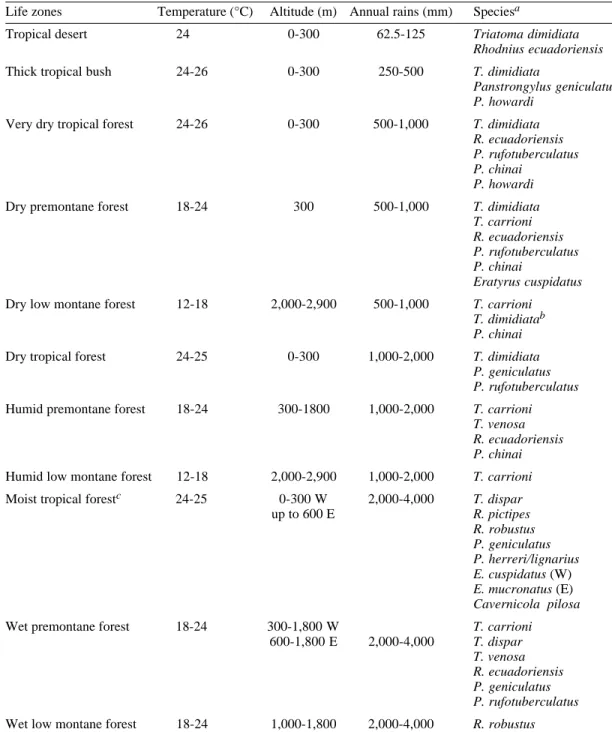
oc-cupy 11 life zones in Ecuador. Life zones in the
Andes range (2,200-6,310 m altitude) were not
in-cluded in the analysis; apparently, only T. carrioni
occurs there. Annual rains in areas where triatomines
occur range between 62.5-125 mm/year in the
tropi-cal desert and 2,000-4,000 mm/year in the wet and
moist forests (Table IV). Average temperatures
ranged from 12-18ºC in the low montane forest
ar-eas to 24-26ºC in the coastal dry tropical forests
(Table IV). Altitude range was 0-2,650 m (Tables I,
IV). The maximum number of species recorded in a
single life zone corresponds to the Amazon rainforest
(seven species, excluding unconfirmed records of
T. dimidiata and R. ecuadoriensis). These two latter
species, deemed the main Chagas disease vectors in
the country, have the widest distribution range; T.
dimidiata has been reported from six different life
zones in the country and R. ecuadoriensis from five
(see Tables I, II, IV). The distributions of these and
all the other species in relation to life zones are also
summarised in Table IV.
No records from the Galápagos Islands were
found.
DISCUSSION
Complementary sampling and further analysis
are indispensable to achieve an accurate idea of
how triatomines are distributed in Ecuador, the way
they are related to different ecological zones, their
synanthropic behaviour, and their inter- and
intra-specific relations. Records from some provinces
are limited or do not exist. The ecological
com-plexity of Ecuador is illustrated in the diversity of
life zones (from desertic areas to pluvial forests).
The high number of triatomine species also reflects
such diversity.
T. dimidiata occurs only in low, dry areas of
the coast, including the tropical desert in the Santa
Elena peninsula (Guayas), and seems to be always
in a domestic habitat. Only one report of adult
specimens found in an allegedly sylvatic
environ-ment (under the bark of a dead tree) (cf. Zeledón
1981) was found. However, the actual presence of
sylvatic colonies of this species in Ecuador has
never been documented; specimens found in
peridomestic terrestrial bromeliads and periurban
rubbish dumps in Manabí (Vector Control Service,
unpublished observations) cannot be considered as
truly sylvatic. This fact, together with the apparent
discontinuity in the distribution of the species from
Mexico to Ecuador (absent from southern
Colom-bia, except in some localities of the upper
Magdalena valley) (Zeledón 1981, D’Alessandro
& Barreto 1985, Carcavallo et al. 1999), makes us
contemplate the hypothesis that it was introduced
into coastal areas of Ecuador and Peru. Sea trade
is known to have linked Mesoamerican and
Ecua-dorian-Peruvian cultures from ~1500 BC (Meggers
& Evans 1963). As pointed out by Schofield et al.
(1999), genetic and phenetic simplification
gener-ally impedes the re-adaptation of strictly domestic
triatomines to new, unstable sylvatic habitats. If
the introduction of such T. dimidiata populations
*New field records were obtained after the preparation of the manuscript (province of Pichincha, life zone 9):
Triatoma dimidiata (domestic colony), Rhodnius ecuadoriensis (adults in house), and Panstrongylus rufotuberculatus (adults in houses).
613 Mem Inst Oswaldo Cruz, Rio de Janeiro, Vol. 96(5), July 2001
Biogeography of Ecuadorian Triatominae. Life zones - 1: tropical desert; 2: thick tropical bush; 3: very dry tropical forest; 4: dry premontane forest; 5: dry low montane forest; 6: dry tropical forest; 7: humid premontane forest; 8: humid low montane forest; 9: moist tropical forest; 10: wet premontane forest; 11: wet low montane forest (Ecuador Provinces); actual distribution: light grey areas; potential distribution: outlined white areas with number of life zone.
4 SUCUMBÍOS ORELLANA PASTAZA ESMERALDAS PICHINCHA IMBABURA Nueva Loja Puerto Francisco de Orellana (Coca) Tena NAPO Puyo Quito Latagunca COTOPAXI MANABÍ GUAYAS LOS RIOSBOLÍVARTUNGURAHA
CHIMBORAZO Ambato Riobamba Guaranda Bebahoyo Tulcán Esmeraldas ZAMORA CHINCHIPE Zamora Loja Cuenca Manchala LOJA EL RIO AZUAY Azogues Macas MORONA -SANTIAGO CAÑAR Guayaquil Portoviejo Imbarra CARCHI
to Ecuador-Peru is confirmed, meaning that no
sylvatic populations of T. dimidiata occur in
Ec-uador, then the species might be a suitable target
for local eradication (pyrethroid insecticide
spray-ing of all dwellspray-ings in positive localities is
recom-mended in such a situation) (Acevedo et al. 2000,
Schofield 2000). Preliminary results of nuclear and
mitochondrial gene sequencing (Bargues et al.
2000, Marcilla et al. 2001, Solís-Mena et al.
un-published data) and morphometry (Solís-Mena et
al. 2000) are lending support to this hypothesis.
Recently, three T. dimidiata adults were allegedly
collected in a dwelling in the Ecuadorian Amazon;
however this finding needs further confirmation.
R. ecuadoriensis colonises human
environ-ments in central and southern Ecuadorian provinces
west of the Andes, and in northern Peru. Sylvatic
populations seem primarily associated with the
endemic Phytelephas aequatorialis palm trees in
the central coastal region (Romaña et al. 1994,
Avilés et al. 1995a, Abad-Franch et al. 2000). We
recently found 27% of 64 P. aequatorialis palms
to harbour R. ecuadoriensis breeding colonies in
three provinces of the Pacific slope of the Andes
(Abad-Franch 2000); both invasion and
colo-nisation of human habitats by wild insects have
TABLE I
Distribution and epidemiological significance of the Triatoma Laporte, Eratyrus Stal, and Cavernicola Barber species in Ecuador
Species Distribution Epidemiological Observations (provinces)a significance
Triatoma dimidiata Manabí, Guayas, The main Trypanosoma Dry life zones in central and southern (Latreille) El Oro, Los Ríos, cruzi vector in the country; coastal region; the apparent discontinuity
Loja, Esmeraldas responsible for the urban in its distribution from Colombia to Peru Uncertain finding endemicity in the city of merits further investigation; sylvatic in the Amazon Guayaquil and for the ecotopes in Ecuador unknown; genetic region (Napo) maintenance of the and morphometric similarities with
transmission in other areas Mesoamerican specimens; its presence in the Amazon needs confirmation
Triatoma carrioni Loja, Azuay, Locally important in areas Temperate valleys and highlands of the Larrousse Cañar, El Oro, of the south, where colonies Andean southern cordillera; records
Pichincha, can be found in domestic from the Amazon slope of Andes and Cotopaxi, Zamora environments northern Ecuador merit further
Chinchipe confirmation; a V instar nymph apparently belonging to this species was captured in a bromeliad epiphyte in La Otonga, Cotopaxi (primary cloud forest, >2,000 m altitude)
Triatoma venosa Azuay, Napo/ Sylvatic in Ecuador – Up to 2,200 m altitude (Stål) Orellanab domestic colonies reported
from Colombia; high altitudes
Triatoma dispar Imbabura, Strictly sylvatic Andean region; one record from Guayas Lent Cotopaxi probably erroneous
Eratyrus mucronatus Napo/Orellanab Sylvatic in Ecuador; Amazon region (primary forest; two Stål reports of domestic specimens captured by light trapping);
colonies in Bolivia one record from Esmeraldas is probably due to misidentification
Eratyrus cuspidatus Loja, Esmeraldas Sylvatic Coastal region and low areas of the
Stål western Andes
Cavernicola pilosa Napo/Orellanab, Sylvatic Amazon region (one specimen captured Barber Pastaza by light trapping)
a: Reports on distribution: T. dimidiata: Lent & Wygodzinsky 1979, Lazo 1985, Defranc 1982, this report; T. carrioni: Leon 1949, Espinoza 1955, Lent & Wygodzinsky 1979, Defranc 1982, Reyes 1982, this report; T. venosa:
Defranc 1982, Lent & Wygodzinsky 1979, this report; T. dispar: Lent & Wygodzinsky 1979, this report; E.
mucronatus: Defranc 1982, Lent & Wygodzinsky 1979, this report; E. cuspidatus: Defranc 1982; C. pilosa: Lent &
615 Mem Inst Oswaldo Cruz, Rio de Janeiro, Vol. 96(5), July 2001
been documented in coastal Ecuador (Defranc
1987, Abad-Franch 2000). Treatment of infested
dwellings and monitoring of re-infestations should
be the recommended control strategy there. We also
studied the presence of R. ecuadoriensis in
tem-perate valleys of the provinces of Loja and El Oro
(near the Peruvian border). Palm trees are
com-pletely absent in the studied areas, probably due to
massive deforestation that occurred in the last
30-40 years (Dodson & Gentry 1991). Nine percent
of 118 dwellings surveyed in two communities
were infested (crowding indices from 42 to 78),
with the majority of colonies breeding in
peridomestic chicken coops, but also inside houses
– mainly in beds and mud walls (Abad-Franch
2000). It is of greater importance for the control of
this species in southern Ecuador and northern Peru
to determine whether sylvatic populations still
oc-cur there (making re-infestation likely), or if
do-mestic insects have become isolated from their wild
conspecifics as a consequence of deforestation
(lo-cal eradication could be attainable in this case).
We have also detected the presence of strictly wild
R. ecuadoriensis forms in northern Ecuador; their
specific status needs however to be confirmed
(Abad-Franch 2000, Abad-Franch et al. 2000).
Fi-nally, we found two specimens labelled as collected
on the eastern slope of the Andes (marked as
un-certain data on the map, as we suspect erroneous
places of capture indicated on labels).
T. carrioni, an endemic species that has adapted
to human habitats in the Andean valleys of
south-ern Ecuador and northsouth-ern Peru, occupies a wide
range of life zones (dry and humid, 1,000-2,650 m
altitude) and has been reported to feed on humans
and horses (Lent & Wygodzinsky 1979). An adult
specimen was recently captured by light trapping
in the northern province of Pichincha. A nymph
apparently belonging to this species was captured
in an epiphytic bromeliad in the canopy of primary
cloud forest in a neighbouring area (Figure, Table
I). In the southern Andean provinces of Loja and
Azuay, the species has been found in
human-re-lated habitats both in rural and urban areas (León
1949, Espinoza 1955, Defranc 1982). Some
cap-ture places (marked with + in the Figure) are
lo-TABLE II
Distribution and epidemiological significance of the Rhodnius Stål species in Ecuador Species Distribution Epidemiological Observations
(provinces)a significance
Rhodnius Manabí, Guayas, Considered as the second main Central and southern coastal region;
ecuadoriensis Los Ríos, El Oro, Trypanosoma cruzi vector in the sylvatic populations reported from Lent & León Loja, Pichincha country; able to invade-colonise Manabí, Los Ríos, and Pichincha
human environments, and found to (the taxonomic status of these latter breed even within dwellings in is under investigation)
good condition; related to domestic birds (chicken, pigeons) and, in wild environments in northern and central Ecuador, to palm trees (Phytelephas aequatorialis); sylvatic populations not reported from southern Ecuador nor northern Peru
Rhodnius Sucumbíos, Probably involved in the Amazon region; we studied the
pictipes Napo/Orellanab, transmission of T. cruzi in some presence of R. stali, a species very
Stål Morona-Santiago areas; adults flying into houses, closely related to R. pictipes, in the even in urban areas (unpublished Ecuadorian Amazon, with negative observation) results (unpublished data);
present in palm trees of at least five genera in Sucumbíos (unpubl.)
Rhodnius Sucumbíos, Probably involved in the Amazon region; palm trees of at least
robustus Napo/Orellanab transmission of T. cruzi in some five genera in Sucumbíos (unpubl.); Larrousse areas; adults flying into houses labelling errors probably involved
in the finding of specimens allegedly collected in the Coastal region
a: Reports on distribution: R. ecuadoriensis: Lazo 1985, Defranc 1982, Carcavallo & Martínez 1985, Romaña et al.
1994, Abad-Franch et al. 2000, this report; R. pictipes: Espinoza 1955, Amunárriz 1991, Amunárriz et al. 1991, Chico et al. 1997, this report; R. robustus: Espinoza 1955, Amunárriz 1991, Amunárriz et al. 1991, Chico et al. 1997, this report; b: Napo and Orellana were separated into two provinces in 1998.
cated in Andean life zones over 2,200 m; data
avail-able indicate that the species has only been found
there in human environments, but this does not
preclude its presence in wild habitats as well.
Con-trol of this species should contemplate the
possi-bility of re-infestations from wild populations;
treating of infested homes and a strong surveillance
component must therefore be recommended.
R. pictipes and R. robustus are recorded from
the Ecuadorian Amazon – where seropositivity
ranges from 0.8% to 6% (cf. Aguilar et al. 1999).
We recently studied their presence in palm trees
in the Ecuadorian Amazon region. Forty-six
per-cent out of 56 palms surveyed were positive,
in-cluding five genera (Attalea, Astrocaryum,
Oenocarpus, Phytelephas, and Elaeis)
(Palo-meque et al. 2000). Several specimens labelled
as R. robustus collected in western Ecuador (Loja
and Los Ríos), are deposited at the H. Lent
Col-lection (Instituto Oswaldo Cruz). This finding
is most likely related to erroneous capture sites
indicated on labels. Our investigations confirm
that R. stali, a synanthropic species close to R.
pictipes (Lent et al. 1993), is not known in the
Ecuadorian Amazon.
P. rufotuberculatus is truly domestic in some
areas of southern Ecuador, where breeding
colo-nies have been found inside dwellings (Avilés et
al. 1995b, Abad-Franch 2000). Similar behaviour
has also been reported from Bolivia (Noireau et
al. 1995, Dujardin et al. 1998) and Peru (Lizaraso
1955, Calderón et al. 1985). Adult insects may
also invade houses attracted to electric light (Lent
& Wygodzinsky 1979, Salomón et al. 1999). The
TABLE III
Distribution and epidemiological significance of the Panstrongylus Berg species in Ecuador Species Distribution Epidemiological Observations
(provinces)a significance
Panstrongylus Imbabura, Manabí, Possibly involved in the Broad distribution (from Argentina to
geniculatus Pichincha, Esmeraldas, transmission of Trypanosoma Mexico); it can be found on both (Latreille) Sucumbíos, cruzi in some areas; adults slopes of the Andes (slight but
Napo/Orellanab flying into houses; reports noticeable chromatic differences
of a trend towards recorded between both populations) domiciliation in Brazil
Panstrongylus Imbabura, Pichincha, Locally important in areas of Western slope of the Andes in
rufotuberculatus Manabí, Loja, El Oro, the south, where it is truly Ecuador, but broad distribution in the (Champion) Los Ríos, Guayas domestic Americas (from Argentina to Mexico)
Panstrongylus Manabí Unclear; adults found within Endemic species apparently restricted
howardi human dwellings to a small geographical area; biology, (Neiva) sylvatic habitats and hosts unknown
Panstrongylus Loja, El Oro Unclear; reports on domestic Mainly sylvatic; southwestern region
chinai colonies
(del Ponte)
Panstrongylus Napo/Orellanab Sylvatic; one female captured Two records by our group in the
herreri inside a house; domestic in Amazon basin; its presence in Ecuador Wygodzinsky northern Peru, where it is the could explain the record of P. lignarius
main vector of Chagas disease from Azuay (see text and below)
Panstrongylus Sucumbíos Sylvatic; recorded only from Only two records (western slope of
lignarius rainforests, with the exception Andes); its relation with P. herreri (Walker) of Cuenca (Azuay) in Ecuador needs further investigation (a sylvatic
(thus probably erroneous) specimen with mixed characters was collected in northern Ecuador Amazon); the record of the species in Azuay is probably due to
misidentification or a labelling error
a: reports on distribution: P. geniculatus: Espinoza 1955, Rodríguez 1959, Defranc 1982, Amunárriz 1991, Amunárriz
et al. 1991, Chico et al. 1997, this report; P. rufotubercutalus: Lazo 1985, Defranc 1982, Reyes 1992, this report; P.
howardi: Defranc 1982, Lent & Wygodzinsky 1979, this report; P. chinai: Defranc 1982, Lent & Wygodzinsky
1979, Reyes 1992; P. herreri: Lent & Wygodzinsky 1979, Aguilar et al. 1999, this report; P. lignarius: Rodríguez 1961, Defranc 1987, Lent & Wygodzinsky 1979, this report; b: Napo and Orellana were separated into two provinces in 1998.
617 Mem Inst Oswaldo Cruz, Rio de Janeiro, Vol. 96(5), July 2001
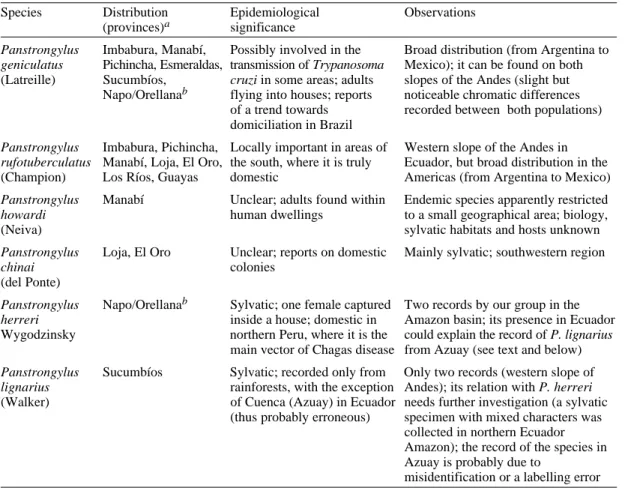
epidemiological significance of this species
de-serves further research in southern Ecuador. The
possibility that this species colonises houses
af-ter domiciliated species are eliminated by
con-trol interventions has to be taken into account by
control managers. The species occurs mainly in
low, dry areas, but may also be found in zones of
very humid premontane forest in northern
Ecua-dor, where it is sylvatic but has been captured in
houses when flying attracted to light.
TABLE IV
Main biogeographical traits of Ecuadorian Triatominae
Life zones Temperature (°C) Altitude (m) Annual rains (mm) Speciesa
Tropical desert 24 0-300 62.5-125 Triatoma dimidiata Rhodnius ecuadoriensis
Thick tropical bush 24-26 0-300 250-500 T. dimidiata
Panstrongylus geniculatus P. howardi
Very dry tropical forest 24-26 0-300 500-1,000 T. dimidiata R. ecuadoriensis P. rufotuberculatus P. chinai
P. howardi
Dry premontane forest 18-24 300 500-1,000 T. dimidiata T. carrioni R. ecuadoriensis P. rufotuberculatus P. chinai
Eratyrus cuspidatus
Dry low montane forest 12-18 2,000-2,900 500-1,000 T. carrioni T. dimidiatab P. chinai
Dry tropical forest 24-25 0-300 1,000-2,000 T. dimidiata P. geniculatus P. rufotuberculatus
Humid premontane forest 18-24 300-1800 1,000-2,000 T. carrioni T. venosa R. ecuadoriensis P. chinai
Humid low montane forest 12-18 2,000-2,900 1,000-2,000 T. carrioni
Moist tropical forestc 24-25 0-300 W 2,000-4,000 T. dispar
up to 600 E R. pictipes R. robustus P. geniculatus P. herreri/lignarius E. cuspidatus (W) E. mucronatus (E) Cavernicola pilosa
Wet premontane forest 18-24 300-1,800 W T. carrioni
600-1,800 E 2,000-4,000 T. dispar T. venosa R. ecuadoriensis P. geniculatus P. rufotuberculatus
Wet low montane forest 18-24 1,000-1,800 2,000-4,000 R. robustus
W: western slope of the Andes (Pacific side); E: eastern slope of the Andes (Amazon side), a: dubious records excluded; b: this record corresponds to one specimen labelled as collected in the city of Loja, and has to be regarded with caution as no further nor previous reports have been made; c: see footnote in Results.
P. geniculatus is broadly distributed
through-out the continent, and occurs on both slopes of the
Andes. Specimens from the Ecuadorian Amazon
and coastal regions display conspicuous, apparently
constant chromatic differences. The species has
been involved in disease transmission in the
Ecua-dorian Amazon foci (cf. Aguilar et al. 1999). It
seems to be readily attracted to electric light (Lent
& Wygodzinsky 1979), and will also approach oil
candles in the Ecuadorian Amazon (FS Palomeque,
pers. commun.). Peridomestic colonies have been
reported from the Brazilian Amazon (Valente et
al. 1998, Valente 1999), but reports of
domicilia-tion in Ecuador (Amunárriz 1991, Chico et al.
1997) need confirmation. The species is to be
con-sidered as a potential secondary vector in its
distri-bution areas.
P. howardi, a little known species endemic to
a dry area of Manabí, is quite commonly found
entering human dwellings – as adult specimens,
except for one report of a breeding colony in a
peridomicile (Defranc 1982). Its sylvatic habitats
and hosts remain unknown. The possibility that P.
howardi transmits T. cruzi to people by colonising
or invading human-related structures points to the
necessity for entomological studies of this species.
P. chinai probably also plays a role in the wild
cycle of T. cruzi transmission in some areas of
south-ern Ecuador and northsouth-ern Peru, but only few data
are available. It has been found to breed in chicken
coops and, occasionally, in human dwellings. Adults
may be attracted to artificial light (Lent &
Wygodzinsky 1979). The species may also behave
as a secondary vector, thus entomological
surveil-lance is a key for the success of control activities.
P. herreri has only been reported once from
Ecuador (Aguilar et al. 1999). It is domestic in
northern Peru, where it is the main vector of Chagas
disease (Herrer 1956, 1977, Lent & Wygodzinsky
1979, Calderón et al. 1985). We recently
identi-fied a female P. herreri captured in a dwelling of
an indigenous village in the province of Napo,
con-firming our previous record. We also examined a
P. lignarius female (captured in primary rainforest)
which has some mixed characters of P. lignarius
and herreri. These closely related species showed
reproductive compatibility under laboratory
con-ditions (Barrett 1988), but no hybrids have been
reported from nature (Lent & Wygodzinsky 1979).
Their taxonomic status needs to be clarified as it
has epidemiological implications. The only
previ-ous record of P. lignarius in Ecuador (in the
Andean highlands city of Cuenca, province of
Azuay) (Rodríguez 1959) may be due to
misidentification with P. herreri, or to an
errone-ous capture site indicated on the label.
Other Triatominae species (T. dispar, T. venosa,
Eratyrus mucronatus, E. cuspidatus and
Cavernicola pilosa) seem to have little or no
epi-demiological significance in Ecuador; Figure and
Table I show the main trends. Three of them (T.
venosa, E. cuspidatus, and E. mucronatus) have
however been reported to show some degree of
synanthropism in different countries (Lent &
Wygodzinsky 1979, D’Alessandro & Barreto 1985,
Noireau et al. 1994), but seem to be mainly
syl-vatic in Ecuador.
The Ministry of Public Health is currently
de-veloping the strategy for the control of vector-borne
Chagas disease in Ecuador. It will be based on
updated information about the distribution and
synanthropic behaviour of different triatomine
spe-cies. The presence of a wide variety of them (~12%
of all recognised species, and ~18% of South
American species), in their majority present in wild
environments, will be one of the main difficulties.
Only one of these species, T. dimidiata, may be
suspected of having been artificially introduced and
therefore susceptible to eradication. The
possibil-ity that some southern domestic populations of R.
ecuadoriensis are isolated from wild foci must be
ascertained; if so, local elimination might also be
attainable. Autochthonous species may behave as
secondary vectors, occupying empty niches when
domestic triatomines are eliminated by insecticide
spraying. Various species are in their way to true
domestication, while others show ability to invade
houses without establishing breeding colonies
there. A strong component of longitudinal vigilance
with community involvement is recommended in
such situations, complementing the use of residual
pyrethroids (Dias 1991, Dias & Schofield 1999,
Acevedo et al. 2000, Schofield 2000). This work
aims to be a contribution to the development of
the technical basis for the National Control
Programme currently in preparation (including
definition of risk areas, sero-entomological
sur-veys, spraying interventions, and the establishment
of longitudinal surveillance systems), and to
pro-vide researchers and public health authorities with
baseline knowledge indispensable for the design
of adequate strategies.
ACKNOWLEDGEMENTS
To CJ Schofield and J Jurberg for their help during the preparation of this work. To AG Guevara (Vozandes Hospital, Quito) and J Racines V (National Institute of Hygiene, Quito) for providing us with entomological records from their fieldwork, and to G Onore and M Webb for permitting us to review the material deposited at the Invertebrate Museum of the Catholic University of Quito and the Natural History Museum (London), respectively.
619 Mem Inst Oswaldo Cruz, Rio de Janeiro, Vol. 96(5), July 2001
REFERENCES
Abad-Franch F 2000. Ecology and Genetics of Chagas
Disease Vectors in Ecuador. Implications for the Design of Control Strategies, MPhil to PhD
Upgrad-ing Report, London School of Hygiene and Tropi-cal Medicine, University of London, UK, 150 pp. Abad-Franch F, Noireau F, Paucar CA, Aguilar VHM,
Carpio CC, Racines VJ 2000. The use of live bait traps for the study of sylvatic Rhodnius populations (Hemiptera: Reduviidae) in palm trees. Trans R Soc
Trop Med Hyg 94: 629-630.
Acevedo F, Godoy E, Schofield CJ 2000. Comparison of intervention strategies for control of Triatoma
dimidiata in Nicaragua. Mem Inst Oswaldo Cruz 95:
867-871.
Aguilar VHM, Abad-Franch F, Paucar CA, Racines VJ 1999. Epidemiology of Chagas disease in Ecuador. A brief review. Mem Inst Oswaldo Cruz 94 (Suppl. I): 387-393.
Amunárriz MU 1991. Enfermedad de Chagas. Primer foco amazónico. In MU Amunárriz, Estudios sobre
Patologías Tropicales en la Amazonía Ecuatoriana,
Ed. CICAME, Pompeya, Napo, Ecuador, p. 27-37. Amunárriz MU, Chico ME, Guderian RH 1991. Chagas disease in Ecuador: a sylvatic focus in the Amazon region. J Trop Med Hyg 94: 145-149.
Avilés H, Cevallos P, Champaloux B, Goujon C, Lema F, Pajony R, Pays JF, Racines VJ, Romaña CA 1995a. Rhodnius ecuadoriensis en áreas endémicas de tripanosomiasis americana en Ecuador. Parasitol
al Día 19 (No. extraordinario): 231.
Avilés H, Cevallos P, Champaloux B, Goujon C, Lema F, Pajony R, Pays JF, Racines VJ, Romaña CA 1995b. Panstrongylus rufotuberculatus y características de la vivienda en la provincia de El Oro, Ecuador. Parasitol al Día 19 (No. extra-ordinario): 230.
Bargues MD, Marcilla A, Ramsey JM, Dujardin JP, Schofield CJ, Mas-Coma S 2000. Nuclear rDNA-based molecular clock of the evolution of Triatominae (Hemiptera: Reduviidae), vectors of Chagas disease. Mem Inst Oswaldo Cruz 95: 567-573.
Barrett TV 1988. Current research on Amazonian Triatominae. Mem Inst Oswaldo Cruz 83 (Suppl I): 441-447.
Calderón FGE, Figueroa K, Náquira F, Carcavallo RU, Canale DM 1985. Perú. In RU Carcavallo, JE Rabinovich, RJ Tonn (eds), Factores Biológicos y
Ecológicos de la Enfermedad de Chagas, vol. II,
CPEHS OPS/OMS, SNCh, Ministerio de Salud y Acción Social, República Argentina, p. 449-456. Cañadas L 1983. Mapa Bioclimático y Ecológico del
Ecuador, MAG-PRONAREG, Quito, Ecuador.
Cañadas L, Estrada W 1978. Ecuador Mapa Ecológico, MAG-PRONAREG, Quito, Ecuador.
Carcavallo RU, Martínez A 1985. Biología, ecología y distribución geográfica de los triatominos americanos. In RU Carcavallo, JE Rabinovich, RJ Tonn (eds), Factores Biológicos y Ecológicos en la
Enfermedad de Chagas, Vol. I. CPEHS OPS/OMS,
SNCh, Ministerio de Salud y Acción Social,
República Argentina.
Carcavallo RU, Curto de Casas SI, Sherlock IA, Galíndez Girón I, Jurberg J, Galvão C, Mena Segura CA, Noireau F 1999 Geographical distribution and alti-latitudinal dispersion. In RU Carcavallo, I Galíndez Girón, J Jurberg, H Lent (eds), Atlas of Chagas
Dis-ease Vectors in the Americas, vol. III, Editora
Fiocruz, Rio de Janeiro, p. 747-792.
Chico HM, Sandoval C, Guevara EA, Calvopiña HM, Cooper PJ, Reed SG, Guderian RH 1997. Chagas disease in Ecuador: evidence for disease transmis-sion in an indigenous population in the Amazon re-gion. Mem Inst Oswaldo Cruz 92: 317-320. D’Alessandro A, Barreto P 1985. Colombia. In RU
Carcavallo, JE Rabinovich, RJ Tonn (eds), Factores
Biológicos y Ecológicos de la Enfermedad de Chagas, vol. II, CPEHS OPS/OMS, SNCh,
Ministerio de Salud y Acción Social, República Ar-gentina, p. 377-399.
Defranc MI 1982. Enfermedad de Chagas, Ed. Casa de la Cultura Ecuatoriana, Núcleo del Guayas, Guayaquil.
Defranc MI 1987. Prevalencia de la enfermedad de Chagas en el Ecuador. Informe 1983-1986. Rev
Ecuat Hig Med Trop 37: 13-47.
Dias JCP 1991. Chagas disease control in Brazil: which strategy after the attack phase? Ann Soc Belge Med
Trop 71 (Suppl. I): 75-86.
Dias JCP, Schofield CJ 1999. The evolution of Chagas disease (American Trypanosomiasis) control after 90 years since Carlos Chagas discovery. Mem Inst
Oswaldo Cruz 94 (Suppl. 1): 103-121.
Dodson CH, Gentry AH 1991. Biological extinction in western Ecuador. Ann Missouri Botanical Garden
78: 273-295.
Dujardin JP, Forgues G, Torrez M, Martínez E, Córdoba C, Gianella A 1998. Morphometrics of domestic
Panstrongylus rufotuberculatus in Bolivia. Ann Trop Med Parasitol 92: 219-228.
Espinoza LA 1955. Epidemiología de la enfermedad de Chagas en la República del Ecuador. Rev Ecuat Hig
Med Trop 12: 25-105.
Herrer A 1956. Observaciones sobre la enfermedad de Chagas en la Provincia de Moyobamba (Depto. de San Martín). Rev Medicina Experimental Lima 10: 59-74.
Herrer A 1977. Reseña de la Entomología Médica en el Perú. I. Principales aspectos entomológicos en la bartonellosis, la trypanosomiasis y la leishmaniasis.
Rev Per Entomol 20: 19-24.
Holdridge LR 1967. Life Zone Ecology, Tropical Sci-ence Center, San José, Costa Rica.
IGM-Instituto Geográfico Militar 1978-82. Índice
Toponímico de la República del Ecuador,
Publicación del Instituto Geográfico Militar (A-Q), Quito, Ecuador.
IGM-Instituto Geográfico Militar 1982-96. Índice
Toponímico de la República del Ecuador,
Publicación del Instituto Geográfico Militar (Q-Z), Quito, Ecuador.
Lazo R 1985. Ecuador. In RU Carcavallo, JE Rabinovich, RJ Tonn (eds), Factores Biológicos y Ecológicos de
la Enfermedad de Chagas, vol. II, CPEHS OPS/
OMS, SNCh, Ministerio de Salud y Acción Social, República Argentina, p. 413-427.
Lent H, Wygodzinsky P 1979. Revision of the Triatominae (Hemiptera, Reduviidae), and their sig-nificance as vectors of Chagas disease. Bull Am Mus
Nat History 163: 123-520.
Lent H, Jurberg J, Galvão C 1993. Rhodnius stali n. sp., afim de Rhodnius pictipes Stal, 1872 (Hemiptera: Reduviidae: Triatominae). Mem Inst Oswaldo Cruz
88: 605-614.
León LA 1949. Información sobre el problema de la enfermedad de Chagas en el Ecuador. Bol Ofic Sanit
Panam 28: 569-585.
Lizaraso Y 1955. Nota sobre el hallazgo de Triatoma
dimidiata y Panstrongylus rufotuberculatus en el
Perú. Rev Med Experimental Lima 9: 119-121. Marcilla JA, Bargues MD, Ramsey JM,
Magallón-Gastélum E, Salazar-Schettino PM, Abad-Franch F, Dujardin JP, Schofield CJ, Mas-Coma S 2001. The ITS-2 of the nuclear rDNA as a molecular marker for populations, species, and phylogenetic relation-ships in Triatominae (Hemiptera: Reduviidae), vec-tors of Chagas disease. Mol Phylogenet Evol 18: 136-142.
Meggers BJ, Evans C 1963. Aboriginal Cultural
Devel-opment in Latin America: an Interpretative Review,
Smithsonian Miscellaneous Collections, vol. 146, no.1, The Smithsonian Institution, Washington DC, USA.
Miranda J 1995. Elementos de Cartografía Básica, Colección de Documentos Didácticos no.1, Centro Panamericano de Estudios e Investigaciones Geográficas, Quito, Ecuador.
Noireau F, Bosseno MF, Carrasco R, Tellería J, Vargas F, Camacho C, Yaksic N, Brenière SF 1995. Syl-vatic triatomines (Hemiptera: Reduviidae) in Bolivia: trends towards domesticity and possible infection with Trypanosoma cruzi (Kinetoplastida: Try-panosomatidae). J Med Entomol 32: 594-598. Palomeque FS, Abad-Franch F, Suárez K, Aguilar VHM
2000. Uso de trampas de cebo vivo para el estudio de poblaciones silvestres de Rhodnius (Reduviidae: Triatominae) en palmeras de la Amazonia Ecuatoriana. Memorias, XIV Jornadas Equatorianas de Biología, p. 108.
Romaña C, Racines VJ, Avilés H, Lema F 1994.
Observaciones de domiciliación de Rhodnius
ecuadoriensis en focos endémicos de la enfermedad
de Chagas en el Ecuador. Microbiología 1: 59. Reyes LV 1992. Enfermedad de Chagas. In R
Sempértegui, P Naranjo, M Padilla (eds), Panorama
Epidemiológico del Ecuador, Ministerio de Salud
Pública, UNICEF, Quito, Ecuador, p. 134-137. Rodríguez JD 1959. Epidemiología de la enfermedad
de Chagas en la República del Ecuador. Rev Goiana
Med 5: 411-438.
Rodríguez JD 1961. Nuevos datos sobre la enfermedad de Chagas en Guayaquil. Rev Ecuat Hig Med Trop
18: 48-52.
Salomón OD, Ripoll CM, Rivetti E, Carcavallo RU 1999. Presence of Panstrongylus rufotuberculatus (Cham-pion, 1899) (Hemiptera: Reduviidae: Triatominae) in Argentina. Mem Inst Oswaldo Cruz 94: 285-288. Schofield CJ 2000. Challenges of Chagas disease vec-tor control in Central America. Position paper WHO/ CDS/WHOPES/GCDPPH/2000.1. WHO, Commu-nicable Diseases Control, Prevention and Eradica-tion, WHO Pesticide Evaluation Scheme (WHOPES), Geneva, Switzerland.
Schofield CJ, Diotaiuti L, Dujardin JP 1999. The pro-cess of domestication in Triatominae. Mem Inst
Oswaldo Cruz 94 (Suppl. I): 375-378
Solís-Mena S, Patterson JS, Abad-Franch F 2000. Study-ing the origin of Ecuadorian Triatoma dimidiata populations (Hemiptera: Reduviidae: Triatominae). Poster, The Trypanosome Evolution Workshop, University of Exeter/London School of Hygiene and Tropical Medicine, London, UK.
Valente VC 1999. Potential for domestication of
Panstrongylus geniculatus (Latreille, 1811)
(Liemiptera, Reduviidae, Triatominae) in the munici-pality of Muará, Marajó Island, State of Pará, Brazil.
Mem Inst Oswaldo Cruz 94 (Suppl. I): 399-400.
Valente VC, Valente SAS, Noireau F, Carrasco HJ, Miles MA 1998. Chagas disease in the Amazon basin: as-sociation of Panstrongylus geniculatus (Hemiptera: Reduviidae) with peridomestic pigs. J Med Entomol
35: 99-103.
WHO-World Health Organization 1991. Control of Chagas disease. WHO Technical Report Series 811. Zeledón R 1981. El Triatoma dimidiata y su Relación
con la Enfermedad de Chagas, Ed. Universidad