Revista Gaúcha
de Enfermagem
Surgical safety in catheterization laboratory
Segurança cirúrgica em laboratório de cateterismo
Seguridad quirúrgica en laboratorio de cateterismo
Rejane Reicha,b
Simone Marques dos Santosb
Marta Georgina Oliveira de Goesb
Paola Severo Romerob
Márcia Flores de Cascob
Juliana Krugerb
Luana Claudia Jacoby Silveirab,c
Roselene Matteb
ABSTRACT
Objective: To describe the process of implanting the surgical safety checklist in a catheterization laboratory (CL).
Method: Descriptive case report study about the safety strategies developed in the last six years in a university hospital in the southern region of Brazil.
Results: The six international patient safety goals (IPSG) were incorporated into the care practice in accordance with the hospital’s Joint Comission International (JCI) accreditation program, through a continuous process of educational nature. The checklist was adapted considering the characteristics of the unit and the procedures performed.
Conclusion: The implementation of the checklist provided the promotion of patient safety, greater staff integration, advances in communication among professionals and
the recording of in-room care information.
Keywords: Patient safety. Checklist. Hospital accreditation.
RESUMO
Objetivo: Descrever o processo de implantação da lista de verificação de segurança cirúrgica em laboratório de cateterismo (LC). Método: Estudo descritivo do tipo relato de experiência das estratégias de segurança desenvolvidas nos últimos seis anos em hospital universitário da região Sul do Brasil.
Resultados: Foram incorporadas na prática assistencial as seis metas internacionais de segurança do paciente (MISP) em consonân-cia com o programa de acreditação hospitalar pela Joint Comission International (JCI), por meio de um processo contínuo com caráter educativo. A lista de verificação foi adaptada considerando as características da unidade e os procedimentos realizados.
Conclusões: A implantação da lista de verificação proporcionou a promoção da segurança do paciente, maior integração da equipe, avanços na comunicação entre os profissionais e no registro das informações da assistência em sala.
Palavras-chave: Segurança do paciente. Lista de checagem. Acreditação hospitalar.
RESUMEN
Objetivo: Describir el proceso de implantación de la lista de verificación de seguridad quirúrgica en un laboratorio de cateterismo (LC). Método: Estudio descriptivo del tipo relato de experiencia sobre las estrategias de seguridad desarrolladas en los últimos seis años en un hospital universitario de la región Sur de Brasil.
Resultados: Se incorporaron en la práctica asistencial las seis metas internacionales de seguridad del paciente (MISP) en conso-nancia con el programa de acreditación hospitalaria por la Joint Comission International (JCI), a través de un proceso continuo con carácter educativo. La lista de verificación fue adaptada considerando las características de la unidad y los procedimientos realizados. Conclusión: La implantación de la lista de verificación proporcionó la promoción de la seguridad del paciente, una mayor integración del equipo, avances en la comunicación entre los profesionales y en el registro de las informaciones de la asistencia en sala. Palabras clave: Seguridad del paciente. Lista de verificación. Acreditación de hospitales.
How to cite this article:
Reich R, Santos SM, Goes MGO, Romero PS, Casco MF, Kruger J, et al. Surgical safe-ty in catheterization laboratory. Rev Gaú-cha Enferm. 2019;40(esp):e20180232. doi: https://doi.org/10.1590/1983-1447.2019.20180232.
a Universidade Federal do Rio Grande do Sul (UFRGS),
Escola de Enfermagem, Programa de Pós-Gradua-ção em Enfermagem, Porto Alegre, Rio Grande do Sul, Brasil.
b Hospital de Clínicas de Porto Alegre (HCPA),
Uni-dade de Diagnóstico e Terapia Cardiovascular. Porto Alegre, Rio Grande do Sul, Brasil.
c Universidade Federal do Rio Grande do Sul
INTRODUCTION
Patient safety is one of the six dimensions of quality in health care. It therefore assumed that it must be performed with safety, effectiveness, patient centrality, opportunity, efficiency and equity(1). The safety dimension in health care
is defined as a set of actions aimed at protecting the pa-tient against risks, adverse events and unnecessary damag-es, which affect from 4 to 17% of the individuals during the care provided in the health services(2).
In the last decades, many institutions have sought con-solidated standards of quality to promote improvements and actions that ensure patient safety in the provision of care. In this context, the Joint Commission International (JCI)
(3-4) is the leading global certification on the safety and
qual-ity of health services. Currently, there are 1,044 accredited organizations in the world, of which 36 are Brazilian(4).
The JCI hospital accreditation process incorporates in-ternational quality standards,
including the implementation of the six internation-al patient safety gointernation-als (IPSG): 1 - To identify patients cor-rectly, 2 - To improve communication effectiveness, 3 - To improve the safety of high vigilance drugs, 4 - To ensure Safe Surgery, 5 - To reduce the risk of healthcare-associated infections and 6 - To reduce the risk of injury to patients resulting from falls(3).
In reference to Goal 4 - To ensure safe surgery, the mea-sures adopted aim to ensure correct patient, location, lat-erality and procedures, in order to prevent adverse events and damages that may occur before, during and after the anesthetic-surgical procedure. To avoid failures during these procedures, a checklist (safe surgery checklist) is used in the operating room(2), which aims to reinforce safety
practices by promoting communication and work among the health team(5).
The checklist is divided into three phases, entitled:
Sign in - itshould be performed in the operating room,
anesthesia/sedation, immediately before the beginning of the anesthetic procedure;Time out - incision or begin-ning of the procedure, with nursing, anesthetist and sur-geon; Sign out - before the patient leaves the operating room or procedure(6-7).At each stage, the person in charge
of the check should confirm that the team has complet-ed its tasks before procecomplet-eding to the next step, and if any item checked is not in compliance, the verification should be interrupted and the patient kept in the operating room until its solution(8).
The checklist implementation process is a relatively simple and a promising strategy to address the safety of surgical patients(9). These actions incorporate the
recom-mendations of the World Health Organization (WHO), in the second global challenge for patient safety “Safe Sur-geries Save Lives”. A successful implementation will be feasible if the principles of simplicity, wide applicability, and measurement capability are followed for the surgical verification(5).
Although the available evidence is not conclusive, it suggests that the checklists, when effectively implement-ed, have the potential to be effective in reducing complica-tions and mortality rates after surgery(10-11). This list should
be understood as an instrument to improve the interdisci-plinary communication, teamwork and safety culture, not just as items to be checked(11).
The catheterization laboratory (CL) is a service of high complexity, in which different medical specialties operate in diagnostic and therapeutic procedures, with a minimally invasive percutaneous and surgical approach, under local and general anesthesia and/or sedation. The nursing team works in all stages of care, from the preparation of the pa-tient to the procedure, the accomplishment and recovery after the procedure(12). The nurse performs specific actions
that involve the management of human and material re-sources, care activities and implementation of processes related to quality and safety.
In view of the above, considering the care characteris-tics of the interventionist scenario, this manuscript aims to describe the process of implantation of the surgical safety checklist in CL.
METHOD
This is a descriptive, experience-based study that ad-dresses the quality and safety strategies incorporated in the last six years to the CL care practices of a large teaching hospital in the southern region of Brazil.
The Hospital of Clinics of Porto Alegre (HCPA) seeks to adopt models for improving the quality of care manage-ment. The Patient Safety Nucleus, composed of the Quality Management and Health Information Program (Qualis) and the Permanent Committee of the Hospital Sanitary Risk Management (Risk Management), has a direct role in these aspects, having as main job to implement and manage quality and safety actions in the institution.
For surgical units or with invasive procedures, the “Goal 4 Group and the Anesthesia and Safe Surgery chapter”(3),
composed by nurses, anesthetists, surgeons and adminis-trators, responsible for the Safe Surgery program, carried out a study in the literature and long-term discussions for the construction of the checklist, based on already used models. After the necessary adaptations to each unit, re-specting the minimum items recommended by the WHO(6),
the checklist was applied in those areas.
The CL, one of the areas in which the checklist was im-plemented, presents three procedure rooms, where the neurology, interventional radiology, electrophysiology, in-terventional cardiology, vascular and cardiac surgery teams work weekly. In addition, one of the rooms has a perma-nent anesthetic team and the others only when necessary. The nursing works integrated to the medical teams in all the procedures, with a nurse, a circulating nursing techni-cian and a scrub nurse.
RESULTS AND DISCUSSION
In order to attend quality and safety processes accord-ing to the JCI, concomitantly, different strategies related to patient safety were implemented in the CL through mul-tidisciplinary work, nurse facilitator of the CL and actions coordinated by Qualis. In order to ensure uniformity in the clinical practice, documents were developed in policy and plan format, describing the process at institutional level and in standard operating procedure format, with speci-fications for all the areas and units, with free access to the internal community of the HCPA.
Each unit, according to its service profile, works the six IPSG, in line with the institutional standards. In this sense, in CL were adopted actions involving direct and indirect care to the patient, resulting in improvements in the identification, communication, safety of special drugs, actions to reduce the risk of infection and damages re-sulting from falls.
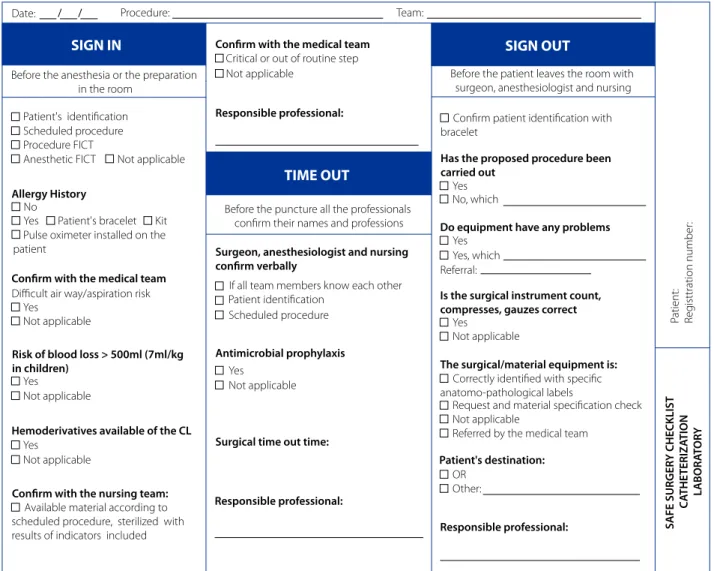
In order to meet the Goal 4 criteria, it was adopt-ed the application of the checklist, calladopt-ed Safe Surgery Checklist, in all diagnostic and therapeutic procedures. The room procedure note contains the patient identifi-cation data, description, material/drug consumption, the description of the laterality of the procedure (when ap-plicable) and a space to register the accomplishment of the checklist.
The implementation of the checklist occurred in 2012 in the CL, in line with other areas, when the institution was in preparation for evaluation by the JCI. A total of 13 units of the HCPA apply the checklist, following the precept of
ensuring intervention in the correct patient, correct proce-dure and correct location.
As a matter of routine, from the moment these strate-gies were instituted, with extensive training of the multi-professional team, the checklist became mandatory in the CL, being checked each item at the entrance of the patient in the room, before the puncture/surgical incision in the presence of all the staff and before the patient leaves the room. Currently, this checking procedure is performed by the nursing team, for being present in all the stages.
The checklist was adapted considering the character-istics of the unit and the procedures performed, and it is already in its second version since its implementation (Figure 1). A study by European researchers evaluated the use of the WHO checklist in 20 CL procedures and verified that the tool was unsatisfactory, it was performed/docu-mented: at the sign in 30%/40%, at the time out 10%/15%, and at the sign out 10%/15% of the time. In addition, two incidents of almost failure were identified, so a modified checklist was implemented for the specific challenges faced in the CL and, after training with the team, a new audit performed in 34 cases showed improvement in all sections in the performed/documented item (at the sign in: 91.2%/82.4%, at the time out: 85.3%/76.5%, and at the sign out: 73.5%/64.7%), with no safety incident(13). These
data reinforce that specific areas should fit the instrument into their own context.
The CL has evolved significantly in recent years, with procedures to treat in addition to coronary diseases, other conditions. Therefore, the checklist should address safety issues for different medical specialties involved in the pa-tient care and when under general anesthesia.
The checklist application/documentation is an indi-cator of quality of care in the HCPA LC (the numerator is equal to the number of checklists applied and the de-nominator to the number of procedures by specialty). Its application rate reaches the institutional goal above 90%. The engagement of medical specialties in the process of applying the checklist needs to be advanced in order to be carried out spontaneously and integrated with the nursing team.
Its use makes it possible to perform other process mon-itoring in the CL service, therefore, it was associated with a decrease in radiation exposure, fewer complications, more rapid changes in patients in the room, and a more posi-tive response in the climate questionnaire answered by the team(14). The checking focused on the needs of each area/
FINAL CONSIDERATIONS
By implementing the patient safety goals and the rec-ommended checklist in Goal 4, it was observed an opti-mization in the communication between the profession-als about the care processes and register of information regarding the accomplishment of the procedure, which began to integrate the data of the patient’s chart.
The safety strategies adopted can serve as an example for other institutions, as well as the developed checklist model. The implantation occurred in a hospital in the pro-cess of hospital accreditation, used to the incorporation of safety measures, which may require other actions for im-plementation in institutions in which this culture is still in development.
REFERENCES
1. Institute of Medicine (US). Committee on Quality of Health Care in America. Crossing the quality chasm: a new health system for the 21st century. Washing-ton (D.C.): National Academy Press; 2001 [cited 2018 Jun 28]. Available from: http://www.nap.edu/books/0309072808/html/.
2. Agência Nacional de Vigilância Sanitária (BR). Pacientes pela segurança do pa-ciente em serviços de saúde: como posso contribuir para aumentar a segurança do paciente? orientações aos pacientes, familiares e acompanhantes. Brasília: Anvisa, 2017 [cited 2018 Jun 28]. Available from: http://portal.anvisa.gov. br/documents/33852/3507912/Como+posso+contribuir+para+aumen-tar+a+seguran%C3%A7a+do+paciente/52efbd76-b692-4b0e-8b70-656 7e532a716.
3. Joint Commission International (US). Padrões de Acreditação da Joint Com-mission International para hospitais incluindo padrões para hospitais do centro médico acadêmico. 6. ed. Oak Brook: Joint Commission Resources; 2017.
SIGN IN SIGN OUT
TIME OUT
Before the anesthesia or the preparation in the room
Critical or out of routine step
Before the patient leaves the room with surgeon, anesthesiologist and nursing Not applicable
Team: Date: Procedure:
Before the puncture all the professionals
confirm their names and professions
Patient identification Patient's identification
Scheduled procedure
If all team members know each other Scheduled procedure
Procedure FICT Anesthetic FICT Not applicable
No
Allergy History
Confirm with the medical team
Responsible professional:
Has the proposed procedure been carried out
Do equipment have any problems
Is the surgical instrument count, compresses, gauzes correct
The surgical/material equipment is:
Patient's destination:
SAFE SURGER
Y CHECKLIST
C
A
THE
TERIZ
A
TION
L
ABOR
A
T
OR
Y
P
atient: Reg
isttration number
:
Responsible professional: Surgeon, anesthesiologist and nursing
confirm verbally
Antimicrobial prophylaxis
Surgical time out time:
Responsible professional: Confirm with the medical team
Risk of blood loss > 500ml (7ml/kg in children)
Hemoderivatives available of the CL
Confirm with the nursing team:
Yes Patient's bracelet Kit
Difficult air way/aspiration risk Yes
Not applicable
Yes Not applicable
Yes Not applicable
Yes Not applicable
Available material according to scheduled procedure, sterilized with results of indicators included
Pulse oximeter installed on the patient
Confirm patient identification with bracelet
Yes No, which
Yes Yes, which Referral:
Yes
Not applicable
Correctly identified with specific anatomo-pathological labels
Request and material specification check Not applicable
OR Other:
Referred by the medical team
Figure 1 - Items present at the CL safe surgery checklist
Source: Checklist CL HCPA Safe Surgery, 2018.
4. Joint Commission International (US) [Internet]. Oakbrook Terrace, IL; c2018 [cit-ed 2018 Jun 24]. JCI - accr[cit-edit[cit-ed organizations; [about 15 screens]. Available from: https://www.jointcommissioninternational.org/about-jci/jci-accredit-ed-organizations/.
5. Organização Mundial da Saúde (CH). Segundo desafio global para a segu-rança do paciente: manual - cirurgias seguras salvam vidas (orientações para cirurgia segura da OMS). Brasília: OPAS, Ministério da Saúde, Agência Nacio-nal de Vigilância Sanitária; 2009 [cited 2018 Jun 24]. Available from: http:// bvsms.saude.gov.br/bvs/publicacoes/seguranca_paciente_cirurgias_segu-ras_guia.pdf.
6. World Health Organization (CH). Surgical safety checklist. Geneva: WHO; 2009 [cited
7. 2018 Jun 28]. Available from: http://apps.who.int/iris/bitstream/han- dle/10665/44186/9789241598590_eng_Checklist.pdf;jsessionid=FEFE1B-53CC8CB8B0B3AB5333645F3AD7?sequence=2.
8. World Health Organization (CH). Implementation manual WHO surgical safety checklist 2009: safe surgery saves life. Geneva: WHO; 2009 [cited 2018 Jun 28]. Available from: http://apps.who.int/iris/bitstream/han-dle/10665/44186/9789241598590_eng.pdf?sequence=1.
9. Safe surgery checklist: implementation guide. Boston, MA: Ariadne Labs; 2015 [cited 2018 Jun 28] Available from: http://www.safesurgery2015. org/uploads/1/0/9/0/1090835/safe_surger y_implementation_ guide__092515.012216_.pdf.
10. Treadwell JR, Lucas S, Tsou AY. Surgical checklists: a systematic review of impacts and implementation. BMJ Qual Saf. 2014 Apr;23(4):299-318. doi: https://doi. org/10.1136/bmjqs-2012-001797.
11. Tang R, Ranmuthugala G, Cunningham F. Surgical safety checklists: a review. ANZ J Surg. 2014 Mar;84(3):148-54. doi: https://doi.org/10.1111/ans.12168. 12. Fudickar A, Hörle K, Wiltfang J, Bein B. The effect of the WHO surgical safety
checklist on complication rate and communication. Dtsch Arztebl Int. 2012 Oct;109(42):695-701. doi: https://doi.org/10.3238/arztebl.2012.0695. 13. Carnevale, F C. Tratado de radiologia intervencionista e cirurgia endovascular. 1.
ed. Rio de Janeiro: Thieme Revinter Publicações; 2017.
14. Braham DL, Richardson AL, Malik IS. Application of the WHO surgical safety checklist outside the operating theatre: medicine can learn from surgery. Clin Med (Lond). 2014 Oct;14(5):468-74. doi: https://doi.org/10.7861/clinmedicine.14-5-468. 15. Lindsay AC, Bishop J, Harron K, Davies S, Haxby E. Use of a safe procedure checklist
in the cardiac catheterisation laboratory. BMJ Open Qual. 2018;7(3):e000074. doi: http://dx.doi.org/10.1136/bmjoq-2017-000074.
Corresponding author:
Rejane Reich
E-mail: [email protected]