www.scielo.br/aabc
Combination sensitivity and processing of communication calls in the
inferior colliculus of the Moustached Bat
Pteronotus parnellii
CHRISTINE V. PORTFORS
School of Biological Sciences, Washington State University 14204 NE Salmon Creek Ave., Vancouver, WA 98686, USA
Manuscript received on January 15, 2004; accepted for publication on February 5, 2004.
ABSTRACT
Many animals use complex communication calls in social behaviors. In some species we know the features in the calls that elicit particular behaviors, but we do not understand how the auditory system encodes the calls. Nor do we understand the mechanisms underlying neural selectivity to calls. Our studies of the auditory midbrain of the Moustached BatPteronotus parnelliihave revealed a neural mechanism important for generating selective responses to calls. Neurons that integrate information across different frequencies show selectivity to communication calls. “Combination sensitivity” may be a common mechanism for encoding complex sounds because it is also important for encoding echolocation signals.
Key words:auditory system, inferior colliculus, communication calls, bat.
INTRODUCTION
Many animals use acoustically complex communi-cation calls in social interactions with conspecifics. The acoustic properties and functional importance of species-specific vocalizations have been studied in a variety of animals. For example, the impor-tance of acoustic communication is well illustrated by the ability of mothers to recognize their own off-spring in a variety of species (bats: Balcombe and McCracken 1992; fur seal: Insley 2000, Mathevon et al. 2004; penguins: Jouventin and Aubin 2002, Aubin 2004; sheep: Searby and Jouventin 2003). However, we have very little understanding of how communication sounds are processed in the audi-tory midbrain, particularly in mammalian species. The inferior colliculus (IC) is the main audi-tory midbrain nucleus, and almost all audiaudi-tory in-formation from lower centers converges in the IC
E-mail: [email protected]
(Brunso-Bechtold et al. 1981, Casseday et al. 2002). It is also the first site in the ascending audi-tory pathway where neurons with spectral integra-tion properties emerge (Portfors and Wenstrup 2001, Wenstrup and Leroy 2001). Because of these features, the IC is a prime site to examine neural processing of complex sounds such as communica-tion sounds.
254 CHRISTINE V. PORTFORS
the processing of echolocation and communication calls in the auditory midbrain. In this short com-munication, we outline the features of a certain type of neural response property, combination sensitiv-ity, and discuss how this response may underlie pro-cessing of echolocation signals and communication signals in the IC of the Moustached BatPteronotus parnellii.
COMBINATION SENSITIVITY AND PROCESSING ECHOLOCATION SIGNALS
There are many combination-sensitive neurons in the IC of the Moustached Bat. These neurons in-tegrate spectral and temporal information in com-plex sounds, and the majority of research has fo-cused on how these neurons integrate elements in the echolocation signal of that species (Mittmann and Wenstrup 1995, Portfors and Wenstrup 1999). Combination-sensitive neurons respond in a facili-tatory or inhibitory manner to combinations of dis-tinct spectral elements in the echolocation signal as long as the elements occur in a specific tempo-ral order. The Moustached Bat echolocation sig-nal has a fundamental frequency in the 24-31 kHz range and consists of a constant frequency compo-nent (20-30 ms) followed by a brief (3-4 ms) fre-quency modulated (FM) down sweep. The charac-teristic frequency and temporal tuning of one type of combination-sensitive neuron, the so-called “FM-FM” neuron, provides an indication that this neu-ron type is involved in analysis of target distance information (Portfors and Wenstrup 1999). These neurons are tuned in frequency to one of the higher harmonic FM bands in the sonar signal (FM2, FM3 or FM4) and are facilitated by a second sound in the frequency band of the first harmonic FM (FM1) of the sonar call, providing that the two sounds occur in a specific temporal relation. In particular, the higher harmonic FM signal must occur after the FM1 sig-nal. The time delay that elicits the best response (best delay) ranges between 1 and 20 ms (Portfors and Wenstrup 1999). These best delays correspond to the behavioral range of echolocation (Kick 1982). In frequency bands that represent the echolocation
signal, over 70% of the neurons show either facilita-tory or inhibifacilita-tory combination sensitivity (Portfors and Wenstrup 1999) suggesting that combination sensitivity is a common response feature in the IC of the Moustached Bat, at least in the regions in-volved in processing echolocation signals. In the sections below, we provide evidence for combina-tion-sensitive neurons in “non-sonar” frequency re-gions in the IC and suggest that these neurons may be involved in processing communication sounds.
FACILITATORY COMBINATION SENSITIVITY AND SELECTIVITY TO COMMUNICATION CALLS
The first suggestion that combination-sensitive neu-rons may be involved in processing sounds other than echolocation signals came from a study by Leroy and Wenstrup (2000) in which they showed that some neurons in the IC of the Moustached Bat were facilitated or inhibited by combinations of fre-quencies outside of the sonar frequency ranges. For example, some neurons were facilitated or inhibited by combinations of pure tones that had frequencies in the 10-23 kHz and 33-47 kHz bands. More re-cently, Portfors and Wenstrup (2002) studied neu-rons in the frequency bands between 15 and 59 kHz and found that over fifty percent of the neurons in this region of the IC had complex frequency tun-ing that included multiple excitatory frequency re-sponse areas and facilitatory combination sensitiv-ity. Further, some neurons showed combination-sensitive facilitation to more than two different fre-quency sounds (Portfors and Wenstrup 2002). These complex frequency-tuning characteristics suggest that some neurons in the IC may be well suited for the analysis of the bat’s communication calls.
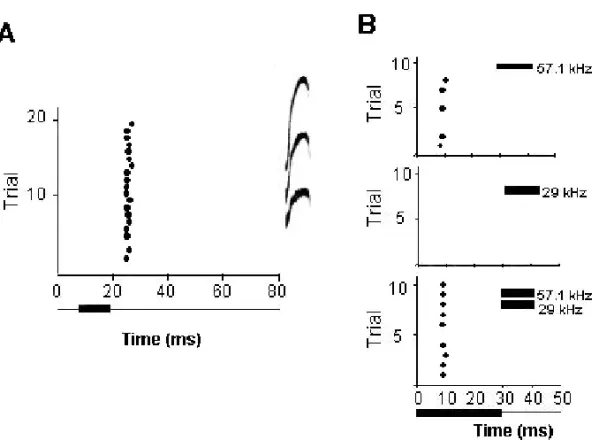
Fig. 1 – Responses of a single neuron in the IC to a communication call and tone stimuli. The single unit shown here responded to only one of fourteen different communication calls. A: Raster plot of the neuron’s response to its preferred vocalization (three-harmonic, upward frequency modulated sweep call is shown in the insert). Twenty emissions of the call were presented to the single unit. B: Raster plots showing combination-sensitive response of the neuron. The neuron responded in a facilitatory manner to the combination of the 57 kHz and 29 kHz tones. Ten emissions of the stimuli were presented. Black bars under raster plots indicate onset time and duration of stimulus.
tones and communication calls. Sounds were pre-sented through a speaker located 10 cm away and 25 degrees toward the contralateral ear. All sounds were presented at a range of intensities up to 80 dB-SPL. The major finding is that a neuron’s response to communication calls was not well predicted by its response to single tones but was well predicted by its combination-sensitive response. Figure 1 shows an example of a neuron that only responded to one call (a multi-harmonic, upward frequency modu-lated sweep; Fig. 1A) regardless of intensity. This selectivity could not be explained by the neuron’s response to single tones (excitatory frequency re-sponse area) but could be explained by the neuron’s combination-sensitive facilitatory response to pairs of tones. The neuron responded weakly to tones at and near 57 kHz and was facilitated when a tone in
256 CHRISTINE V. PORTFORS
selective to particular communication calls.
INHIBITORY COMBINATION SENSITIVITY AND SELECTIVITY TO COMMUNICATION CALLS
Inhibition is another mechanism for creating selec-tivity. Klug et al. (2002) tested selectivity of neu-rons in the IC of the Mexican Free-tailed Bat Tadarida brasiliensisto ten different communica-tion calls and found that most neurons showed selec-tive responses to a subset of the vocalizations even though some of the other vocalizations had energy in the excitatory frequency response area of the neu-ron. Using iontophoresis of bicuculline (a GABA receptor antagonist) onto the selective neurons, they showed that blocking inhibition decreased the selec-tivity of the neurons. In their study, however, it was not clear what range of frequencies was important for creating the selectivity.
In our studies of selectivity and combination-sensitivity in the Moustached Bat IC, we used a two-tone paradigm to determine the frequency tuning of the inhibitory combination-sensitive responses. Combination-sensitive inhibition occurs when the excitatory response of the neuron is inhibited by a second frequency signal that is at least one oc-tave above or below the frequency that elicits the neuron’s best response. Combination-sensitive in-hibition presents an interesting mechanism for sup-pressing a neuron’s response to a variety of stimuli, thereby creating selectivity. For example, a neuron with a best frequency of response of 50 kHz would be expected to respond to all communication sounds with energy in that frequency range. However, if the neuron was also inhibited by a second sound in the 18-25 kHz range, it would not respond to any calls that had energy in both of the frequency ranges. This type of inhibitory combination sensitivity is com-mon in the IC of the Moustached Bat and seems to play an important role in creating selectivity to certain communication calls.
CONCLUDING COMMENTS
In this short communication we have briefly de-scribed how facilitatory and inhibitory combination
sensitivity may underlie the selectivity to communi-cation calls of some neurons in the IC of the Mous-tached Bat. Many questions remain regarding the processing and representation of communication calls in the auditory system. For example, it is not clear whether combination sensitivity underlies processing of communication calls in other mam-mals. We have recent evidence that some neurons in the Laboratory MouseMus musculus IC show combination-sensitive facilitation and/or inhibition, but we do not know if these neurons are involved in processing communication calls (Portfors 2003). However, considering that many of the spectral and temporal features of combination-sensitive neurons in Laboratory Mouse IC are similar to those in Mous-tached Bat IC, it seems likely that combination sen-sitivity is a common neural mechanism in mammals for generating selectivity in neurons involved in pro-cessing complex sounds.
ACKNOWLEDGMENTS
This work was supported by the National Institutes of Health grant DC04733 from the National Insti-tute on Deafness and Communication Disorders. I thank J.J. Wenstrup for helping with many of the ex-periments and D.P. Gans for software and technical assistance. I am grateful to the Wildlife section of the Ministry of Agriculture, Land and Marine Re-sources of Trinidad and Tobago for permission to export the bats.
RESUMO
Muitos animais usam gritos de comunicação complexos
nos seus comportamentos sociais. Sabemos em
algu-mas espécies quais parâmetros dos gritos estimulam
de-terminados comportamentos, mas não entendemos como
o sistema auditivo codifica os gritos. Tampouco
enten-demos os mecanismos subjacentes à seletividade neural
aos gritos. Nossos estudos do mesencéfalo auditivo do
morcegoPteronotus parnelliirevelaram um mecanismo neural importante para produzir respostas seletivas aos
gritos. Neurônios que integram informação proveniente
gri-tos de comunicação. “Sensibilidade a combinações” de
freqüências pode ser um mecanismo comum para
codi-ficar sons complexos, já que é importante também para
codificar sinais de ecolocação.
Palavras-chave: sistema auditivo, colículo inferior,
gri-tos de comunicação, morcego.
REFERENCES
Aubin T. 2004. Penguins and their noisy world. An Acad Bras Cienc 76: 279-283.
Balcombe JP and McCracken GF. 1992. Vocal nition in Mexican Free-tailed Bats: do pups recog-nize mothers? Anim Behav 43: 79-87.
Brunso-Bechtold JK, Thompson GC and Master-ton RB. 1981. HRP study of the organization of auditory afferents ascending to central nucleus of in-ferior colliculus of cat. J Comp Neurol 197: 705-722.
Casseday JH, Fremouw T and Covey E. 2002. The inferior colliculus: A hub for the central auditory system. In:Oertel Det al. (Eds), Integrative func-tions in the mammalian auditory pathway. NewYork: Springer Verlag, p. 238-318.
Griffin DR. 1986. Listening in the dark. Ithaca, NY: Cornell University Press.
Insley SJ. 2000. Long-term vocal recognition in the Northern Fur Seal. Nature 406: 404-405.
Jouventin P and Aubin T. 2002. Acoustic systems are adapted to breeding ecologies: individual recogni-tion in nesting penguins. Anim Behav 64: 747-757.
Kanwal JS, Matsumura S, Ohlemiller K and Suga N. 1994. Analysis of acoustic elements and syntax in communication sounds emitted by Mustached Bats. J Acoust Soc Am 96: 1229-1254.
Kick SA. 1982. Target detection by the echolocating bat,
Eptesicus fuscus. J Comp Physiol 145: 431-435.
Klug A, Bauer EE, Hanson JT, Hurley L, Meitzen J and Pollak GD. 2002. Response selectivity for species-specific calls in the inferior colliculus of Mexican Free-tailed Bats is generated by inhibition. J Neurophysiol 88: 1941-1954.
Leroy SA and Wenstrup JJ. 2000. Spectral integration in the inferior colliculus of the Mustached Bat. J Neurosci 20: 8533-8541.
Mathevon N, Charrier I and Aubin T. 2004. A mem-ory like a fur seal female: long-lasting recognition of pup’s voice by mothers. An Acad Bras Cienc 76: 237-241.
Mittmann DH and Wenstrup JJ. 1995. Combination-sensitive neurons in the inferior colliculus. Hear Res 90: 185-191.
Portfors CV. 2003. Spectral and temporal response properties of single neurons in the inferior colliculus of the mouse. Daytona Beach, Florida, USA: Assoc Res Otolaryngol Abstr, p. 175.
Portfors CV and Wenstrup JJ. 1999. Delay-tuned neurons in the inferior colliculus of the Mustached Bat: Implications for analyses of target distance. J Neurophysiol 82: 1326-1338.
Portfors CV and Wenstrup JJ. 2001. Responses to combinations of tones in the nuclei of the lateral lem-niscus. JARO 2: 104-117.
Portfors CV and Wenstrup JJ. 2002. Excitatory and facilitatory frequency response areas in the inferior colliculus of the Mustached Bat. Hear Res 168: 131-138.
Searby A and Jouventin P. 2003. Mother-lamb acous-tic recognition in sheep: frequency coding. Proc R Soc Lond B 270: 1765-1771.