Affirmative Action Attitudes of Whites: Evidence from a List
Experiment Survey in Brazil
*Robert Vidigal
Universidade de Brasília, Brasília, Distrito Federal, Brasil
Recently in Brazil, public policies have begun to be implemented to reduce discrimination and promote the inclusion of excluded social groups based on a specific individual characteristic: race. However, there is little public consensus about such policies, especially among whites. In this work, I look at the racial attitudes towards affirmative action among white college students. I make use of new research methods for the empirical study of socially sensitive issues and ask whether these attitudes stem from prejudice, conflicts between social groups or individual political predispositions. Furthermore, I ask what is the relationship between political knowledge and such racial attitudes. I use the list experiment method because of its potential to offset the under-representation of opinions and attitudes. This approach allows respondents to be indirectly questioned, ensuring greater sincerity in their answers and, hence, providing more accurate portrayal of attitudes. This study shows that white respondents' answers on affirmative action policies are strongly affected by social desirability. Only 6% of white respondents agreed that it is important to have a quota policy for blacks at the Federal University of Santa Catarina (UFSC). Individuals with greater political knowledge tend to express greater support for affirmative action and hold more coherent racial attitudes Results also reveal that negative racial attitudes and political predispositions are both determinants of the white student's attitudes towards affirmative action policies.
Keywords: Affirmative action; racial attitudes; public opinion; political knowledge; experiment.
(*)http://dx.doi.org/10.1590/1981-3821201800020003 This publication is registered under a CC-BY Licence.
The author thanks Mathieu Turgeon, Ronaldo Pilati and Laurel R. Yohe as well the anonymous BPSRreviewers for their valuable comments. Previous version of this paper was presented on the II Political Behavior and Public Opinion Workshop on the Universidade Federal de Minas Gerais.
he implementation of affirmative action policies in Brazil to promote the inclusion of social groups excluded specifically based on race are a recent development. These policies vary from the creation of quotas that promote access of blacks to higher education to universalist efforts to reduce the impoverished Brazilian populations composed mostly of blacks (TELLES and BAILEY, 2002)1. However, the
perception of these policies by white individuals is not well understood.
In this article, I present a study of racial attitudes among white college students at the Federal University of Santa Catarina (UFSC) and their opposition to affirmative action. Attitudes against affirmative action encompass a variety of arguments and values, which include some of the following notions: affirmative action consists of an unfair preferential policy; the policy is reverse discrimination; and the policy stigmatizes the people they want to help (BOBO, 1999; SEARS et al., 1997).
The purpose of this article is to advance our understanding of white opposition to affirmative action in Brazilian federal public universities. I draw on the literatures of the three main schools of thought explaining opposition to racial policies in the United States, all of which propose competing theories. However, these theories are often discussed in the context of race being a discrete, or even binary, entity. How can these theories be applied to a multiracial society in which the spectrum of skin colors is a continuum containing over a hundred distinct classifications? Therefore, I ask, do the attitudes of white students against affirmative policies reflect a new form of racism based on psychological processes (e.g. prejudice, negative stereotypes and discrimination), or are they an expression of conflicts between groups (e.g. intergroup resentment, out-group devaluation and social domination), or rather are they mere reflections of political values and predispositions? And finally, what is the role of political knowledge in shaping racial attitudes?
I argue that beliefs about social hierarchy and intergroup resentment (PRATTO et al., 1994; SIDANIUS et al., 1999) emerge as the key drivers of rejection of affirmative action by white students. Both race and class shape the social stratification in Brazil, and the origins of class cleavages result from the accumulation of either privileges or disadvantages passed on by previous generations. As a result, opposition to affirmative
_____________________________________________________________________________________________________ 1In this article I use the term “black” to refer to the Portuguese “negro”, which combines the
official categories of race/color used in the Brazilian census: “preto” (black/dark-skinned) and
“pardo” (brown/mixed race).
action can maintain and strengthen group hierarchies, because the policy seeks direct and effective intervention to alter the racial status quo.
Symbolic politics is not directly applicable to the Brazilian context, because the theory was conceived in the context of American society, where a belief in individualism, self-advancement, and a Puritan work ethic are dominant values (KINDER and SEARS, 1981; SEARS, 1988; SEARS and KINDER, 1971). Political predispositions also cannot explain the opposition, because this theory focuses on political and ideological motives (SNIDERMAN and CARMINES, 1997; SNIDERMAN and PIAZZA, 1993). However, in Brazil, attitudes towards individualism, the role and size of the state, and ideology are not strongly developed among all individuals, and the general political knowledge of the population is poor (BARTELS, 1996; LUSKIN, 2002; OLIVEIRA and TURGEON, 2015).
As such, further empirical evidence is needed to explore public opinion in this area. New research methods for identifying 'socially sensitive' attitudes will be helpful for measuring people’s true attitudes. Socially sensitive issues are those that in which individuals may hold opinions that are controversial in relation to social norms, instilling fear and apprehension of stigmas and social reprisals. Issues such as sexuality, race, gender, drug use and more recently, voter buying, (CORSTANGE, 2012; GONZALEZ-OCANTOS et al., 2012) create a social desirability bias in survey answers. This pushes individuals and social groups towards expressing attitudes that are considered acceptable according to wider the social norms (BERINSKY, 2002; CORSTANGE, 2009).
My data was collected via a survey conducted at the Universidade Federal de Santa Catarina (UFSC) regarding the opinions of white students towards affirmative action. The technique I make use of is known as a list experiment and is typically applied in political science research (e.g. KUKLINSKI et al., 1997a; KUKLINSKI et al., 1997b; SNIDERMAN and CARMINES, 1997) to identify opinions on socially sensitive issues. The advantage of the approach is that it allows the researcher to question respondents indirectly, thus ensuring greater sincerity in their answers.
the respondents. Individuals with greater political knowledge expressed markedly different attitudes to those with weak political knowledge (ZALLER, 1992).
In other words, more politically knowledgeable people are more competent in expressing their opinions and are more likely to express opinions that are consistent with their personal preferences. Social dominance theory is based on the idea of 'group centrism', drawn from social psychology, which posits individual identification with a group and a clear differentiation between 'us' and 'them'. Racial cleavages in the US are clear and based on the one-drop rule, yet this is not at all evident in Brazil. Below, I will discuss a few possible theoretical and methodological reasons for these unexpected findings.
In Latin America and Brazil, with few exceptions (e.g., AGUILAR et al., 2015; BAILEY, 2002, 2004; BAILEY et al., 2015; BUENO and DUNNING, 2017; UFF, 2002; TURRA and VENTURI, 1995; SANTOS and SILVA, 2005), there is little public opinion research on racial issues. This study is unusual in that it maps the racial attitudes of college students in Brazil through a survey-experiment (see also TURGEON, CHAVES and WIVES, 2014; VIDIGAL, 2015), providing a more accurate picture of public opinion among those who oppose affirmative action policies in universities. This study demonstrates that research on socially sensitive issues should devote further attention to the social desirability effect, since the results of this study and others (TURGEON, CHAVES and WIVES, 2014; VIDIGAL, 2015) clearly show its effect on the opinions not only of whites, but of individuals in general. Throughout the discussion and conclusion, I discuss the specificities of the Universidade Federal de Santa Catarina, the limitations of the study and the possibility for generalization.
Affirmative action and race relations in Brazil
policies are understood as temporary interventions, which aim to correct social distortions in access to opportunities.
The US experience with affirmative action policies is relevant to Brazil (TELLES and BAILEY, 2013) given the historical similarities between the two countries, such as the fact that they are the two largest European colonies in the Americas and that both have a history of slavery. Not surprisingly, most research on literature, public opinion, and affirmative action is focused on the US (BOBO and KLUEGEL, 1993; SEARS et al., 1997). In the US, public opinion studies often have large samples and include data on racial issues. Indeed, these types of research are canonical in US academic research (BAILEY et al., 2015).
However, the comparison between the US and Brazilian contexts is complex and should be approached with caution, due to the stark contrast in definitions of race/color between the two countries (TELLES and BAILEY, 2002). In the United States, the “ one-drop rule” of racial classification prevails, whereas in Brazil racial ambiguity is celebrated. Racial classification in Brazil is dynamic process2 (MUNIZ, 2012). For
example, people can be identified as light-skinned, even when displaying black features. As in many other Latin American countries, racial classification is not only perceived through physical appearance and ancestry, but also via socioeconomic position: "color is only one of many elements in the relation of race to social construction" (CARVALHO, 2005, p. 75).
A person considered black in the US is not always also considered black in Brazil. Brazilians prefer to use the term 'color' to identify people, and use different terms for classification. This term is preferred because it captures the degree of variation within the country (TELLES, 2004). Moreover, influential ideas about miscegenation in Brazil propose that whites, blacks, and Indians socialize, live, and mingle biologically to the point that racial distinctions become meaningless.
Racial affect, social stratification, and political predispositions
A first perspective on the opposition of whites to racial quotas is ‘symbolic racism’ or ‘new racism’. This differs from ‘traditional’ (or ‘old fashioned’) racism which proclaimed white superiority, physical segregation and legal discrimination against
_____________________________________________________________________________________________________ 2 A thorough review of the use of the race/color variable in quantitative studies can be found in
blacks (SEARS et al., 1997). Symbolic racism involves negative feelings from whites toward blacks. McConahay and Hough (1976) define it as the "expression in symbols and symbolic attitudes that black people are violating estimated values and are carrying out illegitimate demands for change in the racial status quo" (MCCONAHAY and HOUGH 1976, p. 38).
Sears (1988) and McConahay (1986) mention affirmative action opposition as one of the symbolic elements of this new racism. Symbolic racism avoids the explicit manifestations of racism, since these are no longer socially acceptable due to their incompatibility with democratic principles of equality and freedom. As a result, people began to express prejudice in a more restrained and subtle way. The new racism is based on negative feelings and opposition to policies such as 'busing', affirmative action, blacks holding public office, and social assistance (SEARS et al., 1997).
Symbolic racism is formed from three elements. First, it is described as 'symbolic', as it is formulated in abstract terms and reflects the moral code of whites about how society should be organized (KINDER and SEARS, 1981). Second, its cognitive content focuses explicitly on the blacks and on beliefs that racial discrimination is largely a thing of the past; that blacks need to just work harder to overcome their disadvantages; that blacks are making excessive demands for special treatment, are receiving too much attention from political elites, and that their earnings are often undeserved (SEARS, 1988; SEARS et al., 1997). Third, the affective component, racial attitudes stem from a mix of anti-black feelings and perceptions that blacks violate traditional values such as the work ethic, traditional morality, individualism, obedience, long-term rewards, discipline and respect for traditional authority (KINDER and SEARS, 1981).
myth of ‘racial democracy' have produced different dynamics in race relations in Brazil and the development of different societal values.
A second theoretical model argues that racial animus is no longer central to the attitudes and racial beliefs of whites and, moreover, that racial prejudice no longer dominates the reactions to racial policies of whites (SNIDERMAN and PIAZZA, 1993). This position, known as principled politics, focuses on political values that cause racial policies to be perceived as violating non-racial values, thus leading to their rejection by whites (SNIDERMAN and CARMINES, 1997). Hence, in this model, white opposition to affirmative action must be understood through values such as the role of the government in social life and the importance of meritocracy and individualism.
The main argument is that racial policies relate to conflicts over social welfare, driven by opposing views on the role of government and the individual obligations of citizens. When individuals evaluate public policies according to their individual political orientation, they take into account what matters to them and what does not, and then position themselves for or against a public policy.
However, principled politics may be a weak force in Brazil, given that this theory rests on political and ideological values. Attitudes and beliefs about ideology, individualism and the role of the government are not deeply ingrained in Brazil because, in general, political knowledge is poor (BARTELS, 1996; LUSKIN, 2002). Surveys consistently demonstrate that the level of political education of the general public in Brazil, and much of the world, is low (DELLI CARPINI and KEETER, 1996; TURGEON and RENNÓ, 2010). As a result, purely political and ideological motives are unlikely to explain the rejection of racial policies by whites.
A last perspective on racial attitudes is social dominance theory (e.g. FEDERICO and SIDANIUS, 2002; PRATTO et al., 1994; SIDANIUS et al., 1999). This is composed of three main ideas: 1) societies tend to be organized into hierarchical groups with different power and status; 2) politics is the competition between social groups for scarce material and symbolic resources and; 3) dominant groups often depend on a variety of collective representations (for example, ideologies and myths) to justify the disproportionate allocation of resources in society and thus reinforce the inequality between groups (FEDERICO and SIDANIUS, 2002).
predisposition for anti-egalitarianism between groups (SIDANIUS and PRATTO, 2001). Social dominance suggests that opposition to affirmative action would have the aim of strengthening inter-group hierarchies, because affirmative action policies seek direct and effective intervention to alter the racial status quo.
Ideologies are central to the production and reproduction of racial oppression (PRATTO et al., 1994). To proceed smoothly, these ideologies must be widely accepted within a society, appearing as self-evident truths and hierarchy-legitimating myths. Myths help to stabilize oppression (PRATTO et al., 1994), such that they minimize conflict among groups (for example, Brazil's myth of 'racial democracy'3). Dominant
groups sense a greater threat of losing social status when policies are adopted that promote changes in the status quo. These groups more readily perceive the threat of out-groups, because its members are more likely to have higher levels of social dominance and higher levels of in-group identification (PRATTO et al., 1994).
Socioeconomic inequality in Brazil has resulted in strong class cleavages that have traditionally been considered stronger than racial cleavages (BAILEY, 2004). However, race and class both shape social stratification in Brazil. Resistance to changing the racial status quo, beliefs about social hierarchy, and intergroup resentment are hypothesized as central to the rejection of affirmative action4. Therefore, social
dominance theory may be more compatible with the Brazilian reality and most effectively explain opposition to racial quotas.
Political knowledge and racial attitudes
Political sophistication refers to the breadth, depth and organization of an individual’s political cognitions (LUSKIN, 1990). An individual is politically sophisticated when "cognitions are numerous, complex and highly organized" (LUSKIN, 1990, p. 332). Political sophistication, then, is a kind of expertise. For example, ideology is a complex political cognition: a political belief system that is particularly large, wide and organized, and requires expertise about politics.
_____________________________________________________________________________________________________ 3 Racial Democracy is the myth that denies the existence of any kind of racism in Brazil. It is
widely endorsed by both whites and blacks, thus serving to preclude the possibility of collective action by and for specific social groups (BAILEY, 2004). Denying that racial discrimination causes disadvantage to blacks is a central element of this myth, which impacts on both attitudes towards racial policies and actions against racism (BOBO and KLUEGEL, 1993).
4 As the results of Telles and Bailey (2013) also show, most people in Latin America point to
Sophistication is a latent variable, because cognitions cannot be seen or listed (BULLOCK, 2004). As mental organization is an abstraction, past studies used abstractions of speech as measurements. However, measures based on such abstractions are no longer used today (BULLOCK, 2004). Nowadays, measurement is based on knowledge demonstrated in response to factual questions (e.g. "How long is the term of office for a Senator?").
Knowledge of political facts measures the breadth and depth of cognition and is used as proxy for political sophistication (e.g. ALTHAUS, 1998; BULLOCK, 2004; DELLI CARPINI and KEETER, 1996). Hence, a sophisticated person is one who has greater political information. Delli Carpini and Keeter (1996) define political knowledge as "the range of factual information about policies that are stored in long term memory" (DELLI CARPINI and KEETER, 1996, p. 10).
Individuals with greater political knowledge are better able to form opinions that are consistent with their political predispositions (DELLI CARPINI and KEETER, 1996; ZALLER, 1992). Studies show that there are differences between the racial attitudes of individuals with different levels of political knowledge, even after controlling for other variables, such as education and income (BOBO and MASSAGLI, 2001; DELLI CARPINI and KEETER, 1996; OLIVER and MENDELBERG, 2000).
Political knowledge facilitates information processing and helps to sort out attitudes (WOOD, RHODES AND BIEK, 1995). Those possessing it can perceive, understand, and recognize the relative merits of different sources of information. Knowledge helps to crystallize attitudes because they are constructed on a more extensive and well-organized knowledge structure and provides a foundation of information for evaluation of the specific issue (WOOD, RHODES AND BIEK, 1995).
Therefore, the hypothesis here is that political knowledge plays a major role in shaping racial attitudes ̶ not only general political knowledge, but in particular specific knowledge about racial policies. Specific knowledge about policy leads individuals to take different positions to those they would if they did not possess such knowledge (GILENS, 2001).
tolerance within a democratic society and reduces the impact of racism (McCLOSKY and ZALLER, 1984; SNIDERMAN et al., 1991). Hence, if fostering the adoption of democratic norms and political tolerance reduces prejudice, and in this sense leads to greater support for affirmative action (BOBO and MASSAGLI, 2001; OLIVER and MENDELBERG, 2000; ROBISON, 2014), then it is expected that political knowledge will moderate the effects of each one of the theories discussed above.
Method
The measurement of attitudes towards affirmative action is difficult because it is a socially sensitive issue. More specifically, measurement of preferences is complicated in areas where there is a lack of social consensus. These problems are common on questions relating to race, sexual orientation, drug use and vote buying, which, generally, people are reluctant to answer. People prefer not to publicly disclose their preferences on such issues when faced with traditional surveys (BERINSKY, 2002; KRYSAN and COUPER, 2003). This means responses tend to suffer from a 'social desirability' effect, leading respondents to give answers that are more in-keeping with broader social norms.
The social desirability effect describes the propensity of the respondents to answer questions in a way that will be well received by others, as people care what others think of them and want to make a good impression. There is a strong motivational component, a phenomenon known as 'impression management' (BERINSKY, 2002). This effect may lead to the overestimation of 'good attitudes' or the underestimation of 'bad attitudes' according to the social norms. This trend represents a problem for conducting behavioral research using self-reported surveys. Surveys on racial attitudes paint an optimistic picture; economic and social inequality indicators, by contrast, show far less optimistic results (PAGER and QUILIAN, 2005).
guaranteed for respondents. They will therefore provide truthful answers, even when the social norms encourage them to answer according to what is socially desirable.
However, the gains in eliminating social desirability bias come at the cost of less efficient parameters, due to the loss of aggregated responses (i.e. the sum of items selected). Blair and Imai (2012) developed maximum likelihood estimators (ML) that can be applied to multivariate regression analysis. This method estimates values for the different parameters and thus efficiently enables exploration of respondents’ individual characteristics, and the likelihood that they will agree with the sensitive item at hand. The key advantage of the ML estimators proposed by Blair and Imai (2012) is their robust statistical efficiency, as they allow for the recovery information lost due to response aggregation. However, the validity of this method depends on several assumptions.
The first assumption is the 'no design effect'. A 'design effect' can arise when individuals evaluate the list items relative to one another. It is assumed that the addition of the sensitive item does not change the sum of the positive responses to the other control items. A design effect is when respondents evaluate the control items based on their evaluation of the sensitive item, thus altering the likelihood of agreement between control and treatment items (BLAIR and IMAI, 2012).
The second assumption is that respondents give truthful answers to the sensitive item, in short, that there are no liars. Thus, if assumptions 1 and 2 hold up, it is possible to assume that the addition of the sensitive item does not alter the responses to the control items (no design effect) and that the response to each item is true (no liars). Under these conditions, the proposed method allows researchers to conduct multivariate statistical analysis on the results of the list experiment.
In this paper, I focus on the attitudes of whites towards affirmative action in Brazilian federal universities. Only the questionnaires of self-declared white students were analyzed5. The self-declaration criterion involves "internal process of rejection or
acceptance of symbols, traditions and lifestyle associated with certain groups" (TELLES, 2004, p. 89), and so was chosen as the basis of classification.
Self-declaration is still the only way to avoid violating identities. This measure tends to respect preferences and allows skin color to be 'socially constructed', taking into
_____________________________________________________________________________________________________ 5 Two racial criteria were included in the survey: 1. the identification of the color of students'
account a large part of the individual, collective and circumstantial complexities involved in the construction of race/color. Self-classification tends to be a more reflective process, while the categorization made by others (e.g. an interviewer) involves perceptions of status, geographic location and individual color notions (MUNIZ, 2012), which tend to increase the ambiguity of Brazilian racial classification. Furthermore, self-declaration has been used as the official method of racial classification in Brazil since 1950 (TELLES and BAILEY, 2002). This approach thus avoids violating identities, respects preferences, and allows the expression of the individual, collective and circumstantial complexities involved in perceptions of race (MUNIZ, 2012).
The list experiment
Consider a list experiment of a random sample of N respondents from a population. In a standard design, the sample is randomly divided into a treatment group and a control group, where Ti = 1 (Ti = 0) means that the 'i' is a binary state representing whether the respondent belongs to the treatment group (1), or the control group (0). The control group respondents receive a list with 'J' control items and are asked how many items they agree with. Here, four control items were used, J = 4. Meanwhile, treatment group respondents receive the same control items list plus the sensitive item and are asked in the same way how many (J + 1) items they agree with. We assume that the first 'J' items, j = 1, ..., J, are the control items and the last item, j = J + 1 is the sensitive item. The items order on both lists (control and treatment) are always randomized to minimize order effects.
The list experiment embedded in the survey randomly assigned respondents to a baseline group, the control group or the treatment group. The control group items were as follows:
'Now let's talk about the routes of entry into Brazilian federal universities. From the following list of items, how many do you agree with? We do not want to know with which you agree with, we are interested only in the number of items you agree with' (random order every time).
01. All universities should adopt the ENEM;
02. The increase of vacancies facilitated the entry of low-skilled students; 03. All universities should adopt a free admission system;
The sensitive item was asked as follows:
05. The reservation system for blacks (racial quotas policy) is an important policy.
The first item refers to the National Secondary Education Examination (ENEM), which is an exam conducted by the Ministry of Education of Brazil (MEC). It is used to evaluate the quality of secondary education and the results also determine access to higher education in Brazilian public universities through the Unified Selection System (SiSU). ENEM is the largest exam in Brazil and for some it is a fairer admission system as compared to one that is limited by requiring students to travel to the location of the desired university to take a specific exam at that institution.
The second item concerns the increase in the number of vacancies in the federal universities in the last decade by the government of President Lula (2003-2010), which increased the number of places in Brazilian higher education institutions by almost a third. Some believe that this allowed the entry of poorly-qualified students. The third item suggests that universities should abandon entrance exams and adopt a free admission system.
The fourth item measures attitudes towards the traditional exam in Brazilian universities, the Vestibular. The fifth and final item, the sensitive one, measures the students’ attitudes towards the reservation system for blacks, which reserves a quota of places for these candidates.
Bear in mind that all items are related to access to Brazilian public universities, which makes the survey less suspicious and more difficult for the participants to identify the research issue. These items were chosen based on the recommendations of how best to build a list from Glynn (2010). Moreover, the items were chosen in order to avoid any ceiling effect. Kuklinski et al. (1997b) note that a ceiling effect can occur when a respondent honestly answers 'yes' to all non-sensitive items.
To avoid this outcome, Glynn (2010, p. 06) recommends the use of items that are negatively correlated. Among the items on our list this is the case for (01) and (04), as someone who believes the ENEM should be adopted as the means of entry to all federal universities, should never agree to a free admission system in the universities6.
Therefore, false answers do not only imply a measurement error, but also implies that analysis is systematically wrong analysis, estimator signals are incorrect, and variables lack explanatory power.
Instead of the list experiment, the baseline group received a conventional and direct question about the racial quotas. This third group was created to test how the attitudes of respondents changed when confronted directly with the socially sensitive issue. The inclusion of this group thus allows for estimation of the extent of the social desirability bias. The simple embarrassment of admitting antipathy towards another group like blacks, gays, women or foreigners is sufficient to mask and distort truthful answers.
Data
The survey was designed between March and June 2014 and went online in November 2014. The survey was sent to all undergraduate students at the Universidade Federal de Santa Catarina (UFSC), to measure the attitudes of students towards the quota system. The internet has grown in scope and use, making possible the use of large, more accessible and less costly samples.
Krysan and Couper (2003) report through online experimental surveys that the effects of social desirability bias and race of the interviewer are minimized and show new directions in the area of racial studies. Other studies have also reported interesting results using similar methods in studying affirmative actions in Brazil (TURGEON et al., 2014; VIDIGAL, 2015).
The students were contacted by email and answered the survey voluntarily. Students were invited to participate in a study about the profiles of students at UFSC and the experiment asked about the means of entry into Brazilian federal universities. In total, 515 questionnaires were completed and 440 students declared themselves as _____________________________________________________________________________________________________ 6 An argument can be made that item 04 could be seen as a general criticism of vestibular, but
white. Each questionnaire had 14 questions, and they differed only in the experimental question or baseline direct question. Among the white students, 136 answered the baseline question and 304 the list experiment. The final sample is not representative for Brazil, but it matches the variability of race (84.6% white self-declared) and gender (54% women) in the state of Santa Catarina.
The survey included control variables such as income, race, ethnic identity, age, gender, secondary education, and parental profiles. To measure racial attitudes, a Likert scale measured dimensions of each three theories tested in this study. Without any difference between the groups, the items measured symbolic racism, political predispositions and social dominance.
Political knowledge was included and measured as the typical sum of correct answers in a battery of questions about public affairs. A scale for this variable was constructed, consisting of 05 items measuring broad political knowledge and specific knowledge about affirmative action. The specific knowledge questions measured the knowledge about the new rules of entry into federal educational institutions, relating to the percentage of places reserved and the racial and class criteria. A political knowledge variable was created to measure the interaction of this with the racial attitudes and support of (or opposition to) racial quotas. Ideology was also measured in a typical 07-point scale.
Analyses were conducted using the list package on statistical analysis software R. The package implements the methods developed by Imai (2011), Blair and Imai (2012), Lyall, Blair and Imai (2013) and Imai, Greene and Park (2015).
Results
evidence for a design effect, I proceeded to analyze the affirmative action list experiment.
Under the assumptions of no design effect and no liars (Assumptions 01 and 02), I estimated the population proportions of each respondent type. These estimates are shown in Table 01. Table 01 displays the number of respondents estimated for each value of the observed outcome variable y and its proportions, separately for the control and treatment groups. The results indicate that the estimated proportion of respondents agreeing with all items was very low (1.1% and 1.2%) and also the estimated proportion of respondents agreeing with zero items was low (9.8% and 8.4%). Hence, there were neither ceiling nor floor effects.
Table 01. No design effect test for the list experiment
y value Affirmative Action
πy0 SE πy1 SE
0 1 2 8.4% 23.5 36.1 .02 .04 .04 3.1% 5.0 4.7 .03 .05 .04 3 4 19.7 1.1 .03 .01 2.2 1.2 .02 .01
Total 88.8 16.2
Source: Base de Dados Universidade Federal de Santa Catarina: Estudo das opiniões dos estudantes sobre as ações afirmativas (2014).
Note: The table displays the number of respondents for each value of the observed outcome variable 'y' and its proportions, separately for the control and two treatment groups. The
proportions do not sum to 100% due to rounding.
Table 02 summarizes the actual data from the experiment. Table 02 shows that only 3.6% of the respondents from the control group agreed with all the items on the list. From the perspective of the list design, this result is positive because it shows that almost none of the respondents agreed with all list items, diminishing any possible ceiling effect. Therefore, this shows that the items selected for the list provided privacy for the respondents.
reveals an overestimation by 34% of the actual preferences on racial quotas. This indicates the existence of a huge social desirability effect. Although the difference-in-means estimator was informative, I proceeded to estimate multivariate relationships between preferences on the sensitive item and the characteristics of respondents.
Table 02. Estimated respondent types for the list experiment
Response value Control Group Treatment Group
Frequency Proportion Frequency Proportion 0 1 2 19 46 79 9.8% 23.7 40.7 14 41 60 8.4% 24.8 36.4 3 4 5 Total 43 07 163 22.2 .6 40 06 04 141 24.2 3.6 2.4
Source: Base de Dados Universidade Federal de Santa Catarina: Estudo das opiniões dos estudantes sobre as ações afirmativas (2014).
Note: The table displays the number of respondents for each value of the observed outcome variable y and its proportions, separately for the control and two treatment groups (black family and affirmative action items). The proportions do not sum to 100% due to rounding.
Table 03. Estimated average support for racial quotas at UFSC by self-declared whites A
List experiment Group in %
B Baseline Group in %
B – A
5.79 39.70 33.91
(.119) (.040)
N 304 136
Source: Base de Dados Universidade Federal de Santa Catarina: Estudo das opiniões dos estudantes sobre as ações afirmativas (2014).
According to the simple difference-in-means estimation, the list experiment indicates that 5.79% of respondents agree that racial quotas are an important policy, which is much lower than the corresponding figure (39.7%) from the direct question. Numbers in parentheses are bootstrapped standard errors.
Explaining the approval of racial quotas: multivariate models
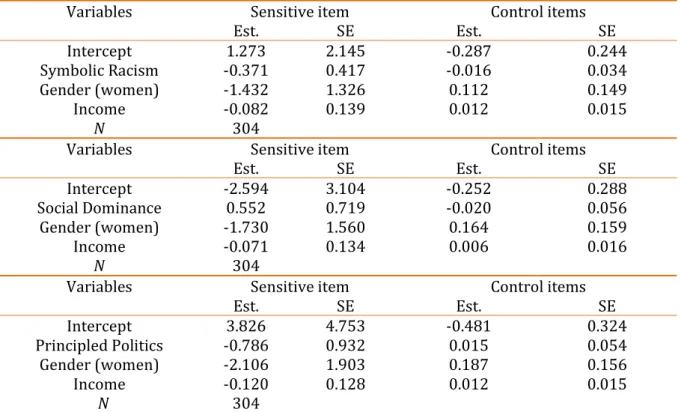
The scales of all of the theories were coded so that higher values indicate greater agreement with that theory. Therefore, it was expected that there was less support for affirmative action among individuals with high scores on each scale. Estimates show that higher scores in symbolic racism or principled politics produce less support for racial quotas, as these theories would predict.
However, the coefficient for social dominance does not behave as expected. It is positive, and higher agreement with the theory leads to higher support for racial quotas. This result does not corroborate the initial hypothesis, although the estimates do not reach statistical significance. Thereby, new models were built to measure the interaction with political knowledge, since there are theoretical reasons for believing that support for racial quotas relies on individuals' level of political knowledge.
Table 04. Multivariate models for AAs' support for the list experiment
Variables Sensitive item Control items
Est. SE Est. SE
Intercept Symbolic Racism Gender (women) 1.273 -0.371 -1.432 2.145 0.417 1.326 -0.287 -0.016 0.112 0.244 0.034 0.149
Income -0.082 0.139 0.012 0.015
N 304
Variables Sensitive item Control items
Est. SE Est. SE
Intercept Social Dominance Gender (women) -2.594 0.552 -1.730 3.104 0.719 1.560 -0.252 -0.020 0.164 0.288 0.056 0.159
Income -0.071 0.134 0.006 0.016
N 304
Variables Sensitive item Control items
Est. SE Est. SE
Intercept Principled Politics Gender (women) 3.826 -0.786 -2.106 4.753 0.932 1.903 -0.481 0.015 0.187 0.324 0.054 0.156
Income -0.120 0.128 0.012 0.015
N 304
Source: Base de Dados Universidade Federal de Santa Catarina: Estudo das opiniões dos estudantes sobre as ações afirmativas (2014).
Note:*.05; **.10; *** .01.
The role of political knowledge
theory, increase the effects of symbolic racism and principled policies, and finally cause the relationship of social dominance and support of affirmative action to be negative.
Table 05. Estimates for symbolic racism with political knowledge
Variables Sensitive Item Control Items
Est. SE Est. SE
Intercept Symbolic Racism Gender (women) -6.596 1.260** -1.673 5.105 0.956 1.454 0.629 -0.220 0.108 0.362 0.080 0.147 Income Political Knowledge -0.035 2.280* 0.184 1.383 0.008 -0.299 0.016 0.104
PK * Symbolic Racism -0.509 0.325 0.068 0.025
N 304
Source: Base de Dados Universidade Federal de Santa Catarina: Estudo das opiniões dos estudantes sobre as ações afirmativas (2014).
Note:*.05; **.10; *** .01.
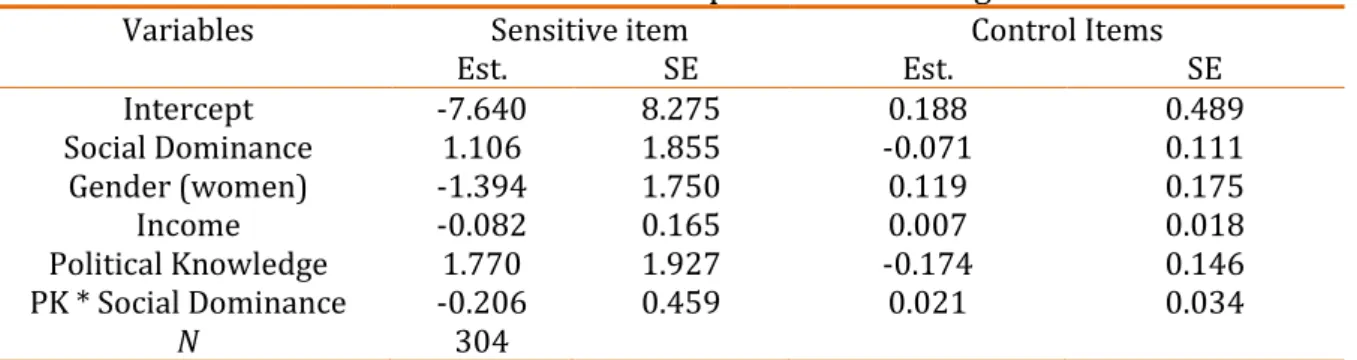
Table 06. Estimates for social dominance with political knowledge
Variables Sensitive item Control Items
Est. SE Est. SE
Intercept Social Dominance Gender (women) -7.640 1.106 -1.394 8.275 1.855 1.750 0.188 -0.071 0.119 0.489 0.111 0.175 Income Political Knowledge -0.082 1.770 0.165 1.927 0.007 -0.174 0.018 0.146
PK * Social Dominance -0.206 0.459 0.021 0.034
N 304
Source: Base de Dados Universidade Federal de Santa Catarina: Estudo das opiniões dos estudantes sobre as ações afirmativas (2014).
Note:*.05; **.10; *** .01.
Table 07. Estimates for principled politics with political knowledge
Variables Sensitive item Control Items
Est. SE Est. SE
Intercept Principled Politics Gender (women) -25.329 4.429** 2.243 17.090 3.573 2.157 0.274 -0.088 -0.002 0.490 0.122 0.144 Income Political Knowledge -0.475 10.681** 0.296 7.366 0.020 -0.228 0.146 0.151
PK * Principled Politics -1.956 1.523 0.030 0.037
N 304
Source: Base de Dados Universidade Federal de Santa Catarina: Estudo das opiniões dos estudantes sobre as ações afirmativas (2014).
Note:*.05; **.10; *** .01.
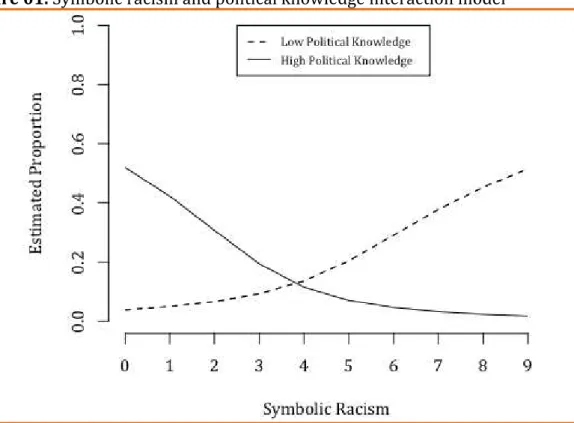
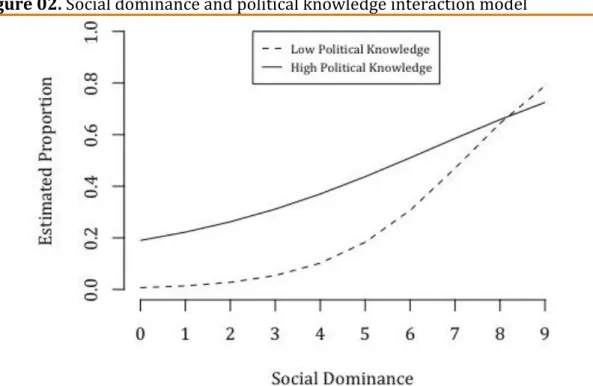
enough to change the direction of the effect. When a multiplicative interaction model is used, the coefficients of the interaction models do not indicate an average effect of a variable as they do in a purely additive model (BRAMBOR et al., 2006). The following figures show the effects between two different levels of political knowledge (high and low). The post estimation model used here is a Markov chain Monte Carlo (MCMC) based on the estimated coefficients and the estimated variance-covariance matrix from the list experiment regression model.
Figure 01. Symbolic racism and political knowledge interaction model
Source: Base de Dados Universidade Federal de Santa Catarina: Estudo das opiniões dos estudantes sobre as ações afirmativas (2014).
Figure 02. Social dominance and political knowledge interaction model
Source: Base de Dados Universidade Federal de Santa Catarina: Estudo das opiniões dos estudantes sobre as ações afirmativas (2014).
Figure 03. Principled politics and political knowledge interaction model
Source: Base de Dados Universidade Federal de Santa Catarina: Estudo das opiniões dos estudantes sobre as ações afirmativas (2014).
Discussion
The results of my analysis shed insight into racial attitudes towards affirmative action in Brazil. The list experiment shows that only about 06% of white respondents agreed with the importance of racial quotas at the Universidade Federal de Santa Catarina. The results indicate that there is a large social desirability bias on white respondents (33.91%), consistent with previous research (VIDIGAL, 2015). It shows the empirical difficulty of measuring socially sensitive issues, such as race, and emphasizes the importance of using new survey methods.
The results indicate that racial affect and the political position of an individual continue to be key determinants of opposition to affirmative action among white students, but only among individuals with high political knowledge. The results for social dominance, show that neither individuals with high nor low political knowledge oppose affirmative action, suggesting the rejection of the hypothesis presented here.
A first explanation may be theoretical: political views are 'statements of social belonging' of social groups (KINDER, 1998). When individuals are invited to express their views, most do so based upon their social group, which carries assessments derived from different social experiences (KINDER, 1998). Belonging to a social group brings visions, roles and particular social positions, which leads to fundamental differences between blacks and whites towards public policy, racial discrimination and affirmative action.
A second explanation may be methodological. The first problem may be related to the internal validity of the items on the social dominance scale. To test this, I conducted reliability tests using Cronbachs' alpha to evaluate whether the scale was in fact a good construct. However, the alpha of the social dominance scales was 0.40, which is relatively low. Ideally, the social dominance scale should be measured with large multi-item batteries, with about 20 items (ANSOLABEHERE et al., 2008; SIDANIUS et al., 2000). However, this is not very realistic considering the typical size and response times on online political science surveys (MONDAK et al., 2010).
There are limitations on inferences that can be made from this research, because the confidence intervals cross zero and the standard errors are inflated. Again, the list experiment tends to require a large sample size7 (GLYNN, 2010). Here, the
experimental group has around 300 respondents, and since only the treated experimental group receives the sensitive item, the N is cut in half. Compared to this, other works based on data from the list experiment in the 1991 National Race and Politics Survey in the United States have twice this number (e.g. KUKLINSKI et al., 1997a; KUKLINSKI et al., 1997b; SNIDERMAN and CARMINES, 1997).This observation should improve the planning of future studies and enhance the feasibility of this technique by making estimates more precise.
Also, the dependent variable that measures the support of students for affirmative action lacks variation, and thus it cannot fully explain the pattern. Only about 06% of respondents support the racial quotas, and there is not much variation to be explained. Despite these limitations that reduce the statistical power of the results, the survey is the first, and perhaps one of the only, to map the racial attitudes of college students in Brazil.
Finally, there may be a context effect on the race of the students. In addition to the state of Santa Catarina’s majority white population, the history of the implementation of racial quotas at UFSC is quite different to that of pioneering institutions such as the UERJ (Rio de Janeiro) and the UFBA (Bahia), the states with the highest proportions of blacks in the country. Weber et al. (2014) suggest that political conflicts over racial policies are subject to change at the state level, according to the proportion of blacks in the state population. There was never extensive discussion of
_____________________________________________________________________________________________________ 7 Glynn (2010) provides a detailed discussion and analysis of sample size and bias on list
affirmative action at UFSC. That individuals were not exposed to information, news and debates that can have an effect on public opinion, may have generated low levels of attention to racial issues at the university, limiting the development of ideas, arguments and considerations about racial quotas in comparison to contexts at other universities.
Conclusion
This paper focused on three American theories for the white opposition to affirmative action: symbolic racism, social dominance and principled politics. The interaction between political knowledge and its influence on racial attitudes was also evaluated. The social desirability effect is clear: white students do not reveal their true opinions when faced with a direct question in a traditional survey, and their support for affirmative action is extremely low.
Despite the results having limited scope for generalization, an important conclusion is the impact of political knowledge on the attitudes of the students. People with higher political knowledge are better able to express their opinions and can coherently express them in a manner that is consistent with their personal preferences. This finding has important implications for surveys with complex scales. As Zaller (1992) has asked, do individuals truly comprehend the items and are they properly expressing their preferences in the questionnaires?
People must continuously process an extraordinarily confusing and complex world around them, and this may affect the translation of their opinions in survey answers. Being able to obtain truthful answers on socially sensitive issues is one of the biggest challenges in survey research and the list experiment emerged as a methodological alternative to this problem (BLAIR and IMAI, 2012). When a strong experimental design is combined with robust statistical analysis, it can effectively explore the power of the list experiment to extract more truthful answers.
experimental design allow for: 01. causal inference; 02. control of variables; 03. precise measurement; and 04. the ability to explore the details of given processes (McDERMOTT, 2002). Aguilar and colleagues (2015) and Bueno and Dunning (2017) are relevant works using experiments precisely discerning race and class in Brazil.
This paper demonstrates that multivariate analysis can be performed with the standard design of the list experiment, since joint proportions and the conditional proportions can be estimated with list experiment data. These proportions allow regression analysis, the treatment of the sensitive item as missing data, and a measure for the implicit privacy protection provided by the list experiment. While the list experiment provides potential design and analysis benefits when taken seriously, there are undoubtedly other aggregated response designs that might improve the reliability of measuring socially sensitive issues.
Third, this paper has focused on the attitudes of whites, but future research should explore attitudes of other racial groups and other forms of racial classification besides the self-classification measurement approach. Finally, the development of equal opportunity policies is a sensitive issue that involves much more than the opinions and attitudes of whites, but since these affect the reality of the policies, their influence cannot be ignored.
Public policies that encourage new forms of contact, inclusion and interaction between different social groups can be particularly valuable. Affirmative action can therefore play an important role: since it provides disadvantaged social groups with a right written in law, members of this group are provided with the basic protections of a democratic society, tending to reduce hostile behavior against them.
Revised by Laurel R. Yohe and Matthew Richmond Submitted on February 15, 2017 Accepted on January 13, 2018
References
AGUILAR, Rosario; CUNOW, Saul, and DESPOSATO, Scott (2015), Choice sets, gender, and candidate choice in Brazil. Electoral Studies. Vol. 39, pp. 230-242.
ALTHAUS, Scott L. (1998), Information effects in collective preferences. American
Political Science Review. Vol. 92, Nº 03, pp. 545–558.
constraint, and issue voting. American Political Science Review. Vol. 102, Nº 02, pp. 215-232.
BAILEY, Stanley; FIALHO, Fabrício; PERIA, Michelle (2015), Support for Race-Targeted Affirmative Action in Brazil. Ethnicities. Vol. 0, Nº 0, pp. 1-34.
BAILEY, Stanley R. (2004), Group dominance and the myth of racial democracy: antiracism attitudes in Brazil. American Sociological Review. Vol. 69, Nº 05, pp. 728-747.
BAILEY, Stanley R. (2002), The race construct and public opinion: understanding Brazilian beliefs about racial inequality and their determinants. American Journal of Sociology. Vol. 108, Nº 02, pp. 406-439.
BARTELS, Larry M. (1996), Uninformed votes: information effects in presidential elections. American Journal of Political Science. Vol. 40, Nº 01, pp. 194-230.
BERINSKY, Adam J. (2002), Political context and the survey response: the dynamics of racial policy opinion. Journal of Politics. Vol. 64, Nº 02, pp. 567-584.
BLAIR, Graeme and IMAI, Kosuke (2012), Statistical analysis of list experiments. Political Analysis. Vol. 20, Nº 01, pp. 47-77.
BOBO, Lawrence D. (1999), Prejudice as group position: micro-foundations of a sociological approach to racism and race relations. Journal of Social Issues. Vol. 55, Nº 03, pp. 445–472.
BOBO, Lawrence D. and KLUEGEL, James R. (1993), Opposition to race targeting: self-interest, stratification ideology, or racial attitudes? American Sociological Review. Vol. 58, pp. 443-464.
BOBO, Lawrence D. and MASSAGLI, Michael P. (2001), Stereotypes and urban inequality.
In: Urban inequality: evidence from four cities. Edited by O'CONNOR, Alice; TILLY,
Chris, and BOBO, Lawrence D.. New York: Russell Sage Foundation. pp. 89-162.
BRAMBOR, Thomas; CLARK, William Roberts, and GOLDER, Matt (2006), Understanding interaction models: improving empirical analyses. Political Analysis. Vol. 14, Nº 01, pp. 63-82.
BUENO, Natália S. and DUNNING, Thad (2017), Race, resources, and representation: evidence from Brazilian politicians. World Politics. Vol. 06, Nº 02, pp. 327-365.
BULLOCK, John G. (2004), Companion to re(:)measuring political sophistication. Unpublished paper presented at POLISCI 353: Workshop in Statistical Modeling. Stanford: Stanford University.
CARVALHO, José Jorge de (2005), Inclusão étnica e racial no Brasil: a questão das cotas no ensino superior. São Paulo: Attar Editorial. 208 pp..
CORSTANGE, Daniel (2012), Vote trafficking in Lebanon. International Journal of Middle East Studies. Vol. 44, Nº 03, pp. 483-505.
CORSTANGE, Daniel (2009), Sensitive questions, truthful answers? Modeling the list experiment with LISTIT. Political Analysis. Vol. 17, Nº 01, pp. 45–63.
DELLI CARPINI, Michael X. and KEETER, Scott (1996), What americans know about politics and why it matters. New Haven: Yale University Press. 416 pp..
FEDERICO, Christopher M. and SIDANIUS, Jim (2002), Racism, ideology, and affirmative action revisited: the antecedents and consequences of 'principled objections' to affirmative action. Journal of Personality and Social Psychology. Vol. 82, Nº 04, pp. 488-502.
GILENS, Martin (2001), Political ignorance and collective policy preferences. American Political Science Review. Vol. 95, Nº 02, pp. 379-396.
GLYNN, Adam N. (2010), What can we learn with statistical truth serum? Design and analysis of the list experiment. Paper. Department of Government. Cambridge: Harvard University.
GONZALEZ-OCANTOS, Ezequiel; JONGE, Chad Kiewiet de; MELÉNDEZ, Carlos; OSORIO, Javier, and NICKERSON, David W. (2012), Vote buying and social desirability bias: experimental evidence from Nicaragua. American Journal of Political Science. Vol. 56, Nº 01, pp. 202-217.
IMAI, Kosuke, (2011), Multivariate regression analysis for the item count technique. Journal of the American Statistical Association. Vol. 106, Nº 494, pp. 407-416.
IMAI, Kosuke; PARK, Bethany, and GREENE, Kenneth F. (2015), Using the predicted responses from list experiments as explanatory variables in regression models. Political Analysis. Vol. 23, Nº 02, pp. 180-196.
KINDER, Donald (1998), Opinion and action in the realm of politics. In: The handbook of social psychology. Edited by GILBERT, Daniel; FISKE, Susan, and LINDSEY, Gardner. Boston: McGraw-Hill. pp. 778-876.
KINDER, Donald R. and SEARS, David O. (1981), Prejudice and politics: symbolic racism versus racial threats to the good life. Journal of Personality and Social Psychology. Vol. 40, Nº 03, pp. 414–431.
KUKLINSKI, James H.; COBB, Michael D., and GILENS, Martin (1997a), Racial attitudes and the New South. Journal of Politics. Vol. 59, Nº 02, pp. 323–349.
KUKLINSKI, James H.; SNIDERMAN, Paul M.; KNIGHT, Kathleen; PIAZZA, Thomas; TETLOCK, Philip E.; LAWRENCE, Gordon R., and MELLERS, Barbara (1997b), Racial prejudice and attitudes toward affirmative action. American Journal of Political
Science. Vol. 41, Nº 02, pp. 402–419.
LIMA, Marcus Eugênio O.; MACHADO, Caliandra; ÁVILA, Josele; LIMA, Carolina, and VALA, Jorge (2006), Normas sociais e preconceito: o impacto da igualdade e da competição no preconceito automático contra negros. Psicologia Reflexão e Crítica. Vol. 19, Nº 02, pp. 309-319.
LUSKIN, Robert C. (2002), From denial to extenuation (and finally beyond): political sophistication and citizen performance. In: Thinking about political psychology. Edited by KUKLINKI, James H..New York: Cambridge University Press. pp. 281-301.
LUSKIN, Robert C. (1990), Explaining political sophistication. Political Behavior. Vol. 12, Nº 04, pp. 331–361.
LYALL, Jason; BLAIR, Graeme, and IMAI, Kosuke (2013), Explaining support for combatants during wartime: a survey experiment in Afghanistan. American Political Science Review. Vol. 107, Nº 04, pp. 679-705.
McCLOSKY, Herbert and ZALLER, John (1984), The American ethos: public attitudes toward capitalism and democracy. Cambridge: Harvard University Press. 360 pp..
McCONAHAY, John B. (1986), Modern racism, ambivalence, and the modern racism scale. In: Prejudice, discrimination, and racism. Edited by DOVIDIO, John F. and GAERTNER, Samuel L. Orlando: Academic Press. pp. 91–125.
McCONAHAY, John B. and HOUGH JR., Joseph C. (1976), Symbolic racism. Journal of Social Issues. Vol. 32, Nº 02, pp. 23-45.
McDERMOTT, Rose (2002), Experimental methodology in political science. Political Analysis. Vol. 10, Nº 04, pp. 325-342.
MONDAK, Jeffery J.; HIBBING, Matthew V.; CANACHE, Damaris; SELIGSON, Mitchel A., and ANDERSON, Mary R. (2010), Personality and civic engagement: an integrative framework for the study of trait effects on political behavior. American Political Science Review. Vol. 104, Nº 01, pp. 85-110.
MOSCOVICI, Serge and PÉREZ, Juan António (1999), A extraordinária resistência das minorias à pressão das maiorias: o caso dos ciganos. In: Novos racismos: perspectivas comparativas. Edited by VALA, Jorge. Oeiras: Celta. pp.103-119.
MUNIZ, Jerônimo Oliveira (2010), Sobre o uso da variável raça-cor em estudos quantitativos. Revista de Sociologia e Política. Vol. 18, Nº 36, pp. 277-291.
OLIVEIRA, Carlos and TURGEON, Mathieu (2015), Ideology and political behavior in the Brazilian electorate. Opinião Pública. Vol. 21, Nº 03, pp.574-600.
OLIVER, J. Eric and MENDELBERG, Tali (2000), Reconsidering the environmental determinants of white racial attitudes. American Journal of Political Science. Vol. 44, Nº 03, pp. 574-589.
PAGER, Devah and QUILLIAN, Lincoln (2005), Walking the talk: what employers say versus what they do. American Sociological Review. Vol. 70, Nº 03, pp. 355-380.
UFF, Universidade Federal Fluminense - Data UFF (2002), Pesquisa Social Brasileira. Niterói: Universidade Federal Fluminense.
PEREIRA, Cícero; TORRES, Ana Raquel Rosas, and ALMEIDA, Saulo Teles (2003), O estudo do preconceito na perspectiva das representações sociais: análise da influência de um discurso justificador da discriminação no preconceito racial. Psicologia: Reflexão e Crítica. Vol. 16, Nº 01, pp. 95-107.
PETTIGREW, Thomas F. and MEERTENS, Roel W. (1995), Subtle and blatant prejudice in Western Europe. European Journal of Social Psychology. Vol. 25, Nº 01, pp. 57-75.
PRATTO, Felicia; SIDANIUS, Jim; STALLWORTH, Lisa M., and MALLE, Bertram F. (1994), Social dominance orientation: a personality variable predicting social and political attitudes. Journal of Personality and Social Psychology. Vol. 67, Nº 04, pp. 741-763.
ROBISON, Joshua (2014), Who knows? Question format and political knowledge International Journal of Public Opinion Research. Vol. 27, Nº 01, pp. 01-21.
SANTOS, Gevanilda Gomes and SILVA, Maria Palmira da (Eds)(2005), Racismo no Brasil: percepções da discriminação e do preconceito no século XXI. São Paulo: Editora Fundação Perseu Abramo. 176 pp..
SEARS, David O. (1988), Symbolic racism. In: Eliminating racism: profiles in controversy. Edited by KATZ, Phyllis A. and TAYLOR, Dalmas A.. New York: Plenum Press. pp. 53-84.
SEARS, David O. and KINDER, Donald R. (1971), Racial tensions and voting in Los Angeles. In: Los Angeles: viability and prospects for metropolitan leadership. Edited by HIRSCH, Werner Z.. New York: Praeger. pp. 51–88.
SIDANIUS, Jim; LEVIN, Shana; RABINOWITZ, Joshua L., and FREDERICO, Christopher M. (1999), Peering into the jaws of the beast: the integrative dynamics of social identity, symbolic racism, and social dominance. In: Cultural divides: understanding and overcoming group conflict. Edited by PRENTICE, Deborah A. and MILLER, Dale T.. New York: Russell Sage Foundation. pp. 80–132.
SIDANIUS, Jim and PRATTO, Felicia (2001), Social dominance: an intergroup theory of social hierarchy and oppression. Cambridge: Cambridge University Press. 403 pp..
SIDANIUS, Jim; SINGH, Pam; HETTS, John J., and FEDERICO, Chris (2000), It's not affirmative action, it's the Blacks: the continuing relevance of race in American politics. In: Racialized politics: the debate about racism in America. Edited by SEARS, David O., SIDANIUS, Jim, and BOBO, Lawrence. Chicago: University of Chicago Press. pp. 191-235.
SNIDERMAN, Paul M.; BRODY, Richard A., and TETLOCK, Philip E. (1991), Reasoning and choice: explorations in political psychology. Cambridge: Cambridge University Press. 304 pp..
SNIDERMAN, Paul M. and CARMINES, Edward G. (1997), Reaching beyond race. Cambridge: Harvard University Press. 208 pp..
SNIDERMAN, Paul M. and PIAZZA, Thomas (1993), The scar of race. Cambridge: Harvard University Press. 228 pp..
TELLES, Edward E. (2004), Race in another America: the signficance of skin color in Brazil. Princeton: Princeton University Press. 336 pp..
TELLES, Edward and BAILEY, Stanley (2013), Understanding Latin American beliefs about racial inequality. American Journal of Sociology. Vol. 118, Nº 06, pp. 1559-1595.
TELLES, Edward and BAILEY, Stanley (2002), Políticas contra o racismo e opinião pública: comparações entre Brasil e Estados Unidos. Opinião Pública. Vol. 08, Nº 01, pp. 30-39.
TURGEON, Mathieu; CHAVES, Bruno Sant'Anna, and WIVES, Willian Washington (2014), Políticas de ação afirmativa e o experimento de listas: o caso das cotas raciais na universidade brasileira. Opinião Pública. Vol. 20, Nº 03, pp. 363-376.
TURGEON, Mathieu and RENNÓ, Lucio (2010), Informação política e atitudes sobre gastos governamentais e impostos no Brasil: evidências a partir de um experimento de opinião pública. Opinião Pública. Vol. 16, Nº 01, pp. 143-159.
TURRA, Cleusa and VENTURI, Gustavo (1995), Racismo cordial. São Paulo: Ática. 208 pp..
WEBER, Christopher R.; LAVINE, Howard; HUDDY, Leonie and Federico, Christopher M. (2014), Placing racial stereotypes in context: Social desirability and the politics of racial hostility. American Journal of Political Science. Vol. 58, Nº 01, pp. 63-78.
WOOD, Wendy; RHODES, Nancy, and BIEK, Michael (1995), Working knowledge and attitude strength: an information-processing analysis. In: Attitude strength: antecedents and consequences. Edited by PETTY, Richard E. and KROSNICK, Jon A.. Mahwah, NJ: Erlbaum. pp. 283–313.
ZALLER, John R. (1992), The nature and origins of mass opinion. New York: Cambridge University Press. 382 pp..