Revista Gaúcha
de Enfermagem
How to cite this article:
Monterroso LEP, Sá LO, Joaquim NMT. Adherence to the therapeutic medication and biopsychosocial aspects of elderly integrated in the home-based long-term care. Rev Gaúcha Enferm. 2017;38(3):e56234. doi: http://dx.doi. org/10.1590/1983-1447.2017.03.56234.
doi: http://dx.doi.org/10.1590/1983-1447.2017.03.56234
Adherence to the therapeutic medication
and biopsychosocial aspects of elderly
integrated in the home-based long-term care
Adesão ao regime terapêutico medicamentoso e aspectos biopsicossociais dos idosos integrados em cuidados continuados domiciliários
Adherencia al régimen terapéutico medicamentoso y aspectos biopsicosociales de los ancianos integrados en cuidados continuados domiciliarios
Lígia Eduarda Pereira Monterrosoa,b
Luís Octávio de Sáa
Natércia Maria Teixeira Joaquimc
a Universidade Católica Portuguesa (UCP), Instituto
de Ciência da Saúde, Centro de Investigação Interdisci-plinar em Saúde. Porto, Portugal.
b Administração Regional de Saúde do Norte, Aces
Baixo Tâmega, USF Tâmega. Marco de Canaveses, Portugal.
c Centro Hospitalar do Algarve. Faro, Portugal.
ABSTRACT
Objective: To evaluate the association between the biopsychosocial aspects and the adherence to the therapeutic medication of elderly integrated into the home-based long-term care teams.
Methods: A cross-sectional, quantitative study, with a sample of 198 eldery. Interviews took place between May 2012 and May 2013 in Portugal. For therapeutic characterization, the data were collected using two questionnaires and one interview. Data analysis made with the Statistical Package for Social Sciences version 20.0. Descriptive statistics were used to present the results and the Chi-Square test to evaluate the association between variables.
Results: It was observed that 49% of the elderly do not adhere to the therapeutic medication and the level of adherence showed a sta-tistically significant association with nutritional status (p = 0.002), instrumental autonomy (p = 0.030) and social isolation (p = 0.046). Conclusions: Due to the multiplicity of aspects involved in adherence, it is suggested that they be considered in the nursing inter-ventions that promote therapeutic control measures.
Keywords: Medication adherence. Elderly. Home health nursing.
RESUMO
Objetivo: Avaliar a associação entre os aspetos biopsicossociais e a adesão ao regime terapêutico medicamentoso dos idosos integra-dos nas equipes de cuidaintegra-dos continuaintegra-dos domiciliários.
Métodos: Estudo transversal, quantitativo com amostra constituída por 198 idosos. As entrevistas decorreram entre maio de 2012 e maio de 2013, em Portugal. Para caraterização terapêutica fez-se a coleta de dados recorrendo a dois questionários e uma entrevista. Análise dos dados feita pelo programa Statistical Package for Social Sciences, versão 20.0. Utilizou-se a estatística descritiva para apresentação dos resultados e o teste Qui-Quadrado para avaliar a associação entre variáveis.
Resultados: Verifica-se que 49% dos idosos não adere ao regime terapêutico medicamentoso e que o nível de adesão apresentou associa-ção estatisticamente significativa, com estado de nutriassocia-ção (p=0,002), autonomia instrumental (p=0,030) e isolamento social (p=0,046). Conclusões: Conhecendo a multiplicidade de aspectos envolvidos na adesão, sugere-se que os mesmos sejam considerados nas intervenções de enfermagem promotoras de medidas de controle da terapêutica.
Palavras-chave: Adesão à medicação. Idoso. Enfermagem domiciliar.
RESUMEN
Objetivo: Evaluar la asociación entre los aspectos biopsicosociales y la adherencia al régimen terapéutico medicamentoso de los ancianos integrados en los equipos de cuidados continuados domiciliarios.
Métodos: Estudio transversal, cuantitativo con muestra de 198 personas de edad avanzada. Las entrevistas tuvieron lugar entre mayo de 2012 y mayo de 2013 en Portugal. Para la caracterización terapéutica se hizo la recolección de datos utilizando dos cuestionarios y una entrevista. Análisis de los datos realizado por el programa Statistical Package for Social Sciences versión 20.0. Se utilizó la estadís-tica descriptiva para presentar los resultados y la prueba de Chi-cuadrado para evaluar la asociación entre variables.
Resultados: Se observa que el 49% de los ancianos no se adhiere al régimen terapéutico medicamentoso y que el nivel de adhe-rencia presentó una asociación estadísticamente significativa, con el estado nutricional (p = 0,002), la autonomía instrumental (p = 0,030) y el aislamiento social (p = 0,046).
Conclusiones: Conociendo la pluralidad de aspectos que intervienen en la adherencia, se sugiere que los mismos sean considerados en las intervenciones de enfermería que promueven medidas de control de la terapéutica.
INTRODUCTION
Last year it was found that the therapeutic medica-tion regime adherence (TMRA) is a subject that generates concerns to health professionals, especially nurses, also preoccupying elders and their families. The lack of TMRA leads to personal, economic and social repercussions, and makes it a relevant public health problem, contributing to an increase in the number of hospitalizations, a decrease in quality of life, and consequently, to the morbidity and mortality of elders, provoking clinical consequences such as falls and the exacerbation of diseases(1).
TMRA is the execution of activities according to a schedule of treatment of the disease and its complications. These activities are satisfactory to reach specific objectives for health, which can be influenced by many variables re-lated to the patient (psychological, social, behavioral and family factors), the treatment (number of medicines) and the patient-physician relationship(2-3). A study conducted in Portugal(4) including 74 people with chronic renal failure in a regular dialysis program, suggests that, since TMRA is a dynamic process, the person must be carefully monitored, evaluated, and the main factors that could negatively influ-ence their adherinflu-ence must be assessed. “Health profession-als need specific training that allow them to improve the intervention when it comes to adherence”(4).
In 2050, there will be over 2 million people over
60 years of age in the world(5). Although old age is not
considered a disease, it strongly contributes for the consumption of health care, since the advance of age results in functional decline, more frequent multi-mor-bidities, and therefore, high dependence levels,
simul-taneously leading to polypharmacy(5).
In Portugal, in the year 2006, the national network for continued care (RNCCI) was created through a Law-De-cree(6). Its objective is the provision of continued and inte-grated care to people who, regardless of age, have been in a situation of dependence. The RNCCI model defines hospitalization, ambulatory, hospital and household team typologies, to be able to answer the different needs of the patients. The continued health and integrated house-care teams (ECCID) are “house-house-care RNCCI teams, multi-disciplinary and under the responsibility of primary care and social support entities, so they can provide home ser-vices that result from integral evaluations, including med-ical care, nursing care, rehabilitation and social support, or others, to people who are in a situation of functional dependency, terminal disease, or going through conva-lescence, who have a social support network but cannot move autonomously”(6).
In a preliminary study that involved the population in-tegrated in a ECCID in the Community Care Unit – Infante(7), in the Algarve region, the authors found that dependent people who are monitored are mostly elders (≥65) or high age elders (≥80). The TMRA in this population is low, be-ing that 72.7% of them do not adhere to the therapeutic regime; 85.2% need 3 or more medications; 25.5% were very dependent; and 24.5% were moderately dependent. Regarding their Mental State, 47.3% of the patients pre-sented moderate demential abnormalities, and 45.5% were moderately depressed. The mental state was a significant influence in the TMRA of this population. Although there was no statistical associations, the results indicated that low income, living alone, and the presence of depression are negative conditions for the TMRA.
The region of Algarve is located in the extreme west of Europe, in the South of Portugal, with a population of nearly 450,000 people, which represents about 4.3% of the population of the country. It receives 5 million tourists ev-ery year. The elder population in this region is approximate-ly 20%, on a par with the other regions of the country(8).
Considering the aspects discussed, this study was orig-inated from the need to find the adherence and manage-ment of the therapeutic medication regime of elders, plan-ning and interveplan-ning effectively to, on one hand, promote the increase of their quality of life, and on the other, to minimize the decline of their general health state, caused by mistakes and omissions in the management of the ther-apeutic medication regime. Thus, the following objectives were defined for this investigation: a) to identify the ther-apeutic medication regime adherence level of elders inte-grated in the ECCID of the Algarve region; b) to identify the factors that condition the adherence and management of the therapeutic medication regime; c) to evaluate the as-sociation between biopsychosocial aspects and the ther-apeutic medication regime adherence of elders integrated in the teams of continued home health care.
METHODOLOGY
The present investigation is cross-sectional, following a quantitative method. The main organ of the network of pri-mary health care in the Algarve region is the ARS Algarve I.P., which is subdivided in 3 ACES (Barlavento, Central e Sotavento). In turn, each ACES consists of a set of health centers, which house the ECCID.
As a result of this situation, in the context of the 15 health centers of the region, there are 28 ECCID, distributed as follows: Albufeira – 1; Alcoutim – 1; Faro – 3; Lagoa – 1; Lagos – 2; Loulé – 5; Monchique – 1; Olhão – 1; Portimão – 3; S. Brás Alportel – 1; Silves – 3; Tavira – 1; Vila do Bispo – 1; Aljezur – 1; And Vila Real Santo António/Castro Marim – 3. The existing capacity of community response is 1240 dependent patients (ARS-Algarve, 2012). The universe was composed of 997 patients, the population, by 245 elders, and a convenience sample was obtained, consisting of 198 elderly. To select the study population, a meeting was pre-viously held with each ECCID, where clinical records were consulted, to ascertain which patients could participate in the study, and obtain addresses and contact information.
In the sampling procedure, all patients who met the following inclusion criteria were included: to be 65 years old or more; to be registered in the teams during the data collection phase; to be autonomous in the management of their therapeutic medication regime; and to have cog-nitive abilities to respond and accept to participate in the study in a free and informed manner. The exclusion criteria included all patients who, on the date of data collection, have presented changes towards cognitive deficit. In the course of the study, 47 participants were excluded, for the following reasons: 1 quit, 5 passed away, 13 suffered psy-chic deterioration which resulted in their inability to par-ticipate, and 28 refused. The application of these criteria resulted in a sample of 198 dependent elders.
Data collection took place between the months of May 2012 and May 2013. It was a study conducted in nat-ural surroundings (at the house of the elderly). Interviews had been previously scheduled with participants, and the data collection interview had an average length of 90 minutes per elder.
The data gathering instrument consisted of three structured questions in the form of an interview for ther-apeutic characterization (number of medicines, ability to acquire medicine, social support for the acquisition of medicine) and two validated questionnaires for the Por-tuguese population, which were: the questionnaire on
the Biopsychosocial Assessment Method(9) (MAB) and the
questionnaire Measure of the Adherence to Treatment(10)
(MAT). The MAB is a structured and standardized tracking method that evaluates the biopsychosocial classification of adults, allowing one to characterize biopsychosocial and functional states, as well as to describe and sense distur-bances of their functionality(9). The ambulatory version is divided into three areas of evaluation: biological (gender, age, existence of health complaints, nutritional state, falls, locomotion, physical autonomy and instrumental
auton-omy); psychological (emotional complaints and cognitive state) and social (social isolation and habits); adding to a total of 12 domains. The 12 domains are composed of 56 questions whose answers are presented on a Likert scale. The domains Falls, Locomotion, Physical autonomy, Instru-mental autonomy, Emotional complaints, Cognitive state, Social state, and Habits are evaluated in 4 levels. For the domains Locomotion, Physical autonomy, Instrumental au-tonomy, and Emotional complaints, the author ranks the patients as incapable (0), dependent (1), autonomous (2) or independent (3). The remaining domains are classified as bad (0) or unsatisfactory (1). The author suggests, for the presentation of the results, the use of two categories for the domains of functionality: 0-1 dependent and 2-3 inde-pendent; for the remaining domains: 0-1 unfavorable and 2-3 favorable. The authors of the MAB(9) scale conducted a reproducibility evaluation through a repeated test, whose Kappa coefficient for the different sub-scales of functional-ity went from 0.60 to 1.0.
Regarding the MAT, it is a scale composed of 7 ques-tions, that allow for the characterization of the habits and beliefs of the participants regarding the consumption of the medicines. For each question, the replies are presented on a 6 point Likert scale, ranging from always = 1 to never = 6. The level of adherence to treatments results from the sum of the values obtained in each item, whose result is then divided by the number of items. Higher values mean a higher level of adherence. In order to conduct the sta-tistical analysis, two age groups were considered: “elderly”, aged between 65 and 79, and “high age elderly”, with age equal and greater than 80 years. For the submission of re-sults, two groups were created according to the median: adhere and does not adhere.
The statistical analysis of the data was conducted through the software Statistical Package for Social Sciences (SPSS) 12.4 version. A confidence interval of 95% was considered.
After the authorization of the ARS Algarve I.P. was obtained, as well as a favorable decision from the Ethics Committee, sent to the authors in the approval letter Nº 152/12 D.E.P. from 02/18/2012, all interviews began. They were accompanied by professionals of the ECCID, who were nearby, thus improving the confidence between the investigator and the participants. In the course of these visits, participants signed the informed consent form and the data collection instrument was applied. In most situ-ations, the questionnaires were filled by the participants themselves; however, in cases of illiteracy or some degree of motor and/or visual disability, the completion of the questionnaires was conducted by the investigator.
RESULTS
The sample was composed by 198 elderly people with an average age of 81 ± 7.8 years, ranging from 65 to 102. It was found that 44.4% (n = 88) belonged to the group “elderly” and 55.6% (n = 110) were “high age elderly”. As for gender, 64.1% of participants were women and 35.9% were men.
Regarding the characterization of the biological di-mension it was found that, in relation to health complaints, 93.9% (n = 186) reported having some health complaints, and only 6.1% of the participants did not mention any complaints. As for the nutritional state, 37.9% (n = 75) of the elderly presented an adequate weight, while 62.1% (n = 123) presented an unfavorable nutritional status, i.e.,
they had either low or excessive weight. Regarding the risk of falls, 38.9% of patients presented an unfavorable risk, while 61.1% of patients presented a favorable risk, to a total of 121 patients. As for locomotion, 67.2% (n = 133) were dependent (requiring the assistance of equipment or third parties), while 32.8% were independent (n = 65). Regarding physical autonomy, 62.1% (n = 123) of the elderly were de-pendent and 37.9% (n = 75) were indede-pendent. About the group’s instrumental autonomy, it was found that 86.4% (n = 171) of the participants were dependent. As to the psychological area of the MAB, the domains “Emotional complaints” and “Cognitive state” were considered. With regard to the Emotional complaints, the result was unfa-vorable to 53.0% (n = 105) of the participants (many emo-tional complaints) and favorable (no complaints) to 47.0% (n = 93) of the participants. As for their cognitive state, it was found that it was unfavourable (altered) to 23.7% (n = 47) and favorable to 76.3% (n = 151) of the participants. For the evaluation of the social state, the participants were questioned in two domains: in the domain social isolation, which was unfavorable (very isolated/isolated) for 35.4% and favorable for 64.6% (little isolated/not isolated), and in the domain habits (physical activity and n.º of meals), for which the results were 62.6% unfavorable and 37.4% favor-able. The social state was found to be 17.7% favorable and 64.6% unfavorable.
Adherence to the therapeutic medication regime
The TMRA index evaluated by the MAT presented an average of 5.22 ± 0.66 with a minimum of 2.57 and a
max-Measure of Adherence to the Treatment – Questions
Likert scale
(Measure of Adherence to the Treatment) Average Standard deviation
Have you ever forgotten 5.00 0.95
Neglected the correct time 4.89 0.95
Felt better and abandoned the medication 5.31 0.90
Felt worse and abandoned the medication 5.23 0.97
More tablets 5.42 0.81
Did not have the medication at home 5.19 0.858
Abandoned for other reasons 5.47 0.74
TMRA index 5.22 0.66
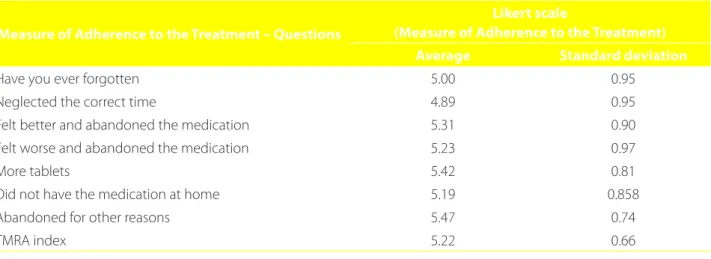
Table 1 – Distribution of the participants’ responses regarding the Measure of Adherence to the Treatment. Algarve, Por-tugal, 2012-2013
imum of 6. When each of the questions of the instrument were individually analyzed (Table 1), the lowest levels of ad-herence were found in the questions related to the med-ications timetable (4.89 ± 0.95) and to forgetfulness (5.00 ± 0.95).
Association between Therapeutic Medication Regime Adherence and the therapeutic pharmaceutical profile
For the study of the association between the biopsy-chosocial characteristics and the TMRA of the elderly, data
is presented in tables 2 and 3. In this study it was found that 49% of the elderly studied do not adhere to the thera-peutic regime. A statistically significant association was ob-served between TMRA and biological area variables relative to the presence of health complaints (p = 0.014), to favor-able nutritional states (p = 0.002) and to the independence of Instrumental Autonomy (p = 0.030).
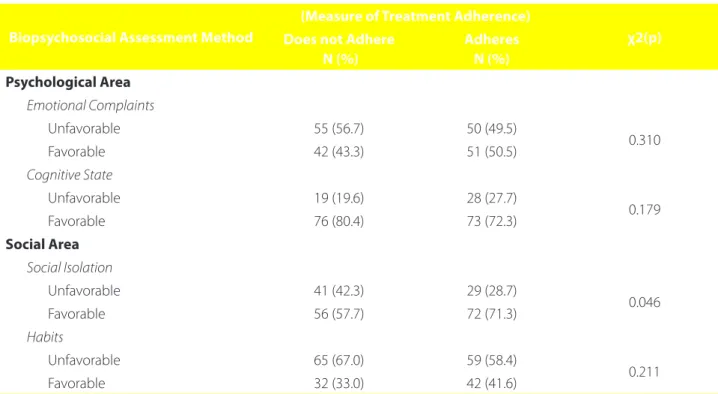
No statistically meaningful associations were found be-tween the TMRA and the psychological MAB variables. Re-garding the social area, the Social Isolation situation had a statistically meaningfull association to the TMRA (p = 0.046) (Table 3).
Biological Profile
Therapeutic Regime Adherence
χ2(p) Does not Adhere
N (%)
Adheres N (%)
Gender
Male 33 (34.0) 38 (37.6) 0.597
Female 64 (66.0) 63 (62.4)
Age group
Elderly (≥ 65 and < 80 years) 39 (40.2) 49 (48.5) 0.240
High age elderly (> 80 years) 58 (59.8) 52 (51.5)
Health Complaints
Has complaints 87 (89.7) 99 (98.0) 0.014
Has no complaints 10 (10.3) 2 (2.0)
Nutritional State
Unfavorable 71 (73.2) 52 (51.5) 0.002
Favorable 26 (26.8) 49 (48.5)
Falls
Unfavorable 40 (41.2) 37 (36.6) 0.507
Favorable 57 (58.8) 64 (63.4)
Locomotion
Dependent 66 (68.0) 67 (66.3) 0.798
Independent 31 (32.0) 34 (33.7)
Physical Autonomy
Dependent 60 (61.9) 63 (62.4) 0.940
Independent 22 (38.1) 53 (37.6)
Instrumental Autonomy
Dependent 89 (91.8) 82 (81.2) 0.030
Independent 8 (8.2) 19 (18.8)
Table 2 – Therapeutic Regime Adherence according to the biological profile. Algarve, Portugal, 2012-2013
According to the association between the therapeutic drug profile variables, most patients take more than three medicines 61.6% (n = 122). Only 38.4% take between one and three medicines. As regards the ability to acquire all prescribed medicines, 6.6% patients refers to not being able to acquire the medication; 17.2% indicate that they acquire the medicines themselves, while 82.8% resort to relatives, neighbors, friends or home support teams. It could be as-certained that the TMRA is associated with whether the patients themselves acquire the prescribed medicines in the pharmacy (p = 0.005). Although there is no significant statistical association between the number of prescribed drugs and adherence, it is possible to conclude that the non-adherence is not influenced by the largest number of medications prescribed (Table 4).
DISCUSSION
This investigation found that the level of TMRA is 51%, as opposed to the result of a similar study(3), elaborated from a sample of 51 elderly under polipharmacy, who attend a center during the day, in the municipality of Olhão/Portugal, and were aged between 64 and 98 years, mostly of the female gender. Their conclusion pointed to
a level of adherence of 100%. This data is not unrelated to the fact that the TMRA, in this context, is supervised by health care professionals.
Another study, conducted in a teaching hospital in the countryside of the state of São Paulo/Brazil, found the elevated TMRA result of 97%. This study points out some factors that influence the adherence, such as: bias in the response (the participants respond what they thinks is right in order to satisfy the researcher or for fear that the researcher will contact the members of the health team, informing them about inappropriate use of medicines); the fact that it is an adult population with an average age of 59.5 ± 10.3 years; and the awareness of the severity of the disease(2). Results that are closer to our study were observed in populations with identical characteristics, for example, among elderly people from Porto Alegre, able to go to the site of the interview and to manage their therapeutic regime, presented a TMRA of 35.4%(1).
The sample of the present study was predominantly of the female gender (64.1%), which coincided with a re-search conducted in the United States by the University of Southern California, covering 13 countries and concluding that, among a vast adult population aged between 50 and
Biopsychosocial Assessment Method
(Measure of Treatment Adherence)
χ2(p) Does not Adhere
N (%)
Adheres N (%)
Psychological Area Emotional Complaints
Unfavorable 55 (56.7) 50 (49.5)
0.310
Favorable 42 (43.3) 51 (50.5)
Cognitive State
Unfavorable 19 (19.6) 28 (27.7)
0.179
Favorable 76 (80.4) 73 (72.3)
Social Area Social Isolation
Unfavorable 41 (42.3) 29 (28.7)
0.046
Favorable 56 (57.7) 72 (71.3)
Habits
Unfavorable 65 (67.0) 59 (58.4)
0.211
Favorable 32 (33.0) 42 (41.6)
Table 3 – Association between the Psychological and Social Profile variables and the Adherence to the Therapeutic Re-gime. Algarve, Portugal, 2012-2013
80 years, the female gender is predominant(11). Identical results were described in an investigation conducted with patients in the convalescence and medium-term hospi-talization units of the Algarve region, in which the sample was composed of 451 elderly individuals, of which 62.1%(12) represented the female gender.
In this study, in the biological area of the MAB instru-ment, we find statistically meaningful associations with three variables that highly influence the TMRA. The facts that the elderly claim to have health complaints, present a favorable nutritional state, and a greater instrumental autonomy, have a strong correlation with a greater TMRA; similar results were found in previous national and Inter-national Studies(9,13), in which the authors concluded that personal, social, and family variables may influence the rep-resentation of the disease, and consequently the type of “coping” related to adherence to treatment, since the same disease, throughout one’s life cycle, can be perceived dif-ferently by the same person.
As far as the psychological area is concerned, no statistically significant association has been verified, notwithstanding the fact that 53.0% (n = 105) of the evaluated population were classified as “unfavorable” relative to the perception of emotional complaints. The percentage of 76.3% (n = 151), which was found regard-ing favorable cognitive states, cannot be considered explanatory, since it was defined from the beginning of this study that one of the essential criteria for inclusion was a favorable cognitive capacity in the responses to the data collection instrument. As for the social area, in
the domain social isolation, there was statistically signif-icant associations with TMRA (p = 0.046), and this result indicates that the patients with more consistent social support have a higher probability of TMRA, corroborat-ing the findcorroborat-ings of other studies(4,9,14).
Concerning the relationship between TMRA and ther-apeutic pharmaceutical profiles, we have verified that the number of prescribed drugs does not present significant association with the TMRA, as verified in a study that was similar, but was conducted with institutionalized elderly in the day center regime(3). These results are not in accor-dance with the theory that says that the increase in the number of medicines tend to make the treatment more complex by lowering the access to the drugs. However, the simplification of medicinal treatments may undoubtedly improve the care of the elderly.
In a Portuguese study with a population of 74 people with chronic renal failure(4), performed at a dialysis clinic in Braga, different results from ours were found. It con-cluded that the intentional non-adherence can be due
to complex regimes(15), the large number of medicines
that the elderly have to take, among other factors, name-ly cognitive deficit, difficulty in opening the distributors/ packaging of medication and memory problems. Oth-er intOth-ernational Studies(16-18) concluded that, in order to avoid forgetfulness, which increases non-adherence to treatment, the health care professional could use remind-ers such as voice mail and telephone counseling. Infor-matics has tools that may facilitate the process, and so the applicability of measures should be careful, considering
Therapeutic Pharmacological Profile
Therapeutic Regime Adherence
χ2(p) Does not Adhere Adheres
N (%) N (%)
No. of Prescribed Medicines
Between 1 and 3 40 (41.2) 36 (35.6)
More than 3 57 (58.8) 65 (64.4) (0.418)
Acquisition of Medicines Prescribed
Yes 87 (89.7) 98 (97.0)
No 10 (10.3) 3 (3.0) (0.037)
Who acquires the medicine
The elderly themselves 9 (9.3) 25 (24.8)
Others 88 (90.7) 76 (75.2) (0.005)
Table 4 – Association between the therapeutic pharmaceutical profile and the Adherence to the Therapeutic Regime. Algarve, Portugal, 2012-2013
the literary knowledge of the population as well as their access to these means.
It was also found that there is a significant association between the TMRA and the acquisition of medication (p = 0,037), since the elderly who acquire all their medication present better TMRA. Furthermore, among the patients who adhere to the TMR, there was a greater proportion of those who buy the medicines themselves (p < 0.05), similar results to those described in a study conducted in an iden-tical context(3).
The present study presents some limitations, since its sampling was chosen by convenience and not in a prob-abilistic way, and it did not consider the variables linked to the patient’s pathology, as well as the typology of the medication, and the homogeneity of the group by pathol-ogy. However, this study allowed the identification of many variables related to the lack of adherence. After all, a nurs-ing intervention is considered a priority when the health requirements of a person are greater than the person’s abil-ity to respond adequately to them(19).
CONCLUSION
This study allowed to conclude that TMRA is associated with the following factors: health complaints, nutritional state, instrumental autonomy and social isolation. Although these did not present statistical associations, the results in-dicated that low income, living alone, and the presence of depression, are negative conditions for the TMRA.
Knowing the multiplicity of aspects involved in the adherence process, health care professionals can, from an inter- and trans-disciplinary perspective, plan and implement appropriate strategies for the dependent elderly, in order to contemplate the singularities of each situation.
Thus, it is suggested that nurses who provide home care to the elderly update themselves with evidence-based information, to optimize skills in the management and use of resources, proposing to make an individualized care plan for the patients, encompassing the pharma-cological relationship with their health status, as well as their personal beliefs/convictions on medication and their perceived health and nutritional status, adjusting the food plan and the activity to the physical and eco-nomic condition of each elder. Moreover, it is suggested to prepare family and community interventions that are appropriate to the instrumental follow-up of the elderly, as well as avoid their isolation and discrimination by giv-ing them constant support and preventgiv-ing their mortality and morbidity by non-TDRA. To do so, the establishment
of therapeutic control tools may also help, as well as the measures of therapeutic control, such as the counting of medicines, the preparation of the medication in one-dose boxes (daily/weekly) and the creation of visual and audible memos.
REFERENCES
1. Schmitt Júnior AA, Lindner S, Helena ET. Avaliação da adesão terapêutica em idosos atendidos na atenção primária. Rev Assoc Med Bras. 2013;59(6):614-21.
2. Coelho M, Costa ECA, Richter VC, Dessotte CAM, Ciol MA, Schmidt A, et al. Estado de saúde percebido e adesão farmacológica em pacientes submetidos à intervenção coronária percutânea. Rev Gaúcha Enferm. 2013;34(3):86-94. 3. Sousa S, Pires A, Conceição C, Nascimento T, Grenha A, Brás L. Polimedicação em
doentes idosos: adesão à terapêutica. Rev Port Clín Geral. 2011;27:176-82. 4. Machado MMP. Adesão ao regime terapêutico: representações das pessoas
com IRC sobre o contributo dos enfermeiros [dissertação]. Braga: Instituto de Educação e Psicologia: Universidade do Minho; 2009.
5. World Health Organization (CH). Global health and ageing. Geneva: World Health Organization; 2011. Available from: http://www.who.int/ageing/ publications/global_hea lth.pdf.
6. Portugal. Decreto-Lei nº 101/2006, de 6 Junho de 2006. É criada, pelo presente decreto-lei, a Rede Nacional de Cuidados Continuados Integrados, no âmbito dos Ministérios da Saúde e do Trabalho e da Solidariedade Social, adiante designada por Rede. Diário da República. 2006 Jun 6;109(I Série – A):3856-65.
7. Monterroso L, Joaquim N, Sá L. Avaliação da adesão do regime terapêutico medicamentoso dos idosos integrados nas equipas domiciliárias de cuidados continuados. Rev Enf Ref. 2015; Série IV(5):9-16.
8. Instituto Nacional de Estatística (PT). Censos 2011: XV recenseamento geral da população V recenseamento geral da habitação. Resultados definitivos Algarve. Lisboa: Instituto Nacional de Estatística; 2012 [cited 2015 Apr 30]. Available from: http://censos.ine.pt/ngt_server/attachfileu.jsp?look_ parentBoui=156658355&att_display=n&att_download=y.
9. Botelho MA. Autonomia funcional em idosos: caracterização multidimensional em idosos pacientes de um centro de saúde urbano. Porto: Edições Bial; 2000. 10. Delgado AB, Lima ML. Contributo para a validação concorrente de uma medida
de adesão aos tratamentos. Psicol Saúde Doenças. 2001;2(2):81-100. 11. Beltrán-Sánchez H, Finch C, Crimmins E. Twentieth century surge of excess adult
male mortality. Proc Natl Acad Sci USA. 2015;112(29):8993-8.
12. Fontes A, Botelho A, Fernandes A. A biopsychosocial evaluation method and the international classification of functioning, disability, and health (ICF). Educ Gerontol. 2014;40(9):686-99.
13. Cintra FA, Guariento ME, Miyasaki LA. Adesão medicamentosa em idosos em seguimento ambulatorial. Ciênc Saúde Coletiva. 2010;15(3):3507-15. 14. Mingheli B, Tomé B, Nunes C, Neves A, Simões C. Comparação dos níveis de
ansiedade e depressão entre idosos ativos e sedentários. Rev Psiquiatr Clin. 2013;40(3):71-6.
15. Teixeira JPDS, Rodrigues MCS, Machado VB. Educação do paciente sobre regime terapêutico medicamentoso no processo de alta hospitalar: uma revisão integrativa. Rev Gaúcha Enferm. 2012;33(2):186-96.
17. Rinfret S, Rodes-Cabau J, Bagur R, Déry JP, Dorais M, Larose E, et al. Telephone contact to improve adherence to dual antiplatelet therapy after drug-eluting stent implantation. Heart. 2013;99(8):562-9.
18. Ho PM, Lambert-Kerzner A, Carey EP, Fahdi IE, Bryson CL, Melnykb, et al. Multifaceted intervention to improve medication adherence and secondary
prevention measures after acute coronary syndrome hospital discharge: a randomized clinical trial. JAMA Intern Med. 2014;174(2):186-93.
19. Queirós P, Vidinha T, Almeida Filho AJ. Autocuidado: o contributo teórico de Orem para a disciplina e profissão de Enfermagem. Rev Enf Ref. 2014; Série IV(3):157-64.
Corresponding author:
Lígia Eduarda Pereira Monterroso E-mail: [email protected]