Anesthesiologic effects of transperitoneal versus
extra-peritoneal approach during robot-assisted radical
prostatectomy: results of a prospective randomized study
_______________________________________________
Fabrizio Dal Moro
1, Alessandro Crestani
1, Claudio Valotto
1, Andrea Guttilla
1, Rodolfo Soncin
1, Angelo
Mangano
2, Filiberto Zattoni
11 Dipartimento di Scienze Chirurgiche, Oncologiche e Gastroenterologiche, Università degli Studi di
Padova, Italia; 2 Dipartimento di Anestesiologia, Azienda Ospedaliera di Padova, Padova, Italia
ABSTRACT
ARTICLE
INFO
______________________________________________________________ ______________________
Objectives: To compare the effects of CO
2 insufflation on hemodynamics and oxygen levels and on acid-base level during Robot-Assisted Radical Prostatectomy (RARP) with transperitoneal (TP) versus extra-peritoneal (EP) accesses.
Materials and Methods: Sixty-two patients were randomly assigned to TP (32) and EP (30) to RARP. Pre-operation data were collected for all patients. Hemodynamic, res-piratory and blood acid-base parameters were measured at the moment of induction of anesthesia (T0), after starting CO
2 insufflation (T1), and at 60 (T2) and 120 minutes (T3) after insufflation. In all cases, the abdominal pressure was set at 15 mmHg. Com-plications were reported according to the Clavien-Dindo classification. Student’s two--t-test, with a significance level set at p<0.05, was used to compare categorical values between groups. The Mann-Whitney U-test was used to compare the median values of two nonparametric continuous variables.
Results: The demographic characteristics of the patients in both groups were statis-tically comparable. Analysis of intra-operative anesthesiologic parameters showed that partial CO
2 pressure during EP was significantly higher than during TP, with a consequent decrease in arterial pH. Other parameters analysed were similar in the two groups. Postoperative complications were comparable between groups. The most important limitations of this study were the small size of the patient groups and the impossibility of maintaining standard abdominal pressure throughout the operational phases, despite attempts to regulate it.
Conclusions: This prospective randomized study demonstrates that, from the anesthe-siologic viewpoint, during RARP the TP approach is preferable to EP, because of lower CO
2 reabsorption and risk of acidosis.
Key words:
Prostatectomy; Robotic Surgical Procedures; Laparoscopy; Anesthesiology
Int Braz J Urol. 2015; 41: 466-72
_____________________
Submitted for publication: April 21, 2014
_____________________
Accepted after revision: September 30, 2014
INTRODUCTION
Robot-Assisted Radical Prostatectomy (RARP) can be performed via either transperitone-al (TP) or tottransperitone-al extra-peritonetransperitone-al (EP) approaches. There are some contraindications for TP
preventing bowel displacement into the surgical field. Another advantage of the EP approach is the possibility of decreasing the risk of intra-abdomi-nal complications such as bowel injury.
Nevertheless, TP is the most frequently used approach to RARP, perhaps because a larger working space is created than during EP.
During laparo-endoscopy, carbon dioxide (CO2) insufflation into both peritoneal and extra--peritoneal cavities produces a wide range of pa-thophysiological hemodynamic changes. Vigilan-ce in monitoring and diligenVigilan-ce in management are essential in order to prevent complications.
Although several studies comparing extra/ retroperitoneal and TP approaches for laparoscopic or robotic surgical interventions (1) have focused on functional and oncological outcomes, the lite-rature contains few reports on the anesthesiologic effects of the two approaches in animal models and only one concerning RARP in humans (2).
This prospective randomized study asses-ses the effects of EP and TP CO2 insufflation on hemodynamic parameters and oxygen transport in a group of patients undergoing RARP for pros-tate cancer.
MATERIALS AND METHODS
In this study, 62 patients were randomly assigned to TP (32) or EP (30) RARP. Pre-operation data, including age, BMI, American Society of An-esthesiologists class, PSA levels, prostate volume, clinical stage and Gleason scores were collected prospectively Table-1.
In order to reduce any confounding factor due to heterogeneity among surgeons, this study was designed so that, in all cases, two similarly experienced surgeons performed the initial ap-proach (FDM and CV), and another experienced surgeon (FZ) performed the actual prostatectomy, using a standardized method.
The time required for each operative step was recorded. The following hemodynamic, res-piratory and oxygen transport parameters were measured: pH, partial arterial pressure of oxygen (PaO2), partial arterial pressure of CO2 (PaCO2), tidal volume, respiratory frequency, ventilation pressure, and volume/minute, recorded for each
patient at the moment of induction of anesthesia (T0), after starting CO2 insufflation (T1), and at 60 (T2) and 120 minutes (T3) after insufflation.
Complications were defined and graded according to the Clavien–Dindo classification (3).
Exclusion criteria included prior abdom-inal surgery. In this series there were no patients with chronic pulmonary disease included since they ideally were not candidate for robotic pros-tatectomy.
We received approval of the ethical com-mittee of the institution and all patients signed a consent form.
ANESTHESIA AND SURGICAL TECHNIQUE
Anesthesia
Patients’ respiratory rate was set at 10 breaths per minute. Tidal volume was set at 8-10 mL/kg and adjusted by means of repeated arterial blood gas analyses to maintain PaO2 and pH with-in the normal ranges of 32-45 mmHg and 7.34-7.47, respectively.
To evaluate hemodynamics and gas ex-change during CO2 insufflation, first arterial blood gas analyses were performed at the moment of in-duction of anesthesia as a baseline value.
Measurements were taken for heart rate, mean arterial blood pressure, and end-tidal CO2. Arterial (radial) and central venous (internal jugu-lar) blood samples were taken for gas analyses of PaO2, PaCO2 pressure, and mixed venous oxygen saturation.
Surgical technique
EP approach
(Intui-tive Surgical, Sunnyvale, CA) on the left side was bluntly introduced about four fingers laterally to the sub-umbilical incision, on the line joining the incision and the left anterior iliac crest. The 12-mm optic trocar was then introduced and insuf-flation was started (intra-abdominal pressure 15 mmHg). Inspection of the extra-peritoneal space was performed with the 0° 3D da Vinci® camera. Under direct vision, the camera itself can be used to increase the size of the extra-peritoneal space by being made to sweep the peritoneal borders gently latero-cranially. The second 8-mm robot trocar can be placed under visual control in or-der to reflect the previously placed one. The 12-mm assistant trocar on the right side was placed cranio-medially to the right anterior iliac crest. Another 8-mm robot trocar was placed under vi-sion on the left side, cranio-medially to the left anterior iliac crest for the fourth arm of the robot.
The 5-mm assistant trocar for the suction device was placed in between, about 2 cm cranially to the right robotic and the optic trocar. The abdominal wall was slightly lifted by the camera-arm trocar (“laparo-lift”). Lastly, the robot was docked.
TP approach
Under general anesthesia, the patient was placed in the Trendelenburg position (33º) with legs apart. A 20-Fr Foley catheter was inserted into the bladder. The skin was incised vertically just above the umbilicus. The anterior rectus sheet was incised vertically over 1 cm. The 12-mm optic trocar was then introduced and a pneumoperito-neum was created (intra-abdominal pressure 15 mmHg). Inspection of the abdominal cavity was performed with the 0º 3D da Vinci® camera. Then the first 8-mm robot trocar on the right side was placed under vision, about four fingers laterally
Table 1 - Demographic and clinical characteristics of extra-peritoneal and transperitoneal robot-assisted radical prostatectomy.
EP Approach TP Approach p value
Age
Mean (SD) 61.3 (±6.57) 64.09 (±6.56) 0.103
ASA class (%)
I-II 100% 100% 1
III-IV 0 0
BMI (kg/m2)
Mean (SD) 25.91 (±2.56) 26.9 (±3.23) 0.588
Pre-operative PSA (ng/mL)
Mean (SD) 6.71 (±3.99) 7.59 (±4.04) 0.469
Prostate volume (cc)
Mean (SD) 39.16 (±16.95) 43.52 (±13.33) 0.427
Bioptical Gl. Score, n (%)
≤6 19 (63%) 18 (56%)
7 9 (30%) 10 (31%) 0.238
8-10 2 (7%) 4 (13%)
Clinical stage, n (%)
T1c 21 (70%) 27 (84.37%)
T2a 3 (10%) 2 (6.25%) 0.220
T2b 4 (13.3%) 3 (9.37%)
T2c 1 (3.33%) 0
to the supra-umbilical incision on the line joining the sub-umbilical incision and the right anterior iliac crest. Another 8-mm robot trocar was placed specularly to the first one on the left side. A third 8-mm robot trocar for the fourth robotic arm was placed 2-4 inches cranially to the left anterior iliac crest. The distance of this trocar to the iliac crest depends on the morphology of the patient. A 12-mm assistant trocar for the suction device and Hem-o-lok® positioning was placed in between, about 2 cm cranially to the right robotic and the optic trocar. Lastly, the robot was docked.
Prostatectomy
In all cases, standard pelvic lymphadenec-tomy was performed before prostateclymphadenec-tomy. After removal of the prostate and before anastomosis, the dorsal vein complex was suture-ligated: dur-ing this phase, intra-cavity pressure was increased to 20 mmHg.
Statistical analysis
Student’s two-tailed t-test, with a
signif-icance level set at p<0.05, was used to compare the categorical values between groups. The Mann-Whitney U-test was used to compare the median values of two nonparametric continuous variables. Statistical significance was p<0.05.
RESULTS
The demographic characteristics of pa-tients in the two groups were statistically compa-rable Table-1.
In the EP group, no patient was converted to the TP approach because of an unapproacha-ble Retzius space or technical difficulties. In two patients, small lacerations in the peritoneum were noted, and procedures were completed extra-peri-toneally.
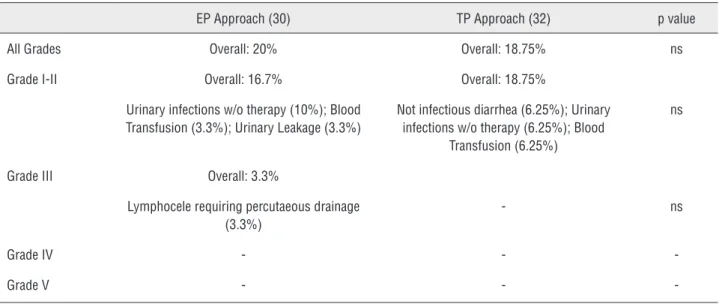
Complications, according to the Din-do-Clavien Classification, are listed in Table-2, showing not statistically significant differences between the two groups. No open conversions were needed.
Analysis of the times required for each step of RARP only revealed a difference in the time for trocar positioning, which was significantly higher in EP (mean 31 min; SD±11) than TP (mean 10 min; SD±2), p<0.001.
Mean time to perform standard pelvic lymphadenectomy was not statistically different (p=0.316) between two groups. In EP group was 23 min (SD±8) and in TP group was 21 min (SD±6).
Mean total operative time was 146 min for EP and 128 min for TP approach, p=0.19.
Mean estimated blood loss was 220 mL for EP and 312 mL for TP approach, p=0.289.
Table 2 - Post operative complications according to Clavien-Dindo classification.
EP Approach (30) TP Approach (32) p value
All Grades Overall: 20% Overall: 18.75% ns
Grade I-II Overall: 16.7% Overall: 18.75%
Urinary infections w/o therapy (10%); Blood Transfusion (3.3%); Urinary Leakage (3.3%)
Not infectious diarrhea (6.25%); Urinary infections w/o therapy (6.25%); Blood
Transfusion (6.25%)
ns
Grade III Overall: 3.3%
Lymphocele requiring percutaeous drainage (3.3%)
- ns
Grade IV - -
The heart rate did not change significantly during either of the surgical approaches.
Although mean arterial blood pressure and cardiac output did increase significantly during TP insufflation, although not during EP insuffla-tion, the differences between the methods were not statistically significant.
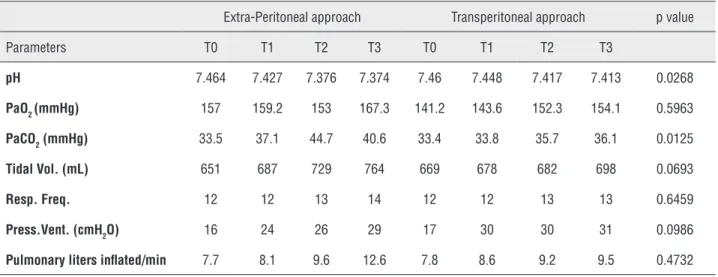
Gas exchange parameters are listed in Table-3.
Figure-1 shows changes in PaCO2 (Panel A) and blood artery pH (Panel B) during RARP with the EP and TP approaches.
Analysis of intra-operative anesthesiolog-ic parameters showed that PaCO2 was significantly higher during EP than during TP at times T2 and T3 (p=0.0125), with a consequent significant de-crease in arterial pH (p=0.0268). Other parameters analysed were similar in both groups.
DISCUSSION
In our study analysis of intra-operative anesthesiologic parameters showed that partial CO2 pressure during EP was significantly high-er than during TP, with a consequent decrease in arterial pH. Furthermore tidal volume was higher in EP group although there was not a statistically significant difference.
CO2 absorption during laparo-endoscopic surgery is a challenging anesthesiologic problem,
Table 3 - Gas exchange parameters.
Extra-Peritoneal approach Transperitoneal approach p value
Parameters T0 T1 T2 T3 T0 T1 T2 T3
pH 7.464 7.427 7.376 7.374 7.46 7.448 7.417 7.413 0.0268
PaO2 (mmHg) 157 159.2 153 167.3 141.2 143.6 152.3 154.1 0.5963
PaCO2 (mmHg) 33.5 37.1 44.7 40.6 33.4 33.8 35.7 36.1 0.0125
Tidal Vol. (mL) 651 687 729 764 669 678 682 698 0.0693
Resp. Freq. 12 12 13 14 12 12 13 13 0.6459
Press.Vent. (cmH2O) 16 24 26 29 17 30 30 31 0.0986
Pulmonary liters inflated/min 7.7 8.1 9.6 12.6 7.8 8.6 9.2 9.5 0.4732
and may lead to hypercarbia and acidosis. Clear-ance of CO2 is related to adequate alveolar venti-lation, and a rapid increase in CO2 levels may be compensated by hyperventilation of the lungs.
Only a small proportion of CO2 is dissolved in blood and delivered directly to the lungs.
Most of it combines with water in red blood cells to form carbonic acid, which then dis-sociates into hydrogen and bicarbonate, according to the formula:
CO2+H2O↔H2CO3↔H++HCO 3
CO2 absorbed through the peritoneum is handled in the same manner and, ultimately, is eliminated by respiratory exchange in the lun-gs. While the patient is under general anesthesia, minute ventilation volumes must be increased to maintain normocarbia.
Although the increase in PaCO2 is not fully compensated by hyperventilation, most he-althy patients can easily adapt to the increase in end-tidal CO2. However, some cannot tolerate the increased CO2 load during insufflation, and this condition may lead to myocardial depression and vasodilation. Conversely, severe acidemia and hypercapnia may depress heart performance, se-condary to decreases in myocardial inotropy (4).
causes persistent increases in blood pressure and he-art rate, increasing catecholamine concentrations (5). In addition, the pneumoperitoneum, becau-se of direct compression of the diaphragm, leads to a significant reduction in forced expiratory volume, peak expiratory flow and forced vital capacity, with a consequent decrease in pulmonary compliance (6).
The extent of the hemodynamic effects of hypercarbia is also correlated to the patient’s po-sition: in the Trendelenburg position, abdominal contents are pushed against the diaphragm, redu-cing functional residual capacity and predisposing to atelectasis (5). In 1946, Case et al. (7)described a 15% decrease in lung volume in this position. The Trendelenburg position also increases central ve-nous pressure, myocardial work, pulmonary veve-nous pressure (decreasing pulmonary compliance), intra--cranial pressure (8) and intra-ocular pressure (9).
Our data concerning hemodynamic changes during RARP demonstrate that the EP approach is associated with hemodynamic alterations similar to those observed during TP access, but with more rapid increases in partial CO2 pressure compared with TP, starting 1 hour after the beginning of CO2 insufflation.
Despite substantially comparable operation times, and despite a less extreme Trendelenburg po-sition in the EP approach and theoretically higher permeation of the gas into the bloodstream from the peritoneal cavity during TP access, in our experien-ce EP RARP causes a significantly higher absorption of CO2 than TP, resulting in more rapid acidosis.
These findings confirm the results of the only reported study comparing CO2 homeostasis du-ring TP and EP RARP in humans (2): the authors reported a more marked acidosis during CO2 insu-fflation in EP than during TP.
The mechanisms responsible for these chan-ges appear to be multifactorial and have not been completely clarified.
One mechanism causing higher EP CO2 re-absorption may be direct intra-vascular uptake of CO2, perhaps facilitated, as suggested by Glascock et al. (10), by the disruption of microvascular and lymphatic channels during the creation of an extra--peritoneal cavity.
Another less well-known element playing a role in CO2 absorption may be the use of a suction de-vice during TP: repeated suction during the operation causes a cyclic decrease-increase in intracavity pres-sure, which is less pronounced in the peritoneal cavi-ty because of the larger space, in which suction leads to a dramatic and rapid decrease in pressure. Repea-ted rapid variations in pressure may act as a sort of pump which insufflates CO2 into the microvessels of the extra-peritoneal cavity, causing gas reabsorption.
Examining the clinical outcomes of our pa-tients, in cases of acidosis and hypercarbia, the ven-tilation parameters were intra-operatively modified to maintain values under 30 mmHg and pH>7.3, respectively, increasing tidal volume and respiratory frequency, and successfully correcting pH alterations without complications.
Figure 1 - Arterial CO2 pressure (A) and pH (B) during carbon dioxide (CO2) insufflation in TP (red line) and EP (blue line)
groups. Data are presented as means at moment of induction of anesthesia (T0), after starting CO2 insufflation (T1), and at
60 (T2) and 120 minutes (T3) after insufflation.
All of our patients performed a pelvic lym-phadenectomy (PLND) independently to the risk group. This step inevitably prolonged the dura-tion of the procedure in both groups. However the extension of the lymphadenectomy has been the same in both groups. We performed PLND in all of our patients for a prospective study (on going in that period) in order to evaluate a new nomogram on the risk of nodes metastasis in prostate cancer patients. The purpose of the study was to inves-tigate whether patients actually classified as low risk (according to D’Amico risk groups) had in fact a risk close to zero to have nodes metastasis and to evaluate the predictive power of a new nomo-gram independently to the core’s number evalua-ted at the biopsy. Nowadays the guidelines do not suggest to perform PLND in all patients because of the very low risk of nodes metastasis in low risk patients. However the nomograms proposed do not evaluate the total number of cores at the biopsy but only the percentage of positive cores.
There are several criticisms of our study: one of the most important is the impossibility of maintaining standard intra-cavity pressure throu-ghout the operational phases, despite attempts to regulate it.
In addition, the statistical power of the small sample size of the two groups may have been insufficient to detect certain differences be-tween them.
Nevertheless, our findings bring to the at-tention-not only of urologists but also of anesthe-siologists-the possible hemodynamic effects of which approach is used for RARP. Although the choice is often dictated by the surgeon’s preferences, the above data may help to tailor a safer approach for each pa-tient, preferring when possible TP access, when CO2 reabsorption could be more dangerous and difficult to manage intra-operatively by the anesthesiologist.
This prospective randomized study demon-strates that TP and EP RARP are comparable, con-sidering the times of the single steps of the oper-ation. From the anesthesiologic viewpoint, during RARP the TP approach is preferable, because there is less CO2 reabsorption and risk of acidosis. These data should consequently be interpreted with cau-tion, until they can be replicated in other settings and in other types of studies.
REFERENCES
1. Ficarra V, Novara G, Artibani W, Cestari A, Galfano A, Graefen M, et al. Retropubic, laparoscopic, and robot-assisted radical prostatectomy: a systematic review and cumulative analysis of comparative studies. Eur Urol. 2009;55:1037-63.
2. Meininger D, Byhahn C, Wolfram M, Mierdl S, Kessler P, Westphal K. Prolonged intraperitoneal versus extraperitoneal insufflation of carbon dioxide in patients undergoing totally endoscopic robot-assisted radical prostatectomy. Surg Endosc. 2004;18:829-33.
3. Dindo D, Demartines N, Clavien PA. Classification of surgical complications: a new proposal with evaluation in a cohort of 6336 patients and results of a survey. Ann Surg. 2004;240:205-13. 4. Youssef MA, Al Mulhim A. Physiologic effects of
pneumoperitoneum in adults with sickle cell disease undergoing laparoscopic cholecystectomy (a case control study). Surg Endosc. 2008;22:1513-8.
5. Kanwer DB, Kaman L, Nedounsejiane M, Medhi B, Verma GR, Bala I. Comparative study of low pressure versus standard pressure pneumoperitoneum in laparoscopic cholecystectomy--a randomised controlled trial. Trop Gastroenterol. 2009;30:171-4.
6. Hasukić S, Mesić D, Dizdarević E, Keser D, Hadziselimović S, Bazardzanović M. Pulmonary function after laparoscopic and open cholecystectomy. Surg Endosc. 2002;16:163-5.
7. Case EH, Stiles JA. The effect of various surgical positions on vital capacity. Anesthesiology. 1946;7:29-31.
8. Park EY, Koo BN, Min KT, Nam SH. The effect of pneumoperitoneum in the steep Trendelenburg position on cerebral oxygenation. Acta Anaesthesiol Scand. 2009;53:895-9. 9. Awad H, Santilli S, Ohr M, Roth A, Yan W, Fernandez S, et al.
The effects of steep trendelenburg positioning on intraocular pressure during robotic radical prostatectomy. Anesth Analg. 2009;109:473-8.
10. Glascock JM, Winfield HN, Lund GO, Donovan JF, Ping ST, Griffiths DL. Carbon dioxide homeostasis during transperitoneal or extraperitoneal laparoscopic pelvic lymphadenectomy: a real-time intraoperative comparison. J Endourol. 1996;10:319-23.
_______________________ Correspondence address: Fabrizio Dal Moro, MD Assistant Professor Dipartimento di Scienze Chirurgiche,
Oncologiche e Gastroenterologiche, Università degli Studi di Padova