REVIEW ARTICLE
412
Efficacy of antibiotic prophylaxis in cystoscopy to prevent
urinary tract infection: a systematic review and meta-analysis
_______________________________________________
Herney Andrés García-Perdomo
1,2, Eladio Jiménez-Mejías
2, Hugo López-Ramos
31 Universidad del Valle, Colombia, CO; 2 Universidad de Granada, España; 3 Universidad del Rosario,
Colombia, CO
ABSTRACT
ARTICLE
INFO
______________________________________________________________ ______________________ Objective: To estimate the efficacy of antibiotic prophylaxis to prevent urinary tract
infection in patients (both gender) who undergo a cystoscopy with sterile urine. Materials and Methods: Search strategy (January 1980-December 2013) in Medline via PubMed, CENTRAL, and EMBASE. Additionally, we searched databases for regis-tered trials and conference abstracts, as well as reference lists of systematic reviews and included studies. Seven published randomized clinical trials (January 1, 1980 to December 31, 2013) were included in quantitative analyses with no language restric-tions. Two independent reviewers collected data. Risk of bias was evaluated with the Cochrane Collaboration tool. We performed a fixed effect analyses due to statistical homogeneity. The primary outcome was urinary tract infection and the secondary was asymptomatic bacteriuria. The effect measure was the risk difference (RD) with 95% confidence interval. The planned interventions were: Antibiotic vs placebo; Antibiotic vs no intervention and Antibiotic vs any other intervention.
Results: 3038 patients were found in seven studies. For the primary outcome, we in-cluded 5 studies and we found a RR 0.53 CI95% (0.31, 0.90) and a RD-0.012 CI95% (-0.023,-0.002), favoring antibiotic prophylaxis. For asymptomatic bacteriuria we in-cluded 6 studies and we found a RR 0.28 CI95% (0.20, 0.39) and a RD-0.055 CI95% (-0.07,-0.039), was found favoring prophylaxis. According to GRADE evaluation, we considered moderate quality of evidence for both outcomes. The subgroup analysis showed that only two studies were classified as having low risk of bias: Cam 2009 and García-Perdomo 2013. They showed no statistical differences (RD-0.009 CI95% -0.03, 0.011).
Conclusions: Based on studies classified as low risk of bias, we found moderate evi-dence to not recommend the use of antibiotic prophylaxis to prevent urinary tract in-fection and asymptomatic bacteriuria in patients who undergo cystoscopy with sterile urine in an ambulatory setting.
Key words:
Urinary Tract Infections; Cystoscopy; Antibiotic Prophylaxis; Meta-Analysis [Publication Type]
Int Braz J Urol. 2015; 41: 412-24
_____________________
Submitted for publication: April 28, 2014
_____________________
Accepted after revision: September 18, 2014
INTRODUCTION
Cystoscopy is the most frequently used and accepted diagnostic tool in urology (1). There are multiple indications as: hematuria, lower uri-nary tract symptoms evaluation, urothelial can-cer follow-u p, foreign body retrieval, planning a surgery, etc. (2). Based on these indications, it
is important to notice its risks to prevent futu-re complications. Pain, hematuria, lower urinary tract symptoms and urinary tract infection are the main adverse effects present during or af-ter the procedure. These symptoms are associated with higher morbidity in patients and increase the cost for healthcare system (3-5). According to García-Perdomo et al. (6) in Latin America,
Vol. 41 (3): 412-424, May - June, 2015
IBJU| EFFICACY OF ANTIBIOTIC PROPHYLAXIS IN CYSTOSCOPY
413
hematuria and urinary tract infection (UTI) inci-dences are 1% and 1.8% respectively, others like Jimenez-Cruz et al. (7) found 10% of UTI inci-dence in Spain, but it could vary between 1 and 21% according to literature (4, 5, 8, 9).
There are studies on UTI in an ambulatory and hospital settings, identifying it as the most common nosocomial infection nowadays (10).
Experimental studies have demonstrated the prophylaxis antibiotic´s efficacy to prevent surgical site infection and UTI in surgical settings (7, 11, 12). According to urological guidelines, it is not mandatory to use antibiotics in procedures like cystoscopy, urodynamics and cystography in patients with sterile urine. In others, like aged patients, anomalies of the urinary tract, poor nu-tritional status, cigarette smoking, immunosup-pression, external catheters, instrumentation of urinary tract and bacteriuria, the prophylaxis is recommended (13-16).
Currently there is no evidence to suggest antibiotic prophylaxis before cystoscopy due to a large amount of studies, heterogeneous, clinical and methodologically. The aim of this systematic review (SR) and meta-analysis (MA) was to es-timate the efficacy of antibiotic prophylaxis to prevent urinary tract infection in patients who undergo a cystoscopy with sterile urine.
MATERIALS AND METHODS
This study was conducted according to the recommendations of the Cochrane Collabora-tion and following PRISMA Statement. The pro-tocol was registered in the international prospec-tive register of systematic reviews (PROSPERO): CRD42014006976.
Eligibility Criteria
Studies: We included parallel, randomi-zed clinical trials (RCT) conducted between Janu-ary 1, 1980 and December 31, 2013. Open label, cross-over trials and studies with simultaneous interventions were excluded. No language res-trictions were imposed.
Participants: Female and male people ol-der than 18 years old who unol-derwent cystoscopy with sterile urine (negative urine culture). There
were no preferences in any other demographic characteristic of participants.
Interventions: The planned interventions were: Antibiotic vs placebo; Antibiotic vs no inter-vention and Antibiotic vs any other interinter-vention.
The antibiotic prophylaxis was unique ad-ministration, 30 to 60 minutes before the urologi-cal procedure. There was no restriction of dosage or type of antibiotic during the selection of the studies.
Outcomes: The primary outcome was the incidence of urinary tract infection (UTI) in pla-cebo and treatment groups, defined as positive urine culture (>105 CFU/mL) plus storage bladder
symptoms. The secondary outcome was asymp-tomatic bacteriuria (AB) defined as positive uri-ne culture (>105CFU/mL) without storage bladder
symptoms. These outcomes were assessed up to 30 days after the procedure.
Exclusions: No assessment of efficacy and antibiotic as a treatment.
Information sources and search strategy
We designed a search strategy for RCTs published in Medline via PubMed, CENTRAL and EMBASE. The search strategy was specific for each database and included a combination of the medical subject headings and free text ter-ms for urinary tract infection and cystoscopy. No language or publication status restrictions were considered. We included articles from January 1, 1980 to December 31, 2013. The full search stra-tegies are listed in Appendix 1.
Other electronic sources were used to find additional studies, such as Clinicaltrials.gov, conference abstracts, DARE and PROSPERO. We looked for additional studies in reference lists of selected articles, contacted with authors about knowledge of published or unpublished articles.
The results of searches were crosschecked in order to eliminate duplicates.
Study selection
IBJU| EFFICACY OF ANTIBIOTIC PROPHYLAXIS IN CYSTOSCOPY
414
a final decision. In case of no agreement, a third reviewer made the final decision.
Data collection process
Relevant data were collected by duplicate, using a standardized data extraction sheet, which contained: study design, participants, interventions and comparators and final outcomes details. Re-viewers confirmed all data entries and checked at least twice for completeness and accuracy. If some information was missing, we contacted authors in order to get data completed.
Risk of bias in individual studies and across them
The risk of bias was assessed independently by two researches using the Cochrane Collaboration risk of bias tool. We solved disagreements by con-sensus. The “Risk of bias table” was edited using Review Manager Software Version 5.2® (RevMan) to illustrate the judgments for each study. A risk of bias summary was made to show the judgments in a cross-tabulation of study by entry. After all, we assessed the general quality by each outcome with the GRADE tool and we produced a summary of findings table.
Summary measures
Analyses were performed in Revman®5.2 and Stata®13 were needed. The Risk Ratio (RR) and the risk difference (RD) were the effect measured of the primary and secondary outcome, with 95% confidence intervals (95%CI). We performed fixed--effects Meta-analysis due to homogeneity (clinical and statistical) found in clinical trials included.
Heterogeneity between trials was assessed through the I2 statistic. An I2 value greater or equal
to 50% could represent heterogeneity according to Higgins et al. (17). Results were reported as forest plots showing the effect size of all the included stu-dies with 95%CI.
Additional Analyses Subgroup Analysis
Risk of bias (low, unclear and high risk of bias)
They were performed on Stata 13. No meta--regression was performed because of the number of included studies.
Sensitivity Analysis
We undertook the sensitivity analysis based on the exclusion of each one of the trials, as well as the unpublished and the smallest trials (18).
Publication Bias
This was not performed due to the number of studies found (less than 10 studies) according to Higgins (17).
RESULTS
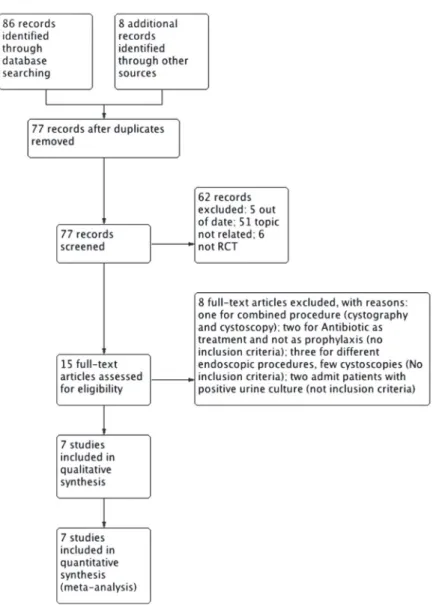
Study Selection: 94 articles were found with the search strategies designed; after exclusions, 7 studies were included in qualitative and quantita-tive analyses (6-8, 19-22) (Figure-1).
Characteristics of included studies: 3038 patients were found in seven studies with a median of 162 patients (45-2172). Five studies assessed UTI as primary outcome (6, 7, 19, 21, 22) and 6 stu-dies assessed asymptomatic bacteriuria as primary outcome (6-8, 19, 20, 22). Some of them measured both outcomes (6, 7, 19, 22) (Table-1).
The studies of Jimenez-Cruz et al., 1993 and Rané et al., 2001 used flexible urethrocystos-cope while the rest of them used rigid cystosurethrocystos-cope. The type of antibiotic administered was parente-ral for the studies of Jimenez-Cruz et al., 1993 and Rané et al., 2001 while the other five used oral administration (Table-1).
Characteristics of excluded studies: The reasons for exclusion were: different endoscopic procedures, combined procedures, not clinical trials, duplicates, inclusion of patients with po-sitive urine culture, another research topic and antibiotic as a treatment.
Risk of bias within studies: We performed the risk of bias assessment for UTI and bacteriu-ria at the same time due to the close relationship between the assessment of the two outcomes:
IBJU| EFFICACY OF ANTIBIOTIC PROPHYLAXIS IN CYSTOSCOPY
415
al., 2012 and Rané et al., 2001 presented on se-quence generation, blinding and attrition biases (Figure-1).
Results of individual studies by outcome Urinary Tract Infection
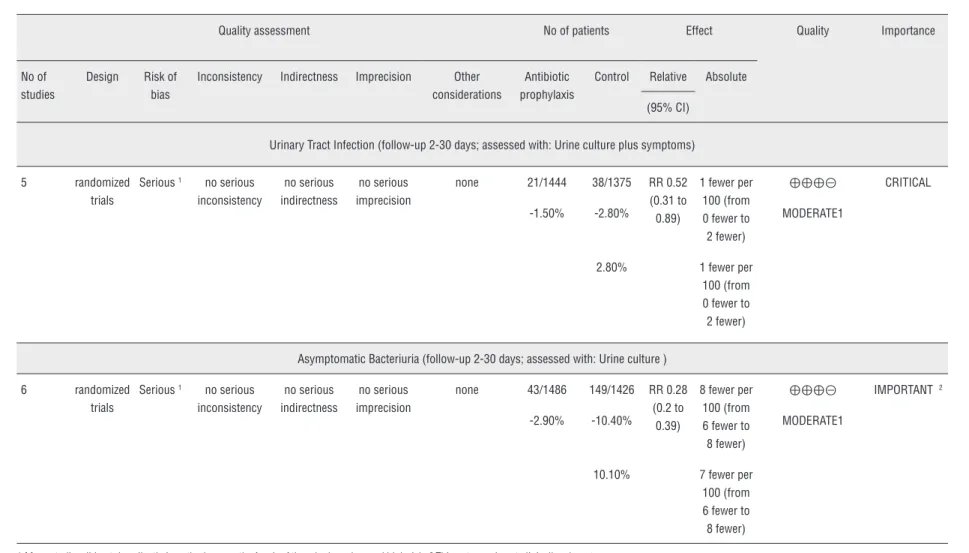
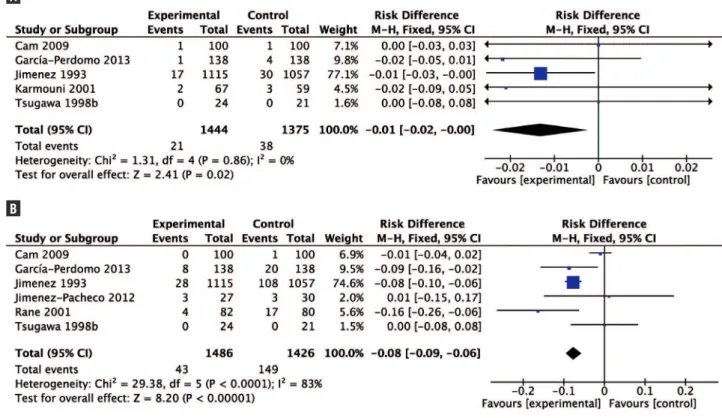
For antibiotic versus any other inter-vention, we included five studies (6, 7, 19, 21, 22); they showed a RR 0.52 IC95% (0.31, 0.89) (and a Risk difference of -0.012 CI95% (-0.023, -0.002)); the analysis of antibiotic compared to no intervention showed a similar effect (RR
0.55 IC95% 0.32, 0.96) (and a Risk difference of –0.012 (-0.023, -0.002)); however, different from the result of antibiotic against placebo only one study was included here (6) (Table-2 and Figu-re-2). Antibiotic vs antibiotic analysis was not performed since we did not find any article.
Asymptomatic Bacteriuria
In the analysis antibiotic vs any other in-tervention we included six studies (6-8, 19, 20, 22) that showed a RR 0.28 IC95% (0.20, 0.39) and a risk difference (RD) -0.012 CI95% (-0.023, -0.002));
IBJU| EFFICACY OF ANTIBIOTIC PROPHYLAXIS IN CYSTOSCOPY
416
the analysis of antibiotic compared to no interven-tion and against placebo resulted in a similar effect (RR 0.26 IC95% 0.18, 0.38) and a Risk difference of –0.012 (-0.023, -0.002)); however, the last one had only one study included (6) (Table-2 and Figu-re-2). We did not performed Antibiotic vs antibiotic analysis since we did not find any article.
Risk of bias across the studies
Most of the items assessed as “Low risk” were: attrition, selective reporting and other bias, the performance (blinding personnel and parti-cipants) and detection (blinding outcome asses-sment); biases showed a “No clear” assessment mostly and allocation concealment along with attrition bias showed mostly a “High risk” evalua-tion (Figure-2).
Subgroup Analysis
We only performed the subgroup analysis related to the risk of bias assessment, based on the Cochrane tool.
Urinary Tract Infection
Regarding this outcome, we found only two studies classified as having mostly low risk of bias: Cam 2009 and García-Perdomo 2013. They showed no statistical differences (RD -0.009 CI95% -0.03, 0.011). Three studies had unclear risk of bias: Jimenez 1993, Karmouni 2001 and Tsugawa 1998. They showed RD -0.013 CI95% (-0.025, -0.001) (p=0.02).
Asymptomatic Bacteriuria
Regarding this outcome, we found two stu-dies classified as having mostly low risk of bias: Cam 2009 and García-Perdomo 2013. They showed a RD -0.02 CI95% (-0.045, 0.005).
Two studies had unclear risk of bias: Ji-menez 1993 and Tsugawa 1998. They showed RD -0.073 CI95% (-0.093, -0.053) and two studies sho-wed a high risk of bias: Jimenez-Pacheco 2012 and Rane 2001. These two showed RD -0.014 CI95%(-0.199, -0.028) (p=0.000).
Sensitivity Analysis
The sensitivity analysis found that the in-clusion of Jimenez-Cruz et al., 1993 study
influen-ced notoriously the results. When this article is in-cluded, the meta-analysis favors prevention of UTI using antibiotic prophylaxis; however when this one is excluded, there are no differences; besides, this study carries an unclear risk of bias.
GRADE Assessment
The quality of evidence assessment was performed by the GRADE methodology and a summary of findings table was generated for both outcomes (Table-1). We found five studies asses-sing the UTI outcome as the clinically important one. These five studies had serious considerations in the risk of bias, according to the Cochrane tool but there were no other important considerations. According to this evaluation, we considered mo-derate quality of evidence for this outcome. There were six studies where we found similar findings for the asymptomatic bacteriuria and we graded as moderate quality of evidence according to the evaluation.
DISCUSSION
Main Findings Summary
In summary, we found 3038 patients in 7 studies included; 5 assessed UTI as primary ou-tcome (6, 7, 19, 21, 22) and 6 studies assessed asymptomatic bacteriuria (6-8, 19, 20, 22). For the primary outcome, a RR 0.52 IC95% (0.31, 0.89) was found; to asymptomatic bacteriuria a RR 0.28 IC95% (0.20, 0.39) was supported.
Interventions To Prevent Urinary Tract Infec-tion
IBJU
|
EFFICA
CY OF ANTIBIO
TIC PROPHYLAXIS IN CYST
OSCOPY
41
7
Table 1 - Characteristics of included studies.
Source Setting No of patients
Mean
age Inclusion criteria Intervention Control Outcome Follow- up
Cam et al.
2009 Turkey 200 58
Patients who underwent rigid cystoscopy for bladder tumor follow-up or hematuria and bladder biopsy and tumor resection. Exclusion: antibiotics
30 days before procedure or positive urine culture.
Cephoperazone 1 gr No intervention UTI and Bacteriuria
Up to 10 days
García-Perdomo et al. 2013
Colombia 276 58
Any non urgent indication of cystoscopy. Exclusion: no follow-up, allergy, interaction with antibiotic, permanent urethral catheter, immunossupression, intermitent catheterization.
Levofloxacin 500 mg Placebo UTI and Bacteriuria
Up to 10 days
Jimenez-Cruz et al. 1993
Spain 2284 NA
Older than 16 years old, negative urine culture, diagnostic cystoscopy. Exclusion: indwelling
urethral catheter, antibiotics, uti,
Ceftriaxone 1 gr No intervention UTI and Bacteriuria
Up to 30 days
Jimenez-Pacheco et al. 2012
Spain 60 65
Any indication for flexible cystoscopy . Exclusion: indwelling urethral catheter, instrumentation of urinary tract 1 month before,
uti, positive urine culture, vesicoureteral reflux, intermitent catheterization, risk of endocarditis,
hypersensitivity.
Phosphomicine
Trometamol 3 gr No intervention Bacteriuria
Up to 10 days
Karmouni
et al. 2001 France 126 66
Diagnostic cystoscopy for bladder tumor follow-up, hematuria, luts, incontinence. Exclusion:
antibiotics, risk of endocarditis, indwelling urethral catheter, double pig tail.
Norfloxacin 400 mg No intervention UTI Up to 10 days
Rane et al. 2001
United
Kingdom 162 NA
Diagnostic cystoscopy for bladder tumor follow-up, Exclusion: antibiotics, risk of endocarditis,
indwelling urethral catheter, bladder biopsy
Gentamicine 120 mg No intervention Bacteriuria Up to 10 days
Tsugawa et
al. 1998 Japan 47 63 Diagnostic cystoscopy based on symptoms Sparfloxacine No intervention
UTI and Bacteriuria
IBJU
|
EFFICA
CY OF ANTIBIO
TIC PROPHYLAXIS IN CYST
OSCOPY
41
8
Table 2 - Search strategies.
Quality assessment No of patients Effect Quality Importance
No of studies
Design Risk of bias
Inconsistency Indirectness Imprecision Other considerations
Antibiotic prophylaxis
Control Relative Absolute
(95% CI)
Urinary Tract Infection (follow-up 2-30 days; assessed with: Urine culture plus symptoms)
5 randomized
trials
Serious 1 no serious inconsistency
no serious indirectness
no serious imprecision
none 21/1444 38/1375 RR 0.52
(0.31 to 0.89)
1 fewer per 100 (from 0 fewer to 2 fewer)
⊕⊕⊕⊝ CRITICAL
-1.50% -2.80% MODERATE1
2.80% 1 fewer per
100 (from 0 fewer to 2 fewer)
Asymptomatic Bacteriuria (follow-up 2-30 days; assessed with: Urine culture )
6 randomized
trials
Serious 1 no serious inconsistency
no serious indirectness
no serious imprecision
none 43/1486 149/1426 RR 0.28
(0.2 to 0.39)
8 fewer per 100 (from 6 fewer to 8 fewer)
⊕⊕⊕⊝ IMPORTANT 2
-2.90% -10.40% MODERATE1
10.10% 7 fewer per
100 (from 6 fewer to 8 fewer)
IBJU| EFFICACY OF ANTIBIOTIC PROPHYLAXIS IN CYSTOSCOPY
419
Figure 2 - Forrest plot for antibiotic versus any other intervention, outcome: A. urinary tract infection B. asymptomatic bacteriuria.
A
B
recommend and prevent UTI using prophylaxis. The sensitivity analysis showed Jimenez-Cruz et al., 1993 as the most weighted study and changes results and conclusion of this research if we put it in or out of the Meta-analysis. According to the subgroup analysis, the low risk bias studies sho-wed no differences between using or not antibio-tic prophylaxis, in contrast to the unclear risk of bias studies.
Clinical guidelines suggest not using pro-phylaxis antibiotic in patients with sterile urine who undergo cystoscopy or urodynamic studies (based on descriptive studies); on the other side, they suggest to use prophylaxis in high-risk pa-tients (13-15); however it is important to remem-ber that these recommendations are based on an expert panel and also, UTI as any other disease, has an interaction between the microorganism and the inflammatory response from the host, which will determine the symptoms according to the immunity response (23). In Colombia, it is
advised to use a first generation cephalosporine in high-risk patients due to the higher antibiotic resistance to ciprofloxacin and TMP/SMX. Indi-cations for antibiotic in high risk patients were not measured in this MA because data were not enough based on the studies and this was not its aim.
Interventions To Prevent Asymptomatic Bacte-riuria
IBJU| EFFICACY OF ANTIBIOTIC PROPHYLAXIS IN CYSTOSCOPY
420
infection, however there is not an statement for preventing asymptomatic bacteriuria since this is not a major outcome in clinical practice (13-15, 25).
All these results are according to publi-shed literature and stated hypothesis due to ins-trumentation of lower urinary tract. Despite of many studies evaluating AB incidence, it is just relevant for pregnant and immunosuppressed pe-ople; however, these patients are frequently ex-cluded from clinical trials.
Limitations
Similar to other MA´s, clinical trials in-cluded were not adequately written (it does not mean bad or low quality), so the assessment could have incurred on overestimations. Currently, the Cochrane risk of bias tool is the best and more consistent tool to evaluate clinical trials because they focus on the way to conduct a clinical trial. This was helpful for the development and assess-ment of the articles included (17).
Two articles had low risk of bias in most items (6, 19). One of them showed high risk of bias in three items (sequence generation, alloca-tion concealment and attrialloca-tion bias) (8), but the rest of them showed mostly no clear risk of bias. In general, across studies we had low risk of bias for sequence generation and attrition bias.
To notice, the most weighted study (7) had no clear risk of bias in four items (sequen-ce generation, allocation con(sequen-cealment, blinding of participants, investigator and assessors); high risk in attrition bias and low risk in reporting and other biases. This is important for analyzing and interpreting results; however it had the bi-gger sample size, which is also relevant. When performing the subgroup analysis we found that those studies classified as low risk of bias showed no differences when using or not antibiotic pro-phylaxis to prevent urinary tract infections and asymptomatic bacteriuria. We believe that this is the most important issue to consider making a decision about using or not antibiotic prophyla-xis before a cystoscopy.
Another important topic that limits our work is the lack of data found to perform a sub-group analysis or a meta-regression.
Despite there was no evidence of neither statistical (I2=0%) nor clinical heterogeneity, it is
important to observe that studies used different type of antibiotics: Cefoperazone (19), Levofloxa-cin (6), Ceftriaxone (7), PhosphomiLevofloxa-cine trometa-mol (20), Norfloxacin (21), Gentamicine (8) and Sparfloxacin (22). This might contribute to the results and clinical application according to an-tibiotic resistance in each hospital or ambulatory setting.
Finally, our Meta-analysis was done for a frequent urological procedure, according to Co-chrane and PRISMA methodology so we could re-commend this intervention for institutions around the world.
As a conclusion, based on studies clas-sified as low risk of bias, we found moderate evidence to not recommend the use of antibiotic prophylaxis to prevent urinary tract infection and asymptomatic bacteriuria in patients who under-go cystoscopy with sterile urine in an ambula-tory setting. Nevertheless, we believe we need more well-designed, adequately powered clinical trials to assess benefits and harms of using anti-biotic prophylaxis in these settings. We also su-ggest conducting clinical trials on patients who are likely to develop UTI to determine the most effective antibiotic/s to prevent it. These factors are: advanced age, urinary tract anomalies, poor nutritional status, cigarette smoking, immunosu-ppression, as well as external catheters, recurrent UTI and bacteriuria.
CONFLICT OF INTEREST
None declared.
REFERENCES
1. Young M, Martínez S, Del Rosario J, Anguizola C. [Bladder endoscopy(cystoscopy): indications and most frequent findings at the Metropolitan Hospital Complex of the Social Security Fund of Panama, 1997]. Rev Med Panama. 1998; 23:20-3.
IBJU| EFFICACY OF ANTIBIOTIC PROPHYLAXIS IN CYSTOSCOPY
421
3. Clark KR, Higgs MJ. Urinary infection following out-patientflexible cystoscopy. Br J Urol. 1990;66:503-5.
4. Almallah YZ, Rennie CD, Stone J, Lancashire MJ. Urinary tract infection and patient satisfaction after flexible cystoscopy and urodynamic evaluation. Urology. 2000; 56:37-9. 5. Burke DM, Shackley DC, O’Reilly PH. The community-based
morbidity of flexible cystoscopy. BJU Int. 2002; 89:347-9. 6. García-Perdomo HA, López H, Carbonell J, Castillo D, Cataño
JG, Serón P. Efficacy of antibiotic prophylaxis in patients undergoing cystoscopy: a randomized clinical trial. World J Urol. 2013; 31:1433-9.
7. Jiménez Cruz JF, Sanz Chinesta S, Otero G, Díaz González R, Alvarez Ruiz F, Flores N, et al. Antimicrobial prophylaxis in urethrocystoscopy. Comparative study. Actas Urol Esp. 1993;17:172-5.
8. Rané A, Cahill D, Saleemi A, Montgomery B, Palfrey E. The issue of prophylactic antibiotics prior to flexible cystoscopy. Eur Urol. 2001; 39:212-4.
9. McCombie SP, Carmichael JP, Banerjee S, Wood SJ. Urinary tract infection following flexible cystoscopy: a comparison between sterilised cystoscopes and disposable sterile sheaths. J Clin Urol. 2013;6:220-4.
10. Foxman B. The epidemiology of urinary tract infection. Nat Rev Urol. 2010; 7:653-60.
11. Verschuur HP, de Wever WW, van Benthem PP. Antibiotic prophylaxis in clean and clean-contaminated ear surgery. Cochrane Database Syst Rev. 2004;CD003996.
12. Cunningham M, Bunn F, Handscomb K. Prophylactic antibiotics to prevent surgical site infection after breast cancer surgery. Cochrane Database Syst Rev. 2006;CD005360. 13. Grabe M. Perioperative antibiotic prophylaxis in urology.
Curr Opin Urol. 2001; 11:81-5.
14. Naber KG, Hofstetter AG, Brühl P, Bichler K, Lebert C; Working group ‘Urinary Tract Infections’ of the Paul Erlich Societ for Chemotherapy; Working group ‘Urological Infections’ of the German Society for Urology. Guidelines for the perioperative prophylaxis in urological interventions of the urinary and male genital tract. Int J Antimicrob Agents. 2001; 17:321-6. 15. Wolf JS Jr, Bennett CJ, Dmochowski RR, Hollenbeck BK,
Pearle MS, Schaeffer AJ; Urologic Surgery Antimicrobial Prophylaxis Best Practice Policy Panel. Best practice policy statement on urologic surgery antimicrobial prophylaxis. J Urol. 2008; 179:1379-90.
16. Bootsma AM, Laguna Pes MP, Geerlings SE, Goossens A. Antibiotic prophylaxis in urologic procedures: a systematic review. Eur Urol. 2008; 54:1270-86.
17. Higgins J, Green S. Cochrane Handbook for Systematic Reviews of Interventions Version 5.1.0 [Internet]. The Cochrane Collaboration; 2011. Available at: www.cochrane-handbook.org
18. DerSimonian R, Laird N. Meta-analysis in clinical trials. Control Clin Trials.1986; 7:177-88.
19. Cam K, Kayikci A, Erol A. Prospective evaluation of the efficacy of antibiotic prophylaxis before cystoscopy. Indian J Urol. 2009; 25:203-6.
20. Jiménez-Pacheco A, Lardelli Claret P, López Luque A, Lahoz-García C, Arrabal Polo MA, Nogueras Ocaña M. Randomized clinical trial on antimicrobial prophylaxis for flexible urethrocystoscopy. Arch Esp Urol. 2012; 65:542-9.
21. Karmouni T, Bensalah K, Alva A, Patard JJ, Lobel B, Guillé F. Role of antibiotic prophylaxis in ambulatory cystoscopy. Prog Urol. 2001; 11:1239-41.
22. Tsugawa M, Monden K, Nasu Y, Kumon H, Ohmori H. Prospective randomized comparative study of antibiotic prophylaxis in urethrocystoscopy and urethrocystography. Int J Urol. 1998; 5:441-3.
23. Krieger JN, Ross SO, Riley DE. Chronic prostatitis: epidemiology and role of infection. Urology. 2002; 60:8-12; discussion 13.
24. Cohn EB, Schaeffer AJ. Urinary tract infections in adults. ScientificWorldJournal. 2004;4(Suppl 1):76-88.
25. Grabe M, Bishop M., Bjerklund-Johansen T, Botto H, Çek M, Lobel B, et al. The management of urinary and male genital tract infections. European Association of Urology; 2008.
_______________________ Correspondence address:
IBJU| EFFICACY OF ANTIBIOTIC PROPHYLAXIS IN CYSTOSCOPY
422
APPENDIX 1Search strategy for medline via pubmed:
(Cystoscopy [mh] OR Urethroscopy [tw] OR Urethrocystoscopy [tw] OR “flexible cystoscopy” [tw] OR “transurethral cystoscopy” [tw]) AND (“anti-infective agents, urinary” [mh] OR “antibiotic prophylaxis” [mh] OR “antibiotic” [tw] OR “antimicrobial prophylaxis” [tw]) AND (urinary tract infec-tion [mh] OR bacteriuria [mh] OR pyuria [mh]) AND (randomized controlled trial [pt] OR controlled clinical trial [pt] OR randomized controlled trials [mh ] OR clinical trial [pt] OR “clinical trial” [tw]) Search strategy for EMBASE:
('cystoscopy'/exp OR 'urethroscopy'/exp OR urethrocystoscopy OR 'flexible cystoscopy' OR 'transurethral cystoscopy') AND ('urinary tract antiinfective agent'/exp OR 'antibiotic prophylaxis'/ exp OR 'antibiotic agent'/exp OR 'antimicrobial prophylaxis') AND ('urinary tract infection'/exp OR 'pyuria'/exp) AND ('randomized controlled trial'/exp OR 'controlled clinical trial'/exp OR 'clinical trial'/exp OR 'clinical trial')
Search strategy for CENTRAL:
IBJU| EFFICACY OF ANTIBIOTIC PROPHYLAXIS IN CYSTOSCOPY
423
EDITORIAL COMMENTRather the use of validated methodologi-cal tools, the author of a systematic review has in his or her hands, a lot of decisions to make, not always controlled by those instruments, whi-ch can determine different conclusions, or even diametrically opposed one. A Systematic Review titled “Efficacy of antibiotic prophylaxis in uri-nary tract cystoscopy to prevent infection” is a good example of the variation of options, in their development, producing results influenced by this variation.
There is a strong school of systematic re-views, that recommends, on behalf of the reader information, to include and aggregate (meta--analysis) works with different populations, di-fferent interventions, didi-fferent comparisons and different outcomes; with distinct strength of evi-dence (number and importance of bias); and im-proper comparisons to define efficacy.
This review includes studies with the use of various antibiotics (Cefoperazone, Levoflo-xacin, Ceftriaxone, Phosphomicine trometamol, Norfloxacin, Gentamicin and Sparfloxacin), whi-ch were never compared, in these patients, allo-wing them to be aggregated with the unique sta-tus of antibiotics.
Some are flexible cystoscopy, other rigid; indications in some cases are for bladder tumors, other diagnostic only. Certainly the risk of infection varies, from uncorrected way, from work to work.
Studies Jimenez in 1993, Jimenez-Pache-co 2012, Karmouni 2001 Rane 2001 and Tsugawa 1998 have important bias relative to randomiza-tion and blinding, and must not be included in the review, and mainly in the meta-analysis. The sensitivity analysis, addressing only one study (Jimenez 1993) confirms this fact.
Only two studies have a low level of bias, and only one study comparing intervention with placebo (García-Perdomo 2013), being the one who should be included to support the concept of efficacy.
The quality assessment of the studies va-ried: according to the outcome analyzed by grou-ping (eg UTI or asymptomatic bacteriuria); accor-ding to the topics of bias tool used; and requires
clinical interpretation of what is moderate, which will vary from doctor to doctor. This fact makes the need for a critic academic exercise, that is the duty of the author, and should not be passed on to the reader, who only wishes to know: whether or not to prescribe antibiotic? and which anti-biotic?
We know that one of the major limita-tions of the systematic review with meta-analy-sis, is the true heterogeneity, which depends on the inherent differences of each included study. There is no instrument, step by step methodolo-gy, which replace the judgment of the author. But there are schools of systematic review that make strong push for the inclusion to be as flexible as possible, to enable the meta-analysis. After all, “systematic review without meta-analysis, is not a systematic review”.
However, in this review to answer the questions: We must use antibiotics for pro-phylaxis of urinary tract infection in cystos-copy? What antibiotics? How effective is the antibiotic? only one study should be included: García Perdomo 2013. And the answer is “yes”, we should use Levofloxacin 500 mg, which re-duces the risk of urinary infection in 25% (Num-ber Need to Treat – NNT = 4) and asymptomatic bacteriuria in 40% (NNT: 2).
REFERENCES
1. Armijo-Olivo S, Ospina M, da Costa BR, Egger M, Saltaji H, Fuentes J, et al. Poor reliability between Cochrane reviewers and blinded external reviewers when applying the Cochrane risk of bias tool in physical therapy trials. PLoS One. 2014;9:e96920.
2. Savović J, Weeks L, Sterne JA, Turner L, Altman DG, Moher D, et al. Evaluation of the Cochrane Collaboration’s tool for assessing the risk of bias in randomized trials: focus groups, online survey, proposed recommendations and their implementation. Syst Rev. 2014;3:37.
3. Bernardo WM. Beyond the evidence: the values for the patient. Rev Assoc Med Bras. 2014;60:1.
IBJU| EFFICACY OF ANTIBIOTIC PROPHYLAXIS IN CYSTOSCOPY
424
5. Turner RM, Bird SM, Higgins JP. The impact of study sizeon meta-analyses: examination of underpowered studies in Cochrane reviews. PLoS One. 2013;8:e59202.
6. Bernardo WM. [The importance of analysis in published evidence levels]. Rev. Assoc Med Bras. 2011;57:1.
7. Moher D, Liberati A, Tetzlaff J, Altman DG; PRISMA Group. Preferred reporting items for systematic reviews and meta-analyses: the PRISMA statement. Int J Surg.2010;8:336-41. Epub 2010 Feb 18. Erratum in: Int J Surg. 2010;8:658.
8. Higgins JP, Thompson SG, Deeks JJ, Altman DG. Measuring inconsistency in meta-analyses. BMJ. 2003;327:557-60. 9. Higgins JP, Thompson SG. Quantifying heterogeneity in a
meta-analysis. Stat Med. 2002;21:1539-58.