A new technique of bladder neck reconstruction during
radical prostatectomy in patients with prostate cancer
_______________________________________________
Yuri Tolkach
1,2, Konstantin Godin
3, Sergey Petrov
2, Sonny Schelin
4, Florian Imkamp
11 Hannover Medical School, Urology and Urologic Oncology Clinic, 30625 Hannover, Deutschland; 2 Military Medical Academy, Urology Clinic, 194044 Saint-Petersburg, Russia; 3 Südharz Klinikum
Nordhausen, Urology Clinic, 99734 Nordhausen, Deutschland; 4 Kalmar County Hospital, 39231 Kalmar,
Sweden
ABSTRACT
ARTICLE
INFO
______________________________________________________________ ______________________
Purpose: To evaluate continence after radical prostatectomy in prostate cancer pa-tients, in whom a new method of the bladder neck reconstruction (BNR) using deep dorsal stitch was implemented (deep single stitch through all bladder layers directly dorsal to the bladder opening after “tennis racket” reconstruction) and to provide jus-tification for its use by means of anatomical study in cadavers.
Material and Methods: Open radical retropubic prostatectomy was performed in 84 patients: 39 patients with a new BNR method used to improve continence and control group of 45 patients with standard “tennis racket” BNR. Median follow-up was 14 months in control group and 12 months in study group. Continence recovery was accessed early postoperatively and every 3 months thereafter. Anatomical study was performed on 2 male fresh cadavers reproducing two different BNR techniques to cla-rify any underlying continence related mechanisms.
Results: Patients with new BNR achieved full continence significantly faster (p=0.041), but the continence rates after 12 months were similar between groups. The severity of incontinence up to month 9 was significantly reduced in BNR group. The anastomo-tic stricture rate was not affected. Applying new BNR to the cadaver model revealed effects on early continence, namely presence of proximal passive closure mechanism in area of bladder neck.
Conclusions: Continence in patients with the new BNR method using deep dorsal stitch recovered significantly faster. Moreover, a reduced grade of residual incontinence was documented. The effect was non-significant at month 12 of follow-up, meaning that only early effect was present.
Key words:
Prostatic Neoplasms;
Prostatectomy; Urinary Bladder; Urinary Incontinence
Int Braz J Urol. 2015; 41: 455-65
_____________________
Submitted for publication: July 10, 2014
_____________________
Accepted after revision: September 18, 2014
INTRODUCTION
Prostate cancer is one of the most common cancers in men. It has the highest incidence among other cancers and is in third place in the structure of cancer related male mortality in Europe (1). Many patients are in need of radical treatment every year. The most common types of applied treatments with
curative intent are radical prostatectomy and radia-tion therapy with the surgical treatment being most common in every day practice (2).
(3, 4), negatively affecting the quality of life in a prolonged and sometimes irreversible manner. The post-operative incontinence can last more than 1 year after the operation in up to 10% of the patients (4, 5), significantly impairing the social functioning in this mostly very active contingent of patients.
The imperfect nature of the radical pros-tatectomy with regard to the urinary continen-ce was object for intense investigations, mainly with an urgent task to improve the operational technique in order to preserve continence in the majority of patients (6, 7). One group of tech-nical methods, which could potentially improve continence after radical prostatectomy is blad-der neck reconstruction, that were investigated in small mainly underpowered studies with an overall tendency to improve the continence early after operation with no differences in general af-ter one year. (8-15).
The aim of this investigation was to eva-luate the functional outcomes of radical prosta-tectomy in terms of urinary continence in patients with prostate cancer, in whom a new method of bladder neck reconstruction (BNR) with a deep dorsal stitch was applied, and also to find the potential underlying mechanisms for the efficacy of the BNR using an anatomic model.
MATERIALS AND METHODS
This is a controlled clinical study with pros-pectively collected data performed in 84 consecuti-ve male patients. All patients underwent open ra-dical retropubic prostatectomy due to the presence of histologically confirmed localized prostate cancer of all clinical risk groups (cT1-cT3N0M0, any PSA, any preoperative Gleason score). In 39 patients a new method of bladder neck reconstruction using a deep dorsal stitch was used, aimed to improve the functional outcomes (urinary continence) after ra-dical prostatectomy. Another 45 patients, in whom a standard reconstruction using “tennis racket” was implemented, were used as a control group. All patients were operated on in the period of 2008-2010 years in a high-volume uro-oncological center (Urology Clinic of Military Medical Academy, Saint--Petersburg, Russia) by a single surgeon (S.P.) with a background of approximately 400 open radical
prostatectomies and 10 years of experience with this operation. The two patient groups included in this study represented two consecutive series (operations on patients in control group were performed earlier than in the new BNR group). Only those patients in whom the nerve bundles were not preserved were included into analysis for the conceptual isolation of the new BNR me-thod. Formally, part of the patients included in the study had the indications for nerve sparing, but this technique was not applied as it was only recently introduced in clinical practice and was not performed at that moment in all patients.
Preoperative staging was performed ac-cording to the current European Association of Urology guidelines. All patients included in the study were continent prior to operation.
Description of the standard method of the BNR After removal of the prostate with the retro-grade dissection technique (release of the apex, tran-section of urethra, retrograde ligation of vascular pe-dicles, dissection of prostate off the bladder) eversion of the bladder mucosa was performed and bladder neck was narrowed with the use of running Vycril 2/0 suture from the dorsal edge of the bladder neck opening resulting from prostate removal (so-called “tennis racket” reconstruction, Figure-1, A-D). Addi-tional single stitch (Vycril 2/0) was used to appro-ximate the dorsal part of the rhabdosphyncter and the remaining portion of the vesico-prostatic muscle dorsal to the bladder neck (Rocco stitch (16). Anas-tomosis was created using 4 to 7 single sutures of Vycril 3/0 (median 5 stitches).
Description of the new method of the BNR (BNR using deep dorsal stitch)
Figure 1 - Consecutive steps of bladder neck reconstruction using the standard and deep stitch techniques: A) Direct view of bladder neck after removal of prostate specimen; B) Mucosa eversion; C, D) ‘tennis racquet’ reconstruction of the bladder neck; E) Placing of the deep stitch dorsally to the bladder neck orifice through all layers of the bladder wall; F) The final view of bladder neck after reconstruction.
Images A-D are the steps of the standard technique, A-F - the steps of the technique under investigation.
A
C
E
B
D
F
After tightening the stitch the bougie was removed and anastomosis was finished equally as described for the standard method.
With this deep dorsal stitch the opening of the bladder neck was compressed by the surroun-ding tissues but without reducing the diameter of the orifice (Figures 1 and 2).
This technique of BNR was suggested by Sonny Schelin (Kalmar County Hospital, Kalmar, Sweden).
Postoperative follow-up
The continence status was evaluated at 6 con-trol time points–within 1 week after catheter removal and at 1, 3, 6, 9 and 12 months after operation.
The evaluated parameters were:
1. Question: Is full continence achieved? 2. Number of the incontinence pads used
per day.
Incontinence Questionnaire Urinary Incontinence Short Form) in a ver-sion, validated for Russian language.
Full continence was strictly defined as full absence of urine leakage. All patients were controlled for residual volume (ultrasound), de-crease in the micturition velocity (uroflowmetry, Qmax), and for the newly arising lower urinary tract symptoms during follow-up.
Ethical issues
Institutional review board and ethical committee of the Military Medical Academy (Saint-Petersburg, Russia) approved this study.
Anatomical study
Anatomical study was performed on two fresh male cadavers with documented reason of de-ath demonstrating no link to the lower urinary tract, which were used to reproduce all steps of radical
pros-tatectomy using both BNR methods under investiga-tion. The intention was to identify anatomical factors, which could pre-determine the efficacy of the BNR with regard to the urinary continence after radical prostatectomy. Anatomical study was covered by the permission of the ethic commission.
Statistics
Statistical analysis was performed using the STATISTICA 8.0 software (StatSoft, Tulsa, USA). Life tables and Kaplan-Meyer analysis were used to compare continence recovery in pa-tients with standard technique and deep stitch technique under investigation.
RESULTS
Median follow-up for the patients after radical prostatectomy was 14 months in the stan-dard BNR group and 12 months in the group of
Figure 2 - Schematic representation of the steps of the bladder neck reconstruction using deep stitch technique: A) Bladder neck view after formation of classic ‘tennis racket’; B) Deep stitch is made dorsally to bladder orifice through all layers of the bladder wall; C) Tightening of the suture results in the tissue shift, which represents a formation of proximal passive closure mechanism (compression of the bladder neck orifice with surrounding tissues without reducing the diameter). A bougie (*) should be introduced into the bladder neck to prevent substantial shrinkage of the tissues during the tightening of the suture.
A
B
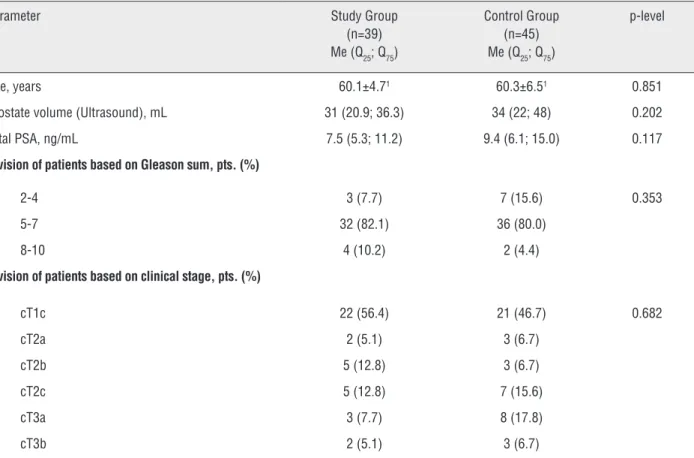
Table 1 - Preoperative characteristics of the patients (by groups).
Parameter Study Group
(n=39) Me (Q25; Q75)
Control Group (n=45) Me (Q25; Q75)
p-level
Age, years 60.1±4.71 60.3±6.51 0.851
Prostate volume (Ultrasound), mL 31 (20.9; 36.3) 34 (22; 48) 0.202
Total PSA, ng/mL 7.5 (5.3; 11.2) 9.4 (6.1; 15.0) 0.117
Division of patients based on Gleason sum, pts. (%)
2-4 3 (7.7) 7 (15.6) 0.353
5-7 32 (82.1) 36 (80.0)
8-10 4 (10.2) 2 (4.4)
Division of patients based on clinical stage, pts. (%)
cT1c 22 (56.4) 21 (46.7) 0.682
cT2a 2 (5.1) 3 (6.7)
cT2b 5 (12.8) 3 (6.7)
cT2c 5 (12.8) 7 (15.6)
cT3a 3 (7.7) 8 (17.8)
cT3b 2 (5.1) 3 (6.7)
1 Mean ± Standard deviation
the patients with the new reconstruction techni-que using deep dorsal stitch.
Preoperative and perioperative clinical pa-rameters are shown in Tables 1 and 2. The patient groups had no significant differences in age, pros-tate volume, total PSA level, biopsy results, clini-cal stage of prostate cancer (cT-stage), estimated blood loss and duration of pelvic drainage.
Operation time showed statistically signi-ficant differences between the groups with lon-ger duration in the control group (p=0.044). This fact was probably related to the consecutive na-ture of the patients.
The duration of catheterization tended to be longer in the control group. This was related to the change in institutional guidelines during the period of study regarding the initial necessity of the extended catheterization time in all pa-tients after prostatectomy.
Table 2 - Perioperative characteristics of the patients (by groups).
Parameter Study Group
(n=39) Me (Q25; Q75)
Control Group (n=45) Me (Q25; Q75)
p-level
Operation time, min 180 (150; 205) 200 (180; 250) 0.044
Estimated blood loss, mL 300 (200; 500) 300 (200; 500) 0.635
Type of suture material for anastomosis
pts. (%) 36 (92.3) 41 (91.1)
Vycril 3/0 0 1 (2.2) 0.074
Vycril 2/0 3 (7.7) 0
Monocryl 3/0 PDS 2/0
0 3 (6.7)
Duration of catheterization, days 12 (10; 13) 13 (12; 15) 0.038
Urinary extravasation1 according to cystography, pts.
(%)
8 (20.5) 12 (26.6) 0.188
Duration of pelvic drainage, days 6 (4; 8) 6 (4; 7) 0.649
1 mostly very small extravasation pattern not warranting prolonged catheterization.
Table 3 - Continence status of the patients and incontinence severity during the follow-up period (by groups).
Timepoint/Parameter Study Group
(n=39)
Control Group (n=45)
p-level
Patients: incontinent/total on follow-up (percent of fully continent patients)1
1-7 days after catheter removal 28/39 (28.2%) 38/45 (15.6%) 0.159
1 month after operation (OP) 22/39 (43.6%) 33/45 (26.7%) 0.01
3 months after OP 14/35 (60.0%) 28/45 (37.8%) 0.02
6 months after OP 7/32 (78.1%) 16/45 (64.4%) 0.175
9 months after OP 5/32 (84.4%) 8/45 (82.2%) 0.77
12 months after OP 2/32 (93.8%) 4/45 (91.1%) 0.670
ICIQ-UI SF, points (Me (Q25; Q75)
1-7 days after catheter removal 10 (9; 13.5) 15 (13; 17) <0.001
1 month after OP 10 (9; 13) 15 (13; 16) <0.001
3 months after OP 9 (8; 10) 14 (12; 15) <0.001
6 months after OP 9 (9; 13) 12 (10; 13.5) 0.077
9 months after OP 9 (9; 10) 12.5 ([10; 13.5) 0.048
12 months after OP 10.5 (7; 14) 13 (10.5; 13.5) 0.817
Pads per day (Me (Q25; Q75)
1-7 days after catheter removal 1 (1; 2) 2 (2; 3) 0.001
1 month after OP 1 (1; 2) 2 (2; 2) <0.001
3 months after OP 1 (1; 1) 2 (1.5; 2) 0.003
6 months after OP 1 (1; 1) 2 (1; 2) 0.033
9 months after OP 1 (1; 1) 1 (1; 2) 0.558
12 months after OP 1 (1; 1) 1.5 (1; 2.5) 0.345
Figure 3 - Kaplan-Meyers curves for the continence restoration in the studied patient groups. Group 1) New method of BNR using deep dorsal stitch, Group 2) Standard BNR using “tennis racket” technique.
and 4 in control group didn’t achieve full conti-nence by the end of the first year (p>0.05).
The analysis shows that the severity of the incontinence in patients who were still in-continent (determined by the ICIQ-UI SF questio-nnaire in a week after catheter removal, at 1, 3, 6, 9 and 12 months) was significantly different in both groups favoring the study group (Table-3). But the difference was no longer significant by month 12. The similar trend was observed for the pad usage in favor of the study group with the new method of BNR.
The rate of BNR complication (stric-ture of the vesico-urethral anastomosis) was also analyzed. The stricture was diagnosed in 7.7% and 8.8% of the patients in the study and control groups respectively by the end of the follow-up period (p>0.05). All cases except one required urethral dilation for the stricture. The-re weThe-re no cases of acute or chronic urinary retention or urine flow deterioration except on the patients with stricture of vesico-urethral anastomoses in both groups.
and before finalizing anastomosis was filled with fluid and a gradually rising pressure was applied to the bladder wall, simulating increases in intra--abdominal pressure. It was obvious that when little pressure was applied there was no leakage with the new technique, while the BNR using the “tennis racket” tended to leak independently of the pressure magnitude.
DISCUSSION
The method of BNR using deep dorsal stitch that was investigated in our study could be considered as one of the bladder neck re-construction techniques used in prostatectomy. Among these techniques the tubularization of the bladder neck using the circular flap, bladder neck invagination, bladder neck plication and intussusception (8-15) are commonly used in cli-nical practice for decades. The efficacy of these techniques was not confirmed in large prospecti-ve studies, though their use is rational from the
anatomical point of view. Published long term outcomes are limited. Few studies mentioned the increased risk of complications inherent to more aggressive techniques of bladder neck re-constructions tubularization (13). The method of BNR using a deep dorsal stitch is technically and conceptually close to the intussusception tech-nique of Walsh P. et al. (10) and to the plication technique of Lee et al. (11). Nevertheless, direct comparison of these methods to the deep dorsal stitch method is hard to do, while the anatomical justification of the potential efficacy is lacking.
In our study we have used the anatomic model in cadavers to elucidate the underlying anatomical mechanisms of the deep dorsal stitch BNR application, which according to our study led to better early continence control after radi-cal prostatectomy. The results provide a possible explanation for the early restoration of continen-ce (Figure-4). The presencontinen-ce of so called proximal passive closure mechanism in the area of the bla-dder neck opening was implemented through the
Figure 4 - Anatomical justification for the efficacy of the new bladder neck reconstruction technique. A view into the bladder cavity: A and B) Wide open bladder neck orifice by the standard reconstruction (‘tennis racquet’); C and D) The orifice is closed by the surrounding tissues, in fact is situated within the tissues (passive proximal closure mechanism due to compression by the surrounding tissues without any changes in the diameter of the bladder neck orifice).
A
C
B
compression by surrounding tissues. On the con-trary, a wide opening of the bladder neck could be seen in patients submitted to standard techni-que of BNR, free for pressure transmission from the bladder cavity to the urethra.
Deep stitching through all layers dorsally to the opening of the bladder neck didn’t chan-ge the diameter of the outflow orifice. The ab-sence of shrinkage was prevented by the inser-tion of the bougie in the bladder cavity before tightening the stitch. Nevertheless, this technique could raise some concerns regarding the increa-sed risk of anastomosis stricture. However this was not observed in our patients. In the described limited follow-up period the rate of anastomo-sis stricture in the group that received the new BNR technique was low (7.7%) and comparable to the standard group rate (8.8%) and to the rates (2.1-10.9%) reported in the contemporary litera-ture (17, 18). Moreover, it could be stated that the highest risk for the development of anastomotic stricture is present in the first postoperative year (17, 19), which is within our follow-up period for the majority of the patients.
According to the opinion of many urolo-gists, the bladder neck zone after prostatectomy doesn’t play a significant role in urinary conti-nence (7-20, 21). The proponents of this theory su-ggest that achievement of continence is a question of time, which is necessary for the distal sphincter complex to take over the function of the proximal one. We believe that early after operation (up to 6 months) a passive proximal closure mechanism could be beneficial for the continence restoration and could compensate at least partially the chan-ges in abdominal pressure related to the activi-ty of the patient, responsible for post-operative incontinence. Later on, structural and functional adjustments of the distal sphincter are a much more important issue in all patients, which could account for the absence of significant difference in the continence rates between the investigated groups by the month 12 of the follow-up.
In our study we have used ICIQ-UI SF questionnaire for the evaluation of the patients, which is a reliable tool to measure the continence status and a subjective reaction to incontinence (22-24). The results of the analysis show that the
differences in the ICIQ-UI SF scores were signi-ficant between the groups in the first 6 months of the follow-up. Later the difference is non-sig-nificant, which probably relates to the fact that the number of patients still being incontinent is reduced and by the end of follow-up in both groups only the patients who had a severe incon-tinence from the start remained incontinent. This was probably due to the initially low functional reserve of the distal sphincter complex.
The obvious limitation of this study is the absence of nerve sparing in our patients, which is nowadays a standard part of the radical pros-tatectomy, whenever possible. However, it can be stated that the relationship of nerve sparing and continence-related functional results is uncertain and the effect of one side nerve preservation is also vague. Other limitations of the study are the relatively small number of patients in both groups, the consecutive nature of the cases and non-ran-domized design. Our study was carried out using the controlled before-and-after intervention stu-dy design. Given that all operations were perfor-med by one surgeon, nevertheless some concerns could arise with regard to the consecutive nature of the cases and therefore possible differences in the outcome in favor of second group related to the gain of experience by the surgeon. However, we consider that the influence of this factor was minimal. The surgical experience of the opera-ting urologist at the moment of the study embra-ced approximately 400 proembra-cedures, which exceed the average number of procedures to achieve the plateau on the learning curve, according to the recently published meta-analysis (25). Moreover, the number of procedures included in the study was not enormous to disclosure substantial expe-rience-related differences. And also the observed substantial shift towards the better continence in the study group early after operation could be hardly explained only by virtual improvement in surgical experience.
CONCLUSIONS
improved early continence was proven, compa-red to the standard technique of bladder neck re-construction using a “tennis racket”. The possible explanation for this clinical effect could be the presence of proximal passive closure mechanism at the level of bladder neck, which probably pro-moted continence until the distal sphincter com-plex could take over.
ABBREVIATIONS
BNR = Bladder neck reconstruction
ICIQ-UI SF = International Consultation on In-continence Questionnaire Urinary InIn-continence Short Form
PSA = Prostate-Specific Antigen
CONFLICT OF INTEREST
None declared.
REFERENCES
1. Ferlay J, Steliarova-Foucher E, Lortet-Tieulent J, Rosso S, Coebergh JW, Comber H, et al. Cancer incidence and mortality patterns in Europe: estimates for 40 countries in 2012. Eur J Cancer 2013;49:1374−403.
2. van Tol-Geerdink JJ, Willem Leer J, Weijerman PC, van Oort IM, Vergunst H, van Lin EN, et al. Choice between prostatectomy and radiotherapy when men are eligible for both: a randomized controlled trial of usual care vs decision aid. BJU Int. 2013;111:564-73.
3. Galvin DJ, Eastham JA. Critical appraisal of outcomes following open radical prostatectomy. Curr Opin Urol. 2009;19:297-302.
4. Prabhu V, Sivarajan G, Taksler GB, Laze J, Lepor H. Long-term continence outcomes in men undergoing radical prostatectomy for clinically localized prostate cancer. Eur Urol. 2014;65:52-7.
5. Jeong SJ, Kim HJ, Kim JH, Oh JJ, Lee SC, Jeong CW, et al. Urinary continence after radical prostatectomy: predictive factors of recovery after 1 year of surgery. Int J Urol. 2012;19:1091-8.
6. Kojima Y, Takahashi N, Haga N, Nomiya M, Yanagida T, Ishibashi K, et al. Urinary incontinence after robot-assisted radical prostatectomy: pathophysiology and intraoperative techniques to improve surgical outcome. Int J Urol. 2013;20:1052−63.
7. Cambio AJ, Evans C. Minimising postoperative incontinence following radical prostatectomy: considerations and evidence. Eur Urol. 2006;50:903−13.
8. Seaman EK, Benson MC. Improved continence with tubularized bladder neck reconstruction following radical retropubic prostatectomy. Urology 1996;47:532−5.
9. Poon M, Ruckle H, Bamshad BR, Tsai C, Webster R, Lui P. Radical retropubic prostatectomy: bladder neck preservation versus reconstruction. J Urol. 2000;163:194– 8.
10. Walsh PC, Marschke PL. Intussusception of the reconstructed bladder neck leads to earlier continence after radical prostatectomy. Urology 2002;59:934−8.
11. Lee DI, Wedmid A, Mendoza P, Sharma S, Walicki M, Hastings R, et al. Bladder neck plication stitch: a novel technique during robot-assisted radical prostatectomy to improve recovery of urinary continence. J Endourol. 2011; 25:1873−7.
12. Connolly JA, Presti JC Jr, Carroll PR. Anterior bladder neck tube reconstruction at radical prostatectomy preserves functional urethral length--a comparative urodynamic study. Br J Urol. 1995;75:766−70.
13. Steiner MS, Burnett AL, Brooks JD, Brendler CB, Stutzman RE, Carter HB. Tubularized neourethra following radical retropubic prostatectomy. J Urol. 1993;150:407−9.
14. Wille S, Varga Z, von Knobloch R, Hofmann R. Intussusception of bladder neck improves early continence after radical prostatectomy: results of a prospective trial. Urology 2005;65:524−7.
15. Sakai I, Harada K, Hara I, Eto H, Miyake H. Intussusception of the bladder neck does not promote early restoration to urinary continence after non-nerve-sparing radical retropubic prostatectomy. Int J Urol. 2005;12:275−9. 16. Rocco F, Luca Carmignani L, Acquati P, Gadda F, Dell’Orto P,
Rocco B, et al. Early continence recovery after open radical prostatectomy with restoration of the posterior aspect of the rhabdosphincter. Eur Urol. 2007;52:376–83.
17. Shimizu T, Takahashi A, Ichihara K, Shinkai N, Ikeda T, Nojima M, et al. Anastomotic stricture following radical retropubic prostatectomy: insights into incidence, management and factors predisposing for occurrence. Nihon Hinyokika Gakkai Zasshi. 2012;103:604−9.
18. Wang R, Wood DP Jr, Hollenbeck BK, Li AY, He C, Montie JE, et al. Risk factors and quality of life for post-prostatectomy vesicourethral anastomotic stenoses. Urology 2012;79:449−57.
20. Paparel P, Akin O, Sandhu JS, Otero JR, Serio AM, Scardino PT, et al. Recovery of urinary continence after radical prostatectomy: association with urethral length and urethral fibrosis measured by preoperative and postoperative endorectal magnetic resonance imaging. Eur Urol. 2009;55:629−37.
21. Kordan Y, Alkibay T, Sozen S, Bozkurt Y, Acar C, Talu T, et al. Is there an impact of postoperative urethral and periurethral anatomical features in post-radical retropubic prostatectomy incontinence? Urol Int. 2007;78:208−13.
22. Karantanis E, Fynes M, Moore KH, Stanton SL. Comparison of the ICIQ-SF and 24 hour pad test with other measures for evaluating the severity of urodynamic stress incontinence. Int Urogynecol J Pelvic Floor Dysfunct. 2004;15:111−6. 23. Wein AJ. ICIQ: a brief and robust measure for evaluating
the symptoms and impact of urinary incontinence. J Urol. 2005;173:908−9.
24. Hajebrahimi S, Corcos J, Lemieux MC. International consultation on incontinence questionnaire short form: comparison of physician versus patient completion and immediate and delayed self-administration. Urology 2004;63:1076−78.
25. Abboudi H, Khan MS, Guru KA, Froghi S, de Win G, Van Poppel H, et al. Learning curves for urological procedures: a systematic review. BJU Int. 2014;114:617-29.
_______________________ Correspondence address: