10-
MINUTEN
EPHROLOGYA
PPOINTMENT| C
ONSULTAS EMN
EFROLOGIA EM10
MINUTOS55
Authors
Luanda Thaís Mendonça Santos 1
Marcus Gomes Bastos 1,2
1 Universidade Federal de Juiz de Fora.
2 Universidade Federal de São Paulo.
Submitted on: 7/15/2016. Approved on: 8/9/2016.
Correspondence to: Luanda Thais Mendonça Santos.
Fundação Imepen. Rua Doutor José Fagundes Neto, nº 120/201, Grambery, Juiz de Fora, MG, Brazil. CEP: 36010-580
E-mail: luandaprof@gmail. com
Baxter e FAPEMIG.
INTRODUCTION
Health literacy (HL) refers to the knowledge, motivation, and skills individuals possess to access, understand,
Developing educational material on chronic kidney disease
using best practices in health literacy
Desenvolvimento de material educacional sobre doença renal
crônica utilizando as melhores práticas em letramento em saúde
Conforme os preceitos do Letramento em Saúde (LS), foi criada a Cartilha Educativa ”Você Conhece a Doença Renal Crônica?”, que constitui o texto base para o primeiro instrumento criado e validado no Brasil para avaliar LS - Teste de Avaliação do Letramen-to em Saúde (TALES). A criação da cartilha educativa obedeceu a quatro etapas iniciais: sistematização do conteúdo; criação das ima-gens por um designer especializado; diagra-mação e edição do conteúdo; submissão a um Comitê de Especialistas em nefrologia e em linguística. A partir da etapa inicial, fo-ram selecionados seis subtemas (definição, diagnóstico, sinais e sintomas, prevenção, fatores de risco e tratamento), desenvolvidos através da multimodalidade, mesclando téc-nicas como: criação de personagens focais; metáforas verbais e visuais; metonímias; per-sonificações; interlocução direta; linguagem clara, livre de tecnicismos. No decorrer do desenvolvimento do TALES, a cartilha mos-trou-se útil na tradução de conceitos científi-cos complicados sobre doença renal em men-sagens de saúde significativas. Em conclusão, além de ser utilizado como texto básico para o desenvolvimento do TALES, a cartilha "Você conhece a doença renal crônica?", baseada em melhores práticas de LS, pode ajudar os profissionais de saúde na comu-nicação com os pacientes usando materiais educacionais facilitados para os usuários, que podem impactar em comportamentos e resultados positivos relacionados à saúde.
RESUMO
Based in the precepts of Health Literacy (HL), an educational booklet "Do you know the Chronic Kidney Disease?" was written. It was used as a basic text for de-velopment of a Brazilian instrument for Assessment of Health Literacy (Teste de Avaliação de Letramento em Saúde or TALES). The guideline used to create the TALES obeyed four steps: systematization of content; creation and drawing of imag-es by an expert dimag-esigner; submission to a Committee of Experts on nephrology and linguistics; and editing and printing of the content. The content covering six aspects of chronic kidney disease (definition, di-agnosis, signs and symptoms, prevention, risk factors and treatment) was developed utilizing multimodality techniques such as: creation of personages; verbal and vi-sual metaphors; metonymy; personifica-tions; direct dialogue; and plain language avoided of technicalities. During the de-velopment of TALES, the booklet proved to be useful in translating complicated scientific concepts on kidney disease into meaningfuly health messages. In conclu-sion, besides of being used as basic text for the development of TALES, the booklet "Do you know chronic kidney disease?", based in best practices in HL, can assist health professionals in communicating to patients using consumer-friendly educa-tional materials that might impact posi-tive health-related behaviors and results.
ABSTRACT
DOI: 10.5935/0101-2800.20170009
Keywords: health literacy; kidney failure, chronic; patient care.
Palavras-chave: educação em saúde; insuficiência renal crônica; letramento em saúde.
J Bras Nefrol 2017;39(1):55-58
Development of educational material on chronic kidney disease
56
Patient HL assessment plays a vital role in the prevention of negative clinical outcomes. However, the few studies carried out on the subject in Brazil used adapted scales not designed to address the Brazilian reality.
The more often cited scales are the Rapid Estimate of Adult Literacy in Medicine (REALM)2, the Test of
Functional Health Literacy in Adults (TOFHLA)3, the
Newest Vital Sign (NVS)4 and the Short Assessment
of Health Literacy for Portuguese (SALPHA-18).5
However, many are their limitations. The first is merely a pronunciation test, a linguistic variable too unstable to assess HL; the second is a consent term for stomach X-ray imaging, a topic alien to the knowledge held by Brazilians in general; the third is an ice cream label and covers solely numeracy; and the fourth explores pronunciation and meaning association, which preferentially sets patients up for a diagnosis of poor HL.
The Health Literacy Assessment Test (Teste de Avaliação de Letramento em Saúde - TALES), designed and validated in Brazil, includes the following steps: a) development of an educational booklet; b) development of a database featuring 63 items divided into three levels of literacy (rudimentary, basic, and literate); c) application of a pilot test containing 18 sentences to assess reading comprehension and three problems involving numerical skills, all of which derived from information printed in the booklet; d) calibration and validation of the scale and its psychometric properties having Classical Test Theory (CTT)6 and Item Response
Theory (IRT) as references.7
This paper describes the processes pertaining to the development of booklet ‘Do You Know Chronic Kidney Disease?’ from the choice of the topics to the resources used to design it.
METHOD
The booklet was developed in four stages:
The first stage comprised an analysis of the most significant knowledge gaps patients had on chronic kidney disease (CKD). The list of gaps was extracted from a previous study (manuscript in preparation), whose purpose was to assess how much knowledge on CKD patients referred from Basic Care Units had. Based on the outcomes of such study and the literature on the topic, a group of physicians, health care workers, and a linguist designed the contents presented in the booklet.
The second stage revolved around a search for pictures in websites, books, and preexisting booklets to faithfully depict the ideas discussed in our booklet. A designer was involved in the creative process.
The contents defined in the first stage of production were edited and the layout of the booklet designed in the third stage.
In the fourth stage, all the materials, including text and pictures, were submitted to a panel of experts made of physicians, nurses, and linguists. The contents were assessed for relevance, adequacy, and information presentation; language was analyzed for clarity and objectivity; the pictures were tested for visual layout, attractiveness, and organization. The changes recommended by the experts were made.
RESULTS AND DISCUSSION
As previously described, the first stage of the study led to the selection of six subthemes (definition; diagnosis; signs and symptoms; prevention; risk factors; treatment) concerning the areas in which patients were more confused and in greater need of clarification.
The importance for daily communications of texts belonging to this genre cannot be summed up solely based on their linguistic or structural features, since their communication and functional characteristics play an ever more relevant role in social discourse and specific communication contexts.8
The booklet fundamentally aims to lead readers to think about the condition affecting them and change their behaviors. Change in reader behavior occurs when there is active responsive comprehension of the contents, i.e., when the contents presented in the educational booklet are meaningful and enhance the level of HL of the patients, thus empowering them to make decisions over their health and care.9
J Bras Nefrol 2017;39(1):55-58 Development of educational material on chronic kidney disease
57
Language’s most important function is to include individuals on social and historical contexts while allowing them to understand each other. It should be noted that enunciative modalities and enunciation possibilities do not emanate from isolated individuals, but from individuals in a society and within an institutional context.10
Therefore, dialogue with booklet readers is established through characters designed to be easily relatable by the general population. Persuasion occurs more effectively when the readers can relate to the characters.
All the characters depicted in the booklet have CKD, but each with their own idiosyncrasies. Doctor Paulo is a hypertensive physician; Dona Ana is an elderly diabetic woman; Seu Chico has diabetes and lives in the country; Raquelzinha is an obese sedentary teen; Betão is a soccer player and a regular user of anti-inflammatory drugs with a family history of CKD.
Throughout the booklet, the characters play stereotypical social roles devised to encourage patients to change their attitudes and behaviors toward the disease.
The strategy to win over the readership through projection and relatable characters is strongly dependent on language register; in other words, text and pictures must suit the audience to which they were designed. However, the readers are not supposed to passively take in information, but rather to actively find the actual meaning of the messages at all times.11
Perhaps the greatest challenge pertaining to language is keeping the readers’ attention, be it by the estrangement caused by the message or by other means, while keeping them interested in the text and, consequently, in the messages in it. And such challenge is overcome with the use of language resources such as metaphor, metonymy, and figurative language.12
The speech pattern adopted by Seu Chico is an example of language that is both relatable and regional to the point of causing some estrangement: ‘Morning! I am Chico. I’ve had this disease in my kidneys for over five years, and now the doc said I also have this thing called diabetes.’
Another effective tool used in educational booklets is direct interlocution, in which the interlocutor feels invited to participate in the text and join the context by adopting a responsive attitude.9
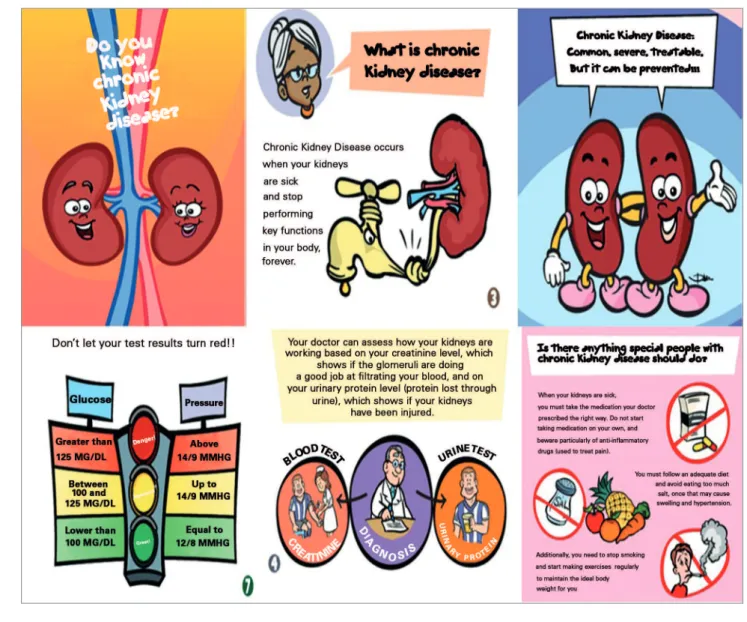
In the sentences ‘Do you know what kidneys are?’ and ‘Don’t let your test results turn red,’ the use of pronouns ‘you’ and ‘your’ signal an intimidating speech pattern. In the metaphor ‘The kidneys are organs in your body whose main job is to filter blood,’ the description of the kidneys as filters facilitates comprehension, once it drives in an analogy with something that belongs to the knowledge of the world held by the readers. This sentence, when associated with a visual metaphor, further clarifies the definition of CKD.
Using personification as a strategy, the kidneys talk and interact with the readers, in an effort to diminish the distance between patients and their disease by giving the target organ a voice.
Pictographs are used throughout the entire educational booklet to call the readers’ attention to noteworthy information and data they should memorize - such as glucose levels and blood pressure - and key ideas such as urine protein and creatinine, not taking anti-inflammatory drugs, excessive salt intake, and warning messages to smokers. Figure 1 shows some of the pictographs.
CONCLUSION
Good health care educational booklets must combine strategies and tools to empower patients with limited HL to become active subjects in the management of their disease and treatment, in the negotiation over which medications to take, in claiming their rights, and in acting to prevent outcomes that may worsen their clinical condition.
Educational booklet ‘Do You Know Kidney Disease’ properly meets multimodality and literacy requirements and may be incorporated as the reference textbook for assessment instrument TALES, the first scale designed and validated in Brazil to assess HL of the Brazilian general population.
ACKNOWLEDGEMENTS
J Bras Nefrol 2017;39(1):55-58
Development of educational material on chronic kidney disease
58
Figure 1. Booklet: ‘Do You Know Chronic Kidney Disease?
REFERENCES
1. Sørensen K, Van den Broucke S, Fullam J, Doyle G, Pelikan J, Slonska Z, et al.; (HLS-EU) Consortium Health Literacy Project European. Health literacy and public health: a systematic review and integration of definitions and models. BMC Public Health 2012;12:80. DOI: http://dx.doi.org/10.1186/1471-2458-12-80 2. Davis TC, Long SW, Jackson RH, Mayeaux EJ, George RB,
Murphy PW, et al. Rapid estimate of adult literacy in medicine: a shortened screening instrument. Fam Med 1993;25:391-5. PMID: 8349060
3. Parker RM, Baker DW, Williams MV, Nurss JR. The test of functional health literacy in adults: a new instrument for mea-suring patients' literacy skills. J Gen Intern Med 1995;10:537-41. DOI: http://dx.doi.org/10.1007/BF02640361
4. Weiss BD, Mays MZ, Martz W, Castro KM, DeWalt DA, Pig-none MP, et al. Quick assessment of literacy in primary care: the newest vital sign. Ann Fam Med 2005;3:514-22. DOI: http://dx.doi.org/10.1370/afm.405
5. Apolinario D, Braga Rde C, Magaldi RM, Busse AL, Campora F, Brucki S, et al. Short Assessment of Health Literacy for Por-tuguese-speaking Adults. Rev Saúde Pública 2012;46:702-11. DOI: http://dx.doi.org/10.1590/S0034-89102012000400015 6. Pasquali L. Psicometria: teoria e aplicações. Brasília: UNB;
1997.
7. Andrade DF, Valle RC. Introdução à Teoria de Resposta ao Item: conceitos e aplicações. Est Aval Educ 1998;18:13-32. 8. Koch IGV. Desvendando os segredos do Texto. 2a ed. São
Pau-lo: Cortez; 2003.
9. Bakhtin M. Os gêneros do discurso. In: Bakhtin M. Estética da criação verbal. São Paulo: Martins Fontes; 2003. DOI: http:// dx.doi.org/10.1080/1045112031000155678
10. Marcuschi LA. Produção Textual, Análise de Gêneros e Com-preensão. São Paulo: Parábola Editorial; 2008.
11. Carvalho N. Publicidade - A linguagem da Sedução. São Paulo: Ática; 2009.