ISSN 1806-3713 © 2017 Sociedade Brasileira de Pneumologia e Tisiologia
http://dx.doi.org/10.1590/S1806-37562016000000125
ABSTRACT
Objective: To evaluate the frequency of and factors associated with indeterminate interferon-gamma release assay (IGRA) results in people living with HIV/AIDS (PLWHA). Methods: We tested 81 PLWHA in the central-west region of Brazil, using the tuberculin skin test and an IGRA. Information on sociodemographic and clinical variables was gathered through the use of questionnaires and from medical records. The association of those variables with indeterminate results was analyzed by calculating the adjusted ORs in a multivariate logistic regression model. Concordance was evaluated by determining the kappa statistic. Results: Among the 81 patients evaluated, the tuberculin skin test results were positive in 18 (22.2%) of the patients, and the IGRA results were positive in 10 (12.3%), with a kappa of 0.62. The IGRA results were indeterminate in 22 (27.1%) of the patients (95% CI: 17.8-38.1%). The odds of obtaining indeterminate results were signiicantly higher in smokers (adjusted OR = 6.0; 95% CI: 1.4-26.7) and in samples stored for less than 35 days (adjusted OR = 14.0; 95% CI: 3.1-64.2). Patients with advanced immunosuppression (CD4+ T-cell count < 200 cells/mm3) were at a higher risk for indeterminate results (OR adjusted for smoking and inadequate duration of sample storage = 4.7; 95% CI: 0.91-24.0), although the difference was not signiicant. Conclusions: The high prevalence of indeterminate results can be a major limitation for the routine use of IGRAs in PLWHA. The need to repeat the test increases its costs and should be taken into account in cost-effectiveness studies. The processing of samples can signiicantly alter the results.
Keywords: Interferon-gamma release tests; Interferon-gamma; Tuberculosis; HIV; Latent tuberculosis; Tuberculin test.
Frequency of indeterminate results from
an interferon-gamma release assay among
HIV-infected individuals
Sandra Maria do Valle Leone de Oliveira1,2,Anete Trajman3,4, Anamaria Mello Miranda Paniago1, Ana Rita Coimbra Motta-Castro1,2, Antonio Rufino-Netto5, Ethel Leonor Noia Maciel6, Julio Croda2,7, Maria da Gloria Bonecini-Almeida8
Correspondence to:
Sandra Maria do Valle Leone de Oliveira. Rua Marques de Pombal, 1889, apto. 3, bloco A, Condomínio Nova Portugal, CEP 79070-900, Campo Grande, MS, Brasil.
Tel.: 55 67 9147-3333. Fax: 55 67 3345-7804. E-mail: [email protected] or [email protected]
Financial support: This study received inancial support from the Fundação de Apoio ao Desenvolvimento do Ensino, Ciência e Tecnologia/Coordenação de
Aperfeiçoamento de Pessoal de Nível Superior (FUNDECT/CAPES, [Mato Grosso do Sul] Foundation for the Development of Education, Science, and Technology/[Brazilian] Ofice for the Advancement of Higher Education; Project N.44/2014-PAPOS-MS: Grant no. 23/200.646/2014) and from Fundação Oswaldo Cruz.
INTRODUCTION
In people living with HIV/AIDS (PLWHA), the treat-ment of latent tuberculosis infection (LTBI) is crucial for reducing morbidity and mortality.(1) Therefore, the identiication and appropriate treatment of LTBI in PLWHA is a priority. Currently, there are two classes of tests for detecting LTBI(2): the tuberculin skin test (TST) and interferon-gamma (IFN-γ) release assays (IGRAs). Two commercially available IGRAs have been widely studied: the QuantiFERON-TB Gold In-Tube (QFT-GIT) assay (Cellestis, Carnegie, Australia), and the T-SPOT.TB assay (Oxford Immunotec, Abingdon, UK). IGRAs have replaced or been added to the TST in many high-income countries.(2) However, the World Health Organization does not recommend these tests for detecting LTBI in
low- and medium-income countries. The TST and IGRAs both show lower sensitivity in PLWHA, because both evaluate the T-cell response to mycobacterial antigens. (3) Although high rates of indeterminate QFT-GIT results have been reported in countries with high HIV burdens, those rates can vary according to the geographic region and the severity of immunosuppression.(4,5) In the presence of indeterminate results, repeating the test once is recommended.(6)
The recent temporary discontinuation of the most widely used PPD (RT23; Statens Serum Institut, Copenhagen, Denmark) has resulted in market shortage of tuberculin, which has impeded the identiication of LTBI in PLWHA in several countries. Replacing the TST with the QFT-GIT assay could be an option, even in low-income countries. 1. Programa de Pós-Graduação em
Doenças Infecciosas e Parasitárias, Faculdade de Medicina, Universidade Federal de Mato Grosso do Sul,
Campo Grande (MS) Brasil.
2. Fundação Oswaldo Cruz, Campo Grande
(MS) Brasil.
3. Montreal Chest Institute, McGill
University, Montreal, Quebec, Canada. 4. Instituto de Medicina Social,
Universidade do Estado do Rio de
Janeiro, Rio de Janeiro (RJ) Brasil.
5. Faculdade de Medicina de Ribeirão Preto, Universidade de São Paulo, Ribeirão Preto (SP) Brasil. 6. Laboratório de Epidemiologia,
Universidade Federal do Espírito Santo,
Vitória (ES) Brasil.
7. Faculdade de Medicina, Universidade Federal da Grande Dourados,
Campo Grande (MS) Brasil.
8. Laboratório de Imunologia e
Imunogenética em Doenças
Infecciosas, Instituto Nacional de
Infectologia Evandro Chagas, Fundação
Oswaldo Cruz, Rio de Janeiro, Rio de Janeiro (RJ) Brasil.
Submitted: 1 May 2016.
Accepted: 1 September 2016.
Study carried out in the Clínica de
Doenças Infecciosas, Universidade Federal de Mato Grosso do Sul,
Campo Grande (MS) Brasil.
J Bras Pneumol. 2017;43(3):215-218
Frequency of indeterminate results from an interferon-gamma release assay among HIV-infected individuals
The objective of the present study was to evaluate the frequency of and factors associated with indeterminate QFT-GIT results in a sample of PLWHA.
METHODS
From January to December of 2011, we conducted a cross-sectional study at the Infectious Disease Clinic of the Federal University of Mato Grosso do Sul. Mato Grosso do Sul is a state with a moderate incidence of tuberculosis (38.8/100,000 population), located in the central-west region of Brazil. The Brazilian National Tuberculosis Guidelines recommend that all PLWHA undergo the TST at least every six months.(7) In this study, we included HIV-infected subjects ≥ 18 years of age, all of whom gave written informed consent for additional QFT-GIT testing. Patients with active tuberculosis were excluded, as were those under treatment for LTBI. The study was approved by the Research Ethics Committee of the Federal University of Mato Grosso do Sul (Protocol no. 1060/2008).
Information was gathered through the use of a questionnaire and from medical records. Each TST was performed using two units of PPD RT23 (Statens Serum Institut) on the volar aspect of the left forearm. After 48-72 h, a trained nurse measured the induration. An induration ≥ 5 mm in diameter was considered indicative of a positive reaction.(7) The QFT-GIT assay was performed in accordance with the manufacturer’s protocol. In brief, whole blood samples were collected directly into 1-mL heparinized tubes containing either Mycobacterium tuberculosis antigens (early secretory antigenic target 6, culture iltrate protein 10, and TB7.7); dextrose and PHA (positive control); or no antigens (negative control). Tubes were incubated for 24 h at 37°C and centrifuged at 2,000 g for 10 min, after which the serum supernatant was harvested. The median time from blood collection to incubation was 144 min (range, 10-294 min). All supernatants were stored at −70°C for up to 8 weeks, until ELISA was performed to quantify the amount of secreted IFN-γ. The assay was run in batches of 24-44 samples of the same lot. Software provided by the manufacturer was used in order to analyze the results. The QFT-GIT result was considered positive if the IFN-γ level after stimulation with M. tuberculosis antigens minus the negative control was ≥ 0.35 IU/mL and 25% higher than the IFN-γ concentration in the unstimulated control sample, whereas it was considered negative if the IFN-γ level was < 0.35 IU/mL. The result was considered indeterminate if the IFN-γ production in the unstimulated sample was ≥ 8.0 IU/mL or the PHA minus the IFN-γ concentration in the unstimulated sample was < 0.5 IU/mL. When the irst QFT-GIT assay produced an indeterminate result, we did not perform a second assay, the clinical decision being based on the TST.(7) Concordance between the QFT-GIT and TST was assessed using the kappa statistic. Agreement was considered excellent if the kappa was > 0.75, fair if it was 0.4-0.75, and poor if it was < 0.4. For the concordance calculation, only positive
and negative results were included. Proportions were compared using the adjusted OR (aOR) and its 95% conidence interval in a multivariate regression model. Analyses were carried out with the SPSS Statistics software package, version 20.0 (IBM Corporation, Armonk, NY, USA).
RESULTS
Eighty-one PLWHA were enrolled in the study. The median age was 41 years (range, 34-48 years); the median CD4+ T-cell count was 422 cells/mm3
(interquartile range [IQR], 221-646 cells/mm3). Among
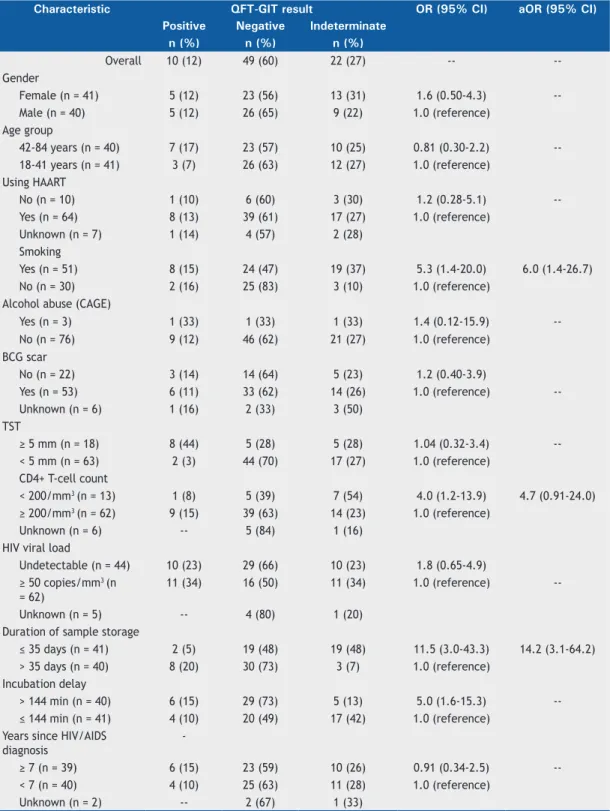
the 81 subjects, the TST and QFT-GIT results were positive in 18 (22.2%) and 10 (12.3%), respectively. Indeterminate QFT-GIT results were obtained in 22 (27.1%) of the subjects (95% CI: 17.8-38.1%). The concordance between the two tests (among valid results) was categorized as fair (κ = 0.62; 95% CI: 0.37-0.87), mainly due to a higher number of negative results on the TST (Table 1).
Among the subjects for whom an indeterminate result was obtained, the median CD4+ T-cell count was 329 cells/mm3 (IQR, 156-575 cells/mm3), compared with
494 cells/mm3 (IQR, 235-696 cells/mm3) among those
for whom a valid result was obtained (p = 0.237). The odds of obtaining an indeterminate result were 6.0 times higher if the subject was a smoker, 14.2 times higher if the duration of sample storage was < 35 days, and 4.7 times higher if the subject had advanced immunosuppression (CD4+ T-cell count < 200 cells/mm3), although the last was not statistically
signiicant, even after adjustment for storage duration and smoking (Table 1).
DISCUSSION
The frequency of indeterminate QFT-GIT results has been reported to range from 0% to 19.8%. (8-12) Many variables have been associated with indeterminate results: HIV infection,(9) advanced immunosuppression,(9) previous BCG vaccination,(10) immunosuppression therapy,(11) underlying diseases,(11) bedridden status,(8) hypoalbuminemia,(8) and active tuberculosis.(13) Technical aspects also result in a signiicant increase in the proportion of indeterminate results(6,9,11): manufacturing defects; analytical errors; incubation or processing delay; incorrect tube shaking technique; and inappropriate blood volume. In our study, we found the proportion of indeterminate QFT-GIT results to be higher than that reported in the literature. Different than in previous reports, that proportion was not signiicantly associated with the CD4+ T-cell count or BCG status, although few of our subjects had CD4+ T-cell counts lower than 200 cells/mm3, which reduced the power of
our analysis. In contrast, smoking and shorter serum storage before processing for ELISA were found to strongly increase the odds of indeterminate results. Smoking can induce immunosuppression through mechanisms other than lowering the CD4+ T-cell count, such as reducing the proliferative response to
Oliveira SMVL, Trajman A, Paniago AMM, Motta-Castro ARC, Rufino-Netto A, Maciel ELN, Croda J, Bonecini-Almeida MG
mitogens.(14) We know of no reports of freezer storage time affecting QFT-GIT results, and we can offer no reasonable explanation for our inding that shorter serum storage increased the odds of indeterminate results. Regardless of the reasons for indeterminate
results, a second test is recommended when the irst produces such a result, and repeating tests will signiicantly increase laboratory costs.(5) Despite the small size of our study sample, we do not believe that there was a selection bias.
Table 1. Factors associated with indeterminate QuantiFERON-TB Gold In-Tube results in 81 HIV-infected patients.
Characteristic QFT-GIT result OR (95% CI) aOR (95% CI)
Positive Negative Indeterminate
n (%) n (%) n (%)
Overall 10 (12) 49 (60) 22 (27) --
--Gender
Female (n = 41) 5 (12) 23 (56) 13 (31) 1.6 (0.50-4.3)
--Male (n = 40) 5 (12) 26 (65) 9 (22) 1.0 (reference)
Age group
42-84 years (n = 40) 7 (17) 23 (57) 10 (25) 0.81 (0.30-2.2)
--18-41 years (n = 41) 3 (7) 26 (63) 12 (27) 1.0 (reference)
Using HAART
No (n = 10) 1 (10) 6 (60) 3 (30) 1.2 (0.28-5.1)
--Yes (n = 64) 8 (13) 39 (61) 17 (27) 1.0 (reference)
Unknown (n = 7) 1 (14) 4 (57) 2 (28)
Smoking
Yes (n = 51) 8 (15) 24 (47) 19 (37) 5.3 (1.4-20.0) 6.0 (1.4-26.7)
No (n = 30) 2 (16) 25 (83) 3 (10) 1.0 (reference) Alcohol abuse (CAGE)
Yes (n = 3) 1 (33) 1 (33) 1 (33) 1.4 (0.12-15.9)
--No (n = 76) 9 (12) 46 (62) 21 (27) 1.0 (reference) BCG scar
No (n = 22) 3 (14) 14 (64) 5 (23) 1.2 (0.40-3.9)
Yes (n = 53) 6 (11) 33 (62) 14 (26) 1.0 (reference)
--Unknown (n = 6) 1 (16) 2 (33) 3 (50)
TST
≥ 5 mm (n = 18) 8 (44) 5 (28) 5 (28) 1.04 (0.32-3.4)
--< 5 mm (n = 63) 2 (3) 44 (70) 17 (27) 1.0 (reference)
CD4+ T-cell count
< 200/mm3 (n = 13) 1 (8) 5 (39) 7 (54) 4.0 (1.2-13.9) 4.7 (0.91-24.0)
≥ 200/mm3 (n = 62) 9 (15) 39 (63) 14 (23) 1.0 (reference)
Unknown (n = 6) -- 5 (84) 1 (16)
HIV viral load
Undetectable (n = 44) 10 (23) 29 (66) 10 (23) 1.8 (0.65-4.9)
≥ 50 copies/mm3 (n
= 62)
11 (34) 16 (50) 11 (34) 1.0 (reference)
--Unknown (n = 5) -- 4 (80) 1 (20)
Duration of sample storage
≤ 35 days (n = 41) 2 (5) 19 (48) 19 (48) 11.5 (3.0-43.3) 14.2 (3.1-64.2)
> 35 days (n = 40) 8 (20) 30 (73) 3 (7) 1.0 (reference)
Incubation delay
> 144 min (n = 40) 6 (15) 29 (73) 5 (13) 5.0 (1.6-15.3)
--≤ 144 min (n = 41) 4 (10) 20 (49) 17 (42) 1.0 (reference) Years since HIV/AIDS
diagnosis
-≥ 7 (n = 39) 6 (15) 23 (59) 10 (26) 0.91 (0.34-2.5)
--< 7 (n = 40) 4 (10) 25 (63) 11 (28) 1.0 (reference)
Unknown (n = 2) -- 2 (67) 1 (33)
QFT-GIT: QuantiFERON-TB Gold In-Tube; aOR: adjusted OR (adjusted for CD4+ T-cell count, smoking, and sample storage duration); HAART: highly active antiretroviral therapy; CAGE: Cut down, Annoyed, Guilty, Eye-opener (questionnaire); and TST: tuberculin skin test.
217
Frequency of indeterminate results from an interferon-gamma release assay among HIV-infected individuals
In summary, we found that a high proportion of QFT-GIT assays produced indeterminate results, which represents a major limitation to the use of such assays in PLWHA
in Brazil. This inding has relevant implications for the cost-effectiveness and feasibility of adopting the use of QFT-GIT assays in low and medium-income countries.
REFERENCES
1. Bucher HC, Grifith LE, Guyatt GH, Sudre P, Naef M, Sendi P, et al. Isoniazid prophylaxis for tuberculosis in HIV infection: a meta-analysis of randomized controlled trials. AIDS. 1999;13(4):501-7. https://doi.
org/10.1097/00002030-199903110-00009
2. Kunst H. Diagnosis of latent tuberculosis infection: The potential role
of new technologies. Respir Med. 2015;100(12):2098-106. https://
doi.org/10.1016/j.rmed.2006.02.032#
3. Khawcharoenporn T, Apisarnthanarak A, Phetsuksiri B, Rudeeaneksin J, Srisungngam S, Mundy LM. Tuberculin skin test
and QuantiFERON-TB Gold In-tube Test for latent tuberculosis in Thai HIV-infected adults. Respirology. 2015;20(2):340-7. https://doi. org/10.1111/resp.12442
4. Pai M, Denkinger CM, Kik SV, Rangaka MX, Zwerling A, Oxlade O, et
al. Gamma interferon release assays for detection of Mycobacterium
tuberculosis infection. Clin Microbiol Rev. 2014;27(1):3-20. https:// doi.org/10.1128/CMR.00034-13
5. Trajman A, Steffen RE, Menzies D. Interferon-Gamma Release Assays versus Tuberculin Skin Testing for the Diagnosis of Latent Tuberculosis Infection: An Overview of the Evidence. Pulm Med.
2013;2013:601737. https://doi.org/10.1155/2013/601737
6. Couturier MR, Myatt R, Dorn D, Yang DT, Pitstick N. Defective
antigen tubes generate false-positive QuantiFERON tuberculosis test results. Clin Infect Dis. 2014;59(11):1649-50. https://doi.org/10.1093/ cid/ciu644
7. Brasil. Ministério da Saúde. Secretaria de Vigilância em Saúde. Programa Nacional de Controle da Tuberculose. Manual de
recomendações para o controle da tuberculose no Brasil. Brasília: Ministério da Saúde; 2011.
8. Yun JW, Chung HS, Koh WJ, Chung DR, Kim YJ, Kang ES. Signiicant reduction in rate of indeterminate results of the QuantiFERON-TB
Gold In-Tube test by shortening incubation delay. J Clin Microbiol.
2014;52(1):90-4. https://doi.org/10.1128/JCM.01547-13
9. Oni T, Gideon HP, Bangani N, Tsekela R, Seldon R, Wood K, et al. Risk factors associated with indeterminate gamma interferon responses in the assessment of latent tuberculosis infection in a high-incidence
environment. Clin Vaccine Immunol. 2012;19(8):1243-7. https://doi.
org/10.1128/CVI.00166-12
10. Herrera V, Yeh E, Murphy K, Parsonnet J, Banaei N. Immediate
incubation reduces indeterminate results for QuantiFERON-TB Gold in-tube assay. J Clin Microbiol. 2010;48(8):2672-6. https://doi. org/10.1128/JCM.00482-10
11. Cattamanchi A, Smith R, Steingart KR, Metcalfe J, Date A, Coleman C, et al. Interferon-gamma release assays for the diagnosis of latent tuberculosis infection in HIV-infected individuals: a systematic review
and meta-analysis. J Acquir Immune Deic Syndr. 2011;56(3):230-8. https://doi.org/10.1097/QAI.0b013e31820b07ab
12. Kussen GM, Dalla-Costa LM, Rossoni A, Raboni SM. Interferon-gamma release assay versus tuberculin skin test for latent tuberculosis infection among HIV patients in Brazil. Braz J Infect Dis.
2016;20(1):69-75. https://doi.org/10.1016/j.bjid.2015.10.007 13. Sauzullo I, Mengoni F, Ermocida A, Massetti AP, D’Agostino C,
Russo G, et al. Interferon- release assay in HIV-infected patients
with active tuberculosis: impact of antituberculous drugs on host
immune response. New Microbiol. 2014;37(2):153-61.
14. Sopori M. Effects of cigarette smoke on the immune system. Nat
Rev Immunol. 2002;2(5):372-7. https://doi.org/10.1038/nri803